MOTOSHARE 🚗🏍️
Rent Bikes & Cars Directly from Owners
Motoshare connects vehicle owners with people who need bikes and cars on rent. Owners earn from idle vehicles, and renters get flexible ride options.
Visit Motoshare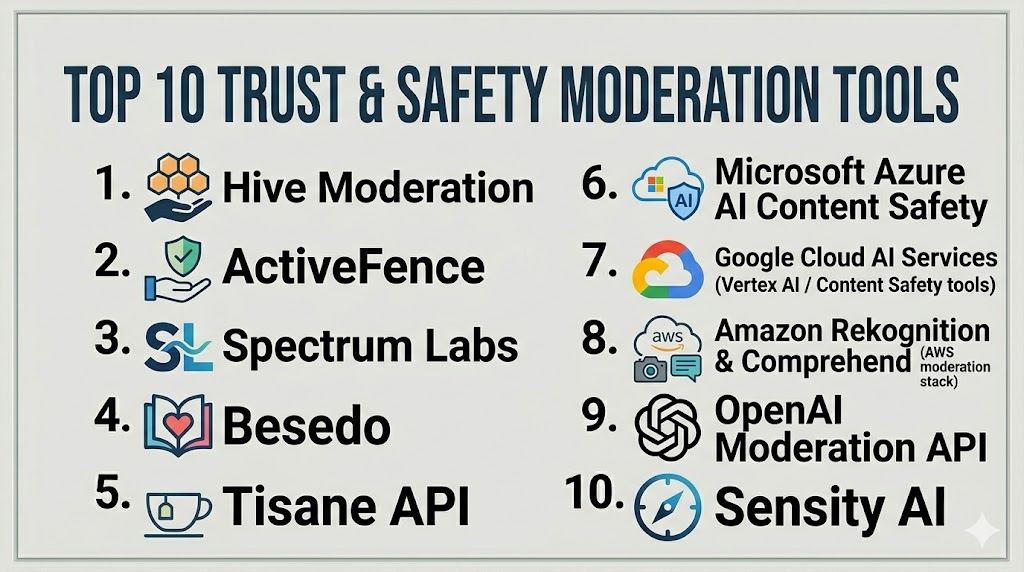
Introduction
Trust & Safety Moderation Tools help organizations detect, review, and manage harmful user-generated content, abusive behavior, fraud, spam, scams, impersonation, hate speech, explicit content, policy violations, and platform misuse. These tools are used by social networks, marketplaces, gaming platforms, creator communities, dating apps, forums, fintech platforms, edtech communities, and customer-facing digital products.Trust and safety is now a critical business function because online platforms must protect users, reduce risk, maintain community quality, and meet increasing expectations around digital safety. Manual moderation alone is not enough for high-volume platforms, so modern tools combine AI detection, human review queues, automated enforcement, policy workflows, case management, and analytics.
Real-world use cases include:
- Detecting toxic comments, harassment, hate speech, and spam
- Reviewing user reports and escalations
- Moderating images, videos, text, profiles, and messages
- Preventing scams, impersonation, and platform abuse
- Managing policy enforcement and appeal workflows
When evaluating Trust & Safety Moderation Tools, buyers should consider:
- AI content detection accuracy
- Human review workflow support
- Text, image, video, and audio moderation
- Policy configuration and enforcement automation
- Case management and escalation workflows
- Analytics and audit logs
- API and platform integrations
- Data privacy and security controls
- Scalability and latency
- Support for multilingual moderation
Best for: Social platforms, online marketplaces, gaming communities, forums, creator platforms, dating apps, edtech platforms, fintech products, and any business managing user-generated content at scale.
Not ideal for: Static websites, small private communities with minimal user activity, or organizations that only need basic comment approval without automation or risk workflows.
Key Trends in Trust & Safety Moderation Tools
- AI moderation is becoming standard for high-volume text, image, and video review.
- Human-in-the-loop workflows are increasingly important for sensitive decisions.
- Multimodal moderation is expanding across text, audio, video, images, and livestreams.
- Real-time moderation is growing for gaming, chat, and live community platforms.
- Policy automation is helping teams enforce complex rules consistently.
- Trust signals, risk scoring, and behavioral analytics are becoming more common.
- Appeal workflows and auditability are becoming important governance requirements.
- Multilingual safety coverage is now essential for global platforms.
- Marketplace fraud, scams, and impersonation detection are merging with moderation workflows.
- Privacy, compliance, and responsible AI expectations are shaping vendor selection.
How We Selected These Tools
- Evaluated recognition across trust and safety, content moderation, and platform integrity teams
- Prioritized platforms with AI-assisted detection and human review workflows
- Considered support for text, image, video, audio, profiles, and messages
- Reviewed scalability for startups, marketplaces, communities, and enterprise platforms
- Compared case management, policy enforcement, and escalation capabilities
- Assessed integration options through APIs, SDKs, and workflow connectors
- Considered analytics, auditability, and moderation operations reporting
- Evaluated support for multilingual and global moderation needs
- Reviewed security posture signals without inventing certifications
- Balanced enterprise platforms, developer-friendly APIs, and specialized moderation tools
Top 10 Trust & Safety Moderation Tools
#1 — Hive Moderation
Short description :
Hive Moderation is an AI-powered content moderation platform designed to detect harmful, explicit, violent, hateful, spammy, and policy-violating content across text, images, videos, and audio. It is used by digital platforms that need automated moderation at scale. The platform is especially useful for marketplaces, social apps, gaming communities, and user-generated content platforms. Hive focuses on fast API-based moderation and broad content classification.
Key Features
- Text, image, video, and audio moderation
- AI classification for harmful and explicit content
- Spam and abuse detection
- Real-time moderation APIs
- Custom moderation thresholds
- Dashboard-based review workflows
- Multilingual moderation support
Pros
- Strong multimodal moderation coverage
- Good fit for high-volume platforms
- Developer-friendly API approach
Cons
- Human review operations may require additional workflow setup
- Accuracy depends on policy tuning and thresholds
- Enterprise pricing may vary by volume
Platforms / Deployment
- Web
- Cloud
Security & Compliance
- Secure API access
- Encryption support
- Access controls available
- SOC 2 / ISO 27001: Not publicly stated
Integrations & Ecosystem
Hive Moderation is built for integration into digital products through APIs and automated moderation workflows.
- API integrations
- Social platforms
- Marketplace workflows
- Gaming platforms
- Review dashboards
Support & Community
Support is typically available through documentation, API resources, onboarding assistance, and enterprise support options.
#2 — ActiveFence
Short description :
ActiveFence is a trust and safety platform focused on detecting harmful content, abuse networks, extremism, misinformation, fraud, and platform risks. It is designed for online platforms that need proactive risk detection rather than simple keyword filtering. ActiveFence is especially relevant for marketplaces, social platforms, gaming companies, and platforms facing coordinated abuse. It combines intelligence, AI detection, and moderation workflows.
Key Features
- Harmful content detection
- Abuse network analysis
- Fraud and scam detection
- Policy enforcement workflows
- Risk intelligence tools
- Multilingual and cross-platform monitoring
- Trust and safety analytics
Pros
- Strong proactive risk detection
- Useful for complex abuse patterns
- Good fit for enterprise trust and safety teams
Cons
- May be too advanced for small communities
- Implementation requires clear policy design
- Pricing is usually enterprise-oriented
Platforms / Deployment
- Web
- Cloud
Security & Compliance
- Secure access controls
- Data protection workflows
- Audit and review capabilities
- SOC 2 / ISO 27001: Not publicly stated
Integrations & Ecosystem
ActiveFence supports trust and safety teams through platform integrations and risk intelligence workflows.
- APIs
- Case management systems
- Moderation queues
- Trust and safety dashboards
- Enforcement workflows
Support & Community
Enterprise support, onboarding, trust and safety consulting, and operational guidance are typically available.
#3 — Spectrum Labs
Short description :
Spectrum Labs provides AI-powered trust and safety tools for detecting toxic behavior, harassment, hate speech, grooming risks, bullying, and other harmful interactions. It is commonly used by social platforms, dating apps, marketplaces, gaming communities, and messaging platforms. The platform focuses on behavioral context and language-based harm detection. It helps teams identify risk patterns earlier and route cases for review.
Key Features
- Toxicity and harassment detection
- Grooming and predatory behavior signals
- Hate speech and abuse detection
- Context-aware AI models
- Risk scoring and alerts
- Moderation workflow support
- Analytics for safety teams
Pros
- Strong behavioral safety focus
- Useful for messaging and community platforms
- Helps identify high-risk conversations
Cons
- Best suited for platforms with significant conversation volume
- Requires policy calibration
- Limited value for organizations without user-generated messaging
Platforms / Deployment
- Web
- Cloud
Security & Compliance
- Secure data handling
- Access control support
- Encryption support
- SOC 2 / ISO 27001: Not publicly stated
Integrations & Ecosystem
Spectrum Labs integrates into platforms that need automated language and behavior moderation.
- Messaging platforms
- Community systems
- Dating apps
- Gaming platforms
- API workflows
Support & Community
Support generally includes onboarding, policy alignment, implementation guidance, and enterprise customer support.
#4 — Besedo
Short description :
Besedo is a moderation and trust and safety platform focused on marketplaces, classifieds, social communities, and online platforms. It combines AI moderation, manual review services, fraud detection, and policy enforcement. The platform is especially useful for marketplaces that need to detect scams, fake listings, prohibited items, abusive content, and suspicious user behavior. Besedo supports both automated and human moderation workflows.
Key Features
- AI and human moderation
- Marketplace fraud detection
- Text and image moderation
- Listing review workflows
- Scam and abuse prevention
- Policy enforcement tools
- Multilingual moderation support
Pros
- Strong marketplace moderation experience
- Combines automation with human review
- Useful for scam and listing quality control
Cons
- May be more marketplace-focused than general community-focused
- Advanced workflows may require implementation support
- Pricing depends on volume and services
Platforms / Deployment
- Web
- Cloud
Security & Compliance
- Secure moderation workflows
- Access controls available
- Data protection practices supported
- SOC 2 / ISO 27001: Not publicly stated
Integrations & Ecosystem
Besedo integrates with marketplace platforms, listing systems, and user-generated content workflows.
- Marketplace platforms
- Classified listing systems
- APIs
- Review queues
- Fraud detection workflows
Support & Community
Support includes onboarding, moderation operations expertise, managed moderation services, and customer success assistance.
#5 — Tisane
Short description :
Tisane is an AI content moderation API focused on detecting abuse, threats, hate speech, sexual content, self-harm signals, profanity, cyberbullying, and policy violations in text. It supports multilingual moderation and is useful for platforms needing language-focused trust and safety automation. Tisane is especially relevant for forums, chat products, gaming communities, social platforms, and customer communities. It is developer-friendly and API-driven.
Key Features
- Text moderation API
- Toxicity and abuse detection
- Threat and self-harm signal detection
- Hate speech and profanity filtering
- Multilingual moderation
- Custom policy tuning
- Developer-friendly implementation
Pros
- Strong text moderation capabilities
- Good multilingual support
- Useful API-first approach
Cons
- Less focused on image or video moderation
- Requires integration work
- Human review workflows may need separate tools
Platforms / Deployment
- Web
- Cloud
Security & Compliance
- Secure API access
- Encryption support
- Access controls: Varies / N/A
- SOC 2 / ISO 27001: Not publicly stated
Integrations & Ecosystem
Tisane is designed for API-based text moderation across digital platforms.
- Chat systems
- Forums
- Gaming communities
- Social platforms
- Custom applications
Support & Community
Support is available through API documentation, developer resources, and customer assistance depending on plan.
#6 — Microsoft Azure AI Content Safety
Short description :
Microsoft Azure AI Content Safety helps developers and enterprises detect harmful text and image content using AI moderation capabilities. It can classify sexual, violent, hate, and self-harm content and integrate into applications through Azure services. The tool is useful for organizations already using Microsoft cloud infrastructure. It is especially suitable for enterprise teams needing scalable AI moderation within a broader cloud environment.
Key Features
- Text and image content safety classification
- Harm category detection
- Severity scoring
- API-based integration
- Enterprise cloud scalability
- Developer tools and documentation
- Integration with Azure ecosystem
Pros
- Strong enterprise cloud foundation
- Good fit for Microsoft ecosystem users
- Scalable API-based moderation
Cons
- Requires technical implementation
- Not a full moderation operations suite by itself
- Human review workflows need additional tooling
Platforms / Deployment
- Web
- Cloud
Security & Compliance
- Azure security ecosystem support
- Encryption and access controls
- Identity and access management support
- Compliance certifications vary by Azure service and configuration
Integrations & Ecosystem
Azure AI Content Safety integrates with Microsoft cloud and application development workflows.
- Azure services
- Developer APIs
- Enterprise applications
- Data pipelines
- Custom moderation workflows
Support & Community
Support is available through Microsoft documentation, enterprise support plans, developer resources, and partner ecosystems.
#7 — Google Cloud Natural Language AI and Vision AI
Short description :
Google Cloud AI services can support trust and safety workflows through language analysis, image moderation, classification, and machine learning-based content review. Organizations can use these services to build custom moderation systems for text, images, and platform content. It is best suited for technical teams that want flexible AI building blocks rather than a packaged moderation operations platform. The toolset fits enterprises, marketplaces, and platforms with engineering capacity.
Key Features
- Text analysis and classification
- Image detection and labeling
- Custom model workflows
- Scalable cloud APIs
- Integration with data pipelines
- Moderation automation building blocks
- Analytics and monitoring support
Pros
- Strong cloud AI infrastructure
- Flexible for custom moderation systems
- Scales well for enterprise workloads
Cons
- Requires engineering resources
- Not a complete trust and safety case management platform
- Policy workflows must be built separately
Platforms / Deployment
- Web
- Cloud
Security & Compliance
- Google Cloud security controls
- Encryption and IAM support
- Audit logging support
- Compliance certifications vary by Google Cloud service and configuration
Integrations & Ecosystem
Google Cloud AI services integrate with enterprise data, analytics, and application environments.
- Google Cloud services
- APIs
- Data warehouses
- Custom applications
- Analytics systems
Support & Community
Support is available through documentation, developer community resources, enterprise support plans, and partner networks.
#8 — Amazon Rekognition and Comprehend
Short description :
Amazon Rekognition and Amazon Comprehend can be used together to build moderation workflows for images, videos, and text. Rekognition supports image and video analysis, while Comprehend supports natural language processing and text analysis. These services are useful for platforms already using AWS and needing scalable moderation building blocks. They are best suited for technical teams building custom trust and safety pipelines.
Key Features
- Image and video moderation support
- Text analysis and classification
- API-based moderation workflows
- Scalable cloud infrastructure
- Custom rules and automation
- Integration with AWS services
- Event-driven processing workflows
Pros
- Strong cloud scalability
- Useful for image and video moderation
- Good fit for AWS-based platforms
Cons
- Requires technical implementation
- Not a complete moderation dashboard by default
- Policy and review workflows must be built separately
Platforms / Deployment
- Web
- Cloud
Security & Compliance
- AWS identity and access controls
- Encryption support
- Audit logging through AWS services
- Compliance certifications vary by AWS service and configuration
Integrations & Ecosystem
AWS services integrate deeply with cloud-native moderation architectures.
- AWS Lambda
- Amazon S3
- Amazon CloudWatch
- Amazon Comprehend
- Custom applications
Support & Community
Support is available through AWS documentation, developer resources, partner networks, and enterprise support plans.
#9 — OpenAI Moderation API
Short description :
OpenAI Moderation API helps developers detect potentially harmful or policy-sensitive text and content categories in applications. It is useful for products that need automated checks before publishing, messaging, or user-generated content display. The API can support chat products, community platforms, SaaS apps, and internal trust and safety workflows. It is best suited for developer teams that want to add automated content safety checks into their own systems.
Key Features
- Automated content moderation API
- Harm category detection
- Text safety classification
- Developer-friendly implementation
- Scalable API-based workflows
- Useful for chat and UGC moderation
- Can support pre-publication review
Pros
- Fast integration for developer teams
- Useful for AI-powered applications
- Good for automated safety checks
Cons
- Not a full case management system
- Requires custom workflow implementation
- Human review and appeals must be built separately
Platforms / Deployment
- Web
- Cloud
Security & Compliance
- Secure API access
- Encryption in transit
- Access management through API keys
- SOC 2 / ISO 27001: Not publicly stated for this specific API
Integrations & Ecosystem
OpenAI Moderation API integrates into applications and automated workflows through API calls.
- Chat applications
- SaaS platforms
- Community tools
- Internal review systems
- Developer pipelines
Support & Community
Support is available through documentation, developer resources, and platform support channels.
#10 — Sentropy
Short description :
Sentropy is a trust and safety moderation tool focused on protecting online communities from harassment, hate, abuse, and toxic behavior. It has been associated with community moderation and safety workflows for social platforms and online communities. It is useful for teams seeking automated detection and safer community operations. Availability and current product structure may vary, so buyers should verify current deployment and vendor details before evaluation.
Key Features
- Toxicity detection
- Abuse and harassment monitoring
- Community moderation workflows
- Policy enforcement support
- User safety analytics
- Automated content review
- Moderator assistance tools
Pros
- Strong focus on community safety
- Useful for harassment and abuse detection
- Designed for moderation teams
Cons
- Current availability may vary
- Vendor structure should be verified before purchase
- May require integration and workflow setup
Platforms / Deployment
- Web
- Cloud
- Current availability: Varies / N/A
Security & Compliance
- Not publicly stated
- Buyers should verify current security controls directly
- SOC 2 / ISO 27001: Not publicly stated
Integrations & Ecosystem
Sentropy-style moderation workflows are typically used with community platforms and social products.
- Community systems
- Social platforms
- Moderation queues
- API workflows
- Reporting dashboards
Support & Community
Varies / Not publicly stated. Buyers should verify current support availability, product status, and onboarding options before purchase.
Comparison Table
| Tool Name | Best For | Platform Supported | Deployment | Standout Feature | Public Rating |
|---|---|---|---|---|---|
| Hive Moderation | Multimodal AI moderation | Web | Cloud | Text, image, video, and audio moderation | N/A |
| ActiveFence | Enterprise trust and safety teams | Web | Cloud | Proactive risk intelligence | N/A |
| Spectrum Labs | Behavioral safety and toxicity detection | Web | Cloud | Context-aware harm detection | N/A |
| Besedo | Marketplace moderation | Web | Cloud | AI plus human marketplace review | N/A |
| Tisane | Text moderation APIs | Web | Cloud | Multilingual abuse detection | N/A |
| Microsoft Azure AI Content Safety | Microsoft ecosystem moderation | Web | Cloud | Enterprise AI safety APIs | N/A |
| Google Cloud AI Services | Custom AI moderation pipelines | Web | Cloud | Flexible AI building blocks | N/A |
| Amazon Rekognition and Comprehend | AWS-based moderation workflows | Web | Cloud | Image, video, and text analysis | N/A |
| OpenAI Moderation API | Developer safety checks | Web | Cloud | API-based content moderation | N/A |
| Sentropy | Community abuse detection | Web | Cloud | Toxicity and harassment detection | N/A |
Evaluation & Scoring of Trust & Safety Moderation Tools
| Tool Name | Core 25% | Ease 15% | Integrations 15% | Security 10% | Performance 10% | Support 10% | Value 15% | Weighted Total |
|---|---|---|---|---|---|---|---|---|
| Hive Moderation | 9 | 8 | 8 | 8 | 9 | 8 | 7 | 8.2 |
| ActiveFence | 9 | 7 | 8 | 8 | 9 | 8 | 6 | 8.0 |
| Spectrum Labs | 8 | 8 | 8 | 7 | 8 | 8 | 7 | 7.8 |
| Besedo | 8 | 8 | 7 | 7 | 8 | 8 | 7 | 7.7 |
| Tisane | 8 | 8 | 8 | 7 | 8 | 7 | 8 | 7.8 |
| Microsoft Azure AI Content Safety | 8 | 7 | 9 | 9 | 9 | 8 | 7 | 8.2 |
| Google Cloud AI Services | 8 | 7 | 9 | 9 | 9 | 8 | 7 | 8.2 |
| Amazon Rekognition and Comprehend | 8 | 7 | 9 | 9 | 9 | 8 | 7 | 8.2 |
| OpenAI Moderation API | 8 | 8 | 8 | 8 | 8 | 7 | 8 | 7.9 |
| Sentropy | 7 | 7 | 7 | 6 | 7 | 6 | 6 | 6.7 |
These scores are comparative and should not be treated as universal rankings. A high score usually means stronger overall fit across moderation capability, scalability, integrations, and operational readiness. Cloud AI services score well for technical teams, but they may require custom case management and human review tooling. Dedicated trust and safety platforms are often better for organizations that need policy workflows, escalation queues, and operational moderation support.
Which Trust & Safety Moderation Tool Is Right for You?
Solo / Freelancer
Small communities, independent app builders, and early-stage founders may prefer API-first tools like Tisane or OpenAI Moderation API. These tools are easier to integrate for basic text safety checks and do not require a large trust and safety team.
SMB
Small and mid-sized platforms with growing user-generated content should consider Hive Moderation, Besedo, or Spectrum Labs. These platforms provide stronger automation, detection, and review support without requiring teams to build every moderation component from scratch.
Mid-Market
Mid-market marketplaces, social apps, gaming platforms, and community products should evaluate Hive Moderation, ActiveFence, Spectrum Labs, and Besedo. These tools offer stronger detection, workflow support, and scalability for more complex abuse patterns.
Enterprise
Large social platforms, marketplaces, gaming networks, and global communities may require ActiveFence, Hive Moderation, Microsoft Azure AI Content Safety, Google Cloud AI services, or AWS moderation workflows. Enterprise teams often need custom policy enforcement, auditability, integrations, and high-volume processing.
Budget vs Premium
Budget-conscious teams may start with API-based tools such as Tisane, OpenAI Moderation API, or cloud AI building blocks. Premium trust and safety teams may require ActiveFence, Hive Moderation, Besedo, or Spectrum Labs for broader coverage and operational support.
Feature Depth vs Ease of Use
For feature depth, ActiveFence, Hive Moderation, Besedo, and Spectrum Labs are strong options. For ease of integration, OpenAI Moderation API, Tisane, and cloud AI services may be simpler starting points for technical teams.
Integrations & Scalability
If your platform already runs on Microsoft Azure, Google Cloud, or AWS, cloud-native moderation services may fit naturally into your architecture. If you need a purpose-built trust and safety operations layer, dedicated tools like ActiveFence, Hive, Besedo, and Spectrum Labs may be more practical.
Security & Compliance Needs
Platforms handling sensitive user content should prioritize encryption, access controls, audit logs, data retention policies, role-based permissions, and vendor transparency. For regulated or high-risk environments, verify compliance documentation directly before purchase.
Frequently Asked Questions
1. What are Trust & Safety Moderation Tools?
Trust & Safety Moderation Tools are platforms that help businesses detect, review, and manage harmful content, abusive behavior, spam, fraud, scams, impersonation, and policy violations. They are commonly used by social platforms, marketplaces, gaming companies, forums, and apps with user-generated content. These tools combine AI detection, review queues, policy enforcement, and analytics. Their main goal is to keep online spaces safer and more trustworthy.
2. How are these tools different from basic content filters?
Basic content filters usually rely on keyword blocking or simple rules. Trust and safety tools go deeper by analyzing context, behavior patterns, user history, risk signals, and policy categories. Many also support human review queues, escalation workflows, audit logs, and appeal processes. This makes them more suitable for platforms with complex safety requirements and large volumes of user-generated content.
3. What pricing models are common for trust and safety tools?
Pricing varies widely depending on content volume, moderation categories, API usage, human review services, platform size, and enterprise support requirements. Some vendors charge based on API calls, while others use custom enterprise contracts. Cloud AI services may follow usage-based pricing, while managed moderation providers may charge by review volume or service level. Buyers should evaluate total cost based on scale, not only listed pricing.
4. How difficult is implementation?
Implementation depends on the tool type. API-based tools can be easier for technical teams but still require policy mapping, thresholds, logging, and enforcement decisions. Enterprise trust and safety platforms may require deeper onboarding, integration with moderation queues, escalation paths, and data pipelines. Teams should test tools on real historical content before full deployment. A phased rollout is usually safer than immediate full automation.
5. Can AI moderation fully replace human moderators?
No. AI moderation can reduce workload and detect harmful content quickly, but human moderators are still needed for context-heavy, sensitive, ambiguous, or appeal-related cases. AI may misclassify sarcasm, cultural context, reclaimed language, or edge cases. The best approach is usually human-in-the-loop moderation, where AI handles triage and high-confidence decisions while humans review complex cases.
6. What are common mistakes when choosing moderation software?
Common mistakes include choosing a tool without testing it on real platform content, relying only on keyword filters, ignoring multilingual coverage, and failing to define clear policies before implementation. Another mistake is automating enforcement too aggressively without appeal workflows. Teams should also avoid selecting tools without checking integration, data privacy, and reporting requirements. Moderation success depends as much on policy design as software selection.
7. What types of content can these platforms moderate?
Different tools support different content types. Some focus only on text, while others support images, videos, audio, livestreams, user profiles, listings, chat messages, and behavioral signals. Multimodal moderation is increasingly important for marketplaces, gaming platforms, dating apps, and social networks. Buyers should map their content types before selecting a vendor.
8. How important is multilingual moderation?
Multilingual moderation is critical for global platforms because harmful content, scams, and abuse can occur in many languages and regional contexts. A tool that works well in English may not perform equally well across all languages. Organizations should test moderation accuracy across their highest-volume languages. They should also consider cultural nuance, local slang, and region-specific policy enforcement needs.
9. Do trust and safety tools help with fraud and scams?
Yes, some trust and safety tools can help detect scams, fake profiles, suspicious listings, impersonation, and coordinated abuse. Marketplace-focused platforms often combine content moderation with fraud signals and behavior analysis. However, fraud prevention may also require identity verification, payment risk analysis, device intelligence, and account security tools. For high-risk marketplaces, moderation should be part of a broader trust and safety stack.
10. How should companies shortlist Trust & Safety Moderation Tools?
Companies should start by listing their highest-risk content types, policy categories, user volume, languages, enforcement workflows, and integration needs. Then they should test shortlisted tools against real content samples and compare false positives, false negatives, latency, reporting, and moderator usability. Security, data retention, and compliance requirements should also be reviewed. The best next step is to run a controlled pilot before scaling automation across the platform.
Conclusion
Trust & Safety Moderation Tools are now essential infrastructure for any platform that hosts user-generated content, conversations, listings, profiles, media, or community interactions. The right tool depends on content type, platform scale, user risk, compliance requirements, technical capacity, and moderation maturity. API-first tools like Tisane and OpenAI Moderation API can help smaller teams add automated safety checks quickly, while dedicated platforms like Hive Moderation, ActiveFence, Spectrum Labs, and Besedo provide broader trust and safety workflows for growing and enterprise platforms. Cloud AI services from Microsoft, Google, and AWS are strong choices for technical teams building custom moderation pipelines, but they may require additional review, case management, and policy tooling. The best approach is not to chase a universal winner, but to shortlist tools based on real platform risks, test them with representative content, validate integrations and security controls, and run a pilot before scaling moderation automation across the organization.
