MOTOSHARE 🚗🏍️
Rent Bikes & Cars Directly from Owners
Motoshare connects vehicle owners with people who need bikes and cars on rent. Owners earn from idle vehicles, and renters get flexible ride options.
Visit Motoshare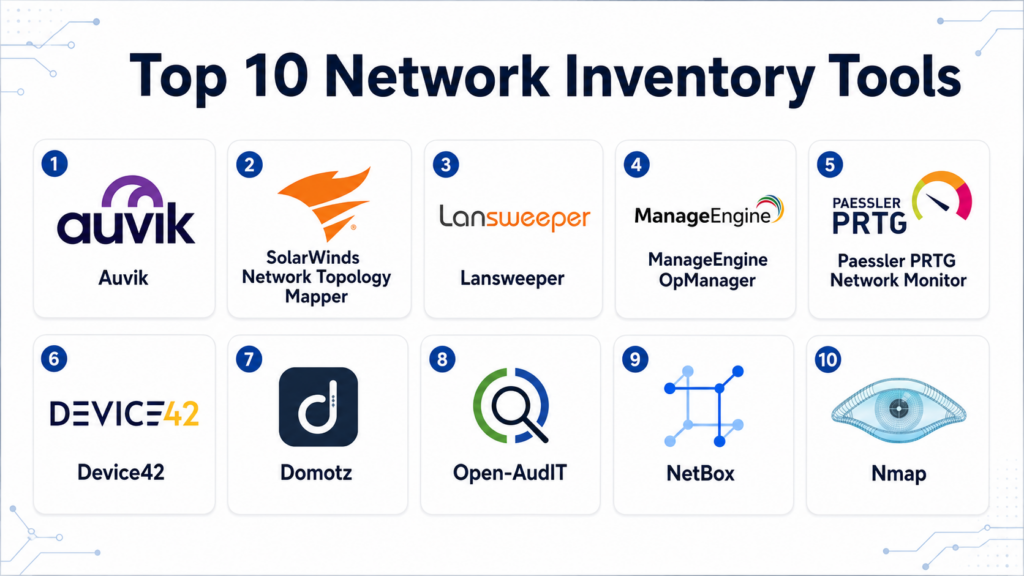
Introduction
Network Inventory Tools help IT teams automatically discover, document, monitor, and manage all devices connected to a network. These devices can include routers, switches, firewalls, servers, workstations, printers, wireless access points, IP phones, virtual machines, IoT devices, and other connected assets. In simple terms, these tools help organizations understand what is connected to the network, where it is located, how it is configured, and whether it has changed.
Network inventory matters because modern networks are more dynamic than traditional office environments. Businesses now manage hybrid infrastructure, remote offices, cloud-connected systems, branch networks, unmanaged devices, Wi-Fi assets, virtual resources, and security-sensitive endpoints. Without accurate inventory, IT teams may miss unauthorized devices, outdated firmware, configuration drift, license gaps, security exposure, and troubleshooting blind spots.Real-world use cases include network discovery, device inventory, topology mapping, configuration tracking, compliance audits, asset documentation, capacity planning, troubleshooting, vulnerability coordination, and ITSM enrichment. Buyers should evaluate discovery accuracy, SNMP and WMI support, network mapping, configuration tracking, alerting, reporting, integrations, scalability, security controls, and ease of administration.
Best for: Network Inventory Tools are best for network administrators, IT operations teams, security teams, infrastructure engineers, managed service providers, compliance teams, and organizations that need accurate visibility across routers, switches, firewalls, servers, endpoints, and network-connected devices.
Not ideal for: These tools may not be necessary for very small teams with only a few devices, simple office networks, or limited compliance needs. In those cases, basic router dashboards, spreadsheets, or lightweight scanning tools may be enough until network complexity increases.
Key Trends in Network Inventory Tools
- Continuous network discovery: Modern tools are moving from one-time scans to continuous or scheduled discovery so inventory stays current as devices join, leave, or change.
- Hybrid network visibility: Organizations need inventory across on-premise networks, branch offices, cloud-connected environments, Wi-Fi infrastructure, VPN-connected systems, and remote sites.
- Automated topology mapping: Network teams increasingly expect visual maps that show device relationships, switch connections, subnet structure, and network paths.
- Security-driven inventory: Network inventory is becoming a foundation for cybersecurity because unknown devices, open services, and outdated network equipment can create serious risk.
- Configuration change tracking: Tools now help identify when firewall, router, or switch configurations change, who changed them, and whether the change was authorized.
- MSP-focused remote management: Managed service providers need network inventory tools that support multi-client environments, remote monitoring, and centralized documentation.
- Integration with ITSM and CMDB: Network inventory data is increasingly used to enrich tickets, incidents, changes, configuration items, and asset management records.
- IoT and unmanaged device discovery: Companies need visibility into printers, cameras, access control devices, smart equipment, sensors, and other non-traditional network assets.
- Cloud and virtual network awareness: Network inventory tools are expanding beyond physical devices to include virtual infrastructure, cloud networks, and software-defined networking components.
- AI-assisted operations: Some platforms are adding analytics and automation to detect unusual device changes, prioritize alerts, summarize incidents, and support faster troubleshooting.
How We Selected These Tools
The tools in this list were selected based on their relevance to network inventory, device discovery, topology mapping, configuration visibility, monitoring, documentation, and operational network management. The category is broad, so the list includes enterprise platforms, MSP-focused tools, open-source options, IT asset discovery platforms, and practical network documentation solutions.
Selection logic included:
- Market recognition in network discovery, inventory, monitoring, and documentation.
- Ability to identify routers, switches, firewalls, servers, workstations, printers, access points, and other connected devices.
- Support for discovery methods such as SNMP, WMI, SSH, IP scanning, agents, APIs, and network protocols.
- Network topology mapping and relationship visibility.
- Reporting capabilities for assets, configurations, device status, software, firmware, and changes.
- Integration with ITSM, CMDB, monitoring, security, and asset management workflows.
- Suitability for SMB, mid-market, enterprise, and managed service provider environments.
- Security and administrative controls such as role-based access, audit logs, permissions, and encrypted access.
- Ease of use for network administrators, IT generalists, and operations teams.
- Overall value for improving visibility, troubleshooting, compliance, and network governance.
Top 10 Network Inventory Tools
1- Auvik
Short description:
Auvik is a cloud-based network management platform designed to help IT teams and managed service providers discover, document, monitor, and troubleshoot network devices. It provides automated network discovery, topology mapping, device inventory, configuration backup, and alerting. Auvik is especially useful for teams that need remote visibility across multiple networks or client environments. It is a strong fit for MSPs, distributed IT teams, and organizations that want always-updated network documentation.
Key Features
- Automated network discovery and inventory.
- Dynamic network topology mapping.
- Device monitoring and alerting.
- Configuration backup and change visibility.
- Remote network management for distributed environments.
- Support for SNMP-based device discovery.
- Reporting for network devices, status, and changes.
Pros
- Strong fit for MSPs and distributed network teams.
- Helpful visual topology maps for troubleshooting.
- Reduces manual network documentation effort.
Cons
- May be more than needed for very small networks.
- Advanced use depends on device credentials and proper network access.
- Pricing and packaging should be validated against number of networks and devices.
Platforms / Deployment
Web
Cloud
Security & Compliance
Auvik provides administrative controls and secure access features for network management workflows. Specific compliance certifications, data retention, encryption scope, and access controls should be validated during procurement.
Integrations & Ecosystem
Auvik integrates with IT service management, documentation, monitoring, remote management, and MSP workflow tools. It is especially useful when network inventory needs to support troubleshooting and client service delivery.
- ITSM platforms
- Professional services automation tools
- Remote monitoring and management systems
- Documentation platforms
- Alerting workflows
- Network device management processes
Support & Community
Auvik provides documentation, onboarding resources, customer support, training materials, and MSP-focused enablement. Its community is strongest among managed service providers and IT teams managing distributed networks.
2- SolarWinds Network Topology Mapper
Short description:
SolarWinds Network Topology Mapper is a network mapping and inventory tool that helps IT teams discover network devices, generate topology maps, and maintain network documentation. It is useful for organizations that need visual network diagrams and asset inventory from automated scans. The tool can help identify connected devices and generate reports for documentation, audits, and troubleshooting. It is best suited for teams that want network inventory with strong mapping capability.
Key Features
- Automated network discovery.
- Network topology map generation.
- Device inventory and network documentation.
- Scheduled scans to keep inventory updated.
- Exportable maps and inventory reports.
- Support for common network discovery protocols.
- Useful reporting for device details and network structure.
Pros
- Strong topology mapping and visual documentation.
- Useful for audit preparation and troubleshooting.
- Helps reduce manual network diagram maintenance.
Cons
- More focused on mapping and inventory than full network monitoring.
- May require complementary tools for advanced performance monitoring.
- Large environments may need scan planning and map organization.
Platforms / Deployment
Windows
Self-hosted
Security & Compliance
SolarWinds Network Topology Mapper provides access and administrative controls suitable for network documentation workflows. Specific compliance coverage, encryption details, and security requirements should be validated based on deployment and procurement needs.
Integrations & Ecosystem
SolarWinds Network Topology Mapper fits well in environments already using SolarWinds network management products. It can support documentation, troubleshooting, reporting, and operational workflows.
- SolarWinds ecosystem tools
- Network monitoring systems
- Documentation workflows
- IT operations reporting
- Audit preparation processes
- Network troubleshooting workflows
Support & Community
SolarWinds provides documentation, customer support, training resources, and a large IT operations user community. Its ecosystem is familiar to many network administrators and infrastructure teams.
3- Lansweeper
Short description:
Lansweeper is an IT asset discovery and inventory platform that helps organizations identify network-connected assets, hardware, software, users, workstations, servers, and other technology resources. It is broader than network inventory alone, but it is highly useful for IT teams that need network asset visibility and centralized inventory data. Lansweeper can help teams discover what is connected, what software is installed, and which assets need attention. It fits SMB, mid-market, and enterprise environments.
Key Features
- Automated network and IT asset discovery.
- Hardware and software inventory.
- Agent-based and agentless discovery options.
- Device and software reporting.
- Asset lifecycle and ownership visibility.
- Integration with helpdesk, ITSM, and security workflows.
- Centralized inventory for network-connected assets.
Pros
- Strong general-purpose asset discovery and inventory.
- Useful for both hardware and software visibility.
- Practical reporting for IT operations and asset management.
Cons
- Network topology mapping may not be as deep as specialized mapping tools.
- Advanced network performance monitoring may require complementary tools.
- Large environments may need careful scan and data management.
Platforms / Deployment
Web
Cloud / Self-hosted options may vary
Security & Compliance
Lansweeper provides administrative controls and access management features for asset inventory workflows. Specific compliance certifications, data protection controls, and regional security requirements should be validated during procurement.
Integrations & Ecosystem
Lansweeper integrates with ITSM, helpdesk, endpoint, security, and reporting platforms. It is useful when network inventory data must support service desk, asset management, and security workflows.
- ITSM platforms
- Helpdesk systems
- Endpoint management tools
- Security platforms
- Reporting tools
- CMDB workflows
Support & Community
Lansweeper provides documentation, support resources, onboarding materials, and community knowledge. Its community is strong among IT administrators, asset managers, and infrastructure teams.
4- ManageEngine OpManager
Short description:
ManageEngine OpManager is a network monitoring and infrastructure management platform that also supports network discovery, device inventory, topology views, performance monitoring, and alerting. It helps IT teams understand what devices are connected and how they are performing. OpManager is especially useful for organizations that want network inventory combined with monitoring and fault management. It is suitable for SMB, mid-market, and enterprise IT teams.
Key Features
- Network device discovery and inventory.
- Router, switch, firewall, server, and VM monitoring.
- Topology maps and network visualization.
- SNMP, WMI, and CLI-based monitoring support.
- Alerts for device health and performance.
- Reporting for availability, performance, and inventory.
- Integration with other ManageEngine products.
Pros
- Combines inventory with monitoring and alerting.
- Strong value for IT teams needing broad network operations features.
- Good fit for organizations using ManageEngine ecosystem tools.
Cons
- Interface and configuration may require tuning for complex environments.
- Advanced modules may depend on product edition or add-ons.
- Large deployments require proper planning and monitoring design.
Platforms / Deployment
Web
Cloud / Self-hosted options may vary
Security & Compliance
ManageEngine OpManager provides user permissions, authentication options, access controls, and administrative settings. Specific compliance coverage and security requirements should be validated based on deployment model and edition.
Integrations & Ecosystem
OpManager integrates with ManageEngine tools and broader IT operations workflows. It is useful when network inventory needs to connect with monitoring, alerting, configuration management, and service desk processes.
- ManageEngine ServiceDesk Plus
- Network Configuration Manager
- Endpoint and server tools
- ITSM workflows
- Notification systems
- Reporting platforms
Support & Community
ManageEngine provides documentation, support resources, forums, training materials, and product assistance. Its community is active among IT administrators and infrastructure teams.
5- Paessler PRTG Network Monitor
Short description:
Paessler PRTG Network Monitor is a network monitoring platform that can discover devices, monitor network health, track sensors, and provide visibility into infrastructure performance. While it is primarily known for monitoring, it also supports network inventory and auditing use cases through discovery and device monitoring. PRTG is useful for teams that want a combined view of devices, bandwidth, uptime, services, applications, and infrastructure health. It fits SMB, mid-market, and enterprise environments.
Key Features
- Automatic network discovery.
- Device and sensor-based monitoring.
- SNMP, WMI, SSH, flow, and packet-based monitoring support.
- Dashboards for network and infrastructure visibility.
- Alerts and notifications for device issues.
- Reporting for inventory, status, and performance.
- Monitoring across servers, devices, applications, and services.
Pros
- Strong monitoring depth with inventory visibility.
- Flexible sensor model for many infrastructure types.
- Useful dashboards and alerting for network operations.
Cons
- Inventory management is not its only focus.
- Sensor planning is important for large environments.
- Advanced asset lifecycle workflows may require other tools.
Platforms / Deployment
Web / Windows-based core server
Cloud / Self-hosted options may vary
Security & Compliance
PRTG provides administrative controls, user permissions, authentication settings, and secure monitoring configuration options. Specific compliance coverage and security requirements should be validated based on deployment model and edition.
Integrations & Ecosystem
PRTG integrates with notification tools, ITSM systems, dashboards, automation workflows, and network operations processes. It is especially useful when inventory visibility must be paired with performance monitoring.
- ITSM platforms
- Notification systems
- Dashboard tools
- Network devices
- Server and application monitoring
- Automation workflows
Support & Community
Paessler provides documentation, support, knowledge base resources, training materials, and community discussions. Its user base is strong among network administrators and infrastructure monitoring teams.
6- Device42
Short description:
Device42 is an infrastructure discovery and IT asset management platform focused on data center assets, network devices, application dependencies, IP addresses, racks, cloud resources, and configuration data. It is useful for teams that need detailed infrastructure inventory and dependency mapping. Device42 can help organizations document physical and virtual environments, support migration planning, and enrich CMDB records. It is best suited for IT operations teams managing complex infrastructure environments.
Key Features
- Network device and infrastructure discovery.
- Data center asset inventory.
- IP address and rack management.
- Application dependency mapping.
- Software, certificate, and hardware inventory.
- Cloud and virtual infrastructure visibility.
- ITSM and CMDB integration.
Pros
- Strong infrastructure and dependency mapping.
- Useful for data center, migration, and CMDB projects.
- Helps connect network inventory with service relationships.
Cons
- May be more infrastructure-focused than simple network inventory tools.
- Setup and discovery accuracy depend on environment complexity.
- Security-first teams may need complementary vulnerability tools.
Platforms / Deployment
Web
Cloud / Self-hosted options may vary
Security & Compliance
Device42 provides administrative controls and security features for infrastructure and asset data management. Specific compliance coverage and security certifications should be validated with the vendor.
Integrations & Ecosystem
Device42 integrates with ITSM, CMDB, cloud, virtualization, automation, and infrastructure management systems. It is valuable when network inventory must connect with data center and service dependency visibility.
- ITSM platforms
- CMDB workflows
- Cloud platforms
- Virtualization systems
- Automation tools
- Infrastructure monitoring tools
Support & Community
Device42 provides documentation, support resources, onboarding guidance, and implementation help. Its community is strongest among infrastructure, data center, and IT operations teams.
7- Domotz
Short description:
Domotz is a network monitoring and management platform often used by MSPs, IT teams, and technology service providers to discover, monitor, and manage connected devices. It supports automated network discovery, device classification, alerts, remote access, and network documentation. Domotz is especially useful for distributed environments, branch offices, smart buildings, AV networks, and small to mid-sized networks. It is a practical option for teams that need simple and continuous network visibility.
Key Features
- Automated network discovery.
- Device inventory and classification.
- Network monitoring and alerting.
- Remote access and troubleshooting support.
- Network topology and device visibility.
- Multi-site network management.
- Reporting for device status and network changes.
Pros
- Strong fit for MSPs and distributed small networks.
- Easy to use for network visibility and remote troubleshooting.
- Useful for mixed environments with IoT, AV, and network devices.
Cons
- May not match deep enterprise ITSM or CMDB platforms.
- Advanced configuration management may require other tools.
- Large enterprise requirements should be validated carefully.
Platforms / Deployment
Web / Mobile apps
Cloud
Security & Compliance
Domotz provides administrative controls and secure remote management features for network monitoring workflows. Specific security certifications, encryption scope, and compliance requirements should be validated during procurement.
Integrations & Ecosystem
Domotz integrates with MSP, ticketing, documentation, alerting, and business workflow tools. It is especially useful when teams need remote device visibility across many sites or clients.
- PSA tools
- ITSM and ticketing platforms
- Documentation tools
- Alerting workflows
- Remote access workflows
- Network management processes
Support & Community
Domotz provides documentation, onboarding resources, customer support, and MSP-focused materials. Its community is strongest among MSPs, AV integrators, and distributed network teams.
8- Open-AudIT
Short description:
Open-AudIT is a network auditing and inventory platform that discovers devices, software, hardware details, and configuration information across a network. It is useful for organizations that want automated network audits and inventory visibility. Open-AudIT can help teams identify what is on the network, detect changes, and maintain documentation. It is especially relevant for teams that want a practical inventory and auditing tool with flexible deployment options.
Key Features
- Automated network scanning and discovery.
- Hardware and software inventory.
- Device auditing and change visibility.
- Reporting for discovered assets and configurations.
- Support for scheduled scans.
- Useful for documenting network-connected devices.
- Inventory insights for compliance and operations.
Pros
- Practical tool for network auditing and inventory.
- Useful for identifying new or changed devices.
- Good fit for teams needing structured network documentation.
Cons
- May require technical setup and tuning.
- Interface and workflow maturity may not match larger enterprise suites.
- Advanced monitoring and remediation may require complementary tools.
Platforms / Deployment
Web
Self-hosted / Deployment options may vary
Security & Compliance
Open-AudIT provides administrative and access control features depending on deployment and configuration. Specific security controls, compliance requirements, and data protection practices should be validated before production use.
Integrations & Ecosystem
Open-AudIT can support auditing, reporting, and IT operations workflows. It is useful when network inventory data needs to be collected, reviewed, and exported for documentation or compliance use.
- IT audit workflows
- Inventory reporting
- Network scanning processes
- Documentation systems
- Compliance reporting
- IT operations workflows
Support & Community
Open-AudIT provides documentation and product support options depending on edition and deployment. Community and support strength should be evaluated based on the selected version and internal technical capability.
9- NetBox
Short description:
NetBox is an open-source infrastructure resource modeling platform used for network source of truth, IP address management, device inventory, racks, circuits, virtualization, and data center documentation. It is not a traditional automatic discovery tool by default, but it is highly valuable for maintaining accurate network inventory and infrastructure documentation. NetBox is best for network engineering teams that want a structured, API-driven source of truth. It is especially useful when teams value clean network data models and automation.
Key Features
- Network source of truth for devices and infrastructure.
- IP address management.
- Rack, site, circuit, and cable documentation.
- Virtualization and data center inventory support.
- API-driven automation and integration.
- Custom fields, tags, and structured data modeling.
- Strong fit for network automation workflows.
Pros
- Excellent structured network documentation model.
- Open-source and automation-friendly.
- Strong fit for network engineering and infrastructure teams.
Cons
- Discovery is not its primary built-in strength.
- Requires disciplined data management and process ownership.
- Non-technical teams may need training to use it effectively.
Platforms / Deployment
Web
Self-hosted / Cloud-hosted options through providers may vary
Security & Compliance
NetBox security depends on deployment, hosting, authentication configuration, access controls, and operational governance. Specific compliance coverage depends on how the platform is implemented and managed.
Integrations & Ecosystem
NetBox is widely used in network automation and infrastructure documentation workflows. Its API-first model makes it useful as a source of truth connected to automation, monitoring, and configuration systems.
- Network automation tools
- IPAM workflows
- Configuration management systems
- Monitoring platforms
- Documentation processes
- Custom APIs and scripts
Support & Community
NetBox has a strong open-source community, documentation, plugins, and ecosystem support. Formal support depends on hosting, service provider, or internal engineering capability.
10- Nmap
Short description:
Nmap is a widely used open-source network discovery and scanning tool that helps technical teams identify hosts, open ports, services, operating systems, and network exposure. It is not a full inventory management platform, but it remains valuable for network administrators, security engineers, and technical teams that need flexible scanning. Nmap is often used for ad hoc discovery, validation, security testing, and troubleshooting. It is best for teams with technical skills and a need for lightweight network visibility.
Key Features
- Host discovery and network scanning.
- Port scanning and service detection.
- Operating system fingerprinting.
- Scriptable scanning through Nmap scripting features.
- Useful for security testing and network validation.
- Command-line flexibility.
- Supports technical troubleshooting and discovery workflows.
Pros
- Open-source and highly flexible.
- Strong for technical network discovery and validation.
- Widely known by security and network professionals.
Cons
- Not a full network inventory management platform.
- Requires technical expertise to use effectively.
- Reporting, governance, and lifecycle tracking need additional tools.
Platforms / Deployment
Windows / macOS / Linux
Self-hosted command-line tool
Security & Compliance
Nmap itself is a technical scanning tool rather than an enterprise governance platform. Security and compliance depend on how it is used, who can run scans, how scan data is stored, and how results are governed.
Integrations & Ecosystem
Nmap can be used independently or as part of custom scripts, network audits, security testing, and discovery workflows. It is often included in broader technical toolkits.
- Network administration scripts
- Security testing workflows
- Penetration testing processes
- Vulnerability validation
- Custom automation
- Technical reporting pipelines
Support & Community
Nmap has a large open-source community, documentation, and broad professional awareness. Formal support depends on internal technical expertise or third-party services.
Comparison Table Top 10
| Tool Name | Best For | Platform Supported | Deployment | Standout Feature | Public Rating |
|---|---|---|---|---|---|
| Auvik | MSPs and distributed IT teams | Web | Cloud | Automated discovery with dynamic topology maps | N/A |
| SolarWinds Network Topology Mapper | Network mapping and documentation | Windows | Self-hosted | Automated topology map generation | N/A |
| Lansweeper | General network and IT asset inventory | Web | Cloud / Self-hosted options may vary | Broad hardware and software inventory | N/A |
| ManageEngine OpManager | Network monitoring plus inventory | Web | Cloud / Self-hosted options may vary | Device discovery with monitoring and alerts | N/A |
| Paessler PRTG Network Monitor | Network monitoring and audit visibility | Web, Windows-based core server | Cloud / Self-hosted options may vary | Sensor-based infrastructure monitoring | N/A |
| Device42 | Infrastructure and dependency documentation | Web | Cloud / Self-hosted options may vary | Data center and application dependency mapping | N/A |
| Domotz | MSP and multi-site network visibility | Web, mobile apps | Cloud | Continuous device discovery and remote troubleshooting | N/A |
| Open-AudIT | Network auditing and inventory | Web | Self-hosted / Deployment options may vary | Automated network audit and change visibility | N/A |
| NetBox | Network source of truth and IPAM | Web | Self-hosted / Cloud-hosted options may vary | Structured network documentation and API-first source of truth | N/A |
| Nmap | Technical scanning and discovery | Windows, macOS, Linux | Self-hosted command-line tool | Open-source host and port discovery | N/A |
Evaluation and Scoring of Network Inventory Tools
The scoring below is comparative and based on discovery coverage, inventory depth, ease of use, integrations, security posture signals, performance, support expectations, and value. These are not public ratings and should be used as directional evaluation scores only. A tool with a lower score may still be the best choice for a specific use case such as topology mapping, network monitoring, MSP operations, open-source documentation, or technical scanning.
| Tool Name | Core 25% | Ease 15% | Integrations 15% | Security 10% | Performance 10% | Support 10% | Value 15% | Weighted Total 0–10 |
|---|---|---|---|---|---|---|---|---|
| Auvik | 9 | 9 | 8 | 8 | 9 | 8 | 8 | 8.45 |
| SolarWinds Network Topology Mapper | 8 | 8 | 7 | 8 | 8 | 8 | 8 | 7.90 |
| Lansweeper | 8 | 8 | 8 | 8 | 8 | 8 | 9 | 8.15 |
| ManageEngine OpManager | 8 | 8 | 8 | 8 | 8 | 8 | 9 | 8.15 |
| Paessler PRTG Network Monitor | 8 | 8 | 8 | 8 | 9 | 8 | 8 | 8.15 |
| Device42 | 8 | 7 | 8 | 8 | 8 | 8 | 8 | 7.85 |
| Domotz | 8 | 9 | 8 | 8 | 8 | 8 | 8 | 8.15 |
| Open-AudIT | 7 | 7 | 6 | 7 | 7 | 7 | 8 | 7.00 |
| NetBox | 8 | 7 | 9 | 8 | 8 | 7 | 10 | 8.20 |
| Nmap | 7 | 6 | 7 | 7 | 8 | 7 | 10 | 7.35 |
These scores should be interpreted based on your environment and use case. Auvik and Domotz are strong for MSPs and distributed networks, while SolarWinds Network Topology Mapper is useful for mapping and documentation. Lansweeper and ManageEngine OpManager provide broad inventory and operations value, while PRTG is stronger when monitoring is equally important. NetBox is excellent as a structured source of truth, but it requires disciplined data management. Nmap remains valuable for technical discovery, but it is not a full inventory platform.
Which Network Inventory Tool Is Right for You?
Solo / Freelancer
Solo professionals usually do not need a full network inventory platform unless they manage client networks or technical infrastructure. Nmap may be enough for basic host discovery and validation. NetBox can be useful if the freelancer manages structured network documentation for multiple clients. For small client environments, lightweight tools like Domotz or Lansweeper may help maintain better visibility. The main goal should be simple discovery, documentation, and troubleshooting support.
SMB
SMBs should prioritize ease of use, affordability, automated discovery, simple reporting, and basic alerting. Lansweeper, Domotz, ManageEngine OpManager, PRTG, and SolarWinds Network Topology Mapper can be practical options depending on the primary need. If the business needs monitoring and alerts, PRTG or OpManager may fit well. If the priority is inventory documentation, Lansweeper or SolarWinds Network Topology Mapper may be more useful. SMBs should avoid overcomplicated tools unless compliance or network size requires them.
Mid-Market
Mid-market organizations often need stronger topology mapping, multi-site visibility, reporting, ITSM integration, and configuration awareness. Auvik, Lansweeper, ManageEngine OpManager, PRTG, Device42, and Domotz can be strong candidates. If the team manages multiple locations or client sites, Auvik and Domotz are worth considering. If infrastructure dependency mapping is important, Device42 may be valuable. Mid-market teams should evaluate whether they need inventory only or inventory plus monitoring.
Enterprise
Enterprises usually need scalability, governance, security controls, ITSM integration, network documentation, topology visibility, and possibly CMDB enrichment. Device42, Lansweeper, ManageEngine OpManager, PRTG, NetBox, and Auvik may fit different enterprise use cases. Enterprises with automation-focused network engineering teams may benefit from NetBox as a source of truth. Large IT operations teams should validate integration with monitoring, ticketing, security, and configuration management systems before selecting a platform.
Budget vs Premium
Budget-focused teams can start with Nmap, NetBox, Open-AudIT, or affordable inventory tools depending on their technical skills. These options can provide strong value when teams have the expertise to configure and maintain them. Premium tools such as Auvik, PRTG, ManageEngine OpManager, Device42, and SolarWinds options may provide better dashboards, support, automation, and reporting. Buyers should compare total cost, including setup, training, maintenance, integrations, and admin effort.
Feature Depth vs Ease of Use
Feature depth matters when networks are complex, distributed, compliance-sensitive, or tied to service management workflows. Device42, ManageEngine OpManager, PRTG, Lansweeper, and Auvik offer stronger depth for different use cases. Ease of use matters when teams need quick visibility without heavy setup. Domotz, Auvik, Lansweeper, and SolarWinds Network Topology Mapper are practical for many teams. NetBox and Nmap are powerful but require more technical discipline.
Integrations and Scalability
Network inventory becomes more valuable when connected to ITSM, monitoring, security, documentation, CMDB, and automation systems. A discovered network device should support real workflows such as incident response, change planning, capacity reporting, or compliance audits. Buyers should validate whether the tool has APIs, connectors, export options, and automation support. Scalability matters for organizations with many sites, VLANs, subnets, cloud networks, or managed clients.
Security and Compliance Needs
Network inventory tools may collect sensitive device names, IP addresses, SNMP data, credentials, configurations, topology maps, and infrastructure relationships. Buyers should evaluate role-based access, credential handling, encryption, audit logs, user permissions, scan controls, and data retention. Compliance-focused teams should ensure inventory reports are accurate, exportable, and repeatable. Security teams should also verify that scanning does not disrupt production networks or expose sensitive device information.
Frequently Asked Questions FAQs
1. What is a Network Inventory Tool?
A Network Inventory Tool is software that discovers and documents devices connected to a network. It can identify routers, switches, firewalls, servers, printers, access points, endpoints, and other network-connected assets. Many tools also collect details such as IP address, MAC address, hostname, vendor, model, firmware, ports, and device status. The goal is to give IT teams an accurate view of what exists on the network. This helps with troubleshooting, planning, audits, and security visibility.
2. How is network inventory different from asset discovery?
Network inventory focuses mainly on network-connected devices, their details, topology, and operational status. Asset discovery is broader and may include endpoints, software, cloud workloads, users, SaaS applications, and lifecycle information. Some tools combine both capabilities, while others specialize in network scanning or IT asset management. Network inventory is especially useful for network administrators managing routers, switches, firewalls, and access points. Asset discovery is often broader for IT operations and security teams.
3. What pricing models are common for Network Inventory Tools?
Network Inventory Tools commonly use pricing based on number of devices, sensors, nodes, networks, users, sites, or product editions. Some tools are open-source or free for technical users, while commercial platforms usually use subscription or perpetual licensing models. MSP-focused platforms may price by client, site, or monitored device. Buyers should ask about discovery limits, monitoring limits, support costs, implementation, add-ons, and renewal pricing. Total cost should include admin time and integration effort, not just license cost.
4. How long does implementation usually take?
Implementation depends on network size, discovery method, credentials, segmentation, firewall rules, and reporting needs. A small network can often be discovered quickly, while large distributed networks require planning around subnets, SNMP credentials, WMI access, SSH access, and scan schedules. The most important steps are defining scan scope, validating results, cleaning duplicate records, and setting reporting standards. Teams should start with one network segment or site before scaling. Inventory accuracy improves as credentials and discovery rules are refined.
5. What are common mistakes when choosing a Network Inventory Tool?
A common mistake is choosing a tool without deciding whether the main need is inventory, monitoring, mapping, configuration tracking, or documentation. Another mistake is relying on manual spreadsheets even after the network becomes too large to track reliably. Some teams also fail to configure device credentials properly, which leads to incomplete inventory data. Poor naming standards and duplicate records can reduce trust in the tool. Buyers should test discovery accuracy before committing to a platform.
6. Are Network Inventory Tools secure?
Network Inventory Tools can be secure when configured with proper access controls, credential management, encryption, audit logs, and scan permissions. However, they can also collect sensitive infrastructure details such as IP ranges, device names, topology maps, and configurations. Buyers should evaluate how credentials are stored, who can access inventory data, and whether scans are controlled safely. Security teams should also review whether the tool follows least privilege principles. Strong governance is important for production environments.
7. Can Network Inventory Tools detect unknown devices?
Yes, many Network Inventory Tools can detect unknown or unmanaged devices through scanning, SNMP discovery, network polling, ARP tables, MAC address data, and device fingerprinting. However, discovery accuracy depends on network access, segmentation, credentials, firewall rules, and the tool’s discovery methods. Unknown device detection is important for security because unmanaged devices may create risk. Teams should test detection across wired networks, Wi-Fi networks, branch offices, and guest networks. Continuous discovery is better than one-time scanning.
8. Can Network Inventory Tools integrate with ITSM or CMDB systems?
Yes, many network inventory tools integrate with ITSM and CMDB systems. This allows discovered devices to enrich tickets, incidents, changes, asset records, and configuration items. Integration helps IT teams avoid manually updating device records and improves troubleshooting context. However, CMDB success depends on data quality, ownership rules, and record deduplication. Buyers should test whether device updates, removals, and changes sync correctly. Good integration turns inventory data into operational value.
9. What alternatives exist if a full Network Inventory Tool is not needed?
Alternatives include spreadsheets, router dashboards, firewall interfaces, open-source scanners, monitoring tools, IP address management systems, and network documentation platforms. These can work for small environments or technical teams with limited requirements. However, they may become hard to maintain as devices, sites, VLANs, and users increase. A dedicated network inventory tool becomes more useful when accuracy, automation, reporting, and auditability matter. The right alternative depends on network size, risk level, and team capacity.
10. How should buyers evaluate Network Inventory Tools?
Buyers should evaluate discovery accuracy, supported protocols, topology mapping, reporting, alerting, integrations, scalability, security controls, and ease of administration. They should test the tool against real network segments, including switches, routers, firewalls, access points, servers, printers, and unmanaged devices. It is important to check whether the tool supports SNMP, WMI, SSH, API integrations, and scheduled scans. Teams should also validate reporting quality and export options. A pilot is the safest way to confirm fit before full rollout.
Conclusion
Network Inventory Tools help IT teams build accurate visibility across routers, switches, firewalls, access points, servers, endpoints, printers, and other connected devices. The right tool depends on whether the main goal is network discovery, topology mapping, monitoring, documentation, source-of-truth management, MSP operations, or technical scanning. Auvik and Domotz are strong for distributed and MSP-style environments, SolarWinds Network Topology Mapper is useful for mapping and documentation, Lansweeper provides broad IT and network inventory, ManageEngine OpManager and PRTG combine inventory with monitoring, Device42 supports infrastructure and dependency mapping, Open-AudIT helps with auditing, NetBox is powerful as a network source of truth, and Nmap remains valuable for technical discovery. There is no single best option for every organization because network size, team skill, compliance needs, budget, and integration requirements vary widely.
