MOTOSHARE 🚗🏍️
Rent Bikes & Cars Directly from Owners
Motoshare connects vehicle owners with people who need bikes and cars on rent. Owners earn from idle vehicles, and renters get flexible ride options.
Visit Motoshare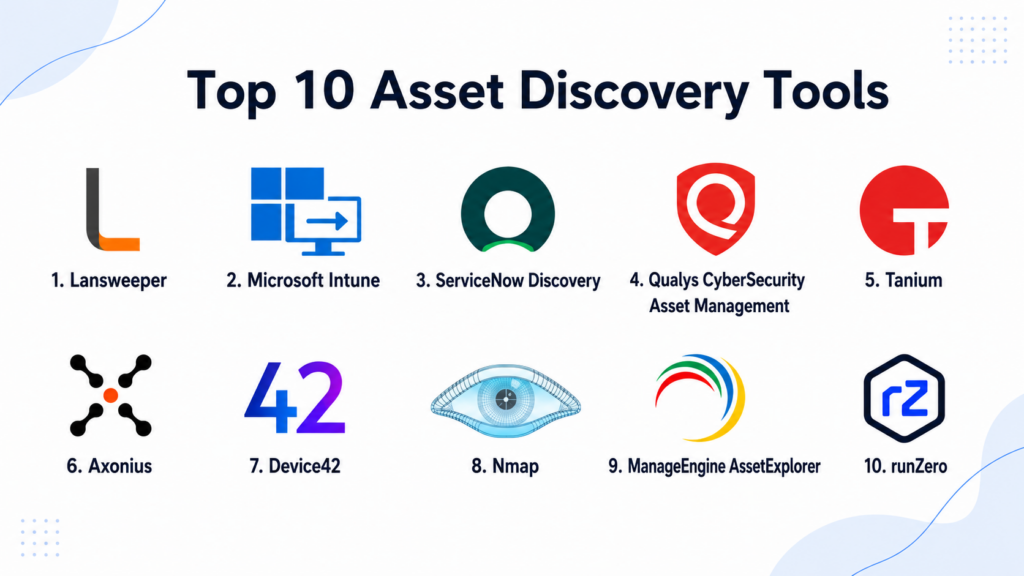
Introduction
Asset Discovery Tools help organizations automatically identify, inventory, classify, and monitor devices, servers, cloud assets, applications, software, users, endpoints, network equipment, containers, and other technology resources across the IT environment. In simple terms, these tools help IT and security teams answer a critical question:Asset discovery matters because modern IT environments are no longer limited to office computers and on-premise servers. Companies now manage remote endpoints, SaaS applications, public cloud workloads, virtual machines, shadow IT, unmanaged devices, IoT systems, containers, and temporary assets. Without accurate discovery, organizations may miss vulnerabilities, lose track of licenses, fail audits, or leave unknown devices exposed.Real-world use cases include IT asset inventory, cybersecurity visibility, vulnerability management, compliance audits, endpoint tracking, cloud asset mapping, CMDB enrichment, software license management, attack surface reduction, and incident response. Buyers should evaluate discovery depth, agent and agentless scanning, cloud coverage, network visibility, software inventory, integrations, reporting, security controls, scalability, and automation.
Best for: Asset Discovery Tools are best for IT operations teams, cybersecurity teams, infrastructure teams, endpoint management teams, asset managers, compliance teams, managed service providers, cloud operations teams, and enterprises that need accurate visibility across hybrid technology environments.
Not ideal for: These tools may not be necessary for very small teams with only a few managed devices and simple IT systems. In those cases, basic endpoint management, spreadsheets, or built-in inventory tools may be enough until asset volume, risk, or compliance requirements increase.
Key Trends in Asset Discovery Tools
- Hybrid asset visibility: Organizations need discovery across on-premise networks, cloud platforms, remote endpoints, SaaS applications, containers, virtual machines, and mobile devices.
- Cybersecurity-driven discovery: Asset discovery is increasingly linked to vulnerability management, attack surface management, endpoint security, and risk prioritization.
- Cloud-native asset mapping: Tools are expanding support for public cloud assets, cloud accounts, workloads, storage, identities, serverless functions, and misconfigured resources.
- Agentless discovery growth: Many teams want to discover assets without installing agents everywhere, especially for unmanaged devices, network equipment, and temporary cloud workloads.
- CMDB enrichment: Asset discovery tools are being used to keep CMDB data current by automatically updating configuration items, ownership, relationships, and lifecycle status.
- Real-time and continuous discovery: Periodic inventory scans are no longer enough. Modern environments require near real-time updates as assets appear, change, and disappear.
- Software and license visibility: Companies want to know which applications are installed, whether licenses are overused, and where unauthorized software is running.
- IoT and OT awareness: Enterprises are increasingly discovering printers, cameras, sensors, medical devices, industrial equipment, and other non-traditional IT assets.
- Risk-based asset prioritization: Asset discovery is becoming more useful when combined with exposure, vulnerability, business criticality, and ownership context.
- Automation and remediation workflows: Discovery insights now trigger ticket creation, asset tagging, owner assignment, security alerts, and compliance workflows.
How We Selected These Tools
The tools in this list were selected based on their relevance to IT asset discovery, cybersecurity visibility, endpoint inventory, cloud asset discovery, network scanning, CMDB enrichment, and operational asset management. The category is broad, so this list includes enterprise platforms, security-focused discovery tools, IT management tools, cloud-aware platforms, and practical inventory solutions.
Selection logic included:
- Market recognition in IT asset discovery, cybersecurity, endpoint management, and asset inventory.
- Ability to discover devices, software, cloud assets, endpoints, servers, network assets, and unmanaged systems.
- Support for agent-based, agentless, network-based, and cloud API-based discovery approaches.
- Integration with ITSM, CMDB, vulnerability management, endpoint security, and compliance platforms.
- Scalability across SMB, mid-market, enterprise, and managed service provider environments.
- Reporting depth for asset inventory, lifecycle, ownership, risk, software usage, and compliance.
- Security and administrative controls such as role-based access, audit logs, permissions, and governance.
- Practical usability for IT operations, security teams, asset managers, and infrastructure teams.
- Automation support for ticketing, tagging, remediation, and workflow orchestration.
- Overall value for improving visibility, reducing unknown assets, and strengthening IT control.
Top 10 Asset Discovery Tools
1- Lansweeper
Short description:
Lansweeper is a widely used IT asset discovery and inventory platform that helps organizations discover hardware, software, users, network devices, and technology assets across their environment. It is known for broad asset visibility and practical inventory reporting. Lansweeper is useful for IT teams that want to identify what is connected, what software is installed, and which assets need attention. It works well for SMB, mid-market, and enterprise teams that need centralized IT asset visibility.
Key Features
- Network asset discovery and inventory.
- Hardware and software asset tracking.
- Agent-based and agentless discovery options.
- Software license and application visibility.
- Reporting dashboards for IT inventory and asset status.
- Integration with ITSM, helpdesk, and security workflows.
- Discovery of endpoints, servers, network devices, and other IT assets.
Pros
- Strong general-purpose IT asset discovery coverage.
- Useful for both hardware and software inventory.
- Practical reporting for IT operations and asset management teams.
Cons
- Advanced security analytics may require complementary security tools.
- Large environments may need careful scan configuration.
- Cloud-native discovery depth should be validated based on requirements.
Platforms / Deployment
Web
Cloud / Self-hosted options may vary
Security & Compliance
Lansweeper provides administrative controls and access management features for asset inventory workflows. Specific security certifications, data protection controls, and compliance coverage should be validated during procurement.
Integrations & Ecosystem
Lansweeper integrates with IT service management, security, helpdesk, and reporting systems. It is useful when asset discovery data needs to enrich tickets, CMDB records, compliance workflows, or vulnerability management processes.
- ITSM platforms
- Helpdesk systems
- Security tools
- Reporting and analytics platforms
- CMDB workflows
- Software license management processes
Support & Community
Lansweeper provides documentation, support resources, onboarding materials, and community knowledge. Its community is strong among IT administrators, asset managers, and infrastructure teams.
2- Microsoft Intune
Short description:
Microsoft Intune is a cloud-based endpoint management platform that helps organizations manage, discover, and inventory devices such as Windows PCs, macOS devices, iOS devices, Android devices, and enrolled endpoints. While it is broader than asset discovery, it plays a major role in endpoint asset visibility for Microsoft-centered organizations. Intune helps IT teams understand device ownership, compliance status, installed apps, configuration state, and security posture. It is best suited for companies already using Microsoft 365 and Entra ID.
Key Features
- Endpoint device inventory and management.
- Windows, macOS, iOS, and Android device visibility.
- Application inventory and deployment tracking.
- Compliance policy monitoring.
- Integration with Microsoft identity and security tools.
- Remote device management and configuration.
- Reporting for device health, enrollment, and compliance.
Pros
- Strong fit for Microsoft 365 and Windows-centered environments.
- Combines asset visibility with endpoint management.
- Useful for remote and hybrid workforce device tracking.
Cons
- Primarily focused on managed endpoints, not full network discovery.
- Unmanaged device visibility may require complementary tools.
- Best value depends on Microsoft ecosystem adoption.
Platforms / Deployment
Web / Windows / macOS / iOS / Android
Cloud
Security & Compliance
Microsoft Intune includes enterprise security controls such as identity integration, device compliance policies, conditional access alignment, role-based administration, and management policies. Specific compliance coverage depends on licensing, tenant configuration, and regional requirements.
Integrations & Ecosystem
Intune integrates deeply with Microsoft 365, Entra ID, Defender, Windows Autopilot, and endpoint security workflows. It is most powerful when used as part of a broader Microsoft endpoint and identity management environment.
- Microsoft 365
- Microsoft Entra ID
- Microsoft Defender
- Windows Autopilot
- Endpoint analytics
- Security and compliance tools
Support & Community
Microsoft provides documentation, enterprise support, learning resources, partner services, and a large administrator community. Support strength is high for organizations already using Microsoft cloud services.
3- ServiceNow Discovery
Short description:
ServiceNow Discovery helps organizations automatically identify infrastructure, applications, devices, and configuration items to keep the CMDB accurate and useful. It is designed for enterprises that use ServiceNow as their ITSM and operations platform. ServiceNow Discovery can map servers, network devices, cloud resources, applications, and relationships between assets. It is especially valuable when asset discovery must support incident, change, problem, service mapping, and configuration management processes.
Key Features
- Infrastructure and configuration item discovery.
- CMDB population and enrichment.
- Relationship mapping between assets and services.
- Discovery of servers, network devices, applications, and cloud resources.
- Integration with ITSM, change, incident, and problem workflows.
- Scheduled and automated discovery processes.
- Service-aware visibility for IT operations.
Pros
- Strong fit for ServiceNow-centered enterprises.
- Helps improve CMDB accuracy and service visibility.
- Valuable for ITSM, change management, and operations workflows.
Cons
- Best value depends on ServiceNow adoption and CMDB maturity.
- Implementation can require planning and experienced administration.
- May be too complex for smaller teams without formal ITSM processes.
Platforms / Deployment
Web
Cloud
Security & Compliance
ServiceNow provides enterprise security controls such as SSO, MFA support, role-based access, audit capabilities, encryption options, and administrative governance. Specific compliance coverage depends on product, region, contract, and configuration.
Integrations & Ecosystem
ServiceNow Discovery connects closely with the ServiceNow platform and broader IT operations workflows. It is especially useful when discovery data must support service management and operational decision-making.
- ServiceNow CMDB
- ServiceNow ITSM
- Change management
- Incident and problem management
- Cloud resources
- IT operations management workflows
Support & Community
ServiceNow offers documentation, training, certification programs, enterprise support, partner services, and a large global community. Successful use often depends on strong CMDB governance and platform expertise.
4- Qualys CyberSecurity Asset Management
Short description:
Qualys CyberSecurity Asset Management helps organizations discover, classify, and assess assets from a cybersecurity and exposure management perspective. It provides visibility into known and unknown assets, software, vulnerabilities, certificates, and security risks. Qualys is especially useful for security teams that need asset discovery connected with vulnerability management and risk prioritization. It is best suited for organizations that want discovery as part of a broader security and compliance program.
Key Features
- Cybersecurity-focused asset discovery.
- Hardware, software, and internet-facing asset visibility.
- Vulnerability and risk context for discovered assets.
- Cloud and endpoint asset visibility.
- Certificate and software inventory support.
- Continuous monitoring and reporting.
- Integration with vulnerability management workflows.
Pros
- Strong security-first approach to asset discovery.
- Useful for reducing unknown and unmanaged asset risk.
- Works well with vulnerability management and compliance programs.
Cons
- May be more security-focused than general IT asset management needs.
- Implementation and tuning require security process maturity.
- Broader lifecycle asset management may need complementary ITAM tools.
Platforms / Deployment
Web
Cloud
Security & Compliance
Qualys provides enterprise security controls, role-based administration, scanning governance, and security-oriented asset visibility. Specific certifications and compliance coverage should be validated based on product scope and contract.
Integrations & Ecosystem
Qualys integrates with security operations, vulnerability management, SIEM, ITSM, and compliance workflows. It is valuable when asset discovery data needs to drive remediation and risk reduction.
- Vulnerability management workflows
- SIEM platforms
- ITSM tools
- Cloud platforms
- Endpoint security tools
- Compliance reporting systems
Support & Community
Qualys provides documentation, customer support, training resources, and enterprise guidance. Its community is strongest among vulnerability management, security operations, and compliance professionals.
5- Tanium
Short description:
Tanium is an endpoint management and security platform that provides real-time visibility into endpoints, assets, software, configurations, vulnerabilities, and operational status. It is especially useful for large enterprises that need fast endpoint discovery and control across distributed environments. Tanium helps IT and security teams ask questions about endpoint assets and receive near real-time answers. It is best suited for organizations that need scalable endpoint visibility, security operations, and remediation capabilities.
Key Features
- Real-time endpoint asset discovery.
- Hardware, software, and configuration inventory.
- Endpoint security and vulnerability visibility.
- Patch and remediation workflow support.
- Query-based endpoint intelligence.
- Reporting for asset status and operational health.
- Integration with IT operations and security workflows.
Pros
- Strong real-time endpoint visibility for large environments.
- Useful for both IT operations and cybersecurity teams.
- Supports discovery, investigation, and remediation workflows.
Cons
- Enterprise-focused platform may be too advanced for smaller teams.
- Requires careful deployment and administration.
- Best value depends on endpoint management and security maturity.
Platforms / Deployment
Web
Cloud / Hybrid options may vary
Security & Compliance
Tanium provides enterprise security and administrative controls for endpoint management and security workflows. Specific compliance certifications, deployment controls, and data protection details should be validated during procurement.
Integrations & Ecosystem
Tanium integrates with ITSM, SIEM, endpoint security, vulnerability management, patching, and operations tools. Its value increases when endpoint discovery data is used for rapid response and remediation.
- SIEM platforms
- ITSM tools
- Endpoint security systems
- Vulnerability management tools
- Patch management workflows
- Reporting platforms
Support & Community
Tanium provides enterprise support, documentation, professional services, customer success resources, and training. Its ecosystem is strongest among large IT operations and security teams.
6- Axonius
Short description:
Axonius is a cybersecurity asset management platform designed to aggregate asset data from many security, IT, cloud, endpoint, identity, and management tools. Instead of relying on one scanner, Axonius connects to existing tools and creates a unified view of assets, users, devices, software, cloud resources, and coverage gaps. It is especially useful for security teams that need to understand unmanaged assets, missing controls, and exposure risks. Axonius is best for organizations with many tools and fragmented asset data.
Key Features
- Asset data aggregation from multiple sources.
- Device, user, software, cloud, and SaaS asset visibility.
- Security coverage gap detection.
- Policy-based asset queries and reporting.
- Automation for ticketing and remediation workflows.
- Risk and compliance-focused asset insights.
- Integration with many IT and security systems.
Pros
- Strong visibility across fragmented security and IT tools.
- Useful for finding unmanaged or under-protected assets.
- Good fit for cybersecurity asset management programs.
Cons
- Value depends on available integrations and source data quality.
- Not a traditional network scanner by itself.
- Requires clear policies and workflows to act on findings.
Platforms / Deployment
Web
Cloud / Deployment options may vary
Security & Compliance
Axonius provides enterprise security and administrative controls for cybersecurity asset management. Specific certifications, access controls, and compliance coverage should be validated with the vendor.
Integrations & Ecosystem
Axonius is built around broad integrations with security, IT, endpoint, identity, cloud, and management systems. It is most valuable when organizations want one normalized view from many existing sources.
- Endpoint management tools
- Cloud platforms
- Identity providers
- Vulnerability scanners
- SIEM and security tools
- ITSM platforms
Support & Community
Axonius provides documentation, customer support, implementation guidance, and security-focused resources. Its community is strongest among cybersecurity teams focused on asset visibility and control gaps.
7- Device42
Short description:
Device42 is an IT asset management and infrastructure discovery platform focused on data centers, cloud environments, applications, network dependencies, and configuration data. It helps organizations map infrastructure assets, application dependencies, racks, IP addresses, certificates, software, and service relationships. Device42 is especially useful for data center modernization, migration planning, CMDB enrichment, and infrastructure visibility. It is best for IT operations teams needing detailed asset and dependency mapping.
Key Features
- Infrastructure and data center asset discovery.
- Application dependency mapping.
- IP address, rack, and network inventory.
- Software, certificate, and hardware inventory.
- Cloud and virtual infrastructure visibility.
- CMDB and ITSM integration.
- Reporting for migration, compliance, and operations planning.
Pros
- Strong infrastructure and dependency discovery.
- Useful for migration planning and CMDB enrichment.
- Good fit for data center and hybrid infrastructure teams.
Cons
- May be more infrastructure-focused than endpoint-focused.
- Setup and discovery accuracy depend on environment complexity.
- Security-first teams may need complementary vulnerability tools.
Platforms / Deployment
Web
Cloud / Self-hosted options may vary
Security & Compliance
Device42 provides administrative controls and security features for asset inventory and infrastructure data management. Specific compliance coverage and security certifications should be validated with the vendor.
Integrations & Ecosystem
Device42 integrates with ITSM, CMDB, cloud, virtualization, automation, and infrastructure management tools. It is useful when detailed asset relationships need to support operations, migrations, and service management.
- ITSM platforms
- CMDB workflows
- Cloud platforms
- Virtualization tools
- Automation systems
- Infrastructure monitoring tools
Support & Community
Device42 provides documentation, support resources, onboarding guidance, and implementation help. Its community is strongest among infrastructure, data center, and IT operations teams.
8- Nmap
Short description:
Nmap is a widely known open-source network discovery and security scanning tool used to identify hosts, open ports, services, operating systems, and network exposure. It is not a full enterprise asset management platform, but it remains highly valuable for technical teams that need flexible network discovery and scanning. Nmap is commonly used by security engineers, network administrators, and penetration testers. It is best for organizations that need lightweight, technical, and scriptable network visibility.
Key Features
- Network host discovery.
- Port scanning and service detection.
- Operating system fingerprinting.
- Scriptable scanning through Nmap scripting capabilities.
- Support for security testing and network mapping.
- Command-line flexibility for technical users.
- Useful for ad hoc scanning and validation.
Pros
- Open-source and highly flexible.
- Strong for technical network discovery and security validation.
- Widely known among network and security professionals.
Cons
- Not a full asset inventory or lifecycle management platform.
- Requires technical expertise to use effectively.
- Reporting, governance, and enterprise workflows require additional tools.
Platforms / Deployment
Windows / macOS / Linux
Self-hosted command-line tool
Security & Compliance
Nmap itself is a technical scanning tool rather than an enterprise governance platform. Security and compliance depend on how it is used, where it is run, and how results are stored and managed.
Integrations & Ecosystem
Nmap can be used independently or incorporated into scripts, security workflows, penetration testing processes, and network validation tasks. It is often part of a broader technical toolkit rather than a standalone enterprise asset system.
- Security testing workflows
- Network administration scripts
- Vulnerability validation processes
- Penetration testing toolkits
- Custom automation
- Technical reporting pipelines
Support & Community
Nmap has a large open-source community, documentation, and broad technical awareness. Formal enterprise support depends on third-party services or internal expertise.
9- ManageEngine AssetExplorer
Short description:
ManageEngine AssetExplorer is an IT asset management platform that helps organizations discover, track, and manage hardware and software assets throughout their lifecycle. It supports asset inventory, software license management, purchase tracking, contracts, and compliance-related reporting. AssetExplorer is useful for IT teams that need practical asset management along with discovery capabilities. It is especially relevant for SMB and mid-market organizations that want structured IT asset lifecycle visibility.
Key Features
- IT asset discovery and inventory.
- Hardware and software asset tracking.
- Software license management.
- Purchase order and contract management.
- Asset lifecycle and ownership tracking.
- Reporting for compliance and inventory.
- Integration with IT service management workflows.
Pros
- Practical ITAM capabilities for asset lifecycle management.
- Useful for software license and hardware inventory tracking.
- Good fit for SMB and mid-market IT teams.
Cons
- Security-focused discovery may require additional tools.
- Cloud and advanced exposure visibility should be validated.
- Best fit is IT asset management rather than deep cyber asset analytics.
Platforms / Deployment
Web
Self-hosted / Deployment options may vary
Security & Compliance
ManageEngine AssetExplorer provides administrative controls, authentication options, permissions, and asset data governance features. Specific security and compliance requirements should be validated based on deployment model and edition.
Integrations & Ecosystem
AssetExplorer works well within ManageEngine and IT service management environments. It is useful when asset data must connect to helpdesk, procurement, software license, and lifecycle workflows.
- ManageEngine ServiceDesk Plus
- Helpdesk systems
- Procurement workflows
- Software license processes
- Directory services
- Reporting systems
Support & Community
ManageEngine provides documentation, support resources, training materials, and user community support. Its ecosystem is strong among IT administrators and asset management teams.
10- Rumble by runZero
Short description:
runZero is an asset discovery and network visibility platform that helps organizations identify devices, services, and exposures across modern networks. It is designed to discover managed, unmanaged, and unknown assets without relying only on agents. runZero is especially useful for security teams, IT operations teams, and organizations with complex or hard-to-see environments. It helps improve asset visibility across traditional IT, cloud-connected networks, and unmanaged devices.
Key Features
- Agentless asset discovery.
- Network device and service identification.
- Unmanaged and unknown asset visibility.
- Exposure and service-level insights.
- Inventory reporting and asset classification.
- Support for security and IT operations workflows.
- Integration with security and IT tools.
Pros
- Strong agentless discovery for unknown assets.
- Useful for identifying unmanaged devices and network exposure.
- Practical for security and IT visibility improvement.
Cons
- Broader lifecycle asset management may require complementary ITAM tools.
- Best results depend on network access and scan planning.
- Advanced enterprise workflows should be validated against requirements.
Platforms / Deployment
Web
Cloud / Self-hosted options may vary
Security & Compliance
runZero provides administrative and security controls for asset discovery workflows. Specific compliance coverage, data handling practices, and deployment controls should be validated during procurement.
Integrations & Ecosystem
runZero integrates with security, ITSM, vulnerability management, and operations workflows. It is valuable when asset discovery needs to identify unknown systems and feed results into security processes.
- ITSM platforms
- Vulnerability management tools
- SIEM systems
- Security operations workflows
- Asset management systems
- Reporting tools
Support & Community
runZero provides documentation, support resources, product guidance, and security-focused educational materials. Its community is strongest among security practitioners and asset visibility teams.
Comparison Table Top 10
| Tool Name | Best For | Platform Supported | Deployment | Standout Feature | Public Rating |
|---|---|---|---|---|---|
| Lansweeper | General IT asset discovery and inventory | Web | Cloud / Self-hosted options may vary | Broad hardware and software inventory | N/A |
| Microsoft Intune | Microsoft endpoint asset visibility | Web, Windows, macOS, iOS, Android | Cloud | Endpoint inventory with device management | N/A |
| ServiceNow Discovery | CMDB and enterprise ITSM discovery | Web | Cloud | CMDB enrichment and service relationship mapping | N/A |
| Qualys CyberSecurity Asset Management | Security-focused asset discovery | Web | Cloud | Asset visibility linked with vulnerability risk | N/A |
| Tanium | Real-time endpoint asset intelligence | Web | Cloud / Hybrid options may vary | Fast endpoint visibility and control | N/A |
| Axonius | Cybersecurity asset management across tools | Web | Cloud / Deployment options may vary | Aggregates asset data from many sources | N/A |
| Device42 | Infrastructure and dependency discovery | Web | Cloud / Self-hosted options may vary | Data center and application dependency mapping | N/A |
| Nmap | Technical network discovery and scanning | Windows, macOS, Linux | Self-hosted command-line tool | Flexible open-source network scanning | N/A |
| ManageEngine AssetExplorer | IT asset lifecycle management | Web | Self-hosted / Deployment options may vary | Hardware, software, license, and lifecycle tracking | N/A |
| runZero | Agentless discovery of unknown assets | Web | Cloud / Self-hosted options may vary | Unmanaged asset and network exposure discovery | N/A |
Evaluation and Scoring of Asset Discovery Tools
The scoring below is comparative and based on discovery coverage, ease of use, integrations, security posture signals, performance, support expectations, and value. These are not public ratings and should be used as directional evaluation scores only. A tool with a lower score may still be the best fit if it solves a specific problem such as endpoint visibility, cloud discovery, CMDB enrichment, or unmanaged asset detection.
| Tool Name | Core 25% | Ease 15% | Integrations 15% | Security 10% | Performance 10% | Support 10% | Value 15% | Weighted Total 0–10 |
|---|---|---|---|---|---|---|---|---|
| Lansweeper | 8 | 8 | 8 | 8 | 8 | 8 | 9 | 8.15 |
| Microsoft Intune | 8 | 8 | 9 | 9 | 8 | 9 | 8 | 8.35 |
| ServiceNow Discovery | 9 | 7 | 10 | 9 | 9 | 9 | 7 | 8.55 |
| Qualys CyberSecurity Asset Management | 9 | 7 | 9 | 9 | 9 | 8 | 8 | 8.45 |
| Tanium | 9 | 7 | 8 | 9 | 10 | 8 | 7 | 8.35 |
| Axonius | 9 | 8 | 10 | 8 | 8 | 8 | 8 | 8.55 |
| Device42 | 8 | 7 | 8 | 8 | 8 | 8 | 8 | 7.85 |
| Nmap | 7 | 6 | 7 | 7 | 8 | 7 | 10 | 7.35 |
| ManageEngine AssetExplorer | 7 | 8 | 7 | 7 | 8 | 8 | 9 | 7.75 |
| runZero | 8 | 8 | 8 | 8 | 9 | 8 | 8 | 8.10 |
These scores should be interpreted based on use case. A security team may prefer Qualys, Axonius, Tanium, or runZero because they provide stronger cybersecurity context. An IT asset management team may prefer Lansweeper, ManageEngine AssetExplorer, or Device42 for inventory and lifecycle tracking. A ServiceNow-centered enterprise may choose ServiceNow Discovery to improve CMDB accuracy. Buyers should test discovery accuracy, integration quality, reporting, and scalability using their actual environment before final selection.
Which Asset Discovery Tool Is Right for You?
Solo / Freelancer
Solo professionals usually do not need a full enterprise asset discovery platform. If you manage a small number of devices or client systems, lightweight tools such as Nmap, endpoint inventory, or built-in cloud dashboards may be enough. The priority should be knowing what systems are active, what services are exposed, and where basic risks exist. A full asset discovery platform becomes more useful when asset count, client environments, or compliance requirements increase.
SMB
SMBs should prioritize ease of use, affordability, basic hardware and software inventory, and simple reporting. Lansweeper, ManageEngine AssetExplorer, runZero, and Microsoft Intune can be practical choices depending on whether the main need is general IT inventory, endpoint management, or unmanaged device discovery. SMBs should avoid overly complex enterprise platforms unless they have clear security or compliance requirements. The best starting point is to discover all endpoints, software, network devices, and cloud assets.
Mid-Market
Mid-market organizations often need stronger reporting, integrations, software inventory, endpoint visibility, cloud coverage, and security context. Lansweeper, Intune, Qualys, Device42, runZero, and Axonius can be strong options depending on the environment. If the company uses Microsoft heavily, Intune may be practical for endpoint visibility. If security exposure is the main concern, Qualys, Axonius, or runZero may be better. If infrastructure mapping matters, Device42 is worth considering.
Enterprise
Enterprises need scalable discovery across endpoints, networks, cloud, data centers, applications, identities, and security tools. ServiceNow Discovery is strong for CMDB-centered enterprises, Tanium is strong for real-time endpoint visibility, Axonius is strong for cybersecurity asset aggregation, and Qualys is strong for security-focused asset management. Enterprises should evaluate discovery accuracy, data normalization, CMDB integration, security controls, API availability, automation, and global scalability.
Budget vs Premium
Budget-focused teams can start with tools like Nmap, ManageEngine AssetExplorer, Lansweeper, or runZero depending on the required depth. Premium enterprise platforms such as ServiceNow Discovery, Tanium, Qualys, and Axonius can deliver greater value when asset visibility is tied to security, compliance, CMDB, and operational processes. Buyers should compare total cost, including implementation, scanning infrastructure, integrations, admin effort, and ongoing maintenance.
Feature Depth vs Ease of Use
Feature depth matters when teams need dependency mapping, cloud discovery, endpoint intelligence, security exposure, CMDB enrichment, and automation. ServiceNow Discovery, Tanium, Qualys, Axonius, and Device42 offer strong depth for specific enterprise use cases. Ease of use matters when teams need quick inventory and practical reporting. Lansweeper, ManageEngine AssetExplorer, Intune, and runZero may be easier for many teams to adopt depending on the environment.
Integrations and Scalability
Asset discovery data becomes more valuable when it integrates with ITSM, CMDB, vulnerability management, endpoint security, SIEM, cloud security, patch management, and compliance workflows. A discovered asset should not just appear in a report; it should trigger ownership assignment, risk review, remediation, or lifecycle action. Buyers should validate API support, connector quality, and data synchronization before selecting a tool. Scalability is especially important for enterprises with multiple networks, regions, and cloud accounts.
Security and Compliance Needs
Asset discovery is central to security and compliance because organizations cannot protect what they cannot see. Buyers should evaluate role-based access, audit logs, data encryption, scan permissions, credential handling, network impact, reporting controls, and integration security. Security teams should also check whether the tool can identify unknown assets, unmanaged endpoints, vulnerable software, exposed services, and missing controls. Compliance-focused organizations should ensure asset records are accurate, exportable, and audit-ready.
Frequently Asked Questions FAQs
1. What is an Asset Discovery Tool?
An Asset Discovery Tool is software that automatically identifies and inventories technology assets across an organization. These assets can include laptops, desktops, servers, cloud workloads, network devices, software, virtual machines, containers, users, and applications. The tool helps IT and security teams understand what exists in the environment. This visibility supports asset management, cybersecurity, compliance, patching, and operational planning. Without asset discovery, unknown and unmanaged systems can create serious risk.
2. How is asset discovery different from asset management?
Asset discovery focuses on finding and identifying assets, while asset management focuses on tracking ownership, lifecycle, cost, contracts, usage, and retirement. Discovery is often the first step because you need to know what exists before you can manage it properly. Asset management may include procurement, depreciation, license tracking, warranty management, and compliance reporting. Many platforms combine both capabilities. The best approach is to use discovery data to keep asset records accurate and current.
3. What pricing models are common for Asset Discovery Tools?
Asset Discovery Tools commonly use pricing based on number of assets, endpoints, users, scanners, modules, cloud resources, or enterprise contract size. Some tools offer open-source or free technical scanning options, while enterprise platforms usually use subscription or custom pricing. Vendors may charge separately for cloud discovery, security modules, integrations, support, or advanced reporting. Buyers should ask for a full cost breakdown before committing. Total cost should include implementation, scanning setup, integrations, training, and ongoing administration.
4. How long does implementation usually take?
Implementation time depends on company size, network complexity, discovery method, security requirements, and integration needs. A small network scan can be set up quickly, while enterprise discovery across multiple regions, clouds, and business units can take longer. The most important steps include defining scan scope, configuring credentials, connecting cloud accounts, validating results, and mapping ownership. Teams should start with a controlled pilot before expanding discovery coverage. Accuracy improves over time as data sources and rules are tuned.
5. What are common mistakes when choosing an Asset Discovery Tool?
A common mistake is choosing a tool without defining what types of assets need to be discovered. Some tools are strong for endpoints, others for cloud, networks, software, security exposure, or CMDB enrichment. Another mistake is assuming discovery data will be perfect immediately. Asset data usually needs normalization, deduplication, ownership mapping, and validation. Teams also fail when they collect asset data but do not connect it to workflows. Discovery should lead to action, not just reports.
6. Are Asset Discovery Tools secure?
Asset Discovery Tools can be secure when configured carefully, but they require proper governance because they may use credentials, scan networks, and collect sensitive infrastructure data. Buyers should evaluate role-based access, encryption, credential storage, audit logs, scan permissions, and data handling practices. Security teams should review how the tool scans assets and whether it could affect network performance. Cloud discovery also requires careful permission design. A secure implementation should follow least privilege principles.
7. Can Asset Discovery Tools find unmanaged devices?
Yes, many asset discovery tools can identify unmanaged or unknown devices, especially through network scanning, agentless discovery, cloud API discovery, or aggregation from existing security tools. However, visibility depends on network access, scan permissions, segmentation, cloud configuration, and tool capabilities. Endpoint management tools may only show enrolled devices, while network discovery tools can reveal assets that are not managed. Security teams should specifically test unmanaged asset detection before selecting a platform. This is one of the most important use cases for reducing risk.
8. Can Asset Discovery Tools integrate with CMDB and ITSM systems?
Yes, many asset discovery tools integrate with CMDB and ITSM platforms to keep configuration items and asset records updated. This helps incident, change, problem, request, and compliance workflows use accurate asset data. Integration can reduce manual CMDB updates and improve service visibility. However, CMDB success depends on data quality, ownership rules, relationship mapping, and governance. Buyers should test how discovered assets are created, updated, merged, and retired in the CMDB.
9. What alternatives exist if a full Asset Discovery Tool is not needed?
Alternatives include endpoint management inventories, cloud provider asset lists, network scanner tools, spreadsheets, configuration management databases, vulnerability scanners, and basic IT asset management systems. These can work for small environments or narrow use cases. However, they may become limited when assets are spread across networks, clouds, remote users, and unmanaged systems. A dedicated asset discovery platform becomes more valuable as complexity increases. The right alternative depends on asset count, risk level, and compliance needs.
10. How should buyers evaluate Asset Discovery Tools?
Buyers should evaluate asset coverage, discovery methods, accuracy, integrations, reporting, security controls, scalability, and ease of administration. They should test the tool in a real environment with endpoints, servers, network devices, cloud resources, and unmanaged systems. It is also important to check whether the tool can identify software, ownership, vulnerabilities, asset relationships, and lifecycle status. Security and IT teams should jointly evaluate the platform because asset discovery supports both operations and risk management. A pilot is the safest way to validate accuracy and usefulness.
Conclusion
Asset Discovery Tools help organizations gain control over their technology environment by identifying devices, software, cloud assets, infrastructure, services, and unmanaged systems. The right tool depends on whether the main goal is IT inventory, cybersecurity visibility, endpoint management, CMDB enrichment, cloud discovery, infrastructure mapping, or software license tracking. Lansweeper and ManageEngine AssetExplorer are practical for IT inventory, Microsoft Intune is strong for Microsoft endpoint visibility, ServiceNow Discovery supports CMDB-centered enterprises, Qualys and Axonius are strong for cybersecurity asset visibility, Tanium provides real-time endpoint intelligence, Device42 is useful for infrastructure mapping, Nmap remains valuable for technical scanning, and runZero helps identify unknown and unmanaged assets. There is no single best platform for every organization because each environment has different asset types, risk levels, and operational needs.
