MOTOSHARE 🚗🏍️
Rent Bikes & Cars Directly from Owners
Motoshare connects vehicle owners with people who need bikes and cars on rent. Owners earn from idle vehicles, and renters get flexible ride options.
Visit Motoshare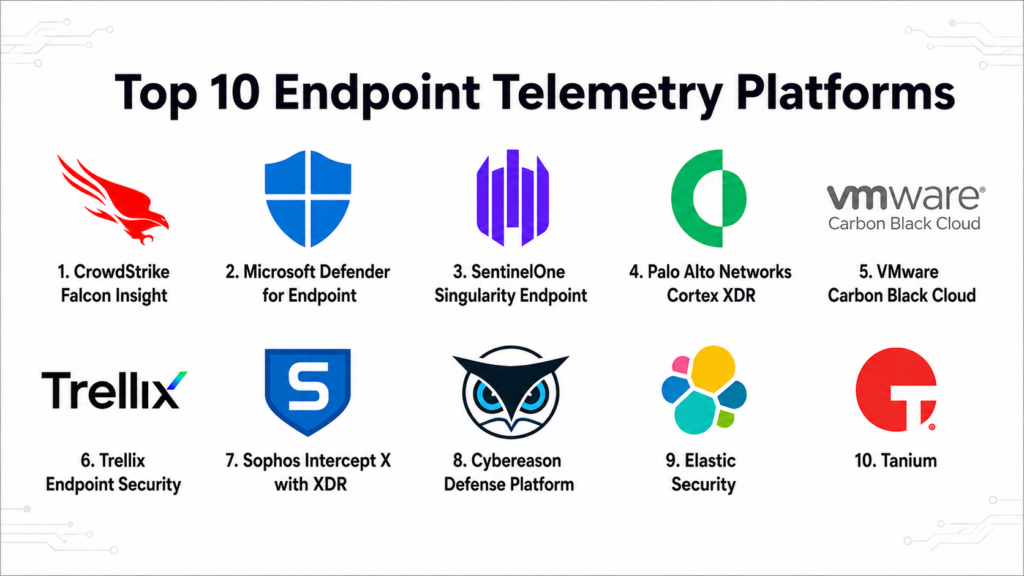
Introduction
Endpoint Telemetry Platforms help security, IT, and operations teams collect detailed activity data from laptops, desktops, servers, workloads, and sometimes mobile devices. In simple terms, these tools show what is happening on endpoints: running processes, file changes, network connections, user activity, registry changes, command-line behavior, suspicious scripts, device health, and security events.
Endpoint telemetry matters because modern attacks often begin or spread through endpoints. Security teams need fast visibility into suspicious behavior, malware activity, lateral movement, credential misuse, and abnormal system activity. IT teams also use endpoint telemetry to understand device posture, software inventory, patch status, and operational health.
Real world use cases include threat hunting, endpoint detection and response, incident investigation, malware analysis, device inventory, vulnerability prioritization, compliance monitoring, insider risk investigation, and security analytics.
Buyers should evaluate:
- Depth of endpoint telemetry
- Real-time detection and response
- Threat hunting capabilities
- Data retention and search quality
- OS and device coverage
- Agent performance and stability
- SIEM and SOAR integrations
- Cloud workload visibility
- Security controls and audit logs
- Scalability across distributed endpoints
Best for: Endpoint Telemetry Platforms are best for security operations centers, incident response teams, threat hunters, IT security teams, managed detection and response providers, enterprise IT teams, compliance teams, and organizations that need deep visibility across endpoint activity.
Not ideal for: Very small teams with limited security operations maturity may not need a full endpoint telemetry platform. A basic endpoint protection tool, antivirus product, or managed security service may be enough when endpoint volume is low, internal investigation skills are limited, and there is no dedicated SOC or security analyst team.
Key Trends in Endpoint Telemetry Platforms
- Telemetry-driven detection: Security teams are moving beyond simple malware signatures toward behavioral telemetry, process lineage, command analysis, and attack chain visibility.
- XDR expansion: Endpoint telemetry is increasingly combined with identity, email, cloud, network, and SaaS data for broader detection and investigation.
- AI-assisted investigation: Platforms are adding AI to summarize alerts, explain suspicious behavior, recommend actions, and reduce analyst workload.
- Cloud workload telemetry: Endpoint visibility is expanding into servers, containers, virtual machines, and cloud workloads.
- Identity and endpoint correlation: Security teams want to connect endpoint activity with user identity, privilege changes, login behavior, and access risk.
- Managed detection adoption: Many organizations now use endpoint telemetry platforms through MDR providers because internal SOC capacity is limited.
- Data lake and SIEM integration: Endpoint telemetry is increasingly sent to SIEM, security data lake, SOAR, and analytics platforms for deeper investigation.
- Agent performance focus: Buyers are paying closer attention to endpoint agent resource usage, stability, update quality, and user experience.
- Regulatory and audit requirements: Endpoint telemetry is important for proving incident investigation, device monitoring, access control, and compliance response.
- Open telemetry and flexible querying: Security teams want query-based endpoint visibility, custom detection logic, and exportable telemetry for advanced use cases.
How We Selected These Tools
The tools below were selected using a practical buyer-focused evaluation approach:
- Market recognition in endpoint telemetry, EDR, XDR, endpoint security, threat hunting, and security operations.
- Telemetry depth across processes, files, network activity, scripts, registry changes, users, devices, and system behavior.
- Detection and response capability, including alerts, investigations, isolation, remediation, and automated response.
- Threat hunting strength, including query language, historical search, process trees, timeline views, and investigation workflows.
- Endpoint coverage, including Windows, macOS, Linux, servers, cloud workloads, and sometimes mobile devices.
- Integration ecosystem with SIEM, SOAR, identity, cloud, vulnerability, and ticketing systems.
- Scalability for SMB, mid-market, enterprise, and managed security environments.
- Security and administration controls, including RBAC, SSO, audit logs, policy management, and data protection.
- Analyst usability, including alert clarity, investigation speed, dashboards, and workflow design.
- Implementation practicality, including agent deployment, tuning effort, support resources, and operational complexity.
Top 10 Endpoint Telemetry Platforms
1- CrowdStrike Falcon Insight
Short description:
CrowdStrike Falcon Insight is a widely recognized endpoint detection and response platform that collects rich endpoint telemetry for security monitoring, threat hunting, and incident response. It is part of the broader CrowdStrike Falcon platform and is commonly used by enterprises, security teams, and managed detection providers. The platform helps analysts investigate process behavior, suspicious activity, malware execution, lateral movement, and attack patterns. It is especially strong for organizations that want cloud-native endpoint security with strong detection and response workflows.
Key Features
- Real-time endpoint telemetry collection
- Process tree and attack timeline visibility
- Threat hunting and investigation workflows
- Endpoint detection and response actions
- Host isolation and remediation support
- Threat intelligence integration
- Cloud-native management console
Pros
- Strong endpoint telemetry and EDR reputation
- Scales well for enterprise and distributed environments
- Useful for mature SOC and threat hunting teams
Cons
- Advanced features may require skilled security analysts
- Costs can increase with additional Falcon modules
- Smaller teams may prefer managed services instead of direct operation
Platforms / Deployment
Web-based management console.
Cloud deployment.
Endpoint agents for major operating systems.
Exact OS coverage should be validated during procurement.
Security & Compliance
Supports enterprise security capabilities such as role-based access, audit logging, policy controls, and secure administration. Specific certifications and compliance details should be validated directly during vendor review.
Integrations & Ecosystem
CrowdStrike Falcon integrates with SIEM, SOAR, cloud, identity, vulnerability, ticketing, and security operations tools. It is often used as a central endpoint telemetry source for SOC workflows.
- SIEM platforms
- SOAR tools
- Cloud security tools
- Identity platforms
- Ticketing systems
- Threat intelligence workflows
Support & Community
CrowdStrike provides documentation, enterprise support, managed services, training resources, and customer success options. Support depth may vary by contract and selected modules.
2- Microsoft Defender for Endpoint
Short description:
Microsoft Defender for Endpoint is an endpoint security and telemetry platform designed for organizations using Microsoft security and productivity ecosystems. It provides endpoint detection, threat hunting, attack surface reduction, vulnerability insights, investigation timelines, and response actions. The platform is especially useful for enterprises already using Microsoft 365, Microsoft Sentinel, Entra ID, and Windows environments. It also supports broader endpoint coverage beyond Windows depending on deployment and licensing.
Key Features
- Endpoint detection and response
- Advanced hunting with query-based investigation
- Device inventory and vulnerability insights
- Attack surface reduction controls
- Automated investigation and response
- Integration with Microsoft security ecosystem
- Endpoint timeline and alert correlation
Pros
- Strong fit for Microsoft-centric organizations
- Good integration with identity, SIEM, and productivity tools
- Useful for both security and device posture visibility
Cons
- Best value depends on Microsoft licensing and ecosystem adoption
- Advanced hunting requires query and analyst skills
- Non-Microsoft environments should validate coverage carefully
Platforms / Deployment
Web-based management console.
Cloud deployment.
Endpoint coverage includes major operating systems depending on configuration and licensing.
Security & Compliance
Supports enterprise security controls through Microsoft identity, access management, RBAC, audit logging, and security administration. Specific certifications and compliance coverage should be validated by buyers based on Microsoft licensing and region.
Integrations & Ecosystem
Microsoft Defender for Endpoint integrates deeply with Microsoft security and productivity platforms. It is especially useful when endpoint telemetry needs to connect with identity, email, cloud, and SIEM data.
- Microsoft Sentinel
- Microsoft Defender XDR
- Microsoft Entra ID
- Microsoft Intune
- Microsoft 365
- Security automation workflows
Support & Community
Microsoft provides documentation, support plans, training resources, partner services, and a large technical community. Support depth varies by licensing, contract, and enterprise support agreement.
3- SentinelOne Singularity Endpoint
Short description:
SentinelOne Singularity Endpoint is an endpoint security and telemetry platform focused on autonomous detection, response, and threat hunting. It collects endpoint behavior data and uses AI-driven detection to identify suspicious activity across devices and workloads. The platform is commonly used by organizations that want strong EDR and XDR capabilities with automated remediation options. It is especially useful for security teams seeking fast endpoint investigation, storyline views, and response automation.
Key Features
- Endpoint telemetry and behavioral detection
- Automated threat response
- Storyline-based investigation views
- Threat hunting and query capabilities
- Rollback and remediation options where supported
- Device control and endpoint policy management
- XDR expansion through broader data sources
Pros
- Strong automation and behavioral detection focus
- Useful investigation experience for security analysts
- Good fit for organizations seeking EDR and XDR capabilities
Cons
- Advanced tuning may be needed in complex environments
- Full value depends on selected modules and data sources
- Smaller teams may need managed support for operations
Platforms / Deployment
Web-based management console.
Cloud deployment.
Endpoint agents for major operating systems.
Exact OS and workload support should be validated.
Security & Compliance
Supports enterprise access controls, role-based administration, audit logging, and security policy management. Specific certifications and compliance coverage should be verified during vendor evaluation.
Integrations & Ecosystem
SentinelOne integrates with security operations, SIEM, SOAR, cloud, identity, and ticketing environments. It can act as a key endpoint telemetry source for broader XDR workflows.
- SIEM platforms
- SOAR platforms
- Cloud security tools
- Identity systems
- Ticketing tools
- Threat intelligence sources
Support & Community
SentinelOne offers documentation, customer support, training, managed services through partners, and enterprise assistance. Support depth may vary by plan, partner, and contract.
4- Palo Alto Networks Cortex XDR
Short description:
Palo Alto Networks Cortex XDR is an extended detection and response platform that combines endpoint telemetry with network, cloud, identity, and security data. It is designed for security teams that want to correlate endpoint activity with broader attack signals across the enterprise. Cortex XDR is especially useful for organizations already using Palo Alto Networks security products. It helps analysts detect threats, investigate incidents, hunt across telemetry, and coordinate response actions.
Key Features
- Endpoint telemetry and EDR capabilities
- XDR correlation across multiple data sources
- Incident grouping and attack chain visibility
- Threat hunting and analytics
- Behavioral detection and response actions
- Integration with Palo Alto security ecosystem
- Dashboards and investigation workflows
Pros
- Strong XDR correlation across endpoint and network data
- Good fit for Palo Alto Networks customers
- Useful for SOC teams investigating multi-stage attacks
Cons
- Best value depends on ecosystem integration
- Setup and tuning may require security expertise
- Smaller teams may find XDR workflows complex
Platforms / Deployment
Web-based management console.
Cloud deployment.
Endpoint agent support varies by operating system and deployment requirements.
Security & Compliance
Supports enterprise security controls such as role-based access, audit logs, policy controls, and secure administration. Specific certifications and compliance details should be validated during vendor review.
Integrations & Ecosystem
Cortex XDR integrates strongly with Palo Alto Networks products and broader security operations environments. It is useful where endpoint telemetry needs to connect with firewall, cloud, identity, and network signals.
- Palo Alto Networks firewalls
- Prisma Cloud
- SIEM platforms
- SOAR tools
- Identity systems
- Cloud and network telemetry sources
Support & Community
Palo Alto Networks provides enterprise support, documentation, training, partner services, and customer success programs. Support depth depends on licensing, contract, and selected services.
5- VMware Carbon Black Cloud
Short description:
VMware Carbon Black Cloud is an endpoint security and telemetry platform used for endpoint detection, prevention, investigation, and response. It provides visibility into endpoint activity such as processes, files, network behavior, and suspicious execution patterns. The platform is useful for security teams that want endpoint activity monitoring, behavioral detection, and investigation workflows. It is especially relevant for organizations familiar with VMware ecosystems or those seeking cloud-based endpoint telemetry and EDR capabilities.
Key Features
- Endpoint telemetry collection
- Process and behavior analysis
- Endpoint detection and response workflows
- Threat hunting support
- Policy-based prevention controls
- Alert triage and investigation tools
- Integration with security operations tools
Pros
- Strong endpoint visibility and investigation capabilities
- Useful for security teams focused on behavioral activity
- Cloud-based management supports distributed environments
Cons
- Advanced investigation may require analyst expertise
- Platform fit should be validated against current VMware strategy
- Full value depends on deployment quality and tuning
Platforms / Deployment
Web-based management console.
Cloud deployment.
Endpoint agent coverage varies by operating system and environment.
Security & Compliance
Supports administrative controls, role-based access, audit-related capabilities, and policy management. Buyers should validate current compliance and security documentation during evaluation.
Integrations & Ecosystem
Carbon Black Cloud integrates with SIEM, SOAR, incident response, and security operations tools. It can contribute endpoint telemetry to broader SOC and investigation workflows.
- SIEM platforms
- SOAR tools
- Incident response tools
- Threat intelligence systems
- Security analytics platforms
- IT operations tools
Support & Community
Support, documentation, and implementation assistance are available through vendor and partner channels. Support depth may vary by contract, licensing, and business environment.
6- Trellix Endpoint Security
Short description:
Trellix Endpoint Security provides endpoint protection, detection, response, and telemetry capabilities for organizations that need visibility across endpoint threats and device behavior. It brings together endpoint security functions that help teams prevent malware, detect suspicious activity, investigate incidents, and respond to threats. Trellix is often considered by organizations with established enterprise security programs and existing Trellix or McAfee heritage environments. It is useful for teams that need endpoint telemetry connected with broader security operations.
Key Features
- Endpoint protection and detection
- Endpoint activity visibility
- Threat investigation workflows
- Response and remediation actions
- Policy and device control features
- Integration with broader security operations
- Enterprise reporting and administration
Pros
- Strong relevance for established enterprise security teams
- Combines endpoint protection and telemetry workflows
- Useful where Trellix ecosystem products are already used
Cons
- User experience and deployment complexity should be evaluated
- Best value may depend on existing Trellix environment
- Advanced telemetry workflows may require skilled security teams
Platforms / Deployment
Web-based and enterprise management options vary.
Cloud and hybrid deployment patterns may vary by product configuration.
Endpoint OS support should be validated during procurement.
Security & Compliance
Supports enterprise security administration, policy controls, access management, and audit-related capabilities. Specific certifications and compliance documentation should be validated directly.
Integrations & Ecosystem
Trellix integrates with enterprise security operations, SIEM, threat intelligence, and broader Trellix platform components. It is especially relevant for organizations standardizing on Trellix security products.
- SIEM platforms
- Trellix ecosystem tools
- Threat intelligence systems
- Security analytics workflows
- Incident response tools
- Enterprise reporting systems
Support & Community
Trellix provides enterprise support, documentation, professional services, and partner assistance. Support availability and depth may vary by licensing and contract.
7- Sophos Intercept X with XDR
Short description:
Sophos Intercept X with XDR combines endpoint protection, endpoint detection, response, and cross-product telemetry for security teams. It is commonly used by SMBs, mid-market companies, and managed service providers that want endpoint security with investigation capabilities. Sophos focuses on combining prevention, detection, managed services, and security operations visibility. It is especially useful for organizations that want strong endpoint telemetry but may also need managed detection and response support.
Key Features
- Endpoint protection and EDR
- XDR investigation capabilities
- Threat hunting queries
- Ransomware protection features
- Endpoint isolation and response actions
- Integration with Sophos security products
- Managed detection and response options
Pros
- Good fit for SMB, mid-market, and MSP environments
- Strong combination of protection and investigation
- Managed service options can help smaller teams
Cons
- Advanced hunting depth should be validated for complex SOC needs
- Best value increases when using Sophos ecosystem products
- Enterprise-scale customization may need review
Platforms / Deployment
Web-based management console.
Cloud deployment.
Endpoint agent support varies by operating system and selected products.
Security & Compliance
Supports role-based administration, policy controls, audit-related features, and secure management capabilities. Buyers should validate specific compliance requirements directly.
Integrations & Ecosystem
Sophos integrates with its broader security ecosystem and supports connections with security operations workflows. It is especially useful when endpoint telemetry is combined with firewall, email, cloud, and MDR services.
- Sophos Central
- Sophos Firewall
- SIEM integrations
- MDR workflows
- Cloud security tools
- Security operations platforms
Support & Community
Sophos provides documentation, partner support, managed services, customer support, and community resources. Support is often strong through reseller and MSP channels.
8- Cybereason Defense Platform
Short description:
Cybereason Defense Platform provides endpoint detection, response, and telemetry capabilities focused on identifying malicious operations across endpoints. It helps analysts detect suspicious behavior, investigate attack chains, and respond to threats across distributed environments. Cybereason is especially useful for security teams that want to understand attacker behavior and connect related endpoint events into broader malicious operations. It is often evaluated by organizations looking for EDR and MDR-oriented security operations capabilities.
Key Features
- Endpoint telemetry and behavioral analytics
- Malicious operation detection
- Threat hunting and investigation workflows
- Response and remediation actions
- Attack chain visibility
- Managed detection and response options
- Security operations dashboards
Pros
- Strong focus on attack behavior and malicious operations
- Useful for investigation-driven security teams
- MDR options can support teams with limited internal capacity
Cons
- Market fit should be validated against buyer’s current security stack
- Advanced workflows may require trained analysts
- Integration requirements should be reviewed carefully
Platforms / Deployment
Web-based management console.
Cloud deployment options vary.
Endpoint OS support should be validated during vendor evaluation.
Security & Compliance
Supports enterprise access control, administrative security features, and audit-friendly workflows. Specific certifications and compliance documentation should be confirmed directly.
Integrations & Ecosystem
Cybereason can integrate with security operations, SIEM, SOAR, and incident response tools. It is designed to support investigation and detection workflows across endpoint activity.
- SIEM platforms
- SOAR tools
- Incident response workflows
- Threat intelligence tools
- Security analytics systems
- Managed service workflows
Support & Community
Cybereason offers support, managed detection services, documentation, and customer success options. Support levels may vary by contract and service package.
9- Elastic Security
Short description:
Elastic Security is a security analytics, SIEM, and endpoint telemetry platform built on the Elastic Stack. It provides endpoint visibility, detection rules, event search, threat hunting, and investigation capabilities. Elastic Security is especially useful for teams that want flexible search, scalable data analytics, and the ability to combine endpoint telemetry with logs, cloud data, network events, and security alerts. It is a strong option for security teams comfortable with query-driven investigation and data engineering.
Key Features
- Endpoint telemetry collection
- Security event search and analytics
- Detection rules and alerting
- Threat hunting workflows
- SIEM and endpoint data correlation
- Dashboards and visualization
- Flexible data ingestion and retention options
Pros
- Strong search and analytics flexibility
- Useful for teams building security data platforms
- Can combine endpoint telemetry with broader log sources
Cons
- Requires technical skill for best results
- Tuning, storage, and data management need planning
- May be more complex than turnkey EDR tools
Platforms / Deployment
Web-based platform.
Cloud and self-managed deployment options may be available.
Endpoint agent and telemetry support vary by environment.
Security & Compliance
Supports role-based access, spaces, security controls, audit-related features, and deployment-level security options. Specific compliance depends on deployment model and should be validated directly.
Integrations & Ecosystem
Elastic Security integrates with many data sources, endpoint agents, cloud systems, SIEM workflows, and security tools. It is especially strong for organizations that want telemetry-rich search and analytics.
- Elastic Agent
- Cloud platforms
- SIEM data sources
- Network and log data
- Security analytics workflows
- Custom integrations
Support & Community
Elastic provides documentation, support plans, training resources, community content, and professional services. Community strength is strong among engineering, observability, and security analytics teams.
10- Tanium
Short description:
Tanium is an endpoint management and security platform known for real-time endpoint visibility, asset inventory, patch visibility, incident response, and operational telemetry. It is especially useful for large enterprises that need fast answers about endpoint state across thousands of devices. Tanium supports security and IT operations use cases, including threat hunting, software inventory, vulnerability visibility, compliance checks, and incident response. It is a strong choice for organizations that want endpoint telemetry connected with operational control.
Key Features
- Real-time endpoint visibility
- Asset and software inventory
- Endpoint query and investigation
- Patch and vulnerability visibility
- Threat hunting and incident response support
- Compliance and configuration monitoring
- Large-scale endpoint management capabilities
Pros
- Strong real-time endpoint visibility at scale
- Useful for both IT operations and security teams
- Good fit for large enterprise environments
Cons
- May require operational maturity and skilled administrators
- Implementation and policy design need planning
- Smaller teams may not need the full platform depth
Platforms / Deployment
Web-based management console.
Cloud and enterprise deployment options may vary.
Endpoint coverage should be validated based on environment.
Security & Compliance
Supports enterprise access controls, role-based administration, audit capabilities, and secure endpoint management workflows. Specific certifications and compliance details should be verified during vendor review.
Integrations & Ecosystem
Tanium integrates with IT operations, SIEM, vulnerability management, endpoint management, and security workflows. It is often used where endpoint telemetry must connect with both operations and security programs.
- SIEM platforms
- Vulnerability management tools
- IT service management tools
- Endpoint management systems
- Security analytics platforms
- Compliance reporting tools
Support & Community
Tanium provides enterprise support, documentation, professional services, training, and customer success assistance. Support depth depends on contract and deployment scope.
Comparison Table
| Tool Name | Best For | Platform Supported | Deployment | Standout Feature | Public Rating |
|---|---|---|---|---|---|
| CrowdStrike Falcon Insight | Enterprise EDR and threat hunting | Web, endpoint agents | Cloud | Strong endpoint telemetry and cloud-native EDR | N/A |
| Microsoft Defender for Endpoint | Microsoft-centric security teams | Web, endpoint agents | Cloud | Deep Microsoft ecosystem integration | N/A |
| SentinelOne Singularity Endpoint | Automated endpoint detection and response | Web, endpoint agents | Cloud | Storyline-based investigation and automated response | N/A |
| Palo Alto Networks Cortex XDR | XDR correlation across endpoint and network | Web, endpoint agents | Cloud | Multi-source XDR attack correlation | N/A |
| VMware Carbon Black Cloud | Endpoint behavior monitoring | Web, endpoint agents | Cloud | Behavioral endpoint investigation | N/A |
| Trellix Endpoint Security | Enterprise endpoint security programs | Web, endpoint agents | Cloud, hybrid options vary | Endpoint protection and telemetry in security ecosystem | N/A |
| Sophos Intercept X with XDR | SMB, mid-market, and MSP security teams | Web, endpoint agents | Cloud | Endpoint protection with XDR and MDR options | N/A |
| Cybereason Defense Platform | Investigation-driven EDR teams | Web, endpoint agents | Cloud options vary | Malicious operation detection | N/A |
| Elastic Security | Security analytics and flexible telemetry search | Web, endpoint agents | Cloud, self-managed options vary | Search-driven endpoint telemetry analytics | N/A |
| Tanium | Large-scale endpoint visibility and control | Web, endpoint agents | Cloud, enterprise options vary | Real-time endpoint visibility at scale | N/A |
Evaluation & Scoring of Endpoint Telemetry Platforms
| Tool Name | Core 25% | Ease 15% | Integrations 15% | Security 10% | Performance 10% | Support 10% | Value 15% | Weighted Total 0–10 |
|---|---|---|---|---|---|---|---|---|
| CrowdStrike Falcon Insight | 9.5 | 8.3 | 9.0 | 9.0 | 9.1 | 8.7 | 8.0 | 8.82 |
| Microsoft Defender for Endpoint | 9.0 | 8.2 | 9.3 | 9.1 | 8.8 | 8.5 | 8.5 | 8.78 |
| SentinelOne Singularity Endpoint | 9.1 | 8.5 | 8.6 | 8.8 | 8.9 | 8.3 | 8.2 | 8.69 |
| Palo Alto Networks Cortex XDR | 9.0 | 7.9 | 9.0 | 8.9 | 8.8 | 8.4 | 8.0 | 8.56 |
| VMware Carbon Black Cloud | 8.5 | 7.8 | 8.3 | 8.4 | 8.4 | 8.0 | 7.8 | 8.19 |
| Trellix Endpoint Security | 8.3 | 7.7 | 8.2 | 8.5 | 8.3 | 8.1 | 7.9 | 8.13 |
| Sophos Intercept X with XDR | 8.2 | 8.5 | 8.0 | 8.3 | 8.4 | 8.3 | 8.4 | 8.30 |
| Cybereason Defense Platform | 8.4 | 8.0 | 8.1 | 8.3 | 8.4 | 8.0 | 8.0 | 8.22 |
| Elastic Security | 8.5 | 7.5 | 8.8 | 8.4 | 8.5 | 8.0 | 8.6 | 8.38 |
| Tanium | 8.8 | 7.6 | 8.6 | 8.7 | 9.0 | 8.4 | 7.8 | 8.44 |
The scores are comparative and should be used as a practical evaluation guide, not as fixed universal ratings. Enterprise SOC teams may prioritize telemetry depth, threat hunting, response controls, and SIEM integrations more heavily. SMBs may value ease of use, managed service options, and bundled protection more than advanced query depth. Microsoft-heavy organizations may benefit from Defender for Endpoint, while security analytics teams may prefer Elastic Security. The right platform depends on endpoint volume, analyst maturity, compliance needs, integrations, and budget.
Which Endpoint Telemetry Platform Is Right for You?
Solo / Freelancer
Solo professionals rarely need a full endpoint telemetry platform unless they manage client security environments or handle sensitive systems. A lightweight endpoint protection tool, secure device management setup, and basic monitoring may be enough.
If the freelancer is a security consultant, incident responder, or managed service provider, a more advanced platform may be useful for investigation and client visibility. In that case, the priority should be ease of deployment, clear reporting, and manageable cost.
SMB
SMBs should prioritize simple deployment, strong protection, manageable alerts, MDR options, and easy reporting. Sophos Intercept X with XDR, Microsoft Defender for Endpoint, SentinelOne, and CrowdStrike may be practical depending on budget and security maturity.
Smaller teams should avoid tools that generate too much telemetry without enough analyst capacity. If there is no internal SOC, managed detection and response may be more valuable than a complex self-managed telemetry platform.
Mid-Market
Mid-market companies often need stronger EDR, threat hunting, incident response, and integration with SIEM or ticketing systems. CrowdStrike, Microsoft Defender for Endpoint, SentinelOne, Cortex XDR, Sophos, and Elastic Security can be strong options depending on environment.
These organizations should evaluate how many endpoints they manage, whether analysts can perform investigations, and how endpoint alerts will be routed. Integration with identity, email, cloud, and ticketing tools becomes increasingly important.
Enterprise
Enterprises need scalable telemetry collection, advanced hunting, broad OS coverage, policy controls, audit logs, SIEM integration, response automation, and global deployment support. CrowdStrike, Microsoft Defender for Endpoint, SentinelOne, Cortex XDR, Tanium, Elastic Security, and Trellix are strong enterprise candidates.
Large organizations should also evaluate data retention, agent performance, regional compliance, multi-team RBAC, API access, managed services, and integration with existing security architecture. Enterprise endpoint telemetry works best when connected to a broader detection and response strategy.
Budget vs Premium
Budget-focused buyers should start by checking what capabilities are already included in existing security or productivity licenses. Microsoft Defender for Endpoint may offer strong value for Microsoft-centric organizations. Sophos can also be practical for teams that want protection and XDR features with managed service options.
Premium platforms are better when the organization needs deep telemetry, advanced hunting, rapid incident response, large-scale deployment, and high-quality investigation workflows. CrowdStrike, SentinelOne, Cortex XDR, and Tanium may justify higher investment when endpoint visibility is business-critical.
Feature Depth vs Ease of Use
Feature-rich platforms provide deep process telemetry, behavioral analytics, custom queries, timeline investigation, and advanced response actions. These features are valuable for mature security teams but require analyst skill and operational discipline.
Ease-of-use platforms are better for teams that need fast deployment, clear alerts, and guided response. Buyers should avoid choosing only the most powerful tool if the team cannot operate it effectively.
Integrations & Scalability
Endpoint telemetry becomes more valuable when connected with SIEM, SOAR, identity, cloud security, vulnerability management, ticketing, and incident response tools. Strong integrations help security teams correlate endpoint behavior with broader attack signals.
Scalability matters when organizations manage thousands of endpoints across regions, business units, remote workers, and cloud workloads. Buyers should validate deployment methods, update processes, API access, data retention, and agent performance before rollout.
Security & Compliance Needs
Endpoint telemetry platforms collect sensitive system, user, process, file, and network activity data. Buyers should evaluate SSO, MFA, RBAC, audit logs, encryption, data residency, retention controls, administrator permissions, and access governance.
Regulated industries should review how endpoint telemetry is stored, who can access it, how long it is retained, and whether it can support investigations or audits. Security and compliance teams should be involved early in vendor selection.
Frequently Asked Questions
1. What is an Endpoint Telemetry Platform?
An Endpoint Telemetry Platform collects detailed activity data from devices such as laptops, desktops, servers, and workloads. This data may include running processes, file activity, network connections, login behavior, command-line activity, scripts, registry changes, and security events. Security teams use this telemetry to detect threats, investigate incidents, and understand how attacks move through endpoints. IT teams may also use it for device visibility and operational health. These platforms are especially important for organizations that need strong endpoint security and investigation capabilities.
2. How is endpoint telemetry different from antivirus?
Traditional antivirus mainly focuses on detecting and blocking known malware or suspicious files. Endpoint telemetry platforms collect broader behavioral data and help analysts investigate what happened before, during, and after suspicious activity. Many modern endpoint security tools combine antivirus, EDR, and telemetry capabilities in one platform. Telemetry helps teams understand process chains, lateral movement, command execution, and user behavior. This makes endpoint telemetry more useful for threat hunting and incident response than basic antivirus alone.
3. What pricing models do Endpoint Telemetry Platforms use?
Most endpoint telemetry platforms use subscription pricing based on number of endpoints, modules, data retention, detection features, response capabilities, and managed service options. Some vendors bundle telemetry with endpoint protection, EDR, XDR, vulnerability management, or MDR services. Enterprise contracts may include premium support, threat intelligence, professional services, or advanced integrations. Buyers should evaluate total cost of ownership, including agent deployment, tuning, analyst time, storage, integrations, and incident response workflows. The cheapest option is not always best if telemetry quality or investigation speed is weak.
4. How long does implementation usually take?
Implementation time depends on endpoint count, operating system mix, deployment tools, security policies, integrations, and testing requirements. A smaller team can often deploy agents and begin collecting telemetry quickly, but tuning alerts and workflows takes longer. Large enterprises may need staged rollouts across regions, departments, servers, cloud workloads, and user groups. Integration with SIEM, SOAR, identity systems, and ticketing tools can also add time. The best approach is to pilot with a representative endpoint group before expanding broadly.
5. What are common mistakes when choosing an endpoint telemetry platform?
A common mistake is choosing a platform based only on detection claims without testing investigation workflows. Another mistake is collecting large amounts of telemetry without having analysts, processes, or storage strategy to use it effectively. Some teams also ignore agent performance, OS coverage, and integration complexity. Buyers should test real use cases such as malware investigation, suspicious PowerShell activity, lateral movement, endpoint isolation, and alert escalation. The right tool should improve visibility without overwhelming the team with noise.
6. Are Endpoint Telemetry Platforms secure?
Endpoint Telemetry Platforms can be secure, but buyers must review vendor controls carefully. These tools collect sensitive device, user, process, file, and network activity data. Important security features include SSO, MFA, role-based access, audit logs, encryption, secure agent communication, data retention controls, and administrative permissions. Organizations should also review data residency, legal requirements, and access governance. Security review is especially important for regulated industries, global companies, and environments handling sensitive customer or employee data.
7. Can endpoint telemetry integrate with SIEM and SOAR platforms?
Yes, most serious endpoint telemetry platforms integrate with SIEM and SOAR tools. SIEM integration helps security teams correlate endpoint activity with identity, network, email, cloud, and application logs. SOAR integration helps automate response actions such as ticket creation, host isolation, alert enrichment, and escalation. Buyers should validate whether integrations are native, API-based, connector-based, or custom. Integration quality matters because endpoint telemetry is often one of the most important data sources in security operations.
8. Do endpoint telemetry platforms support AI and automation?
Many endpoint telemetry platforms include AI, machine learning, or automation features. These may help detect abnormal behavior, summarize alerts, group related events, recommend remediation, classify threats, or automate response actions. Automation can also isolate hosts, kill processes, quarantine files, or trigger workflows. However, AI should support analysts rather than replace investigation and judgment. Buyers should test AI features with real security scenarios and validate whether recommendations are explainable, actionable, and safe.
9. When should a business move from basic endpoint protection to endpoint telemetry?
A business should consider endpoint telemetry when it needs deeper investigation, threat hunting, incident response, or compliance visibility. Warning signs include repeated endpoint alerts with unclear root cause, limited visibility into user activity, inability to investigate past events, and difficulty proving what happened during an incident. Endpoint telemetry becomes more important as the number of devices, remote users, cloud workloads, and security risks grow. It is especially valuable for companies with a SOC, security analyst team, or managed detection provider.
10. What alternatives exist if we do not need a full endpoint telemetry platform?
Alternatives include basic endpoint protection, antivirus tools, mobile device management, device management platforms, managed detection services, SIEM-only logging, and open-source endpoint query tools. These options may work for small teams with limited risk exposure and simple environments. However, they may not provide enough visibility for serious incident investigation or threat hunting. A dedicated endpoint telemetry platform is better when endpoint behavior, process history, response actions, and attack timelines are required. The right alternative depends on risk level, team maturity, and budget.
Conclusion
Endpoint Telemetry Platforms give organizations the visibility needed to understand endpoint behavior, detect threats, investigate incidents, and respond faster to security risks. The best platform depends on endpoint scale, security maturity, existing ecosystem, analyst capability, compliance requirements, and budget. CrowdStrike Falcon Insight, Microsoft Defender for Endpoint, SentinelOne Singularity Endpoint, and Cortex XDR are strong choices for endpoint detection and response, while Elastic Security is attractive for teams that want flexible telemetry search and analytics. Tanium is powerful for large-scale endpoint visibility across IT and security operations, while Sophos, Trellix, VMware Carbon Black, and Cybereason offer practical options depending on environment and security strategy. There is no single universal winner because endpoint telemetry value depends on how well the platform fits your people, processes, and integrations.
