MOTOSHARE 🚗🏍️
Rent Bikes & Cars Directly from Owners
Motoshare connects vehicle owners with people who need bikes and cars on rent. Owners earn from idle vehicles, and renters get flexible ride options.
Visit Motoshare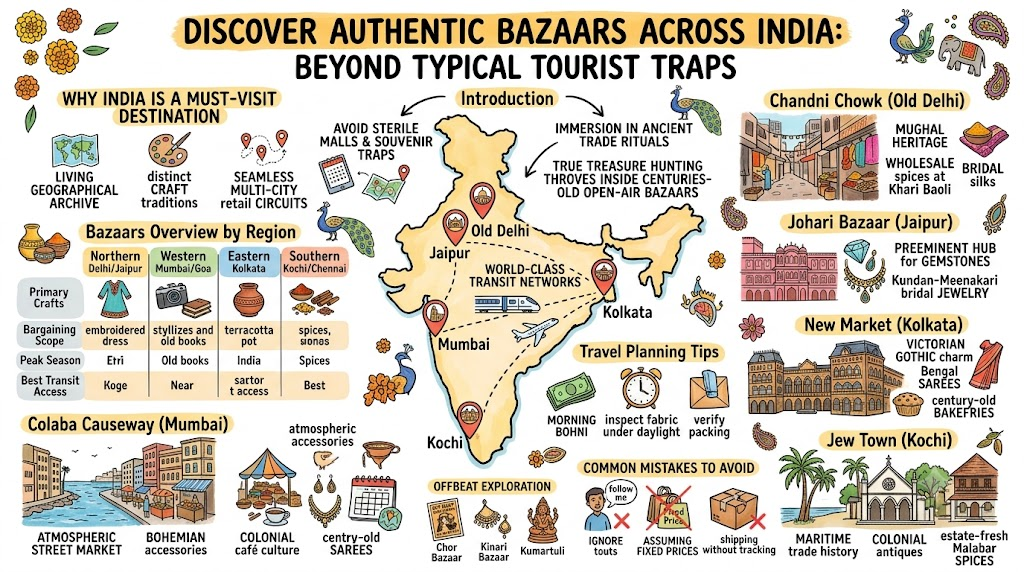
Introduction
Most international itineraries funnels travelers straight into sterile multi-story shopping malls or overpriced souvenir emporiums curated exclusively for tour buses. True treasure hunting in India, however, thrives inside centuries-old open-air bazaars scented with crushed cardamom, fresh marigolds, and indigo-dyed cotton.
Stepping into these markets connects you directly with multi-generational artisan lineages that have operated out of the exact same stone alcoves since the Mughal and princely eras. You do not just purchase an artifact; you participate in an ancient trade ritual grounded in hospitality, bargaining banter, and tangible living culture.
Spice Market in Old Delhi.
Why India is a must-visit destination
India’s shopping landscape is a living geographical archive where every single state showcases distinct craft traditions honed over millennia. From royal silk looms and gemstone cutting guilds to hammered brassware, visiting these retail enclaves uncovers the socioeconomic foundation of regional heritage. World-class transit networks—including high-speed Vande Bharat express trains, extensive metro grids, and comprehensive domestic flight corridors—make multi-city retail circuits remarkably seamless for solo backpackers, couples, and traveling families alike.
The classic tourist shopping circuit spans northern imperial hubs, royal desert capitals, and southern coastal port cities, creating a vibrant loop of textiles, jewels, and spices.
| Market Characteristic | Northern Circuit (Delhi/Jaipur) | Western Circuit (Mumbai/Goa) | Eastern Circuit (Kolkata) | Southern Circuit (Kochi/Chennai) |
|---|---|---|---|---|
| Primary Crafts | Zardozi embroidery, Kundan jewelry, blue pottery | Leather goods, antique curios, Bollywood memorabilia | Terracotta, Kantha stitch silk, rare literature | Malabar spices, Kanchipuram silk, bronze statues |
| Bargaining Scope | High (Start at 40-50% lower) | Moderate to High | Moderate | Low to Fixed Price |
| Peak Season | October to March | November to February | October to February | September to March |
| Best Transit Access | Delhi & Jaipur Metro, E-Rickshaws | Local suburban trains, Black-and-Yellow cabs | Kolkata Metro, Yellow ambassador taxis | Metro rail, Auto-rickshaws |
Best Places or Experiences
Chandni Chowk (Old Delhi)
Constructed in the 17th century by Mughal Emperor Shah Jahan and designed by his daughter Jahanara, Chandni Chowk remains one of the largest wholesale markets on the subcontinent. The bustling artery divides into specialized sub-lanes known as katras, where shops narrower than a doorway house museum-quality bridal silks, silver filigree, and hand-blended attars.
Walking into Khari Baoli, located at the western edge of the chowk, engulfs the senses in a cloud of dried chilies, saffron strands, and unrefined spice pods. The area preserves authentic Shahjahanabad heritage, where centuries-old carved doorways hide courtyard warehouses that continue trading goods globally.
- Location: Old Delhi District, approximately 4 km north of Connaught Place hub.
- Why it is worth visiting: Unrivaled epicenter for authentic Mughal bridal lehengas, raw spices at wholesale rates, and traditional silverware.
- Best things to do: Navigate Khari Baoli spice roof for panoramic skyline shots, browse antique silver pendants in Dariba Kalan, and sample deep-fried stuffed flatbreads in Paranthe Wali Gali.
- Best time to visit: Mid-morning between 10:30 AM and 12:30 PM to bypass heavy afternoon crowds.
- Ideal for whom: Cultural purists, street photographers, and budget textile collectors.
- Travel tip: Take the Delhi Metro Yellow Line directly to Chandni Chowk Station Gate 5 to avoid crushing road gridlock.
Johari Bazaar (Jaipur)
Johari Bazaar stands as the sparkling heart of the Pink City, planned rigorously by Maharaja Sawai Jai Singh II in 1727. Renowned internationally for precious and semi-precious gemstones, this wide commercial avenue is flanked by uniform terracotta-pink porticos housing jewelers whose families served the Rajput courts.
Beyond fine emeralds and sapphires, the adjoining alleys like Gopalji Ka Rasta reveal master artisans creating Meenakari enamelwork and traditional Kundan settings. The surrounding courtyards feature bandhani (tie-and-dye) textiles and block-printed cotton bedding stacked to the ceilings.
Traditional Crafts at Johari Bazaar.
- Location: Old Walled City, Jaipur, Rajasthan, roughly 3 km from Jaipur Junction Railway Station.
- Why it is worth visiting: The world’s preeminent hub for ethically cut loose gemstones, Kundan-Meenakari bridal jewelry, and Jaipuri quilts.
- Best things to do: Commission custom gemstone rings, watch silver foil (vark) being pounded by hand, and purchase handmade camel-leather juttis.
- Best time to visit: Late afternoon around 3:30 PM to 6:00 PM when storefronts light up.
- Ideal for whom: Luxury connoisseurs, jewelry enthusiasts, and heritage architecture fans.
- Travel tip: Always demand official hallmarked certificates and government-recognized laboratory paperwork for high-value gemstone purchases.
Colaba Causeway (Mumbai)
Colaba Causeway, officially named Shahid Bhagat Singh Road, is an iconic shopping stretch bridging historic South Mumbai with the Arabian Sea. Established during the British colonial era, the pedestrian arcade features heritage buildings with wrought-iron balconies overlooking dense pavements lined with eclectic stalls.
Here, high-fashion export surplus apparel hangs alongside antique brass compasses, beaded bohemian footwear, and colorful glass bangles. The street maintains a lively rhythm, punctuated by heritage cafes where travelers pause between bargain negotiations.
Street Shopping on Colaba Causeway.
- Location: Colaba, South Mumbai, Maharashtra, 2.5 km south of Chhatrapati Shivaji Maharaj Terminus (CSMT).
- Why it is worth visiting: The ultimate atmospheric street market combining bohemian accessories, vintage books, and colonial café culture.
- Best things to do: Hunt for vintage pocket watches and nautical brass instruments, browse handmade beaded tote bags, and take a cold brew break at historic Leopold Cafe.
- Best time to visit: Weekday mornings from 11:00 AM to 1:00 PM for calm browsing before pavements crowd.
- Ideal for whom: Solo backpackers, budget fashion hunters, and vintage antique collectors.
- Travel tip: Street vendors quote elevated rates for foreign visitors; politely begin counter-offers at around 40% of the initial quote.
New Market (Kolkata)
Constructed in 1874 as Sir Stuart Hogg Market, this grand Victorian Gothic brick building has survived massive fires, urban shifts, and modern mall expansions. Its maze-like interior contains over 2,000 stalls arranged logically by commodity, ranging from pure silver cutlery to hand-rolled cheeses.
The atmosphere carries old Calcutta charm, where red-capped porters (coolies) guide shoppers through labyrinthine corridors. The bazaar remains the top regional source for handloom Bengal sarees, particularly crisp Dhakai Jamdani and Murshidabad silks.
Historic New Market in Kolkata.
- Location: Lindsay Street, Dharmatala area, Central Kolkata, West Bengal, 3 km from Howrah Railway Station.
- Why it is worth visiting: A quintessential colonial bazaar experience renowned for handcrafted terracotta, Jamdani sarees, and century-old Jewish bakeries.
- Best things to do: Source authentic Baluchari and Tant cotton sarees, purchase rich fruitcake from historic Nahoum & Sons confectionery, and hunt for hand-carved terracotta wall art.
- Best time to visit: Late mornings around 11:30 AM or winter evenings during the Christmas festival season.
- Ideal for whom: Textile collectors, food history enthusiasts, and vintage lovers.
- Travel tip: Hire a licensed government-badged market coolie at the entrance for nominal rates to easily navigate the interior labyrinth.
Jew Town (Kochi)
Situated between the 16th-century Paradesi Synagogue and Mattancherry Palace, Jew Town is a narrow, scenic lane paved with centuries of maritime trade history. Arab, Chinese, Dutch, and British merchant fleets anchored here for centuries to load fragrant black pepper, cardamom, and mountain cinnamon.
Today, Portuguese-era warehouses have transformed into antique showrooms filled with carved temple pillars, bronze spice urns (urulis), and vintage teakwood furniture. The air retains a faint, evocative aroma of ginger and clove drifting from operational wholesale warehouses down the alley.
- Location: Mattancherry, Kochi, Kerala, approximately 10 km from Ernakulam Junction railway station.
- Why it is worth visiting: The premier destination in Southern India for curated colonial antiques, hand-woven Kasavu garments, and estate-fresh Malabar spices.
- Best things to do: Browse ancestral Kerala snake boat remnants and teak cabinets, pick up vacuum-sealed grade-A Tellicherry peppercorns, and explore antique brass lamps.
- Best time to visit: Morning hours between 9:30 AM and 12:00 PM before coastal humidity peaks.
- Ideal for whom: Interior designers, antique collectors, couples, and slow-travel enthusiasts.
- Travel tip: Reputable antique galleries arrange direct insured international sea-freight containers for substantial wooden furniture.
Offbeat Exploration: Hidden Gems Tourists Miss
Chor Bazaar’s Mutton Street (Mumbai)
Often overlooked in favor of generic seaside stalls, Mutton Street inside South Mumbai’s 150-year-old Thieves Market is an incredible cavern of mid-century treasures. Tucked away under faded awnings are authentic vintage Bollywood film posters, 1940s valve radios, restored gramophones, and brass ship hardware salvaged directly from Alang ship-breaking yard. Visiting early on Friday mornings reveals rare curios being unloaded before commercial galleries snap them up.
Kinari Bazaar (Delhi)
While regular tourists crowd Chandni Chowk’s main road, Kinari Bazaar hides down a narrow, shadowy alley behind Paranthe Wali Gali. This lane is entirely dedicated to traditional bridal trimmings, borders, laces, zardozi tassels, and wooden puppet accessories. The shops supply local fashion designers with intricate handcrafted brocades and hand-stitched borders at a fraction of boutique costs.
Kumartuli Potters Colony (Kolkata)
Located along the Hooghly River in North Kolkata, this 300-year-old labyrinthine artisan village is not an ordinary retail market, but a living open-air sculptural studio. Generations of traditional sculptors fashion straw, bamboo frames, and sacred river clay into life-sized idols of Hindu deities. Travelers can purchase handcrafted terracotta jewelry, hand-painted clay masks, and miniature river-clay figurines directly from the artists’ home-workshops.
Detailed Practical Guidance for Travelers
| Destination | Standard Entry Fee | General Timings | Best Local Food Options Nearby | Recommended Nearby Attractions |
|---|---|---|---|---|
| Chandni Chowk (Delhi) | Free public entry | 10:00 AM – 8:00 PM (Closed Sundays) | Karim’s (Mughlai kebabs), Natraj Dahi Bhalla | Red Fort, Jama Masjid, Sis Ganj Sahib |
| Johari Bazaar (Jaipur) | Free public entry | 10:30 AM – 7:30 PM (Daily) | Laxmi Mishthan Bhandar (Ghewar & Pyaaz Kachori) | Hawa Mahal, City Palace, Jantar Mantar |
| Colaba Causeway (Mumbai) | Free public entry | 11:00 AM – 9:30 PM (Daily) | Leopold Cafe, Cafe Mondegar (Keema Pav, Beers) | Gateway of India, Taj Mahal Palace Hotel |
| New Market (Kolkata) | Free public entry | 10:30 AM – 8:30 PM (Closed Sunday afternoons) | Nahoum & Sons (Plum cake), Nizam’s (Kathi rolls) | Indian Museum, Victoria Memorial |
| Jew Town (Kochi) | Free public entry | 10:00 AM – 6:00 PM (Closed Saturdays) | Mocha Art Cafe, Kashi Art Cafe (Seafood & Coffees) | Paradesi Synagogue, Mattancherry Dutch Palace |
Logistics & On-Ground Navigation
Local Transport Options
- Metro Rail Systems: Delhi and Kolkata feature modern, air-conditioned metro networks with stations opening directly into traditional commercial zones. Delhi Metro’s Yellow Line drops shoppers directly under Chandni Chowk.
- Auto-Rickshaws & E-Rickshaws: Ideal for navigating narrow bazaar lanes where cars cannot enter. Always negotiate upfront or insist on meter activation; e-rickshaws in Delhi and Jaipur charge flat commuter rates between Rs 10 to Rs 30 per hop.
- App-Based Taxis: Services like Uber and Ola offer air-conditioned transit between major hotel districts and market entry gates. Have them drop you off at perimeter landmarks rather than trying to drive directly into old-city centers.
- Heritage Walking: The interior katras and lanes are strictly pedestrian-friendly. Wear sturdy walking shoes that slip off easily for entering antique shrines or traditional white-sheet cloth stores (gaddis).
Budget Planning
- Backpacker Tier (Rs 1,500 – Rs 2,500 / $18 – $30 per day): Covers regional street-food meals, state metro cards, shared e-rickshaws, and hostel dorms. Leaves margin for small souvenirs like block-print scarves, rolled spices, and brass trinkets.
- Comfort & Mid-Range Tier (Rs 6,000 – Rs 12,000 / $70 – $145 per day): Includes private air-conditioned cab rentals, heritage boutique hotel stays, seated meals at historic restaurants, and serious purchases like certified silver jewelry, silk sarees, and rare home decor.
Safety and Inclusivity Tips
- General Safety & Pickpocketing: Crowded markets require vigilance. Carry cross-body bags with secure zippers held across your chest; avoid keeping smartphones in loose rear pockets.
- Couples & Solo Women Travelers: Dress conservatively in loose linen shirts, cotton pants, or long skirts to avoid unwanted staring in traditional wholesale sectors. Keep emergency local taxi numbers pinned offline.
- Family Travel: Bazaar lanes can be overstimulating for young children. Plan two-hour market excursions separated by relaxing sit-down cafe meals, and carry bottled water to stay hydrated in afternoon heat.
Strategic Travel Planning Guardrails
Travel Planning Tips for India Bazaars
- Carry Cash Reserves: While India’s digital UPI payments are widespread, international cards often fail at small street-side stalls. Keep crisp, small-denomination Indian Rupee notes (Rs 50, Rs 100, Rs 200).
- Respect the Morning Bohni: The first transaction of the morning (bohni) holds sacred significance for Hindu and Jain merchants. Avoid aggressive lowball bargaining during initial shop openings; shopkeepers are more flexible with afternoon negotiations.
- Inspect Items Under Daylight: Traditional yellow incandescent lighting inside deep-market alley stalls can mask textile snags or misrepresent gemstone hues. Step outside into natural daylight to inspect fabrics and stones before paying.
- Verify Packing and Sealing: When purchasing loose culinary spices or fragrant tea, verify the shopkeeper heat-seals packages in thick multi-layered foil to maintain freshness and comply with airport customs rules.
- Download Offline Maps: Tight brick-and-stone bazaar alleys frequently block cellular data reception. Download offline Google Maps areas for historic quarters before setting out.
Common Mistakes to Avoid
- Following Commission “Touts”: Never allow friendly taxi drivers, auto drivers, or self-appointed pavement guides to lead you to their “uncle’s government emporium.” They earn 30% to 50% kickbacks that are added directly to your retail bill.
- Assuming Fixed Prices: Unless a store clearly displays “Fixed Price” regulatory signage, the initial figure quoted to tourists is rarely the final price.
- Shipping Without Tracking: Never leave expensive bespoke purchases to be shipped by independent roadside vendors without courier airway bills and valid transit insurance documents.
- Skipping Water Safety: Avoid open iced drinks sold on market sidewalks; purchase sealed, branded mineral water bottles from established brick-and-mortar grocery kiosks.
- Carrying Rigid Luggage: Shopping in India fills bags quickly. Pack an expandable soft duffel bag inside your main suitcase to comfortably bring delicate handcrafted goods home.
Suggested Itinerary Blueprints
1. Day Quick Dash (The Capital Treasures Route)
Designed for travelers on a tight transit stopover in Delhi who want to experience both Mughal-era street bazaars and state-regulated artisan cooperatives.
- 09:30 AM: Arrive via Delhi Metro at Chandni Chowk; tour the rooftop spice vistas at Khari Baoli.
- 11:30 AM: Browse silver filigree and semi-precious bead jewelry along Dariba Kalan.
- 01:30 PM: Take an auto-rickshaw to Connaught Place; enjoy an authentic North Indian thali.
- 03:00 PM: Walk down Baba Kharak Singh Marg to browse the State Government Emporiums for guaranteed fixed-price Kashmiri shawls, Madhubani paintings, and sandalwood carvings.
- 06:00 PM: End with tea and street-shopping under the colonial colonnades of Janpath.
2. Day Deep-Dive (The Royal Rajasthan Craft Route)
A comprehensive two-day circuit focused on Jaipur’s historic gemstone, block-print, and blue-pottery traditions.
- Day 1 (Walled City Heritage Bazaars):
- Morning: Explore Johari Bazaar for emeralds, silver bands, and semi-precious stone strings.
- Afternoon: Walk into Bapu Bazaar for lightweight hand-blocked cotton textiles, camel-leather mojris, and brass artifacts.
- Evening: Savor onion kachoris and lassi while shopping for lacquer bangles along the illuminated corridors of Tripolia Bazaar.
- Day 2 (Artisan Villages & Atelier Suburbs):
- Morning: Travel to the outskirts in Sanganer to witness traditional wooden block carving and paper manufacturing workshops.
- Afternoon: Visit Neerja International or Kripal Kumbh to collect genuine hand-glazed cobalt blue pottery plates and vases.
- Evening: Return for an upscale rooftop dinner overlooking the illuminated Amber fort ridge.
3. Complete Weekend Travel Plan (The Colonial & Spice Trail in Kochi)
A three-day coastal loop across Fort Kochi and Mattancherry balancing spice warehouses, historic architecture, and seaside dining.
- Friday: Check into a heritage boutique hotel in Fort Kochi. Spend late afternoon browsing Princess Street’s vintage bookstalls, cotton tunics, and handmade paper notebooks. Dine at an open-air courtyard cafe.
- Saturday: Dedicate the day to Mattancherry. Spend the morning in Jew Town exploring grand antique warehouses, collecting brass urulis, and sampling fresh pepper varieties. Tour the Dutch Palace and take an evening Kathakali performance break.
- Sunday: Take an early morning harbor walk past the Chinese Fishing Nets. Pick up vacuum-sealed organic spice assortments and high-grown Nilgiri teas, finishing the weekend with a relaxed seafood dinner.
Common Tourist Mistakes to Avoid
Geographic Blunders
A frequent mistake travelers make is attempting to combine geographically opposite trading quarters in giant metropolitan centers on the same day. For example, trying to visit both Old Delhi’s Chandni Chowk and South Delhi’s Dilli Haat in one afternoon guarantees hours trapped in bumper-to-bumper traffic. Cluster your shopping itinerary by single districts each day.
Commercial Traps
Many tourists spend precious hours inside sanitized suburban shopping malls that house standard Western chain stores found in any major airport. Skip these sterile environments. The true character, artistic craftsmanship, and best pricing in India always reside in historic, atmospheric street bazaars where trade has evolved organically over centuries.
Neglecting Modern/Alternative Zones
While ancient bazaars offer incredible historical charm, ignoring indie design enclaves misses half the story. Modern Indian lifestyle hubs—like Delhi’s Shahpur Jat, Mumbai’s Bandra lanes, and Bengaluru’s Indiranagar—house brilliant independent designers who blend traditional weaving techniques with contemporary cuts. Balancing ancient lanes with designer studios gives you a complete perspective of modern Indian craft.
Transport Overpayment
Hailing an unmetered taxi or auto-rickshaw directly outside a tourist monument often results in inflated flat rates. Always verify standard fares using ride-sharing apps like Uber or Ola, even if you choose a street cab. When taking auto-rickshaws, politely ask the driver to switch on the digital fare meter (meter chalu kijiye) before driving away.
Luxury Dining Bias
Confining yourself exclusively to five-star hotel buffets strips away an essential dimension of the Indian shopping experience. Historic bazaars developed hand-in-hand with iconic street food traditions designed to fuel busy shoppers. Enjoying hot samosas, saffron-soaked jalebis, or crisp dosas from legendary, multi-generational street stalls is an integral part of the bazaar adventure.
Frequently Asked Questions
1. What is the most respectful way to negotiate prices in Indian street bazaars?
Approach bargaining with a warm smile, good humor, and patience rather than aggression. View it as a friendly conversation rather than a confrontation. A solid general benchmark is to counter at roughly 40% to 50% below the vendor’s opening quote in open street markets, gradually meeting somewhere near the middle.
2. Are credit cards and mobile digital payments widely accepted in local markets?
High-end jewelry showrooms, established antique stores, and government emporiums accept international Visa and Mastercard without issues. However, small pavement stalls and snack kiosks rely strictly on cash or local UPI QR codes. Because foreign cards rarely connect to UPI, always keep sufficient physical cash on hand.
3. How can tourists distinguish between genuine Pashmina and synthetic blends?
Perform the warmth and touch test; genuine Pashmina feels exceptionally light and warms quickly against skin. An authentic shawl glides effortlessly through a finger ring. You can also inspect the weave: authentic handspun Pashmina displays minor irregularities, whereas machine-made synthetic imitations feature unnaturally uniform threads and a plasticky sheen.
4. What are the best traditional souvenirs to bring home from India?
Top authentic souvenirs include certified hand-block printed cotton bedspreads, organic Tellicherry peppercorns, Darjeeling loose-leaf tea, handmade leather juttis, brass lamps, and Kanchipuram silk sarees. These items carry rich regional provenance, support artisan livelihoods, and pack easily into standard international travel luggage.
5. How do travelers safely ship oversized furniture or antiques back home?
Established antique galleries in Kochi, Jaipur, and Delhi regularly handle international shipping via DHL, FedEx, or insured sea-freight containers. Never leave a shop without an official invoice detailing the dimensions, timber provenance certificate, insurance coverage, and a tracking number to monitor port transit.
6. Which Indian cities are best for purchasing precious stones and jewelry?
Jaipur is the undisputed world capital for cutting and polishing semi-precious and precious gemstones like emeralds, rubies, and tanzanite. Hyderabad is famous for natural pearls, while Delhi’s Dariba Kalan provides the most extensive selection of pure silver ornaments and heirloom-quality Kundan-Meenakari bridal jewelry.
7. When do traditional Indian markets close during the week?
Market holidays vary by neighborhood and municipal laws. In Delhi, Chandni Chowk closes on Sundays, while Khan Market rests on Mondays. Jaipur’s bazaars operate daily, though certain alleys shutter on Tuesdays. In Kolkata, New Market closes on Sunday afternoons. Always double-check specific market schedules before planning your day.
8. Is street food safe to eat while shopping in busy bazaars?
Street food is safe and delicious if you observe basic safety hygiene. Patronize bustling stalls surrounded by local families, which guarantees rapid ingredient turnover. Choose piping-hot, freshly fried items like kachoris, dosas, and parathas, while skipping raw cut salads, unpeeled fruits, and beverages containing non-purified tap water ice.
9. What dress code is recommended when visiting historic traditional markets?
Wear lightweight, breathable cotton or linen clothing that covers shoulders and knees. This shows cultural respect in conservative heritage quarters and protects you from the sun. Choose comfortable, slip-on shoes, as visiting fabric showrooms, jewelers, or adjoining shrines often requires removing your footwear.
10. How can tourists avoid getting scammed by fake gemstone sellers?
Avoid purchasing gemstones from street vendors or roadside stalls near major monuments. Stick to reputable, government-approved jewelers who provide genuine international gemological certificates (such as GIA or IGI). Never accept business or investment advice from strangers claiming you can resell stones abroad for a profit.
11. What custom regulations apply when taking spices out of India?
Most international customs authorities permit dried, commercially packaged spices for personal use. Ensure all spices are professionally vacuum-sealed and labeled with their commercial ingredients. Never carry whole fresh agricultural produce, seeds, or unsealed raw soil products, as border bio-security checks will confiscate them upon arrival.
12. Can tourists claim tax refunds on shopping purchases in India?
India continues developing simplified airport Tourist VAT/GST refund counters across major international departure hubs. Currently, save all computerized tax invoices with GST breakdowns from government-registered stores. Keep expensive, unused goods stored in your carry-on luggage for random verification by airport customs authorities before international check-in.
Conclusion
Trading the sterilized convenience of modern department stores for the bustling energy of India’s historic markets rewards travelers with genuine cultural discovery. Every hand-knotted carpet, block-printed scarf, and sealed jar of Malabar spices carries the heartbeat of artisans whose families have refined their skills across generations. Navigating these historic bazaars connects you with a living commercial heritage, transforming simple shopping into an unforgettable journey through the heart of Indian craftsmanship.
