MOTOSHARE 🚗🏍️
Rent Bikes & Cars Directly from Owners
Motoshare connects vehicle owners with people who need bikes and cars on rent. Owners earn from idle vehicles, and renters get flexible ride options.
Visit Motoshare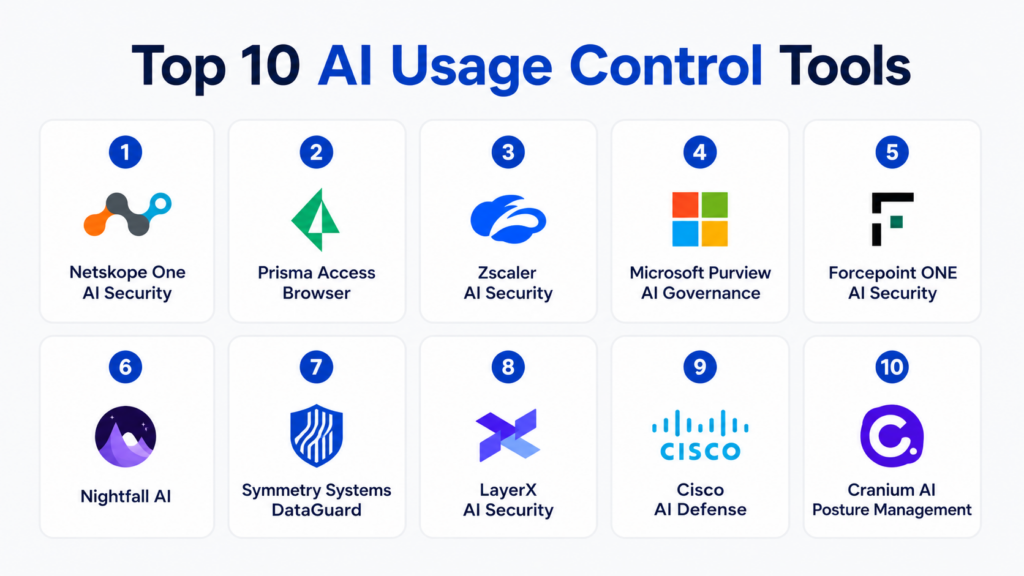
Introduction
AI Usage Control Tools help organizations monitor, regulate, secure, and govern how employees, applications, and systems use artificial intelligence platforms. These tools provide visibility into AI usage patterns, enforce organizational policies, prevent sensitive data exposure, manage approved AI applications, and reduce operational risks associated with generative AI adoption.As enterprises rapidly integrate AI into software development, customer support, content generation, analytics, and internal operations, uncontrolled AI usage has become a major concern. Employees may unknowingly expose confidential information to public AI models, use unapproved AI services, or bypass compliance requirements. AI Usage Control Tools help organizations balance innovation with governance by enabling secure and compliant AI adoption.
Real World Use Cases:
- Monitoring employee use of AI applications
- Preventing sensitive data leakage into public LLMs
- Enforcing approved AI model policies
- Managing enterprise AI governance workflows
- Tracking AI usage analytics across departments
Evaluation Criteria for Buyers:
- AI visibility and monitoring capabilities
- Policy enforcement flexibility
- Data protection and DLP integration
- User activity analytics
- AI application discovery
- Integration ecosystem
- Scalability and deployment flexibility
- Compliance and audit capabilities
- Ease of administration
- Runtime AI governance support
Best for: Enterprises adopting generative AI at scale, security teams, compliance-driven organizations, regulated industries, IT administrators, and organizations implementing enterprise AI governance.
Not ideal for: Small teams with limited AI adoption, organizations using only internally hosted AI systems with strict isolation, or users seeking lightweight AI productivity tools instead of governance platforms.
Key Trends in AI Usage Control Tools
- AI governance platforms are rapidly expanding beyond basic monitoring into policy automation.
- Shadow AI discovery has become a major enterprise requirement.
- AI-specific DLP capabilities are growing in importance.
- Organizations increasingly demand runtime AI access controls.
- Browser-based AI security extensions continue gaining adoption.
- AI usage analytics dashboards are becoming standard enterprise features.
- Enterprises are consolidating AI governance and security operations into unified platforms.
- Cloud-native deployment models dominate modern AI governance tools.
- Integration with CASB and SSE ecosystems is becoming more common.
- AI policy enforcement for copilots and AI agents is emerging rapidly.
How We Selected These Tools
The tools in this list were evaluated using practical enterprise and operational criteria:
- Market adoption and enterprise visibility
- AI governance and control capabilities
- AI application discovery and monitoring
- Data protection functionality
- Integration support with enterprise ecosystems
- Security and compliance posture
- Ease of deployment and administration
- Scalability for large organizations
- Runtime policy enforcement capabilities
- Suitability across SMB, mid-market, and enterprise environments
Top 10 AI Usage Control Tools
#1 — Netskope One AI Security
Short description: Netskope One AI Security helps organizations monitor, govern, and secure employee usage of AI applications and generative AI platforms. The solution provides visibility into sanctioned and unsanctioned AI usage while helping prevent sensitive data exposure. It integrates AI governance into broader cloud and data security workflows. Enterprises commonly use Netskope to operationalize AI risk management at scale.
Key Features
- AI application discovery
- Shadow AI visibility
- AI-specific DLP controls
- Policy enforcement workflows
- User activity monitoring
- Real-time governance controls
- Risk analytics dashboards
Pros
- Strong enterprise security ecosystem
- Advanced DLP capabilities
- Broad AI application visibility
Cons
- Complex enterprise deployment
- Premium pricing structure
- Requires security administration expertise
Platforms / Deployment
- Cloud / Hybrid
Security & Compliance
- RBAC
- SSO/SAML
- MFA
- Audit logs
- Encryption
- GDPR support
- SOC 2 support
Integrations & Ecosystem
Netskope integrates deeply with enterprise security, networking, and cloud governance environments. It is commonly used alongside broader SSE and CASB deployments.
- Microsoft integrations
- Google Workspace support
- SIEM integrations
- API ecosystem
- Cloud platform integrations
- Security workflow automation
Support & Community
Strong enterprise support ecosystem with onboarding, implementation assistance, and extensive documentation.
#2 — Palo Alto Networks Prisma Access Browser
Short description: Prisma Access Browser helps organizations secure AI usage directly within enterprise browsing environments. The platform provides visibility into AI interactions, enforces AI usage policies, and reduces risks related to sensitive data exposure. It is particularly useful for organizations managing AI access across distributed workforces. The solution integrates closely with broader Zero Trust security architectures.
Key Features
- AI usage monitoring
- Browser-based AI controls
- Data leakage prevention
- Policy enforcement
- Shadow AI detection
- Secure browser isolation
- User activity analytics
Pros
- Strong browser-level governance
- Good Zero Trust integration
- Enterprise-grade security controls
Cons
- Best suited for existing Palo Alto environments
- Browser-focused approach may limit flexibility
- Premium enterprise pricing
Platforms / Deployment
- Cloud
Security & Compliance
- RBAC
- SSO/SAML
- Encryption
- Audit logging
- MFA
- Compliance support varies
Integrations & Ecosystem
Prisma Access Browser integrates with Palo Alto Networks security ecosystems and enterprise identity systems.
- Cortex integrations
- SIEM integrations
- Identity provider support
- Security analytics integration
- Cloud platform support
Support & Community
Enterprise-focused support with strong documentation and deployment guidance.
#3 — Zscaler AI Security
Short description: Zscaler AI Security provides organizations with visibility and governance capabilities for generative AI application usage. The platform helps security teams identify shadow AI adoption, enforce policies, and protect sensitive data from exposure to external AI systems. It is designed for cloud-first enterprises managing large user environments. Zscaler integrates AI governance into its broader Zero Trust architecture.
Key Features
- AI application discovery
- AI risk classification
- Data loss prevention
- User activity monitoring
- Policy enforcement
- Zero Trust AI governance
- AI usage analytics
Pros
- Strong cloud-native architecture
- Excellent scalability
- Mature enterprise governance capabilities
Cons
- Enterprise-focused deployment complexity
- Higher licensing costs
- Requires integration planning
Platforms / Deployment
- Cloud
Security & Compliance
- RBAC
- MFA
- Audit logs
- SSO/SAML
- Encryption
- GDPR support
Integrations & Ecosystem
Zscaler integrates with enterprise security operations, identity systems, and cloud governance platforms.
- SIEM integrations
- CASB compatibility
- Cloud platform integrations
- Identity provider support
- API integrations
Support & Community
Strong enterprise support ecosystem with implementation and operational guidance.
#4 — Microsoft Purview AI Governance
Short description: Microsoft Purview AI Governance helps organizations monitor, classify, and govern AI usage across Microsoft environments. The platform supports AI compliance, data governance, policy enforcement, and risk visibility. Enterprises using Microsoft Copilot and Azure AI services often leverage Purview for centralized governance. It is especially valuable for Microsoft-centric enterprise environments.
Key Features
- AI governance dashboards
- Data classification
- AI compliance workflows
- Policy enforcement
- User activity visibility
- Sensitive data protection
- AI risk analytics
Pros
- Strong Microsoft ecosystem integration
- Good compliance capabilities
- Centralized governance workflows
Cons
- Best suited for Microsoft-heavy environments
- Complex licensing structures
- Advanced features may require multiple services
Platforms / Deployment
- Cloud / Hybrid
Security & Compliance
- RBAC
- Audit logging
- Encryption
- SSO/SAML
- Compliance support varies by deployment
Integrations & Ecosystem
Purview integrates deeply across Microsoft security, productivity, and AI ecosystems.
- Microsoft 365 integration
- Azure AI support
- Defender ecosystem integration
- Power Platform support
- API ecosystem
Support & Community
Large enterprise ecosystem with extensive documentation and training resources.
#5 — Forcepoint ONE AI Security
Short description: Forcepoint ONE AI Security helps organizations secure employee interactions with AI platforms while preventing data leakage and policy violations. The platform combines AI governance with DLP and Zero Trust security principles. It is commonly used by organizations managing sensitive enterprise data across distributed environments. Forcepoint emphasizes adaptive risk management and behavioral analytics.
Key Features
- AI usage monitoring
- AI-specific DLP
- Behavioral analytics
- Policy automation
- User risk scoring
- Data protection workflows
- Governance dashboards
Pros
- Strong DLP heritage
- Good behavioral analytics capabilities
- Flexible policy enforcement
Cons
- Complex enterprise administration
- Advanced configurations require expertise
- Premium deployment costs
Platforms / Deployment
- Cloud / Hybrid
Security & Compliance
- RBAC
- MFA
- Audit logs
- Encryption
- SSO/SAML
- GDPR support
Integrations & Ecosystem
Forcepoint integrates with enterprise security infrastructure and governance ecosystems.
- SIEM integrations
- Cloud platform support
- Identity provider integrations
- API ecosystem
- Security automation support
Support & Community
Enterprise-grade support with implementation and operational guidance.
#6 — Nightfall AI
Short description: Nightfall AI provides AI-powered data protection and AI usage governance capabilities for modern cloud environments. The platform helps organizations detect sensitive data exposure across SaaS applications and AI systems. It is especially useful for cloud-native organizations adopting generative AI rapidly. Nightfall emphasizes automation and lightweight deployment workflows.
Key Features
- AI-driven DLP
- Sensitive data detection
- AI application monitoring
- Workflow automation
- Real-time alerts
- Cloud SaaS protection
- Risk analytics
Pros
- Lightweight deployment
- Strong cloud-native focus
- Good automation capabilities
Cons
- Smaller enterprise ecosystem
- Advanced governance features evolving
- Limited on-premises focus
Platforms / Deployment
- Cloud
Security & Compliance
- Encryption
- RBAC
- Audit logging
- SSO/SAML
- Compliance details vary
Integrations & Ecosystem
Nightfall integrates with cloud productivity and SaaS environments.
- Slack integrations
- Google Workspace support
- API integrations
- SaaS platform integrations
- Workflow automation support
Support & Community
Growing ecosystem with modern documentation and developer-focused onboarding.
#7 — Symmetry Systems DataGuard
Short description: Symmetry Systems DataGuard helps organizations secure AI-related data access and enforce governance controls around sensitive enterprise information. The platform focuses heavily on data security posture management and AI governance visibility. It is commonly used by organizations with strict compliance and regulatory requirements. DataGuard supports modern cloud and AI environments.
Key Features
- Data access governance
- AI data visibility
- Risk monitoring
- Compliance reporting
- Sensitive data discovery
- AI usage analytics
- Governance dashboards
Pros
- Strong data-centric security model
- Good compliance visibility
- Useful for regulated industries
Cons
- More data-focused than AI-native
- Advanced workflows may require customization
- Smaller market visibility
Platforms / Deployment
- Cloud
Security & Compliance
- RBAC
- Encryption
- Audit logs
- MFA
- Compliance support varies
Integrations & Ecosystem
DataGuard integrates with enterprise cloud data platforms and governance ecosystems.
- AWS integrations
- Azure integrations
- Data warehouse support
- API integrations
- Governance workflow support
Support & Community
Enterprise support model with growing adoption among security-focused organizations.
#8 — LayerX AI Security
Short description: LayerX AI Security focuses on browser-based AI governance and secure AI adoption for enterprise workforces. The platform helps organizations control AI usage, detect risky AI behavior, and prevent sensitive data exposure within browser environments. It is especially valuable for distributed teams and SaaS-heavy enterprises. LayerX emphasizes lightweight deployment and rapid operational visibility.
Key Features
- Browser-based AI governance
- Shadow AI detection
- AI usage analytics
- Data leakage prevention
- Policy enforcement
- Real-time monitoring
- Workforce AI visibility
Pros
- Fast deployment model
- Strong browser security capabilities
- Good workforce visibility
Cons
- Browser-centric approach
- Limited offline control capabilities
- Smaller enterprise ecosystem
Platforms / Deployment
- Cloud
Security & Compliance
- RBAC
- Encryption
- Audit logs
- SSO/SAML
- Compliance support varies
Integrations & Ecosystem
LayerX integrates with browser security and cloud identity ecosystems.
- Identity provider support
- SaaS integrations
- Security analytics support
- API integrations
- Cloud ecosystem compatibility
Support & Community
Modern onboarding workflows with growing enterprise adoption.
#9 — Cisco AI Defense
Short description: Cisco AI Defense provides visibility, governance, and security controls for enterprise AI environments. The platform helps organizations manage AI risks, monitor AI interactions, and enforce operational AI security policies. Cisco positions the solution as part of broader enterprise networking and security ecosystems. It supports organizations adopting AI at large operational scale.
Key Features
- AI visibility and monitoring
- AI governance controls
- Policy enforcement
- Security analytics
- Runtime AI protection
- Enterprise reporting
- Risk detection
Pros
- Strong enterprise networking ecosystem
- Broad security integration support
- Scalable enterprise architecture
Cons
- Enterprise deployment complexity
- Newer AI-focused ecosystem
- Premium enterprise pricing
Platforms / Deployment
- Cloud / Hybrid
Security & Compliance
- RBAC
- MFA
- Audit logs
- Encryption
- SSO/SAML
- Compliance capabilities vary
Integrations & Ecosystem
Cisco AI Defense integrates with broader Cisco networking and security platforms.
- SecureX integration
- Identity integrations
- SIEM support
- API integrations
- Security analytics compatibility
Support & Community
Large enterprise support ecosystem with strong operational guidance.
#10 — Cranium
Short description: Cranium provides AI security posture management and AI governance capabilities for enterprises adopting generative AI technologies. The platform helps organizations monitor AI assets, assess AI risks, and enforce governance controls across AI ecosystems. Cranium is especially focused on AI asset visibility and operational security management. It supports modern enterprise AI governance initiatives.
Key Features
- AI asset discovery
- AI risk assessment
- Governance workflows
- AI posture management
- Security analytics
- AI monitoring
- Compliance visibility
Pros
- Strong AI asset visibility
- Modern governance workflows
- Enterprise-focused AI security approach
Cons
- Emerging vendor ecosystem
- Advanced workflows still evolving
- Limited public deployment information
Platforms / Deployment
- Cloud
Security & Compliance
- RBAC
- Audit logging
- Encryption
- Compliance details not publicly stated
Integrations & Ecosystem
Cranium integrates with enterprise AI and cloud governance environments.
- Cloud platform integrations
- API ecosystem
- Security analytics support
- Governance workflow integrations
- AI infrastructure compatibility
Support & Community
Growing enterprise ecosystem with expanding AI governance visibility.
Comparison Table
| Tool Name | Best For | Platform(s) Supported | Deployment | Standout Feature | Public Rating |
|---|---|---|---|---|---|
| Netskope One AI Security | Enterprise AI governance | Web / Cloud | Cloud / Hybrid | AI-specific DLP | N/A |
| Prisma Access Browser | Browser-based AI control | Web / Browser | Cloud | Secure AI browser governance | N/A |
| Zscaler AI Security | Large cloud-first enterprises | Web / Cloud | Cloud | Zero Trust AI governance | N/A |
| Microsoft Purview AI Governance | Microsoft ecosystems | Web / Cloud | Cloud / Hybrid | Microsoft AI governance integration | N/A |
| Forcepoint ONE AI Security | Data-centric AI protection | Web / Cloud | Cloud / Hybrid | Behavioral AI governance | N/A |
| Nightfall AI | Cloud-native AI monitoring | Web / Cloud | Cloud | Lightweight AI DLP | N/A |
| Symmetry Systems DataGuard | Regulated environments | Web / Cloud | Cloud | AI data governance visibility | N/A |
| LayerX AI Security | Browser workforce governance | Web / Browser | Cloud | Browser AI monitoring | N/A |
| Cisco AI Defense | Enterprise AI operations | Web / Cloud | Cloud / Hybrid | Network-integrated AI security | N/A |
| Cranium | AI posture management | Web / Cloud | Cloud | AI asset discovery | N/A |
Evaluation & Scoring of AI Usage Control Tools
| Tool Name | Core 25% | Ease 15% | Integrations 15% | Security 10% | Performance 10% | Support 10% | Value 15% | Weighted Total |
|---|---|---|---|---|---|---|---|---|
| Netskope One AI Security | 9.3 | 8.5 | 9.1 | 9.4 | 9.0 | 8.8 | 7.8 | 8.9 |
| Prisma Access Browser | 8.9 | 8.4 | 8.8 | 9.1 | 8.7 | 8.5 | 7.6 | 8.5 |
| Zscaler AI Security | 9.1 | 8.3 | 9.0 | 9.2 | 9.0 | 8.7 | 7.7 | 8.8 |
| Microsoft Purview AI Governance | 9.0 | 8.0 | 9.3 | 9.1 | 8.8 | 8.9 | 8.0 | 8.8 |
| Forcepoint ONE AI Security | 8.8 | 7.9 | 8.7 | 9.0 | 8.6 | 8.4 | 7.5 | 8.4 |
| Nightfall AI | 8.3 | 8.7 | 8.0 | 8.4 | 8.3 | 8.0 | 8.6 | 8.3 |
| Symmetry Systems DataGuard | 8.5 | 7.8 | 8.1 | 8.9 | 8.5 | 7.9 | 8.0 | 8.2 |
| LayerX AI Security | 8.4 | 8.6 | 8.2 | 8.5 | 8.4 | 8.1 | 8.4 | 8.3 |
| Cisco AI Defense | 8.9 | 7.9 | 9.0 | 9.1 | 8.8 | 8.6 | 7.4 | 8.5 |
| Cranium | 8.6 | 8.0 | 8.3 | 8.7 | 8.5 | 7.8 | 8.1 | 8.3 |
These scores are comparative rather than absolute. Enterprise-focused platforms typically score higher in governance, integrations, and compliance capabilities, while lightweight cloud-native tools often score better in ease of deployment and operational simplicity. Organizations should prioritize the categories most relevant to their AI adoption maturity, compliance requirements, and operational scale. Running controlled pilot deployments is usually the most effective way to validate long-term fit and operational usability.
Which AI Usage Control Tool Is Right for You?
Solo / Freelancer
Independent professionals and small teams generally do not require enterprise-scale AI governance platforms. Lightweight AI monitoring or browser-based AI controls may be sufficient. LayerX AI Security and Nightfall AI can provide simpler visibility and protection capabilities without large operational overhead.
SMB
SMBs typically need balanced AI governance with manageable deployment complexity. Nightfall AI and LayerX AI Security offer strong cloud-native deployment models with practical AI monitoring capabilities. Microsoft-centric SMBs may also benefit from Purview integration.
Mid-Market
Mid-market organizations often require stronger governance, AI analytics, and policy enforcement. Netskope One AI Security, Forcepoint ONE AI Security, and Zscaler AI Security provide scalable governance capabilities without the operational complexity of highly customized enterprise deployments.
Enterprise
Large enterprises with regulatory exposure and distributed AI usage should evaluate Netskope, Zscaler, Microsoft Purview, Cisco AI Defense, and Forcepoint. These platforms provide deeper governance controls, AI visibility, compliance workflows, and operational scalability.
Budget vs Premium
Cloud-native AI governance tools may provide faster deployment and lower operational complexity, while premium enterprise platforms offer deeper integrations, policy controls, and advanced analytics. Organizations should evaluate total operational cost, not just licensing expenses.
Feature Depth vs Ease of Use
Enterprise-grade governance platforms usually provide deeper security and compliance capabilities but may require more administration effort. Lightweight AI monitoring tools often prioritize usability and deployment speed.
Integrations & Scalability
Organizations already operating SSE, CASB, or Zero Trust ecosystems should prioritize tools that integrate directly with existing security infrastructure. Strong integration support significantly improves operational efficiency and governance visibility.
Security & Compliance Needs
Regulated industries such as healthcare, finance, legal services, and government should prioritize platforms with strong audit logging, DLP capabilities, policy enforcement, RBAC, and governance reporting.
Frequently Asked Questions FAQs
1. What are AI Usage Control Tools?
AI Usage Control Tools help organizations monitor, regulate, and secure how employees and systems use artificial intelligence applications. These platforms provide visibility into AI adoption, enforce usage policies, and reduce risks related to data leakage and unauthorized AI usage. As enterprises increasingly adopt generative AI tools, governance and operational oversight have become essential. AI Usage Control Tools help organizations balance productivity with security and compliance requirements. They are now becoming a core part of enterprise AI governance strategies.
2. Why are AI Usage Control Tools important?
Organizations adopting generative AI face growing risks related to sensitive data exposure, shadow AI usage, compliance violations, and uncontrolled AI interactions. Employees may unknowingly share confidential information with external AI platforms. AI Usage Control Tools help organizations enforce governance policies and monitor AI usage behavior. These tools also improve operational visibility and risk management. As AI adoption accelerates, governance capabilities are becoming increasingly critical for enterprise environments. Modern AI security programs depend heavily on continuous monitoring and policy enforcement.
3. What is shadow AI?
Shadow AI refers to employees using unapproved or unmanaged AI applications without organizational oversight. This can include public LLMs, browser extensions, AI productivity apps, or third-party AI services. Shadow AI creates security, compliance, and operational risks because organizations may not know where sensitive information is being shared. AI Usage Control Tools help discover and monitor shadow AI activity. Visibility into unsanctioned AI usage has become a major enterprise requirement. Many organizations now prioritize shadow AI detection during governance planning.
4. Do these tools replace traditional DLP platforms?
Not entirely. Many AI Usage Control Tools integrate with or extend traditional Data Loss Prevention platforms rather than replacing them completely. AI governance introduces unique challenges such as prompt monitoring, AI-specific policy enforcement, and AI application visibility. Some vendors combine AI governance with existing DLP capabilities. Organizations often deploy AI governance as part of broader security ecosystems. Traditional DLP alone may not provide sufficient visibility into generative AI workflows.
5. Can these tools block access to AI applications?
Yes, many platforms support policy-based controls that allow organizations to block, restrict, or monitor access to specific AI applications. Some tools operate through browser controls, while others integrate into network or cloud security environments. Organizations can define policies for approved and unapproved AI services. This helps reduce risks associated with shadow AI adoption. Policy enforcement flexibility varies significantly between vendors. Enterprises should evaluate how granular the controls need to be.
6. Are AI Usage Control Tools only for large enterprises?
No, although enterprise adoption is currently strongest, mid-sized organizations and SMBs are increasingly deploying these solutions as AI adoption grows. Cloud-native tools with lightweight deployment models are making AI governance more accessible. SMBs often prioritize ease of deployment and operational simplicity. Larger enterprises typically require deeper integrations and governance capabilities. The appropriate solution depends more on AI exposure and regulatory requirements than company size. Even small organizations can face significant AI-related data risks.
7. How do these tools integrate with existing security ecosystems?
Most modern AI Usage Control Tools integrate with SIEM platforms, CASB solutions, identity providers, cloud security platforms, and DLP systems. Integration support is important for centralized visibility and operational efficiency. API ecosystems are especially critical for scalability. Organizations should validate compatibility with existing security architectures before selecting a platform. Strong integrations reduce operational friction significantly. Enterprise buyers often prioritize ecosystem compatibility during procurement evaluations.
8. What industries benefit most from AI governance platforms?
Industries handling sensitive or regulated information benefit the most from AI governance platforms. Healthcare, finance, legal services, government, cybersecurity, and enterprise technology sectors are among the strongest adopters. Organizations deploying customer-facing AI systems also require stronger governance controls. Compliance-heavy industries often prioritize auditability and operational visibility. AI governance is becoming increasingly important across nearly every enterprise sector. The level of governance required depends on operational risk exposure.
9. What are common mistakes organizations make with AI governance?
One common mistake is allowing uncontrolled AI adoption without visibility or policy enforcement. Another issue is focusing only on blocking AI access rather than enabling safe and productive AI usage. Some organizations underestimate the importance of AI-specific DLP capabilities. Others fail to involve compliance, legal, and security teams collaboratively. Effective AI governance requires both operational visibility and user enablement. Organizations should balance innovation with governance rather than relying solely on restrictive controls.
10. How should organizations choose the right AI Usage Control Tool?
Organizations should start by evaluating their AI adoption maturity, security requirements, compliance obligations, and operational complexity. Teams with strong cloud-native environments may prioritize lightweight deployment and API integrations. Regulated industries often require deeper governance and audit capabilities. Organizations already operating Zero Trust ecosystems may prefer integrated platforms from existing vendors. Running pilot deployments with shortlisted tools is usually the best approach. Real-world operational testing provides better insights than feature comparisons alone.
Conclusion
AI Usage Control Tools are rapidly becoming essential for organizations adopting generative AI at enterprise scale. As employees increasingly interact with AI copilots, chatbots, AI productivity platforms, and autonomous AI systems, organizations must balance innovation with governance, security, and compliance requirements. Modern enterprises need visibility into AI usage patterns, policy enforcement capabilities, AI-specific data protection, and operational monitoring to reduce risks associated with uncontrolled AI adoption. Some organizations may prioritize lightweight browser-based monitoring, while others require enterprise-scale governance integrated into broader Zero Trust and security ecosystems. The best platform depends heavily on operational maturity, regulatory exposure, deployment scale, integration requirements, and security priorities. Organizations should shortlist several suitable tools, run controlled pilot programs, validate compatibility with existing security infrastructure, and evaluate how effectively each platform supports long-term AI governance, visibility, and operational control strategies.
