MOTOSHARE 🚗🏍️
Rent Bikes & Cars Directly from Owners
Motoshare connects vehicle owners with people who need bikes and cars on rent. Owners earn from idle vehicles, and renters get flexible ride options.
Visit Motoshare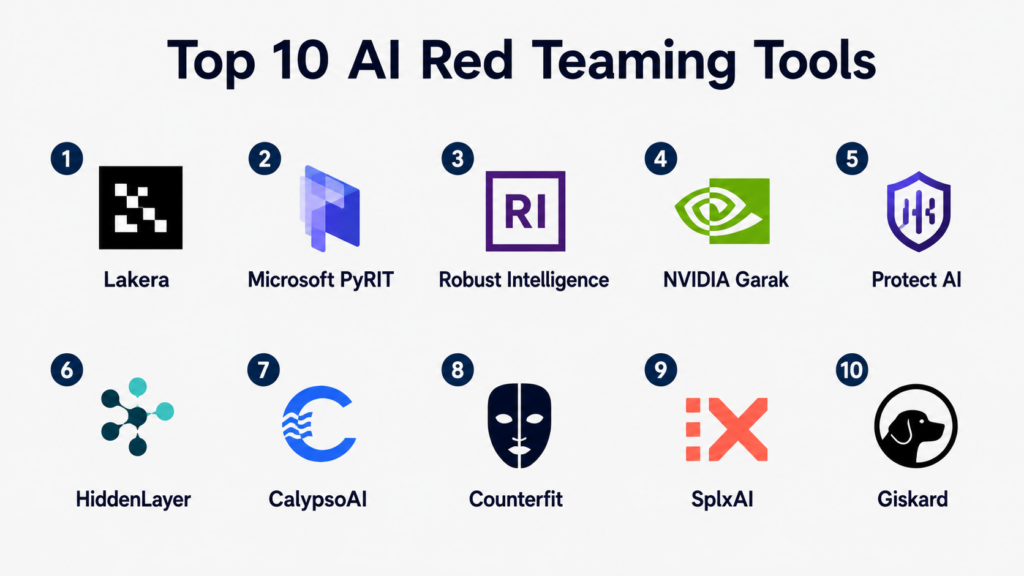
Introduction
AI Red Teaming Tools help organizations test, evaluate, and secure AI systems before they are exposed to real-world threats. These tools simulate adversarial prompts, jailbreak attempts, prompt injections, toxic outputs, hallucinations, and unsafe AI behaviors across large language models, AI agents, copilots, and generative AI applications.As enterprises rapidly deploy generative AI into customer service, software engineering, healthcare, finance, cybersecurity, and internal productivity workflows, AI security has become a major operational priority. Organizations are now expected to validate not only AI accuracy and performance, but also resilience, safety, governance, and compliance. AI red teaming has evolved from a research-focused exercise into a critical part of modern AI operations.
Real-world use cases include:
- Testing LLM jailbreak resistance
- Detecting prompt injection vulnerabilities
- Evaluating AI agent safety
- Identifying toxic or biased outputs
- Stress-testing enterprise copilots
What buyers should evaluate:
- Depth of adversarial testing
- LLM and AI model compatibility
- Automation capabilities
- Governance and compliance support
- AI agent testing coverage
- Scalability and deployment flexibility
- Ease of use
- Integration ecosystem
- Reporting and risk scoring
- Runtime monitoring features
Best for: Enterprises deploying AI applications, AI platform teams, security engineers, compliance teams, regulated industries, and organizations operating customer-facing AI systems.
Not ideal for: Small teams experimenting casually with public chatbots, organizations without production AI environments, or users needing only lightweight content moderation.
Key Trends in AI Red Teaming Tools
- AI red teaming is becoming part of continuous AI deployment pipelines.
- Prompt injection defense is now a core enterprise requirement.
- AI agent testing is emerging as a major feature category.
- Runtime AI monitoring is gaining importance alongside pre-deployment testing.
- Open-source AI security frameworks continue growing in adoption.
- Enterprises increasingly demand governance and compliance reporting.
- Multimodal AI testing is expanding beyond text-only models.
- AI risk scoring dashboards are becoming standard features.
- Cloud-native deployment models dominate enterprise adoption.
- Security vendors are integrating AI testing into DevSecOps ecosystems.
How We Selected These Tools
The tools in this list were evaluated based on practical enterprise and developer-focused criteria:
- Market adoption and industry visibility
- Breadth of AI red teaming capabilities
- Support for modern LLMs and AI agents
- Automation and scalability
- Enterprise security and governance capabilities
- Integration support with AI and cloud platforms
- Ease of deployment and operational usability
- Open-source innovation and flexibility
- Vendor ecosystem maturity
- Fit across SMB, mid-market, and enterprise environments
Top 10 AI Red Teaming Tools
#1 — Lakera
Short description: Lakera helps organizations secure generative AI systems against prompt injections, jailbreaks, unsafe prompts, and malicious AI interactions. The platform is designed for enterprises deploying AI copilots, customer-facing chatbots, and AI-powered applications. Lakera combines real-time AI security controls with automated adversarial testing workflows. It is widely used by organizations building operational AI security programs.
Key Features
- Prompt injection detection
- AI jailbreak testing
- Real-time AI threat monitoring
- Policy enforcement workflows
- Automated red teaming
- AI application firewall capabilities
- API-first deployment architecture
Pros
- Strong enterprise AI security focus
- Good API integration capabilities
- Operational monitoring support
Cons
- Enterprise pricing may be expensive for small teams
- Advanced workflows require security expertise
- Less useful for non-production AI usage
Platforms / Deployment
- Cloud / Hybrid
Security & Compliance
- RBAC
- Audit logs
- Encryption
- SSO/SAML
- GDPR support
- Additional certifications not publicly stated
Integrations & Ecosystem
Lakera integrates with enterprise AI stacks, cloud platforms, and modern AI application workflows. The platform supports deployment alongside AI gateways and security pipelines.
- OpenAI integrations
- Anthropic compatibility
- Azure AI integrations
- API support
- Security workflow integrations
- Cloud-native deployment support
Support & Community
Lakera provides enterprise onboarding, technical documentation, and implementation guidance. Its ecosystem visibility continues growing in the AI security market.
#2 — Microsoft PyRIT
Short description: Microsoft PyRIT is an open-source AI red teaming framework built for automated adversarial testing of AI systems. It enables developers and security researchers to simulate attacks against large language models at scale. PyRIT is highly customizable and integrates well into developer workflows. It is particularly useful for organizations building internal AI testing automation pipelines.
Key Features
- Automated adversarial testing
- Multi-turn attack simulation
- Open-source architecture
- Custom attack workflows
- Prompt injection testing
- Extensible Python framework
- AI evaluation automation
Pros
- Highly flexible for developers
- Strong research credibility
- No vendor lock-in
Cons
- Requires engineering expertise
- Limited enterprise UI workflows
- Complex for non-technical teams
Platforms / Deployment
- Windows / macOS / Linux
- Self-hosted
Security & Compliance
- Not publicly stated
Integrations & Ecosystem
PyRIT integrates effectively into AI development environments and MLOps pipelines. Its open-source nature allows extensive customization.
- Python ecosystem
- GitHub workflows
- Azure AI integrations
- Custom LLM connectors
- CI/CD compatibility
Support & Community
Strong open-source documentation and growing developer adoption across AI security communities.
#3 — Robust Intelligence
Short description: Robust Intelligence delivers AI validation, governance, and red teaming capabilities for enterprise AI environments. The platform focuses on testing AI resilience, detecting vulnerabilities, and operationalizing AI trust programs. It supports generative AI as well as traditional machine learning systems. Large organizations often use it for governance-heavy AI deployments.
Key Features
- AI stress testing
- Runtime AI monitoring
- Governance dashboards
- Adversarial attack simulation
- Risk scoring
- Policy enforcement
- Enterprise reporting tools
Pros
- Strong governance capabilities
- Enterprise-grade reporting
- Broad AI model support
Cons
- Premium enterprise pricing
- Higher implementation complexity
- Less beginner-friendly
Platforms / Deployment
- Cloud / Hybrid
Security & Compliance
- SSO/SAML
- RBAC
- Audit logs
- Encryption
- Compliance certifications vary
Integrations & Ecosystem
Robust Intelligence integrates with enterprise AI platforms, governance systems, and cloud AI infrastructure.
- Databricks support
- AWS integrations
- Azure integrations
- MLOps compatibility
- API ecosystem support
Support & Community
Enterprise-focused onboarding and professional services with strong support for regulated industries.
#4 — NVIDIA Garak
Short description: NVIDIA Garak is an open-source LLM vulnerability scanner designed for adversarial AI testing and security evaluation. It enables researchers and AI engineers to identify unsafe behaviors through automated probes and attack patterns. Garak is particularly useful for technical teams performing structured LLM evaluations. Its plugin architecture makes it highly extensible.
Key Features
- LLM vulnerability scanning
- Automated probes
- Plugin-based architecture
- Adversarial behavior testing
- Prompt safety analysis
- Open-source extensibility
- Multiple model support
Pros
- Flexible technical framework
- Useful for research workflows
- Lightweight deployment model
Cons
- Technical learning curve
- Limited enterprise workflows
- Less suitable for business users
Platforms / Deployment
- Windows / macOS / Linux
- Self-hosted
Security & Compliance
- Not publicly stated
Integrations & Ecosystem
Garak works well within AI research and evaluation environments through APIs and scripting support.
- Python ecosystem
- Hugging Face support
- Local model compatibility
- Automation pipeline support
- API integrations
Support & Community
Growing open-source community with active participation from AI security researchers.
#5 — Protect AI
Short description: Protect AI focuses on securing machine learning and generative AI pipelines through AI scanning, governance, monitoring, and red teaming workflows. The platform helps enterprises operationalize secure AI deployment practices. It also emphasizes AI supply-chain security and model integrity validation. Protect AI is commonly used by organizations building enterprise-scale AI governance programs.
Key Features
- AI red teaming workflows
- AI supply-chain scanning
- Governance dashboards
- Model integrity validation
- Risk assessment tools
- AI monitoring
- Security analytics
Pros
- Broad AI security coverage
- Enterprise-focused governance capabilities
- Strong operational visibility
Cons
- Complex deployment requirements
- Higher enterprise cost structure
- May exceed SMB requirements
Platforms / Deployment
- Cloud / Hybrid
Security & Compliance
- RBAC
- Audit logs
- Encryption
- SSO/SAML
- Additional certifications not publicly stated
Integrations & Ecosystem
Protect AI integrates with enterprise AI pipelines, cloud infrastructure, and DevSecOps workflows.
- Kubernetes support
- Cloud AI integrations
- CI/CD integration
- MLOps compatibility
- Security workflow connectors
Support & Community
Enterprise onboarding and implementation guidance with strong support for operational AI programs.
#6 — HiddenLayer
Short description: HiddenLayer specializes in AI model security and adversarial defense for enterprise AI systems. The platform helps organizations identify vulnerabilities, monitor runtime behavior, and secure AI infrastructure. HiddenLayer supports machine learning and generative AI security operations. It is often used by enterprises deploying mission-critical AI applications.
Key Features
- AI threat detection
- Runtime monitoring
- Adversarial attack testing
- AI model defense tooling
- Security analytics dashboards
- Governance workflows
- Risk visibility tools
Pros
- Strong AI-focused security capabilities
- Good operational monitoring
- Enterprise-grade workflows
Cons
- Enterprise pricing structure
- Requires mature AI programs
- Complex deployment for smaller teams
Platforms / Deployment
- Cloud / Hybrid
Security & Compliance
- RBAC
- MFA
- Encryption
- Audit logs
- Compliance certifications vary
Integrations & Ecosystem
HiddenLayer integrates with enterprise AI infrastructure and cybersecurity environments.
- AWS integrations
- Azure integrations
- Security analytics connectors
- API support
- Monitoring platform integrations
Support & Community
Strong enterprise support model with growing adoption in AI security ecosystems.
#7 — CalypsoAI
Short description: CalypsoAI provides AI governance, adversarial testing, and operational security capabilities for enterprise AI deployments. The platform is designed to help organizations deploy generative AI safely while maintaining compliance and policy enforcement. It is commonly used in regulated and government-focused environments. CalypsoAI emphasizes governance visibility and AI risk management.
Key Features
- AI governance controls
- Red teaming automation
- Adversarial testing
- Compliance workflows
- AI monitoring
- Risk dashboards
- Policy enforcement
Pros
- Strong governance capabilities
- Good fit for regulated industries
- Enterprise operational controls
Cons
- Less developer-focused
- Premium enterprise positioning
- Complex onboarding workflows
Platforms / Deployment
- Cloud / Hybrid
Security & Compliance
- SSO/SAML
- Encryption
- Audit logs
- RBAC
- Additional certifications vary
Integrations & Ecosystem
CalypsoAI integrates with enterprise AI governance and operational security systems.
- API integrations
- Cloud AI compatibility
- Governance workflow support
- Enterprise security integrations
Support & Community
Enterprise-focused onboarding and consulting support with strong compliance-oriented workflows.
#8 — Counterfit
Short description: Counterfit is an open-source adversarial AI testing framework developed for security researchers and technical AI teams. It enables organizations to automate attacks against AI models and evaluate vulnerabilities systematically. Counterfit is highly customizable and supports research-oriented AI security workflows. It is best suited for technical teams building advanced testing pipelines.
Key Features
- Automated adversarial testing
- Open-source architecture
- Attack orchestration
- AI vulnerability evaluation
- Custom attack workflows
- Extensible framework
- Research-focused automation
Pros
- Flexible and customizable
- Strong research utility
- No licensing costs
Cons
- Requires technical expertise
- Limited enterprise workflows
- Smaller operational ecosystem
Platforms / Deployment
- Windows / macOS / Linux
- Self-hosted
Security & Compliance
- Not publicly stated
Integrations & Ecosystem
Counterfit integrates into AI research environments through APIs and automation pipelines.
- Python support
- ML framework compatibility
- Automation pipeline integration
- AI testing ecosystem support
Support & Community
Strong open-source research community with growing AI security adoption.
#9 — SplxAI
Short description: SplxAI focuses on automated red teaming for AI agents, LLM applications, and generative AI workflows. The platform helps organizations identify prompt injections, jailbreaks, and unsafe outputs through continuous testing. SplxAI emphasizes automation and operational scalability. It is gaining traction among enterprises deploying AI-powered products quickly.
Key Features
- Automated AI red teaming
- Prompt injection testing
- AI agent evaluation
- Jailbreak simulation
- Security scoring
- Continuous monitoring
- Risk reporting dashboards
Pros
- Strong AI agent testing focus
- Good automation workflows
- Modern enterprise AI capabilities
Cons
- Newer vendor ecosystem
- Limited public deployment details
- Some advanced workflows evolving rapidly
Platforms / Deployment
- Cloud
Security & Compliance
- Not publicly stated
Integrations & Ecosystem
SplxAI integrates with enterprise AI stacks and modern GenAI application workflows.
- OpenAI integrations
- Anthropic support
- API integrations
- CI/CD compatibility
- AI workflow integrations
Support & Community
Growing vendor ecosystem with increasing visibility among AI platform teams.
#10 — Giskard
Short description: Giskard provides AI evaluation, testing, and red teaming capabilities for machine learning and generative AI systems. The platform helps organizations automate AI quality assurance and identify AI risks before deployment. Giskard supports both technical and governance-oriented workflows. It combines open-source flexibility with enterprise testing capabilities.
Key Features
- AI evaluation automation
- Adversarial testing
- Bias detection
- Hallucination testing
- Monitoring dashboards
- Continuous AI validation
- Test suite management
Pros
- Balanced usability for developers and enterprises
- Strong evaluation workflows
- Flexible deployment support
Cons
- Advanced enterprise scaling may require customization
- Some governance capabilities evolving
- Complex for beginners
Platforms / Deployment
- Cloud / Self-hosted
Security & Compliance
- RBAC
- Encryption
- Audit support
- Additional certifications not publicly stated
Integrations & Ecosystem
Giskard integrates with modern AI development workflows and evaluation pipelines.
- Hugging Face support
- Python integrations
- CI/CD compatibility
- API support
- ML workflow integration
Support & Community
Strong open-source ecosystem combined with commercial support offerings.
Comparison Table
| Tool Name | Best For | Platform(s) Supported | Deployment | Standout Feature | Public Rating |
|---|---|---|---|---|---|
| Lakera | Enterprise AI protection | Web / Cloud | Cloud / Hybrid | Prompt injection defense | N/A |
| Microsoft PyRIT | Developer-led AI testing | Windows / macOS / Linux | Self-hosted | Automated adversarial testing | N/A |
| Robust Intelligence | AI governance programs | Web / Cloud | Cloud / Hybrid | AI risk governance | N/A |
| NVIDIA Garak | LLM vulnerability scanning | Windows / macOS / Linux | Self-hosted | Plugin-based vulnerability probes | N/A |
| Protect AI | Secure AI pipelines | Web / Cloud | Cloud / Hybrid | AI supply-chain security | N/A |
| HiddenLayer | Enterprise AI defense | Web / Cloud | Cloud / Hybrid | Runtime AI protection | N/A |
| CalypsoAI | Regulated industries | Web / Cloud | Cloud / Hybrid | Governance-focused controls | N/A |
| Counterfit | AI security research | Windows / macOS / Linux | Self-hosted | Open-source adversarial framework | N/A |
| SplxAI | AI agent testing | Web / Cloud | Cloud | AI-agent red teaming | N/A |
| Giskard | AI evaluation automation | Web / Linux / macOS | Cloud / Self-hosted | AI quality assurance workflows | N/A |
Evaluation & Scoring of AI Red Teaming Tools
| Tool Name | Core 25% | Ease 15% | Integrations 15% | Security 10% | Performance 10% | Support 10% | Value 15% | Weighted Total |
|---|---|---|---|---|---|---|---|---|
| Lakera | 9.2 | 8.7 | 8.9 | 9.1 | 8.8 | 8.5 | 7.9 | 8.8 |
| Microsoft PyRIT | 8.8 | 6.9 | 8.5 | 7.2 | 8.4 | 7.5 | 9.1 | 8.1 |
| Robust Intelligence | 9.4 | 8.1 | 8.9 | 9.2 | 9.0 | 8.7 | 7.3 | 8.8 |
| NVIDIA Garak | 8.4 | 6.8 | 8.0 | 7.1 | 8.2 | 7.4 | 9.0 | 7.9 |
| Protect AI | 9.0 | 8.0 | 8.7 | 9.1 | 8.9 | 8.6 | 7.5 | 8.6 |
| HiddenLayer | 8.9 | 7.9 | 8.5 | 9.0 | 8.8 | 8.3 | 7.4 | 8.5 |
| CalypsoAI | 8.6 | 7.7 | 8.2 | 8.9 | 8.4 | 8.2 | 7.2 | 8.2 |
| Counterfit | 8.2 | 6.7 | 7.8 | 7.0 | 8.1 | 7.3 | 9.0 | 7.8 |
| SplxAI | 8.5 | 8.0 | 8.1 | 8.2 | 8.4 | 7.8 | 8.1 | 8.2 |
| Giskard | 8.8 | 8.3 | 8.5 | 8.2 | 8.5 | 8.1 | 8.4 | 8.5 |
These scores are comparative rather than absolute. Enterprise-focused platforms usually score higher in governance, compliance, and operational visibility, while open-source frameworks often deliver better flexibility and value. Organizations should prioritize the categories most relevant to their AI maturity, regulatory requirements, and operational complexity. Developer-focused teams may value customization more heavily, while regulated industries often prioritize governance and reporting capabilities. Running a pilot program is usually the best way to validate tool fit before large-scale adoption.
Which AI Red Teaming Tools Tool Is Right for You?
Solo / Freelancer
Independent AI developers and researchers usually benefit most from open-source tools such as Microsoft PyRIT, NVIDIA Garak, and Counterfit. These frameworks provide flexibility, lower cost, and strong customization capabilities for experimentation and learning.
SMB
Small and mid-sized businesses typically need a balance between usability, automation, and affordability. Giskard and SplxAI provide modern testing workflows without the operational overhead associated with larger governance-heavy platforms.
Mid-Market
Mid-market organizations often require scalable AI testing with governance visibility and API integrations. Lakera, Protect AI, and HiddenLayer are strong choices for organizations deploying AI copilots and customer-facing AI applications.
Enterprise
Large enterprises with complex governance requirements should evaluate Robust Intelligence, HiddenLayer, CalypsoAI, and Lakera. These platforms provide stronger governance controls, audit capabilities, runtime monitoring, and compliance workflows.
Budget vs Premium
Open-source frameworks like PyRIT, Counterfit, and Garak offer flexibility and lower costs but require technical expertise. Premium enterprise platforms provide governance dashboards, automation, enterprise support, and operational monitoring at higher pricing levels.
Feature Depth vs Ease of Use
Enterprise platforms usually provide deeper governance and security capabilities but may require more implementation effort. Developer-focused tools emphasize customization and flexibility for technical teams.
Integrations & Scalability
Organizations operating cloud-native AI environments should prioritize tools with strong API ecosystems and MLOps compatibility. Enterprise environments benefit significantly from CI/CD integrations and AI observability support.
Security & Compliance Needs
Regulated industries such as healthcare, finance, and government should prioritize governance-heavy platforms with strong audit logging, RBAC, policy enforcement, and operational reporting features.
Frequently Asked Questions FAQs
1. What are AI red teaming tools?
AI red teaming tools help organizations identify vulnerabilities and unsafe behaviors in AI systems before deployment. These platforms simulate adversarial prompts, prompt injections, jailbreaks, and harmful interactions against large language models and AI applications. The goal is to improve AI safety, reliability, governance, and resilience. Modern AI deployments require continuous validation because AI systems behave differently from traditional software systems. AI red teaming has become an essential component of responsible AI operations. Organizations increasingly integrate these tools into production AI pipelines.
2. Why are AI red teaming tools important?
Generative AI systems can introduce new attack surfaces that traditional security tools are not designed to handle. AI models may produce harmful outputs, leak sensitive information, or become manipulated through adversarial prompts. AI red teaming tools help organizations proactively discover these weaknesses before attackers exploit them. They also support compliance and governance initiatives. As enterprises deploy AI into customer-facing environments, continuous adversarial testing becomes increasingly necessary. Modern AI security programs depend heavily on automated validation workflows.
3. What types of attacks do these tools test?
Most AI red teaming platforms simulate prompt injections, jailbreak attempts, toxic content generation, hallucination exploitation, bias testing, and model manipulation attacks. Advanced platforms also support AI agent testing and autonomous workflow evaluation. Some tools focus heavily on runtime monitoring and policy enforcement. Others prioritize research-oriented adversarial experimentation. Organizations should evaluate whether a platform supports the attack categories most relevant to their AI architecture. Attack coverage varies significantly between vendors.
4. Are open-source AI red teaming tools reliable?
Open-source AI red teaming frameworks can be highly effective when operated by experienced technical teams. Tools such as Microsoft PyRIT, NVIDIA Garak, and Counterfit provide strong flexibility and customization capabilities. However, they often require engineering expertise and operational maintenance. Commercial platforms usually offer more polished workflows, governance dashboards, and enterprise support services. Organizations should evaluate their internal expertise before choosing an open-source-only approach. Many enterprises combine commercial platforms with open-source tooling.
5. How do these tools integrate with AI pipelines?
Modern AI red teaming tools commonly integrate with MLOps pipelines, CI/CD workflows, cloud AI platforms, and AI observability systems. This enables organizations to automate adversarial testing during deployment and operational monitoring processes. API-based integrations are especially important for enterprise scalability. Integration depth varies across vendors and deployment models. Teams should validate compatibility with their existing AI infrastructure before selection. Strong integration support reduces operational complexity significantly.
6. Can these tools test AI agents?
Yes, many modern platforms now support AI agent testing. AI agents introduce additional risks because they can access tools, external systems, APIs, and business workflows autonomously. AI red teaming tools evaluate how these agents behave under adversarial conditions. This includes prompt manipulation, unsafe actions, unauthorized access attempts, and workflow abuse scenarios. Agent-focused testing is becoming one of the fastest-growing segments within AI security. Enterprises deploying autonomous workflows should prioritize this capability.
7. What are common mistakes during AI red teaming?
One common mistake is treating AI security as a one-time exercise instead of a continuous operational process. Another issue is focusing only on harmful outputs while ignoring prompt injection and AI agent risks. Some organizations underestimate governance and compliance requirements for production AI systems. Others rely exclusively on manual testing methods. Effective AI security programs usually combine automation, governance, runtime monitoring, and human oversight. Continuous validation is essential for evolving AI environments.
8. Are AI red teaming platforms expensive?
Pricing varies significantly depending on deployment scale, enterprise requirements, and feature depth. Open-source tools are generally free but require internal engineering resources. Enterprise platforms often use subscription-based pricing tied to API usage, users, deployment scale, or testing volume. Organizations should evaluate total operational cost rather than only licensing expenses. Governance-heavy platforms typically cost more because they include compliance workflows and enterprise support services. Smaller organizations should carefully evaluate operational complexity before investing.
9. Which industries benefit most from AI red teaming?
Industries deploying customer-facing or operational AI systems benefit the most from AI red teaming. Healthcare, finance, government, cybersecurity, legal services, and software companies are among the strongest adopters. Regulated industries especially require governance and compliance capabilities. AI copilots, AI search systems, autonomous workflows, and customer support agents are common use cases. Any organization deploying production AI systems can benefit from adversarial testing. The risk level depends on AI exposure and operational sensitivity.
10. How should organizations choose the right AI red teaming platform?
Organizations should start by evaluating their AI deployment maturity, governance requirements, operational scale, and internal expertise. Teams deploying AI agents may require deeper runtime testing capabilities. Developer-focused organizations may prioritize flexibility and customization. Enterprises in regulated industries often prioritize governance, reporting, and auditability. Integration support is also critical for long-term scalability. Running a pilot program with shortlisted vendors is usually the most effective evaluation strategy before enterprise-wide deployment.
Conclusion
AI red teaming tools are becoming essential for organizations deploying generative AI systems at scale. As AI adoption expands across customer support, enterprise automation, software development, healthcare, finance, and autonomous workflows, the need for continuous AI security validation continues growing rapidly. Modern organizations must evaluate not only AI performance and accuracy, but also resilience, governance, compliance, runtime behavior, and adversarial resistance. Some organizations may prioritize open-source flexibility and developer-centric workflows, while others require enterprise-grade governance, auditability, and operational monitoring. The best AI red teaming platform ultimately depends on deployment maturity, security requirements, compliance exposure, integration needs, and operational complexity. Enterprises should shortlist a few suitable platforms, run controlled pilot programs, validate integration compatibility with existing AI infrastructure, and assess how effectively each solution supports long-term AI governance and security objectives.
