MOTOSHARE 🚗🏍️
Rent Bikes & Cars Directly from Owners
Motoshare connects vehicle owners with people who need bikes and cars on rent. Owners earn from idle vehicles, and renters get flexible ride options.
Visit Motoshare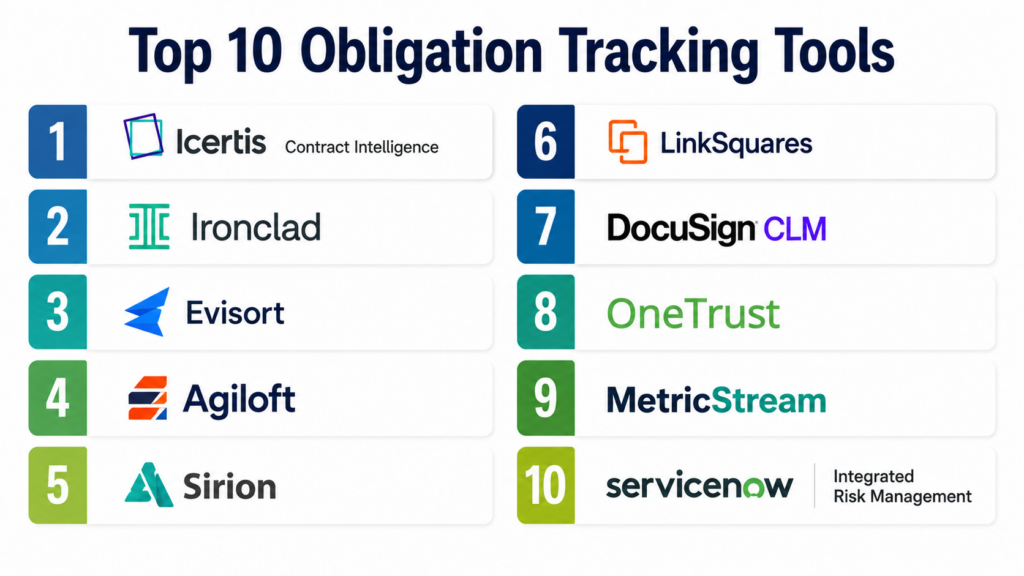
Introduction
Obligation Tracking Tools help organizations identify, manage, monitor, and report commitments that come from contracts, regulations, policies, service agreements, legal requirements, supplier terms, customer agreements, audits, and internal governance rules. In simple terms, these tools help teams know what must be done, who owns it, when it is due, and whether it has been completed.
Obligation tracking matters because missed obligations can lead to penalties, contract breaches, lost revenue, supplier disputes, customer dissatisfaction, compliance failures, audit issues, and legal risk. Many organizations still track obligations using spreadsheets, emails, shared folders, manual reminders, and scattered contract notes. This creates visibility gaps and makes it difficult to prove compliance. Modern obligation tracking tools use contract intelligence, workflow automation, alerts, dashboards, task ownership, evidence collection, and reporting to make obligations easier to control.
Real World Use Cases:
- Tracking contractual obligations from supplier, customer, lease, and service agreements
- Monitoring regulatory obligations, policy requirements, and compliance tasks
- Managing renewal dates, notice periods, SLAs, deliverables, and milestones
- Assigning obligation owners across legal, procurement, finance, sales, and operations
- Collecting evidence that obligations were completed on time
- Reporting obligation status, overdue items, risk exposure, and compliance gaps
Evaluation Criteria for Buyers:
- Obligation extraction and metadata management
- Contract, regulation, policy, and SLA tracking depth
- Alerts, reminders, escalation workflows, and task ownership
- Evidence collection, audit trails, and compliance reporting
- AI-assisted clause and obligation identification
- Integration with CLM, GRC, ERP, CRM, procurement, and document systems
- Dashboards for overdue obligations, risk exposure, and business owners
- Role-based permissions, encryption, audit logs, and access governance
- Ease of use for legal, compliance, procurement, sales, finance, and operations
- Implementation support, migration capability, scalability, and total cost
Best for: Obligation Tracking Tools are best for legal teams, contract managers, procurement teams, compliance teams, risk managers, finance teams, vendor management teams, sales operations, regulatory affairs teams, audit teams, and enterprises that need reliable visibility into contractual, regulatory, supplier, customer, and internal commitments.
Not ideal for: Obligation tracking tools may not be necessary for very small businesses with only a few simple contracts and limited compliance obligations. In those cases, a spreadsheet, calendar reminders, shared task board, or basic contract repository may be enough temporarily. However, once obligation volume, contract complexity, regulatory exposure, and cross-functional ownership increase, dedicated obligation tracking software becomes much more valuable.
Key Trends in Obligation Tracking Tools
- AI-assisted obligation extraction is growing: Modern tools increasingly use AI to identify key obligations, dates, clauses, deliverables, SLAs, renewal terms, and compliance commitments from contracts and documents.
- Contract repositories are becoming more actionable: Organizations no longer want static contract storage only. They want contract data converted into tasks, reminders, obligations, and business workflows.
- Legal and compliance teams are collaborating more closely: Contract obligations, regulatory duties, audit requirements, policy controls, and vendor commitments often overlap, so cross-functional workflows are becoming essential.
- SLA and milestone tracking are gaining importance: Customer service agreements, supplier contracts, outsourcing deals, software subscriptions, and managed services agreements often include measurable service obligations.
- Evidence-based compliance is becoming standard: Teams want proof that obligations were completed, reviewed, approved, or escalated, especially for audits and regulatory examinations.
- Obligation ownership is moving to business teams: Legal may identify obligations, but procurement, finance, operations, IT, sales, and vendor managers often own execution.
- Integration with CLM and GRC is becoming important: Obligation tracking is most powerful when connected with contract lifecycle management, risk management, compliance, audit, and procurement workflows.
- Renewal and notice tracking remain major drivers: Missed renewal windows, auto-renewals, termination notices, and pricing change deadlines continue to create avoidable cost and risk.
- Dashboards are becoming executive-facing: Leaders want visibility into overdue obligations, high-risk commitments, vendor deliverables, regulatory deadlines, and business owner accountability.
- Configurable workflows matter: Different organizations define obligations differently, so buyers need flexible fields, statuses, due dates, escalations, reminders, and approval workflows.
How We Selected These Tools
The Top 10 tools were selected using practical evaluation logic for obligation tracking buyers.
- Recognition in contract lifecycle management, contract intelligence, compliance management, legal operations, GRC, and workflow automation
- Suitability for legal, procurement, compliance, finance, sales operations, vendor management, and enterprise risk teams
- Feature depth across obligation identification, tracking, reminders, ownership, reporting, and evidence management
- Ability to support contract obligations, regulatory obligations, policy obligations, SLAs, renewals, milestones, and audit commitments
- Integration potential with CLM, e-signature, CRM, ERP, procurement, GRC, document storage, and business intelligence systems
- Strength of AI-assisted extraction, metadata capture, clause visibility, and obligation analytics
- Reporting depth for overdue obligations, upcoming deadlines, owner accountability, risk exposure, and completion evidence
- Scalability across business units, contract types, geographies, departments, owners, and obligation categories
- Security posture signals, role permissions, auditability, and enterprise data protection expectations
- Vendor support, migration services, implementation maturity, documentation, and long-term platform value
Top 10 Obligation Tracking Tools
1- Icertis Contract Intelligence
Short description:
Icertis Contract Intelligence is an enterprise contract management platform with strong obligation tracking, contract intelligence, metadata extraction, and analytics capabilities. It helps organizations identify commitments from contracts, assign ownership, monitor performance, and connect contract obligations with business processes. The platform is especially relevant for large enterprises managing complex supplier, customer, partner, and compliance contracts. It is best for organizations that need enterprise-scale obligation visibility and contract intelligence.
Key Features
- AI-assisted contract obligation extraction
- Centralized obligation tracking and ownership management
- Renewal, milestone, and commitment monitoring
- Contract analytics and obligation dashboards
- Workflow support for obligation review and follow-up
- Integration with ERP, CRM, procurement, and business systems
- Enterprise-scale governance across regions and business units
Pros
- Strong enterprise contract intelligence depth
- Useful for complex global obligation portfolios
- Good fit for organizations needing contract data tied to business execution
Cons
- Implementation can be complex for smaller teams
- Requires strong metadata and obligation taxonomy planning
- Best value depends on enterprise contract volume and governance maturity
Platforms / Deployment
Web / Cloud
Security & Compliance
Not publicly stated. Buyers should verify SSO, MFA, encryption, RBAC, audit logs, data retention, and compliance controls directly.
Integrations & Ecosystem
Icertis fits organizations that need obligation data connected with finance, procurement, sales, supplier, and compliance workflows.
- ERP systems
- CRM platforms
- Procurement and supplier systems
- E-signature workflows
- Document storage and collaboration tools
- Analytics and reporting dashboards
Support & Community
Icertis provides enterprise implementation support, documentation, training, customer success resources, and partner services. Support quality depends on deployment size, integration complexity, and contract data maturity.
2- Ironclad
Short description:
Ironclad is a contract lifecycle management platform that helps legal and business teams manage contract workflows, repositories, approvals, metadata, renewals, and obligations. It supports post-signature contract management by helping teams track key dates, commitments, business owners, and contract-related actions. The platform is especially useful for organizations that want obligation tracking connected with contract creation, negotiation, approval, and storage workflows. It is best for modern legal teams and mid-market to enterprise organizations.
Key Features
- Contract repository with searchable metadata
- Obligation and renewal tracking support
- Workflow automation and task routing
- AI-assisted contract data extraction depending on configuration
- Approval, review, and contract lifecycle workflows
- E-signature and business system integrations
- Reporting dashboards for contract status and ownership
Pros
- Strong user experience for legal and business teams
- Connects obligations with broader CLM workflows
- Useful for organizations modernizing legal operations
Cons
- May be more than teams needing only simple obligation reminders require
- Migration and metadata cleanup require planning
- Advanced obligation analytics should be validated for complex use cases
Platforms / Deployment
Web / Cloud
Security & Compliance
Not publicly stated. Buyers should verify SSO, MFA, encryption, RBAC, audit logs, data retention, and compliance documentation directly.
Integrations & Ecosystem
Ironclad fits organizations that need obligation tracking connected with legal, sales, procurement, and operational contract workflows.
- E-signature workflows
- CRM systems
- Procurement and supplier systems
- Document storage platforms
- Workflow and approval tools
- Reporting and analytics systems
Support & Community
Ironclad provides onboarding, implementation support, documentation, training, customer success resources, and legal operations guidance. Support quality depends on contract volume, migration complexity, and workflow scope.
3- Evisort
Short description:
Evisort is an AI-powered contract intelligence platform that helps organizations centralize contracts, extract key terms, identify obligations, track renewals, and analyze risk across contract portfolios. It is especially useful for teams with many legacy agreements that need fast visibility into obligations and deadlines. The platform helps legal, procurement, finance, and operations teams understand what contracts require and who needs to act. It is best for organizations prioritizing AI-assisted obligation discovery and contract analytics.
Key Features
- AI-powered contract search and obligation extraction
- Metadata, clause, and key term identification
- Renewal, expiration, and deadline tracking
- Contract analytics and risk visibility
- Legacy contract migration and analysis support
- Reporting dashboards for legal and business teams
- Integration with CLM, CRM, ERP, and document systems depending on configuration
Pros
- Strong AI contract intelligence capabilities
- Useful for extracting obligations from legacy contracts
- Helps make contract commitments searchable and actionable
Cons
- AI extraction may require human review for sensitive obligations
- Workflow depth should be validated against full CLM needs
- Implementation depends on contract quality and migration scope
Platforms / Deployment
Web / Cloud
Security & Compliance
Not publicly stated. Buyers should verify SSO, MFA, encryption, RBAC, audit logs, data retention, and compliance documentation directly.
Integrations & Ecosystem
Evisort fits organizations that need AI-powered obligation visibility connected with legal, procurement, finance, and operational systems.
- CLM systems
- E-signature workflows
- CRM and ERP systems
- Document storage platforms
- Procurement and supplier systems
- Analytics and reporting tools
Support & Community
Evisort provides implementation support, contract migration assistance, documentation, customer success resources, and AI contract analytics guidance. Support quality depends on contract volume, extraction needs, and integration scope.
4- Agiloft
Short description:
Agiloft is a configurable contract lifecycle management platform with strong workflow automation, contract repository, renewal tracking, metadata management, and obligation tracking capabilities. It helps organizations define obligations, assign owners, send reminders, track completion, and report on contract commitments. The platform is especially useful for organizations that need flexible obligation workflows across legal, procurement, sales, and compliance teams. It is best for teams that want configurable obligation tracking inside a broader CLM platform.
Key Features
- Central contract repository with structured metadata
- Configurable obligation tracking workflows
- Renewal, expiration, milestone, and notice alerts
- Task assignments and escalation routing
- Contract search and reporting dashboards
- Template, clause, and approval workflow support
- Integration with e-signature and enterprise systems
Pros
- Highly configurable for different obligation workflows
- Good fit for legal, procurement, and compliance use cases
- Strong workflow automation and reporting flexibility
Cons
- Configuration flexibility requires strong process design
- User experience depends on implementation quality
- Smaller teams may not need full CLM depth
Platforms / Deployment
Web / Cloud / Self-hosted options may vary by configuration
Security & Compliance
Not publicly stated. Buyers should verify SSO, MFA, encryption, RBAC, audit logs, data retention, and compliance documentation directly.
Integrations & Ecosystem
Agiloft fits organizations that need obligation tracking connected with contract workflows and business systems.
- E-signature platforms
- CRM and sales systems
- Procurement and supplier systems
- ERP and finance workflows
- Document management tools
- Reporting and analytics systems
Support & Community
Agiloft provides implementation support, documentation, training, customer support, and partner services. Support quality depends on configuration complexity, contract types, and internal ownership.
5- Sirion
Short description:
Sirion is a contract lifecycle management and contract performance platform focused on complex commercial relationships, supplier contracts, customer agreements, outsourcing deals, and service obligations. It helps organizations manage contractual commitments, obligations, deliverables, SLAs, performance, deviations, and governance. The platform is especially relevant for enterprises with complex supplier and customer contracts where execution matters after signature. It is best for organizations needing obligation tracking tied to contract performance and relationship governance.
Key Features
- Obligation and commitment tracking
- SLA and deliverable management
- Contract performance monitoring
- Supplier and customer relationship governance
- Contract repository and analytics
- Workflow automation for contract execution
- Dashboards for obligations, risk, and performance
Pros
- Strong focus on post-signature contract performance
- Useful for complex outsourcing, supplier, and customer agreements
- Helps connect contract terms with operational execution
Cons
- May be more advanced than simple repository needs require
- Implementation requires contract and SLA process clarity
- Best suited to complex commercial contract environments
Platforms / Deployment
Web / Cloud
Security & Compliance
Not publicly stated. Buyers should verify SSO, MFA, encryption, RBAC, audit logs, data retention, and compliance controls directly.
Integrations & Ecosystem
Sirion fits organizations that need obligation tracking connected with contract performance, supplier management, and service delivery.
- CLM workflows
- Supplier and vendor management systems
- CRM and customer management systems
- ERP and finance systems
- SLA and performance reporting
- Business intelligence dashboards
Support & Community
Sirion provides enterprise implementation support, documentation, customer success resources, and contract performance expertise. Support quality depends on contract complexity, relationship scope, and integration requirements.
6- LinkSquares
Short description:
LinkSquares is a contract management and analytics platform focused on AI-powered contract repository, search, metadata extraction, reporting, and post-signature contract visibility. It helps legal teams identify important terms, track renewal dates, understand obligations, and create contract insights. The platform is especially useful for legal teams that need faster visibility into signed contracts and key commitments. It is best for organizations looking for AI-driven contract analytics and practical obligation visibility.
Key Features
- AI-powered contract repository and search
- Metadata and key term extraction
- Renewal and expiration tracking
- Contract analytics and reporting dashboards
- Legal operations visibility
- Post-signature contract management
- Workflow support depending on selected modules
Pros
- Strong post-signature contract analytics focus
- Useful for quickly identifying key obligations and dates
- Good fit for legal teams improving contract visibility
Cons
- Full pre-signature CLM depth depends on modules
- Complex SLA and performance tracking should be validated
- Metadata quality depends on migration and review process
Platforms / Deployment
Web / Cloud
Security & Compliance
Not publicly stated. Buyers should verify SSO, MFA, encryption, RBAC, audit logs, data retention, and compliance controls directly.
Integrations & Ecosystem
LinkSquares fits organizations that need obligation visibility connected with legal operations and contract reporting.
- E-signature workflows
- CRM systems
- Document storage platforms
- Legal operations workflows
- Reporting dashboards
- Business collaboration tools
Support & Community
LinkSquares provides onboarding, contract migration support, customer success resources, documentation, and legal operations guidance. Support quality depends on repository size, extraction needs, and analytics requirements.
7- DocuSign CLM
Short description:
DocuSign CLM provides contract lifecycle management capabilities including contract repository, workflow automation, approvals, document generation, e-signature integration, and post-signature tracking. It can help organizations manage obligations by capturing key contract fields, tracking dates, and connecting signed agreements with business workflows. The platform is especially useful for organizations already using DocuSign for e-signature. It is best for companies that want obligation tracking connected with signing, contract workflows, and repository management.
Key Features
- Contract repository and metadata management
- Workflow automation and approval routing
- E-signature integration
- Renewal and deadline tracking
- Contract templates and document generation
- Contract status and reporting dashboards
- CRM and enterprise system integrations
Pros
- Strong fit for DocuSign e-signature users
- Useful for connecting signed agreements with CLM workflows
- Good platform for contract process standardization
Cons
- Deep obligation intelligence should be validated by use case
- Implementation and configuration planning are important
- Some teams may need additional analytics for complex obligations
Platforms / Deployment
Web / Cloud / Mobile support depending on configuration
Security & Compliance
Not publicly stated. Buyers should verify SSO, MFA, encryption, RBAC, audit logs, data retention, and compliance controls directly.
Integrations & Ecosystem
DocuSign CLM fits organizations that need contract workflows, signing, storage, and obligation tracking connected.
- DocuSign e-signature
- CRM systems
- ERP and finance systems
- Document storage systems
- Workflow and approval tools
- Reporting and analytics platforms
Support & Community
DocuSign provides onboarding, documentation, customer support, implementation partners, and a large ecosystem. Support quality depends on CLM configuration, migration needs, and workflow complexity.
8- OneTrust
Short description:
OneTrust supports compliance, privacy, risk, policy, third-party risk, and regulatory obligation tracking workflows. While not only a contract obligation platform, it is relevant for organizations that need to track regulatory obligations, privacy requirements, policy commitments, vendor obligations, and compliance tasks. The platform helps teams map obligations to controls, owners, assessments, evidence, and reports. It is best for enterprises where obligation tracking is closely connected with compliance, privacy, risk, and regulatory governance.
Key Features
- Regulatory and compliance obligation tracking
- Policy and control mapping
- Third-party and privacy obligation workflows
- Evidence collection and audit support
- Risk assessments and remediation tracking
- Dashboards for compliance and risk teams
- Workflow automation and task ownership
Pros
- Strong fit for compliance and privacy obligation management
- Useful for mapping obligations to controls and evidence
- Good for cross-functional governance workflows
Cons
- Contract-specific obligation extraction may require complementary CLM tools
- Configuration can require governance maturity
- Best value depends on broader OneTrust platform usage
Platforms / Deployment
Web / Cloud
Security & Compliance
Not publicly stated. Buyers should verify SSO, MFA, encryption, RBAC, audit logs, privacy controls, data retention, and compliance documentation directly.
Integrations & Ecosystem
OneTrust fits organizations that need obligation tracking connected with privacy, compliance, risk, third-party, and policy workflows.
- GRC and compliance workflows
- Privacy management systems
- Third-party risk workflows
- Policy management processes
- Evidence and audit workflows
- Reporting dashboards
Support & Community
OneTrust provides onboarding, implementation support, documentation, training, and customer resources. Support quality depends on module scope, workflow complexity, and governance maturity.
9- MetricStream
Short description:
MetricStream is an integrated risk, compliance, audit, policy, and GRC platform that supports regulatory obligation tracking, control mapping, policy compliance, issue management, and evidence workflows. It helps organizations track compliance obligations from laws, regulations, policies, audits, and internal controls. While it is not a contract-only tool, it is strong for enterprise compliance obligation management. It is best for regulated organizations needing obligation tracking connected with GRC and audit workflows.
Key Features
- Regulatory obligation tracking and compliance mapping
- Control and policy management
- Audit, issue, and remediation workflows
- Risk assessments and compliance dashboards
- Evidence collection and certification workflows
- Workflow automation and approvals
- Enterprise reporting for compliance and risk teams
Pros
- Strong integrated GRC and compliance depth
- Useful for regulated enterprises with many obligations
- Connects obligations with controls, audits, and remediation
Cons
- Contract obligation extraction may require separate CLM integration
- Implementation can be resource-intensive
- Best fit is broader GRC obligation management
Platforms / Deployment
Web / Cloud / Hybrid depending on configuration
Security & Compliance
Not publicly stated. Buyers should verify SSO, MFA, encryption, RBAC, audit logs, data retention, and compliance controls directly.
Integrations & Ecosystem
MetricStream fits organizations that need compliance and regulatory obligations connected with risk, audit, policy, and control workflows.
- GRC and compliance systems
- Audit management workflows
- Policy management systems
- Control testing workflows
- Enterprise data and reporting tools
- Issue and remediation processes
Support & Community
MetricStream provides enterprise implementation support, documentation, training, customer success resources, and partner services. Support quality depends on module scope, configuration, and risk program maturity.
10- ServiceNow Integrated Risk Management
Short description:
ServiceNow Integrated Risk Management can support obligation tracking through configurable risk, compliance, policy, control, issue, audit, and workflow automation capabilities. Organizations can use it to assign obligation owners, track tasks, collect evidence, escalate overdue items, and connect obligations with remediation workflows. It is especially relevant for enterprises already using ServiceNow for IT, security, operations, or GRC processes. It is best for organizations that want obligation tracking inside a broader enterprise workflow platform.
Key Features
- Configurable obligation, issue, and task workflows
- Risk, compliance, policy, and control management
- Evidence collection and audit tracking
- Escalation, reminders, and remediation workflows
- Dashboards for executives and control owners
- Integration with IT, security, and operational workflows
- Enterprise workflow automation
Pros
- Strong workflow automation and enterprise platform capabilities
- Useful for organizations already using ServiceNow
- Good for connecting obligations with remediation actions
Cons
- Requires configuration for obligation-specific workflows
- Contract obligation extraction may require CLM integration
- Best value depends on ServiceNow maturity and implementation quality
Platforms / Deployment
Web / Cloud
Security & Compliance
ServiceNow environments commonly support identity controls, role-based access, encryption, auditability, and enterprise security features depending on configuration. Buyers should verify specific obligation workflow controls directly.
Integrations & Ecosystem
ServiceNow IRM fits organizations that need obligation tracking connected with enterprise risk, compliance, IT, security, and operational workflows.
- IT and security workflows
- Audit and compliance processes
- Risk and control management
- Issue remediation workflows
- Policy management systems
- Enterprise reporting and dashboards
Support & Community
ServiceNow provides enterprise support, implementation partners, documentation, training, and a large platform ecosystem. Support quality depends on configuration complexity, partner expertise, and internal platform maturity.
Comparison Table
| Tool Name | Best For | Platform Supported | Deployment | Standout Feature | Public Rating |
|---|---|---|---|---|---|
| Icertis Contract Intelligence | Enterprise contract obligation management | Web | Cloud | Contract intelligence and obligation tracking at scale | N/A |
| Ironclad | Modern legal teams needing CLM plus obligation workflows | Web | Cloud | Obligation tracking connected with contract workflows | N/A |
| Evisort | AI-powered obligation discovery from contracts | Web | Cloud | AI extraction of key terms and obligations | N/A |
| Agiloft | Configurable obligation workflows | Web | Cloud / Self-hosted options may vary | Flexible contract and obligation workflow automation | N/A |
| Sirion | Complex contract performance and SLA obligations | Web | Cloud | Post-signature obligation and performance governance | N/A |
| LinkSquares | Legal teams needing contract analytics | Web | Cloud | AI-powered post-signature contract visibility | N/A |
| DocuSign CLM | DocuSign-centered contract workflows | Web | Cloud | Obligation tracking connected with e-signature and CLM | N/A |
| OneTrust | Compliance, privacy, and regulatory obligations | Web | Cloud | Obligation tracking inside trust and compliance workflows | N/A |
| MetricStream | Enterprise GRC and compliance obligations | Web | Cloud / Hybrid | Regulatory obligations mapped to controls and audits | N/A |
| ServiceNow Integrated Risk Management | Enterprise workflow-based obligation management | Web | Cloud | Obligation tasks connected with remediation workflows | N/A |
Evaluation & Scoring of Obligation Tracking Tools
| Tool Name | Core 25% | Ease 15% | Integrations 15% | Security 10% | Performance 10% | Support 10% | Value 15% | Weighted Total 0–10 |
|---|---|---|---|---|---|---|---|---|
| Icertis Contract Intelligence | 9.3 | 7.4 | 9.0 | 8.5 | 8.8 | 8.7 | 7.5 | 8.5 |
| Ironclad | 8.8 | 8.3 | 8.7 | 8.3 | 8.7 | 8.6 | 7.8 | 8.5 |
| Evisort | 8.8 | 8.1 | 8.4 | 8.2 | 8.6 | 8.4 | 7.8 | 8.4 |
| Agiloft | 8.7 | 7.8 | 8.5 | 8.2 | 8.5 | 8.4 | 8.0 | 8.3 |
| Sirion | 9.0 | 7.7 | 8.5 | 8.2 | 8.7 | 8.5 | 7.7 | 8.4 |
| LinkSquares | 8.4 | 8.4 | 8.2 | 8.2 | 8.5 | 8.4 | 8.0 | 8.3 |
| DocuSign CLM | 8.2 | 8.0 | 8.8 | 8.4 | 8.5 | 8.6 | 7.8 | 8.3 |
| OneTrust | 8.5 | 8.0 | 8.5 | 8.3 | 8.4 | 8.4 | 7.9 | 8.3 |
| MetricStream | 8.6 | 7.5 | 8.7 | 8.3 | 8.4 | 8.5 | 7.6 | 8.3 |
| ServiceNow Integrated Risk Management | 8.3 | 7.6 | 9.0 | 8.7 | 8.5 | 8.6 | 7.6 | 8.3 |
These scores are comparative and should be used as a practical guide, not as a universal ranking. A tool with a slightly lower score may be the best fit if it matches your obligation type, contract volume, compliance exposure, technology stack, and internal ownership model. CLM tools are stronger for contract obligations, while GRC platforms are stronger for regulatory, policy, audit, and control obligations. Many enterprises use both types together.
Which Obligation Tracking Tool Is Right for You?
Solo / Freelancer
Solo legal consultants, compliance advisors, contract managers, and risk consultants usually do not need a full enterprise obligation tracking platform for internal use. They may use spreadsheets, task tools, calendar alerts, or lightweight contract repositories. For client advisory work, knowledge of Icertis, Ironclad, Evisort, Agiloft, Sirion, OneTrust, MetricStream, and ServiceNow can be valuable depending on the client’s maturity.
For contract-heavy clients, CLM and contract intelligence tools are more relevant. For regulated clients, GRC and compliance obligation tools may be more appropriate.
SMB
Small and mid-sized businesses should start with basic obligation visibility: contract owner, due date, renewal date, notice period, responsible department, status, and evidence. ContractWorks-style repositories, simple CLM tools, or configurable workflow tools may be enough if obligations are not highly complex.
SMBs should avoid overbuying enterprise software before organizing contracts and defining ownership. The most important first step is creating a reliable list of critical obligations and assigning business owners.
Mid-Market
Mid-market organizations usually need stronger obligation tracking across contracts, suppliers, customers, audits, and compliance workflows. Ironclad, Agiloft, Evisort, LinkSquares, DocuSign CLM, OneTrust, and MetricStream can all be relevant depending on whether obligations are contract-led or compliance-led.
Mid-market buyers should test whether the tool can extract obligations, assign owners, send reminders, track evidence, escalate overdue items, and report status to leadership.
Enterprise
Large enterprises need scalable obligation tracking across business units, entities, regions, contract types, regulations, policies, controls, and owner groups. Icertis, Sirion, Ironclad, Agiloft, Evisort, OneTrust, MetricStream, and ServiceNow are strong candidates depending on use case.
Enterprise buyers should define whether the system of record will be CLM, GRC, ServiceNow, or a connected architecture. Obligation tracking should not become another disconnected spreadsheet process.
Budget vs Premium
Budget-focused buyers should begin with the obligations that create the most risk, such as renewals, payment commitments, SLAs, regulatory deadlines, audit findings, or supplier deliverables. A simple repository with alerts may be enough for early-stage needs.
Premium platforms make sense when obligation volume is high, contracts are complex, regulators require evidence, or multiple departments own commitments. The cost should be compared with avoided penalties, reduced leakage, better compliance, and improved accountability.
Feature Depth vs Ease of Use
Icertis, Sirion, Agiloft, and Ironclad provide deeper contract obligation and CLM capabilities. Evisort and LinkSquares are strong for AI-powered post-signature visibility. OneTrust, MetricStream, and ServiceNow are stronger for regulatory, compliance, policy, and control obligations. DocuSign CLM is useful when obligation tracking should connect with e-signature and contract workflows.
Choose feature depth when obligations are complex and cross-functional. Choose ease of use when the main need is reliable reminders, ownership, and completion tracking.
Integrations & Scalability
Obligation Tracking Tools should integrate with CLM, contract repositories, CRM, ERP, procurement, supplier management, GRC, audit, policy management, e-signature, document storage, and business intelligence systems. Integrations are important because obligations often come from one system but must be executed by another team.
Scalability depends on obligation count, contract volume, regulatory complexity, owner groups, geographies, entities, and reporting expectations. A strong tool should support growth without forcing teams back to manual trackers.
Security & Compliance Needs
Obligation tracking tools store sensitive contract terms, legal commitments, compliance duties, regulatory evidence, supplier obligations, customer commitments, pricing terms, and audit records. Buyers should evaluate SSO, MFA, encryption, RBAC, audit logs, data retention, evidence controls, and administrator permissions.
Organizations should also define who can view high-risk obligations, legal commitments, customer SLAs, supplier terms, compliance deadlines, and remediation evidence. If a vendor does not clearly confirm a security or compliance control, request documentation before implementation.
Frequently Asked Questions
1. What is an Obligation Tracking Tool?
An Obligation Tracking Tool is software that helps organizations manage commitments from contracts, regulations, policies, audits, service agreements, and internal controls. It tracks what must be done, who owns it, when it is due, and whether it has been completed. These tools often include reminders, dashboards, evidence collection, escalation workflows, and audit trails. They help reduce missed deadlines and improve accountability. The main goal is to turn obligations into visible, trackable business actions.
2. How is obligation tracking different from contract management?
Contract management covers the full lifecycle of contracts, including drafting, negotiation, approval, signing, storage, and renewal. Obligation tracking focuses specifically on the commitments that must be fulfilled after a contract, regulation, or policy is active. For example, a contract may require monthly reporting, service levels, insurance certificates, payment milestones, or notice periods. Contract management stores the agreement, while obligation tracking ensures the commitments are executed. Many CLM platforms include obligation tracking features.
3. How much do Obligation Tracking Tools cost?
Pricing varies based on users, obligation volume, contract volume, AI features, modules, integrations, implementation services, and support level. Simple tools with reminders and metadata may be more affordable, while enterprise CLM or GRC platforms usually require custom pricing and implementation support. Costs may also include contract migration, obligation extraction, workflow design, training, and integrations. Buyers should evaluate total cost of ownership. The business case should include fewer missed deadlines, better compliance, reduced legal risk, and stronger accountability.
4. How long does implementation usually take?
Implementation time depends on obligation volume, contract quality, regulatory complexity, source systems, metadata requirements, and workflow design. A small team tracking renewals and key commitments can implement faster than a global enterprise mapping thousands of obligations across contracts, regulations, policies, and controls. Obligation extraction and ownership assignment often take the most effort. A phased rollout is usually best. Start with high-risk contracts or regulatory obligations, then expand to broader obligation categories.
5. What are common mistakes when choosing obligation tracking software?
A common mistake is choosing a tool before defining obligation types, ownership rules, escalation paths, and evidence requirements. Another mistake is relying only on AI extraction without human review for important commitments. Some organizations track obligations but fail to assign accountable owners. Others create too many low-value tasks, causing users to ignore alerts. The best selection process tests real contracts, real regulatory requirements, real deadlines, and real reporting needs.
6. What types of obligations can be tracked?
Organizations can track contract obligations, supplier deliverables, customer commitments, SLA requirements, payment milestones, renewal deadlines, notice periods, regulatory obligations, policy tasks, audit actions, control activities, reporting deadlines, and compliance evidence. Some tools are stronger for contract obligations, while others are stronger for regulatory and policy obligations. The right tool depends on the source and complexity of obligations. Buyers should define their top obligation categories before selecting software.
7. Can AI automatically extract obligations from contracts?
Yes, some tools use AI to identify obligations, clauses, dates, notice periods, SLAs, payment terms, deliverables, and responsibilities from contracts. This can save time, especially when reviewing large legacy contract portfolios. However, AI extraction should be reviewed by legal, compliance, or contract experts for high-risk obligations. Contract language can be complex and context-specific. AI is useful for accelerating review, but human validation remains important for sensitive commitments.
8. What integrations are most important?
Important integrations include CLM, contract repositories, e-signature tools, CRM, ERP, procurement systems, supplier management, GRC platforms, audit tools, policy management systems, document storage, and BI dashboards. CLM integration helps extract and track contract obligations. GRC integration helps manage regulatory and control obligations. ERP and procurement integrations help connect supplier obligations with operational execution. Strong integrations reduce manual work and improve accountability.
9. How should buyers evaluate reminder and escalation workflows?
Buyers should test whether the tool supports due dates, advance reminders, recurring obligations, escalation rules, owner changes, approval steps, and overdue reporting. Reminders should be configurable by obligation type and risk level. Escalations should notify managers or control owners when obligations are not completed. The system should also track evidence and completion history. Good reminders prevent missed deadlines, but too many unnecessary alerts can reduce user adoption.
10. Can obligation tracking help with audits?
Yes, obligation tracking can help with audits by showing what obligations exist, who owns them, when they were due, what actions were taken, and what evidence was collected. This creates a clear audit trail for contract compliance, regulatory compliance, supplier governance, policy adherence, and control execution. Auditors can review obligation status and supporting evidence more easily. The value depends on accurate data and consistent user updates. A tool is most effective when completion evidence is stored directly against the obligation.
Conclusion
Obligation Tracking Tools help organizations move from passive document storage to active accountability by turning contract, regulatory, policy, SLA, and business commitments into trackable tasks with owners, deadlines, evidence, and reporting. The best tool depends on whether obligations are mainly contract-driven, compliance-driven, supplier-driven, customer-driven, or enterprise workflow-driven. Icertis, Ironclad, Evisort, Agiloft, Sirion, LinkSquares, and DocuSign CLM are strong for contract obligation tracking, while OneTrust, MetricStream, and ServiceNow Integrated Risk Management are strong for regulatory, compliance, policy, and control obligations. There is no single universal winner because a legal team tracking contract renewals, a procurement team tracking supplier deliverables, a compliance team tracking regulatory duties, and an operations team tracking SLAs all have different needs.

Deploying specialized commercial contract commitment governance software optimizes enterprise regulatory mandate compliance logistics, ensuring accelerated legal agreement fulfillment tracking and seamless corporate accountability governance workflows.