MOTOSHARE 🚗🏍️
Rent Bikes & Cars Directly from Owners
Motoshare connects vehicle owners with people who need bikes and cars on rent. Owners earn from idle vehicles, and renters get flexible ride options.
Visit Motoshare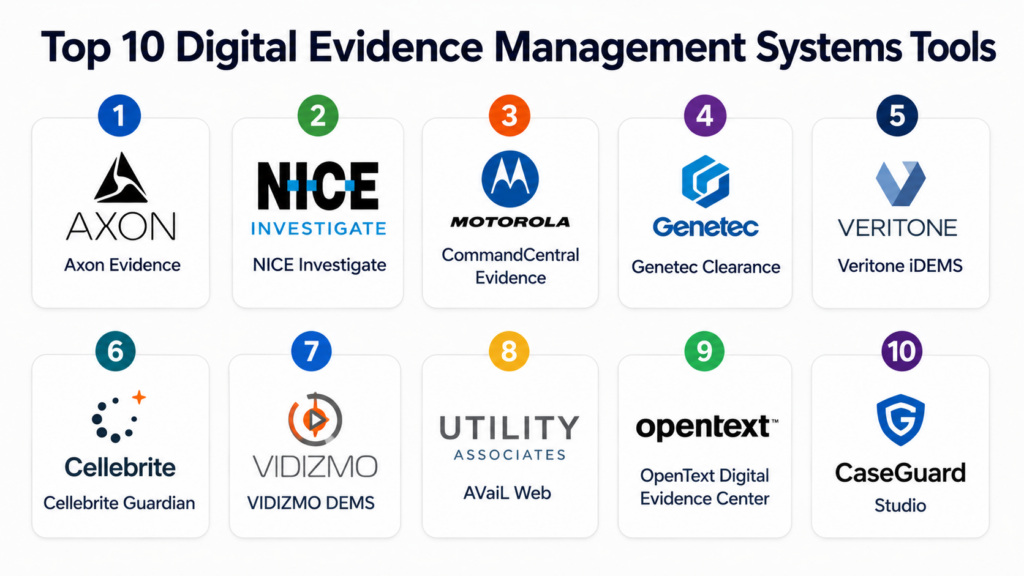
Introduction
Digital Evidence Management Systems help organizations securely collect, store, organize, analyze, and share digital evidence such as body camera footage, CCTV recordings, interview audio, forensic files, mobile evidence, and incident-related media. These platforms are widely used by law enforcement agencies, public safety organizations, legal teams, corporate investigators, and compliance departments to maintain chain-of-custody integrity and streamline investigations.
As digital evidence volumes continue growing across policing, transportation, smart cities, retail security, and enterprise environments, modern evidence management has become far more complex. Organizations now need scalable cloud storage, AI-powered search, automated retention policies, secure sharing workflows, and compliance-ready audit trails. The shift toward remote investigations, body-worn cameras, AI-assisted analytics, and stricter privacy regulations has made digital evidence platforms a critical operational requirement.
Common real-world use cases include:
- Police body camera and dashcam evidence management
- CCTV and surveillance video investigations
- Digital forensic case management
- Court evidence preparation and secure sharing
- Corporate fraud and compliance investigations
Buyers should evaluate:
- Chain-of-custody integrity
- Scalability for large video datasets
- AI search and analytics capabilities
- Security and encryption standards
- Compliance and audit logging
- Integration with CAD/RMS/VMS systems
- Ease of evidence sharing
- Mobile access and field usability
- Long-term storage and retention management
- Pricing and deployment flexibility
Best for: Law enforcement agencies, public safety departments, forensic labs, transportation authorities, airports, correctional facilities, legal teams, and enterprises handling sensitive digital investigations.
Not ideal for: Very small organizations with minimal evidence handling needs or teams requiring only basic file storage. Simpler document management or cloud storage tools may be sufficient for low-volume environments.
Key Trends in Digital Evidence Management Systems
- AI-powered video analysis is becoming standard for object detection, facial matching, transcription, and automated tagging.
- Cloud-native evidence platforms are replacing legacy on-premise storage systems.
- Integration with body cameras, drones, IoT sensors, and mobile devices is expanding rapidly.
- Automated redaction tools are improving privacy compliance and reducing manual review time.
- CJIS-focused security architectures remain a major purchasing requirement in public safety.
- Hybrid deployment models are growing for agencies balancing sovereignty and scalability.
- Evidence sharing with prosecutors, courts, and external agencies is becoming more workflow-driven.
- Mobile-first investigation capabilities are improving field response efficiency.
- Retention automation and policy-based deletion are increasingly important for compliance.
- AI-assisted search and natural-language querying are reducing investigation timelines.
How We Selected These Tools
The tools in this list were selected using a practical SaaS and operational evaluation framework focused on real-world digital evidence workflows.
Selection criteria included:
- Strong market adoption in law enforcement or enterprise investigations
- Broad digital evidence management capabilities
- Scalability for high-volume video and media storage
- Chain-of-custody and audit-tracking reliability
- Security and compliance posture signals
- AI and automation capabilities
- Integration ecosystem maturity
- Cloud and hybrid deployment flexibility
- Customer fit across SMB, mid-market, and enterprise agencies
- Operational usability for investigators and administrators
Top 10 Digital Evidence Management Systems Tools
#1 — Axon Evidence
Short description :
(6-8lines): Axon Evidence is one of the most recognized digital evidence management platforms in public safety. It is designed primarily for law enforcement agencies handling body camera footage, dashcam recordings, and investigative media. The platform combines cloud evidence storage with AI-assisted workflows, secure sharing, automated categorization, and case management support. Axon Evidence integrates tightly with the broader Axon ecosystem, including TASER devices and body-worn cameras. It is particularly well-suited for large police departments and agencies needing scalable evidence operations. The platform also emphasizes CJIS-oriented security controls and audit visibility.
Key Features
- Cloud-native evidence storage
- AI-assisted video transcription
- Automated redaction tools
- Chain-of-custody tracking
- Secure prosecutor evidence sharing
- Body camera integration
- Mobile evidence upload support
Pros
- Strong ecosystem integration
- Mature AI and workflow capabilities
- Highly scalable for large agencies
Cons
- Premium pricing structure
- Best experience tied to Axon hardware ecosystem
- Complex deployments for smaller agencies
Platforms / Deployment
- Web / iOS / Android
- Cloud
Security & Compliance
- MFA
- Audit logs
- RBAC
- Encryption
- CJIS-oriented security controls
Integrations & Ecosystem
Axon Evidence integrates deeply with law enforcement technology ecosystems including body cameras, RMS platforms, dispatch systems, and courtroom workflows.
- Axon body cameras
- CAD systems
- RMS integrations
- Mobile evidence capture
- Prosecutor sharing portals
- API support
Support & Community
Axon offers enterprise onboarding, training programs, implementation support, and extensive public safety deployment experience. Community adoption is strong across North America and global policing organizations.
#2 — NICE Investigate Digital Evidence Management
Short description :
(6-8lines): NICE Investigate is an enterprise-focused digital evidence management platform built for public safety and investigative operations. It centralizes evidence from multiple sources including CCTV, interview rooms, body cameras, and dispatch recordings. The platform is known for advanced analytics, case collaboration, and scalable evidence retention capabilities. NICE also emphasizes workflow efficiency for investigators and prosecutors. Agencies with complex multi-source evidence environments often choose NICE for its interoperability strengths. It is particularly effective in large metropolitan policing and transportation security environments.
Key Features
- Multi-source evidence ingestion
- Investigation workflow management
- AI-assisted search capabilities
- Video and audio analytics
- Secure collaboration tools
- Centralized evidence repository
- Advanced audit tracking
Pros
- Excellent multi-source integration
- Strong analytics capabilities
- Enterprise-grade scalability
Cons
- Can require significant implementation planning
- Higher operational complexity
- Premium enterprise pricing
Platforms / Deployment
- Web
- Cloud / Hybrid
Security & Compliance
- Encryption
- Audit logging
- Role-based access controls
- MFA
- Compliance-focused workflows
Integrations & Ecosystem
NICE integrates with surveillance systems, dispatch infrastructure, and investigative platforms across public safety ecosystems.
- CCTV systems
- CAD platforms
- Interview recording systems
- RMS integrations
- API connectivity
- Video analytics tools
Support & Community
NICE provides enterprise implementation assistance, technical consulting, and professional services. Adoption is strong among large public safety and transportation organizations.
#3 — Motorola Solutions CommandCentral Evidence
Short description :
(6-8lines): Motorola Solutions CommandCentral Evidence is designed for secure evidence management within public safety operations. The platform supports evidence collection from body cameras, in-car video systems, and public safety media workflows. It focuses heavily on operational efficiency, evidence integrity, and prosecutor collaboration. Motorola also integrates the platform with broader CommandCentral public safety solutions. Agencies looking for unified public safety workflows often benefit from this integrated ecosystem. The platform is widely used in police, emergency response, and municipal environments.
Key Features
- Digital evidence storage
- Secure sharing workflows
- Body camera integration
- Automated retention management
- Chain-of-custody controls
- Public safety workflow integration
- Video evidence management
Pros
- Strong public safety ecosystem
- Reliable integration capabilities
- Good scalability options
Cons
- Ecosystem benefits strongest with Motorola products
- Feature depth varies by deployment
- May require specialized onboarding
Platforms / Deployment
- Web / Mobile
- Cloud
Security & Compliance
- Encryption
- Audit trails
- Access management
- CJIS-oriented operational support
Integrations & Ecosystem
Motorola integrates CommandCentral Evidence with dispatch, records, surveillance, and emergency response systems.
- Motorola body cameras
- CAD systems
- RMS solutions
- Surveillance infrastructure
- Mobile workflows
- APIs
Support & Community
Motorola provides enterprise-grade support and implementation assistance. Public safety adoption and operational familiarity are significant strengths.
#4 — Genetec Clearance
Short description :
(6-8lines): Genetec Clearance focuses on collaborative digital evidence management and secure video evidence sharing. It is widely adopted in security operations, transportation, law enforcement, and smart city environments. The platform supports video retrieval, evidence collection, cloud-based case sharing, and collaborative investigations. Genetec’s open-platform strategy makes it attractive for organizations with mixed surveillance ecosystems. It is especially effective for agencies needing rapid external evidence sharing and centralized investigative workflows. The system also supports integration with Genetec Security Center environments.
Key Features
- Cloud evidence sharing
- Video evidence retrieval
- Case collaboration tools
- Surveillance integration
- Secure external access
- Audit logging
- Investigation workflows
Pros
- Strong interoperability
- Easy collaboration capabilities
- Effective video investigation workflows
Cons
- Advanced analytics may require additional tools
- Some enterprise features add complexity
- Costs can scale with storage usage
Platforms / Deployment
- Web
- Cloud / Hybrid
Security & Compliance
- MFA
- Encryption
- Audit trails
- Role-based permissions
Integrations & Ecosystem
Genetec Clearance integrates with surveillance ecosystems and public safety infrastructure.
- Genetec Security Center
- CCTV systems
- Video management systems
- Public safety platforms
- APIs
- Mobile uploads
Support & Community
Genetec has a strong global integrator ecosystem and enterprise support structure. Documentation and deployment resources are well developed.
#5 — Veritone iDEMS
Short description :
(6-8lines): Veritone iDEMS is an AI-driven digital evidence management system focused on automation, media analysis, and investigative efficiency. The platform leverages AI for transcription, object recognition, categorization, and advanced evidence search. It is designed for law enforcement, legal investigations, and media-intensive public safety environments. Agencies handling large video datasets benefit from Veritone’s automation capabilities. The platform also supports evidence collaboration and retention workflows. Its AI-first approach differentiates it from many traditional evidence repositories.
Key Features
- AI-powered media analysis
- Automated transcription
- Object and face detection
- Evidence categorization
- Secure cloud storage
- Advanced search functionality
- Case collaboration
Pros
- Strong AI capabilities
- Efficient large-scale media processing
- Good automation workflows
Cons
- AI configuration may require tuning
- Premium AI features can increase costs
- Smaller ecosystem than some competitors
Platforms / Deployment
- Web
- Cloud
Security & Compliance
- Encryption
- Access controls
- Audit tracking
- MFA
Integrations & Ecosystem
Veritone integrates with media ingestion tools, surveillance systems, and investigative workflows.
- Video systems
- Public safety tools
- APIs
- AI analytics modules
- Cloud storage integrations
Support & Community
Veritone offers enterprise onboarding and AI-focused implementation assistance. Support quality is generally strong for large deployments.
#6 — Cellebrite Guardian
Short description :
(6-8lines): Cellebrite Guardian is designed for secure digital evidence management focused heavily on mobile forensics and investigative workflows. It helps organizations manage extracted mobile device evidence, case files, and digital forensic data. The platform integrates tightly with Cellebrite forensic tools, creating a unified investigative workflow for digital evidence handling. It is widely used by forensic investigators, law enforcement agencies, and intelligence operations. Secure evidence sharing and centralized forensic management are major strengths. Organizations focused on mobile evidence investigations often prioritize this platform.
Key Features
- Mobile forensic evidence management
- Secure evidence sharing
- Case collaboration
- Chain-of-custody tracking
- Digital forensic workflows
- Centralized storage
- Investigator access controls
Pros
- Excellent mobile forensics integration
- Strong investigative workflow support
- Secure evidence sharing
Cons
- Best suited for forensic-focused environments
- Less generalized than broader DEMS platforms
- Advanced functionality may require Cellebrite ecosystem
Platforms / Deployment
- Web
- Cloud / Hybrid
Security & Compliance
- Encryption
- Audit logs
- Role-based access
- MFA
Integrations & Ecosystem
Cellebrite Guardian works closely with forensic investigation ecosystems and digital extraction tools.
- Cellebrite forensic products
- Investigation systems
- APIs
- Evidence sharing portals
- Case management tools
Support & Community
Cellebrite provides strong investigative training programs and enterprise support. Adoption is high in digital forensic communities.
#7 — VIDIZMO Digital Evidence Management System
Short description :
(6-8lines): VIDIZMO offers a flexible digital evidence management platform designed for law enforcement, public safety, and enterprise investigations. The system supports evidence ingestion, AI analytics, media management, and secure sharing. It is known for deployment flexibility including cloud, hybrid, and self-hosted environments. Organizations with data sovereignty concerns often consider VIDIZMO due to its deployment adaptability. The platform also supports automated redaction and video analytics workflows. It fits agencies seeking customization and infrastructure control.
Key Features
- AI-powered evidence search
- Automated redaction
- Multi-format media support
- Secure evidence sharing
- Video analytics
- Retention management
- Flexible deployment options
Pros
- Strong deployment flexibility
- Good customization capabilities
- AI-enabled investigation support
Cons
- Smaller market presence than leading competitors
- Advanced customization may increase setup complexity
- User experience varies by deployment
Platforms / Deployment
- Web / Windows
- Cloud / Self-hosted / Hybrid
Security & Compliance
- Encryption
- Audit logs
- MFA
- Role-based permissions
Integrations & Ecosystem
VIDIZMO integrates with surveillance, cloud storage, and investigative workflows.
- CCTV systems
- Azure integrations
- AWS integrations
- APIs
- Identity providers
- Media ingestion tools
Support & Community
VIDIZMO provides enterprise support and implementation services. Documentation quality is generally strong for technical teams.
#8 — Utility Associates AVaiL Web
Short description :
(6-8lines): Utility Associates AVaiL Web is designed for public safety video evidence and vehicle-based media management. It supports dashcam footage, body camera evidence, GPS-linked incident data, and field evidence workflows. The platform emphasizes operational visibility and centralized media management for police fleets and first responders. Agencies managing connected patrol vehicle environments often use AVaiL Web for evidence synchronization and review. Its operational focus differentiates it from broader enterprise-only evidence systems. The solution is particularly useful in transportation-heavy policing operations.
Key Features
- Fleet video evidence management
- GPS-linked incident tracking
- Dashcam integration
- Body camera support
- Secure media storage
- Incident synchronization
- Evidence retrieval tools
Pros
- Strong fleet integration
- Effective patrol video workflows
- Reliable field evidence synchronization
Cons
- More specialized toward fleet operations
- Limited enterprise investigation breadth
- UI modernization may vary
Platforms / Deployment
- Web
- Cloud / Hybrid
Security & Compliance
- Audit trails
- Encryption
- Role-based access
- CJIS-oriented operational support
Integrations & Ecosystem
The platform integrates with vehicle systems, cameras, and public safety workflows.
- Dash cameras
- GPS systems
- Body cameras
- Fleet systems
- Public safety infrastructure
Support & Community
Utility Associates provides implementation and operational support tailored to public safety fleets and patrol environments.
#9 — OpenText Digital Evidence Center
Short description :
(6-8lines): OpenText Digital Evidence Center focuses on enterprise-grade evidence handling and legal investigation workflows. It helps organizations manage digital evidence, case materials, and investigative collaboration in regulated environments. OpenText leverages its broader enterprise information management capabilities to support scalable digital investigations. The platform is suitable for legal operations, enterprise investigations, and compliance-heavy industries. Organizations handling sensitive legal workflows often value its governance and retention capabilities. It also supports secure collaboration across distributed teams.
Key Features
- Centralized evidence management
- Legal investigation support
- Governance workflows
- Retention management
- Secure collaboration
- Audit tracking
- Enterprise information integration
Pros
- Strong governance capabilities
- Enterprise-grade scalability
- Effective legal workflow support
Cons
- Can be complex for smaller organizations
- Broader enterprise focus may add overhead
- Pricing varies significantly
Platforms / Deployment
- Web
- Cloud / Hybrid
Security & Compliance
- Encryption
- RBAC
- Audit logging
- Enterprise security controls
Integrations & Ecosystem
OpenText integrates with enterprise content management and compliance ecosystems.
- Enterprise content systems
- Legal platforms
- APIs
- Identity management tools
- Compliance workflows
Support & Community
OpenText offers enterprise onboarding and professional services. Support depth is stronger for large enterprise customers.
#10 — CaseGuard Studio
Short description :
(6-8lines): CaseGuard Studio is a specialized redaction and evidence management platform widely used in law enforcement and legal workflows. It focuses on AI-assisted video, audio, image, and document redaction to support privacy and disclosure requirements. The platform helps agencies reduce manual editing workloads while improving compliance efficiency. It is especially useful for organizations processing public records requests and courtroom evidence disclosures. CaseGuard also supports transcription and media review workflows. Smaller agencies often adopt it for its targeted functionality and operational simplicity.
Key Features
- AI-assisted redaction
- Audio and video editing
- Document redaction
- Automated transcription
- Media review workflows
- Evidence export tools
- Privacy-focused processing
Pros
- Strong redaction capabilities
- Good operational efficiency
- Useful for disclosure workflows
Cons
- Narrower scope than full DEMS suites
- Less suited for massive evidence repositories
- Enterprise integrations can vary
Platforms / Deployment
- Windows
- Self-hosted
Security & Compliance
- Access controls
- Audit capabilities
- Encryption support
Integrations & Ecosystem
CaseGuard supports evidence processing and export workflows across legal and public safety environments.
- Video formats
- Audio processing
- Legal workflows
- Evidence export systems
- Transcription integrations
Support & Community
CaseGuard offers onboarding resources, product documentation, and operational support. Community adoption is growing in legal and law enforcement sectors.
Comparison Table Top 10
| Tool Name | Best For | Platform(s) Supported | Deployment | Standout Feature | Public Rating |
|---|---|---|---|---|---|
| Axon Evidence | Large law enforcement agencies | Web, iOS, Android | Cloud | AI-powered public safety ecosystem | N/A |
| NICE Investigate | Enterprise investigations | Web | Cloud, Hybrid | Multi-source evidence analytics | N/A |
| Motorola CommandCentral Evidence | Public safety operations | Web, Mobile | Cloud | Integrated public safety workflows | N/A |
| Genetec Clearance | Video collaboration workflows | Web | Cloud, Hybrid | Secure evidence sharing | N/A |
| Veritone iDEMS | AI-driven investigations | Web | Cloud | AI media analysis | N/A |
| Cellebrite Guardian | Mobile forensic evidence | Web | Cloud, Hybrid | Digital forensics integration | N/A |
| VIDIZMO DEMS | Flexible deployment needs | Web, Windows | Cloud, Self-hosted, Hybrid | Custom deployment flexibility | N/A |
| Utility Associates AVaiL Web | Fleet video evidence | Web | Cloud, Hybrid | Patrol vehicle integration | N/A |
| OpenText Digital Evidence Center | Enterprise legal workflows | Web | Cloud, Hybrid | Governance-focused evidence management | N/A |
| CaseGuard Studio | Redaction-heavy workflows | Windows | Self-hosted | AI-assisted redaction | N/A |
Evaluation & Scoring of Digital Evidence Management Systems
| Tool Name | Core 25% | Ease 15% | Integrations 15% | Security 10% | Performance 10% | Support 10% | Value 15% | Weighted Total |
|---|---|---|---|---|---|---|---|---|
| Axon Evidence | 9.5 | 8.5 | 9.5 | 9.5 | 9.0 | 9.0 | 7.5 | 8.98 |
| NICE Investigate | 9.2 | 7.8 | 9.3 | 9.2 | 9.1 | 8.8 | 7.2 | 8.63 |
| Motorola CommandCentral Evidence | 9.0 | 8.2 | 8.8 | 9.0 | 8.8 | 8.8 | 7.8 | 8.57 |
| Genetec Clearance | 8.7 | 8.6 | 8.9 | 8.8 | 8.7 | 8.5 | 8.0 | 8.52 |
| Veritone iDEMS | 8.9 | 7.9 | 8.4 | 8.7 | 8.8 | 8.3 | 7.5 | 8.26 |
| Cellebrite Guardian | 8.8 | 8.0 | 8.5 | 9.0 | 8.7 | 8.6 | 7.4 | 8.35 |
| VIDIZMO DEMS | 8.3 | 8.0 | 8.2 | 8.6 | 8.3 | 8.0 | 8.5 | 8.23 |
| Utility Associates AVaiL Web | 7.9 | 7.8 | 7.9 | 8.4 | 8.1 | 8.0 | 8.2 | 7.98 |
| OpenText Digital Evidence Center | 8.7 | 7.2 | 8.7 | 9.1 | 8.8 | 8.5 | 7.0 | 8.18 |
| CaseGuard Studio | 7.8 | 8.4 | 7.0 | 8.2 | 8.0 | 7.8 | 8.6 | 7.94 |
These scores are comparative rather than absolute. Higher scores generally indicate stronger enterprise readiness, integration maturity, and operational scalability. Organizations should prioritize categories that align most closely with their operational requirements. For example, agencies focused heavily on AI automation may prioritize Veritone, while organizations emphasizing governance may prefer OpenText. Smaller teams may value ease of use and pricing flexibility more than enterprise ecosystem depth.
Which Digital Evidence Management Systems Tool Is Right for You?
Solo / Freelancer
Independent investigators, legal consultants, and smaller forensic specialists often benefit from focused and affordable tools. CaseGuard Studio can work well for redaction-heavy workflows, while VIDIZMO may fit organizations needing flexible deployments without massive infrastructure requirements.
SMB
Small and mid-sized agencies usually need manageable deployment complexity with reliable evidence workflows. Genetec Clearance and VIDIZMO provide balanced scalability, collaboration, and operational usability for growing evidence environments.
Mid-Market
Mid-sized public safety organizations often require integrations, chain-of-custody automation, and centralized evidence management. Motorola CommandCentral Evidence and Cellebrite Guardian are strong choices depending on whether the focus is operational policing or digital forensics.
Enterprise
Large public safety agencies and multi-jurisdiction organizations generally need advanced analytics, AI workflows, governance, and scalability. Axon Evidence and NICE Investigate are among the strongest enterprise-grade options in this category.
Budget vs Premium
Budget-conscious organizations may prefer CaseGuard Studio or VIDIZMO for targeted operational requirements. Premium platforms like Axon and NICE deliver deeper ecosystem integration and AI automation but at significantly higher operational costs.
Feature Depth vs Ease of Use
Platforms with extensive capabilities can introduce operational complexity. Axon and NICE provide broad enterprise depth, while Genetec Clearance offers a more collaboration-focused experience with simpler workflows for many teams.
Integrations & Scalability
Organizations already invested in specific ecosystems should prioritize compatibility. Motorola customers often benefit from CommandCentral integration, while forensic-focused teams gain strong workflow continuity from Cellebrite Guardian.
Security & Compliance Needs
Public safety agencies with CJIS-oriented requirements should prioritize platforms with mature audit logging, encryption, access management, and evidence integrity workflows. Enterprise legal teams may additionally require strong governance and retention management features.
Frequently Asked Questions FAQs
1. What is a Digital Evidence Management System?
A Digital Evidence Management System is a platform used to securely collect, organize, store, review, and share digital evidence such as videos, images, audio recordings, forensic files, and surveillance footage. These systems help maintain evidence integrity through chain-of-custody controls and audit logging. Law enforcement agencies, legal organizations, and enterprises use them to improve investigative efficiency. Modern platforms also support AI-powered search, transcription, and redaction. As digital evidence volumes grow, manual handling becomes increasingly difficult without centralized management. DEMS platforms simplify compliance, collaboration, and evidence retrieval.
2. Why are cloud-based evidence systems becoming popular?
Cloud deployments reduce infrastructure overhead and improve scalability for large video datasets. Agencies can access evidence remotely, collaborate more easily with prosecutors, and expand storage without major hardware investments. Cloud platforms also support automatic updates and disaster recovery improvements. Many vendors now provide CJIS-oriented security controls and encrypted evidence handling. However, some agencies still prefer hybrid deployments due to sovereignty or regulatory concerns. The cloud model is particularly attractive for organizations experiencing rapid evidence growth.
3. How important is chain-of-custody tracking?
Chain-of-custody tracking is one of the most critical components of digital evidence management. It ensures that evidence integrity is preserved throughout collection, transfer, review, and courtroom presentation. Audit logs help organizations prove that evidence was not altered or improperly accessed. Without strong chain-of-custody controls, evidence credibility may be challenged during legal proceedings. Modern DEMS platforms automate much of this process through timestamping and access monitoring. Strong audit visibility also improves internal accountability.
4. What AI capabilities are commonly included?
Many modern platforms now include AI-assisted transcription, object recognition, facial matching, automated tagging, and video analytics. AI can significantly reduce investigation time by helping users search large evidence repositories more efficiently. Automated redaction is another rapidly growing capability. Some systems also support natural-language evidence searches and intelligent categorization. However, AI effectiveness depends heavily on training quality and operational tuning. Organizations should evaluate AI performance carefully before large-scale adoption.
5. How do these systems integrate with law enforcement infrastructure?
Digital evidence platforms commonly integrate with CAD systems, RMS platforms, body cameras, surveillance systems, interview room recording tools, and mobile devices. APIs are increasingly important for interoperability and workflow automation. Integration maturity can greatly impact operational efficiency. Agencies already invested in a vendor ecosystem often benefit from tighter workflow continuity. Buyers should evaluate both current integrations and future extensibility. Integration planning is frequently one of the biggest implementation challenges.
6. Are self-hosted deployments still relevant?
Yes, especially for organizations with strict data sovereignty or regulatory requirements. Some government agencies and forensic organizations prefer maintaining local infrastructure control. Hybrid deployments are also increasingly common because they combine local governance with cloud scalability. Self-hosted environments can provide greater customization flexibility. However, they also require more internal IT expertise and infrastructure management. Cloud platforms generally reduce operational complexity but may not fit every compliance requirement.
7. What are common mistakes during implementation?
One common mistake is underestimating storage growth from body cameras and high-resolution video evidence. Organizations also sometimes overlook integration planning and user training requirements. Weak retention policies can create unnecessary compliance risks and excessive storage costs. Another issue is selecting a platform without considering future scalability needs. Some agencies focus heavily on hardware while neglecting workflow usability. A successful deployment usually requires operational planning, governance policies, and cross-department collaboration.
8. How should organizations evaluate security capabilities?
Organizations should prioritize encryption, audit logging, role-based access controls, MFA support, and evidence integrity protections. Public safety agencies often require CJIS-oriented operational security controls. Legal and enterprise buyers may additionally evaluate governance, retention automation, and access monitoring capabilities. Buyers should also assess how vendors handle incident response and data backups. Third-party compliance certifications can be helpful if clearly documented. Security reviews should involve both operational and IT stakeholders.
9. Is switching evidence platforms difficult?
Migration complexity depends on evidence volume, metadata quality, integrations, and retention requirements. Organizations with many years of stored video footage often face significant migration planning challenges. Metadata preservation and chain-of-custody continuity are especially important during transitions. API availability can simplify evidence export and transfer workflows. Many vendors provide migration assistance services. Agencies should run pilot migrations before committing to full-scale transitions.
10. What alternatives exist besides full DEMS platforms?
Some organizations use basic cloud storage or enterprise content management tools for smaller evidence workloads. Video management systems can also handle certain surveillance-centric workflows. However, these alternatives often lack chain-of-custody automation, investigative workflows, AI analytics, and prosecutor-sharing capabilities. Dedicated DEMS platforms are generally better suited for regulated investigations and legal evidence handling. Organizations with high operational risk typically benefit from purpose-built evidence management solutions. The right choice depends on evidence volume, compliance exposure, and workflow complexity.
Conclusion
Digital Evidence Management Systems have become foundational infrastructure for modern investigations, public safety operations, legal workflows, and enterprise compliance programs. The rapid growth of body cameras, surveillance systems, digital forensics, and AI-powered investigations has transformed evidence handling into a highly data-intensive operational challenge. Organizations now require far more than simple storage — they need scalable workflows, chain-of-custody protection, AI-assisted analytics, secure collaboration, automated redaction, and strong governance controls. Platforms like Axon Evidence, NICE Investigate, and Motorola CommandCentral Evidence dominate large public safety environments, while tools such as VIDIZMO, CaseGuard Studio, and Cellebrite Guardian address more specialized operational requirements. There is no universal “best” platform because organizational priorities vary significantly across scalability, integrations, forensic depth, deployment flexibility, and budget constraints. The most effective approach is to shortlist several vendors, validate integrations with existing systems, run operational pilots using real evidence workflows, and carefully assess security, retention, and compliance requirements before making a long-term investment decision.
