MOTOSHARE 🚗🏍️
Rent Bikes & Cars Directly from Owners
Motoshare connects vehicle owners with people who need bikes and cars on rent. Owners earn from idle vehicles, and renters get flexible ride options.
Visit Motoshare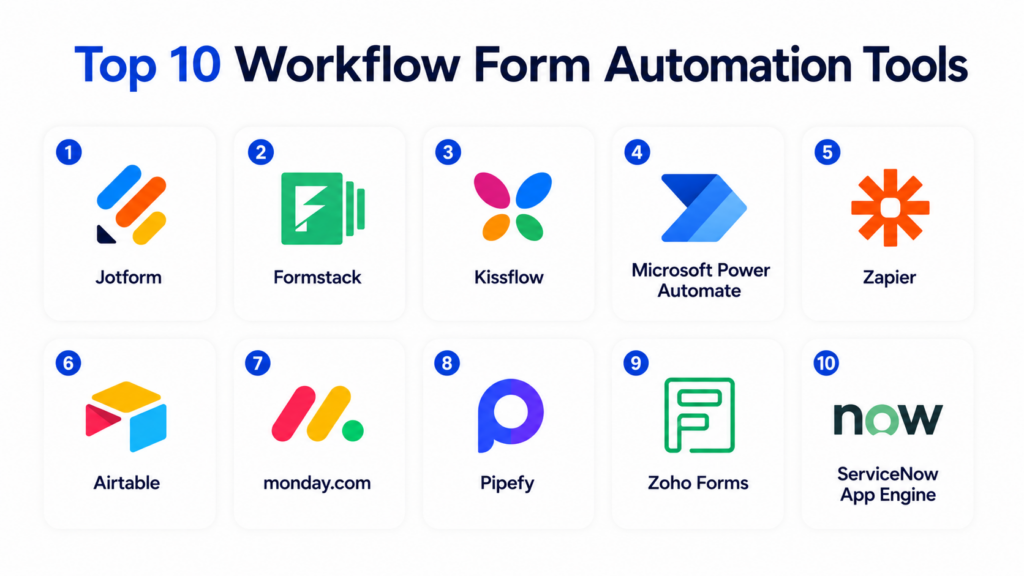
Introduction
Workflow Form Automation Tools help organizations create digital forms that automatically trigger actions, approvals, notifications, routing, document generation, and business processes. Instead of manually handling requests through emails, spreadsheets, or paper forms, these platforms automate how information moves across teams and systems.These tools are increasingly important because businesses now rely heavily on digital workflows for HR onboarding, purchase approvals, incident reporting, lead capture, customer intake, IT requests, compliance reviews, and operational processes. Modern workflow form automation platforms combine drag-and-drop form builders, automation engines, integrations, analytics, and no-code workflows to reduce manual work and improve process visibility.
Real-world use cases include:
- Employee onboarding and HR approvals
- Customer intake and support workflows
- Purchase request and procurement approvals
- Incident reporting and compliance management
- Lead generation and CRM automation
Key evaluation criteria buyers should consider:
- Workflow automation depth
- Ease of form creation
- Conditional logic support
- Approval routing capabilities
- CRM and productivity integrations
- Security and permissions management
- Reporting and analytics
- Mobile responsiveness
- Scalability across departments
- No-code and low-code flexibility
Best for: HR teams, operations teams, IT departments, finance teams, customer service teams, SMBs, enterprises, agencies, and organizations managing repeatable business workflows.
Not ideal for: Businesses needing only simple contact forms, teams with very low submission volume, or organizations requiring fully custom enterprise application development.
Key Trends in Workflow Form Automation Tools
- AI-assisted workflow generation is becoming more common in no-code platforms.
- Approval automation is replacing email-based routing processes.
- Workflow forms are increasingly connected directly to CRM and ERP systems.
- Conditional logic and dynamic field rendering are improving user experience.
- Embedded automation is reducing manual data entry between systems.
- Enterprises are prioritizing auditability and governance in automated workflows.
- Workflow analytics are helping organizations optimize approval bottlenecks.
- Mobile-first workflow forms are becoming standard for distributed workforces.
- Low-code workflow automation is reducing dependence on IT teams.
- Cross-platform automation through integration tools is expanding rapidly.
How We Selected These Tools
The following workflow form automation tools were selected using practical automation, usability, integration, and governance criteria.
- Evaluated market adoption and platform maturity
- Reviewed workflow automation flexibility
- Assessed form creation and usability
- Considered approval routing and orchestration capabilities
- Evaluated integration ecosystems
- Reviewed reporting and analytics features
- Assessed scalability for SMB and enterprise use
- Considered security and permissions management
- Evaluated no-code and low-code workflow support
- Balanced lightweight and enterprise-grade platforms
Top 10 Workflow Form Automation Tools
1- Jotform
Short description: Jotform is a no-code workflow form automation platform that combines drag-and-drop forms, approvals, automation, document generation, payments, and workflow routing. It is widely used across HR, healthcare, education, operations, and customer service workflows because of its flexibility and ease of use. Jotform helps organizations automate repetitive processes such as onboarding, intake, approvals, and request management without requiring complex coding. It supports both SMB and enterprise-scale workflow automation environments.
Key Features
- Drag-and-drop workflow forms
- Approval automation
- Conditional logic
- Payment collection
- PDF document generation
- Workflow routing
- Integration automation
Pros
- Broad no-code workflow flexibility
- Strong template ecosystem
- Useful across many departments
Cons
- Advanced governance requires setup
- Pricing scales with usage
- Large workflows can become complex
Platforms / Deployment
- Web / Mobile
- Cloud
Security & Compliance
Supports encryption, permissions, SSO on applicable plans, and enterprise security workflows.
Integrations & Ecosystem
Jotform integrates with CRM, payment, productivity, and workflow systems for operational automation.
- Salesforce
- Google Workspace
- Microsoft 365
- Stripe
- PayPal
- Zapier
Support & Community
Large template library, onboarding guidance, documentation, and enterprise support options.
2- Formstack
Short description: Formstack is a workflow automation platform focused on secure forms, approvals, document workflows, and operational automation. It helps organizations automate employee onboarding, customer intake, approvals, healthcare workflows, and business processes with strong workflow orchestration capabilities. Formstack is especially useful for regulated industries and operational teams that require secure form handling and advanced automation workflows.
Key Features
- Workflow automation
- Secure forms
- Approval routing
- Conditional workflows
- Document automation
- E-signatures
- Data collection management
Pros
- Strong operational workflow support
- Good secure workflow capabilities
- Useful document automation features
Cons
- More complex than lightweight tools
- Advanced workflows require planning
- Higher pricing for enterprise features
Platforms / Deployment
- Web
- Cloud
Security & Compliance
Supports secure workflows, permissions, encryption, and enterprise access controls depending on deployment.
Integrations & Ecosystem
Formstack integrates with CRM, productivity, and workflow automation platforms.
- Salesforce
- HubSpot
- Zapier
- Microsoft 365
- Google Workspace
- Payment systems
Support & Community
Provides onboarding, enterprise consulting, workflow guidance, and documentation resources.
3- Kissflow
Short description: Kissflow is a low-code workflow automation and business process management platform that allows organizations to automate forms, approvals, requests, and operational workflows. It is designed for teams that need configurable workflow orchestration without building custom software. Kissflow is especially useful for procurement, HR, finance, operations, and enterprise process automation workflows.
Key Features
- Workflow form builder
- Approval routing
- Process automation
- Low-code workflow design
- Role-based task management
- Reporting dashboards
- Workflow analytics
Pros
- Strong business workflow automation
- Good no-code process orchestration
- Useful enterprise workflow visibility
Cons
- Learning curve for advanced workflows
- Premium pricing for enterprise use
- Requires process planning
Platforms / Deployment
- Web / Mobile
- Cloud
Security & Compliance
Supports RBAC, encryption, permissions, workflow governance, and enterprise controls.
Integrations & Ecosystem
Kissflow integrates with business systems and operational automation workflows.
- CRM systems
- ERP systems
- Slack
- Microsoft 365
- Google Workspace
- APIs
Support & Community
Provides enterprise onboarding, implementation guidance, and workflow consulting.
4- Microsoft Power Automate
Short description: Microsoft Power Automate is a workflow automation platform that helps organizations automate approvals, form submissions, notifications, document processing, and operational workflows across Microsoft and third-party systems. It is especially valuable for enterprises standardized on Microsoft 365. Power Automate combines low-code automation, robotic process automation, and workflow orchestration capabilities with Microsoft Forms and SharePoint workflows.
Key Features
- Workflow automation
- Approval processes
- Robotic process automation
- Microsoft ecosystem integration
- Conditional workflows
- Notification automation
- API-based integrations
Pros
- Excellent Microsoft ecosystem integration
- Strong enterprise automation support
- Good low-code workflow flexibility
Cons
- Advanced workflows can become complex
- Licensing varies across features
- Best value inside Microsoft ecosystem
Platforms / Deployment
- Web / Windows / Mobile
- Cloud / Hybrid
Security & Compliance
Supports Microsoft enterprise security controls, RBAC, encryption, audit logs, and governance features.
Integrations & Ecosystem
Power Automate integrates deeply with Microsoft business workflows and external SaaS systems.
- Microsoft Forms
- SharePoint
- Teams
- Dynamics 365
- Salesforce
- APIs
Support & Community
Large enterprise ecosystem with extensive documentation, community support, and Microsoft guidance.
5- Zapier
Short description: Zapier is a no-code workflow automation platform that connects applications and automates repetitive tasks using trigger-and-action workflows. While not strictly a form builder, Zapier is heavily used alongside forms to automate lead routing, approvals, notifications, CRM updates, and operational workflows. It is especially useful for SMBs and non-technical teams that need cross-application workflow automation quickly.
Key Features
- Trigger-based automation
- App integrations
- Multi-step workflows
- Conditional logic
- AI-assisted automation
- Notification workflows
- No-code automation builder
Pros
- Huge integration ecosystem
- Very easy automation setup
- Good SMB workflow flexibility
Cons
- Complex workflows can become expensive
- Heavy automation depends on integrations
- Governance is lighter than enterprise BPM tools
Platforms / Deployment
- Web
- Cloud
Security & Compliance
Supports account controls, permissions, and workflow administration features.
Integrations & Ecosystem
Zapier connects thousands of SaaS applications and workflow systems.
- Google Workspace
- Salesforce
- Slack
- Airtable
- HubSpot
- Microsoft 365
Support & Community
Extensive documentation, large automation community, and broad integration support.
6- Airtable
Short description: Airtable combines database-style workflow management with forms, automation, approvals, and collaborative process management. It allows organizations to collect data through forms and automate workflows directly inside structured operational databases. Airtable is especially useful for project management, operations, marketing, content workflows, and collaborative business processes.
Key Features
- Database-connected forms
- Workflow automation
- Approval tracking
- Collaboration workflows
- Conditional automation
- Custom dashboards
- Data organization
Pros
- Strong operational workflow flexibility
- Good collaboration support
- Useful low-code environment
Cons
- Advanced database structures require planning
- Complex workflows need governance
- Less traditional BPM functionality
Platforms / Deployment
- Web / Mobile / Desktop app
- Cloud
Security & Compliance
Supports permissions, access controls, admin management, and secure collaboration workflows.
Integrations & Ecosystem
Airtable integrates with workflow, collaboration, and automation systems.
- Slack
- Zapier
- Google Workspace
- CRM systems
- Project management tools
- APIs
Support & Community
Large user community with templates, workflow examples, and onboarding resources.
7- monday.com
Short description: monday.com is a work management and workflow automation platform that includes forms, approvals, project workflows, and operational process automation. Organizations use it to automate requests, task routing, onboarding workflows, and operational approvals across departments. It is especially useful for collaborative teams that want visual workflow management combined with simple form automation.
Key Features
- Workflow forms
- Visual process automation
- Approval management
- Task routing
- Workflow dashboards
- Team collaboration
- Automation rules
Pros
- Easy visual workflow management
- Good collaboration features
- Useful cross-functional workflows
Cons
- Complex enterprise automation may require customization
- Pricing scales with users
- Deep BPM workflows are limited
Platforms / Deployment
- Web / Mobile
- Cloud
Security & Compliance
Supports permissions, SSO, admin controls, encryption, and enterprise governance options.
Integrations & Ecosystem
monday.com integrates with productivity, CRM, and workflow systems.
- Slack
- Microsoft Teams
- Salesforce
- Google Workspace
- Jira
- Zapier
Support & Community
Provides onboarding, workflow templates, documentation, and customer success support.
8- Pipefy
Short description: Pipefy is a workflow automation and process management platform designed for structured business workflows such as procurement, HR operations, finance approvals, and service requests. It combines forms, automation, approvals, SLA tracking, and operational visibility into one platform. Pipefy is especially useful for organizations standardizing repeatable processes across departments.
Key Features
- Workflow forms
- Process automation
- SLA tracking
- Approval routing
- Workflow analytics
- Role-based permissions
- No-code process builder
Pros
- Strong operational process management
- Good approval workflow visibility
- Useful governance features
Cons
- Requires process design planning
- Enterprise workflows may need training
- Smaller ecosystem than larger platforms
Platforms / Deployment
- Web / Mobile
- Cloud
Security & Compliance
Supports permissions, encryption, audit workflows, and governance controls.
Integrations & Ecosystem
Pipefy integrates with CRM, ERP, and collaboration workflows.
- Salesforce
- Slack
- Microsoft Teams
- ERP systems
- APIs
- Workflow automation tools
Support & Community
Provides onboarding, process consulting, workflow guidance, and customer support.
9- Zoho Forms
Short description: Zoho Forms is a cloud-based form automation platform integrated with the broader Zoho ecosystem. It supports approvals, notifications, workflow routing, and operational automation across sales, HR, customer support, and internal business processes. Zoho Forms is especially useful for SMBs already using Zoho applications because of its native integrations and affordable workflow capabilities.
Key Features
- Drag-and-drop form creation
- Workflow approvals
- Conditional automation
- Mobile forms
- Notifications and routing
- Analytics and reporting
- Offline submission support
Pros
- Strong Zoho ecosystem integration
- Good SMB workflow automation
- Useful mobile workflows
Cons
- Best value inside Zoho ecosystem
- Enterprise governance is lighter
- Complex workflows may require additional Zoho tools
Platforms / Deployment
- Web / iOS / Android
- Cloud
Security & Compliance
Supports permissions, secure form workflows, and administrative controls.
Integrations & Ecosystem
Zoho Forms integrates deeply with Zoho business applications and productivity tools.
- Zoho CRM
- Zoho Desk
- Zoho Campaigns
- Google Workspace
- Payment gateways
- APIs
Support & Community
Provides onboarding resources, documentation, and customer support for SMB workflows.
10- ServiceNow App Engine
Short description: ServiceNow App Engine is an enterprise workflow automation and low-code application platform that allows organizations to automate service requests, approvals, forms, case management, and operational workflows. It is especially useful for large enterprises managing IT, HR, legal, finance, and cross-functional service workflows with strong governance and scalability requirements.
Key Features
- Enterprise workflow automation
- Service request forms
- Case management
- Approval orchestration
- Low-code application builder
- SLA management
- Operational analytics
Pros
- Strong enterprise workflow governance
- Excellent scalability
- Good IT and service management workflows
Cons
- Complex enterprise implementation
- Premium pricing
- Requires dedicated administration
Platforms / Deployment
- Web / Mobile
- Cloud / Hybrid
Security & Compliance
Supports enterprise-grade RBAC, encryption, audit logging, SSO, and governance workflows.
Integrations & Ecosystem
ServiceNow integrates with enterprise IT, operations, and workflow systems.
- Microsoft 365
- Jira
- ERP systems
- CRM systems
- APIs
- ITSM workflows
Support & Community
Large enterprise ecosystem with consulting partners, documentation, training, and support programs.
Comparison Table
| Tool Name | Best For | Platform(s) Supported | Deployment | Standout Feature | Public Rating |
|---|---|---|---|---|---|
| Jotform | General workflow forms | Web, Mobile | Cloud | Broad no-code workflow flexibility | N/A |
| Formstack | Secure operational workflows | Web | Cloud | Workflow and document automation | N/A |
| Kissflow | Business process automation | Web, Mobile | Cloud | Low-code process orchestration | N/A |
| Microsoft Power Automate | Microsoft enterprise workflows | Web, Windows, Mobile | Cloud, Hybrid | Microsoft ecosystem automation | N/A |
| Zapier | Cross-app automation | Web | Cloud | Massive integration ecosystem | N/A |
| Airtable | Database-driven workflows | Web, Mobile, Desktop | Cloud | Collaborative operational workflows | N/A |
| monday.com | Team workflow management | Web, Mobile | Cloud | Visual workflow automation | N/A |
| Pipefy | Structured process automation | Web, Mobile | Cloud | SLA-driven workflows | N/A |
| Zoho Forms | SMB workflow automation | Web, Mobile | Cloud | Zoho-native workflow integration | N/A |
| ServiceNow App Engine | Enterprise service workflows | Web, Mobile | Cloud, Hybrid | Enterprise workflow governance | N/A |
Evaluation & Scoring of Workflow Form Automation Tools
| Tool Name | Core 25% | Ease 15% | Integrations 15% | Security 10% | Performance 10% | Support 10% | Value 15% | Weighted Total |
|---|---|---|---|---|---|---|---|---|
| Jotform | 9.0 | 8.5 | 8.5 | 8.5 | 8.5 | 8.5 | 8.5 | 8.6 |
| Formstack | 9.0 | 7.5 | 8.5 | 8.5 | 8.5 | 8.5 | 7.5 | 8.4 |
| Kissflow | 8.5 | 7.5 | 8.5 | 8.5 | 8.5 | 8.0 | 7.5 | 8.1 |
| Microsoft Power Automate | 9.0 | 7.0 | 9.5 | 9.0 | 8.5 | 8.5 | 8.0 | 8.6 |
| Zapier | 8.0 | 9.0 | 10.0 | 7.5 | 8.0 | 8.0 | 8.5 | 8.5 |
| Airtable | 8.5 | 8.0 | 8.5 | 8.0 | 8.5 | 8.0 | 8.0 | 8.3 |
| monday.com | 8.0 | 8.5 | 8.5 | 8.0 | 8.0 | 8.0 | 8.0 | 8.2 |
| Pipefy | 8.5 | 7.5 | 8.0 | 8.5 | 8.5 | 8.0 | 8.0 | 8.2 |
| Zoho Forms | 8.0 | 8.0 | 8.5 | 8.0 | 8.0 | 8.0 | 8.5 | 8.1 |
| ServiceNow App Engine | 9.5 | 6.5 | 9.0 | 9.5 | 9.0 | 8.5 | 6.5 | 8.5 |
These scores are comparative and intended to help buyers evaluate workflow form automation platforms based on workflow complexity, governance, integrations, and scalability. Jotform and Formstack are strong for broad workflow automation, Microsoft Power Automate excels in Microsoft-centric enterprises, Zapier is excellent for cross-app automation, and ServiceNow App Engine is best suited for enterprise-scale service workflows.
Which Workflow Form Automation Tool Is Right for You?
Solo / Freelancer
Solo professionals usually need lightweight workflow automation for intake forms, lead capture, scheduling, or approvals. Jotform, Zapier, Zoho Forms, or Airtable are practical because they are easy to deploy and require minimal technical expertise.
SMB
SMBs should prioritize affordability, integrations, automation flexibility, and ease of deployment. Jotform, Zapier, monday.com, Zoho Forms, and Airtable are strong choices for growing teams handling operational workflows without dedicated IT departments.
Mid-Market
Mid-market organizations often need stronger approvals, reporting, automation orchestration, and governance. Formstack, Kissflow, Pipefy, Airtable, and Microsoft Power Automate can support more structured operational workflows effectively.
Enterprise
Enterprises should prioritize governance, auditability, scalability, integrations, role-based permissions, and workflow orchestration. ServiceNow App Engine, Microsoft Power Automate, Kissflow, and Formstack are strong enterprise options depending on infrastructure requirements.
Budget vs Premium
Budget-conscious teams may prefer Zapier, Zoho Forms, or Jotform for quick workflow automation. Premium platforms are better suited for organizations needing enterprise approvals, SLA management, governance, and advanced process orchestration.
Feature Depth vs Ease of Use
Zapier and Jotform are easier for beginners and SMBs. ServiceNow and Power Automate provide deeper enterprise workflow capabilities but require more planning and administration. Airtable offers strong operational flexibility with moderate learning requirements.
Integrations & Scalability
Organizations should prioritize integrations with CRM systems, ERP platforms, productivity suites, document systems, collaboration tools, and APIs. Workflow automation becomes most valuable when forms connect directly to operational systems.
Security & Compliance Needs
Healthcare, finance, legal, HR, and enterprise teams should evaluate encryption, audit logs, role-based permissions, workflow governance, and secure data handling before deploying sensitive workflows.
Frequently Asked Questions
1. What are workflow form automation tools?
Workflow form automation tools combine digital forms with automation engines that trigger actions, approvals, notifications, routing, and business processes automatically. Instead of manually handling requests through email or spreadsheets, these platforms move work through predefined workflows. They help organizations reduce delays, improve consistency, and centralize operational processes. Many tools also support integrations, analytics, document generation, and low-code workflow customization. These systems are widely used across HR, operations, finance, and customer service teams.
2. Why do businesses use workflow form automation?
Businesses use workflow form automation to reduce repetitive manual work and improve operational efficiency. Automated workflows reduce approval delays, minimize errors, improve tracking, and create better accountability. Organizations also gain better visibility into process bottlenecks and workflow performance. Automation helps teams scale processes without increasing administrative overhead. It is especially useful for repeatable processes such as onboarding, procurement, approvals, and customer intake.
3. What is the difference between a form builder and workflow automation platform?
A basic form builder focuses mainly on collecting information through digital forms. Workflow automation platforms go further by routing submissions, triggering approvals, generating documents, assigning tasks, updating systems, and automating business processes. Some tools combine both capabilities in one platform. Organizations should evaluate whether they only need data collection or full operational automation. Complex business workflows usually require stronger orchestration capabilities.
4. Are workflow form automation tools secure?
Workflow form automation tools can be secure when they provide encryption, permissions management, audit logs, role-based access controls, secure integrations, and workflow governance. Security is especially important when forms contain customer, employee, healthcare, financial, or legal information. Enterprises should review vendor security features carefully before deployment. Regulated industries may require stronger compliance workflows and approval controls.
5. Can workflow forms integrate with CRM and ERP systems?
Yes, many workflow automation tools integrate with CRM, ERP, HR, ITSM, and productivity systems. Integrations allow forms to automatically create tickets, update customer records, assign approvals, generate invoices, or trigger operational workflows. This reduces manual data entry and improves process consistency. API access is especially important for enterprise automation. Integration quality should always be validated before large-scale rollout.
6. What workflows are commonly automated?
Common workflows include employee onboarding, leave requests, procurement approvals, customer intake, incident reporting, service requests, lead capture, invoice approvals, vendor onboarding, and compliance reviews. Workflow form automation is especially effective for repeatable processes involving multiple stakeholders or approval stages. Organizations often begin with one operational process before expanding automation across departments.
7. How long does implementation take?
Simple workflows can often be deployed quickly using templates and drag-and-drop automation. More advanced enterprise workflows may require process mapping, integrations, permissions setup, governance review, and testing. Organizations should start with a pilot workflow before scaling automation broadly. Large deployments often involve cross-functional process redesign and training. Successful implementation depends heavily on process clarity and stakeholder alignment.
8. What mistakes should buyers avoid?
A common mistake is automating broken or unclear processes without redesigning them first. Buyers should also avoid choosing tools without evaluating integration quality, permissions management, and scalability. Another mistake is overcomplicating workflows with unnecessary approval layers. Teams should begin with practical workflows that provide immediate operational value. User adoption and governance planning are also critical for long-term success.
9. What industries benefit most from workflow form automation?
Healthcare, finance, education, HR, legal, government, manufacturing, customer support, and IT operations benefit heavily from workflow form automation because they manage structured operational requests and approvals. However, almost any organization with repetitive processes can benefit from automation. The strongest value usually appears where workflows involve multiple teams, approvals, or manual data handling.
10. What are the best alternatives to workflow form automation tools?
Alternatives include spreadsheets, email approvals, shared documents, ticketing systems, custom-built applications, or manual paper processes. These alternatives may work for small teams but become inefficient as process complexity grows. Dedicated workflow form automation tools are better for visibility, accountability, integrations, approvals, and scalability. The best solution depends on process complexity, compliance requirements, and organizational maturity.
Conclusion
Workflow form automation tools help organizations streamline operations by combining digital forms with approvals, routing, notifications, integrations, and automated business processes. The best platform depends on workflow complexity, governance requirements, integration needs, and organizational scale. Jotform and Formstack are strong all-purpose workflow form platforms, while Zapier excels at cross-application automation and Airtable supports flexible operational workflows. Kissflow, Pipefy, and monday.com provide structured process automation for business teams, while Microsoft Power Automate and ServiceNow App Engine deliver enterprise-grade orchestration and governance capabilities. Zoho Forms is especially useful for SMBs already using the Zoho ecosystem. Organizations should shortlist tools based on actual operational workflows, map approval processes clearly, validate integrations and security controls, run pilot deployments with real users, and scale automation gradually as adoption and process maturity improve.
