MOTOSHARE 🚗🏍️
Rent Bikes & Cars Directly from Owners
Motoshare connects vehicle owners with people who need bikes and cars on rent. Owners earn from idle vehicles, and renters get flexible ride options.
Visit Motoshare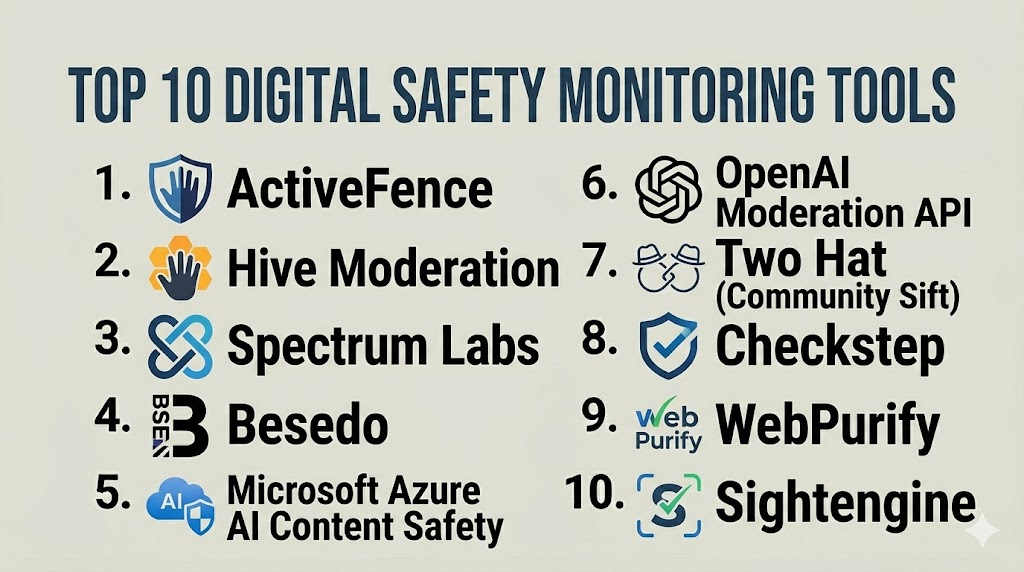
Introduction
Digital Safety Monitoring Tools help organizations identify, monitor, detect, and respond to online safety risks across digital platforms, communities, applications, social channels, marketplaces, messaging systems, and enterprise environments. These tools support trust and safety operations by detecting harmful content, scams, fraud, cyberbullying, impersonation, misinformation, account abuse, toxic behavior, and other digital risks.As businesses increasingly depend on online engagement, user-generated content, and AI-driven interactions, digital safety monitoring has become a strategic operational requirement. Organizations must now balance user growth, compliance, reputation protection, and platform integrity while handling large-scale digital interactions in real time. Modern digital safety platforms combine AI detection, behavioral analytics, automated moderation, human review workflows, and risk intelligence to maintain safer digital ecosystems.
Real-world use cases include:
- Monitoring harmful or abusive online content
- Detecting fraud, scams, impersonation, and fake accounts
- Managing safety risks in gaming and social platforms
- Protecting online communities and marketplaces
- Monitoring AI-generated content and policy violations
When evaluating Digital Safety Monitoring Tools, buyers should consider:
- AI detection accuracy and explainability
- Real-time monitoring and alerting
- Text, image, audio, and video analysis support
- Human review and escalation workflows
- Behavioral and risk analytics
- API integrations and developer tooling
- Scalability for high-volume platforms
- Audit logging and governance controls
- Multilingual moderation support
- Security and compliance readiness
Best for: Social platforms, gaming companies, SaaS vendors, marketplaces, fintech products, online communities, creator platforms, edtech platforms, and enterprise collaboration tools.
Not ideal for: Small static websites, low-interaction internal systems, or businesses without user-generated content or digital engagement risks.
Key Trends in Digital Safety Monitoring Tools
- AI-powered moderation and risk detection are becoming standard platform infrastructure.
- Multimodal monitoring now includes text, images, video, livestreams, and audio.
- Human-in-the-loop moderation models remain critical for nuanced policy decisions.
- Real-time moderation is increasingly required for gaming, chat, and livestream environments.
- AI safety and generative AI monitoring are becoming major investment areas.
- Marketplace fraud detection is merging with content moderation operations.
- Regulatory pressure is increasing around online safety and harmful content governance.
- Behavioral analytics and trust scoring are improving proactive risk detection.
- Multilingual safety monitoring is becoming essential for global communities.
- Moderator wellness and workflow automation are gaining operational importance.
How We Selected These Tools
- Evaluated adoption across trust and safety, moderation, and digital risk operations
- Prioritized tools with AI-assisted safety monitoring and scalable workflows
- Compared multimodal moderation coverage across text, image, audio, and video
- Reviewed fraud, abuse, toxicity, and behavioral detection capabilities
- Assessed integration flexibility and developer ecosystem maturity
- Compared scalability for startups through enterprise digital platforms
- Evaluated analytics, auditability, and operational governance features
- Reviewed multilingual support and global deployment readiness
- Assessed security posture signals and access control capabilities
- Balanced enterprise trust-and-safety suites with developer-first APIs
Top 10 Digital Safety Monitoring Tools
#1 — ActiveFence
Short description :
ActiveFence is an enterprise-grade digital safety and trust platform focused on detecting harmful content, abuse networks, fraud, extremism, misinformation, and platform integrity risks. It combines AI moderation, behavioral intelligence, policy workflows, and human review capabilities. The platform is especially valuable for large-scale social platforms, marketplaces, gaming ecosystems, and digital communities. ActiveFence is known for proactive threat intelligence and multimodal safety monitoring capabilities.
Key Features
- AI-powered harmful content detection
- Behavioral risk and abuse analysis
- Fraud and scam monitoring
- Multimodal moderation support
- Human review workflows
- Policy enforcement automation
- Trust and safety analytics
Pros
- Strong enterprise-scale safety monitoring
- Advanced risk intelligence capabilities
- Useful for complex abuse detection scenarios
Cons
- Enterprise-oriented pricing and deployment
- May be too advanced for smaller teams
- Requires policy and workflow planning
Platforms / Deployment
- Web
- Cloud
Security & Compliance
- Access controls and audit workflows
- Encryption support
- SOC 2 and ISO 27001 publicly referenced by vendor materials
- Role-based administration support
Integrations & Ecosystem
ActiveFence supports integrations across moderation, analytics, and trust-and-safety operations.
- APIs
- Marketplace systems
- Community platforms
- Case management workflows
- Moderation dashboards
Support & Community
Enterprise onboarding, trust-and-safety consulting, implementation support, and operational guidance are available.
#2 — Hive Moderation
Short description :
Hive Moderation is an AI-powered moderation and digital safety monitoring platform supporting text, image, video, and audio analysis. It helps organizations detect harmful, violent, explicit, or policy-violating content at scale. Hive is commonly used by marketplaces, gaming companies, social platforms, and creator ecosystems. The platform emphasizes developer-friendly APIs and scalable automated moderation.
Key Features
- Text, image, audio, and video moderation
- Real-time AI content classification
- Spam and abuse detection
- Custom moderation thresholds
- Moderation dashboards
- API-first deployment
- Multilingual moderation support
Pros
- Strong multimodal moderation support
- Developer-friendly APIs
- Good scalability for large platforms
Cons
- Human review workflows may need additional tooling
- Enterprise usage can become expensive at scale
- Requires moderation policy tuning
Platforms / Deployment
- Web
- Cloud
Security & Compliance
- Secure API access
- Access controls and encryption support
- Compliance certifications: Varies / N/A
Integrations & Ecosystem
Hive integrates into digital safety and moderation pipelines through APIs and automation workflows.
- APIs
- Marketplace systems
- Gaming platforms
- Social platforms
- Analytics dashboards
Support & Community
Provides documentation, onboarding assistance, API support, and enterprise customer success programs.
#3 — Spectrum Labs
Short description :
Spectrum Labs specializes in AI-powered trust and safety monitoring focused on toxic behavior, harassment, hate speech, scams, grooming, and harmful interactions. It is widely used in gaming, dating, social, and messaging environments where behavioral context matters. The platform focuses on identifying subtle risk patterns rather than simple keyword filtering.
Key Features
- Context-aware toxicity detection
- Behavioral risk analysis
- Grooming and harassment monitoring
- Risk scoring workflows
- AI moderation automation
- Human review support
- Multilingual safety detection
Pros
- Strong behavioral detection capabilities
- Useful for messaging and gaming environments
- Good contextual AI moderation
Cons
- Advanced implementation may require policy tuning
- Best suited for active conversation environments
- Premium pricing for enterprise usage
Platforms / Deployment
- Web
- Cloud
Security & Compliance
- Encryption and access control support
- Moderation logging workflows
- Compliance certifications: Not publicly stated
Integrations & Ecosystem
Supports integrations into messaging, gaming, and community ecosystems.
- Messaging platforms
- Community systems
- APIs
- Gaming platforms
- Moderation workflows
Support & Community
Enterprise onboarding, implementation guidance, and safety operations support are available.
#4 — Besedo
Short description :
Besedo is a digital safety and moderation platform designed for marketplaces, classifieds, and online communities. It combines AI moderation, fraud detection, human moderation services, and policy enforcement workflows. Besedo is especially strong in marketplace safety and listing quality management.
Key Features
- Marketplace moderation workflows
- Fraud and scam detection
- AI plus human moderation
- Listing review systems
- Text and image moderation
- Policy enforcement automation
- Analytics and reporting
Pros
- Strong marketplace safety expertise
- Combines AI with human review
- Good fraud and listing moderation support
Cons
- More marketplace-focused than general community-focused
- Managed moderation services may increase cost
- Workflow complexity can require onboarding support
Platforms / Deployment
- Web
- Cloud
Security & Compliance
- Secure moderation workflows
- Access controls and permissions
- Data protection support
- SOC 2 / ISO 27001: Not publicly stated
Integrations & Ecosystem
Besedo integrates with marketplaces and user-generated content systems.
- APIs
- Marketplace platforms
- Listing systems
- Moderation workflows
- Reporting systems
Support & Community
Offers onboarding, managed moderation support, and trust-and-safety operational guidance.
#5 — Microsoft Azure AI Content Safety
Short description :
Microsoft Azure AI Content Safety provides AI-based detection for harmful text and image content through scalable cloud APIs. It helps organizations classify sexual, violent, hateful, and self-harm content while integrating with broader Azure infrastructure. The platform is suitable for enterprises already operating within Microsoft ecosystems.
Key Features
- AI-based content safety classification
- Text and image moderation
- Severity scoring
- API-driven workflows
- Azure ecosystem integration
- Enterprise scalability
- Developer tooling support
Pros
- Strong cloud infrastructure support
- Good enterprise integration ecosystem
- Scalable moderation APIs
Cons
- Requires technical implementation
- Human review workflows need additional tooling
- Less operational moderation depth than dedicated safety suites
Platforms / Deployment
- Web
- Cloud
Security & Compliance
- Azure security ecosystem support
- Identity and access management
- Encryption and audit logging
- Compliance certifications vary by Azure service configuration
Integrations & Ecosystem
Azure AI Content Safety integrates with Microsoft cloud and enterprise application workflows.
- Azure services
- APIs
- Enterprise applications
- Data pipelines
- Analytics workflows
Support & Community
Microsoft documentation, enterprise support plans, and developer resources are widely available.
#6 — OpenAI Moderation API
Short description :
OpenAI Moderation API helps developers identify potentially harmful or policy-sensitive content within digital products and AI-powered applications. It supports automated moderation checks for chats, forums, SaaS products, and user-generated content workflows. The API is useful for teams needing lightweight integration into existing systems.
Key Features
- AI-powered moderation API
- Harm category classification
- Text safety detection
- Developer-friendly APIs
- Automated workflow support
- Scalable moderation checks
- Chat safety integration
Pros
- Fast API integration
- Useful for AI-powered applications
- Good scalability for developer teams
Cons
- Not a full moderation operations suite
- Human review workflows must be built separately
- Requires additional governance tooling for enterprise operations
Platforms / Deployment
- Web
- Cloud
Security & Compliance
- Secure API access
- Encryption in transit
- API-key-based access management
- Compliance certifications: Not publicly stated specifically for the API
Integrations & Ecosystem
Integrates into AI applications and moderation pipelines through APIs.
- SaaS applications
- Chat platforms
- Community systems
- Internal review workflows
- Developer pipelines
Support & Community
Developer documentation, API resources, and support channels are available.
#7 — Two Hat
Short description :
Two Hat is a trust-and-safety moderation platform focused on detecting toxic behavior, abuse, exploitation risks, and harmful interactions in gaming and online communities. It is widely recognized for scalable AI moderation and behavioral analysis capabilities.
Key Features
- Toxicity detection
- Behavioral analysis
- Real-time moderation workflows
- Risk scoring systems
- AI-driven safety automation
- Multilingual moderation
- Gaming-focused moderation support
Pros
- Strong gaming and social moderation support
- Useful behavioral safety analysis
- Good enterprise scalability
Cons
- Enterprise-focused deployment model
- Technical implementation may require resources
- Smaller teams may find it overly complex
Platforms / Deployment
- Web
- Cloud
Security & Compliance
- Access controls and permissions
- Moderation logging support
- Encryption workflows
- Compliance certifications: Varies / N/A
Integrations & Ecosystem
Supports integrations with gaming and online platform ecosystems.
- Gaming systems
- APIs
- Community workflows
- Analytics dashboards
- Moderation pipelines
Support & Community
Enterprise onboarding, implementation support, and trust-and-safety operational guidance are available.
#8 — Checkstep
Short description :
Checkstep is a trust-and-safety operations platform focused on moderation workflows, policy enforcement, compliance management, and human review orchestration. It helps organizations manage moderation queues, escalations, compliance obligations, and operational governance.
Key Features
- Human review workflows
- Policy enforcement management
- Moderation queue orchestration
- Audit logging
- Escalation workflows
- Analytics dashboards
- Compliance-focused moderation
Pros
- Strong operational moderation tooling
- Good governance and workflow management
- Useful for regulated environments
Cons
- Requires operational planning
- May be more workflow-focused than detection-focused
- Enterprise pricing may vary
Platforms / Deployment
- Web
- Cloud
Security & Compliance
- Audit logs and permissions
- Access controls
- Governance workflows
- Compliance tooling support
Integrations & Ecosystem
Supports moderation operations and workflow integrations.
- APIs
- Moderation systems
- Compliance workflows
- Review dashboards
- Analytics tools
Support & Community
Enterprise onboarding, operational consulting, and workflow implementation support are available.
#9 — WebPurify
Short description :
WebPurify is a moderation and digital safety platform focused on profanity filtering, image moderation, and user-generated content monitoring. It combines automated moderation with optional human review services. WebPurify is commonly used by gaming communities, forums, and online marketplaces.
Key Features
- Profanity filtering
- Image moderation
- Human moderation support
- Real-time content filtering
- Custom moderation rules
- API integration
- Moderation alerts
Pros
- Easy integration workflows
- Good profanity and image moderation support
- Affordable entry-level moderation options
Cons
- More limited enterprise depth
- Less advanced behavioral analysis
- Limited multimodal analytics compared to larger platforms
Platforms / Deployment
- Web
- Cloud
Security & Compliance
- Secure API access
- Access permissions
- Encryption support
- SOC 2 / ISO 27001: Not publicly stated
Integrations & Ecosystem
Supports moderation integration across forums, games, and marketplaces.
- APIs
- Community systems
- Gaming platforms
- Marketplace workflows
- Content filtering systems
Support & Community
Documentation, onboarding assistance, and customer support resources are available.
#10 — Sightengine
Short description :
Sightengine is a developer-focused moderation API platform specializing in image, video, and text safety analysis. It is widely used in dating apps, marketplaces, social communities, and media platforms. The platform emphasizes fast API-based moderation and scalable visual content analysis.
Key Features
- Image and video moderation
- Text moderation support
- Real-time API analysis
- Nudity and violence detection
- AI-based safety scoring
- Custom moderation rules
- Developer-focused APIs
Pros
- Strong visual moderation capabilities
- Fast API integration
- Useful for media-heavy platforms
Cons
- Limited built-in moderation workflow tooling
- Human review systems require additional tools
- Enterprise governance capabilities are lighter than full safety suites
Platforms / Deployment
- Web
- Cloud
Security & Compliance
- Secure APIs
- Access management support
- Encryption workflows
- Compliance certifications: Not publicly stated
Integrations & Ecosystem
Designed for API-based moderation integration across applications.
- APIs
- Social platforms
- Media systems
- Marketplace workflows
- Mobile applications
Support & Community
Developer documentation, onboarding resources, and API support are available.
Comparison Table
| Tool Name | Best For | Platform Supported | Deployment | Standout Feature | Public Rating |
|---|---|---|---|---|---|
| ActiveFence | Enterprise trust and safety | Web | Cloud | Proactive threat intelligence | N/A |
| Hive Moderation | Multimodal AI moderation | Web | Cloud | Text, image, audio, and video moderation | N/A |
| Spectrum Labs | Behavioral safety detection | Web | Cloud | Context-aware toxicity detection | N/A |
| Besedo | Marketplace moderation | Web | Cloud | AI plus human moderation workflows | N/A |
| Microsoft Azure AI Content Safety | Enterprise AI moderation | Web | Cloud | Azure-integrated safety APIs | N/A |
| OpenAI Moderation API | Developer safety workflows | Web | Cloud | Lightweight moderation APIs | N/A |
| Two Hat | Gaming and social moderation | Web | Cloud | Behavioral risk detection | N/A |
| Checkstep | Moderation operations governance | Web | Cloud | Human review orchestration | N/A |
| WebPurify | Profanity and image filtering | Web | Cloud | Fast moderation filtering | N/A |
| Sightengine | Visual moderation APIs | Web | Cloud | Image and video analysis | N/A |
Evaluation & Scoring of Digital Safety Monitoring Tools
| Tool Name | Core 25% | Ease 15% | Integrations 15% | Security 10% | Performance 10% | Support 10% | Value 15% | Weighted Total |
|---|---|---|---|---|---|---|---|---|
| ActiveFence | 9 | 7 | 8 | 9 | 9 | 8 | 7 | 8.2 |
| Hive Moderation | 9 | 8 | 8 | 8 | 9 | 8 | 8 | 8.3 |
| Spectrum Labs | 8 | 8 | 7 | 8 | 8 | 8 | 7 | 7.8 |
| Besedo | 8 | 8 | 7 | 8 | 8 | 8 | 7 | 7.8 |
| Microsoft Azure AI Content Safety | 8 | 7 | 9 | 9 | 9 | 8 | 7 | 8.2 |
| OpenAI Moderation API | 8 | 9 | 8 | 8 | 8 | 7 | 8 | 8.0 |
| Two Hat | 8 | 7 | 8 | 8 | 9 | 8 | 7 | 7.9 |
| Checkstep | 8 | 7 | 8 | 8 | 8 | 8 | 7 | 7.8 |
| WebPurify | 7 | 8 | 7 | 7 | 7 | 7 | 8 | 7.3 |
| Sightengine | 8 | 8 | 8 | 7 | 8 | 7 | 8 | 7.8 |
These scores are comparative and reflect relative strengths across moderation depth, operational governance, AI capability, scalability, and integration readiness. Enterprise platforms generally score higher in governance and analytics, while developer-first APIs often score higher for ease of integration and implementation speed. Organizations should prioritize the criteria most aligned with their platform risks and operational maturity.
Which Digital Safety Monitoring Tool Is Right for You?
Solo / Freelancer
Small apps, forums, and independent creators may benefit most from OpenAI Moderation API, WebPurify, or Sightengine because they are easier to integrate and require less operational overhead.
SMB
Growing SaaS platforms, gaming communities, and marketplaces should consider Hive Moderation, Besedo, or Spectrum Labs for broader moderation automation and scalable workflows.
Mid-Market
Mid-market social platforms and creator ecosystems often require stronger behavioral monitoring, moderation analytics, and escalation workflows. ActiveFence, Spectrum Labs, and Checkstep are strong options here.
Enterprise
Large marketplaces, gaming ecosystems, fintech products, and social platforms usually need enterprise-grade governance, auditability, fraud detection, and scalable moderation operations. ActiveFence, Azure AI Content Safety, Hive Moderation, and Two Hat are strong candidates.
Budget vs Premium
Budget-conscious organizations may start with OpenAI Moderation API, WebPurify, or Sightengine. Premium trust-and-safety operations often require ActiveFence, Hive Moderation, or enterprise moderation governance platforms.
Feature Depth vs Ease of Use
Developer-focused APIs are usually easier to implement but may lack built-in human review workflows. Enterprise safety suites provide deeper governance, analytics, and moderation operations but require more onboarding and operational maturity.
Integrations & Scalability
Organizations already invested in Azure, AWS, or Google Cloud may benefit from cloud-native moderation ecosystems. Marketplaces and social communities often benefit more from specialized trust-and-safety platforms with dedicated workflows.
Security & Compliance Needs
High-risk or regulated industries should prioritize audit logs, role-based permissions, data retention policies, encryption, moderation transparency, and vendor documentation around compliance and governance.
Frequently Asked Questions
1. What are Digital Safety Monitoring Tools?
Digital Safety Monitoring Tools help organizations detect harmful content, abuse, fraud, scams, spam, impersonation, and policy violations across digital platforms. They combine AI monitoring, moderation workflows, analytics, and governance tools to maintain safer online environments. These tools are especially important for businesses managing user-generated content or online communities. Modern platforms also support human review and escalation workflows for sensitive moderation decisions.
2. How do these tools use AI?
Most digital safety tools use machine learning models to classify harmful text, images, videos, audio, and behavioral patterns. AI helps automate detection of spam, abuse, hate speech, scams, explicit media, and suspicious activity at scale. However, the effectiveness of AI depends on training data, policy tuning, and human oversight. Many organizations combine AI with human review for higher accuracy.
3. Can digital safety monitoring replace human moderators?
No. AI helps reduce workload and improve scalability, but human moderators are still needed for edge cases, appeals, policy interpretation, and nuanced context. The best trust-and-safety operations use a hybrid model where AI handles repetitive tasks while humans manage complex decisions. This is especially important for sensitive or high-risk moderation categories.
4. What industries benefit most from these tools?
Social media, gaming, marketplaces, dating apps, SaaS communities, fintech platforms, livestreaming services, creator ecosystems, edtech products, and enterprise collaboration platforms benefit heavily from digital safety monitoring. Any business handling user-generated content or online interaction can reduce operational and reputational risk through moderation systems. High-volume digital communities especially depend on scalable monitoring workflows.
5. What types of content can be monitored?
Modern platforms can analyze text, images, videos, livestreams, audio, user profiles, marketplace listings, and behavioral signals. Some platforms specialize in multimodal moderation, while others focus primarily on text or image safety. Buyers should map their content types before selecting a tool. Platforms with large media libraries usually need broader multimodal support.
6. What are common mistakes when selecting moderation tools?
Common mistakes include relying entirely on keyword filtering, failing to define moderation policies before implementation, ignoring multilingual support, and not testing tools with real platform content. Another mistake is automating enforcement too aggressively without appeal or review workflows. Organizations should also evaluate latency, scalability, reporting, and integration requirements before deployment.
7. How important are integrations?
Integrations are critical because moderation tools often need to connect with messaging systems, forums, marketplaces, analytics platforms, support tools, CRMs, and internal workflows. API flexibility and workflow automation can significantly reduce operational complexity. Platforms without strong integration ecosystems may require costly custom development.
8. Are these tools secure?
Most enterprise-grade tools support encryption, access controls, moderation logs, secure APIs, and governance workflows. However, security maturity varies by vendor and deployment type. Buyers should verify identity management, audit logging, data retention policies, and compliance documentation directly with vendors before deployment.
9. How do organizations measure moderation success?
Success metrics usually include false positive rates, false negative rates, moderation response time, escalation resolution speed, spam reduction, user safety indicators, and community engagement quality. Organizations should monitor both operational efficiency and user trust outcomes. Effective moderation balances safety with healthy community participation.
10. How should organizations shortlist Digital Safety Monitoring Tools?
Organizations should first identify their highest-risk content types, moderation volume, compliance requirements, and operational maturity. Then they should test shortlisted platforms using representative historical data and real moderation scenarios. Integration, reporting, scalability, and governance requirements should also be validated before purchase. Running a controlled pilot is usually the safest next step before full rollout.
Conclusion
Digital Safety Monitoring Tools are becoming foundational infrastructure for modern digital platforms, online communities, marketplaces, gaming ecosystems, and AI-powered applications. The right platform depends on moderation scale, content type, technical resources, governance requirements, and risk exposure. Developer-first APIs such as OpenAI Moderation API and Sightengine can help smaller teams deploy moderation quickly, while enterprise-focused platforms like ActiveFence, Hive Moderation, Spectrum Labs, and Besedo provide broader operational coverage, analytics, and governance workflows. Cloud-native options such as Microsoft Azure AI Content Safety offer scalable moderation within larger cloud ecosystems, while operational platforms like Checkstep strengthen moderation governance and review processes. The best approach is not to search for a universal winner, but to shortlist tools based on real platform risks, validate integrations and moderation accuracy using historical content, test human review workflows, and run pilot deployments before scaling trust-and-safety operations organization-wide.
