MOTOSHARE 🚗🏍️
Rent Bikes & Cars Directly from Owners
Motoshare connects vehicle owners with people who need bikes and cars on rent. Owners earn from idle vehicles, and renters get flexible ride options.
Visit Motoshare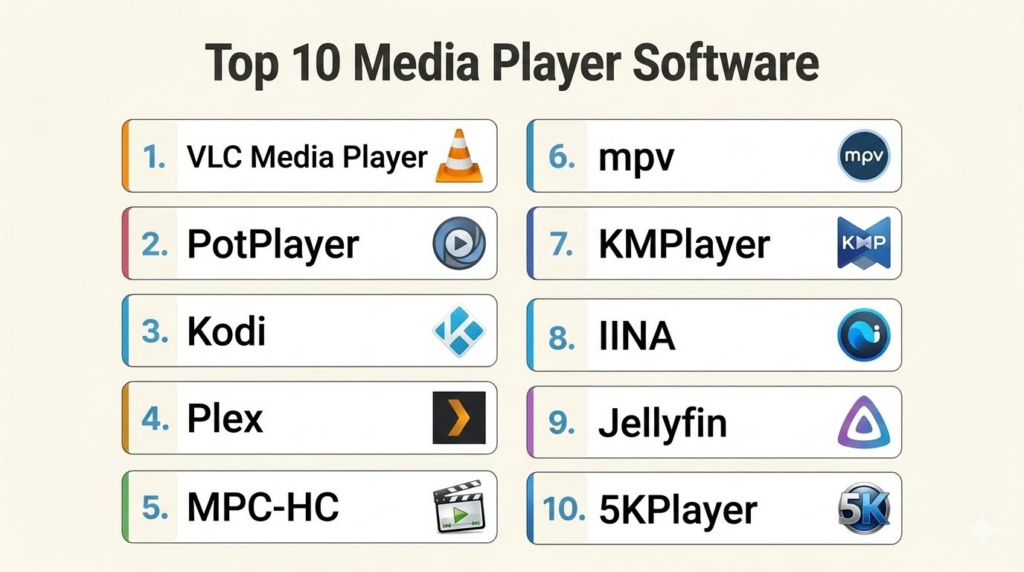
Introduction
Media Player Software allows users to play, stream, organize, and manage audio and video content across desktops, laptops, smartphones, tablets, TVs, and home entertainment systems. These tools support multiple media formats, subtitles, playlists, streaming protocols, high-resolution playback, and advanced audio-video controls that go far beyond basic built-in operating system players.Media consumption has changed dramatically because users now watch 4K videos, HDR movies, online streams, podcasts, surround-sound audio, and large multimedia libraries across multiple devices. Standard default players often struggle with codecs, subtitles, or advanced formats. Modern media player software solves these problems with broader compatibility, hardware acceleration, customizable playback engines, media servers, streaming capabilities, and enhanced playback optimization.
Real-World Use Cases
- Watching movies and TV shows in high resolution
- Playing music, podcasts, and audio libraries
- Streaming personal media collections across devices
- Managing home theater systems
- Watching anime and subtitle-heavy content
- Running local media servers for family streaming
- Viewing training videos and educational content
Evaluation Criteria for Buyers
When evaluating Media Player Software, buyers should consider:
- Codec and format compatibility
- Playback quality and stability
- Hardware acceleration support
- Subtitle handling and customization
- Streaming and casting capabilities
- Media library organization
- Cross-platform availability
- Resource usage and performance
- Plugin and customization ecosystem
- Privacy and local playback controls
Best for: Home users, movie enthusiasts, gamers, creators, students, editors, photographers, developers, and organizations managing multimedia playback workflows.
Not ideal for: Users who only play occasional basic MP4 files using built-in operating-system tools or enterprises requiring advanced broadcast-grade media asset management systems.
Key Trends in Media Player Software
- AI-assisted video enhancement is improving playback quality for older content.
- Hardware acceleration is becoming essential for smooth 4K and HDR playback.
- Open-source media players continue growing because of transparency and codec flexibility.
- Home media server ecosystems are becoming more mainstream.
- Cross-device streaming is now a major expectation for home entertainment users.
- Subtitle management and multilingual playback support continue improving.
- Lightweight high-performance players remain popular among advanced users.
- Privacy-focused local playback is gaining importance among self-hosting communities.
- Streaming and local playback are increasingly combined into single platforms.
- Smart TV integration and wireless casting support are expanding rapidly.
How We Selected These Tools
The tools in this list were selected based on playback quality, codec support, performance, platform compatibility, usability, streaming functionality, and long-term reliability.
Selection criteria included:
- Audio and video format support
- Playback performance and hardware optimization
- Subtitle and multilingual playback support
- Streaming and casting capabilities
- Cross-platform compatibility
- Media library and server functionality
- Resource efficiency and stability
- Open-source transparency where applicable
- Community adoption and ecosystem strength
- Value for casual and advanced users
Top 10 Media Player Software
1- VLC Media Player
Short Description
VLC Media Player is one of the most widely used multimedia players because it supports nearly every major audio and video format without requiring additional codec installation. It works across desktop and mobile platforms while supporting local files, DVDs, subtitles, network streams, and playlists. VLC is especially useful for users who want reliable playback with minimal setup complexity. Its lightweight architecture and open-source nature make it a trusted option for both beginners and advanced users.
Key Features
- Broad audio and video codec support
- Subtitle synchronization and customization
- Streaming and network playback
- Hardware acceleration
- Playlist and library support
- Audio and video filters
- Cross-platform support
Pros
- Supports almost every media format
- Lightweight and reliable
- Free and open-source
Cons
- Interface feels outdated to some users
- Library organization is basic
- Advanced settings may overwhelm beginners
Platforms / Deployment
- Windows
- macOS
- Linux
- Android
- iOS
- Desktop and Mobile
Security & Compliance
- Open-source architecture
- Local playback support
- Community-driven updates
- Security depends on deployment and update practices
Integrations & Ecosystem
VLC supports flexible local and streaming workflows with strong compatibility across devices and formats.
- Network streaming
- Chromecast support
- Subtitle ecosystems
- Playlist management
- Audio streaming
- Local media libraries
Support & Community
VLC has one of the largest multimedia software communities with extensive guides, documentation, plugins, and troubleshooting resources.
2- PotPlayer
Short Description
PotPlayer is a Windows-focused media player known for advanced playback controls, HDR support, hardware acceleration, and highly customizable playback settings. It is especially useful for users who watch high-resolution movies, anime, Blu-ray rips, and subtitle-heavy content. PotPlayer provides extensive playback tuning and visual customization for advanced multimedia enthusiasts.
Key Features
- HDR and 4K playback
- Hardware acceleration
- Subtitle customization
- VR and 3D playback
- Audio enhancement tools
- Screen capture support
- Extensive codec compatibility
Pros
- Excellent playback performance
- Highly customizable
- Strong subtitle support
Cons
- Windows-only platform
- Complex settings for beginners
- Interface can feel cluttered
Platforms / Deployment
- Windows
- Desktop
Security & Compliance
- Local playback support
- Security depends on installation source
- Detailed compliance is Not publicly stated
Integrations & Ecosystem
PotPlayer focuses heavily on advanced multimedia playback optimization.
- Subtitle systems
- Audio tuning
- Hardware acceleration
- Streaming playback
- High-resolution video workflows
Support & Community
PotPlayer maintains strong popularity among advanced media users and subtitle-heavy content communities.
3- Kodi
Short Description
Kodi is an open-source media center platform designed for home entertainment systems and centralized multimedia libraries. It allows users to organize movies, TV shows, music, live TV, and streaming services inside a customizable interface. Kodi is especially useful for users building home theater PCs and custom entertainment environments.
Key Features
- Media center interface
- Library organization
- Add-on and plugin support
- Live TV functionality
- Streaming support
- Subtitle handling
- Cross-device playback
Pros
- Excellent home theater experience
- Highly customizable
- Large add-on ecosystem
Cons
- Setup can feel technical
- Add-on management may become confusing
- Performance depends on device hardware
Platforms / Deployment
- Windows
- macOS
- Linux
- Android
- iOS
- TV devices
- Media center deployments
Security & Compliance
- Open-source architecture
- Local and network playback support
- Security depends on plugin usage and deployment choices
Integrations & Ecosystem
Kodi integrates deeply into home entertainment ecosystems.
- Streaming add-ons
- NAS systems
- TV tuners
- Home theater environments
- Subtitle ecosystems
- Local media libraries
Support & Community
Kodi has a massive open-source community with strong customization and troubleshooting resources.
4- Plex
Short Description
Plex combines media playback with media server functionality, allowing users to organize and stream personal media libraries across multiple devices. It is especially useful for users managing large movie, TV, and music collections that need centralized streaming and remote access. Plex works well for home media servers and family entertainment systems.
Key Features
- Media server support
- Remote streaming
- Library organization
- Metadata and artwork support
- Smart TV compatibility
- Multi-user streaming
- Cross-device access
Pros
- Excellent streaming workflows
- Strong media organization
- Good multi-device support
Cons
- Premium features require subscriptions
- Server setup may require technical knowledge
- Performance depends on hardware quality
Platforms / Deployment
- Windows
- macOS
- Linux
- Android
- iOS
- Smart TVs
- Cloud and Local server
Security & Compliance
- Account-based permissions
- Encryption support
- Remote access controls
- Security depends on network configuration
Integrations & Ecosystem
Plex supports home streaming and media-server workflows.
- NAS systems
- Streaming devices
- Smart TVs
- Shared libraries
- Remote streaming
- Home theater systems
Support & Community
Plex has strong adoption among home entertainment users with extensive setup and streaming documentation.
5- Media Player Classic Home Cinema MPC-HC
Short Description
MPC-HC is a lightweight Windows media player focused on speed, simplicity, and reliable playback. It is especially useful for users who prefer classic desktop-style software with low resource usage and stable local playback. MPC-HC remains popular among users wanting efficient playback on both modern and older hardware.
Key Features
- Lightweight playback engine
- Subtitle support
- Hardware acceleration
- Broad codec compatibility
- Playlist support
- Minimal interface
- Custom shaders
Pros
- Extremely lightweight
- Excellent performance on older systems
- Simple interface
Cons
- Windows-only platform
- Limited media library tools
- Interface feels old-fashioned
Platforms / Deployment
- Windows
- Desktop
Security & Compliance
- Local playback workflows
- Open-source heritage
- Security depends on download source and updates
Integrations & Ecosystem
MPC-HC supports lightweight multimedia workflows.
- Subtitle systems
- Hardware acceleration
- Local playback
- Codec compatibility
- Playlist management
Support & Community
MPC-HC maintains a loyal community among users preferring lightweight playback environments.
6- mpv
Short Description
mpv is a minimalist open-source media player focused on playback quality, customization, rendering performance, and scripting support. It is especially useful for advanced users who want HDR playback, hardware acceleration, and lightweight multimedia performance. mpv is highly respected among technical users and playback enthusiasts.
Key Features
- Lightweight playback engine
- HDR support
- Hardware acceleration
- Scripting support
- Subtitle handling
- High-quality rendering
- Command-line workflows
Pros
- Excellent playback quality
- Highly customizable
- Lightweight and fast
Cons
- Minimal interface may confuse beginners
- Advanced setup requires technical knowledge
- Limited library management
Platforms / Deployment
- Windows
- macOS
- Linux
- Desktop
Security & Compliance
- Open-source transparency
- Local playback support
- Security depends on deployment and update practices
Integrations & Ecosystem
mpv supports advanced playback customization and scripting workflows.
- Scripting ecosystems
- Hardware acceleration
- Subtitle workflows
- Rendering customization
- Command-line integrations
Support & Community
mpv has a strong technical community and broad adoption among advanced multimedia users.
7- KMPlayer
Short Description
KMPlayer is a multimedia player focused on broad codec compatibility, subtitle flexibility, and high-resolution playback. It is especially useful for users watching multilingual content, anime, and UHD video libraries requiring extensive subtitle customization and playback tuning.
Key Features
- Broad format support
- Subtitle customization
- UHD and 4K playback
- Streaming support
- VR playback support
- Hardware acceleration
- Playlist management
Pros
- Strong subtitle support
- Good high-resolution playback
- Flexible multimedia compatibility
Cons
- Interface can feel cluttered
- Ads may appear in some versions
- Too many settings for casual users
Platforms / Deployment
- Windows
- Android
- iOS
- Desktop and Mobile
Security & Compliance
- Local playback support
- Security depends on installation source
- Detailed compliance is Not publicly stated
Integrations & Ecosystem
KMPlayer supports flexible multimedia and streaming workflows.
- VR playback
- Streaming playback
- Subtitle systems
- Mobile playback
- Hardware acceleration
Support & Community
KMPlayer maintains broad international usage with multilingual support communities.
8- IINA
Short Description
IINA is a modern macOS media player built around the mpv playback engine. It combines advanced playback capabilities with a clean Apple-native interface and modern controls. IINA is especially useful for Mac users who want a more polished and modern playback experience than traditional desktop players.
Key Features
- Modern macOS interface
- Subtitle support
- Touch Bar integration
- Gesture controls
- Picture-in-picture mode
- Streaming playback
- mpv playback engine
Pros
- Excellent Apple-native experience
- Smooth modern interface
- Strong playback quality
Cons
- macOS-only platform
- Smaller ecosystem than VLC
- Advanced configuration may require learning
Platforms / Deployment
- macOS
- Desktop
Security & Compliance
- Open-source foundation
- Local playback support
- Security depends on deployment and updates
Integrations & Ecosystem
IINA integrates naturally into Apple device workflows.
- Touch Bar
- macOS features
- Streaming playback
- Subtitle workflows
- Picture-in-picture support
Support & Community
IINA has a growing Apple-focused user community and active development support.
9- Jellyfin
Short Description
Jellyfin is an open-source media server and playback platform designed for users wanting complete control over personal streaming libraries. It supports movies, TV shows, music, live TV, and remote streaming while emphasizing privacy and self-hosting flexibility.
Key Features
- Open-source media server
- Multi-device streaming
- Library organization
- Live TV support
- User accounts
- Remote access
- Metadata management
Pros
- Fully open-source
- Strong self-hosting support
- Good privacy-focused workflows
Cons
- Technical setup required
- Smaller ecosystem than Plex
- Performance depends on server hardware
Platforms / Deployment
- Windows
- macOS
- Linux
- Android
- iOS
- Smart TVs
- Self-hosted
Security & Compliance
- Self-managed infrastructure
- User account controls
- Security depends on deployment practices
Integrations & Ecosystem
Jellyfin supports self-hosted multimedia streaming environments.
- NAS systems
- Smart TVs
- Remote streaming
- Local media libraries
- Metadata providers
- Multi-user playback
Support & Community
Jellyfin has an active open-source community and strong adoption among self-hosting users.
10- 5KPlayer
Short Description
5KPlayer is a multimedia player designed for high-resolution playback, wireless streaming, AirPlay support, and local media management. It is especially useful for users who want smooth 4K playback combined with wireless media-sharing capabilities and Apple ecosystem compatibility.
Key Features
- 4K and 8K playback
- AirPlay support
- DLNA streaming
- Subtitle support
- Hardware acceleration
- Wireless streaming workflows
- Music playback
Pros
- Strong high-resolution playback
- Useful wireless streaming support
- Good Apple integration
Cons
- Interface may feel busy
- Less lightweight than minimalist players
- Some features may feel unnecessary
Platforms / Deployment
- Windows
- macOS
- Desktop
Security & Compliance
- Local playback support
- Network streaming workflows
- Detailed compliance is Not publicly stated
Integrations & Ecosystem
5KPlayer supports wireless and high-resolution multimedia workflows.
- AirPlay
- DLNA
- Streaming playback
- Hardware acceleration
- Subtitle systems
- Music playback
Support & Community
5KPlayer provides onboarding resources and broad multimedia playback support for home users.
Comparison Table
| Tool Name | Best For | Platform Supported | Deployment | Standout Feature | Public Rating |
|---|---|---|---|---|---|
| VLC Media Player | Overall playback compatibility | Windows, macOS, Linux, Android, iOS | Desktop and Mobile | Broad codec support | N/A |
| PotPlayer | Advanced Windows playback | Windows | Desktop | HDR and subtitle customization | N/A |
| Kodi | Home theater systems | Windows, macOS, Linux, Android | Media center | Media center customization | N/A |
| Plex | Media streaming servers | Windows, macOS, Linux, Smart TVs | Cloud and Local server | Cross-device streaming | N/A |
| MPC-HC | Lightweight playback | Windows | Desktop | Low resource usage | N/A |
| mpv | Advanced playback enthusiasts | Windows, macOS, Linux | Desktop | High-quality rendering | N/A |
| KMPlayer | Subtitle-heavy playback | Windows, Android, iOS | Desktop and Mobile | Subtitle flexibility | N/A |
| IINA | macOS users | macOS | Desktop | Apple-native interface | N/A |
| Jellyfin | Self-hosted streaming | Windows, Linux, Smart TVs | Self-hosted | Open-source streaming server | N/A |
| 5KPlayer | Wireless streaming workflows | Windows, macOS | Desktop | AirPlay and DLNA support | N/A |
Evaluation & Scoring of Media Player Software
| Tool Name | Core 25% | Ease 15% | Integrations 15% | Security 10% | Performance 10% | Support 10% | Value 15% | Weighted Total |
|---|---|---|---|---|---|---|---|---|
| VLC Media Player | 10 | 9 | 9 | 8 | 9 | 10 | 10 | 9.4 |
| PotPlayer | 9 | 7 | 7 | 7 | 10 | 8 | 9 | 8.3 |
| Kodi | 9 | 7 | 9 | 7 | 8 | 9 | 9 | 8.4 |
| Plex | 9 | 8 | 9 | 8 | 8 | 9 | 7 | 8.3 |
| MPC-HC | 8 | 9 | 6 | 7 | 9 | 8 | 10 | 8.1 |
| mpv | 9 | 6 | 7 | 8 | 10 | 8 | 10 | 8.3 |
| KMPlayer | 8 | 8 | 7 | 7 | 8 | 7 | 8 | 7.7 |
| IINA | 8 | 9 | 7 | 8 | 9 | 8 | 8 | 8.1 |
| Jellyfin | 9 | 6 | 8 | 9 | 8 | 8 | 10 | 8.4 |
| 5KPlayer | 8 | 8 | 8 | 7 | 8 | 7 | 8 | 7.8 |
These scores are comparative and should be interpreted according to playback needs and technical comfort. VLC remains one of the strongest all-around media players because of reliability and broad compatibility, while Kodi and Plex are better for streaming and home theater workflows. mpv and PotPlayer appeal more to advanced users seeking performance optimization and deep customization.
Which Media Player Software Is Right for You?
Solo / Freelancer
Solo users generally benefit most from VLC Media Player because it combines reliability, broad compatibility, and ease of use. Mac users may prefer IINA for a cleaner Apple-native experience, while advanced users who prioritize playback tuning may prefer mpv or PotPlayer.
SMB
Small businesses often need reliable media playback for presentations, training content, podcasts, or internal media libraries. VLC and Plex are practical options because they support broad compatibility and centralized streaming workflows.
Mid-Market
Mid-market organizations may require centralized media servers, streaming workflows, and better library organization. Plex and Jellyfin perform especially well in these environments, while Kodi can support digital signage or internal media-center systems.
Enterprise
Enterprises should prioritize deployment control, streaming scalability, compatibility, and infrastructure integration. Jellyfin and Plex may support internal media workflows, but larger organizations may eventually require enterprise-grade media asset management platforms.
Budget vs Premium
Many leading media players are free or open-source, making the category extremely accessible. VLC, Kodi, Jellyfin, mpv, and MPC-HC provide excellent value without subscription costs. Premium ecosystems mainly matter for advanced streaming and server features.
Feature Depth vs Ease of Use
VLC and IINA offer balanced usability for most users. PotPlayer and mpv provide deeper playback customization but require more technical knowledge. Kodi and Plex are stronger for complete media-center environments.
Integrations & Scalability
Users should evaluate smart TV support, NAS compatibility, subtitle workflows, hardware acceleration, and streaming ecosystems. Home theater users should prioritize Plex, Kodi, or Jellyfin, while local playback users may prefer VLC, PotPlayer, or IINA.
Security & Compliance Needs
Media players can access local files, streaming sources, subtitles, plugins, and remote servers. Users should avoid unofficial builds and download software only from trusted sources. Self-hosted systems like Jellyfin and Plex require proper network security and account management.
Frequently Asked Questions
1. What is Media Player Software?
Media Player Software allows users to play audio and video files across computers, mobile devices, TVs, and streaming systems. Modern media players support advanced codecs, subtitles, playlists, hardware acceleration, and streaming features. Some focus on lightweight playback while others include full media-server functionality. Their main purpose is to provide smooth and reliable multimedia playback across many formats and devices.
2. Which Media Player Software is best overall?
VLC Media Player is often considered the strongest overall option because it supports nearly every major media format without additional codecs. It is reliable, lightweight, open-source, and available across multiple platforms. However, advanced users may prefer PotPlayer or mpv, while home theater users may prefer Kodi or Plex.
3. What is the difference between VLC and Kodi?
VLC focuses primarily on media playback, while Kodi functions as a complete home entertainment and media-center platform. VLC is better for quick and reliable playback, whereas Kodi is designed for organizing libraries, managing streaming add-ons, and building home theater environments.
4. Which media player is best for 4K and HDR playback?
PotPlayer, VLC, mpv, and 5KPlayer are strong options for high-resolution playback. PotPlayer is especially popular among Windows users because of advanced hardware acceleration and HDR optimization. mpv is respected for rendering quality and playback performance among advanced users.
5. Are open-source media players safer?
Open-source media players like VLC, Kodi, mpv, and Jellyfin provide transparency because their code can be reviewed publicly. This often improves trust among technical and privacy-focused users. However, security still depends on proper updates, trusted downloads, and safe plugin usage.
6. Which media player is best for home theater systems?
Kodi, Plex, and Jellyfin are excellent home theater solutions because they support media libraries, remote streaming, smart TV integrations, and centralized entertainment management. Kodi excels in customization, Plex in polished streaming experiences, and Jellyfin in privacy-focused self-hosting.
7. Why do some media players perform better than others?
Performance differences depend on codec optimization, rendering engines, hardware acceleration, subtitle handling, and resource usage. Lightweight players like MPC-HC and mpv prioritize efficiency, while media-center platforms require more system resources because of additional streaming and library features.
8. What are the most common mistakes users make with media players?
Users often install unofficial codec packs or suspicious plugins that create security and performance risks. Another mistake is using outdated software versions lacking hardware acceleration improvements and security updates. Overloading media centers with unnecessary add-ons can also reduce stability.
9. Which media player is best for macOS users?
IINA is one of the strongest macOS-focused media players because it combines advanced playback capabilities with a modern Apple-native interface. VLC also works very well on macOS, but many Apple users prefer IINA’s cleaner design and smoother macOS integration.
10. How should users choose the right Media Player Software?
Users should first identify whether they prioritize simple playback, advanced customization, home theater streaming, lightweight performance, or Apple ecosystem integration. VLC is best for broad compatibility, PotPlayer for advanced Windows playback, Kodi and Plex for streaming ecosystems, and IINA for Mac users wanting a modern interface.
Conclusion
Media Player Software has evolved far beyond simple video playback tools into powerful multimedia ecosystems supporting streaming, home entertainment, subtitle management, media servers, high-resolution playback, and advanced customization. The best solution depends on whether users prioritize compatibility, streaming workflows, performance tuning, privacy, or home theater functionality. VLC Media Player remains one of the strongest all-around choices because of its reliability and broad codec support, while Kodi and Plex dominate media-center environments. PotPlayer and mpv appeal strongly to advanced users seeking playback optimization and deep customization, while IINA provides an excellent modern experience for macOS users. Jellyfin continues attracting privacy-focused self-hosting enthusiasts, and lightweight players like MPC-HC remain valuable for older systems and minimalist workflows. Buyers should shortlist a few tools, test playback performance with their actual media formats, evaluate subtitle and streaming workflows, and choose the media player that best fits their devices, content libraries, and long-term multimedia needs.
