MOTOSHARE 🚗🏍️
Rent Bikes & Cars Directly from Owners
Motoshare connects vehicle owners with people who need bikes and cars on rent. Owners earn from idle vehicles, and renters get flexible ride options.
Visit Motoshare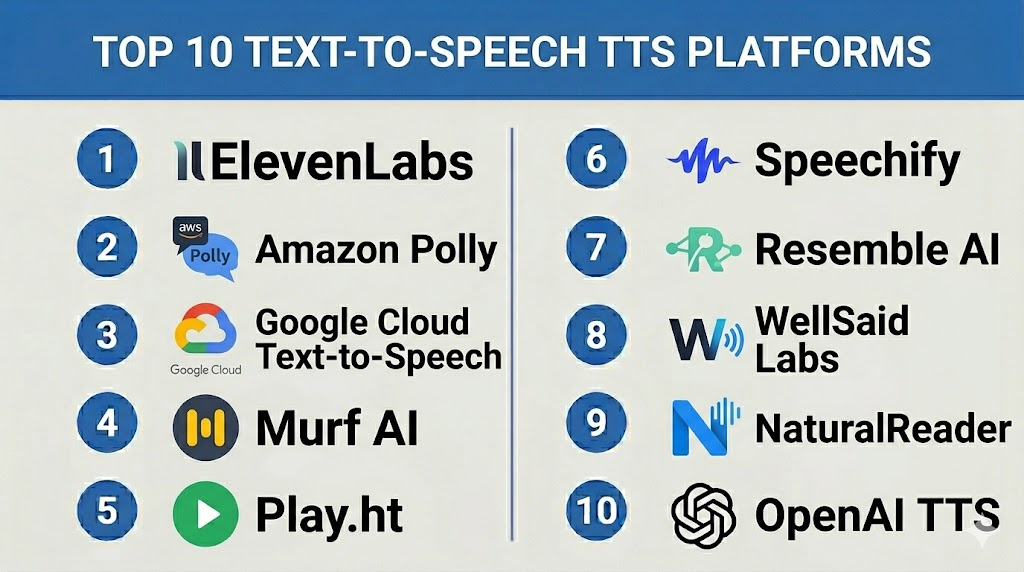
Introduction
Text-to-Speech TTS Platforms help businesses, creators, developers, educators, and enterprises convert written text into natural-sounding spoken audio using AI-powered voice synthesis technologies. These platforms are widely used for voiceovers, audiobooks, virtual assistants, podcasts, customer support automation, accessibility workflows, eLearning narration, gaming dialogue, and conversational AI systems.Modern TTS platforms have evolved far beyond robotic computer-generated speech. Today’s AI voice systems can produce highly realistic voices with emotional tone, multilingual pronunciation, custom accents, voice cloning, and real-time conversational capabilities. Organizations now use TTS technology to scale content production, improve accessibility, automate communication, and create engaging digital experiences without relying entirely on traditional voice recording processes.
Common real-world use cases include:
- Creating AI voiceovers for videos and courses
- Building conversational AI assistants
- Generating audiobooks and podcasts
- Supporting accessibility and screen readers
- Automating IVR and customer support systems
Buyers evaluating Text-to-Speech TTS Platforms should focus on:
- Voice realism and natural speech quality
- Language and accent support
- Voice cloning capabilities
- API flexibility and integrations
- Real-time streaming support
- Scalability for enterprise workloads
- Security and governance controls
- Editing and customization workflows
- Licensing and commercial usage rights
- Pricing flexibility and deployment options
Best for: Enterprises, developers, educators, creators, SaaS companies, accessibility teams, AI startups, media organizations, and businesses producing voice-enabled digital experiences at scale.
Not ideal for: Teams that only need occasional basic narration and do not require realistic voices, automation, integrations, or scalable production workflows.
Key Trends in Text-to-Speech TTS Platforms
- AI voices are becoming increasingly realistic with emotional speech generation.
- Voice cloning is becoming a major capability for creators and enterprises.
- Real-time conversational voice AI is expanding rapidly.
- Multilingual and regional accent support is improving significantly.
- AI dubbing and voice localization workflows are becoming mainstream.
- Open-source TTS models are increasing deployment flexibility.
- Enterprise governance around synthetic voices is becoming more important.
- API-first architectures are enabling scalable automation workflows.
- Low-latency streaming voice systems are improving conversational experiences.
- Custom brand voice generation is becoming a competitive differentiator.
How We Selected These Tools
The tools in this list were selected using a balanced evaluation framework focused on voice quality, scalability, usability, and enterprise readiness.
- Evaluated overall market adoption and visibility
- Compared natural speech realism and quality
- Assessed voice cloning and customization features
- Reviewed multilingual and regional language support
- Evaluated scalability and API capabilities
- Compared enterprise deployment flexibility
- Assessed streaming and low-latency performance
- Reviewed workflow usability for creators and businesses
- Evaluated integration ecosystems and automation support
- Included enterprise, creator-focused, and developer-oriented solutions
Top 10 Text-to-Speech TTS Platforms
1- ElevenLabs
Short Description:
ElevenLabs is one of the most advanced AI voice generation platforms for creators, developers, media companies, and enterprises. It provides highly realistic voice synthesis, multilingual narration, emotional speech generation, and voice cloning capabilities. The platform is especially popular for podcasts, audiobooks, cinematic narration, AI assistants, and content production workflows.
Key Features
- Realistic AI voice generation
- Voice cloning
- Emotional speech modulation
- Multilingual narration
- Conversational voice support
- Streaming APIs
- AI dubbing capabilities
Pros
- Extremely realistic voice quality
- Strong creator ecosystem
- Excellent voice cloning features
Cons
- Premium pricing for heavy usage
- Governance concerns around voice cloning
- Advanced workflows require configuration
Platforms / Deployment
- Web
- Cloud
Security & Compliance
- Enterprise access controls
- API security features
- Team permissions
Integrations & Ecosystem
ElevenLabs integrates with AI, media production, and developer ecosystems for scalable voice workflows.
- APIs
- AI assistant workflows
- Podcast systems
- Video production tools
- Content automation workflows
- Developer platforms
Support & Community
Strong creator community, enterprise onboarding, and developer documentation.
2- Amazon Polly
Short Description:
Amazon Polly is a cloud-based TTS platform designed for enterprises, developers, customer support systems, and scalable automation workflows. It provides neural voice generation, real-time speech synthesis, and multilingual support while integrating deeply with enterprise cloud environments.
Key Features
- Neural voice synthesis
- Real-time speech generation
- SSML customization
- Broad language support
- Cloud scalability
- Streaming voice generation
- API-driven workflows
Pros
- Excellent enterprise scalability
- Strong AWS integration
- Reliable cloud infrastructure
Cons
- Requires technical implementation
- Less creator-focused workflows
- Voice customization depth varies
Platforms / Deployment
- Web
- Cloud
Security & Compliance
- Encryption
- IAM controls
- Audit logging
- Enterprise governance features
Integrations & Ecosystem
Amazon Polly integrates deeply with enterprise automation and cloud ecosystems.
- AWS services
- APIs
- Customer support systems
- Accessibility workflows
- Enterprise automation pipelines
Support & Community
Strong enterprise support and extensive developer resources.
3- Google Cloud Text-to-Speech
Short Description:
Google Cloud Text-to-Speech is a developer-focused AI voice platform designed for conversational AI, accessibility systems, enterprise applications, and automation workflows. It provides neural voice synthesis, multilingual support, and scalable API-based deployment options.
Key Features
- Neural AI voices
- Streaming speech generation
- Broad language coverage
- SSML customization
- API integrations
- Cloud scalability
- Custom voice capabilities
Pros
- Strong multilingual support
- Excellent cloud scalability
- Reliable infrastructure
Cons
- Requires technical setup
- Less creator-oriented tooling
- Enterprise pricing can scale quickly
Platforms / Deployment
- Web
- Cloud
Security & Compliance
- Encryption
- IAM controls
- Audit logging
- Enterprise cloud governance
Integrations & Ecosystem
Google Cloud TTS integrates with AI, accessibility, and automation ecosystems.
- APIs
- Google Cloud services
- AI systems
- Accessibility applications
- Enterprise workflows
Support & Community
Strong developer ecosystem and enterprise documentation resources.
4- Murf AI
Short Description:
Murf AI is a creator-focused AI voice generation platform designed for eLearning, corporate presentations, marketing videos, and training content. It provides realistic voiceovers, collaboration workflows, voice editing, and multilingual narration capabilities.
Key Features
- AI voice generation
- Voice editing tools
- Team collaboration
- Presentation narration
- Voice synchronization
- Multilingual support
- Voice cloning
Pros
- User-friendly interface
- Good for business content creation
- Strong eLearning workflows
Cons
- Less developer-focused flexibility
- Limited deep customization
- Enterprise governance depth is moderate
Platforms / Deployment
- Web
- Cloud
Security & Compliance
- Team permissions
- Enterprise account controls
- Encryption
Integrations & Ecosystem
Murf AI supports business, education, and content production workflows.
- Video production systems
- Presentation workflows
- eLearning platforms
- Collaboration tools
- Marketing content pipelines
Support & Community
Strong onboarding materials and creator-focused support resources.
5- Play.ht
Short Description:
Play.ht is a cloud-based AI voice generation platform focused on realistic narration, podcast production, developer APIs, and multilingual speech synthesis. It supports voice cloning, conversational AI workflows, and scalable content production use cases.
Key Features
- AI voice synthesis
- Voice cloning
- API support
- Podcast narration
- Conversational AI workflows
- Multilingual support
- Audio export flexibility
Pros
- Strong narration quality
- Good developer APIs
- Broad multilingual support
Cons
- Premium features require higher plans
- Voice customization varies
- Enterprise workflow depth is moderate
Platforms / Deployment
- Web
- Cloud
Security & Compliance
- Encryption
- Team permissions
- Enterprise account controls
Integrations & Ecosystem
Play.ht integrates with content creation and AI application ecosystems.
- APIs
- Podcast systems
- AI workflows
- Publishing systems
- Developer platforms
Support & Community
Strong creator documentation and onboarding resources.
6- Speechify
Short Description:
Speechify is a TTS platform focused on accessibility, productivity, and reading assistance. It helps users convert documents, articles, PDFs, and books into spoken audio for easier content consumption. The platform is widely used by students, professionals, and accessibility-focused users.
Key Features
- Document narration
- Mobile accessibility workflows
- OCR reading support
- Reading speed controls
- Multilingual voices
- Cross-device syncing
- Audio playback customization
Pros
- Excellent accessibility support
- Easy mobile usability
- Good productivity workflows
Cons
- Less enterprise automation focus
- Limited advanced developer tools
- Moderate voice customization depth
Platforms / Deployment
- Web / iOS / Android
- Cloud
Security & Compliance
- MFA
- Account security controls
- Encryption
Integrations & Ecosystem
Speechify supports accessibility and productivity workflows across devices.
- PDF workflows
- Cloud storage systems
- Mobile productivity systems
- Reading applications
- Education environments
Support & Community
Strong accessibility-focused support and onboarding resources.
7- Resemble AI
Short Description:
Resemble AI is an enterprise-oriented voice synthesis platform designed for conversational AI, gaming, media production, and branded voice applications. It supports custom voice cloning, low-latency speech generation, and scalable conversational AI workflows.
Key Features
- Custom voice cloning
- Real-time speech generation
- Conversational AI support
- API integrations
- Emotion control
- AI audio generation
- Enterprise voice workflows
Pros
- Strong conversational AI support
- Good enterprise customization
- Real-time streaming capabilities
Cons
- Requires technical expertise
- Enterprise pricing structure
- Smaller creator ecosystem
Platforms / Deployment
- Web
- Cloud / Hybrid
Security & Compliance
- Encryption
- API security controls
- Enterprise access management
Integrations & Ecosystem
Resemble AI integrates with enterprise AI and conversational systems.
- APIs
- Gaming workflows
- AI assistants
- Enterprise automation systems
- Conversational AI applications
Support & Community
Enterprise onboarding and developer-focused documentation are available.
8- WellSaid Labs
Short Description:
WellSaid Labs is an AI voice generation platform focused on professional narration, training content, and enterprise communication workflows. It provides studio-quality AI narration for eLearning, business presentations, and corporate training systems.
Key Features
- Professional AI narration
- Team collaboration
- Voiceover workflows
- Script management
- Audio project organization
- Enterprise voice libraries
- Content production tools
Pros
- High-quality professional narration
- Strong enterprise training workflows
- Good collaboration support
Cons
- Premium pricing
- Less developer-focused flexibility
- Moderate customization depth
Platforms / Deployment
- Web
- Cloud
Security & Compliance
- Team permissions
- Enterprise account management
- Encryption
Integrations & Ecosystem
WellSaid Labs supports corporate communication and training workflows.
- Training systems
- eLearning platforms
- Collaboration workflows
- Enterprise communication tools
- Video production systems
Support & Community
Strong enterprise onboarding and support resources.
9- NaturalReader
Short Description:
NaturalReader is a TTS platform focused on accessibility, reading assistance, education, and document narration workflows. It supports multilingual voices, OCR reading, and audio export capabilities while helping users consume written content through audio playback.
Key Features
- Document narration
- OCR support
- Multilingual voices
- Audio exports
- Reading accessibility workflows
- Mobile support
- Cloud synchronization
Pros
- Easy to use
- Good accessibility support
- Useful for education workflows
Cons
- Less enterprise automation depth
- Limited advanced customization
- Not optimized for conversational AI
Platforms / Deployment
- Web / Windows / macOS / iOS / Android
- Cloud
Security & Compliance
- Account security controls
- Encryption
- User access management
Integrations & Ecosystem
NaturalReader supports productivity and accessibility-focused workflows.
- Education tools
- Reading applications
- Cloud storage systems
- Productivity workflows
- Document management systems
Support & Community
Strong onboarding resources and accessibility-focused documentation.
10- OpenAI TTS
Short Description:
OpenAI TTS provides AI-powered speech synthesis for conversational AI systems, enterprise automation, voice assistants, and developer applications. It supports natural speech generation, streaming workflows, and conversational voice experiences for modern AI applications.
Key Features
- AI speech synthesis
- Conversational voice support
- Streaming generation
- API integrations
- Natural voice generation
- Multilingual capabilities
- Enterprise AI workflows
Pros
- Strong conversational AI support
- Developer-friendly APIs
- Good natural voice quality
Cons
- Technical implementation required
- Enterprise customization still evolving
- Voice control options vary
Platforms / Deployment
- Web
- Cloud
Security & Compliance
- Encryption
- API security controls
- Enterprise account management
Integrations & Ecosystem
OpenAI TTS integrates with conversational AI and enterprise automation workflows.
- APIs
- AI assistants
- Enterprise automation systems
- Conversational AI applications
- Developer ecosystems
Support & Community
Large developer ecosystem and growing enterprise AI support resources.
Comparison Table
| Tool Name | Best For | Platform(s) Supported | Deployment | Standout Feature | Public Rating |
|---|---|---|---|---|---|
| ElevenLabs | Premium AI narration | Web | Cloud | Human-like emotional voices | N/A |
| Amazon Polly | Enterprise automation | Web | Cloud | AWS scalability | N/A |
| Google Cloud TTS | Enterprise AI systems | Web | Cloud | Neural multilingual voices | N/A |
| Murf AI | Business content narration | Web | Cloud | Easy business voice workflows | N/A |
| Play.ht | Podcast and API workflows | Web | Cloud | Voice cloning support | N/A |
| Speechify | Accessibility workflows | Web, iOS, Android | Cloud | Productivity narration | N/A |
| Resemble AI | Conversational AI | Web | Cloud / Hybrid | Real-time speech generation | N/A |
| WellSaid Labs | Enterprise training narration | Web | Cloud | Professional business narration | N/A |
| NaturalReader | Education and accessibility | Web, Windows, macOS, iOS, Android | Cloud | Document narration | N/A |
| OpenAI TTS | Conversational AI systems | Web | Cloud | AI conversational speech | N/A |
Evaluation & Scoring of Text-to-Speech TTS Platforms
| Tool Name | Core (25%) | Ease (15%) | Integrations (15%) | Security (10%) | Performance (10%) | Support (10%) | Value (15%) | Weighted Total |
|---|---|---|---|---|---|---|---|---|
| ElevenLabs | 10 | 8 | 8 | 8 | 9 | 8 | 8 | 8.7 |
| Amazon Polly | 9 | 6 | 10 | 9 | 9 | 8 | 8 | 8.5 |
| Google Cloud TTS | 9 | 6 | 10 | 9 | 9 | 8 | 8 | 8.5 |
| Murf AI | 8 | 9 | 7 | 7 | 8 | 8 | 8 | 8.0 |
| Play.ht | 8 | 8 | 8 | 7 | 8 | 7 | 8 | 7.9 |
| Speechify | 7 | 9 | 6 | 7 | 8 | 8 | 8 | 7.7 |
| Resemble AI | 9 | 6 | 9 | 8 | 9 | 8 | 7 | 8.1 |
| WellSaid Labs | 8 | 8 | 7 | 7 | 8 | 8 | 7 | 7.7 |
| NaturalReader | 7 | 9 | 6 | 6 | 7 | 7 | 9 | 7.4 |
| OpenAI TTS | 9 | 7 | 9 | 8 | 9 | 8 | 8 | 8.4 |
These scores are comparative and should be interpreted based on operational priorities rather than raw rankings alone. Enterprise API platforms generally score higher in scalability and integrations, while creator-focused platforms emphasize usability and content production workflows. Accessibility-focused tools provide strong value for education and productivity environments. Open-source and conversational AI systems often provide greater flexibility but may require technical implementation expertise. Organizations should test voice quality, latency, workflow compatibility, and governance capabilities before making long-term deployment decisions.
Which Text-to-Speech TTS Platform Is Right for You?
Solo / Freelancer
Freelancers, YouTubers, podcasters, and creators generally benefit most from ElevenLabs, Murf AI, or Play.ht because these platforms combine realistic voice quality, fast workflows, and accessible content production tools.
SMB
SMBs typically require a balance between usability, affordability, multilingual support, and workflow flexibility. Murf AI, Play.ht, Speechify, and WellSaid Labs are practical choices for training, marketing, and business communication workflows.
Mid-Market
Mid-market organizations should prioritize integrations, collaboration workflows, multilingual narration, and scalability. ElevenLabs, Resemble AI, and OpenAI TTS are strong options depending on conversational AI and content production needs.
Enterprise
Large enterprises usually require governance, deployment flexibility, low latency, API scalability, and enterprise-grade security. Amazon Polly, Google Cloud TTS, OpenAI TTS, and conversational AI-focused platforms are particularly suitable for enterprise-scale deployments.
Budget vs Premium
Budget-focused users may prefer accessibility-focused platforms or simpler AI narration tools because of lower operational costs. Premium buyers may prioritize ElevenLabs or enterprise conversational AI platforms when realism, customization, and scalability matter more than pricing.
Feature Depth vs Ease of Use
Creator-focused platforms prioritize usability and fast onboarding, while enterprise API platforms focus on scalability, automation, and advanced integrations. Conversational AI systems generally require more technical expertise and deployment planning.
Integrations & Scalability
Organizations already invested in AWS or Google Cloud ecosystems may benefit from native TTS cloud services. AI assistant developers may prefer OpenAI TTS or Resemble AI, while content production teams often benefit from Murf AI or ElevenLabs workflows.
Security & Compliance Needs
Healthcare, finance, education, legal, and enterprise communication workflows should prioritize encryption, API security, governance controls, and deployment flexibility. Organizations using voice cloning should also implement strong governance and approval workflows to reduce misuse risks.
Frequently Asked Questions
1. What is a Text-to-Speech TTS Platform?
A Text-to-Speech platform converts written text into spoken audio using AI-powered voice synthesis technologies. These systems are commonly used for accessibility, narration, AI assistants, audiobooks, podcasts, gaming, and automation workflows. Modern platforms generate realistic voices with emotional tone, multilingual support, and conversational speech capabilities. Businesses increasingly use them for scalable content production and customer interaction systems.
2. How realistic are modern AI-generated voices?
Modern AI-generated voices are significantly more natural than earlier generations and can closely resemble professional human narration. Advanced platforms now support emotional tone, pacing control, multilingual pronunciation, and context-aware speech generation. Voice realism varies depending on the platform and intended use case. High-quality narration is especially important for podcasts, storytelling, and customer-facing AI systems.
3. What is voice cloning?
Voice cloning allows a platform to generate speech that sounds similar to a specific speaker using recorded audio samples. Some systems can create synthetic voice models using only short recordings. Voice cloning is useful for personalization, branding, and scalable content creation. However, organizations should implement governance policies and consent management to avoid misuse.
4. Which platform is best for creators?
ElevenLabs, Murf AI, and Play.ht are especially strong for creators because they combine realistic voice quality, editing workflows, multilingual support, and creator-friendly usability. Content creators producing podcasts, videos, or audiobooks often prioritize emotional narration and workflow simplicity. The best platform depends on content style and production requirements.
5. Which TTS platform is best for enterprise AI systems?
Amazon Polly, Google Cloud TTS, OpenAI TTS, and Resemble AI are strong choices for enterprise AI systems because they provide scalable APIs, automation workflows, low-latency generation, and cloud-native infrastructure. Enterprises building conversational AI assistants often prioritize reliability, scalability, and integration flexibility.
6. Are open-source TTS models improving?
Yes. Open-source TTS systems are improving rapidly and increasingly support realistic voice generation, multilingual narration, and flexible deployments. Enterprises interested in private deployments or custom workflows often explore open-source alternatives. However, these systems usually require greater technical expertise and infrastructure management.
7. What are the biggest mistakes organizations make?
One common mistake is choosing platforms based only on voice realism without evaluating integrations, scalability, or workflow compatibility. Another issue is failing to implement governance around voice cloning and synthetic voice usage. Organizations should also carefully review licensing and commercial usage rights before deployment.
8. Are TTS platforms useful for accessibility workflows?
Yes. TTS platforms are widely used for accessibility because they help users consume written content through spoken audio. Common accessibility workflows include document narration, screen readers, educational content, and assistive technologies. Platforms such as Speechify and NaturalReader are particularly popular in accessibility-focused environments.
9. Can these platforms support multilingual narration?
Yes. Most modern TTS platforms support multiple languages and accents. Some systems also support multilingual voice cloning and AI dubbing workflows. Organizations distributing global content should evaluate pronunciation quality, accent support, and localization workflows carefully before deployment.
10. What should organizations prioritize when selecting a TTS platform?
Organizations should prioritize voice realism, integrations, scalability, multilingual support, latency, governance controls, workflow compatibility, and deployment flexibility. Businesses handling regulated or customer-facing voice systems should also evaluate security and compliance requirements carefully. Running pilot tests with real scripts and production workflows is strongly recommended.
Conclusion
Text-to-Speech TTS Platforms have become critical technologies for accessibility, content production, conversational AI, customer engagement, enterprise automation, education, and digital media workflows. Modern AI-powered voice systems now provide highly realistic narration, multilingual speech generation, emotional voice modulation, streaming audio, and scalable conversational capabilities that were previously difficult or expensive to achieve. The best platform depends heavily on workflow complexity, operational scale, integration requirements, and desired voice quality. Creator-focused tools such as ElevenLabs, Murf AI, and Play.ht provide excellent usability and premium narration experiences, while enterprise cloud platforms such as Amazon Polly and Google Cloud TTS deliver scalable infrastructure and automation flexibility. Conversational AI workflows increasingly depend on low-latency streaming voice systems optimized for interactive experiences. Accessibility and education environments also continue driving strong adoption of TTS technologies. Instead of selecting a platform based only on voice realism, organizations should evaluate governance, scalability, integrations, multilingual support, security, and long-term operational compatibility. The best next step is to shortlist a few platforms, test them with real scripts and workflows, validate voice quality and performance, and then select the platform that best aligns with future content, automation, and AI communication goals.
