MOTOSHARE 🚗🏍️
Rent Bikes & Cars Directly from Owners
Motoshare connects vehicle owners with people who need bikes and cars on rent. Owners earn from idle vehicles, and renters get flexible ride options.
Visit Motoshare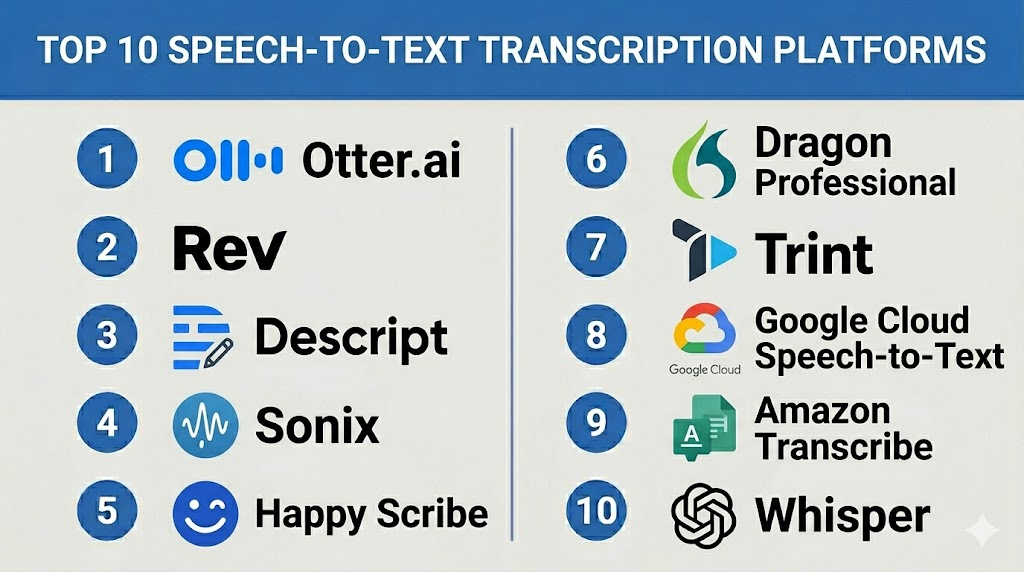
Introduction
Speech-to-Text Transcription Platforms help businesses, creators, educators, enterprises, researchers, and media teams convert spoken audio into searchable and editable text. These platforms are commonly used for meeting transcription, webinar documentation, podcast conversion, subtitle generation, customer support analytics, interview recording, legal documentation, healthcare dictation, and enterprise knowledge management.As remote work, virtual meetings, podcasts, video content, and digital collaboration continue growing, transcription platforms have become essential productivity tools. Modern platforms now include AI-powered transcription, speaker recognition, multilingual support, automated summaries, searchable archives, collaboration workflows, and integration with business communication systems. These tools help organizations save time, improve accessibility, reduce manual note-taking, and create searchable knowledge libraries from audio and video content.
Common real-world use cases include:
- Transcribing meetings and webinars
- Creating subtitles and captions for videos
- Converting podcasts into articles and transcripts
- Automating customer support documentation
- Managing searchable enterprise knowledge archives
Buyers evaluating Speech-to-Text Transcription Platforms should focus on:
- Transcription accuracy
- Real-time and batch processing support
- Speaker identification quality
- Multilingual language support
- Collaboration and editing workflows
- API and integration capabilities
- Export format support
- Security and compliance controls
- AI-powered summaries and automation
- Scalability and pricing flexibility
Best for: Enterprises, media companies, podcasters, educators, marketers, legal teams, healthcare providers, customer support teams, researchers, and organizations handling large amounts of audio or video content.
Not ideal for: Teams that only occasionally need manual transcription and do not require automation, collaboration, accessibility, or scalable workflows.
Key Trends in Speech-to-Text Transcription Platforms
- AI-powered transcription accuracy is improving rapidly across multiple languages and accents.
- Real-time meeting assistants are becoming standard in enterprise collaboration workflows.
- AI-generated summaries and action items are reducing manual note-taking.
- Speaker recognition and sentiment analysis are improving business intelligence capabilities.
- Open-source transcription models are increasing deployment flexibility for enterprises.
- Accessibility and subtitle workflows are becoming major business requirements.
- Cloud-native APIs are enabling scalable workflow automation.
- Voice-driven productivity workflows are growing for hands-free operations.
- Hybrid AI-plus-human review models remain important for sensitive content.
- Enterprise security and governance controls are becoming critical buying factors.
How We Selected These Tools
The tools in this list were selected using a practical evaluation framework focused on accuracy, scalability, usability, and enterprise readiness.
- Evaluated market adoption and overall recognition
- Compared transcription quality and language support
- Assessed real-time and batch transcription capabilities
- Reviewed collaboration and editing workflows
- Evaluated integration ecosystems and APIs
- Compared enterprise governance and security controls
- Assessed AI-powered automation capabilities
- Reviewed export flexibility and workflow compatibility
- Considered scalability for business and enterprise deployments
- Included enterprise, creator-focused, and developer-oriented solutions
Top 10 Speech-to-Text Transcription Platforms
1- Otter.ai
Short Description:
Otter.ai is a widely used AI transcription and meeting assistant platform designed for businesses, educators, and collaborative teams. It automatically transcribes meetings, webinars, and conversations while generating searchable notes, summaries, and speaker identification. Otter.ai is especially popular for meeting productivity and collaboration workflows.
Key Features
- Real-time transcription
- AI meeting summaries
- Speaker identification
- Searchable transcript archives
- Live collaboration tools
- Meeting note sharing
- Cloud meeting integrations
Pros
- Excellent for meeting workflows
- Strong collaboration features
- Easy onboarding experience
Cons
- Accuracy depends on audio quality
- Advanced features require premium plans
- Limited advanced subtitle editing capabilities
Platforms / Deployment
- Web / iOS / Android
- Cloud
Security & Compliance
- MFA
- Encryption
- Team access controls
- Enterprise permissions
Integrations & Ecosystem
Otter.ai integrates with modern business collaboration ecosystems for meeting automation and documentation.
- Zoom
- Google Meet
- Microsoft Teams
- Slack
- Calendar systems
- Cloud storage platforms
Support & Community
Strong documentation, onboarding materials, enterprise support, and collaboration-focused resources.
2- Rev
Short Description:
Rev combines AI transcription with professional human-reviewed transcription services for businesses, media companies, educators, and enterprises that require higher accuracy. It supports subtitles, captions, and enterprise transcription workflows. Rev is particularly useful for professional-grade content and compliance-sensitive workflows.
Key Features
- AI transcription
- Human-reviewed transcription
- Subtitle generation
- Caption export formats
- Speaker identification
- Enterprise workflow support
- Multilingual capabilities
Pros
- High accuracy with human review
- Good for professional workflows
- Strong subtitle and caption support
Cons
- Human services increase costs
- Turnaround times may vary
- Less focused on collaborative editing
Platforms / Deployment
- Web
- Cloud
Security & Compliance
- Encryption
- Enterprise access controls
- Team management features
Integrations & Ecosystem
Rev supports media, enterprise, accessibility, and publishing workflows.
- Media production systems
- Video publishing workflows
- Podcast production
- Enterprise documentation systems
- Accessibility workflows
Support & Community
Professional support, enterprise onboarding, and customer assistance services are available.
3- Descript
Short Description:
Descript combines transcription, podcast editing, subtitle generation, and video editing into one unified workflow. Users can edit audio and video by editing text, making it especially useful for podcasters, creators, educators, and marketing teams. Descript is highly effective for content repurposing workflows.
Key Features
- AI transcription
- Text-based video editing
- Subtitle generation
- Podcast editing
- Screen recording
- Collaboration tools
- AI voice features
Pros
- Excellent creator workflows
- Easy editing experience
- Strong podcast support
Cons
- AI transcription may need corrections
- Less enterprise governance depth
- Advanced workflows require learning
Platforms / Deployment
- Web / Windows / macOS
- Cloud
Security & Compliance
- MFA
- Encryption
- Team access management
Integrations & Ecosystem
Descript integrates with creator, podcast, and marketing production ecosystems.
- Podcast workflows
- Video editing workflows
- Collaboration platforms
- Social content workflows
- Cloud publishing systems
Support & Community
Strong creator community, onboarding resources, tutorials, and support documentation.
4- Sonix
Short Description:
Sonix is an AI-powered transcription and translation platform designed for researchers, podcasters, journalists, media companies, and enterprise teams. It provides multilingual transcription, searchable transcripts, subtitle generation, and collaborative editing capabilities. Sonix is especially useful for multilingual content operations.
Key Features
- AI transcription
- Multilingual support
- Searchable transcript libraries
- Subtitle generation
- Translation workflows
- Speaker identification
- Collaboration tools
Pros
- Strong language support
- Fast processing workflows
- Good searchable transcript system
Cons
- AI output may need review
- Accuracy varies by audio quality
- Less advanced editing than creator platforms
Platforms / Deployment
- Web
- Cloud
Security & Compliance
- MFA
- Encryption
- Team permissions
- Enterprise workflow controls
Integrations & Ecosystem
Sonix supports enterprise, media, podcast, and multilingual publishing workflows.
- Cloud storage platforms
- Podcast workflows
- Video production systems
- APIs
- Enterprise collaboration tools
Support & Community
Strong documentation and multilingual workflow support resources are available.
5- Happy Scribe
Short Description:
Happy Scribe is a transcription and subtitle platform offering both AI-generated and human-reviewed workflows. It supports multilingual transcription, subtitle translation, collaboration, and accessibility workflows. The platform is useful for creators, educators, and businesses managing multilingual content.
Key Features
- AI transcription
- Human review services
- Subtitle generation
- Translation workflows
- Speaker identification
- Export flexibility
- Collaboration support
Pros
- Strong multilingual capabilities
- Human review options available
- Useful subtitle workflows
Cons
- Human review increases costs
- AI output still needs corrections
- Enterprise workflow depth is moderate
Platforms / Deployment
- Web
- Cloud
Security & Compliance
- Encryption
- Team management controls
- Enterprise account support
Integrations & Ecosystem
Happy Scribe fits well into education, publishing, media, and multilingual workflows.
- Podcast workflows
- Translation pipelines
- Video publishing workflows
- Collaboration systems
- Media production environments
Support & Community
Strong support documentation and multilingual workflow guidance.
6- Dragon Professional
Short Description:
Dragon Professional is a business-grade dictation and speech recognition platform focused on document creation, productivity, and voice-driven workflows. It is widely used in legal, healthcare, and enterprise environments where dictation accuracy and hands-free productivity are important.
Key Features
- Voice dictation
- Professional document creation
- Custom vocabulary support
- Voice command automation
- Fast transcription
- Desktop productivity tools
- Industry terminology customization
Pros
- Excellent dictation accuracy
- Strong professional workflows
- Good for legal and healthcare environments
Cons
- Premium pricing
- Desktop-focused operations
- Requires training for best performance
Platforms / Deployment
- Windows
- Self-hosted
Security & Compliance
- Enterprise deployment controls
- Access management
- Local deployment flexibility
Integrations & Ecosystem
Dragon integrates with professional productivity and documentation environments.
- Microsoft Office
- Enterprise document systems
- Healthcare workflows
- Legal documentation systems
- Productivity applications
Support & Community
Enterprise onboarding, support programs, and productivity-focused training resources are available.
7- Trint
Short Description:
Trint is a collaborative AI transcription platform designed for journalists, media organizations, marketing teams, and enterprise content operations. It combines AI transcription with searchable transcript libraries and collaborative editing workflows. Trint is especially strong for newsroom and editorial environments.
Key Features
- AI transcription
- Collaborative editing
- Searchable transcript library
- Speaker identification
- Translation support
- Team collaboration
- Content export workflows
Pros
- Strong collaboration workflows
- Good for editorial teams
- Useful searchable transcript capabilities
Cons
- Premium pricing for larger teams
- AI output still requires review
- Less focused on dictation workflows
Platforms / Deployment
- Web / iOS
- Cloud
Security & Compliance
- Encryption
- Enterprise access controls
- Team permissions
Integrations & Ecosystem
Trint supports media, editorial, and enterprise collaboration workflows.
- Editorial production systems
- Collaboration workflows
- APIs
- Cloud storage platforms
- Media production pipelines
Support & Community
Professional onboarding and enterprise support resources are available.
8- Google Cloud Speech-to-Text
Short Description:
Google Cloud Speech-to-Text is a developer-oriented transcription API platform designed for enterprises, customer support systems, AI applications, and large-scale automation workflows. It supports real-time and batch transcription with broad multilingual support and enterprise cloud scalability.
Key Features
- Real-time transcription APIs
- Batch transcription
- Broad language coverage
- Streaming speech recognition
- Custom vocabulary support
- Enterprise scalability
- Noise-robust recognition
Pros
- Excellent scalability
- Strong API flexibility
- Broad language support
Cons
- Technical implementation required
- Less beginner-friendly
- Pricing can scale quickly
Platforms / Deployment
- Web
- Cloud
Security & Compliance
- IAM controls
- Encryption
- Audit logging
- Enterprise cloud governance
Integrations & Ecosystem
Google Cloud Speech-to-Text integrates deeply with cloud automation and enterprise AI ecosystems.
- Google Cloud services
- APIs
- AI workflows
- Customer support systems
- Enterprise applications
Support & Community
Strong enterprise documentation and developer ecosystem support.
9- Amazon Transcribe
Short Description:
Amazon Transcribe is a cloud-based speech recognition service focused on enterprise automation, analytics, customer support, and scalable transcription operations. It supports real-time transcription, custom vocabulary support, and enterprise cloud workflows.
Key Features
- Real-time transcription
- Batch audio processing
- Speaker identification
- Custom vocabulary support
- Call analytics support
- Cloud scalability
- API-driven workflows
Pros
- Strong AWS ecosystem integration
- Excellent enterprise scalability
- Useful for analytics workflows
Cons
- Technical deployment required
- Pricing complexity for large workloads
- Less creator-focused usability
Platforms / Deployment
- Web
- Cloud
Security & Compliance
- IAM controls
- Encryption
- Enterprise security ecosystem
Integrations & Ecosystem
Amazon Transcribe integrates with AWS cloud and automation workflows.
- AWS services
- APIs
- Customer support systems
- Analytics workflows
- Enterprise automation pipelines
Support & Community
Strong AWS enterprise support and implementation documentation.
10- Whisper
Short Description:
Whisper is an open-source speech recognition model known for strong multilingual transcription accuracy and deployment flexibility. It is widely used by developers, researchers, startups, and enterprises building custom transcription workflows and AI-powered applications.
Key Features
- Open-source transcription
- Multilingual language support
- Noise-robust recognition
- Flexible deployment options
- API compatibility
- Broad language coverage
- AI workflow support
Pros
- Strong multilingual accuracy
- Flexible deployment models
- Large open-source ecosystem
Cons
- Requires technical expertise
- No built-in enterprise interface
- Infrastructure management is user responsibility
Platforms / Deployment
- Windows / macOS / Linux
- Cloud / Hybrid / Self-hosted
Security & Compliance
- Depends on deployment environment
- Not publicly stated for enterprise certifications
Integrations & Ecosystem
Whisper integrates with developer, research, and enterprise AI ecosystems.
- AI pipelines
- APIs
- Enterprise automation workflows
- Research systems
- Open-source ecosystems
Support & Community
Large global developer community and extensive implementation resources.
Comparison Table
| Tool Name | Best For | Platform(s) Supported | Deployment | Standout Feature | Public Rating |
|---|---|---|---|---|---|
| Otter.ai | Meeting productivity | Web, iOS, Android | Cloud | Real-time meeting transcription | N/A |
| Rev | Professional workflows | Web | Cloud | Human-reviewed accuracy | N/A |
| Descript | Creator workflows | Web, Windows, macOS | Cloud | Text-based editing | N/A |
| Sonix | Multilingual transcription | Web | Cloud | Searchable multilingual transcripts | N/A |
| Happy Scribe | Subtitle and translation workflows | Web | Cloud | Human plus AI workflows | N/A |
| Dragon Professional | Voice dictation | Windows | Self-hosted | Professional dictation accuracy | N/A |
| Trint | Editorial collaboration | Web, iOS | Cloud | Collaborative transcript editing | N/A |
| Google Cloud Speech-to-Text | Enterprise APIs | Web | Cloud | Scalable cloud APIs | N/A |
| Amazon Transcribe | Enterprise automation | Web | Cloud | AWS integration workflows | N/A |
| Whisper | Open-source AI workflows | Windows, macOS, Linux | Cloud / Hybrid / Self-hosted | Open-source flexibility | N/A |
Evaluation & Scoring of Speech-to-Text Transcription Platforms
| Tool Name | Core (25%) | Ease (15%) | Integrations (15%) | Security (10%) | Performance (10%) | Support (10%) | Value (15%) | Weighted Total |
|---|---|---|---|---|---|---|---|---|
| Otter.ai | 9 | 9 | 8 | 7 | 8 | 8 | 8 | 8.3 |
| Rev | 9 | 8 | 7 | 8 | 9 | 9 | 7 | 8.2 |
| Descript | 8 | 9 | 8 | 7 | 8 | 8 | 8 | 8.1 |
| Sonix | 8 | 8 | 7 | 8 | 8 | 8 | 8 | 7.9 |
| Happy Scribe | 8 | 8 | 7 | 7 | 8 | 8 | 8 | 7.8 |
| Dragon Professional | 9 | 7 | 7 | 8 | 9 | 8 | 6 | 7.9 |
| Trint | 8 | 8 | 8 | 7 | 8 | 8 | 7 | 7.8 |
| Google Cloud Speech-to-Text | 9 | 6 | 10 | 9 | 9 | 8 | 7 | 8.3 |
| Amazon Transcribe | 8 | 6 | 10 | 9 | 9 | 8 | 7 | 8.0 |
| Whisper | 9 | 5 | 9 | 6 | 9 | 8 | 10 | 8.1 |
These scores are comparative and should be interpreted based on workflow requirements rather than raw rankings alone. Enterprise API platforms generally score higher in scalability and integrations, while creator-focused platforms emphasize usability and collaboration. Open-source solutions provide excellent flexibility and value but often require technical expertise. Human-reviewed workflows remain important for legal, healthcare, education, and compliance-sensitive environments. Organizations should always test platforms with real audio and workflow requirements before making long-term decisions.
Which Speech-to-Text Transcription Platform Is Right for You?
Solo / Freelancer
Freelancers, creators, podcasters, and independent professionals usually benefit most from Descript, Otter.ai, or Happy Scribe because these tools provide easy workflows, fast onboarding, and strong content creation capabilities.
SMB
SMBs generally need a balance between collaboration, automation, usability, and pricing. Sonix, Otter.ai, Happy Scribe, and Descript are practical options for webinars, meetings, podcasts, and marketing workflows.
Mid-Market
Mid-market organizations should prioritize integrations, searchable transcript management, multilingual support, and collaboration workflows. Trint, Sonix, Rev, and enterprise meeting assistants are strong choices.
Enterprise
Large enterprises usually require governance, API scalability, compliance, automation, and enterprise-grade security. Google Cloud Speech-to-Text, Amazon Transcribe, Rev Enterprise, and enterprise collaboration platforms are especially suitable for these environments.
Budget vs Premium
Budget-focused users may prefer Whisper or AI-first transcription workflows because of their flexibility and lower operational costs. Premium enterprise buyers may prioritize Rev or enterprise cloud APIs when accuracy, governance, and reliability matter more than pricing.
Feature Depth vs Ease of Use
Creator-focused platforms emphasize usability and quick onboarding, while enterprise cloud platforms prioritize scalability, APIs, and automation. Whisper provides excellent flexibility but requires technical expertise. Otter.ai and Descript offer strong ease-of-use advantages for non-technical users.
Integrations & Scalability
Organizations already invested in AWS or Google Cloud ecosystems may benefit from native transcription APIs. Media teams may prefer Trint or Descript, while collaboration-heavy organizations often benefit from Otter.ai workflows.
Security & Compliance Needs
Healthcare, legal, education, finance, and regulated industries should prioritize encryption, governance controls, enterprise permissions, and human-reviewed workflows. Sensitive content environments often require stricter operational oversight and compliance-focused deployments.
Frequently Asked Questions
1. What is a Speech-to-Text Transcription Platform?
A Speech-to-Text Transcription Platform converts spoken audio into written text using AI-powered speech recognition technologies. These systems are commonly used for meetings, podcasts, webinars, interviews, captions, customer support, and enterprise communication workflows. Modern platforms also provide speaker recognition, summaries, translation, and collaboration features. Businesses use them to improve productivity and accessibility.
2. How accurate are modern AI transcription platforms?
Modern transcription platforms are significantly more accurate than earlier generations, especially for clear recordings and common languages. However, accuracy still depends on audio quality, accents, technical terminology, and background noise. Human review is often recommended for legal, medical, educational, and compliance-sensitive content. Organizations should test tools using their own audio environments before deployment.
3. What is the difference between dictation and transcription?
Dictation usually refers to converting live speech into text in real time for productivity workflows and document creation. Transcription typically refers to converting existing audio or video recordings into text after recording. Some platforms specialize in dictation while others focus more heavily on collaborative transcription workflows. Buyers should evaluate which use case matters most for their operations.
4. Which platform is best for meetings?
Otter.ai is especially strong for meetings because of its real-time transcription, collaboration features, summaries, and integrations with video conferencing systems. Enterprises may also evaluate cloud-based APIs for larger-scale meeting automation workflows. The best platform depends on integration requirements, governance needs, and collaboration expectations.
5. Are open-source transcription models reliable?
Yes. Open-source models such as Whisper are highly capable and widely used in enterprise and developer workflows. They provide strong multilingual support and deployment flexibility. However, open-source deployments usually require technical expertise, infrastructure planning, and operational management. Businesses should evaluate support and governance requirements before selecting open-source solutions.
6. What integrations matter most?
Important integrations often include video conferencing platforms, cloud storage systems, CRM software, project management tools, learning platforms, and APIs. Integration quality directly impacts workflow automation and scalability. Businesses should evaluate how well transcription tools fit existing collaboration and content workflows before purchasing.
7. Can these platforms support multilingual transcription?
Yes. Many modern transcription platforms support multiple languages and multilingual workflows. Some tools also provide subtitle generation and translation capabilities. Accuracy varies depending on language complexity, accents, and recording quality. Human review is often recommended for important multilingual content.
8. What are the biggest mistakes organizations make?
One common mistake is publishing AI-generated transcripts without quality review. Another issue is selecting tools without evaluating workflow integrations and scalability requirements. Organizations also sometimes underestimate governance, permissions, and security needs for sensitive business content. Pilot testing with real workflows is highly recommended.
9. Which platform is best for creators and podcasters?
Descript is particularly strong for creators and podcasters because it combines transcription, editing, subtitles, and content repurposing into a unified workflow. Sonix and Happy Scribe are also useful for multilingual publishing and searchable transcript management. The best option depends on editing requirements and publishing workflows.
10. What should organizations prioritize when selecting a platform?
Organizations should prioritize accuracy, integrations, scalability, collaboration capabilities, multilingual support, export flexibility, workflow fit, and security controls. Businesses managing regulated or sensitive content should also evaluate governance and compliance-related capabilities carefully. Testing multiple platforms with real content is the best way to identify the right solution.
Conclusion
Speech-to-Text Transcription Platforms have become essential operational tools for businesses managing meetings, podcasts, webinars, customer communication, education content, media production, and enterprise collaboration workflows. Modern platforms now provide far more than simple transcription by combining AI-powered summaries, searchable knowledge management, multilingual support, collaboration, automation, and workflow integrations into centralized productivity systems. The best solution depends heavily on workflow complexity, content sensitivity, collaboration needs, integration requirements, and operational scale. Creator-focused tools like Descript and Otter.ai are excellent for productivity and content workflows, while enterprise platforms and cloud APIs provide stronger scalability, governance, and automation capabilities. Human-reviewed services remain especially important for regulated or accuracy-sensitive environments. Open-source solutions such as Whisper offer impressive flexibility for technical teams and enterprises building custom AI workflows. Instead of selecting a platform based only on pricing or AI claims, organizations should evaluate transcription quality, integrations, scalability, workflow compatibility, security requirements, and operational usability. The best next step is to shortlist a few platforms, test them with real audio samples and workflows, validate accuracy and collaboration capabilities, and then select the platform that best supports long-term operational needs.
