MOTOSHARE 🚗🏍️
Rent Bikes & Cars Directly from Owners
Motoshare connects vehicle owners with people who need bikes and cars on rent. Owners earn from idle vehicles, and renters get flexible ride options.
Visit Motoshare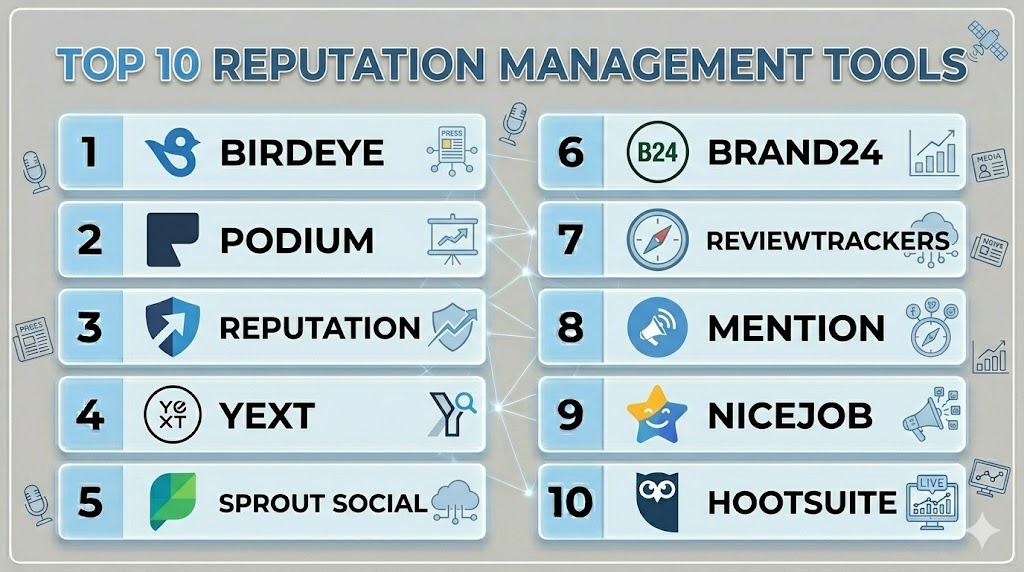
Introduction
Reputation Management Tools help businesses monitor, improve, and protect how their brand appears online across review websites, search engines, social media platforms, forums, and business directories. These tools centralize customer feedback, review responses, listings management, social listening, and sentiment analysis into one operational platform. Businesses use them to maintain customer trust, improve visibility, and respond quickly to public feedback.Online reputation has become a major business factor because customers increasingly rely on ratings, reviews, and social proof before making purchasing decisions. Negative reviews, poor response handling, or inaccurate business listings can directly affect revenue and customer retention. Modern platforms now use AI-powered sentiment analysis, automated workflows, and customer engagement tools to help organizations manage reputation at scale.
Common real-world use cases include:
- Monitoring customer reviews across multiple platforms
- Managing multi-location business listings
- Improving local SEO visibility
- Automating customer review requests
- Tracking brand sentiment and customer satisfaction
Buyers should evaluate these tools based on:
- Review monitoring coverage
- AI sentiment analysis quality
- Automation and workflow capabilities
- Listings management features
- Analytics and reporting depth
- CRM and helpdesk integrations
- Ease of onboarding and usability
- Security and access controls
- Scalability for multi-location operations
- Pricing flexibility and operational ROI
Best for: SMBs, franchises, healthcare organizations, hospitality brands, retail chains, agencies, eCommerce companies, and enterprise customer experience teams that rely heavily on public trust and customer reviews.
Not ideal for: Businesses with limited online engagement, organizations operating entirely offline, or teams that only require social media publishing instead of full reputation management capabilities.
Key Trends in Reputation Management Tools
- AI-powered sentiment analysis is improving customer feedback classification and risk detection.
- Automated review response suggestions are reducing manual workload for support and marketing teams.
- Multi-location reputation management is becoming essential for franchises and retail chains.
- Google Business Profile optimization is now a standard capability across major platforms.
- Unified customer experience workflows are combining reviews, surveys, messaging, and social listening.
- Mobile-first management experiences are improving response speed for distributed teams.
- Predictive analytics are helping businesses identify reputation risks earlier.
- Integration ecosystems with CRM and marketing platforms are becoming a major buying factor.
- Compliance-focused governance is increasing in healthcare and finance industries.
- Subscription pricing models are becoming more flexible for SMB and mid-market customers.
How We Selected These Tools (Methodology)
The tools in this list were selected using a balanced evaluation process focused on practical business value and market adoption.
- Evaluated overall market adoption and industry visibility
- Compared feature completeness across reviews, listings, analytics, and automation
- Assessed usability for SMB, mid-market, and enterprise organizations
- Reviewed AI and automation capabilities
- Compared integration depth with CRM, marketing, and support systems
- Considered scalability for multi-location businesses
- Evaluated reporting and analytics maturity
- Assessed security posture indicators and governance capabilities
- Considered onboarding quality and customer support
- Included a mix of enterprise-focused and SMB-friendly platforms
Top 10 Reputation Management Tools
1- Birdeye
Short Description:
Birdeye is a comprehensive reputation management and customer experience platform designed for SMBs, franchises, healthcare providers, and enterprise businesses. The platform combines review monitoring, listings management, surveys, messaging, and social engagement into one centralized dashboard. Birdeye is particularly strong for businesses operating across multiple locations because it simplifies customer engagement workflows and automates review collection processes. Its AI-powered automation capabilities help organizations improve customer satisfaction while reducing manual effort.
Key Features
- Multi-platform review monitoring
- AI-assisted review response generation
- Customer survey workflows
- Listings management across directories
- SMS and messaging engagement
- Social media monitoring
- Multi-location operational dashboards
Pros
- Excellent multi-location management
- Strong automation capabilities
- Broad customer engagement feature set
Cons
- Premium pricing for advanced plans
- Initial setup may require onboarding support
- Advanced reporting has a learning curve
Platforms / Deployment
- Web / iOS / Android
- Cloud
Security & Compliance
- MFA
- SSO/SAML
- RBAC
- Encryption
- GDPR support
Integrations & Ecosystem
Birdeye integrates with CRM systems, customer support tools, social platforms, and marketing ecosystems to centralize customer engagement operations.
- Salesforce
- HubSpot
- Google Business Profile
- Shopify
- Zapier
Support & Community
Birdeye offers enterprise onboarding assistance, implementation support, training resources, and dedicated customer success programs for larger organizations.
2- Podium
Short Description:
Podium focuses heavily on customer interaction, review generation, and messaging automation for SMBs and local businesses. It helps organizations collect reviews using SMS workflows, manage customer conversations, and streamline engagement processes. Podium is particularly popular in automotive, dental, home services, and retail industries because of its ease of use and fast deployment model.
Key Features
- SMS-based review requests
- Unified customer inbox
- Messaging automation
- Customer interaction workflows
- Payment collection tools
- Mobile management features
- Review monitoring dashboards
Pros
- Very easy to deploy
- Strong SMS engagement tools
- Good fit for SMBs
Cons
- Less advanced enterprise analytics
- Limited customization in basic plans
- Costs increase as usage grows
Platforms / Deployment
- Web / iOS / Android
- Cloud
Security & Compliance
- MFA
- Encryption
- RBAC
- Not publicly stated for additional certifications
Integrations & Ecosystem
Podium integrates with customer communication, CRM, and business management platforms to simplify customer engagement operations.
- Google Business Profile
- Salesforce
- HubSpot
- QuickBooks
- Zapier
Support & Community
Podium provides onboarding support, implementation guidance, and responsive customer service focused on SMB users.
3- Reputation
Short Description:
Reputation is an enterprise-grade reputation experience management platform built for large organizations and multi-location operations. It combines customer feedback management, social listening, business listings, analytics, and AI-driven sentiment analysis into a unified platform. Reputation is commonly used in healthcare, retail, and automotive industries where customer experience directly impacts operational performance.
Key Features
- Enterprise review analytics
- AI-powered sentiment analysis
- Multi-location management
- Customer survey automation
- Listings management
- Competitor benchmarking
- Operational governance controls
Pros
- Strong enterprise scalability
- Advanced analytics capabilities
- Excellent governance controls
Cons
- Higher implementation complexity
- Premium enterprise pricing
- Requires operational planning for deployment
Platforms / Deployment
- Web / iOS / Android
- Cloud
Security & Compliance
- SSO/SAML
- MFA
- RBAC
- Audit logs
- GDPR support
Integrations & Ecosystem
Reputation integrates with enterprise customer experience, marketing, and operational systems to centralize feedback management.
- Salesforce
- Microsoft Dynamics
- Google Business Profile
- Adobe Experience Cloud
- APIs
- Medallia
Support & Community
Enterprise-grade onboarding, account management, training programs, and implementation support are available.
4- Yext
Short Description:
Yext is widely recognized for digital listings management and local search optimization. The platform helps businesses maintain accurate location information, manage reviews, and improve visibility across search engines and online directories. Yext is particularly effective for enterprises and franchise operations managing large numbers of business locations.
Key Features
- Listings synchronization
- Local SEO management
- Review monitoring
- Knowledge graph management
- Search optimization tools
- Multi-location support
- Analytics dashboards
Pros
- Excellent local listings capabilities
- Strong enterprise scalability
- Good search visibility management
Cons
- Complex pricing structure
- Some advanced capabilities require additional modules
- Enterprise-oriented learning curve
Platforms / Deployment
- Web
- Cloud
Security & Compliance
- SSO/SAML
- MFA
- RBAC
- GDPR support
Integrations & Ecosystem
Yext integrates with search engines, CRM systems, customer engagement tools, and enterprise platforms.
- Google Business Profile
- Apple Maps
- Salesforce
- HubSpot
- Adobe
- APIs
Support & Community
Yext provides enterprise onboarding, implementation guidance, documentation, and customer success services.
5- Sprout Social
Short Description:
Sprout Social combines social media management with reputation monitoring and customer engagement analytics. The platform is ideal for brands that rely heavily on social channels for customer communication and public engagement. It offers social listening, sentiment tracking, collaboration tools, and reporting features that help marketing and support teams manage brand perception effectively.
Key Features
- Social listening
- Sentiment analysis
- Unified social inbox
- Analytics dashboards
- Review monitoring
- Publishing workflows
- Team collaboration tools
Pros
- Strong social media capabilities
- Excellent analytics dashboards
- Good team collaboration features
Cons
- Reputation management less specialized
- Premium pricing for advanced plans
- Better suited for social-first organizations
Platforms / Deployment
- Web / iOS / Android
- Cloud
Security & Compliance
- MFA
- SSO/SAML
- RBAC
- GDPR support
Integrations & Ecosystem
Sprout Social integrates with social platforms, marketing systems, and collaboration tools for unified customer engagement.
- Salesforce
- HubSpot
- Slack
Support & Community
Strong onboarding programs, customer support, training resources, and an active customer community.
6- Brand24
Short Description:
Brand24 is a social listening and online reputation monitoring platform designed for SMBs, agencies, and marketing teams. The platform tracks mentions across social media, blogs, news websites, and forums in real time. Brand24 emphasizes affordability, simplicity, and fast deployment while still providing useful analytics and sentiment tracking capabilities.
Key Features
- Real-time mention monitoring
- Social listening
- Sentiment analysis
- Influencer identification
- Competitor monitoring
- Reporting dashboards
- Mention alerts
Pros
- Affordable pricing structure
- Easy onboarding process
- Good real-time monitoring
Cons
- Limited enterprise governance
- Fewer advanced automations
- Reporting depth lower than enterprise suites
Platforms / Deployment
- Web
- Cloud
Security & Compliance
- MFA
- Encryption
- Not publicly stated for advanced certifications
Integrations & Ecosystem
Brand24 integrates with analytics and collaboration tools to simplify monitoring and reporting workflows.
- Slack
- Google Analytics
- APIs
- Social media platforms
- Email alerts
Support & Community
Brand24 offers responsive customer support, onboarding materials, and documentation suitable for SMB customers.
7- ReviewTrackers
Short Description:
ReviewTrackers focuses specifically on customer review aggregation, reputation monitoring, and local SEO visibility. It is commonly used by hospitality, retail, healthcare, and service organizations that need centralized review visibility across multiple review platforms. The platform prioritizes simplicity and operational efficiency for customer experience teams.
Key Features
- Review aggregation
- Multi-location monitoring
- Sentiment analysis
- Competitor benchmarking
- Reporting dashboards
- Review response workflows
- Local SEO insights
Pros
- Simple operational workflows
- Strong review monitoring coverage
- Useful local SEO insights
Cons
- Limited social media capabilities
- Narrower functionality than broader CX suites
- Less enterprise customization flexibility
Platforms / Deployment
- Web
- Cloud
Security & Compliance
- MFA
- RBAC
- Encryption
- Not publicly stated for broader certifications
Integrations & Ecosystem
ReviewTrackers integrates with CRM and reporting systems to centralize customer review management.
- Salesforce
- HubSpot
- Google Business Profile
- Slack
- APIs
Support & Community
Reliable onboarding support and practical customer service for local and multi-location businesses.
8- Mention
Short Description:
Mention is a media monitoring and social listening platform designed for agencies, digital marketing teams, and growing brands. It helps organizations monitor conversations, track mentions, and analyze customer sentiment across web and social channels. The platform is especially useful for teams that need real-time brand visibility and campaign tracking.
Key Features
- Brand mention tracking
- Real-time monitoring
- Social listening
- Competitive tracking
- Collaboration workflows
- Social publishing
- Reporting analytics
Pros
- Good media monitoring capabilities
- Easy-to-use dashboards
- Strong for agency workflows
Cons
- Limited review management depth
- Fewer enterprise governance features
- Workflow customization can be limited
Platforms / Deployment
- Web
- Cloud
Security & Compliance
- MFA
- Encryption
- GDPR support
Integrations & Ecosystem
Mention integrates with social channels, publishing tools, and collaboration systems for streamlined engagement.
- Twitter/X
- Slack
- Buffer
- APIs
Support & Community
Mention provides onboarding resources, customer support, and training materials for SMB and agency customers.
9- NiceJob
Short Description:
NiceJob is designed primarily for SMBs and local service businesses focused on improving customer reviews and online visibility. The platform automates review requests, referral generation, and customer engagement workflows. Its simplicity and automation-first approach make it attractive for smaller teams without dedicated marketing departments.
Key Features
- Automated review collection
- Referral marketing tools
- Website review widgets
- Customer engagement workflows
- SMS review requests
- Social proof automation
- Reputation monitoring
Pros
- Very easy to use
- Strong automation features
- Affordable SMB pricing
Cons
- Limited enterprise capabilities
- Narrower analytics depth
- Smaller integration ecosystem
Platforms / Deployment
- Web
- Cloud
Security & Compliance
- MFA
- Encryption
- Not publicly stated for broader compliance frameworks
Integrations & Ecosystem
NiceJob integrates with SMB business systems and customer communication platforms to simplify review management.
- Google Business Profile
- CRM platforms
- Zapier
- Website builders
Support & Community
NiceJob provides onboarding guidance and customer support focused on small business adoption.
10- Hootsuite
Short Description:
Hootsuite is primarily known as a social media management platform but also includes social listening and reputation monitoring capabilities. The platform helps organizations manage social engagement, monitor conversations, and track brand perception across multiple channels. It is commonly used by marketing teams handling high-volume social communication workflows.
Key Features
- Social listening
- Brand monitoring
- Social publishing
- Sentiment tracking
- Collaboration workflows
- Analytics dashboards
- Multi-channel engagement
Pros
- Mature social ecosystem
- Strong scheduling capabilities
- Good collaboration workflows
Cons
- Reputation management less specialized
- Advanced analytics require premium plans
- Better suited for social-centric operations
Platforms / Deployment
- Web / iOS / Android
- Cloud
Security & Compliance
- MFA
- SSO/SAML
- RBAC
- GDPR support
Integrations & Ecosystem
Hootsuite integrates with major social networks, analytics tools, and marketing ecosystems.
- Salesforce
- Slack
- Canva
Support & Community
Large customer community, onboarding resources, and extensive documentation for marketing teams.
Comparison Table
| Tool Name | Best For | Platform(s) Supported | Deployment | Standout Feature | Public Rating |
|---|---|---|---|---|---|
| Birdeye | Multi-location businesses | Web, iOS, Android | Cloud | AI-powered review automation | N/A |
| Podium | SMB customer engagement | Web, iOS, Android | Cloud | SMS review generation | N/A |
| Reputation | Enterprise customer experience | Web, iOS, Android | Cloud | Enterprise reputation analytics | N/A |
| Yext | Listings and local SEO | Web | Cloud | Listings synchronization | N/A |
| Sprout Social | Social-first brands | Web, iOS, Android | Cloud | Social listening analytics | N/A |
| Brand24 | SMB social monitoring | Web | Cloud | Real-time mention tracking | N/A |
| ReviewTrackers | Review aggregation | Web | Cloud | Local SEO review insights | N/A |
| Mention | Media monitoring | Web | Cloud | Real-time brand alerts | N/A |
| NiceJob | SMB review automation | Web | Cloud | Automated review collection | N/A |
| Hootsuite | Social engagement management | Web, iOS, Android | Cloud | Unified social management | N/A |
Evaluation & Scoring of Reputation Management Tools
| Tool Name | Core (25%) | Ease (15%) | Integrations (15%) | Security (10%) | Performance (10%) | Support (10%) | Value (15%) | Weighted Total |
|---|---|---|---|---|---|---|---|---|
| Birdeye | 9 | 8 | 9 | 8 | 9 | 9 | 8 | 8.6 |
| Podium | 8 | 9 | 8 | 7 | 8 | 8 | 8 | 8.1 |
| Reputation | 9 | 7 | 9 | 9 | 9 | 9 | 7 | 8.5 |
| Yext | 9 | 7 | 9 | 8 | 9 | 8 | 7 | 8.2 |
| Sprout Social | 8 | 8 | 8 | 8 | 8 | 8 | 7 | 7.9 |
| Brand24 | 7 | 9 | 6 | 6 | 7 | 7 | 9 | 7.5 |
| ReviewTrackers | 8 | 8 | 7 | 7 | 8 | 8 | 8 | 7.8 |
| Mention | 7 | 8 | 7 | 6 | 7 | 7 | 8 | 7.3 |
| NiceJob | 7 | 9 | 6 | 6 | 7 | 8 | 9 | 7.5 |
| Hootsuite | 8 | 8 | 9 | 8 | 8 | 8 | 7 | 8.0 |
These scores are comparative and designed to help buyers evaluate strengths across different operational priorities. Enterprise-focused platforms typically score higher in governance, scalability, and integrations, while SMB-focused platforms usually provide better simplicity and pricing flexibility. A higher score does not automatically mean the platform is the best fit for every business. Buyers should prioritize the categories most relevant to their operational goals, such as automation, social monitoring, compliance, or local SEO visibility. Testing shortlisted platforms through pilot deployments is strongly recommended before long-term adoption.
Which Reputation Management Tool Is Right for You?
Solo / Freelancer
Freelancers, consultants, and local professionals usually benefit most from lightweight and affordable tools like NiceJob or Podium. These platforms provide automated review collection and customer engagement without requiring dedicated operational teams. Ease of use and quick setup are more important than enterprise governance capabilities in this segment.
SMB
SMBs generally need a balance between automation, affordability, and customer engagement visibility. Birdeye, Podium, and ReviewTrackers are strong options because they combine reviews, analytics, messaging, and operational simplicity into unified workflows.
Mid-Market
Mid-market organizations should prioritize workflow automation, integration depth, and analytics capabilities. Reputation and Sprout Social work well for businesses managing larger customer engagement operations across multiple departments and digital channels.
Enterprise
Large enterprises usually require advanced governance, analytics, scalability, and centralized management capabilities. Reputation and Yext are particularly strong for enterprise deployments because they support multi-location operations, governance controls, and deep integration ecosystems.
Budget vs Premium
Budget-conscious organizations may prefer Brand24, NiceJob, or Podium because of their simplicity and lower operational costs. Premium platforms like Reputation and Yext provide broader enterprise functionality but typically involve higher licensing and implementation investments.
Feature Depth vs Ease of Use
Platforms with deeper operational functionality generally require more onboarding and training. Birdeye and Reputation provide advanced capabilities but may involve longer deployment timelines. NiceJob and Podium prioritize operational simplicity and fast adoption.
Integrations & Scalability
Organizations already invested in CRM, marketing automation, or customer support platforms should prioritize tools with strong API ecosystems and integration maturity. Birdeye, Reputation, and Yext provide stronger enterprise scalability and operational flexibility.
Security & Compliance Needs
Healthcare, finance, and regulated industries should prioritize platforms with governance controls, SSO, MFA, audit logs, and role-based access management. Enterprise-focused tools usually provide stronger compliance and operational oversight capabilities.
Frequently Asked Questions
1. What are Reputation Management Tools used for?
Reputation Management Tools help businesses monitor, manage, and improve how customers perceive their brand online. These platforms aggregate reviews, track social mentions, analyze customer sentiment, and centralize customer engagement workflows. Businesses use them to improve trust, respond to customer feedback faster, and maintain positive online visibility. Many tools also support listings management and local SEO optimization. They are especially important for customer-facing industries where reviews directly influence purchasing decisions.
2. Are these tools only useful for large businesses?
No. Small businesses often benefit significantly because online reviews directly impact local customer acquisition. SMB-focused tools simplify review collection and automate engagement workflows for smaller teams with limited resources. Enterprise platforms provide additional governance, scalability, and analytics features, but smaller businesses can still achieve strong ROI using simpler platforms. Local service providers, clinics, agencies, and retailers are common users.
3. How much do Reputation Management Tools typically cost?
Pricing varies depending on features, locations, review volume, integrations, and user counts. SMB platforms often use monthly subscription models, while enterprise platforms typically provide custom pricing structures. Some vendors also charge based on messaging usage or advanced analytics modules. Buyers should evaluate total operational value instead of focusing only on subscription costs. Long-term ROI often depends on customer retention and review improvements.
4. How difficult is implementation?
Implementation complexity depends on organizational size and integration requirements. SMB deployments may only take a few days, while enterprise implementations involving CRM integrations, multi-location governance, and workflow customization can take several weeks. Proper onboarding and operational planning are important for maximizing platform adoption. Businesses should also define review response policies and customer engagement ownership early in the process.
5. What are the biggest mistakes businesses make?
One major mistake is focusing only on collecting reviews without responding to customer feedback consistently. Another common issue is purchasing overly complex enterprise platforms that exceed operational needs. Some businesses also underestimate integration requirements and reporting expectations. Failing to train teams properly can reduce adoption and limit ROI. Successful deployments usually require operational discipline and consistent usage.
6. Can these tools improve local SEO performance?
Yes. Many reputation management platforms improve local visibility by helping businesses maintain accurate listings and generate more customer reviews. Positive reviews and active customer engagement can improve trust and search visibility. Platforms like Yext and Birdeye are particularly strong in local SEO support. However, reputation management should complement broader SEO and digital marketing strategies rather than replace them entirely.
7. Are AI features genuinely useful in these platforms?
AI features are becoming increasingly valuable for sentiment analysis, response suggestions, customer trend analysis, and workflow automation. AI helps businesses identify urgent complaints faster and reduce manual workload for customer engagement teams. However, human oversight remains important for sensitive or complex customer interactions. Organizations should treat AI as an operational assistant rather than a complete replacement for human communication.
8. What integrations matter most?
CRM integrations are often the most important because they connect customer feedback with operational workflows. Businesses should also evaluate integrations with helpdesk systems, social media platforms, analytics tools, and marketing automation ecosystems. API availability is another critical factor for scalability. Strong integrations improve reporting visibility and reduce operational silos across departments.
9. Can businesses switch vendors later?
Yes, although migration complexity depends on integrations, historical data requirements, and operational dependencies. Businesses should verify export capabilities, onboarding support, and API flexibility before selecting a vendor. Larger organizations may require phased migration strategies to avoid workflow disruptions. Planning ahead can reduce long-term switching costs significantly.
10. Are there alternatives to dedicated Reputation Management Tools?
Some organizations combine social media management platforms, survey tools, CRM systems, and review monitoring services instead of using dedicated reputation management software. However, this approach can create fragmented workflows and inconsistent reporting. Dedicated platforms centralize customer engagement, review management, sentiment analysis, and reporting into one operational environment. The best approach depends on business complexity, operational maturity, and budget.
Conclusion
Reputation Management Tools have evolved far beyond simple review monitoring platforms and now play a critical role in customer experience, brand perception, and operational trust management. Businesses today must monitor reviews, manage listings, respond to customer concerns quickly, and maintain visibility across multiple digital channels. The right platform depends heavily on organizational size, operational complexity, integration requirements, and customer engagement strategy. SMBs may prioritize affordability and ease of use through platforms like Podium or NiceJob, while enterprises often require deeper analytics, governance, and scalability from solutions like Reputation or Yext. Social-first organizations may benefit more from Sprout Social or Hootsuite, while local SEO-focused businesses may prioritize Birdeye or ReviewTrackers. Instead of searching for a single universal winner, organizations should shortlist platforms based on operational priorities, customer engagement goals, and integration needs. Running a pilot deployment with real customer workflows and validating security, reporting, and automation capabilities is usually the best next step before making a long-term investment decision.

one factor worth adding is data portability between reputation platforms. Historical reviews, sentiment trends, response records, and workflow metadata can become difficult to migrate, so export quality should be tested before long-term adoption