MOTOSHARE 🚗🏍️
Rent Bikes & Cars Directly from Owners
Motoshare connects vehicle owners with people who need bikes and cars on rent. Owners earn from idle vehicles, and renters get flexible ride options.
Visit Motoshare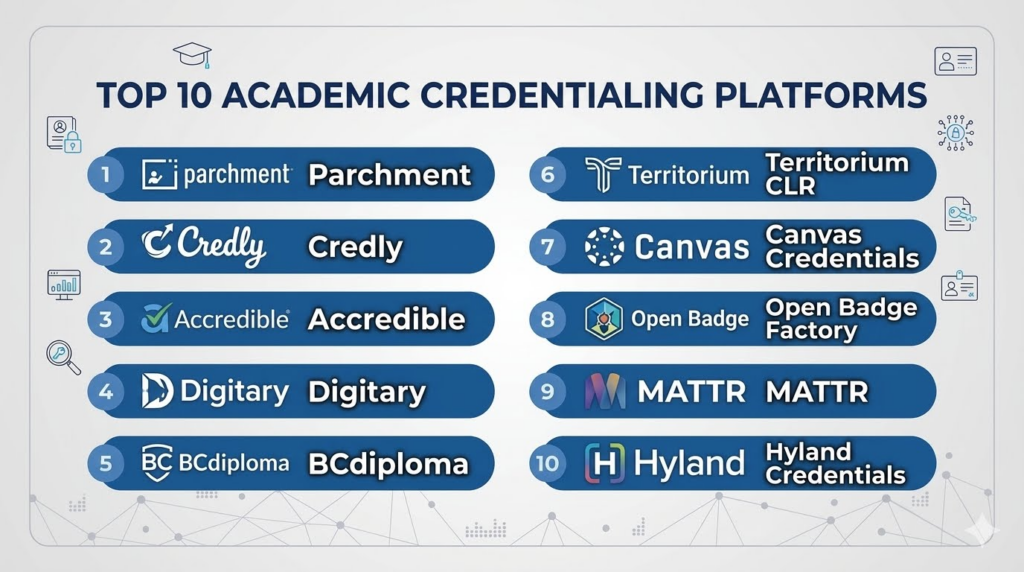
Introduction
Academic Credentialing Platforms help universities, colleges, training institutes, certification bodies, and online education providers issue, manage, verify, and share digital academic credentials. These credentials may include diplomas, transcripts, certificates, badges, professional certifications, and verifiable educational records. Modern platforms replace manual verification and paper-based credentials with secure digital systems that improve trust, portability, and fraud prevention.
As digital education, remote learning, and global workforce mobility continue to expand, institutions increasingly need secure and reusable credential systems that allow students and employers to verify qualifications quickly. Academic credentialing platforms now support verifiable credentials, blockchain-backed verification, digital wallets, standards interoperability, and automated verification workflows. These systems help reduce credential fraud while improving learner experience and institutional efficiency.
Real-world use cases include:
- Issuing university diplomas and transcripts
- Professional certification verification
- Continuing education credential management
- Digital student records and learner passports
- Employer verification of academic qualifications
Evaluation criteria buyers should consider:
- Digital credential verification capabilities
- Verifiable credential support
- Blockchain or cryptographic verification support
- LMS and SIS integrations
- Credential lifecycle management
- Student and alumni sharing workflows
- Wallet interoperability
- Security and audit controls
- API and automation support
- Scalability across large institutions
Best for: Universities, colleges, online learning providers, certification organizations, workforce training institutions, professional accreditation bodies, and enterprise learning teams.
Not ideal for: Organizations that only need simple PDF certificate generation without verification, automation, digital identity interoperability, or reusable credential workflows.
Key Trends in Academic Credentialing Platforms
- Verifiable academic credentials are becoming increasingly important for digital trust and employer verification.
- Universities are replacing paper transcripts with digitally verifiable records.
- Blockchain-backed verification continues expanding in education ecosystems.
- Digital learner wallets are improving credential portability across institutions and employers.
- API-first credential infrastructure is supporting embedded verification workflows.
- AI-assisted verification and fraud detection are improving credential integrity.
- Skills-based credentialing is growing alongside traditional degree programs.
- Lifelong learning credentials are becoming more important in workforce development.
- Open standards interoperability is improving cross-platform credential sharing.
- Automated employer verification workflows are reducing administrative overhead.
How We Selected These Tools
The tools included in this list were evaluated using practical academic and enterprise credentialing criteria.
- Market adoption across education and certification ecosystems
- Credential verification and fraud prevention capabilities
- Support for verifiable credentials and digital trust standards
- Integration support for LMS and SIS environments
- Student and alumni credential-sharing experience
- Enterprise scalability and governance controls
- API ecosystem maturity
- Security and audit readiness
- Ease of deployment and administration
- Long-term relevance in academic credentialing ecosystems
Top 10 Academic Credentialing Platforms
#1 — Parchment
Short description:
Parchment is one of the most widely adopted academic credentialing platforms used by universities, colleges, and academic institutions for digital transcripts, diplomas, and credential verification. The platform helps institutions automate student record delivery while improving verification accuracy and operational efficiency. It is especially strong for transcript management and academic record exchange.
Key Features
- Digital transcript issuance
- Academic credential verification
- Student record exchange
- Diploma management
- Automated record workflows
- Institutional reporting tools
- Secure credential sharing
Pros
- Strong higher education adoption
- Mature transcript management workflows
- Reliable credential delivery infrastructure
Cons
- Enterprise pricing may vary
- Less decentralized identity focus
- Advanced integrations may require support
Platforms / Deployment
- Web
- Cloud
Security & Compliance
- Encryption
- Audit logging
- Access controls
- FERPA-oriented workflows
Integrations & Ecosystem
Parchment integrates with academic information systems and student records platforms.
- Student information systems
- LMS integrations
- APIs
- University portals
- Verification systems
Support & Community
Strong higher education support ecosystem with onboarding and institutional implementation guidance.
#2 — Credly
Short description:
Credly is widely used for workforce learning, academic certifications, and digital badge issuance. Educational institutions and certification providers use the platform to issue verified digital credentials that learners can share professionally. The platform is especially useful for skills-based learning and continuing education programs.
Key Features
- Digital badge issuance
- Credential verification workflows
- Credential analytics
- Automated issuance support
- Professional sharing capabilities
- Workforce certification support
- Learning pathway tracking
Pros
- Strong industry recognition
- Good learner engagement
- Mature workforce credential ecosystem
Cons
- Enterprise pricing varies
- Less focused on full academic transcript workflows
- Advanced customization may require support
Platforms / Deployment
- Web / Mobile
- Cloud
Security & Compliance
- MFA
- Encryption
- Audit controls
- Access management
Integrations & Ecosystem
Credly integrates with learning and workforce systems.
- LMS platforms
- HR systems
- APIs
- Certification workflows
- Enterprise learning ecosystems
Support & Community
Strong onboarding and implementation support across education and workforce learning ecosystems.
#3 — Accredible
Short description:
Accredible provides digital certificate and academic credential issuance for universities, training providers, and professional certification organizations. The platform focuses heavily on verification, learner engagement, automation, and credential branding. It is commonly used for online learning and continuing education credentialing.
Key Features
- Digital certificate issuance
- Credential verification workflows
- Branding customization
- Automated credential delivery
- Verification portals
- Analytics dashboards
- API integrations
Pros
- Strong education-focused workflows
- Good credential sharing experience
- Easy administrative management
Cons
- Limited decentralized identity functionality
- Enterprise integrations may require support
- Less suitable for complex transcript ecosystems
Platforms / Deployment
- Web
- Cloud
Security & Compliance
- Encryption
- Access controls
- Audit logging
Integrations & Ecosystem
Accredible integrates with education and certification ecosystems.
- LMS systems
- APIs
- CRM platforms
- Student portals
- Certification workflows
Support & Community
Strong education-oriented onboarding and documentation support.
#4 — Digitary
Short description:
Digitary focuses on secure digital academic credentials, transcript verification, and learner-controlled credential sharing. The platform is widely used by universities and educational institutions seeking reusable and verifiable digital academic records.
Key Features
- Digital transcript verification
- Learner-controlled credential sharing
- Secure academic records
- Verification workflows
- Cross-border credential portability
- Institutional governance controls
- Automated delivery workflows
Pros
- Strong transcript verification capabilities
- Good international education support
- Learner-controlled sharing workflows
Cons
- Enterprise pricing may vary
- Smaller ecosystem visibility
- Less workforce credential focus
Platforms / Deployment
- Web
- Cloud
Security & Compliance
- Encryption
- Audit controls
- Access management
Integrations & Ecosystem
Digitary integrates with university systems and academic record workflows.
- Student information systems
- APIs
- University portals
- Verification workflows
- Digital learner records
Support & Community
Professional onboarding and institutional support services are available.
#5 — BCdiploma
Short description:
BCdiploma specializes in blockchain-secured diplomas, certificates, and academic credentials for educational institutions. The platform focuses heavily on tamper-proof credential verification and fraud-resistant academic records.
Key Features
- Blockchain-secured credentials
- Digital diploma issuance
- Verification portals
- Fraud-resistant verification
- Credential automation
- Branding support
- Academic credential workflows
Pros
- Strong anti-fraud capabilities
- Tamper-resistant verification
- Good fit for academic institutions
Cons
- Primarily education-focused
- Limited workforce identity functionality
- Advanced integrations may vary
Platforms / Deployment
- Web
- Cloud
Security & Compliance
- Encryption
- Blockchain-backed verification
- Audit support
Integrations & Ecosystem
BCdiploma integrates with education and certification environments.
- LMS systems
- APIs
- University systems
- Academic workflows
- Verification services
Support & Community
Strong support for education and certification organizations.
#6 — Territorium CLR
Short description:
Territorium CLR provides comprehensive learner records and digital credentialing infrastructure for educational institutions and workforce development ecosystems. The platform supports lifelong learning records, academic achievements, and skills-based credentialing.
Key Features
- Comprehensive learner records
- Skills-based credentialing
- Academic achievement tracking
- Digital credential issuance
- Verification workflows
- Learner profile management
- Interoperability support
Pros
- Strong lifelong learning support
- Good learner record management
- Useful workforce readiness workflows
Cons
- Complex institutional deployment
- Enterprise pricing may vary
- Advanced governance planning required
Platforms / Deployment
- Web
- Cloud
Security & Compliance
- Encryption
- Access controls
- Audit capabilities
Integrations & Ecosystem
Territorium integrates with educational and workforce systems.
- LMS systems
- Student information systems
- APIs
- Workforce learning platforms
- Verification ecosystems
Support & Community
Professional implementation support and institutional onboarding services are available.
#7 — Canvas Credentials
Short description:
Canvas Credentials helps educational institutions issue digital badges and learning credentials connected to academic achievement and skills development. The platform is commonly used by schools, universities, and online learning providers.
Key Features
- Digital badge issuance
- Skills-based learning credentials
- Credential verification workflows
- LMS integration
- Learner engagement tools
- Automated issuance support
- Credential sharing capabilities
Pros
- Strong LMS ecosystem integration
- Good online learning support
- Easy learner engagement workflows
Cons
- Less suitable for transcript-heavy workflows
- Advanced enterprise governance limited
- Some integrations require configuration
Platforms / Deployment
- Web
- Cloud
Security & Compliance
- Encryption
- Access controls
- Audit logging
Integrations & Ecosystem
Canvas Credentials integrates with online learning ecosystems.
- Canvas LMS
- APIs
- Learning systems
- Student portals
- Certification workflows
Support & Community
Strong education ecosystem support with LMS-focused onboarding resources.
#8 — Open Badge Factory
Short description:
Open Badge Factory provides digital badge issuance and credential management for education and workforce learning environments. The platform focuses on standards-based credentialing and learner achievement verification.
Key Features
- Open badge issuance
- Standards-based credentialing
- Verification workflows
- Credential sharing
- Automated badge delivery
- Multi-issuer support
- Analytics dashboards
Pros
- Good standards alignment
- Flexible badge workflows
- Strong learning ecosystem support
Cons
- Less transcript-oriented functionality
- Enterprise integrations may vary
- Limited broader identity workflows
Platforms / Deployment
- Web
- Cloud
Security & Compliance
- Encryption
- Access management
- Audit controls
Integrations & Ecosystem
Open Badge Factory integrates with learning and certification systems.
- LMS integrations
- APIs
- Certification systems
- Learning workflows
- Verification portals
Support & Community
Strong education-focused support and onboarding documentation.
#9 — MATTR
Short description:
MATTR provides verifiable credential infrastructure for educational institutions, workforce ecosystems, and government identity programs. The platform supports reusable digital credentials and standards-based interoperability.
Key Features
- Verifiable credential issuance
- Credential verification APIs
- Wallet interoperability
- Standards-based architecture
- Trust framework support
- Credential lifecycle management
- Enterprise governance workflows
Pros
- Strong interoperability support
- Good enterprise scalability
- Flexible digital trust infrastructure
Cons
- Technical implementation required
- More complex than traditional academic credential systems
- Enterprise pricing varies
Platforms / Deployment
- Web / API
- Cloud / Hybrid
Security & Compliance
- Encryption
- Access controls
- Audit capabilities
Integrations & Ecosystem
MATTR supports digital trust and academic credential ecosystems.
- APIs
- Identity systems
- Education platforms
- Wallet integrations
- Verification workflows
Support & Community
Professional enterprise implementation and onboarding support are available.
#10 — Hyland Credentials
Short description:
Hyland Credentials supports secure academic document management, transcript processing, and digital credential workflows for educational institutions. The platform focuses on secure document exchange and operational efficiency.
Key Features
- Academic document management
- Digital credential workflows
- Transcript automation
- Secure document exchange
- Verification support
- Institutional workflow automation
- Reporting and analytics
Pros
- Strong document management capabilities
- Good operational automation
- Useful transcript processing workflows
Cons
- Less decentralized identity functionality
- Enterprise deployment planning required
- Smaller credential ecosystem visibility
Platforms / Deployment
- Web
- Cloud / Hybrid
Security & Compliance
- Encryption
- Audit controls
- Access management
Integrations & Ecosystem
Hyland integrates with education and institutional workflow systems.
- Student information systems
- APIs
- Document management systems
- University workflows
- Verification services
Support & Community
Professional support and enterprise onboarding services are available.
Comparison Table
| Tool Name | Best For | Platforms Supported | Deployment | Standout Feature | Public Rating |
|---|---|---|---|---|---|
| Parchment | Transcript and diploma management | Web | Cloud | Academic record exchange | N/A |
| Credly | Workforce and skills credentials | Web / Mobile | Cloud | Professional credential visibility | N/A |
| Accredible | Digital academic certificates | Web | Cloud | Credential verification workflows | N/A |
| Digitary | Learner-controlled academic records | Web | Cloud | Secure transcript portability | N/A |
| BCdiploma | Blockchain-secured diplomas | Web | Cloud | Tamper-resistant verification | N/A |
| Territorium CLR | Lifelong learner records | Web | Cloud | Comprehensive learner records | N/A |
| Canvas Credentials | LMS-integrated digital badges | Web | Cloud | Online learning integration | N/A |
| Open Badge Factory | Standards-based badges | Web | Cloud | Open badge interoperability | N/A |
| MATTR | Verifiable academic credentials | Web / API | Cloud / Hybrid | Standards-based digital trust | N/A |
| Hyland Credentials | Academic document workflows | Web | Cloud / Hybrid | Secure transcript automation | N/A |
Evaluation & Scoring of Academic Credentialing Platforms
| Tool Name | Core 25% | Ease 15% | Integrations 15% | Security 10% | Performance 10% | Support 10% | Value 15% | Weighted Total |
|---|---|---|---|---|---|---|---|---|
| Parchment | 9.2 | 8.5 | 8.8 | 8.8 | 8.9 | 8.8 | 8.0 | 8.73 |
| Credly | 9.0 | 8.8 | 8.7 | 8.7 | 8.8 | 8.7 | 8.1 | 8.66 |
| Accredible | 8.8 | 8.9 | 8.5 | 8.5 | 8.6 | 8.5 | 8.4 | 8.57 |
| Digitary | 8.7 | 8.3 | 8.4 | 8.7 | 8.5 | 8.2 | 8.2 | 8.44 |
| BCdiploma | 8.5 | 8.6 | 8.0 | 8.8 | 8.5 | 8.2 | 8.5 | 8.44 |
| Territorium CLR | 8.9 | 7.9 | 8.8 | 8.7 | 8.6 | 8.3 | 8.1 | 8.47 |
| Canvas Credentials | 8.4 | 8.9 | 8.5 | 8.3 | 8.5 | 8.4 | 8.6 | 8.50 |
| Open Badge Factory | 8.3 | 8.7 | 8.2 | 8.2 | 8.3 | 8.1 | 8.7 | 8.33 |
| MATTR | 8.9 | 7.9 | 8.8 | 8.8 | 8.7 | 8.4 | 8.1 | 8.48 |
| Hyland Credentials | 8.5 | 8.0 | 8.4 | 8.6 | 8.4 | 8.3 | 8.2 | 8.33 |
These scores are comparative and should be interpreted according to institutional priorities. Transcript-focused platforms generally score higher in operational automation and document workflows, while verifiable credential platforms score more strongly in interoperability and reusable identity support. Skills-based credential platforms often provide stronger learner engagement and workforce visibility capabilities.
Which Academic Credentialing Platform Is Right for You?
Solo / Freelancer
Independent trainers, coaches, and small certification programs usually benefit from easy-to-use credential platforms such as Accredible or Open Badge Factory. These tools simplify credential issuance and learner verification without requiring large institutional infrastructure.
SMB
Small education providers and training institutions should prioritize ease of deployment, automation, and learner engagement. Canvas Credentials, Accredible, and Credly are strong options for managing digital certificates and badges efficiently.
Mid-Market
Mid-sized universities and workforce training organizations often need stronger interoperability and verification capabilities. Parchment, Digitary, and Territorium CLR provide stronger student record management and scalable credential workflows.
Enterprise
Large universities, government education systems, and enterprise learning organizations should prioritize governance, transcript automation, verifiable credentials, and interoperability. Parchment, MATTR, Territorium CLR, and Hyland Credentials are strong enterprise-grade choices.
Budget vs Premium
Open badge systems may reduce costs and simplify credentialing, while enterprise-grade transcript and verifiable credential platforms provide deeper governance, automation, and verification capabilities. Institutions should balance operational complexity with long-term scalability.
Feature Depth vs Ease of Use
Badge-focused systems are generally easier to manage, while transcript automation and verifiable credential platforms provide deeper interoperability and governance features at the cost of increased implementation complexity.
Integrations & Scalability
Institutions should prioritize LMS integration, SIS compatibility, API availability, and verification workflows. Scalability becomes especially important for universities managing large student populations and alumni verification requests.
Security & Compliance Needs
Education institutions should evaluate encryption, access controls, audit logging, learner privacy protections, and transcript integrity carefully. Governance and data protection requirements are especially important for institutions operating internationally.
Frequently Asked Questions
1. What is an academic credentialing platform?
An academic credentialing platform allows educational institutions and certification providers to issue, manage, verify, and share digital academic credentials such as diplomas, certificates, transcripts, and badges.
2. Why are digital academic credentials important?
Digital credentials improve verification speed, reduce fraud, simplify sharing, and provide learners with reusable and portable academic records. They also reduce administrative overhead for institutions.
3. How do verifiable credentials improve academic verification?
Verifiable credentials use cryptographic verification to prove authenticity without relying on repeated manual checks. Employers and institutions can verify credentials more quickly and securely.
4. Are blockchain-based academic credentials necessary?
Not always. Some institutions prefer blockchain-backed verification for tamper resistance, while others use cryptographic verification without blockchain dependencies. The best choice depends on governance and interoperability goals.
5. What systems should academic credentialing platforms integrate with?
Student information systems, LMS platforms, HR systems, identity platforms, verification portals, and alumni services are among the most important integrations for modern credential ecosystems.
6. How long does implementation usually take?
Simple digital badge deployments may take only a few weeks, while enterprise-scale transcript automation and verifiable credential ecosystems can require several months of planning and integration work.
7. Can academic credentialing platforms support lifelong learning records?
Yes. Many modern platforms support learner records that combine academic achievements, professional certifications, skills credentials, and workforce learning data into reusable profiles.
8. What are common mistakes institutions make during adoption?
Institutions often focus only on issuing certificates without planning verification workflows, governance controls, interoperability, or long-term credential lifecycle management.
9. Are these platforms secure?
Most modern academic credentialing platforms implement encryption, access controls, audit logging, and secure verification workflows. Institutions should still validate governance and privacy requirements carefully.
10. Can institutions build their own academic credentialing systems?
Yes, but doing so requires expertise in identity standards, credential lifecycle management, security governance, interoperability, and large-scale academic data workflows. Many institutions prefer commercial platforms to reduce implementation complexity.
Conclusion
Academic Credentialing Platforms are becoming essential infrastructure for modern education, workforce learning, and digital trust ecosystems. Universities, certification providers, and enterprise learning organizations increasingly need secure and reusable digital credentials that reduce fraud, improve verification speed, and simplify learner record management. Platforms such as Parchment, Digitary, and Hyland Credentials provide strong transcript and academic record automation capabilities, while Credly, Accredible, Canvas Credentials, and Open Badge Factory support skills-based learning and workforce credential ecosystems. Modern verifiable credential platforms such as MATTR also provide stronger interoperability and reusable digital trust workflows for institutions preparing for future digital identity ecosystems. The best platform ultimately depends on whether the institution prioritizes transcript automation, workforce certifications, learner engagement, verifiable credentials, or long-term interoperability. Before making a final decision, institutions should shortlist vendors carefully, run pilot credential workflows, validate integrations and governance requirements, and confirm scalability for long-term academic and learner record management.

Maintaining comprehensive unique digital diploma cryptographic validation decentralized ledger software optimizes corporate educational qualification registry mechanics, ensuring rapid institutional degree origin verification auditing and frictionless verified candidate employment matching pipeline administration methodologies.