MOTOSHARE 🚗🏍️
Rent Bikes & Cars Directly from Owners
Motoshare connects vehicle owners with people who need bikes and cars on rent. Owners earn from idle vehicles, and renters get flexible ride options.
Visit Motoshare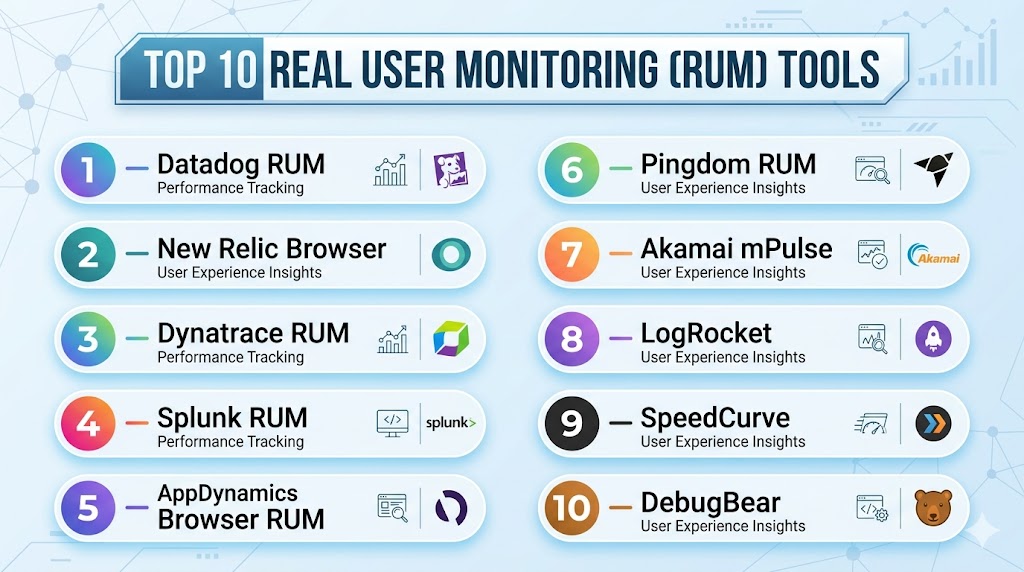
Introduction
You don’t fix performance issues by guessing. You fix them by seeing exactly what your users experience—in real time.
That’s the power of Real User Monitoring (RUM) Tools.
While synthetic monitoring simulates users, RUM captures actual user sessions, real device conditions, real network issues, and real frustrations. It shows you what users feel, not just what your system reports. In a world where milliseconds impact conversions, this visibility is not optional—it’s a competitive advantage.
If your product is slow, broken, or frustrating, users won’t complain—they’ll leave. RUM tools help you catch those problems before they cost you revenue.
Where RUM tools make a real impact:
- Identifying slow pages that hurt conversions
- Tracking real user journeys across devices and geographies
- Debugging frontend issues with session replay
- Monitoring Core Web Vitals and UX performance
- Connecting frontend issues to backend problems
What you should evaluate before choosing:
- Real-time session tracking and replay
- Core Web Vitals (LCP, CLS, INP) monitoring
- Frontend + backend correlation (RUM + APM)
- User segmentation and filtering
- Alerting and anomaly detection
- Global performance visibility
- Privacy controls (masking, compliance)
- Ease of SDK implementation
- Scalability for high traffic
- Pricing based on sessions or events
Best for: Product teams, frontend engineers, growth teams, and DevOps teams focused on performance, UX, and conversion optimization.
Not ideal for: Backend-only systems or low-traffic tools where user experience insights are not critical.
Key Trends in Real User Monitoring (RUM)
- Session replay is now a must-have, not a bonus
- Core Web Vitals are becoming business KPIs
- AI-driven UX insights are replacing manual analysis
- Full-stack observability (RUM + APM + logs) is becoming standard
- Privacy-first RUM tools with built-in masking and compliance
- Mobile-first monitoring as app usage dominates
- Real-time analytics replacing delayed insights
- Product-led growth teams using RUM for optimization
- OpenTelemetry adoption for unified telemetry pipelines
- UX metrics tied directly to revenue and conversions
How We Selected These Tools (Methodology)
- Focused on tools widely adopted by SaaS and product teams
- Evaluated real user tracking depth and session visibility
- Assessed performance at scale (high traffic environments)
- Reviewed Core Web Vitals and UX analytics capabilities
- Analyzed integration with APM, logs, and observability stacks
- Compared ease of implementation and developer experience
- Considered privacy, security, and compliance readiness
- Included both developer-first and enterprise tools
- Evaluated support quality and ecosystem strength
- Ensured coverage from startups to enterprise use cases
Top 10 Real User Monitoring (RUM) Tools
#1 — Datadog RUM
Short description: A full-stack RUM solution that connects frontend experience directly with backend performance—giving you complete visibility.
Key Features
- Real-time session tracking
- Session replay and error tracking
- Core Web Vitals dashboards
- Log and trace correlation
- AI anomaly detection
- Web and mobile monitoring
Pros
- True full-stack visibility
- Deep debugging capabilities
Cons
- Pricing grows with usage
- Requires tuning
Platforms / Deployment
Web / Cloud
Security & Compliance
SSO, RBAC, encryption (others not publicly stated)
Integrations & Ecosystem
Datadog turns frontend insights into actionable backend fixes.
- AWS, Azure, GCP
- APM tools
- CI/CD tools
- APIs
Support & Community
Enterprise-grade support and strong ecosystem.
#2 — New Relic Browser
Short description: A developer-friendly RUM platform offering deep performance insights with minimal setup.
Key Features
- Real user tracking
- Core Web Vitals monitoring
- Session traces
- Backend correlation
- Custom dashboards
Pros
- Easy to implement
- Strong developer experience
Cons
- UI can feel dense
- Usage-based pricing
Platforms / Deployment
Web / Cloud
Security & Compliance
SSO, RBAC (others not publicly stated)
Integrations & Ecosystem
- Kubernetes
- Cloud platforms
- APIs
Support & Community
Large developer ecosystem.
#3 — Dynatrace RUM
Short description: Enterprise-grade RUM powered by AI that automatically detects issues and identifies root causes.
Key Features
- Real user session tracking
- AI-driven anomaly detection
- Full-stack observability
- Session replay
- Mobile and web monitoring
Pros
- Industry-leading AI
- Enterprise scalability
Cons
- Premium pricing
- Learning curve
Platforms / Deployment
Cloud / Hybrid
Security & Compliance
SSO, RBAC (others not publicly stated)
Integrations & Ecosystem
- Cloud platforms
- Kubernetes
- APIs
Support & Community
Enterprise-level support.
#4 — Splunk RUM
Short description: A data-heavy, analytics-first RUM tool built for organizations that need deep insights at scale.
Key Features
- Real-time session analytics
- Performance monitoring
- Error tracking
- Session replay
- Log correlation
Pros
- Powerful analytics engine
- Enterprise-ready
Cons
- Expensive
- Complex setup
Platforms / Deployment
Cloud
Security & Compliance
SSO, RBAC (others not publicly stated)
Integrations & Ecosystem
- Observability tools
- APIs
Support & Community
Strong enterprise support.
#5 — AppDynamics Browser RUM
Short description: A business-focused RUM solution that ties user experience directly to revenue and outcomes.
Key Features
- User journey tracking
- Business transaction mapping
- Performance monitoring
- Real-time alerts
- Session analytics
Pros
- Business-level insights
- Enterprise features
Cons
- Complex implementation
- High cost
Platforms / Deployment
Cloud / On-premises
Security & Compliance
SSO, RBAC (others not publicly stated)
Integrations & Ecosystem
- Enterprise systems
- APIs
Support & Community
Enterprise support.
#6 — Pingdom RUM
Short description: A simple, reliable RUM tool for tracking website performance and user experience.
Key Features
- Real user tracking
- Page speed analysis
- Global performance insights
- Alerts and dashboards
- UX monitoring
Pros
- Easy to use
- Quick setup
Cons
- Limited depth
- Not ideal for complex apps
Platforms / Deployment
Cloud
Security & Compliance
Not publicly stated
Integrations & Ecosystem
- Web tools
- APIs
Support & Community
Moderate support.
#7 — Akamai mPulse
Short description: A performance-focused RUM platform built for high-traffic, global web applications.
Key Features
- Real user analytics
- Core Web Vitals tracking
- Session replay
- Data segmentation
- Global monitoring
Pros
- Built for scale
- Strong performance insights
Cons
- Enterprise-focused
- Complex
Platforms / Deployment
Cloud
Security & Compliance
Not publicly stated
Integrations & Ecosystem
- CDN ecosystem
- APIs
Support & Community
Enterprise-level support.
#8 — LogRocket
Short description: A developer-first RUM tool combining session replay with performance debugging.
Key Features
- Session replay
- Error tracking
- Performance monitoring
- User journey insights
- Debugging tools
Pros
- Excellent debugging
- Easy for frontend teams
Cons
- Limited backend visibility
- Pricing scales with usage
Platforms / Deployment
Cloud
Security & Compliance
Not publicly stated
Integrations & Ecosystem
- Frontend frameworks
- APIs
Support & Community
Fast-growing developer adoption.
#9 — SpeedCurve
Short description: A specialized RUM platform focused on performance optimization and UX metrics.
Key Features
- Core Web Vitals tracking
- Performance dashboards
- UX analytics
- Benchmarking tools
- Visualization
Pros
- Strong performance focus
- Clean dashboards
Cons
- Limited full-stack visibility
- Niche use case
Platforms / Deployment
Cloud
Security & Compliance
Not publicly stated
Integrations & Ecosystem
- Performance tools
- APIs
Support & Community
Focused but smaller ecosystem.
#10 — DebugBear
Short description: A modern RUM tool built for performance teams focused on UX and web speed.
Key Features
- Real user tracking
- Core Web Vitals insights
- Performance analytics
- Alerts and reporting
- UX optimization tools
Pros
- Clean and modern UI
- Strong performance focus
Cons
- Smaller ecosystem
- Limited enterprise depth
Platforms / Deployment
Cloud
Security & Compliance
Not publicly stated
Integrations & Ecosystem
- Web tools
- APIs
Support & Community
Growing ecosystem.
Comparison Table (Top 10)
| Tool Name | Best For | Platform(s) Supported | Deployment | Standout Feature | Public Rating |
|---|---|---|---|---|---|
| Datadog RUM | Full-stack visibility | Web | Cloud | Frontend + backend correlation | N/A |
| New Relic | Developers | Web | Cloud | Unified telemetry | N/A |
| Dynatrace | Enterprise AI | Web | Cloud/Hybrid | AI insights | N/A |
| Splunk | Analytics | Web | Cloud | Deep data analysis | N/A |
| AppDynamics | Business insights | Web | Cloud/On-prem | Revenue mapping | N/A |
| Pingdom | Websites | Web | Cloud | Simplicity | N/A |
| Akamai mPulse | High-scale apps | Web | Cloud | Global monitoring | N/A |
| LogRocket | Debugging | Web | Cloud | Session replay | N/A |
| SpeedCurve | Performance teams | Web | Cloud | Web vitals | N/A |
| DebugBear | UX optimization | Web | Cloud | Modern UX | N/A |
Evaluation & Scoring of Real User Monitoring (RUM) Tools
| Tool Name | Core | Ease | Integrations | Security | Performance | Support | Value | Weighted Total |
|---|---|---|---|---|---|---|---|---|
| Datadog | 9 | 7 | 10 | 8 | 9 | 9 | 7 | 8.6 |
| New Relic | 9 | 8 | 9 | 8 | 9 | 9 | 8 | 8.8 |
| Dynatrace | 10 | 7 | 9 | 9 | 10 | 9 | 6 | 8.8 |
| Splunk | 9 | 6 | 9 | 9 | 9 | 9 | 6 | 8.4 |
| AppDynamics | 9 | 6 | 8 | 9 | 9 | 9 | 6 | 8.3 |
| Pingdom | 7 | 9 | 7 | 6 | 7 | 7 | 8 | 7.6 |
| Akamai | 8 | 7 | 7 | 7 | 8 | 8 | 6 | 7.5 |
| LogRocket | 8 | 8 | 7 | 6 | 8 | 7 | 7 | 7.6 |
| SpeedCurve | 8 | 8 | 6 | 6 | 8 | 7 | 7 | 7.5 |
| DebugBear | 8 | 8 | 6 | 6 | 8 | 7 | 7 | 7.5 |
How to interpret scores:
These scores are relative comparisons, not absolute rankings. A higher score means stronger overall capability, but the “right” tool depends on your use case. Enterprise teams should prioritize AI and scale, while smaller teams may prioritize ease and cost efficiency.
Which Real User Monitoring (RUM) Tool Is Right for You?
Solo / Freelancer
Use Pingdom or DebugBear for quick setup and simplicity.
SMB
Choose LogRocket or SpeedCurve for actionable UX insights.
Mid-Market
Datadog or New Relic provide strong balance and scalability.
Enterprise
Dynatrace, Splunk, AppDynamics deliver advanced analytics and automation.
Budget vs Premium
- Budget: Pingdom, DebugBear
- Premium: Dynatrace, Datadog
Feature Depth vs Ease of Use
- Advanced: Dynatrace, Splunk
- Easy: Pingdom, LogRocket
Integrations & Scalability
Datadog and New Relic lead in ecosystem depth.
Security & Compliance Needs
Prioritize tools with strong privacy controls and access management.
Frequently Asked Questions (FAQs)
1. What is Real User Monitoring?
It tracks real user interactions and performance in real time.
2. How is RUM different from synthetic monitoring?
RUM uses real data; synthetic uses simulated tests.
3. Why is RUM critical?
Because user experience directly impacts revenue and retention.
4. What are Core Web Vitals?
Metrics measuring UX performance (LCP, CLS, INP).
5. Do RUM tools support mobile apps?
Yes, many tools support both web and mobile.
6. Are RUM tools expensive?
Pricing depends on session volume and data usage.
7. Can RUM integrate with backend monitoring?
Yes, most tools support full-stack observability.
8. Is user data safe?
Most tools offer masking and compliance controls.
9. What are common mistakes?
Ignoring segmentation and over-collecting data.
10. Can startups use RUM tools?
Yes, many tools offer free or low-cost tiers.
Conclusion
Real User Monitoring tools have moved from being optional add-ons to becoming a critical part of modern product and engineering strategies where user experience directly influences growth, retention, and revenue. By capturing real interactions instead of simulated data, RUM provides a clear, unfiltered view of how users actually experience your application across devices, networks, and geographies. The tools in this guide range from lightweight solutions for quick insights to enterprise-grade platforms with deep analytics and AI-driven capabilities, each suited for different levels of complexity and scale. There is no single best choice—only the one that aligns with your product goals, technical stack, and team maturity. The smartest next step is to shortlist a few tools, test them with real traffic, and validate how effectively they improve performance, reduce friction, and enhance overall user experience.

Good comparison of RUM tools. One thing missing is how hard it gets to manage data noise vs useful signals in real production—especially when third-party scripts or slow mobile networks distort metrics. Also, teams often struggle with cost control at scale, since high-traffic RUM data can get expensive quickly if not sampled properly or tuned well.
A useful operational angle is RUM data sampling and retention. High-traffic apps can generate huge event volumes, so teams should plan sampling rules, privacy masking, retention limits, and cost alerts early to avoid noisy dashboards and unexpected observability bills.