MOTOSHARE 🚗🏍️
Rent Bikes & Cars Directly from Owners
Motoshare connects vehicle owners with people who need bikes and cars on rent. Owners earn from idle vehicles, and renters get flexible ride options.
Visit Motoshare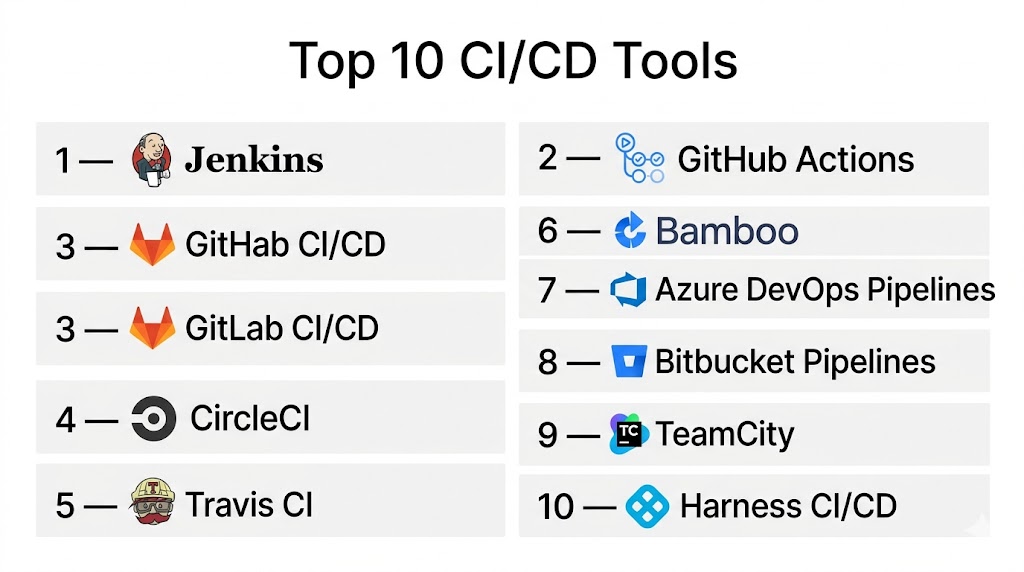
Introduction
CI/CD (Continuous Integration and Continuous Delivery/Deployment) tools automate the process of building, testing, and deploying software. They enable teams to integrate code changes frequently, validate them automatically, and release updates faster with minimal manual intervention.
In modern DevOps-driven environments, CI/CD tools are critical for maintaining speed, reliability, and scalability. As organizations adopt microservices, cloud-native architectures, and rapid release cycles, CI/CD pipelines ensure consistent delivery without compromising quality. These tools also reduce human error and improve collaboration across development, QA, and operations teams.
Common use cases include:
- Automating build and test pipelines
- Continuous deployment to cloud environments
- Infrastructure-as-code validation
- Release management and rollback automation
- Multi-environment testing and delivery
What buyers should evaluate:
- Pipeline flexibility and customization
- Integration with version control systems
- Scalability and performance
- Security and compliance features
- Ease of use and onboarding
- Support for containerization and Kubernetes
- Cost and licensing model
- Monitoring and reporting capabilities
Best for: Developers, DevOps engineers, SRE teams, and organizations practicing agile and continuous delivery.
Not ideal for: Small projects with infrequent releases or teams without automation maturity.
Key Trends in CI/CD Tools
- AI-powered pipeline optimization for faster builds and smarter test selection
- Shift toward GitOps workflows for deployment automation
- Cloud-native CI/CD platforms with Kubernetes integration
- Security-first pipelines (DevSecOps) embedding security checks early
- Low-code pipeline configuration for broader accessibility
- Ephemeral environments for testing and preview deployments
- Multi-cloud and hybrid deployment support
- Advanced observability and pipeline analytics
- Integration with feature flag and experimentation tools
How We Selected These Tools (Methodology)
- Evaluated industry adoption and popularity
- Reviewed pipeline flexibility and feature depth
- Assessed ease of use and developer experience
- Considered scalability and enterprise readiness
- Checked security capabilities and compliance readiness
- Analyzed integration ecosystem and extensibility
- Included tools suitable for various business sizes
- Balanced open-source and commercial solutions
Top 10 CI/CD Tools
#1 — Jenkins
Short description: Open-source automation server widely used for building CI/CD pipelines.
Key Features
- Highly customizable pipelines
- Large plugin ecosystem
- Distributed builds
- Pipeline-as-code support
- Integration with almost all tools
- Self-hosted flexibility
Pros
- Extremely flexible
- Massive community support
Cons
- Complex setup and maintenance
- UI can feel outdated
Platforms / Deployment
Self-hosted
Security & Compliance
RBAC, plugin-based security (varies)
Integrations & Ecosystem
Extensive integrations across DevOps tools.
- GitHub, GitLab
- Docker, Kubernetes
- AWS, Azure
- Testing tools
Support & Community
Very large global community with extensive documentation.
#2 — GitHub Actions
Short description: Native CI/CD tool integrated within GitHub for automation workflows.
Key Features
- Workflow automation
- YAML-based pipelines
- Marketplace for actions
- GitHub integration
- Parallel jobs
- Secrets management
Pros
- Seamless GitHub integration
- Easy setup
Cons
- Limited outside GitHub ecosystem
- Cost scaling concerns
Platforms / Deployment
Cloud
Security & Compliance
Secrets management, RBAC
Integrations & Ecosystem
- GitHub repos
- Cloud providers
- Docker, Kubernetes
Support & Community
Strong developer community.
#3 — GitLab CI/CD
Short description: Built-in CI/CD solution within GitLab platform.
Key Features
- End-to-end DevOps platform
- Pipeline automation
- Built-in security scanning
- Container registry
- Kubernetes integration
Pros
- All-in-one platform
- Strong DevSecOps features
Cons
- Can be resource-heavy
- Learning curve
Platforms / Deployment
Cloud / Self-hosted
Security & Compliance
RBAC, SSO, security scanning
Integrations & Ecosystem
- GitLab ecosystem
- Kubernetes
- Cloud providers
Support & Community
Strong enterprise and open-source support.
#4 — CircleCI
Short description: Cloud-native CI/CD platform focused on speed and scalability.
Key Features
- Fast builds
- Parallel execution
- Docker support
- Config-as-code
- Caching optimization
Pros
- High performance
- Developer-friendly
Cons
- Pricing complexity
- Limited UI customization
Platforms / Deployment
Cloud
Security & Compliance
SSO, encryption
Integrations & Ecosystem
- GitHub, Bitbucket
- AWS, GCP
- Docker
Support & Community
Strong documentation and support.
#5 — Travis CI
Short description: CI tool popular among open-source projects.
Key Features
- Easy setup
- GitHub integration
- Multi-language support
- Automated testing
- Build matrix support
Pros
- Simple onboarding
- Good for open-source
Cons
- Limited scalability
- Pricing concerns
Platforms / Deployment
Cloud
Security & Compliance
Not publicly stated
Integrations & Ecosystem
- GitHub
- Cloud services
Support & Community
Moderate community support.
#6 — Bamboo
Short description: CI/CD server by Atlassian designed for enterprise teams.
Key Features
- Tight Jira integration
- Build pipelines
- Deployment projects
- Permissions management
- Test reporting
Pros
- Great for Atlassian users
- Enterprise features
Cons
- Expensive
- Limited outside ecosystem
Platforms / Deployment
Self-hosted
Security & Compliance
RBAC, enterprise controls
Integrations & Ecosystem
- Jira, Bitbucket
- Atlassian tools
Support & Community
Enterprise-level support.
#7 — Azure DevOps Pipelines
Short description: CI/CD service within Azure DevOps for cloud and hybrid deployments.
Key Features
- Multi-platform pipelines
- YAML pipelines
- Cloud deployment
- Test automation
- Artifact management
Pros
- Strong Microsoft ecosystem
- Scalable
Cons
- Complex UI
- Learning curve
Platforms / Deployment
Cloud / Hybrid
Security & Compliance
SSO, RBAC, enterprise-grade
Integrations & Ecosystem
- Azure services
- GitHub
- Kubernetes
Support & Community
Strong enterprise support.
#8 — Bitbucket Pipelines
Short description: CI/CD tool integrated with Bitbucket repositories.
Key Features
- Built-in pipelines
- Docker support
- YAML configuration
- Deployment automation
- Cloud-based execution
Pros
- Easy for Bitbucket users
- Simple configuration
Cons
- Limited features vs competitors
- Less flexible
Platforms / Deployment
Cloud
Security & Compliance
RBAC
Integrations & Ecosystem
- Bitbucket
- Atlassian tools
Support & Community
Moderate support.
#9 — TeamCity
Short description: CI/CD server by JetBrains with strong developer tools integration.
Key Features
- Build automation
- Advanced configuration
- Test reporting
- VCS integration
- Parallel builds
Pros
- Powerful features
- Good UI
Cons
- Licensing cost
- Setup complexity
Platforms / Deployment
Self-hosted
Security & Compliance
RBAC
Integrations & Ecosystem
- JetBrains tools
- VCS systems
Support & Community
Strong developer support.
#10 — Harness CI/CD
Short description: Modern CI/CD platform with AI-driven deployment capabilities.
Key Features
- AI-driven deployments
- Continuous verification
- Cloud-native
- Canary deployments
- Rollback automation
Pros
- Advanced automation
- Strong DevOps focus
Cons
- Expensive
- Learning curve
Platforms / Deployment
Cloud
Security & Compliance
RBAC, SSO
Integrations & Ecosystem
- Kubernetes
- Cloud providers
- DevOps tools
Support & Community
Enterprise-grade support.
Comparison Table (Top 10)
| Tool Name | Best For | Platform(s) Supported | Deployment | Standout Feature | Public Rating |
|---|---|---|---|---|---|
| Jenkins | Flexibility | Cross-platform | Self-hosted | Plugin ecosystem | N/A |
| GitHub Actions | GitHub users | Web | Cloud | Native integration | N/A |
| GitLab CI/CD | All-in-one DevOps | Cross-platform | Hybrid | Built-in DevSecOps | N/A |
| CircleCI | Performance | Web | Cloud | Fast builds | N/A |
| Travis CI | Open-source | Web | Cloud | Easy setup | N/A |
| Bamboo | Atlassian users | Cross-platform | Self-hosted | Jira integration | N/A |
| Azure DevOps | Enterprise | Web | Hybrid | Microsoft ecosystem | N/A |
| Bitbucket Pipelines | Bitbucket users | Web | Cloud | Simple pipelines | N/A |
| TeamCity | Dev teams | Cross-platform | Self-hosted | Advanced config | N/A |
| Harness | Modern DevOps | Web | Cloud | AI deployments | N/A |
Evaluation & Scoring of CI/CD Tools
| Tool Name | Core | Ease | Integrations | Security | Performance | Support | Value | Weighted Total |
|---|---|---|---|---|---|---|---|---|
| Jenkins | 10 | 6 | 10 | 7 | 9 | 9 | 9 | 8.9 |
| GitHub Actions | 9 | 9 | 9 | 8 | 8 | 9 | 8 | 8.7 |
| GitLab CI/CD | 9 | 8 | 9 | 9 | 9 | 9 | 8 | 8.9 |
| CircleCI | 8 | 8 | 8 | 7 | 9 | 8 | 8 | 8.1 |
| Travis CI | 7 | 9 | 7 | 6 | 7 | 7 | 7 | 7.3 |
| Bamboo | 8 | 7 | 8 | 8 | 8 | 8 | 6 | 7.8 |
| Azure DevOps | 9 | 7 | 9 | 9 | 9 | 9 | 8 | 8.7 |
| Bitbucket | 7 | 8 | 7 | 7 | 7 | 7 | 7 | 7.3 |
| TeamCity | 8 | 7 | 8 | 7 | 8 | 8 | 7 | 7.8 |
| Harness | 9 | 7 | 9 | 9 | 9 | 9 | 7 | 8.6 |
How to interpret scores:
These scores reflect relative strengths across core capabilities and operational factors. Higher scores indicate more mature and feature-rich tools, often suited for complex environments. Simpler tools may score lower overall but still be ideal for specific use cases like small teams or quick deployments.
Which CI/CD Tool Is Right for You?
Solo / Freelancer
- Best: GitHub Actions, Travis CI
SMB
- Best: CircleCI, Bitbucket Pipelines
Mid-Market
- Best: GitLab CI/CD, TeamCity
Enterprise
- Best: Jenkins, Azure DevOps, Harness
Budget vs Premium
- Budget: Jenkins, GitHub Actions
- Premium: Harness, Bamboo
Feature Depth vs Ease of Use
- Easy: GitHub Actions, Travis CI
- Advanced: Jenkins, Harness
Integrations & Scalability
- Choose tools with strong ecosystem support
Security & Compliance Needs
- Enterprises should prefer GitLab, Azure DevOps, Harness
Frequently Asked Questions (FAQs)
What is CI/CD?
CI/CD automates software building, testing, and deployment processes.
Why use CI/CD tools?
They improve speed, reliability, and reduce manual errors.
Are CI/CD tools free?
Some are open-source; others have paid plans.
Can CI/CD tools integrate with cloud platforms?
Yes, most support major cloud providers.
Do CI/CD tools support Kubernetes?
Many modern tools provide Kubernetes integration.
What is pipeline-as-code?
It defines pipelines using code (YAML or scripts).
Are CI/CD tools secure?
Security depends on configuration and tool capabilities.
Can I switch CI/CD tools?
Yes, but migration requires effort.
What are alternatives?
Manual deployment or basic scripting.
Which tool is best?
Depends on your team size, needs, and ecosystem.
Conclusion
CI/CD tools have become a foundational part of modern software development, enabling teams to deliver faster, more reliable, and high-quality applications. From open-source flexibility to enterprise-grade automation, the ecosystem offers a wide range of options tailored to different needs. While some tools prioritize ease of use and quick setup, others focus on scalability, security, and deep integrations. Choosing the right tool depends on your development workflow, team size, and long-term goals. Instead of relying on a one-size-fits-all solution, it is best to evaluate a few tools based on your requirements and test them in real-world scenarios. Start by shortlisting two or three tools, run a pilot, and validate how well they integrate with your existing stack before making a final decision.

Good comparison of CI/CD tools. One real-world challenge often missed is pipeline maintenance over time—complex workflows, flaky tests, and growing deployment dependencies can quickly make pipelines harder to manage and slower to troubleshoot.
One thing I’ve noticed in real projects is that the best CI/CD tool isn’t always the one with the most features—it’s the one teams can manage and troubleshoot easily as their workflows grow. Scalability of the process often matters more than scalability of the platform itself.