MOTOSHARE 🚗🏍️
Rent Bikes & Cars Directly from Owners
Motoshare connects vehicle owners with people who need bikes and cars on rent. Owners earn from idle vehicles, and renters get flexible ride options.
Visit Motoshare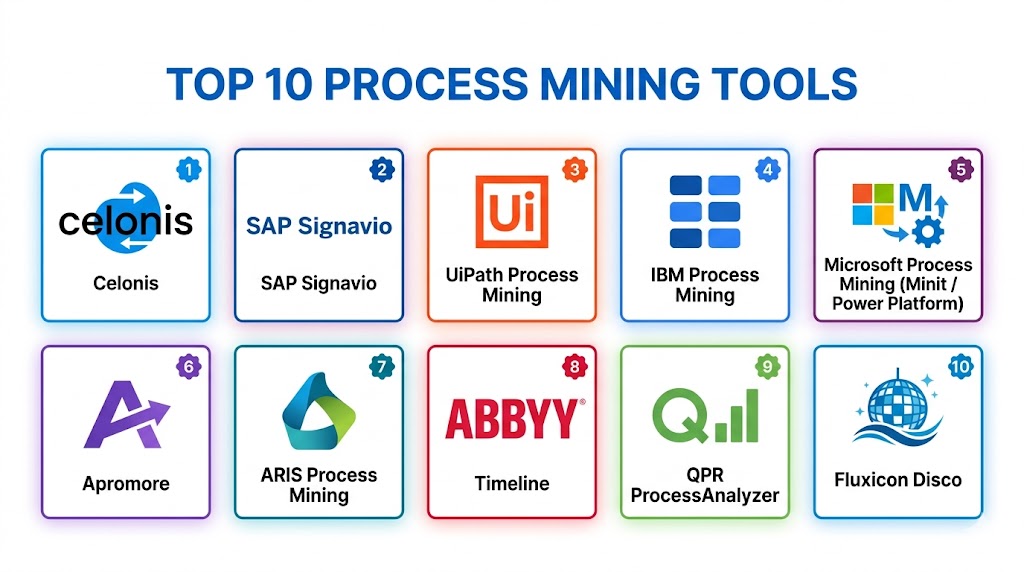
Introduction
Process Mining Tools help organizations discover, analyze, monitor, and improve real business processes using event data from systems like ERP, CRM, HR, ticketing, and finance platforms. Instead of relying only on assumptions or process maps, these tools show how work actually flows, where delays happen, why rework occurs, and which bottlenecks reduce efficiency.
They matter because businesses need faster operations, lower costs, stronger compliance, and better customer experiences. As digital systems generate more data, process mining has become a practical way to turn operational data into measurable improvements.
Common use cases include:
- Order-to-cash optimization
- Procurement process improvement
- Claims and case handling analysis
- IT service workflow efficiency
- Customer onboarding acceleration
What buyers should evaluate:
- Data connectivity
- Process discovery quality
- Root cause analytics
- Real-time monitoring
- Automation integrations
- AI recommendations
- Security controls
- Scalability
- Ease of use
- Pricing model
Best for: Enterprises, operations leaders, transformation teams, finance teams, supply chain managers, automation teams, and analysts seeking measurable efficiency gains.
Not ideal for: Very small businesses with low process volume, organizations with poor system data quality, or teams needing only simple dashboards rather than deep process intelligence.
Key Trends in Process Mining Tools
- AI copilots are helping users ask process questions in natural language.
- Object-centric process mining is improving analysis of complex multi-entity workflows.
- Task mining is being bundled with process mining for desktop-level visibility.
- Real-time monitoring is replacing one-time diagnostic projects.
- Stronger integrations with RPA and workflow automation platforms are increasing actionability.
- Industry templates are reducing time to value.
- Low-code customization is improving business-user adoption.
- Predictive analytics is helping forecast delays and SLA risks.
- Governance and compliance monitoring are becoming core buying criteria.
- Cloud-first deployments dominate new implementations.
How We Selected These Tools (Methodology)
We selected these tools using the following evaluation logic:
- Market presence and enterprise adoption
- Feature depth across discovery, conformance, analytics, and monitoring
- Ease of implementation and usability
- Integration ecosystem quality
- Security and governance readiness
- Innovation in AI and automation
- Fit across SMB, mid-market, and enterprise segments
- Scalability for high-volume event data
- Customer support and partner ecosystem
- Overall value relative to complexity and cost
Top 10 Process Mining Tools
#1 — Celonis
Short description: Category-leading process intelligence platform built for enterprises that need deep analytics, large-scale transformation, and measurable operational outcomes.
Key Features
- Process discovery from enterprise systems
- Object-centric process mining
- Action engine for automated responses
- Real-time KPI monitoring
- Root cause analytics
- AI-assisted insights
- Large connector ecosystem
Pros
- Very strong analytical depth
- Excellent for enterprise-scale programs
- Mature ecosystem and templates
Cons
- Premium pricing
- Learning curve for new users
- May be excessive for smaller teams
Platforms / Deployment
Web / Cloud / Hybrid
Security & Compliance
Enterprise-grade controls, SSO, RBAC, audit logs, encryption.
Integrations & Ecosystem
Strong ecosystem across ERP, CRM, finance, supply chain, and automation tools.
- SAP
- Oracle
- Salesforce
- ServiceNow
- APIs
Support & Community
Large partner network, enterprise support tiers, strong training resources.
#2 — SAP Signavio
Short description: Strong choice for organizations using SAP and teams combining process modeling, transformation planning, and mining in one suite.
Key Features
- Process mining
- Process modeling
- Journey analysis
- Compliance monitoring
- Collaboration tools
- SAP data connectivity
- Transformation insights
Pros
- Excellent SAP ecosystem fit
- Strong governance capabilities
- Combines design + mining
Cons
- Best value inside SAP environments
- Can require specialist skills
- Pricing may suit larger organizations
Platforms / Deployment
Web / Cloud
Security & Compliance
Enterprise access controls, encryption, auditability, identity integrations.
Integrations & Ecosystem
Strongest for SAP-centric landscapes with growing third-party support.
- SAP ERP
- SAP S/4HANA
- APIs
- Data tools
Support & Community
Strong vendor support, training programs, global partner ecosystem.
#3 — UiPath Process Mining
Short description: Ideal for automation-first teams that want to discover processes and directly connect findings to bots and workflows.
Key Features
- Process mining
- Task mining support
- Automation recommendations
- KPI dashboards
- Variant analysis
- RPA integration
- Process monitoring
Pros
- Excellent with automation programs
- Good operational visibility
- Strong enterprise momentum
Cons
- Best value within UiPath ecosystem
- Advanced use cases need expertise
- Licensing can vary by bundle
Platforms / Deployment
Web / Cloud / Hybrid
Security & Compliance
SSO, encryption, role controls, enterprise governance options.
Integrations & Ecosystem
Designed to work closely with automation pipelines.
- UiPath Studio
- Orchestrator
- APIs
- Enterprise systems
Support & Community
Strong community, academy resources, commercial support.
#4 — IBM Process Mining
Short description: Enterprise platform for regulated industries and organizations focused on process optimization with AI and automation options.
Key Features
- Process discovery
- Conformance checking
- Process simulation
- AI insights
- Monitoring dashboards
- Enterprise connectors
- Automation alignment
Pros
- Trusted enterprise vendor
- Good for large governance-heavy environments
- Strong analytics breadth
Cons
- Can be complex to deploy
- Enterprise pricing model
- Smaller community than some rivals
Platforms / Deployment
Web / Cloud / Hybrid
Security & Compliance
Enterprise controls available, encryption, access management.
Integrations & Ecosystem
Works well in broader IBM enterprise environments.
- Data platforms
- APIs
- Automation tools
- Business systems
Support & Community
Enterprise support programs and consulting ecosystem.
#5 — Microsoft Process Mining (Minit / Power Platform)
Short description: Good fit for organizations invested in Microsoft 365, Azure, Power BI, and Power Automate.
Key Features
- Process discovery
- Power Platform integration
- Dashboarding
- Automation triggers
- Data connectors
- Collaboration workflows
- Low-code extensibility
Pros
- Excellent Microsoft ecosystem value
- Familiar interface for many teams
- Strong BI alignment
Cons
- Best experience in Microsoft stack
- Some advanced mining needs may require extras
- Feature depth varies by product path
Platforms / Deployment
Web / Cloud
Security & Compliance
Microsoft enterprise security capabilities available.
Integrations & Ecosystem
Best with Microsoft-first environments.
- Power BI
- Power Automate
- Azure
- Dynamics 365
Support & Community
Large global community and broad documentation resources.
#6 — Apromore
Short description: Process intelligence platform combining mining, modeling, monitoring, and simulation with flexible deployment options.
Key Features
- Process mining
- Task mining
- Process simulation
- Drift detection
- Monitoring
- No-code tools
- Flexible pricing options
Pros
- Strong all-in-one capability
- Good value potential
- Recognized market presence
Cons
- Smaller ecosystem than largest vendors
- Enterprise reach varies by region
- Some advanced buyers may need more partners
Platforms / Deployment
Web / Cloud / Hybrid
Security & Compliance
Varies by edition and deployment.
Integrations & Ecosystem
Supports common enterprise systems and APIs.
Support & Community
Commercial support plus active specialist ecosystem.
#7 — ARIS Process Mining
Short description: Strong option for organizations combining enterprise architecture, process governance, and mining.
Key Features
- Process mining
- Process design tools
- Governance workflows
- Risk and compliance visibility
- Analytics dashboards
- Lifecycle management
- Enterprise modeling
Pros
- Strong process governance heritage
- Good enterprise visibility
- Broad transformation use cases
Cons
- May be more than needed for smaller teams
- Can require training
- Pricing varies by scope
Platforms / Deployment
Web / Cloud / Hybrid
Security & Compliance
Enterprise-grade controls vary by deployment.
Integrations & Ecosystem
Supports enterprise applications, APIs, and architecture workflows.
Support & Community
Established enterprise support and partner ecosystem.
#8 — ABBYY Timeline
Short description: Useful for teams needing visibility into customer journeys, operational workflows, and unstructured processes.
Key Features
- Process intelligence
- Journey mapping
- Timeline analytics
- Root cause analysis
- Monitoring
- Automation opportunities
- Data integrations
Pros
- Strong visual analysis approach
- Good for service operations
- Useful customer journey insights
Cons
- Less mindshare than market leaders
- Complex enterprise scope may need validation
- Pricing varies by deployment
Platforms / Deployment
Web / Cloud
Security & Compliance
Not publicly stated in full detail.
Integrations & Ecosystem
Supports enterprise data sources and APIs.
Support & Community
Commercial support available.
#9 — QPR ProcessAnalyzer
Short description: Analytics-focused process mining platform for organizations needing strong root cause and performance analysis.
Key Features
- Process discovery
- KPI analysis
- Predictive insights
- Root cause analytics
- Dashboards
- Process comparison
- Data modeling
Pros
- Strong analytics orientation
- Good for data-driven teams
- Flexible deployment options
Cons
- Smaller ecosystem
- Lower mainstream visibility
- UI preference varies by user
Platforms / Deployment
Web / Cloud / On-premises
Security & Compliance
Varies by deployment.
Integrations & Ecosystem
Connectors and APIs for enterprise systems.
Support & Community
Vendor-led support with specialist expertise.
#10 — Fluxicon Disco
Short description: Fast, desktop-based process mining tool favored by analysts and consultants for quick investigations and proofs of concept.
Key Features
- Fast log loading
- Interactive filtering
- Fuzzy miner visualization
- Variant analysis
- Performance metrics
- Easy exploration
- Desktop simplicity
Pros
- Very fast to start
- Analyst-friendly
- Great for focused projects
Cons
- Desktop-oriented approach
- Less enterprise orchestration depth
- Limited compared with large suites
Platforms / Deployment
Windows / macOS / Desktop
Security & Compliance
Local deployment model; enterprise controls depend on environment.
Integrations & Ecosystem
Import-focused workflow using event logs and datasets.
Support & Community
Well-known among practitioners and consultants.
Comparison Table (Top 10)
| Tool Name | Best For | Platform(s) Supported | Deployment | Standout Feature | Public Rating |
|---|---|---|---|---|---|
| Celonis | Large enterprises | Web | Hybrid | Deep process intelligence | N/A |
| SAP Signavio | SAP customers | Web | Cloud | Modeling + mining suite | N/A |
| UiPath Process Mining | Automation teams | Web | Hybrid | RPA integration | N/A |
| IBM Process Mining | Regulated enterprises | Web | Hybrid | Simulation + governance | N/A |
| Microsoft Process Mining | Microsoft users | Web | Cloud | Power Platform alignment | N/A |
| Apromore | Flexible mid-market | Web | Hybrid | Mining + simulation | N/A |
| ARIS | Governance-focused orgs | Web | Hybrid | Lifecycle visibility | N/A |
| ABBYY Timeline | Service operations | Web | Cloud | Timeline analytics | N/A |
| QPR ProcessAnalyzer | Analysts | Web | Hybrid | Root cause analytics | N/A |
| Fluxicon Disco | Consultants | Desktop | Desktop | Fast analysis | N/A |
Evaluation & Scoring of Process Mining Tools
| Tool Name | Core (25%) | Ease (15%) | Integrations (15%) | Security (10%) | Performance (10%) | Support (10%) | Value (15%) | Weighted Total (0–10) |
|---|---|---|---|---|---|---|---|---|
| Celonis | 9.5 | 7.5 | 9.5 | 9.0 | 9.0 | 9.0 | 6.5 | 8.7 |
| SAP Signavio | 9.0 | 7.8 | 8.8 | 8.8 | 8.5 | 8.8 | 7.0 | 8.4 |
| UiPath PM | 8.8 | 8.0 | 8.8 | 8.3 | 8.4 | 8.6 | 7.8 | 8.4 |
| IBM PM | 8.5 | 7.2 | 8.2 | 8.8 | 8.5 | 8.3 | 7.0 | 8.0 |
| Microsoft PM | 8.0 | 8.5 | 9.0 | 8.8 | 8.0 | 8.5 | 8.5 | 8.4 |
| Apromore | 8.4 | 8.0 | 7.8 | 7.8 | 8.2 | 8.0 | 8.5 | 8.1 |
| ARIS | 8.4 | 7.3 | 8.0 | 8.3 | 8.2 | 8.0 | 7.3 | 7.9 |
| ABBYY Timeline | 7.9 | 8.0 | 7.5 | 7.5 | 7.8 | 7.8 | 7.8 | 7.8 |
| QPR | 8.0 | 7.5 | 7.5 | 7.8 | 8.0 | 7.5 | 8.0 | 7.8 |
| Disco | 7.8 | 9.0 | 6.0 | 7.0 | 8.5 | 7.5 | 8.5 | 7.9 |
These scores are comparative estimates designed to help shortlist tools. A higher score does not guarantee a better fit. Data quality, team capability, ecosystem alignment, and expected ROI matter just as much as feature rankings.
Which Process Mining Tool Is Right for You?
Solo / Freelancer
Choose Fluxicon Disco if you need fast, focused analysis without enterprise complexity.
SMB
Apromore or Microsoft Process Mining can offer strong value with easier adoption.
Mid-Market
UiPath Process Mining, Apromore, and Signavio provide strong balance between capability and scalability.
Enterprise
Celonis, SAP Signavio, IBM, and ARIS are strong options for large transformation programs.
Budget vs Premium
- Budget/value: Disco, Microsoft, Apromore
- Mid-tier: UiPath, QPR
- Premium: Celonis, SAP Signavio, IBM
Feature Depth vs Ease of Use
- Easier start: Disco, Microsoft, Apromore
- Deepest capability: Celonis, Signavio, ARIS
Integrations & Scalability
Celonis, Microsoft, UiPath, and SAP Signavio perform strongly in connected environments.
Security & Compliance Needs
IBM, SAP Signavio, Celonis, and ARIS are strong candidates for governance-heavy organizations.
Frequently Asked Questions (FAQs)
What is process mining?
It is the practice of analyzing event data from business systems to understand how processes actually run and where improvements are possible.
How is process mining different from BI dashboards?
BI shows metrics. Process mining shows flow paths, bottlenecks, rework loops, and conformance to expected processes.
Do I need clean data?
Yes. Good timestamps, case IDs, and activity logs are essential for reliable results.
Is process mining only for enterprises?
No. Mid-sized organizations can benefit too, especially in finance, operations, and customer service.
Can process mining reduce costs?
Yes. It often identifies delays, manual work, rework, and inefficient handoffs that increase operating costs.
Does it replace BPM software?
Not exactly. Process mining discovers and measures processes, while BPM tools often design and automate them.
What systems can connect to these tools?
Common sources include SAP, Oracle, Salesforce, ServiceNow, Microsoft apps, ERPs, CRMs, and custom databases.
How long does implementation take?
Simple pilots may take weeks. Large enterprise programs can take months depending on data readiness.
Is AI important in process mining?
Increasingly yes. AI helps summarize findings, recommend improvements, and predict issues.
How do I choose the right tool?
Start with your data sources, process complexity, automation goals, budget, and internal skills before shortlisting vendors.
Conclusion
Process Mining Tools help organizations move from assumptions to evidence-based process improvement. The best platform depends on whether you prioritize deep enterprise analytics, ecosystem alignment, automation readiness, or fast analyst workflows. Shortlist two or three options, run a pilot on a real business process, validate data connectivity, and measure business outcomes before making a long-term investment.

One topic I’d recommend adding is the importance of data readiness before selecting a process mining platform. In real-world implementations, organizations often spend more effort standardizing event logs, defining consistent case IDs, and improving data quality than configuring the tool itself. It would also be valuable to evaluate how each solution supports ongoing process governance, conformance monitoring, and data validation as business processes evolve. From an engineering perspective, process mining delivers the greatest ROI when it’s integrated into a continuous improvement cycle with automation, observability, and business ownership, rather than being treated as a one-time discovery project.