MOTOSHARE 🚗🏍️
Rent Bikes & Cars Directly from Owners
Motoshare connects vehicle owners with people who need bikes and cars on rent. Owners earn from idle vehicles, and renters get flexible ride options.
Visit Motoshare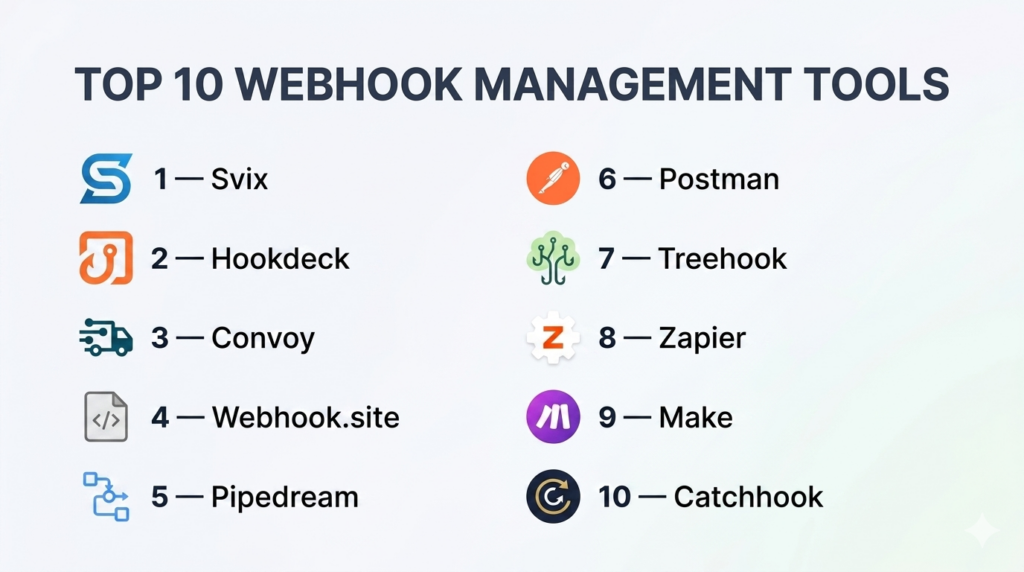
Introduction
Webhook management tools help businesses send, receive, monitor, secure, and troubleshoot webhooks at scale. A webhook is an automated HTTP callback that sends real-time data when an event happens, such as a payment success, new signup, order update, or deployment event. While basic webhooks seem simple, production-grade webhook operations require retries, logging, replay, routing, security, filtering, rate limiting, and observability. That is where dedicated tooling becomes valuable.
Webhook management matters because modern software stacks depend on integrations across SaaS apps, internal services, automation workflows, and customer-facing APIs. Teams need reliable event delivery without building custom infrastructure from scratch.
Real-world use cases:
- Sending product events to customer endpoints
- Receiving third-party webhooks from payment or commerce tools
- Debugging failed webhook deliveries
- Routing events to multiple internal systems
- Triggering automation workflows in real time
What buyers should evaluate:
- Reliability and retry logic
- Replay tools
- Security and signing
- Routing rules
- Transformation support
- Logs and observability
- Developer experience
- Deployment flexibility
- Pricing scalability
- API and ecosystem support
Best for: SaaS companies, developers, DevOps teams, platform teams, eCommerce businesses, and enterprises managing many integrations.
Not ideal for: Very small projects with minimal webhook traffic where lightweight custom scripts may be enough.
Key Trends in Webhook Management Tools
- Managed webhook infrastructure is replacing custom in-house systems.
- AI workflows increasingly depend on webhook triggers and event streams.
- More teams need both inbound and outbound webhook tooling.
- Replay and debugging features are becoming standard expectations.
- Event routing and transformation reduce middleware complexity.
- Security features like signatures and verification are gaining priority.
- Usage-based pricing is becoming more common.
- Self-hosted options remain attractive for privacy-sensitive teams.
- Better dashboards now provide delivery analytics and failure visibility.
- Webhook tooling is merging with broader automation platforms.
How We Selected These Tools (Methodology)
We selected these tools using practical criteria:
- Strong market visibility and adoption
- Reliable webhook delivery capabilities
- Mature debugging and replay features
- Security readiness
- Integration ecosystem quality
- Fit for startups to enterprises
- Developer experience and documentation
- Deployment flexibility (cloud/self-hosted)
- Pricing value across growth stages
- Product momentum and community interest
Top 10 Webhook Management Tools
#1 — Svix
Short description: A leading webhook infrastructure platform focused on outbound webhooks for SaaS products. Strong choice for teams sending webhooks to customers reliably.
Key Features
- Reliable outbound webhook delivery
- Automatic retries
- Signing and verification
- Customer-facing webhook portals
- Delivery logs
- Multi-language SDKs
- Developer APIs
Pros
- Excellent for product teams sending webhooks
- Strong developer experience
- Scales well for SaaS growth
Cons
- Less focused on inbound workflows
- Premium tiers may be needed at scale
- Advanced setup for enterprise workflows
Platforms / Deployment
Cloud / Self-hosted
Security & Compliance
Signing, RBAC, encryption. Additional compliance varies by plan.
Integrations & Ecosystem
Strong SDK and API ecosystem.
- Node.js
- Python
- Go
- Java
- CI/CD workflows
Support & Community
Strong docs, modern APIs, growing adoption.
#2 — Hookdeck
Short description: Popular platform for receiving, routing, inspecting, and managing inbound webhooks from third-party services.
Key Features
- Inbound webhook queueing
- Routing rules
- Replay tools
- Request inspection
- Transformations
- Monitoring dashboards
- Rate limiting
Pros
- Excellent inbound reliability
- Strong debugging interface
- Useful routing controls
Cons
- Less focused on outbound products
- Costs rise with scale
- Smaller ecosystem than giant platforms
Platforms / Deployment
Cloud
Security & Compliance
RBAC, encryption, verification tools. Additional compliance varies.
Integrations & Ecosystem
Works well with common SaaS sources.
- Stripe
- Shopify
- GitHub
- Slack
- Internal APIs
Support & Community
Strong documentation and commercial support.
#3 — Convoy
Short description: Open-source webhook gateway supporting both inbound and outbound webhook operations for teams wanting control.
Key Features
- Self-hosted deployment
- Retries
- Signing
- Delivery tracking
- Replay
- Rate limiting
- Event logs
Pros
- Open-source flexibility
- Supports multiple webhook models
- Good for custom infrastructure teams
Cons
- Requires operational resources
- Less polished UI than SaaS tools
- Setup complexity for beginners
Platforms / Deployment
Self-hosted / Cloud
Security & Compliance
Depends on deployment setup.
Integrations & Ecosystem
- Docker
- PostgreSQL
- Redis
- Internal systems
- Custom APIs
Support & Community
Open-source community support.
#4 — Webhook.site
Short description: Well-known webhook inspection and testing platform for quickly receiving and examining webhook payloads.
Key Features
- Instant temporary endpoints
- Payload inspection
- Header viewing
- Replay tools
- Custom actions
- Search and filters
- Fast setup
Pros
- Extremely easy to start
- Great for testing
- Useful for debugging integrations
Cons
- Not a full enterprise delivery platform
- Production use cases are narrower
- Advanced features require paid plans
Platforms / Deployment
Web / Cloud / Self-hosted
Security & Compliance
Varies by plan and deployment.
Integrations & Ecosystem
- QA workflows
- API testing
- Integration debugging
- Security testing
Support & Community
Very popular among developers.
#5 — Pipedream
Short description: Integration platform for developers that uses webhooks, APIs, code, and automation workflows together.
Key Features
- Webhook triggers
- Workflow automation
- Custom code steps
- API connectors
- Event pipelines
- Scheduling
- Team workflows
Pros
- Flexible automation platform
- Great for developer workflows
- Combines code + no-code logic
Cons
- Broader than pure webhook management
- Can become complex
- Pricing depends on usage
Platforms / Deployment
Cloud
Security & Compliance
Varies by plan.
Integrations & Ecosystem
- SaaS apps
- APIs
- Databases
- AI tools
- Internal services
Support & Community
Good docs and active developer audience.
#6 — Postman
Short description: API collaboration platform with webhook testing, mock servers, and request workflows.
Key Features
- API testing
- Webhook requests
- Mocking
- Collections
- Automation tests
- Team collaboration
- Documentation tools
Pros
- Familiar interface
- Useful for API + webhook teams
- Broad ecosystem
Cons
- Not webhook-specialized
- Advanced governance costs extra
- Large workspaces can get complex
Platforms / Deployment
Web / Windows / macOS / Linux
Security & Compliance
SSO/SAML, RBAC, encryption. Additional compliance varies.
Integrations & Ecosystem
- CI/CD
- Git tools
- APIs
- Monitoring tools
Support & Community
Excellent documentation and global community.
#7 — Treehook
Short description: Dedicated webhook management platform focused on routing, relaying, retries, and multi-environment workflows.
Key Features
- Relay webhooks
- Transform payloads
- Retry failed requests
- Multi-project support
- Environment routing
- Request history
- Easy onboarding
Pros
- Good for multi-environment teams
- Straightforward routing features
- Practical pricing tiers
Cons
- Smaller ecosystem
- Less enterprise recognition
- Narrower feature depth than leaders
Platforms / Deployment
Cloud
Security & Compliance
Not publicly stated.
Integrations & Ecosystem
- CI/CD triggers
- Git workflows
- Internal apps
- Dev/test/staging systems
Support & Community
Growing vendor support.
#8 — Zapier
Short description: Popular no-code automation platform with webhook triggers and actions for business users.
Key Features
- Catch hooks
- Send webhooks
- App integrations
- AI workflows
- Multi-step automations
- Templates
- Easy builder
Pros
- Massive app ecosystem
- Very beginner-friendly
- Great for business automation
Cons
- Expensive at scale
- Not ideal for heavy engineering workloads
- Debugging advanced logic can be harder
Platforms / Deployment
Cloud
Security & Compliance
Varies by plan.
Integrations & Ecosystem
- CRM tools
- Marketing tools
- Databases
- AI apps
- Productivity apps
Support & Community
Huge user base and strong documentation.
#9 — Make
Short description: Visual automation platform with strong data transformation and webhook workflows.
Key Features
- Visual flows
- Webhook triggers
- JSON parsing
- Branching logic
- Integrations
- Scheduling
- Monitoring tools
Pros
- Strong logic builder
- Better data handling than many no-code tools
- Good value for many teams
Cons
- Learning curve for complex flows
- Not webhook-only focused
- Governance features vary by plan
Platforms / Deployment
Cloud
Security & Compliance
Varies by plan.
Integrations & Ecosystem
- SaaS apps
- Databases
- APIs
- Marketing tools
Support & Community
Strong community and practical learning resources.
#10 — Catchhook
Short description: Modern webhook platform focused on capture, debug, route, and transform workflows for developers.
Key Features
- Real-time capture
- Debug tools
- Smart routing
- Replay testing
- Transform filters
- Analytics
- Multiple destinations
Pros
- Modern developer-focused workflows
- Strong debugging capabilities
- Useful routing options
Cons
- Newer market entrant
- Smaller ecosystem
- Long-term maturity still developing
Platforms / Deployment
Cloud
Security & Compliance
End-to-end encryption mentioned. Additional details not publicly stated.
Integrations & Ecosystem
- GitHub
- Slack
- Stripe
- Custom endpoints
Support & Community
Growing platform with early momentum.
Comparison Table
| Tool Name | Best For | Platform(s) Supported | Deployment | Standout Feature | Public Rating |
|---|---|---|---|---|---|
| Svix | SaaS outbound webhooks | Web | Hybrid | Customer-facing webhook portals | N/A |
| Hookdeck | Inbound management | Web | Cloud | Queueing + routing | N/A |
| Convoy | Self-hosted control | Web | Hybrid | Open-source gateway | N/A |
| Webhook.site | Testing & inspection | Web | Hybrid | Instant endpoints | N/A |
| Pipedream | Automation workflows | Web | Cloud | Code + webhook workflows | N/A |
| Postman | API teams | Web/Desktop | Hybrid | API collaboration | N/A |
| Treehook | Multi-environment routing | Web | Cloud | Relay + retry workflows | N/A |
| Zapier | No-code automation | Web | Cloud | Massive integrations | N/A |
| Make | Visual automation | Web | Cloud | Advanced branching logic | N/A |
| Catchhook | Developer debugging | Web | Cloud | Capture + transform | N/A |
Evaluation & Scoring of Webhook Management Tools
| Tool Name | Core | Ease | Integrations | Security | Performance | Support | Value | Weighted Total |
|---|---|---|---|---|---|---|---|---|
| Svix | 9 | 8 | 8 | 9 | 9 | 8 | 8 | 8.45 |
| Hookdeck | 9 | 8 | 8 | 8 | 9 | 8 | 7 | 8.20 |
| Convoy | 8 | 6 | 7 | 8 | 8 | 7 | 9 | 7.65 |
| Webhook.site | 7 | 10 | 6 | 6 | 7 | 8 | 9 | 7.75 |
| Pipedream | 8 | 8 | 9 | 7 | 8 | 8 | 8 | 8.05 |
| Postman | 8 | 9 | 9 | 8 | 8 | 9 | 7 | 8.20 |
| Treehook | 7 | 8 | 6 | 6 | 7 | 7 | 8 | 7.15 |
| Zapier | 7 | 10 | 10 | 7 | 7 | 9 | 6 | 7.95 |
| Make | 8 | 8 | 8 | 7 | 8 | 8 | 8 | 7.95 |
| Catchhook | 7 | 8 | 6 | 7 | 7 | 7 | 8 | 7.20 |
These scores are comparative, not absolute. A lower-ranked tool may still be best for your use case. Engineering teams may prioritize reliability and control, while business teams may prefer ease of use and integrations. Always test with your real webhook volume and workflow needs.
Which Webhook Management Tool Is Right for You?
Solo / Freelancer
Choose Webhook.site, Zapier, or Make for low-friction setup and quick results.
SMB
Hookdeck, Pipedream, and Postman offer strong functionality without heavy enterprise complexity.
Mid-Market
Svix, Hookdeck, and Make balance scale, flexibility, and integrations.
Enterprise
Svix and Hookdeck are strong for production-grade reliability. Convoy works well when control and self-hosting matter.
Budget vs Premium
Free/value tools: Webhook.site, Make entry plans, Convoy self-hosted.
Premium tools: Svix, Hookdeck, advanced automation suites.
Feature Depth vs Ease of Use
Need deep engineering controls? Svix or Convoy.
Need simplicity? Zapier or Webhook.site.
Integrations & Scalability
Zapier and Make lead for app integrations. Svix and Hookdeck lead for webhook scale.
Security & Compliance Needs
Choose platforms with signing, RBAC, auditability, and deployment flexibility.
Frequently Asked Questions (FAQs)
What is a webhook management tool?
It helps teams reliably send, receive, secure, and monitor webhook traffic without building custom infrastructure.
Why not build webhooks in-house?
Basic delivery is easy, but retries, replay, logs, and scaling are harder than they appear.
What is the difference between inbound and outbound webhooks?
Inbound means receiving webhooks from other systems. Outbound means sending webhooks to customers or partners.
Which tool is best for SaaS products?
Svix is strong for outbound customer-facing webhook infrastructure.
Which tool is best for testing?
Webhook.site is one of the easiest tools for fast inspection and debugging.
Are open-source options available?
Yes. Convoy is a recognized open-source option.
Can no-code teams use webhooks?
Yes. Zapier and Make make webhook workflows accessible to non-developers.
What security features matter most?
Signing, authentication, RBAC, encryption, logs, and rate limiting.
How do pricing models usually work?
Most tools charge by events, tasks, seats, or premium feature tiers.
Can I switch tools later?
Yes, if you keep event schemas documented and plan migrations carefully.
Conclusion
Webhook management tools save teams from rebuilding difficult infrastructure around reliability, security, and observability. The best platform depends on whether you need outbound delivery, inbound routing, testing simplicity, automation workflows, or self-hosted control.

One aspect worth adding is that webhook management platforms should be evaluated on how well they handle production-grade event reliability rather than just delivery features. As systems scale, duplicate events, out-of-order delivery, schema versioning, idempotency, and downstream service failures become common operational challenges. Platforms that provide event lineage, distributed tracing, dead-letter queue management, replay auditing, and seamless integration with observability tools enable engineering teams to diagnose failures much faster and maintain consistent event processing across complex microservice architectures. These operational capabilities often determine long-term reliability more than basic retry or routing functionality.