MOTOSHARE 🚗🏍️
Rent Bikes & Cars Directly from Owners
Motoshare connects vehicle owners with people who need bikes and cars on rent. Owners earn from idle vehicles, and renters get flexible ride options.
Visit Motoshare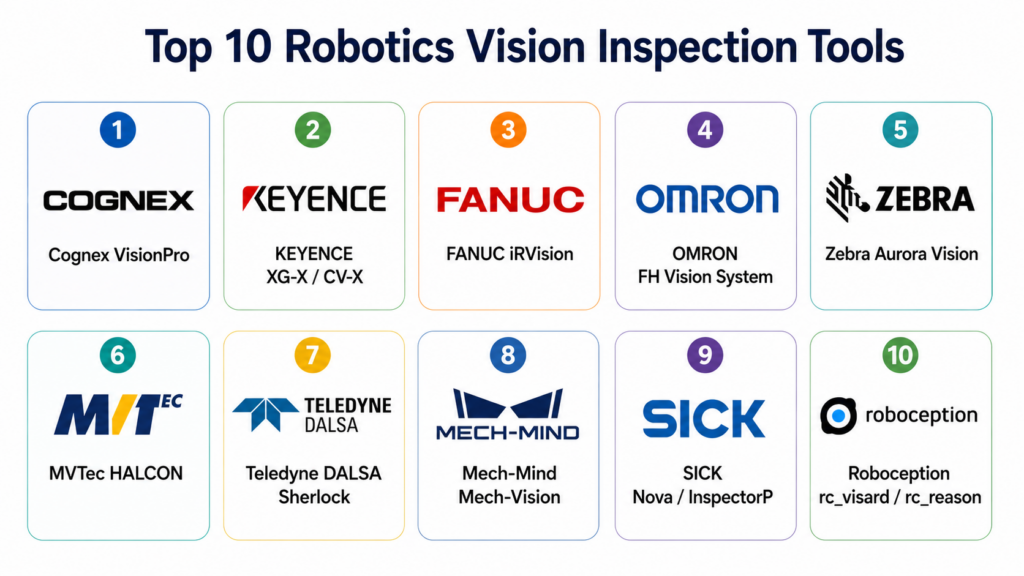
Introduction
Robotics vision inspection tools help robots “see,” understand, inspect, measure, guide, and verify objects in industrial environments. In plain English, these tools combine cameras, sensors, lighting, image-processing software, AI models, and robot communication interfaces so automated systems can detect defects, identify parts, check assembly quality, guide pick-and-place movements, and confirm product consistency before items move to the next stage.
Robotics vision inspection matters now because manufacturers are under pressure to improve quality, reduce manual inspection errors, increase throughput, support traceability, and operate with fewer production delays. Modern factories increasingly need inspection systems that can work with robotic arms, conveyors, cobots, automated cells, warehouse automation, packaging lines, and quality management workflows.
Real-world use cases include:
- Defect detection for scratches, dents, cracks, contamination, missing parts, and surface flaws
- Robot guidance for bin picking, pick-and-place, assembly, palletizing, and depalletizing
- Measurement and alignment for precision manufacturing and tolerance checks
- OCR, barcode, and label verification for packaging, logistics, and regulated industries
- Final quality inspection before shipment or downstream production
Evaluation Criteria for Buyers:
- Accuracy and repeatability under real production conditions
- Support for 2D, 3D, and AI-based inspection
- Robot, PLC, camera, and sensor compatibility
- Ease of training, configuration, and maintenance
- Performance under changing lighting, part variation, and line speed
- Integration with MES, SCADA, QMS, ERP, and traceability systems
- Deployment flexibility across edge, industrial PC, and hybrid setups
- Vendor support, documentation, and integrator ecosystem
- Security, role access, auditability, and factory network readiness
- Total cost of ownership, including hardware, licensing, training, and support
Best for: Robotics vision inspection tools are best for manufacturing leaders, automation engineers, quality teams, robotics integrators, industrial engineers, and operations teams in industries such as automotive, electronics, pharma, medical devices, food and beverage, logistics, packaging, aerospace, and general manufacturing.
Not ideal for: These tools may not be necessary for very low-volume manual operations, simple visual checks that do not require automation, or teams without stable inspection criteria. In some cases, a basic camera inspection system, manual QA process, barcode scanner, or simple sensor-based setup may be more cost-effective than a full robotics vision platform.
Key Trends in Robotics Vision Inspection Tools
- AI-assisted defect detection is becoming more practical: More vendors now support deep learning or AI-based inspection to detect complex defects that are difficult to define with rule-based logic.
- 3D vision is growing for robotic guidance: Applications such as bin picking, depalletizing, random object handling, and part localization increasingly rely on 3D vision and depth sensing.
- Edge deployment is preferred on factory floors: Many inspection systems run on industrial PCs, smart cameras, edge controllers, or local servers to reduce latency and avoid cloud dependency.
- No-code and low-code configuration is expanding: Vendors are making model training, inspection setup, camera calibration, and robot integration easier for plant engineers without advanced programming skills.
- Robot and PLC interoperability matters more: Buyers want tools that can communicate with robots, PLCs, motion controllers, conveyors, and factory automation systems without heavy custom engineering.
- Traceability is becoming a standard expectation: Vision inspection is no longer only about pass or fail decisions. Manufacturers also want image records, defect history, production analytics, and audit-ready quality evidence.
- Hybrid rule-based and AI inspection is common: Many teams combine traditional measurement, pattern matching, and barcode reading with AI models for surface defects and irregular objects.
- Lighting and optics remain critical: Even advanced AI inspection depends heavily on good lighting, lens selection, camera placement, and consistent mechanical design.
- Integrator ecosystems influence success: Robotics vision projects often require strong local system integrators, application engineers, and support teams for successful deployment.
- Cost models are shifting: Buyers now evaluate not only software licenses but also cameras, controllers, robot integration, training data, maintenance, support, and upgrade costs.
How We Selected These Tools
The Top 10 tools were selected using practical evaluation logic relevant to robotics vision inspection and industrial automation buyers.
- Market adoption and recognition in machine vision, robotic inspection, and industrial automation
- Breadth of inspection capabilities across 2D, 3D, AI, measurement, guidance, and verification
- Suitability for real factory environments with robots, conveyors, PLCs, and industrial networks
- Reliability signals based on long-term industrial usage and vendor ecosystem maturity
- Integration strength with robot brands, automation hardware, cameras, sensors, and industrial PCs
- Fit across different customer segments, including SMB manufacturers, system integrators, and enterprises
- Support for repeatable inspection workflows, image processing, calibration, and quality analytics
- Flexibility for different deployment models such as edge, industrial PC, smart camera, and hybrid setups
- Practical value for use cases such as defect detection, robot guidance, OCR, barcode verification, and assembly validation
- Availability of documentation, application support, partner networks, and training resources
Top 10 Robotics Vision Inspection Tools
#1 — Cognex VisionPro
Short description :
Cognex VisionPro is a well-known industrial machine vision software platform used for inspection, measurement, guidance, and identification applications. It is designed for manufacturers and automation teams that need robust vision tools for demanding production environments. The platform is often used with cameras, industrial PCs, robots, and automation systems where accuracy and repeatability are critical. It fits automotive, electronics, packaging, logistics, medical device, and general manufacturing use cases.
Key Features
- Advanced image processing for inspection, measurement, alignment, and guidance
- Support for pattern matching, calibration, image analysis, and industrial vision workflows
- Useful for robot guidance, assembly verification, defect detection, and dimensional checks
- Strong compatibility with industrial machine vision cameras and automation environments
- Supports complex inspection projects where rule-based vision remains important
- Suitable for high-throughput manufacturing and production quality control
- Large ecosystem of application engineers, integrators, and industrial users
Pros
- Strong reputation in industrial vision and factory automation
- Powerful toolset for complex inspection and guidance applications
- Good fit for enterprise-grade production environments
Cons
- May require experienced vision engineers or system integrators
- Total cost can be high when hardware, licensing, and integration are included
- Setup complexity may be more than small teams need
Platforms / Deployment
Windows / Industrial PC / Edge deployment / Hybrid depending on system design
Security & Compliance
Not publicly stated. Security posture often depends on deployment architecture, industrial network design, user access controls, and integrator configuration.
Integrations & Ecosystem
Cognex VisionPro typically fits into industrial automation architectures where cameras, robots, PLCs, HMIs, and quality systems must work together. It is often selected by teams that already use Cognex hardware or need mature machine vision capabilities.
- Industrial cameras and vision hardware
- Robot guidance workflows
- PLC and factory automation systems
- Barcode and ID verification environments
- MES, QMS, and traceability workflows through custom integration
- System integrator and automation partner ecosystem
Support & Community
Cognex has a strong industrial support ecosystem, training resources, documentation, and partner network. Support experience may vary by region, reseller, integrator, and project complexity.
#2 — KEYENCE XG-X / CV-X Vision Systems
Short description :
KEYENCE XG-X and CV-X vision systems are widely used in industrial inspection, measurement, and robot-guided automation. These systems are known for combining cameras, controllers, lighting, and software into practical factory-ready inspection setups. They are especially useful for manufacturers that want a packaged vision solution with strong application support. KEYENCE systems are commonly used in electronics, automotive parts, packaging, medical products, and high-speed production lines.
Key Features
- 2D and 3D inspection capabilities depending on selected system
- Measurement, defect detection, alignment, presence check, and OCR functions
- Controller-based architecture suited for factory floor environments
- Camera, lens, lighting, and software ecosystem from one vendor
- Useful for robot position correction and automated inspection cells
- Strong application support for line-side deployment
- Designed for production teams that need repeatable inspection workflows
Pros
- Strong hardware and software combination for industrial inspection
- Good fit for teams that want vendor-assisted setup and application support
- Broad use across manufacturing and automation environments
Cons
- Cost may be higher than basic open-platform vision setups
- Flexibility can depend on selected controller and camera configuration
- Advanced customization may require vendor or integrator support
Platforms / Deployment
Controller-based / Industrial PC depending on configuration / Edge deployment / Factory floor deployment
Security & Compliance
Not publicly stated. Security depends on controller configuration, network segmentation, access management, and integration design.
Integrations & Ecosystem
KEYENCE vision systems are commonly integrated into automation cells with PLCs, robots, sensors, and production equipment. The ecosystem is strong for inspection-focused industrial deployments.
- PLC and automation controller integration
- Robot guidance and positioning support
- Industrial cameras, lighting, and sensors
- Barcode, OCR, and measurement workflows
- Factory line inspection stations
- Application engineering support
Support & Community
KEYENCE is known for direct sales and application support in many markets. Documentation, field engineering, and onboarding support are typically strong, but project experience may vary depending on region and application complexity.
#3 — FANUC iRVision
Short description :
FANUC iRVision is a robot-integrated vision system designed for FANUC robotic automation. It helps robots locate parts, adjust movement, inspect objects, and perform guided handling tasks. It is especially valuable when the main requirement is vision-guided robotics rather than standalone quality inspection software. Manufacturers using FANUC robots often consider iRVision for picking, assembly, palletizing, depalletizing, and part orientation tasks.
Key Features
- Native vision capability for FANUC robot environments
- Supports robot guidance, part location, orientation, and picking workflows
- Useful for 2D and 3D vision applications depending on setup
- Designed to reduce the need for external robot-vision middleware
- Helps robots adapt to part position variation
- Suitable for automated assembly, material handling, and inspection cells
- Works closely with FANUC robot programming and automation workflows
Pros
- Strong choice for companies already using FANUC robots
- Simplifies vision-to-robot communication in FANUC environments
- Good fit for robotic guidance and handling applications
Cons
- Best suited to FANUC robot ecosystems rather than mixed robot fleets
- May not replace advanced standalone inspection software for complex QA
- Requires robotics knowledge for successful implementation
Platforms / Deployment
FANUC robot controller ecosystem / Edge deployment / Industrial automation cell
Security & Compliance
Not publicly stated. Security depends on robot controller setup, factory network architecture, access controls, and integrator practices.
Integrations & Ecosystem
FANUC iRVision is built around FANUC robot automation. It is strongest when robot motion, camera input, and inspection or positioning logic need to work together inside a FANUC-controlled cell.
- FANUC robot controllers
- Vision-guided picking and placement
- Robotic assembly cells
- Factory PLC systems
- End-of-arm tooling and grippers
- Industrial cameras and sensors depending on configuration
Support & Community
FANUC has a large global robotics ecosystem with training, integrators, and application support. Support is usually strong for FANUC-centered projects, but multi-vendor integration may need additional engineering help.
#4 — OMRON FH Vision System
Short description :
OMRON FH Vision System is an industrial vision platform used for high-speed inspection, measurement, positioning, and automated quality control. It is suitable for manufacturers that already use OMRON automation products or need a vision system tightly connected to factory control architecture. The FH platform can support complex inspection tasks in electronics, automotive, packaging, food, medical, and assembly environments. It is often used where reliability, speed, and automation integration are important.
Key Features
- High-speed vision processing for industrial inspection
- Supports measurement, positioning, defect detection, and verification tasks
- Works with automation controllers, PLCs, sensors, and robotics systems
- Useful for line inspection, part positioning, and quality control
- Supports multiple camera configurations depending on system design
- Designed for demanding production environments
- Fits well into broader OMRON automation ecosystems
Pros
- Strong fit for factories using OMRON automation hardware
- Good balance of inspection performance and automation integration
- Useful for high-speed and repeatable inspection workflows
Cons
- May require specialized setup and automation knowledge
- Best value is often realized in OMRON-centered environments
- Advanced AI use cases may require careful validation
Platforms / Deployment
Controller-based / Industrial PC depending on configuration / Edge deployment / Factory floor deployment
Security & Compliance
Not publicly stated. Security depends on controller configuration, network architecture, access rules, and plant-level security practices.
Integrations & Ecosystem
OMRON FH fits naturally into automation systems where PLCs, motion control, sensors, robots, and inspection stations need to communicate reliably. It is often selected for production lines that require tightly integrated control and vision.
- OMRON PLC and automation systems
- Industrial cameras and sensors
- Robot positioning workflows
- Manufacturing inspection cells
- MES and traceability workflows through integration
- Factory automation networks
Support & Community
OMRON provides industrial automation documentation, training, and partner support in many regions. Support quality depends on local availability, integrator skill, and project scope.
#5 — Zebra Aurora Vision
Short description :
Zebra Aurora Vision is a machine vision software environment used for industrial inspection, automation, and image analysis. It supports vision application development for defect detection, measurement, object identification, and production verification. The tool is useful for manufacturers, system integrators, and automation teams that need configurable machine vision workflows. It fits inspection use cases across packaging, electronics, logistics, manufacturing, and quality control.
Key Features
- Machine vision software for inspection, measurement, and automation
- Supports graphical workflow development for vision applications
- Useful for image acquisition, processing, analysis, and decision logic
- Can work with industrial cameras and automation hardware depending on setup
- Supports inspection tasks such as presence checks, dimensional checks, and defect detection
- Suitable for system integrators building custom industrial vision applications
- Part of Zebra’s broader machine vision and scanning ecosystem
Pros
- Good fit for configurable industrial vision projects
- Strong alignment with barcode, scanning, and automation environments
- Useful for teams needing flexible machine vision workflows
Cons
- Implementation may require vision engineering experience
- Hardware and integration choices affect total project success
- Security and compliance details should be verified for each deployment
Platforms / Deployment
Windows / Industrial PC / Edge deployment / Hybrid depending on configuration
Security & Compliance
Not publicly stated. Security depends on deployment model, user access, network setup, and enterprise integration design.
Integrations & Ecosystem
Zebra Aurora Vision can fit into machine vision, scanning, identification, and automation workflows. It is practical for teams that need inspection and traceability to work together.
- Industrial cameras and image acquisition systems
- Barcode and scanning workflows
- PLC and automation systems
- Packaging and logistics inspection
- Custom machine vision applications
- Zebra hardware ecosystem where applicable
Support & Community
Zebra has an established industrial technology ecosystem with documentation and support channels. Community strength may be more specialized than general-purpose developer platforms, but integrator and vendor support are important assets.
#6 — MVTec HALCON
Short description :
MVTec HALCON is a powerful machine vision software library used by developers, OEMs, and advanced automation teams. It is known for broad image-processing capabilities, 2D and 3D vision, deep learning features, and flexibility across many industrial applications. HALCON is often used when teams need to build custom inspection, measurement, recognition, or robot vision applications. It is best suited for engineering teams that want deep control rather than a simple plug-and-play inspection interface.
Key Features
- Comprehensive machine vision library for industrial applications
- Supports 2D vision, 3D vision, image processing, and measurement
- Deep learning capabilities for selected inspection and classification tasks
- Useful for robot guidance, object recognition, defect detection, and calibration
- Supports application development across different hardware environments
- Strong fit for OEMs and system integrators building custom solutions
- Flexible programming interfaces for advanced engineering teams
Pros
- Highly flexible and powerful for custom machine vision development
- Strong technical depth for complex inspection and robotics applications
- Suitable for OEMs and teams building reusable vision products
Cons
- Requires software development and machine vision expertise
- Not ideal for teams wanting a simple no-code inspection tool
- Implementation time may be longer for custom applications
Platforms / Deployment
Windows / Linux / Industrial PC / Edge deployment / Self-hosted or embedded-style deployment depending on application design
Security & Compliance
Not publicly stated. Security depends on the application built with HALCON, deployment environment, access controls, and customer architecture.
Integrations & Ecosystem
HALCON is often embedded into custom industrial applications, robotics systems, and OEM machines. It is valued when flexibility and technical depth are more important than prebuilt workflows.
- C, C++, C#, Python, and other development environments depending on edition and setup
- Industrial cameras and frame grabbers
- Robot guidance and calibration workflows
- OEM machine software
- Custom inspection applications
- Industrial automation systems through custom integration
Support & Community
MVTec provides technical documentation, examples, training resources, and professional support. The community is more engineering-focused, making it stronger for developers and vision specialists than casual users.
#7 — Teledyne DALSA Sherlock
Short description :
Teledyne DALSA Sherlock is machine vision software used to create inspection applications for industrial automation. It supports inspection, measurement, guidance, identification, and image-processing workflows. Sherlock is often used by system integrators and manufacturers that need configurable inspection logic with industrial camera and hardware support. It fits quality control, assembly validation, packaging inspection, and automated production environments.
Key Features
- Machine vision software for inspection and automation applications
- Supports image acquisition, processing, measurement, and decision logic
- Useful for defect detection, part verification, and alignment tasks
- Fits industrial camera and automation workflows
- Can support complex inspection sequences and production logic
- Suitable for integrators building repeatable inspection stations
- Works in industrial PC-based environments
Pros
- Practical option for configurable industrial vision inspection
- Strong alignment with Teledyne imaging ecosystem
- Useful for integrators and automation teams
Cons
- May require experienced setup for complex applications
- Less simple than basic smart camera tools for non-technical users
- Advanced AI capabilities should be evaluated against project needs
Platforms / Deployment
Windows / Industrial PC / Edge deployment / Factory floor deployment
Security & Compliance
Not publicly stated. Security depends on operating system hardening, plant network design, user access, and deployment practices.
Integrations & Ecosystem
Sherlock fits into machine vision systems where cameras, lighting, automation controllers, and production logic must work together. It is commonly considered by teams using Teledyne imaging products.
- Teledyne cameras and imaging hardware
- Industrial PCs and inspection stations
- PLC and automation system communication
- Measurement and quality workflows
- Custom inspection sequences
- System integrator-led deployments
Support & Community
Teledyne has a strong imaging and machine vision background with technical documentation and industrial support channels. Support experience varies based on distributor, integrator, and project complexity.
#8 — Mech-Mind Mech-Vision
Short description :
Mech-Mind Mech-Vision is machine vision software designed for robotic automation tasks such as bin picking, depalletizing, palletizing, machine tending, assembly, and object handling. It is especially relevant for teams that need robot guidance rather than only static defect inspection. The platform is built around practical robot vision workflows where object recognition, pose estimation, and motion guidance are important. It is useful for logistics, manufacturing, automotive, electronics, and warehouse automation.
Key Features
- Vision software focused on robotic automation and object handling
- Supports robot guidance applications such as bin picking and depalletizing
- Helps identify object position and orientation for robot movement
- Works with 3D vision and robotic automation workflows
- Useful for machine tending, sorting, assembly, and palletizing
- Designed to simplify complex vision-guided robot deployments
- Supports practical industrial automation use cases
Pros
- Strong fit for robotic guidance and 3D vision applications
- Useful for automation teams working on picking and handling workflows
- Designed around real robot deployment scenarios
Cons
- Not primarily a traditional quality inspection suite for all defect types
- Best results depend on object type, lighting, camera setup, and robot integration
- May require integrator support for complex cells
Platforms / Deployment
Industrial PC / Edge deployment / Robotic automation cell / Hybrid depending on system design
Security & Compliance
Not publicly stated. Security depends on deployment architecture, access controls, local network setup, and integration practices.
Integrations & Ecosystem
Mech-Vision is designed to connect visual perception with robot movement. It is useful where cameras, robot controllers, grippers, and path planning need to work together in a repeatable workflow.
- Industrial robot systems
- 3D cameras and vision hardware
- Bin picking and depalletizing workflows
- Machine tending and assembly cells
- Grippers and end-of-arm tooling
- Factory automation systems
Support & Community
Support typically depends on vendor resources, local partners, and system integrators. Documentation and onboarding are important because robotic vision projects require careful calibration and process validation.
#9 — SICK Nova / InspectorP
Short description :
SICK Nova and InspectorP solutions support industrial vision inspection, object detection, measurement, and automation workflows. SICK is widely known for industrial sensors, safety systems, and automation technology, making its vision tools relevant for factories that need sensor-rich inspection environments. These tools are useful for packaging, logistics, automotive, electronics, and general manufacturing inspection tasks. They are especially helpful when machine vision must work alongside sensors, scanners, and automation infrastructure.
Key Features
- Industrial vision tools for inspection, measurement, and object detection
- Works well in sensor-driven automation environments
- Supports smart camera and configurable inspection workflows
- Useful for presence detection, position checks, quality verification, and sorting
- Fits production lines, logistics automation, and packaging applications
- Strong alignment with SICK’s industrial sensor ecosystem
- Suitable for edge inspection and factory automation cells
Pros
- Good fit for factories already using SICK sensors and automation hardware
- Practical for inspection workflows connected to industrial sensing
- Strong industrial automation background
Cons
- May not be the first choice for highly custom AI vision development
- Capabilities depend on selected camera, sensor, and software configuration
- Complex robot guidance may need additional integration
Platforms / Deployment
Smart camera / Edge deployment / Industrial automation environment / Varies by product configuration
Security & Compliance
Not publicly stated. Security depends on device configuration, factory network design, authentication setup, and integration approach.
Integrations & Ecosystem
SICK vision solutions fit well into automation environments that combine vision, sensors, safety systems, identification, and control logic. They are especially relevant for operations that already standardize on SICK technology.
- SICK sensors and smart cameras
- Factory automation networks
- PLC and controller communication
- Packaging and logistics systems
- Sorting and object detection workflows
- Industrial inspection stations
Support & Community
SICK has a strong industrial automation support structure, documentation, and partner ecosystem. Support experience may vary by geography, distributor, and application complexity.
#10 — Roboception rc_visard / rc_reason
Short description :
Roboception offers robot vision products focused on 3D perception, object localization, and robotic automation. Its tools are useful for robots that need spatial awareness, object pose estimation, and reliable perception in dynamic industrial environments. Roboception is especially relevant for robotic picking, handling, assembly, and navigation-style perception workflows. It is best suited for teams building robot-centric automation where 3D vision is more important than traditional 2D inspection alone.
Key Features
- 3D vision and perception for robotic automation
- Supports object localization and pose estimation
- Useful for robot guidance, picking, handling, and positioning
- Designed for robot applications requiring spatial understanding
- Supports perception workflows for industrial automation cells
- Can fit cobot and robot integration projects
- Useful for developers and integrators building robot vision systems
Pros
- Strong focus on robot perception and 3D vision
- Useful for advanced robotic automation use cases
- Good fit for teams needing object pose and spatial data
Cons
- Not a broad general-purpose quality inspection suite
- Requires robotics and integration expertise
- Best suited to specific robot perception use cases
Platforms / Deployment
Edge device / Industrial automation environment / Robot-integrated deployment / Varies by configuration
Security & Compliance
Not publicly stated. Security depends on device configuration, network setup, access controls, and customer deployment design.
Integrations & Ecosystem
Roboception is mainly relevant when vision data must guide robot behavior. It fits projects where cameras, robots, perception software, and motion planning need to work together.
- Robotic arms and cobots
- 3D perception workflows
- Object localization and pose estimation
- Robot operating environments depending on setup
- Industrial automation cells
- Custom robotics software integration
Support & Community
Support is typically strongest for robotics-focused teams and integrators. Documentation and technical support are important because successful deployment depends on calibration, robot integration, and application design.
Comparison Table
| Tool Name | Best For | Platform(s) Supported | Deployment | Standout Feature | Public Rating |
|---|---|---|---|---|---|
| Cognex VisionPro | Enterprise machine vision inspection and robot guidance | Windows, Industrial PC | Edge / Hybrid | Mature industrial vision toolset | N/A |
| KEYENCE XG-X / CV-X | Packaged inspection systems with strong application support | Controller-based, Industrial PC depending on setup | Edge | Hardware, software, lighting, and support ecosystem | N/A |
| FANUC iRVision | FANUC robot users needing native robot vision | FANUC robot controller ecosystem | Edge | Native vision-guided robotics for FANUC cells | N/A |
| OMRON FH Vision System | High-speed inspection inside automation lines | Controller-based, Industrial PC depending on setup | Edge | Strong fit with OMRON automation systems | N/A |
| Zebra Aurora Vision | Configurable machine vision inspection applications | Windows, Industrial PC | Edge / Hybrid | Flexible vision workflow development | N/A |
| MVTec HALCON | Developers, OEMs, and custom machine vision systems | Windows, Linux | Self-hosted / Edge | Deep technical machine vision library | N/A |
| Teledyne DALSA Sherlock | Industrial PC-based inspection applications | Windows, Industrial PC | Edge | Configurable inspection workflow builder | N/A |
| Mech-Mind Mech-Vision | Robot guidance, bin picking, and depalletizing | Industrial PC, robot cell | Edge / Hybrid | Practical 3D robot vision workflows | N/A |
| SICK Nova / InspectorP | Sensor-rich inspection and automation environments | Smart camera, industrial automation environment | Edge | Vision plus industrial sensor ecosystem | N/A |
| Roboception rc_visard / rc_reason | 3D robot perception and object localization | Edge device, robot-integrated setup | Edge | Robot-centric 3D perception | N/A |
Evaluation & Scoring of Robotics Vision Inspection Tools
| Tool Name | Core 25% | Ease 15% | Integrations 15% | Security 10% | Performance 10% | Support 10% | Value 15% | Weighted Total 0–10 |
|---|---|---|---|---|---|---|---|---|
| Cognex VisionPro | 9.5 | 7.5 | 9.0 | 7.0 | 9.0 | 8.5 | 7.5 | 8.4 |
| KEYENCE XG-X / CV-X | 9.0 | 8.5 | 8.5 | 7.0 | 9.0 | 9.0 | 7.5 | 8.5 |
| FANUC iRVision | 8.5 | 8.0 | 8.5 | 7.0 | 8.5 | 8.5 | 8.0 | 8.2 |
| OMRON FH Vision System | 8.8 | 8.0 | 8.8 | 7.0 | 8.8 | 8.5 | 7.8 | 8.3 |
| Zebra Aurora Vision | 8.5 | 7.8 | 8.5 | 7.0 | 8.3 | 8.0 | 8.0 | 8.1 |
| MVTec HALCON | 9.2 | 6.8 | 8.8 | 7.0 | 9.0 | 8.0 | 7.8 | 8.2 |
| Teledyne DALSA Sherlock | 8.2 | 7.8 | 8.2 | 7.0 | 8.3 | 8.0 | 7.8 | 7.9 |
| Mech-Mind Mech-Vision | 8.5 | 8.0 | 8.3 | 7.0 | 8.5 | 7.8 | 8.0 | 8.1 |
| SICK Nova / InspectorP | 8.0 | 8.0 | 8.2 | 7.0 | 8.2 | 8.2 | 8.0 | 8.0 |
| Roboception rc_visard / rc_reason | 8.0 | 7.5 | 8.0 | 7.0 | 8.3 | 7.5 | 7.8 | 7.8 |
These scores are comparative, not universal. A higher score does not automatically mean the tool is the best choice for every factory or robotics cell. A tool with a lower overall score may be the best fit if it matches your robot brand, inspection type, camera setup, integrator skill, or deployment budget. Buyers should validate each option through a real pilot using actual parts, lighting, robot motion, production speed, and defect samples.
Which Robotics Vision Inspection Tools Tool Is Right for You?
Solo / Freelancer
Solo automation consultants, freelance machine vision engineers, and small integrators should focus on tools that balance capability with learning curve. MVTec HALCON is strong for developers who want deep technical control, while Zebra Aurora Vision and Teledyne DALSA Sherlock can work well for configurable inspection workflows. If the project is robot-specific, Roboception or Mech-Mind may be better depending on the use case.
For solo users, the best choice often depends on available hardware, programming skill, and customer requirements. Avoid overcommitting to enterprise-level platforms if the client only needs a simple presence check or basic inspection station.
SMB
SMB manufacturers usually need practical tools that can be deployed quickly and supported reliably. KEYENCE XG-X / CV-X, OMRON FH, SICK Nova / InspectorP, and Zebra Aurora Vision are strong options because they align well with factory-floor use cases. These platforms can support inspection, measurement, part verification, and automation integration without requiring every SMB to build a custom vision stack from scratch.
SMBs should prioritize vendor support, local integrator availability, ease of maintenance, and predictable total cost. A slightly more expensive packaged system may be better than a cheaper tool that requires heavy internal engineering.
Mid-Market
Mid-market companies often need more scalability, repeatability, and integration with MES, ERP, QMS, and traceability systems. Cognex VisionPro, OMRON FH, KEYENCE systems, Zebra Aurora Vision, and Teledyne DALSA Sherlock are practical candidates. These teams should evaluate whether they need standardized inspection templates across multiple lines or flexible custom applications for different plants.
Mid-market buyers should also consider how inspection data will be stored, reviewed, and connected to quality analytics. The tool should not only detect defects but also support process improvement and production visibility.
Enterprise
Enterprise manufacturers need strong reliability, multi-site repeatability, integrator ecosystems, lifecycle support, and compatibility with industrial automation standards. Cognex VisionPro, KEYENCE, OMRON, FANUC iRVision, MVTec HALCON, and Zebra Aurora Vision are strong candidates depending on the use case. Enterprises with robot-heavy operations should also evaluate FANUC iRVision, Mech-Mind, and Roboception for robot guidance and 3D perception.
Enterprise teams should run structured pilots and define standard architecture patterns. They should also validate cybersecurity, access control, data retention, model governance, and integration with enterprise quality systems.
Budget vs Premium
Budget-focused buyers should first define whether the inspection problem truly needs advanced AI or 3D vision. For simpler tasks, a smart camera or controller-based vision system may be enough. Premium platforms are more suitable when the use case involves high-speed lines, multiple defect types, strict tolerance measurement, robot guidance, or enterprise scalability.
The cheapest option is not always the lowest-cost option. Poor lighting design, weak integration, or unstable inspection logic can create downtime, false rejects, and expensive rework.
Feature Depth vs Ease of Use
MVTec HALCON offers deep technical flexibility but requires engineering skill. Cognex VisionPro and Zebra Aurora Vision provide strong machine vision depth with configurable development environments. KEYENCE, OMRON, and SICK can be easier for packaged factory deployments, especially when vendor support is available.
If the team has limited machine vision expertise, prioritize guided setup, vendor support, and integrator availability. If the team has strong developers and needs custom algorithms, a deeper development platform may be more effective.
Integrations & Scalability
Robotics vision inspection tools must connect with cameras, robots, PLCs, HMIs, conveyors, MES, QMS, and plant networks. FANUC iRVision is best when FANUC robots are central. OMRON FH is attractive in OMRON automation environments. Cognex, Zebra, Teledyne, and MVTec can fit broader machine vision architectures with the right engineering support.
Scalability depends on more than software. Standardized lighting, camera mounting, calibration, inspection recipes, backup procedures, and operator training are equally important.
Security & Compliance Needs
For regulated industries such as medical devices, pharma, food, aerospace, and automotive, buyers should validate user access, audit logs, image retention, change control, role permissions, and system validation support. Many robotics vision tools are deployed locally, so security often depends on industrial network design rather than a cloud compliance certificate.
Ask vendors and integrators how the system handles access control, configuration changes, inspection data storage, backup, and integration with quality records. Do not assume compliance features unless they are clearly documented and validated.
Frequently Asked Questions
1. What are robotics vision inspection tools?
Robotics vision inspection tools are systems that combine cameras, sensors, software, lighting, and robot integration to help automated machines inspect and understand objects. They can detect defects, verify part presence, guide robot movement, measure dimensions, read codes, and confirm product quality. These tools are commonly used in factories, warehouses, packaging lines, and automated assembly cells. Their main goal is to improve consistency, reduce manual inspection dependency, and help robots make better decisions based on visual data.
2. How much do robotics vision inspection tools cost?
Pricing varies widely because the total cost usually includes software, cameras, lenses, lighting, controllers, industrial PCs, robot integration, training, and support. A simple smart camera inspection setup may cost much less than a full AI-driven 3D robot guidance cell. Enterprise deployments can also include multi-line rollout, validation, custom integration, and long-term support contracts. Buyers should calculate total cost of ownership rather than only comparing license prices. The right budget depends on production volume, defect cost, downtime risk, and inspection complexity.
3. How long does implementation usually take?
Implementation can take a few days for simple inspection tasks and several weeks or months for complex robotic vision cells. The timeline depends on part variation, lighting conditions, camera placement, robot programming, data collection, validation requirements, and integration scope. AI-based inspection may also require defect image samples and model testing. A successful rollout usually starts with a focused pilot on one line or one inspection station. After validation, the system can be expanded to additional products, lines, or plants.
4. What are the most common mistakes buyers make?
One common mistake is choosing software before clearly defining the inspection problem. Another mistake is ignoring lighting, optics, camera angle, and mechanical stability. Many failed projects happen because teams expect AI to fix poor image quality or unclear defect definitions. Buyers also underestimate integration work with PLCs, robots, MES, and quality systems. The best approach is to test with real parts, real defects, real cycle times, and real production conditions before committing to a full rollout.
5. Are AI-based vision inspection tools better than traditional rule-based tools?
AI-based tools are better for complex visual defects, natural variation, surface flaws, and patterns that are difficult to define with fixed rules. Traditional rule-based tools are still excellent for measurement, alignment, presence checks, barcode reading, and predictable inspection logic. Many successful factories use both approaches together. The best choice depends on the defect type, available training data, required explainability, and production environment. AI is powerful, but it still needs good images, clear acceptance criteria, and careful validation.
6. What integrations should robotics vision inspection tools support?
Important integrations include robots, PLCs, cameras, lighting controllers, HMIs, conveyors, MES, QMS, SCADA, ERP, and traceability systems. For robotic applications, the tool must communicate object location, orientation, pass or fail status, and movement guidance reliably. For quality teams, image records and inspection results may need to connect with batch records, serial numbers, and defect analytics. Integration needs should be documented before vendor selection. A tool that works well in isolation may still fail if it cannot fit into the factory automation architecture.
7. Are these tools suitable for small manufacturers?
Yes, but small manufacturers should choose carefully. They may not need a complex enterprise-grade machine vision platform if the inspection task is simple. A packaged smart camera system, controller-based vision tool, or integrator-supported inspection station may be more practical. Small manufacturers should prioritize ease of use, local support, low maintenance, and clear ROI. The system should solve a specific production problem rather than becoming an expensive technology experiment.
8. How important is lighting in robotics vision inspection?
Lighting is extremely important. Even the best software can struggle if images are inconsistent, shadows are strong, reflections are uncontrolled, or the part surface changes unpredictably. Proper lighting helps the camera capture the features that matter for inspection. It also improves repeatability and reduces false rejects. Buyers should treat lighting, lens selection, camera mounting, and mechanical stability as core parts of the system, not secondary accessories. A good vision project often starts with image quality before software configuration.
9. Can robotics vision inspection tools scale across multiple factories?
Yes, but scalability requires standardization. Companies need consistent inspection recipes, hardware standards, naming conventions, calibration processes, training methods, image storage rules, and support procedures. Multi-site deployments should also define how updates, model changes, backups, and quality approvals will be managed. A system that works well on one line may need adjustments before it works across different products, lighting conditions, and operators. Enterprises should build a repeatable rollout framework before expanding globally.
10. What should teams check before switching tools?
Before switching, teams should identify why the current system is failing. The issue may be poor lighting, weak integration, limited support, outdated hardware, or unclear defect criteria rather than the software itself. Buyers should also review existing cameras, robots, PLCs, inspection logic, saved images, and operator workflows. Migration may require retraining models, rebuilding inspection recipes, and revalidating quality processes. Switching is worthwhile when the new tool clearly improves accuracy, maintainability, scalability, or integration capability.
Conclusion
Robotics vision inspection tools are becoming essential for manufacturers that want stronger quality control, more reliable automation, and better use of robots in production environments. The best tool depends on the inspection challenge, robot ecosystem, camera setup, production speed, defect complexity, internal engineering skill, and long-term scalability needs. Cognex VisionPro, KEYENCE, OMRON, FANUC iRVision, Zebra Aurora Vision, MVTec HALCON, Teledyne DALSA Sherlock, Mech-Mind, SICK, and Roboception all serve different buyer profiles. Some are stronger for traditional inspection, some for robot guidance, some for developer-led customization, and some for packaged factory deployment.

Adopting automated robotic guided imaging software optimizes intelligent industrial sorting accuracy, ensuring high-speed component orientation detection and seamless product distribution workflow execution.