MOTOSHARE 🚗🏍️
Rent Bikes & Cars Directly from Owners
Motoshare connects vehicle owners with people who need bikes and cars on rent. Owners earn from idle vehicles, and renters get flexible ride options.
Visit Motoshare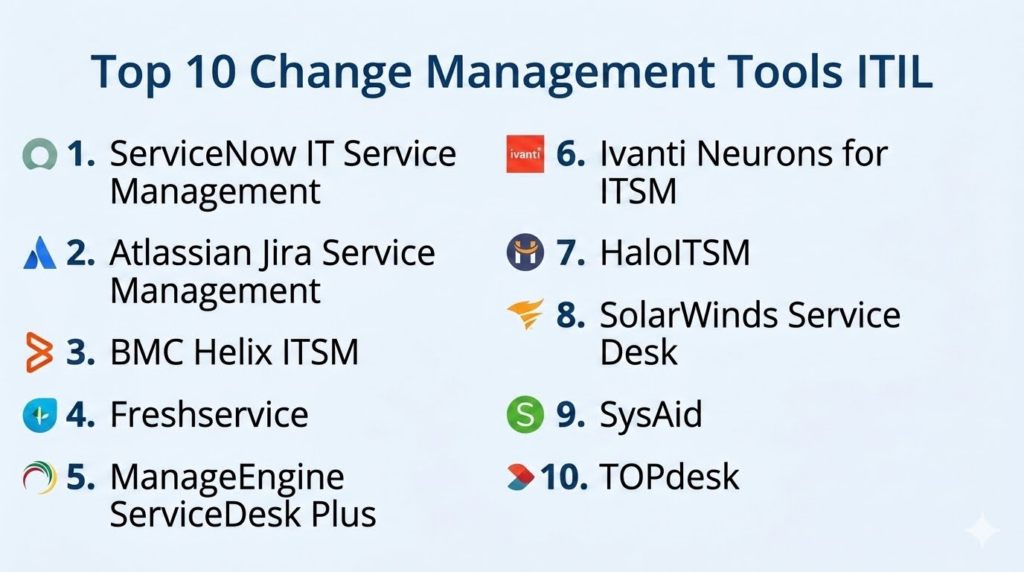
Introduction
Change Management Tools ITIL help organizations plan, approve, track, communicate, and review changes to IT systems in a controlled way. In simple terms, these tools make sure that software updates, infrastructure changes, configuration updates, security patches, cloud deployments, access changes, and production releases do not create unnecessary outages or business risk. They provide workflows for change requests, approvals, risk assessment, scheduling, documentation, implementation tracking, and post-change review.
Change management matters because modern IT environments are more complex than ever. Businesses now manage cloud infrastructure, SaaS systems, DevOps pipelines, cybersecurity controls, remote employees, compliance requirements, and customer-facing digital services. Poorly managed changes can lead to downtime, security gaps, failed deployments, audit issues, and unhappy users.
Real-world use cases include standard change approvals, emergency change handling, production deployment governance, infrastructure change tracking, CAB reviews, release coordination, audit documentation, and service impact analysis. Buyers should evaluate ITIL alignment, workflow flexibility, approval automation, risk scoring, CMDB integration, DevOps integration, reporting, security controls, ease of use, and scalability.
Best for: Change Management Tools ITIL are best for IT service management teams, IT operations teams, DevOps teams, release managers, change advisory boards, compliance teams, security teams, managed service providers, and enterprises that need structured change governance.
Not ideal for: These tools may not be necessary for very small teams with low-risk systems, informal change processes, or simple internal applications. In those cases, a lightweight project tracker, ticketing system, or DevOps workflow may be enough until risk, scale, or compliance pressure increases.
Key Trends in Change Management Tools ITIL
- DevOps and ITIL alignment: Modern tools are bridging traditional ITIL change management with faster DevOps release cycles so teams can maintain governance without slowing delivery.
- Automated risk assessment: Platforms increasingly use rules, historical data, dependency insights, and AI-assisted analysis to classify change risk and recommend approval paths.
- Standard change automation: Repetitive low-risk changes are being converted into pre-approved standard change workflows to reduce bottlenecks and speed up routine operations.
- Emergency change governance: Organizations are improving emergency change workflows with faster approvals, audit trails, incident linkage, and post-implementation reviews.
- CMDB and service mapping integration: Change decisions are becoming more dependent on asset relationships, service dependencies, and configuration item impact analysis.
- Change calendar visibility: Teams need shared calendars to avoid conflicts between deployments, maintenance windows, blackout periods, and business-critical events.
- AI-assisted change summaries: AI features are starting to summarize change requests, identify missing information, recommend approvers, and improve documentation quality.
- Compliance-ready audit trails: Regulated organizations need clear records of who requested, approved, implemented, reviewed, and closed each change.
- Platform-based ITSM consolidation: Companies prefer change management tools that are part of broader ITSM platforms with incident, problem, asset, CMDB, request, and knowledge management.
- Integration with CI/CD pipelines: Change workflows increasingly connect with tools such as code repositories, deployment pipelines, monitoring systems, and incident response platforms.
How We Selected These Tools
The tools in this list were selected based on their relevance to ITIL change management, IT service management, release governance, workflow automation, approval management, and enterprise IT operations. The list includes enterprise ITSM platforms, flexible service desk platforms, and IT operations tools that support structured change control.
Selection logic included:
- Recognition and adoption in ITSM, ITIL, change management, and service operations.
- Strength of change request workflows, approval paths, risk assessment, and change calendars.
- Support for standard, normal, and emergency change processes.
- Integration with incident, problem, asset, CMDB, release, monitoring, and DevOps workflows.
- Workflow flexibility for IT operations, DevOps, security, compliance, and business stakeholders.
- Reporting for change success rate, failed changes, approval time, audit readiness, and service impact.
- Security and administrative controls such as role-based access, audit logs, and permission governance.
- Scalability across SMB, mid-market, enterprise, and managed service provider environments.
- Ease of use for change managers, IT agents, CAB members, approvers, and technical teams.
- Overall value for reducing change-related incidents and improving IT governance.
Top 10 Change Management Tools ITIL
1- ServiceNow IT Service Management
Short description:
ServiceNow IT Service Management is one of the most widely used enterprise ITSM platforms for incident, problem, change, request, asset, CMDB, and service operations workflows. Its change management capabilities help organizations define change models, automate approvals, assess risk, schedule changes, and track implementation outcomes. It is especially strong for large enterprises with mature ITIL practices and complex service environments. ServiceNow is best for organizations that need scalable change governance connected with broader digital workflows.
Key Features
- Normal, standard, and emergency change workflows.
- Change risk assessment and approval routing.
- Change calendar and blackout window visibility.
- Integration with incident, problem, CMDB, and asset workflows.
- CAB support and approval documentation.
- Automated notifications, tasks, and workflow orchestration.
- Reporting for change success, failed changes, and service impact.
Pros
- Strong enterprise-grade ITIL change management depth.
- Excellent fit for organizations already using ServiceNow ITSM.
- Scales across complex, regulated, and multi-team IT environments.
Cons
- Implementation can be complex and resource-intensive.
- Requires strong administration and process governance.
- May be too advanced for smaller teams with simple change needs.
Platforms / Deployment
Web / Mobile experiences
Cloud
Security & Compliance
ServiceNow provides enterprise security controls such as SSO, MFA support, role-based access, audit capabilities, encryption options, and administrative governance. Specific compliance coverage depends on product, region, contract, and configuration.
Integrations & Ecosystem
ServiceNow integrates deeply with enterprise IT systems, DevOps tools, monitoring platforms, CMDB data, asset systems, and automation workflows. Its change management value increases when changes are connected to services, configuration items, incidents, and deployment pipelines.
- CMDB and asset management
- Incident and problem management
- Monitoring and observability tools
- DevOps and CI/CD systems
- Identity and access systems
- Enterprise automation workflows
Support & Community
ServiceNow has extensive documentation, training programs, certification paths, enterprise support, professional services, and a large global partner ecosystem. Community strength is high among ITSM professionals, enterprise IT leaders, and workflow administrators.
2- Atlassian Jira Service Management
Short description:
Jira Service Management is a flexible ITSM platform that supports change management, incident management, request management, problem management, asset workflows, and DevOps collaboration. It is especially useful for organizations that want ITIL change management connected with engineering and software delivery workflows. Jira Service Management helps teams track change requests, manage approvals, link deployments, and coordinate changes with technical teams. It is a strong option for DevOps-oriented IT organizations and teams already using Atlassian tools.
Key Features
- Change request tracking and approval workflows.
- Change calendar and deployment visibility.
- Integration with Jira Software and DevOps workflows.
- Incident, problem, request, and asset management support.
- Automation rules for routing, notifications, and approvals.
- Knowledge base support through Confluence integration.
- Reporting for change performance and service operations.
Pros
- Strong fit for DevOps and engineering-heavy teams.
- Flexible workflows and automation.
- Good collaboration between IT operations and development teams.
Cons
- Enterprise ITIL governance may require careful configuration.
- Best value is achieved when the organization uses Atlassian tools.
- Complex change advisory processes may need additional process design.
Platforms / Deployment
Web / iOS / Android
Cloud / Data Center options may vary
Security & Compliance
Atlassian provides security features such as permissions, access controls, SSO options, audit logs on selected plans, and administrative governance. Specific compliance coverage depends on product plan, deployment model, region, and configuration.
Integrations & Ecosystem
Jira Service Management integrates strongly with Atlassian products, DevOps systems, monitoring tools, collaboration apps, and asset management workflows. It is especially useful when change management must connect with software delivery.
- Jira Software
- Confluence
- Bitbucket and code tools
- CI/CD pipelines
- Monitoring and alerting tools
- Slack and Microsoft Teams
Support & Community
Atlassian provides documentation, marketplace apps, training resources, partner services, community forums, and support plans. Its community is large and active among DevOps, ITSM, agile, and software delivery teams.
3- BMC Helix ITSM
Short description:
BMC Helix ITSM is an enterprise IT service management platform with strong capabilities for change management, incident management, problem management, asset management, service request management, and IT operations. It is designed for organizations with mature ITIL practices and complex IT environments. Its change management capabilities help teams manage approvals, risk, scheduling, impact analysis, and audit requirements. BMC Helix is best for large enterprises needing structured governance and operational control.
Key Features
- ITIL-aligned change management workflows.
- Standard, normal, and emergency change support.
- Risk and impact assessment capabilities.
- Change calendar and approval management.
- Integration with incident, problem, asset, and CMDB workflows.
- Service impact and operational visibility.
- Reporting for compliance, change outcomes, and performance.
Pros
- Strong enterprise ITSM and ITIL process depth.
- Suitable for complex and regulated IT environments.
- Good fit for mature service management teams.
Cons
- Can require significant implementation and administration expertise.
- May be more complex than needed for smaller organizations.
- Process maturity is important to get full value.
Platforms / Deployment
Web
Cloud / Hybrid options may vary
Security & Compliance
BMC Helix provides enterprise security and administrative controls, including role-based access, permissions, governance features, and auditability. Specific compliance certifications and deployment-level controls should be validated during procurement.
Integrations & Ecosystem
BMC Helix integrates with enterprise IT operations, monitoring, asset, CMDB, automation, and reporting systems. It is especially useful for organizations that need change management connected to broader IT operations.
- CMDB and asset systems
- Monitoring platforms
- IT operations tools
- Automation systems
- Identity management tools
- Enterprise reporting tools
Support & Community
BMC provides enterprise support, documentation, professional services, partner assistance, and training resources. Its ecosystem is strongest among large IT organizations with mature service management practices.
4- Freshservice
Short description:
Freshservice is a cloud-based ITSM platform with change management, incident management, problem management, asset management, service catalog, knowledge base, and automation capabilities. It is known for its user-friendly interface and practical setup for SMB and mid-market teams. Freshservice helps IT teams create change requests, manage approvals, schedule changes, and connect changes with incidents and assets. It is a strong choice for organizations that want ITIL-style change control without excessive enterprise complexity.
Key Features
- Change request creation and approval workflows.
- Standard, normal, and emergency change support.
- Change calendar and scheduling.
- Incident, problem, asset, and service request integration.
- Workflow automation for routing and notifications.
- Knowledge base and self-service support.
- Reporting for change performance and IT operations.
Pros
- Easy to adopt for SMB and mid-market IT teams.
- Good balance of ITIL process support and usability.
- Practical automation and service desk integration.
Cons
- Very complex enterprise governance may require deeper customization.
- Some advanced features depend on selected plan.
- Large-scale change processes require careful workflow design.
Platforms / Deployment
Web / iOS / Android
Cloud
Security & Compliance
Freshservice provides security controls such as role-based access, SSO options, audit logs, data protection features, and administrative permissions depending on plan and configuration. Specific compliance requirements should be validated during procurement.
Integrations & Ecosystem
Freshservice integrates with collaboration tools, identity systems, monitoring tools, asset systems, and business applications. Its change management workflows work well when connected with IT service operations and asset data.
- Microsoft Teams
- Slack
- Identity providers
- Monitoring tools
- Asset management systems
- Business applications
Support & Community
Freshservice provides documentation, customer support, onboarding resources, training materials, and a Freshworks user community. It is especially practical for teams that want faster onboarding and straightforward ITSM administration.
5- ManageEngine ServiceDesk Plus
Short description:
ManageEngine ServiceDesk Plus is an ITSM platform that includes change management, incident management, problem management, service catalog, asset management, project management, and knowledge base features. It is popular among SMB, mid-market, and cost-conscious enterprise IT teams. Its change management module helps teams define change types, approval stages, CAB workflows, implementation tasks, and review steps. ServiceDesk Plus is a strong option for organizations that want broad ITSM functionality with flexible deployment options.
Key Features
- ITIL-style change management workflows.
- Change templates, roles, approvals, and tasks.
- CAB support and change calendar.
- Incident, problem, asset, and project management integration.
- Risk assessment and planning fields.
- Reporting for change status and outcomes.
- Cloud and self-hosted deployment options.
Pros
- Strong value for ITSM and change management functionality.
- Flexible deployment options for different IT environments.
- Practical for SMB and mid-market teams.
Cons
- Advanced enterprise workflows may require extra configuration.
- Interface and process depth may need tuning for large organizations.
- Some advanced capabilities depend on edition and setup.
Platforms / Deployment
Web / Mobile apps
Cloud / Self-hosted options may vary
Security & Compliance
ManageEngine ServiceDesk Plus provides access controls, role-based permissions, authentication options, audit features, and administrative settings. Specific compliance coverage and security requirements should be validated based on deployment model and edition.
Integrations & Ecosystem
ServiceDesk Plus integrates with other ManageEngine products and third-party IT systems. It is useful for organizations that want change workflows connected with helpdesk, asset, monitoring, identity, and endpoint management systems.
- ManageEngine ecosystem tools
- Active Directory and identity systems
- Monitoring platforms
- Endpoint management tools
- Asset management systems
- Email and collaboration tools
Support & Community
ManageEngine provides documentation, support resources, training materials, forums, and product assistance. Its community is strong among IT administrators and service desk teams looking for practical ITSM adoption.
6- Ivanti Neurons for ITSM
Short description:
Ivanti Neurons for ITSM is a service management platform that supports change management, incident management, problem management, asset management, knowledge management, service catalog, and automation. It is designed for IT teams that want change control connected with asset visibility, endpoint context, and service operations. Ivanti helps teams plan changes, route approvals, assess impact, and automate service workflows. It is a strong fit for organizations that value both ITSM and endpoint or asset-aware operations.
Key Features
- Change request and approval workflows.
- ITIL-aligned incident, problem, and change processes.
- Asset and endpoint management alignment.
- Service catalog and request workflows.
- Workflow automation and notifications.
- Knowledge base and self-service support.
- Reporting for service and change performance.
Pros
- Strong connection between ITSM and asset operations.
- Useful for teams managing endpoint and service workflows together.
- Flexible workflow automation capabilities.
Cons
- Configuration may require experienced administration.
- User experience depends on implementation quality.
- Some capabilities may vary by product scope and licensing.
Platforms / Deployment
Web
Cloud / Hybrid options may vary
Security & Compliance
Ivanti provides security and administrative controls such as user permissions, role-based access, and governance capabilities. Specific compliance coverage, encryption details, and certification scope should be verified during procurement.
Integrations & Ecosystem
Ivanti integrates with endpoint, asset, identity, monitoring, and service management systems. Its change management value improves when asset relationships and endpoint data are connected to change workflows.
- Endpoint management tools
- Asset management systems
- Identity providers
- Monitoring platforms
- Collaboration tools
- Enterprise automation systems
Support & Community
Ivanti provides documentation, customer support, implementation resources, and partner assistance. Its community is strongest among IT teams focused on endpoint, asset, and service management operations.
7- HaloITSM
Short description:
HaloITSM is a modern IT service management platform that supports change management, incident management, problem management, asset management, service catalog, knowledge base, and workflow automation. It is designed for organizations that want flexible ITSM processes and configurable workflows. HaloITSM helps teams manage change requests, approvals, risk, implementation tasks, and post-change reviews. It is suitable for mid-market, enterprise, and service provider environments that need adaptable change governance.
Key Features
- Change management workflows and approvals.
- Incident, problem, asset, and service request support.
- Custom forms, templates, and workflow automation.
- Change calendar and task management.
- SLA and service performance reporting.
- Knowledge base and self-service portal.
- Configurable processes for ITSM and service delivery.
Pros
- Modern and flexible ITSM platform.
- Strong workflow configurability for change processes.
- Good fit for teams that need adaptable service management.
Cons
- Advanced configuration requires thoughtful process design.
- Buyers should validate ecosystem fit with existing IT systems.
- Enterprise-scale requirements should be reviewed carefully.
Platforms / Deployment
Web
Cloud / Self-hosted options may vary
Security & Compliance
HaloITSM provides administrative security controls such as user permissions, authentication options, and access governance. Specific certifications, compliance coverage, and data protection details should be validated with the vendor.
Integrations & Ecosystem
HaloITSM integrates with identity, monitoring, collaboration, asset, and business systems. Its change management capabilities are most useful when connected with ticketing, assets, and service workflows.
- Identity systems
- Collaboration tools
- Monitoring platforms
- Asset management systems
- Email and notification tools
- Business applications
Support & Community
HaloITSM provides documentation, customer support, onboarding assistance, and implementation guidance. Its community is growing among ITSM teams and managed service providers.
8- SolarWinds Service Desk
Short description:
SolarWinds Service Desk is a cloud-based ITSM platform that includes change management, incident management, asset management, service catalog, knowledge base, and automation capabilities. It is designed for IT teams that need a practical cloud service desk with structured workflows. Its change management features help teams plan, approve, schedule, and track IT changes. SolarWinds Service Desk is a good fit for SMB and mid-market teams looking for manageable ITIL-style change control.
Key Features
- Change management workflows and approvals.
- Incident, asset, knowledge, and service catalog support.
- Workflow automation and notifications.
- Change tracking and documentation.
- SLA management and reporting.
- Employee self-service portal.
- Cloud-based IT service desk operations.
Pros
- Practical ITSM features for SMB and mid-market teams.
- Combines change, incident, asset, and service workflows.
- Cloud deployment supports easier access and administration.
Cons
- Very complex enterprise change governance may need deeper tools.
- Advanced customization should be validated before purchase.
- Integration depth depends on existing IT environment.
Platforms / Deployment
Web
Cloud
Security & Compliance
SolarWinds Service Desk provides security and administrative controls for IT service desk workflows. Specific compliance certifications, access controls, and data protection details should be validated based on plan and procurement requirements.
Integrations & Ecosystem
SolarWinds Service Desk connects with IT management, monitoring, asset, identity, and collaboration workflows. It is especially useful for teams already using SolarWinds or cloud-based IT operations tools.
- SolarWinds ecosystem tools
- Identity systems
- Asset management workflows
- Monitoring tools
- Email and notification systems
- Collaboration platforms
Support & Community
SolarWinds provides documentation, support resources, customer assistance, and community forums. Its ecosystem is familiar to many IT operations and service desk teams.
9- SysAid
Short description:
SysAid is an ITSM and helpdesk platform that includes change management, ticketing, asset management, service catalog, knowledge base, automation, and self-service capabilities. It is designed for IT teams that want a manageable platform for service desk and ITIL processes. Its change management features help teams document changes, route approvals, manage tasks, and track outcomes. SysAid is especially useful for SMB and mid-market teams that need structured ITSM without adopting a large enterprise platform.
Key Features
- Change management and approval workflows.
- Incident, request, and asset management.
- Service catalog and self-service portal.
- Workflow automation for routing and notifications.
- Knowledge base and AI-assisted support features.
- SLA tracking and reporting.
- Custom forms and process configuration.
Pros
- Practical ITSM and change management for growing teams.
- Easier to manage than many enterprise-heavy platforms.
- Combines service desk, assets, catalog, and automation.
Cons
- May not match the enterprise depth of larger ITSM suites.
- Advanced multi-team governance may require extra configuration.
- Integration needs should be validated for complex environments.
Platforms / Deployment
Web
Cloud / Self-hosted options may vary
Security & Compliance
SysAid provides administrative controls, user permissions, authentication options, and security features for helpdesk workflows. Specific compliance certifications and enterprise security details should be validated with the vendor.
Integrations & Ecosystem
SysAid integrates with IT systems, identity tools, communication platforms, and service desk workflows. It is useful when IT teams want change requests connected with ticketing and asset visibility.
- Identity systems
- Email and notification tools
- Asset management workflows
- Remote support tools
- Collaboration platforms
- IT operations systems
Support & Community
SysAid provides documentation, customer support, onboarding resources, and product guidance. Its community is practical for IT service desk teams looking for manageable ITSM adoption.
10- TOPdesk
Short description:
TOPdesk is a service management platform that supports ITSM, enterprise service management, change management, incident management, service catalog, asset management, and self-service workflows. It is used by IT, facilities, HR, and shared service teams to organize internal services and manage operational work. Its change management capabilities help teams structure approvals, tasks, communication, and review steps. TOPdesk is a good fit for organizations that want service management across IT and other business departments.
Key Features
- Change management and service workflow support.
- Incident and request management.
- Service catalog and self-service portal.
- Asset and reservation management capabilities.
- Knowledge base and documentation support.
- Workflow automation and task assignment.
- Reporting for service and change performance.
Pros
- Good fit for enterprise service management beyond IT.
- User-friendly portal and service workflow experience.
- Supports multiple internal service teams in one platform.
Cons
- Complex enterprise customization should be validated during evaluation.
- Advanced automation depth may vary by configuration.
- Best results require process ownership and governance.
Platforms / Deployment
Web
Cloud / Deployment options may vary
Security & Compliance
TOPdesk provides administrative and access control features for service management workflows. Specific security certifications, data protection details, and compliance coverage should be validated with the vendor.
Integrations & Ecosystem
TOPdesk integrates with business systems, identity tools, communication platforms, and service workflows. It is useful for organizations that want change and service management processes across multiple departments.
- Identity providers
- Email and collaboration systems
- Asset management tools
- HR and facilities workflows
- Reporting tools
- Business applications
Support & Community
TOPdesk provides documentation, support, implementation guidance, training resources, and customer success services. Its community is strong among service management teams focused on IT and shared services.
Comparison Table Top 10
| Tool Name | Best For | Platform Supported | Deployment | Standout Feature | Public Rating |
|---|---|---|---|---|---|
| ServiceNow IT Service Management | Enterprise ITIL change governance | Web, mobile experiences | Cloud | Deep enterprise change workflows and CMDB integration | N/A |
| Atlassian Jira Service Management | DevOps and Atlassian-centered IT teams | Web, iOS, Android | Cloud / Data Center options may vary | Change management connected with software delivery | N/A |
| BMC Helix ITSM | Large enterprises with mature ITIL processes | Web | Cloud / Hybrid options may vary | Enterprise-grade ITIL change control | N/A |
| Freshservice | SMB and mid-market ITSM teams | Web, iOS, Android | Cloud | User-friendly ITIL-style change management | N/A |
| ManageEngine ServiceDesk Plus | Cost-conscious IT teams needing broad ITSM | Web, mobile apps | Cloud / Self-hosted options may vary | Practical change templates and CAB workflows | N/A |
| Ivanti Neurons for ITSM | ITSM connected with assets and endpoints | Web | Cloud / Hybrid options may vary | Change workflows linked with asset operations | N/A |
| HaloITSM | Flexible ITSM and service provider teams | Web | Cloud / Self-hosted options may vary | Configurable change workflows | N/A |
| SolarWinds Service Desk | Cloud ITSM for SMB and mid-market teams | Web | Cloud | Practical cloud change tracking | N/A |
| SysAid | SMB and mid-market helpdesk teams | Web | Cloud / Self-hosted options may vary | Manageable change and ticket workflows | N/A |
| TOPdesk | Multi-department service management | Web | Cloud / Deployment options may vary | Service management beyond IT | N/A |
Evaluation and Scoring of Change Management Tools ITIL
The scoring below is comparative and based on ITIL change management depth, workflow automation, ease of use, integration ecosystem, security posture signals, performance, support expectations, and value. These are not public ratings and should be used as directional evaluation scores only. A tool with a lower score may still be the best fit if it matches your company size, IT maturity, existing stack, and budget.
| Tool Name | Core 25% | Ease 15% | Integrations 15% | Security 10% | Performance 10% | Support 10% | Value 15% | Weighted Total 0–10 |
|---|---|---|---|---|---|---|---|---|
| ServiceNow IT Service Management | 10 | 7 | 10 | 9 | 9 | 9 | 7 | 8.75 |
| Atlassian Jira Service Management | 9 | 8 | 9 | 8 | 8 | 8 | 8 | 8.40 |
| BMC Helix ITSM | 9 | 7 | 9 | 9 | 9 | 8 | 7 | 8.30 |
| Freshservice | 8 | 9 | 8 | 8 | 8 | 8 | 9 | 8.30 |
| ManageEngine ServiceDesk Plus | 8 | 8 | 8 | 8 | 8 | 8 | 9 | 8.15 |
| Ivanti Neurons for ITSM | 8 | 7 | 8 | 8 | 8 | 8 | 8 | 7.80 |
| HaloITSM | 8 | 8 | 8 | 8 | 8 | 8 | 8 | 8.00 |
| SolarWinds Service Desk | 7 | 8 | 7 | 8 | 8 | 8 | 8 | 7.65 |
| SysAid | 7 | 8 | 7 | 7 | 8 | 8 | 8 | 7.50 |
| TOPdesk | 8 | 8 | 7 | 8 | 8 | 8 | 8 | 7.85 |
These scores should be interpreted in context. Enterprise organizations may prioritize governance, CMDB depth, audit trails, and complex approval workflows. SMBs may prioritize ease of setup, affordability, and simple change tracking. DevOps-heavy teams may prefer platforms that integrate well with software delivery workflows. Buyers should test real change scenarios, including standard changes, emergency changes, CAB reviews, rollback plans, and post-implementation reviews before selecting a tool.
Which Change Management Tools ITIL Tool Is Right for You?
Solo / Freelancer
Solo professionals usually do not need a dedicated ITIL change management tool. If you manage small websites, internal systems, or client projects, a simple task tracker, deployment checklist, calendar, and documentation process may be enough. However, freelancers working with regulated clients or production systems should still document changes, risks, approvals, and rollback steps. A lightweight service desk or project management tool can provide enough control without adding unnecessary complexity.
SMB
SMBs should prioritize simple change workflows, easy approvals, fast setup, and affordable ITSM capabilities. Freshservice, ManageEngine ServiceDesk Plus, SolarWinds Service Desk, SysAid, and HaloITSM can be practical options depending on the IT environment. SMB teams should start with basic change types such as standard, normal, and emergency changes. The goal should be to reduce risky informal changes without creating too much approval friction.
Mid-Market
Mid-market organizations often need stronger workflow automation, change calendars, reporting, asset integration, and approval governance. Jira Service Management, Freshservice, ManageEngine ServiceDesk Plus, HaloITSM, Ivanti, and TOPdesk can be strong choices. If the organization has DevOps teams, Jira Service Management may be useful. If asset and endpoint context is important, Ivanti can be considered. Mid-market buyers should focus on balancing process control with delivery speed.
Enterprise
Enterprises need scalable change governance, audit trails, CMDB integration, CAB workflows, risk assessment, emergency change handling, and service impact visibility. ServiceNow IT Service Management and BMC Helix ITSM are strong enterprise candidates. Jira Service Management may also fit enterprises with engineering-heavy environments. Enterprise buyers should evaluate data model quality, integration maturity, reporting, security controls, and governance ownership before selecting a platform.
Budget vs Premium
Budget-focused teams should look for tools that provide practical change workflows without heavy implementation cost. ManageEngine ServiceDesk Plus, Freshservice, SysAid, SolarWinds Service Desk, and HaloITSM may provide strong value for many teams. Premium platforms such as ServiceNow and BMC Helix are better suited for organizations with complex IT environments, compliance requirements, and mature ITIL practices. Buyers should compare total cost, including configuration, training, administration, integrations, and long-term support.
Feature Depth vs Ease of Use
Feature depth matters when change management must connect with CMDB, incident management, problem management, release management, DevOps pipelines, compliance audits, and service impact analysis. ServiceNow, BMC Helix, Jira Service Management, and Ivanti offer strong depth. Ease of use matters when teams need fast adoption and simple workflows. Freshservice, ManageEngine, SysAid, SolarWinds Service Desk, and HaloITSM may be easier for many teams to start with. The right balance depends on change risk and organizational maturity.
Integrations and Scalability
Change management becomes more effective when connected to CMDB, monitoring, incident response, asset management, DevOps pipelines, identity systems, and collaboration tools. Integrations help teams understand which services may be affected, whether incidents are linked, and whether deployments are successful. DevOps teams should validate CI/CD integration. Enterprise IT teams should validate CMDB and asset integration. Without reliable integrations, change records can become disconnected paperwork.
Security and Compliance Needs
Change management tools often store sensitive operational information about infrastructure, applications, access, security patches, and business systems. Buyers should evaluate SSO, MFA, role-based access, audit logs, approval history, encryption, data retention, and administrator controls. Regulated industries should also ensure that change records support audit requirements. A strong change process should show who requested the change, who approved it, what was changed, when it happened, and whether it succeeded.
Frequently Asked Questions FAQs
1. What is an ITIL Change Management Tool?
An ITIL Change Management Tool helps organizations control changes to IT services, systems, infrastructure, and applications. It provides workflows for submitting change requests, assessing risk, getting approvals, scheduling implementation, tracking tasks, and reviewing outcomes. The goal is to reduce incidents caused by poorly planned changes. These tools support standard, normal, and emergency changes. They are especially useful for organizations that need auditability, governance, and service reliability.
2. What is the difference between change management and release management?
Change management focuses on evaluating, approving, scheduling, and controlling changes to IT services. Release management focuses more on planning and deploying software or system releases into environments. A release may include multiple changes, and a change may be part of a release. In ITIL environments, the two processes often work together. Change management provides governance, while release management focuses on packaging, coordination, deployment, and communication.
3. What pricing models are common for Change Management Tools ITIL?
Most Change Management Tools ITIL are priced as part of broader ITSM platforms. Pricing may depend on agents, users, modules, assets, platform tier, deployment model, or enterprise contract terms. Some tools include change management in standard ITSM plans, while others require higher tiers or add-on capabilities. Buyers should ask about implementation costs, admin training, integrations, automation limits, reporting, support tiers, and long-term renewal pricing. Total ownership cost is more important than license cost alone.
4. How long does implementation usually take?
Implementation time depends on the tool, company size, workflow complexity, approval structure, CMDB quality, and integration needs. A small team can start with simple change workflows faster than an enterprise implementing CAB processes, service mapping, risk scoring, and compliance reporting. The most time-consuming work is usually defining change types, approval rules, risk categories, templates, blackout periods, and reporting requirements. A phased rollout is often best. Start with core change workflows, then improve automation and integrations over time.
5. What are common mistakes in ITIL change management?
A common mistake is making every change go through the same slow approval process, even when some changes are low-risk and repeatable. Another mistake is failing to document rollback plans, impact analysis, and implementation results. Some teams also treat change management as paperwork instead of a risk reduction process. Poorly defined change categories can create confusion between standard, normal, and emergency changes. Good change management should reduce risk without blocking necessary work.
6. Are Change Management Tools secure?
Change Management Tools can be secure when configured with proper access controls, authentication, permissions, audit logs, and administrative governance. Security is important because change records may include infrastructure details, application dependencies, access changes, patch plans, and sensitive operational data. Buyers should evaluate SSO, MFA, role-based access, encryption, audit history, and data retention. Regulated organizations should also validate whether change records support audit requirements. Security review should be part of the tool selection process.
7. Can Change Management Tools integrate with DevOps pipelines?
Yes, many modern change management tools can integrate with DevOps pipelines, code repositories, deployment tools, monitoring systems, and incident platforms. This helps teams connect change records with software deployments and production releases. DevOps integration can reduce manual updates and improve traceability. However, integration depth varies widely by platform and configuration. Teams should test whether the tool can support automated change creation, deployment linking, approvals, and post-deployment validation.
8. What is a Change Advisory Board?
A Change Advisory Board, often called CAB, is a group of stakeholders that reviews and approves higher-risk changes. CAB members may include IT operations, security, application owners, business representatives, infrastructure teams, and service managers. The purpose is to evaluate risk, timing, business impact, rollback plans, and dependencies before a change is implemented. Not every change should require CAB review. Low-risk standard changes can often be pre-approved to avoid unnecessary delays.
9. What alternatives exist if a full ITIL change tool is not needed?
Alternatives include project management tools, DevOps boards, deployment checklists, spreadsheets, approval forms, shared calendars, and basic ticketing systems. These can work for small teams or low-risk environments. However, they may become weak when audit trails, approvals, rollback plans, service impact analysis, and cross-team visibility are required. A dedicated ITIL change management tool becomes more useful as systems grow in complexity. The right alternative depends on risk, compliance needs, and change volume.
10. How should buyers evaluate Change Management Tools ITIL?
Buyers should evaluate workflow flexibility, change templates, approval routing, CAB support, change calendar, CMDB integration, DevOps integration, audit trails, reporting, security controls, and ease of use. They should test real change scenarios such as standard changes, emergency changes, infrastructure updates, production deployments, and rollback documentation. It is important to involve IT operations, DevOps, security, compliance, and business stakeholders during evaluation. The best tool is the one that improves control and visibility without creating unnecessary process friction.
Conclusion
Change Management Tools ITIL help organizations reduce production risk, improve service reliability, document operational decisions, and create a controlled process for modifying IT systems. The right tool depends on company size, IT maturity, existing service desk stack, DevOps practices, compliance requirements, and change volume. ServiceNow and BMC Helix are strong for enterprise-grade ITIL governance, Jira Service Management is useful for DevOps and Atlassian-centered teams, Freshservice and ManageEngine ServiceDesk Plus offer practical value for SMB and mid-market teams, while Ivanti, HaloITSM, SolarWinds Service Desk, SysAid, and TOPdesk provide useful options for different service management needs. There is no universal best platform because each organization has different risk levels, approval needs, and system complexity. The practical next step is to shortlist three to five tools, define your standard, normal, and emergency change workflows, test approval and rollback scenarios, validate integrations and security controls, and run a pilot before scaling change management across the organization.
