MOTOSHARE 🚗🏍️
Rent Bikes & Cars Directly from Owners
Motoshare connects vehicle owners with people who need bikes and cars on rent. Owners earn from idle vehicles, and renters get flexible ride options.
Visit Motoshare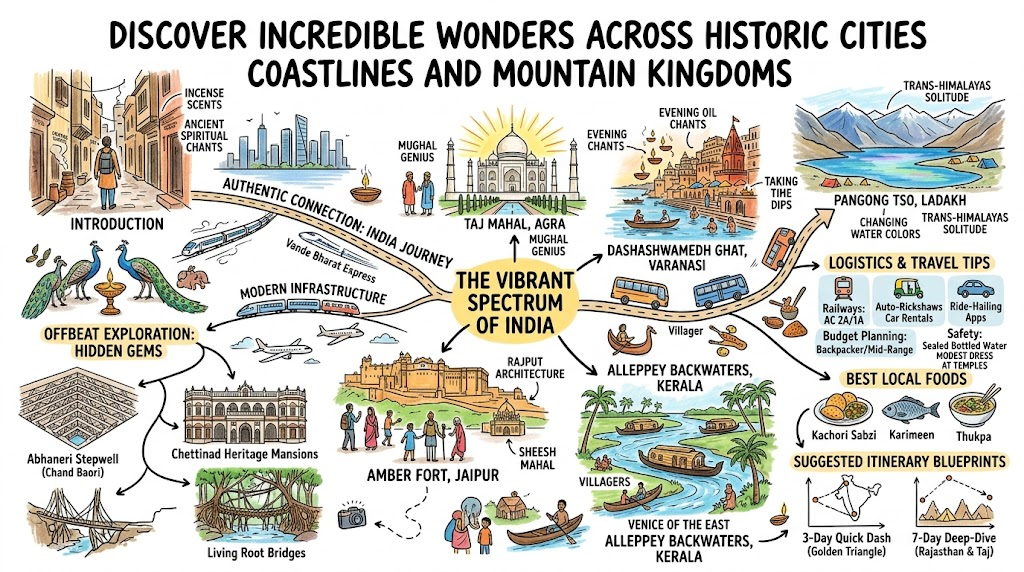
Introduction
Beyond cookie-cutter resort escapes and manufactured tourist traps lies a subcontinent vibrating with five millennia of unbroken human story. India does not simply welcome visitors; it pulls them into a living canvas of incense-scented alleyways, colossal sandstone citadels, and emerald palm groves. Choosing this journey means trading sanitized predictability for raw, authentic connection, where ancient spiritual chants echo against modern skylines and every street corner tells a story.
The iconic Taj Mahal at sunrise.
Why India is a must-visit city
India stands as an unmatched epicenter of global heritage, offering an extraordinary breadth of geographical diversity across a single unified landmass. From the frost-dusted peaks of the Trans-Himalayas to the tropical backwaters of the Malabar Coast, this region holds monumental historical weight as the birthplace of major world religions and architectural marvels. Exploring it reveals how centuries of royal dynasties, trading routes, and cultural shifts created a dynamic ecosystem of hospitality.
Navigating this vast travel circuit is seamless thanks to an extensive modern network of vande bharat express trains, national highways, and well-connected international airports. Whether you are a solo backpacker hopping on local sleeper buses or a family traveling via private chauffeured vehicles, the infrastructure effortlessly bridges ancient heritage zones with modern comfort.
Thomas Cook
| Key Metric | Destination Detail |
|---|---|
| Ideal Trip Duration | 10 to 14 Days (for primary circuits) |
| Peak Season | October to March (Pleasant across most regions) |
| Primary Transit Hubs | New Delhi (DEL), Mumbai (BOM), Bengaluru (BLR) |
| Cultural Heritage | 42 UNESCO World Heritage Sites |
| Local Currency | Indian Rupee (INR / ₹) |
Best Places or Experiences
Taj Mahal, Agra
Rising dramatically above the banks of the Yamuna River, the Taj Mahal is the ultimate physical manifestation of Mughal architectural genius and timeless devotion. Built between 1631 and 1648 by Emperor Shah Jahan in memory of Mumtaz Mahal, this white marble mausoleum features flawless bilateral symmetry, intricate pietra dura gemstone inlays, and poetic calligraphy. Walking through the grand red sandstone gateway reveals a sight that leaves travelers speechless.
Beyond its iconic central dome, the surrounding complex houses detailed Persian gardens (Charbagh), a grand red sandstone mosque, and intricate floral carvings. The marble dynamically shifts colors depending on the hour, glowing soft pink under early dawn light, brilliant white at midday, and warm gold as the sun dips below the horizon.
- Location: Tajganj District, Agra (Approx. 210 km south of New Delhi)
- Why it is worth visiting: It is a UNESCO World Heritage site and one of the New Seven Wonders of the World, representing the pinnacle of Indo-Islamic architecture.
- Best things to do: Admire the marble inlay craftsmanship up close, photograph reflections in the central pool, and view the monument across the river from Mehtab Bagh at sunset.
- Best time to visit: 6:00 AM at sunrise for low crowds and the best lighting.
- Ideal for whom: History buffs, couples, architecture lovers, and first-time travelers.
- Travel tip: The main complex is closed every Friday for prayers; plan your itinerary accordingly.
Dashashwamedh Ghat, Varanasi
Varanasi is widely recognized as one of the world’s oldest continuously inhabited cities, serving as the spiritual heart of Hinduism along the sacred Ganga River. Dashashwamedh Ghat is its most vibrant and ancient riverbank, where life, death, and spirituality converge in a powerful daily spectacle. Steeped in myth, local lore holds that Lord Brahma created this spot to welcome Lord Shiva.
Visiting this ghat offers a sensory plunge into India’s deepest living traditions. From dawn until dusk, pilgrims perform ritual dips, sadhus offer blessings, and floating oil lamps illuminate the river waters. The evening Ganga Aarti ritual turns the stone steps into an unforgettable open-air amphitheater filled with burning brass lamps, incense smoke, and rhythmic chanting.
Historic riverfront ghats along Varanasi.
- Location: Old City center along the Ganga River, Varanasi (18 km from Lal Bahadur Shastri Airport)
- Why it is worth visiting: It offers an intense, unfiltered look into ancient spiritual rituals that have remained unchanged for thousands of years.
- Best things to do: Take a dawn boat ride along the riverfront, witness the evening Ganga Aarti from a wooden boat, and explore the labyrinthine alleyways behind the ghat.
- Best time to visit: October to March, particularly during early morning (5:30 AM) or evening (6:30 PM).
- Ideal for whom: Cultural explorers, solo travelers, photographers, and spiritual seekers.
- Travel tip: Be wary of self-proclaimed “gurus” offering unsolicited blessings in exchange for cash donations on the steps.
Amber Fort, Jaipur
Perched atop the rugged Cheel ka Teela (Hill of Eagles) in the Aravalli range, Amber Fort stands as a masterclass in Rajput military architecture blended with Mughal aesthetics. Constructed primarily from yellow and pink sandstone by Raja Man Singh I in 1592, this massive hilltop fortress overlooks the serene Maota Lake. Its formidable outer walls conceal opulent royal apartments and grand courtyards.
Inside, the fort houses the world-famous Sheesh Mahal (Mirror Palace), whose walls and ceilings are inlaid with thousands of convex glass mirrors that reflect a single beam of light into a shimmering starscape. Traversing its hidden tunnels, intricate jali screens, and grand archways offers a glimpse into the lavish lives of Rajasthan’s historic rulers.
Sandstone archways at Amber Fort.
- Location: Amer District, Jaipur (11 km north of Pink City center)
- Why it is worth visiting: It is a breathtaking blend of fierce defensive walls and delicate artistic interiors, offering panoramic views over the Aravalli mountains.
- Best things to do: Marvel at the mirrorwork inside Sheesh Mahal, explore the underground tunnel to Jaigarh Fort, and watch the evening light and sound show.
- Best time to visit: 8:00 AM right as gates open to avoid heavy midday heat and crowds.
- Ideal for whom: Families, architecture enthusiasts, history buffs, and photographers.
- Travel tip: Skip the elephant rides in favor of walking or taking an eco-friendly golf cart up the ramparts.
Alleppey Backwaters, Kerala
Known affectionately as the “Venice of the East,” the backwaters of Alleppey (Alappuzha) form a serene labyrinth of interconnected canals, rivers, and freshwater lakes parallel to the Arabian Sea coast. This unique ecosystem has sustained coastal communities for generations, serving as a highway for traditional wooden cargo boats known as Kettuvallams. Today, these craft have been transformed into eco-friendly floating houseboats.
Gliding through these emerald waterways reveals a slower, idyllic pace of life. Palm trees bend low over glassy waters while local villagers navigate in handmade canoes, kingfishers dive for prey, and vibrant green paddy fields sit below sea level. The quiet rhythm of the water provides a therapeutic antidote to bustling city streets.
Traditional houseboat in Kerala backwaters.
- Location: Alappuzha District, Kerala (85 km south of Cochin International Airport)
- Why it is worth visiting: It offers an eco-luxury nature retreat through lush, tropical landscapes unique to Southern India.
- Best things to do: Hire an overnight private houseboat, row a small country canoe through narrow village canals, and sample fresh karimeen (pearl spot fish) cooked onboard.
- Best time to visit: November to February for cool breezes and clear skies.
- Ideal for whom: Couples, honeymooners, nature lovers, and slow-travel enthusiasts.
- Travel tip: Book houseboats that are government-certified for eco-compliance to avoid diesel-polluting vessels.
Pangong Tso, Ladakh
Stretching across the high-altitude desert of the Trans-Himalayas at over 14,000 feet above sea level, Pangong Tso is a breathtaking endorheic salt lake. Spanning 134 kilometers across international borders, its crystal-clear waters are famous for shifting color throughout the day—changing rapidly from deep indigo to turquoise, cobalt, and light blue.
Surrounded by barren, snow-dusted peaks, the landscape feels utterly otherworldly. The absence of noise, combined with razor-thin mountain air and vast open skies, creates a stark, humbling solitude. Nighttime brings an unpolluted view of the Milky Way, making it a dream destination for stargazers.
Vibrant waters of Pangong Tso.
- Location: Changthang Region, Ladakh (225 km east of Leh town center)
- Why it is worth visiting: It is one of the highest saltwater lakes on Earth, offering high-altitude mountain scenery.
- Best things to do: Camp along the shore in eco-huts, photograph the changing shades of blue at sunrise, and spot rare migratory black-necked cranes.
- Best time to visit: June to September when mountain passes are free of heavy ice blockages.
- Ideal for whom: Adventure seekers, road-trippers, landscape photographers, and stargazers.
- Travel tip: You must acquire an Inner Line Permit (ILP) in Leh before traveling, and spend at least 48 hours acclimatizing to avoid acute mountain sickness.
Offbeat Exploration: Hidden Gems Tourists Miss
Abhaneri Stepwell (Chand Baori), Rajasthan
Located in a quiet village between Jaipur and Agra, Chand Baori is one of the deepest and largest stepwells in the world. Built in the 9th century by King Chanda, this architectural marvel features 3,500 narrow steps arranged in perfect geometric symmetry across 13 stories, dropping 100 feet into a cool subterranean pool. It provided rainwater harvesting and public relief from summer heat.
Chettinad Heritage Mansions, Tamil Nadu
Tucked away in Tamil Nadu, Chettinad is a region famous for its palatial 19th-century merchant mansions. Built by the wealthy Nattukottai Chettiars, these architectural treasures incorporate Italian marble, Burmese teak, and handmade Athangudi tiles. Walking through these 100-room residences offers an intimate peek into a bygone era of spice-trading fortunes.
Living Root Bridges of Cherrapunji, Meghalaya
Deep in the subtropical rainforests of Northeast India, indigenous Khasi communities have spent centuries training the aerial roots of Ficus elastica trees across roaring river canyons. Over decades, these living roots interweave to form strong, self-healing bridges that handle heavy monsoon rains better than concrete, serving as a masterpiece of bio-engineering.
Detailed Practical Guidance for Travelers
| Destination | Standard Entry Fee | General Timings | Best Local Food Options Nearby | Recommended Nearby Attractions |
|---|---|---|---|---|
| Taj Mahal | ₹1,100 (Foreign) / ₹50 (Indian) | 6:00 AM – 6:30 PM (Closed Fri) | Bedai & Jalebi, Mughlai Parathas | Agra Fort, Mehtab Bagh |
| Dashashwamedh | Free (Boats ₹300-₹800/hr) | Open 24 Hours (Aarti 6:30 PM) | Malaiyyo, Kachori Sabzi, Blue Lassi | Kashi Vishwanath, Manikarnika Ghat |
| Amber Fort | ₹500 (Foreign) / ₹100 (Indian) | 8:00 AM – 5:30 PM, 6:30 PM – 9:15 PM | Pyaaz Kachori, Dal Baati Churma | Jaigarh Fort, Stepwell Panna Meena |
| Alleppey | Free (Houseboat ₹7,000-₹18,000) | Day Cruises: 11:00 AM – 5:00 PM | Karimeen Pollichathu, Duck Roast | Marari Beach, Vembanad Lake |
| Pangong Tso | ₹400 ILP Fee + Env Tax | Open 24 Hours (Daylight best) | Thukpa, Butter Tea, Momos | Chang La Pass, Hemis Monastery |
Logistics & On-Ground Navigation
Local Transport Options
- Railways: The Indian Railways network connects nearly every town; reserve AC First Class (1A) or AC 2-Tier (2A) for long-haul comfortable travel.
- Auto-Rickshaws & E-Rickshaws: Ideal for short intra-city trips through dense markets. Always insist on using the meter or negotiate the fare prior to boarding.
- Car Rentals with Driver: Renting an AC vehicle with a local driver is surprisingly affordable and removes the stress of navigating rural roads.
- Ride-Hailing Apps: Uber and Ola operate reliably across major cities, providing transparent pricing without haggling.
Budget Planning
- Backpacker / Budget Tier: ₹2,000 – ₹3,500 per day. Includes boutique hostel beds, street food meals, public buses/trains, and self-guided walking tours.
- Mid-Range / Comfort Tier: ₹7,000 – ₹14,000 per day. Includes heritage homestays or 4-star hotels, private AC intercity cabs, sit-down regional dining, and entry passes.
Safety and Inclusivity Tips
- For Families: Stick to private transfers on long road trips, keep bottled water handy, and schedule rest breaks during peak afternoon hours.
- For Couples: Maintain moderate public displays of affection in conservative rural or religious zones to respect local customs.
- General Safety: Drink only sealed bottled or purified water, buy local SIM cards at airport kiosks for continuous GPS navigation, and secure valuables in crowded bazars.
Strategic Travel Planning Guardrails
Travel Planning Tips for India
- Book major express train tickets 30 to 60 days in advance, as popular routes fill up quickly.
- Digital payments via UPI are ubiquitous, but keep ₹2,000 in small cash notes for rural stalls and tips.
- Wear easy-to-remove slip-on shoes when visiting active temples and religious sites.
- Carry a light cotton scarf to cover shoulders and knees at conservative monuments.
- Download offline Google Maps for remote regions like Ladakh and Northeast India.
Common Mistakes to Avoid
- Over-packing your schedule with too many cities; slow down to absorb each location deeply.
- Drinking tap water or eating pre-peeled fruits from roadside vendors.
- Assuming all regions share the same climate; research regional weather before packing.
- Relying exclusively on luxury hotel dining while ignoring famous neighborhood eateries.
- Accepting first price quotes in markets without polite counter-negotiation.
Suggested Itinerary Blueprints
3-Day Quick Dash (Golden Triangle Express)
Targeted at travelers short on time who want to hit core heritage icons efficiently.
- Day 1: Arrive in New Delhi; explore Humayun’s Tomb and drive down Rajpath past India Gate.
- Day 2: Early morning drive via Yamuna Expressway to Agra; tour the Taj Mahal and Agra Fort.
- Day 3: Express drive to Jaipur; tour Amber Fort and Hawa Mahal before catching an evening flight back.
7-Day Deep-Dive (Royal Rajasthan & Taj Circuit)
Designed for cultural enthusiasts eager to explore historic forts, markets, and architecture.
- Days 1-2: New Delhi exploration; Old Delhi spice markets, Qutub Minar, and street food tours.
- Days 3-4: Agra immersion; sunrise Taj Mahal, Mehtab Bagh gardens, and Fatehpur Sikri.
- Days 5-7: Jaipur regional loop; Amber Fort, City Palace, Jal Mahal, and shopping in Johari Bazaar.
Complete Weekend Travel Plan (Southern Backwaters & Heritage)
A relaxing Friday-to-Sunday tropical circuit ideal for nature lovers.
- Friday: Land in Cochin; explore Fort Kochi’s Chinese fishing nets and colonial architecture.
- Saturday: Drive to Alleppey; board a private houseboat for a day-night backwater cruise.
- Sunday: Morning village canoe ride; sample fresh coastal cuisine before catching an evening flight from Cochin.
Common Tourist Mistakes to Avoid
- Geographic Blunders: Attempting to visit Delhi, Jaipur, and Kerala in a short 4-day window. Stick to localized geographic clusters to avoid spending your entire trip in transit.
- Commercial Traps: Spending afternoon hours in modern air-conditioned shopping malls when historic bazars offer superior craft quality and atmosphere.
- Neglecting Modern/Alternative Zones: Skipping vibrant contemporary arts hubs like Mumbai’s Kala Ghoda or Bangalore’s microbrewery districts in favor of ancient sites alone.
- Transport Overpayment: Accepting unmetered taxi quotes at train stations instead of booking through official prepaid booths or ride-sharing apps.
- Luxury Dining Bias: Eating every meal inside high-end international hotel restaurants, missing out on legendary regional culinary hubs.
Frequently Asked Questions
1. Is it safe for solo travelers to explore these regions?
Yes, traveling solo is generally safe if you take sensible precautions. Stick to well-traveled routes, book verified accommodations, avoid late-night solo strolls in unlit areas, and keep local emergency numbers saved on your phone.
2. What is the best time of year to visit Northern India?
The ideal window is between October and March. During these months, daytime temperatures are comfortable for sightseeing, avoiding both extreme summer heat and heavy monsoon rain.
3. Do I need special permits to visit high-altitude border regions?
Yes, areas like Ladakh, Sikkim, and Arunachal Pradesh require an Inner Line Permit (ILP) or Protected Area Permit (PAP) for foreign and domestic visitors due to border security protocols.
4. Can I use international credit cards everywhere?
Major hotels, high-end shops, and established restaurants readily accept Visa and Mastercard. However, street food stalls, small rickshaws, and rural vendors rely exclusively on cash or local UPI digital payments.
5. How should I dress when visiting temples and mosques?
Modest dress is required at all religious sites. Ensure your shoulders and knees are covered, remove shoes before entering, and carry a scarf to cover your head if requested.
6. What is the most reliable mode of intercity travel?
For medium distances, high-speed trains like Shatabdi and Vande Bharat offer reliable service. For longer distances across states, domestic flights are affordable and save significant travel time.
7. How do I avoid getting sick from food and water?
Drink only sealed bottled or filtered water, avoid ice cubes at street stalls, eat at busy food vendors with high customer turnover, and stick to freshly cooked hot dishes.
8. Are vegetarian food options widely available?
India is one of the most vegetarian-friendly destinations in the world. A significant portion of the population follows a vegetarian diet, so almost every restaurant offers extensive vegetarian menus.
9. What is the protocol for tipping in restaurants and for drivers?
In sit-down restaurants, a tip of 7-10% is customary if a service charge isn’t already added to the bill. For private drivers, tipping ₹300-₹500 per day is appreciated for good service.
10. Is English widely spoken across tourist routes?
English is widely spoken in major cities, hotels, airports, and tourist hubs. In rural areas, basic English combined with translation apps is more than enough to navigate easily.
11. How far in advance should I book major attraction tickets?
For popular monuments like the Taj Mahal, it is best to purchase entry tickets online a few days in advance through official government portals to skip long ticket counter queues.
12. What should I pack for a multi-region trip?
Pack light, breathable cotton clothing for warmer regions, a versatile scarf, comfortable walking shoes, sun protection, and a warm jacket if your itinerary includes high-altitude northern areas.
Conclusion
Stepping out of your comfort zone to experience this incredible subcontinent yields rewards that linger long after the dust settles on your luggage. It is a journey that recalibrates how you see history, community, and beauty. By looking past cookie-cutter vacation options and leaning into local traditions, you return home not just with photographs, but with a piece of the world’s most vibrant living heritage permanently woven into your own story.

Fragile multi-modal transit links and volatile seasonal weather conditions often disrupt itinerary schedules across remote topography. Travelers need decentralized offline GPS caching and flexible connection windows to navigate dynamic regional delays across varied terrains.