MOTOSHARE 🚗🏍️
Rent Bikes & Cars Directly from Owners
Motoshare connects vehicle owners with people who need bikes and cars on rent. Owners earn from idle vehicles, and renters get flexible ride options.
Visit Motoshare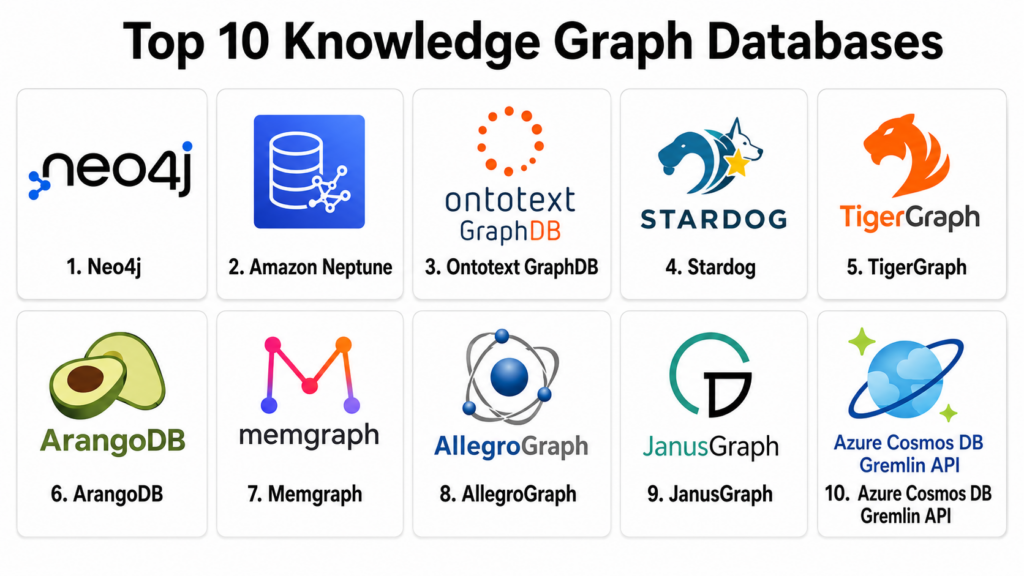
Introduction
Knowledge Graph Databases help organizations store, connect, query, reason over, and analyze data as relationships between entities. In simple terms, they make it easier to represent how people, products, places, documents, events, risks, assets, transactions, and concepts are connected. Instead of only storing data in rows and columns, knowledge graph databases model meaning through nodes, edges, properties, ontologies, vocabularies, and relationships.
Knowledge graph databases matter because modern businesses need context-rich data for AI, search, analytics, compliance, fraud detection, cybersecurity, customer intelligence, recommendation systems, drug discovery, supply chain visibility, and enterprise knowledge management. They are especially useful when relationships matter as much as the data itself.
Real world use cases include GraphRAG, enterprise search, semantic knowledge management, recommendation engines, fraud investigation, identity resolution, customer 360, cybersecurity attack path analysis, biomedical research, supply chain mapping, and regulatory intelligence.
Buyers should evaluate graph model support, query language, ontology features, reasoning, scalability, performance, cloud deployment, APIs, security, visualization, AI integration, data import, governance, and ecosystem maturity.
Best for: Knowledge Graph Databases are best for data architects, AI teams, semantic technology teams, knowledge management teams, search teams, fraud analysts, cybersecurity teams, data scientists, research organizations, enterprise architects, and organizations that need connected context across complex data.
Not ideal for: These tools may not be necessary for simple reporting, basic transactional apps, spreadsheet-style analytics, or datasets with few meaningful relationships. In those cases, relational databases, document databases, search engines, or standard data warehouses may be easier and more cost-effective.
Key Trends in Knowledge Graph Databases
- GraphRAG is becoming a major driver: Organizations are using knowledge graphs to improve retrieval-augmented generation by adding entity relationships, context, source traceability, and explainability to AI outputs.
- RDF and property graph models are both important: RDF is common for semantic web, ontologies, SPARQL, and reasoning, while property graphs are popular for application development, graph analytics, and flexible relationship modeling.
- Hybrid graph support is increasing: Buyers increasingly want platforms that can support multiple graph styles, query languages, or interoperability between semantic and property graph use cases.
- Enterprise search is becoming graph-powered: Knowledge graphs help search systems understand synonyms, entities, concepts, relationships, and business meaning instead of only matching keywords.
- AI governance needs connected context: Enterprises use knowledge graphs to connect data lineage, policies, documents, systems, owners, controls, risks, and compliance requirements.
- Graph analytics is expanding: Fraud detection, customer journeys, supply chain networks, identity graphs, and cybersecurity relationships benefit from pathfinding, centrality, community detection, and pattern matching.
- Ontology and taxonomy management is becoming strategic: Businesses need controlled vocabularies and semantic models to align definitions across AI, analytics, search, and governance.
- Cloud-managed graph databases are growing: Teams increasingly prefer managed graph services to reduce infrastructure administration and simplify scaling.
- Vector search and graph databases are converging: Some graph platforms are adding vector capabilities or integrating with vector databases to support semantic search and AI workflows.
- Security and access control are bigger buying factors: Knowledge graphs often contain sensitive relationships, so RBAC, SSO, audit logs, encryption, and fine-grained access matter.
How We Selected These Tools
The tools in this list were selected based on their relevance to knowledge graph databases, semantic graph stores, property graph databases, RDF stores, graph analytics, AI knowledge systems, and enterprise relationship modeling.
Selection logic included:
- Recognition in graph database, knowledge graph, RDF, semantic database, property graph, or graph analytics markets.
- Support for graph query languages such as Cypher, SPARQL, Gremlin, GSQL, AQL, or other graph query approaches.
- Ability to model entities, relationships, properties, ontologies, taxonomies, or semantic metadata.
- Fit for enterprise use cases such as GraphRAG, fraud detection, knowledge management, customer 360, cybersecurity, and recommendations.
- Scalability for large graphs, high relationship counts, and complex traversal queries.
- Integration with AI platforms, data pipelines, search engines, BI tools, APIs, and cloud services.
- Security and governance features such as SSO, RBAC, audit logs, encryption, and access policies.
- Deployment flexibility across cloud, self-hosted, hybrid, managed, open-source, and enterprise environments.
- Documentation, support model, ecosystem maturity, and community strength.
- Overall value for building trusted, connected, AI-ready knowledge systems.
Top 10 Knowledge Graph Databases
1- Neo4j
Short description:
Neo4j is one of the most widely recognized graph databases and is commonly used for knowledge graphs, fraud detection, recommendation engines, identity graphs, network analysis, and GraphRAG workflows. It uses the property graph model and the Cypher query language, making it approachable for developers and data teams. Neo4j is strong when teams need flexible relationship modeling, fast graph traversals, visualization support, and a mature ecosystem. It is a strong fit for enterprises and startups building graph-powered applications and AI knowledge systems.
Key Features
- Property graph database model.
- Cypher query language for graph querying.
- Graph traversal and pattern matching.
- Graph Data Science capabilities depending on edition.
- Knowledge graph and GraphRAG use case support.
- Cloud, self-managed, and enterprise deployment options.
- Visualization, APIs, drivers, and ecosystem integrations.
Pros
- Mature graph database ecosystem and strong community.
- Developer-friendly query language and tooling.
- Strong fit for relationship-heavy application development.
Cons
- RDF and ontology-heavy semantic web use cases may require additional tools.
- Enterprise deployment and scaling need careful architecture planning.
- Licensing and feature availability vary by edition.
Platforms / Deployment
Web / Linux / Windows / macOS / APIs
Cloud / Self-hosted / Hybrid options may vary
Security & Compliance
Neo4j provides enterprise security controls such as authentication, role-based access, encryption options, audit capabilities, and access governance depending on edition and deployment. Specific certifications and compliance coverage should be validated during procurement.
Integrations & Ecosystem
Neo4j integrates with data pipelines, AI frameworks, visualization tools, cloud platforms, APIs, and application development stacks. It is useful when graph data must power applications, search, analytics, and AI workflows.
- Python, Java, JavaScript, and .NET drivers
- LangChain and GraphRAG workflows
- BI and visualization tools
- Cloud platforms
- Data science workflows
- ETL and data integration tools
Support & Community
Neo4j has extensive documentation, training resources, commercial support, partner services, and a large graph developer community. Its ecosystem is one of the strongest in the graph database market.
2- Amazon Neptune
Short description:
Amazon Neptune is a fully managed graph database service from AWS that supports graph use cases such as knowledge graphs, identity graphs, fraud detection, cybersecurity, and AI-enhanced retrieval. It supports both property graph and RDF-style workloads, making it useful for teams that need flexibility across graph models. Neptune is especially strong for AWS-centered organizations that want managed infrastructure, cloud security, and integration with AWS services. It is a strong fit for enterprise graph applications, GraphRAG, and cloud-native knowledge systems.
Key Features
- Fully managed graph database service.
- Support for property graph and RDF graph workloads.
- Query support through graph query languages depending on model.
- Integration with AWS analytics, AI, security, and application services.
- Serverless and managed deployment options may vary by setup.
- Use cases for GraphRAG, fraud, customer 360, and cybersecurity.
- Cloud-native scalability and AWS operational integration.
Pros
- Strong fit for AWS-centered enterprises.
- Reduces database infrastructure management burden.
- Supports multiple graph modeling approaches.
Cons
- Best value depends on AWS ecosystem adoption.
- Less flexible for organizations avoiding cloud lock-in.
- Query design and data modeling still require graph expertise.
Platforms / Deployment
Web / AWS services / APIs
Cloud
Security & Compliance
Amazon Neptune uses AWS security controls such as IAM, VPC networking, encryption options, monitoring, access policies, and cloud governance. Specific compliance coverage depends on AWS region, account setup, and workload architecture.
Integrations & Ecosystem
Neptune integrates with AWS analytics, AI, storage, monitoring, and application services. It is useful when the knowledge graph is part of a broader AWS data and AI architecture.
- Amazon Bedrock workflows
- AWS Glue and data pipelines
- Amazon S3
- AWS Lambda
- Amazon CloudWatch
- AWS identity and security services
Support & Community
AWS provides documentation, enterprise support, training, partner services, and a large cloud developer community. Neptune adoption benefits from strong AWS architecture and graph modeling skills.
3- Ontotext GraphDB
Short description:
Ontotext GraphDB is an RDF graph database designed for semantic knowledge graphs, linked data, ontologies, reasoning, and SPARQL-based querying. It is especially useful for organizations that need semantic modeling, inference, taxonomies, vocabularies, and standards-based knowledge representation. GraphDB is used in enterprise knowledge management, publishing, life sciences, data governance, and semantic search use cases. It is a strong fit for teams that need RDF-native knowledge graph capabilities.
Key Features
- RDF-native graph database.
- SPARQL query support.
- Ontology and semantic reasoning capabilities.
- Linked data and semantic web standards support.
- Text search and semantic search integration options.
- Enterprise knowledge graph management.
- Support for large semantic datasets.
Pros
- Strong fit for RDF, SPARQL, and ontology-driven use cases.
- Useful for semantic reasoning and linked data.
- Good choice for enterprise knowledge management and semantic AI.
Cons
- Property graph developers may face a learning curve.
- RDF modeling requires semantic technology expertise.
- Application development patterns may differ from property graph systems.
Platforms / Deployment
Web / RDF / SPARQL / APIs
Cloud / Self-hosted / Hybrid options may vary
Security & Compliance
GraphDB provides enterprise security features such as authentication, access control, repository permissions, and administrative governance depending on edition and deployment. Specific compliance coverage should be validated during procurement.
Integrations & Ecosystem
GraphDB integrates with semantic tools, search platforms, data catalogs, AI workflows, ontology tools, and enterprise data systems. It is especially useful when business meaning and semantic standards matter.
- RDF and linked data tools
- Ontology editors
- Search platforms
- SPARQL endpoints
- Data integration pipelines
- AI and semantic search workflows
Support & Community
Ontotext provides documentation, enterprise support, consulting, training, and semantic technology expertise. Its ecosystem is strong among RDF, linked data, publishing, life sciences, and knowledge management teams.
4- Stardog
Short description:
Stardog is an enterprise knowledge graph platform focused on semantic data integration, virtualization, reasoning, metadata management, and AI-ready connected data. It helps organizations build knowledge graphs across distributed enterprise data without always physically moving everything first. Stardog is especially useful for data fabric, semantic layer, enterprise search, analytics, and AI governance use cases. It is a strong fit for large organizations that need a semantic knowledge graph across complex data landscapes.
Key Features
- Enterprise knowledge graph platform.
- RDF, SPARQL, reasoning, and semantic modeling.
- Data virtualization and virtual graph access.
- Ontology management and semantic layer support.
- AI and data fabric use case alignment.
- Query across distributed enterprise data.
- Security and governance features for enterprise adoption.
Pros
- Strong semantic integration and reasoning capabilities.
- Useful for enterprise data fabric and AI-ready knowledge layers.
- Can reduce duplication through virtual graph patterns.
Cons
- Requires semantic modeling and architecture expertise.
- May be more advanced than smaller teams need.
- Buyers should validate performance for specific federation and reasoning workloads.
Platforms / Deployment
Web / RDF / SPARQL / APIs
Cloud / Self-hosted / Hybrid options may vary
Security & Compliance
Stardog provides enterprise security capabilities such as access controls, authentication integration, permissions, auditing, and governance features depending on deployment. Specific compliance coverage should be validated with the vendor.
Integrations & Ecosystem
Stardog integrates with enterprise databases, data lakes, BI tools, semantic systems, data catalogs, and AI workflows. It is useful when organizations need semantic access across distributed data.
- Relational databases
- Data lakes and warehouses
- BI tools
- Ontology tools
- AI and semantic search workflows
- Enterprise data fabric systems
Support & Community
Stardog provides documentation, enterprise support, professional services, training, and semantic architecture guidance. Its community is strongest among enterprise knowledge graph and data fabric teams.
5- TigerGraph
Short description:
TigerGraph is a scalable graph database and analytics platform designed for large connected datasets, deep link analytics, fraud detection, customer 360, recommendation systems, supply chain analysis, and cybersecurity. It uses a parallel graph engine and GSQL query language for graph analytics at scale. TigerGraph is especially useful when graph workloads require high performance across large relationship networks. It is a strong fit for enterprises needing operational and analytical graph workloads.
Key Features
- Scalable property graph database.
- GSQL query language.
- Parallel graph processing and analytics.
- Support for deep link analytics and large graph workloads.
- Graph algorithms for analytics use cases.
- Cloud and self-managed deployment options may vary.
- Strong fit for fraud, recommendations, cybersecurity, and supply chain.
Pros
- Strong performance focus for large graph analytics.
- Useful for complex relationship analysis at enterprise scale.
- Good fit for fraud, identity, and recommendation workloads.
Cons
- GSQL may require learning for new teams.
- RDF and ontology-heavy use cases may require other platforms.
- Buyers should benchmark real graph workloads before adoption.
Platforms / Deployment
Web / APIs / Graph query workflows
Cloud / Self-hosted / Hybrid options may vary
Security & Compliance
TigerGraph provides enterprise security features such as authentication, access control, encryption options, audit capabilities, and administrative governance depending on edition and deployment. Specific compliance coverage should be validated during procurement.
Integrations & Ecosystem
TigerGraph integrates with data platforms, BI tools, cloud systems, APIs, and machine learning workflows. It is useful when graph analytics must support operational decision-making.
- Cloud data platforms
- BI and analytics tools
- Machine learning workflows
- Data pipelines
- APIs and application services
- Visualization tools
Support & Community
TigerGraph provides documentation, commercial support, training resources, and graph analytics guidance. Its ecosystem is strongest among teams building large-scale graph analytics applications.
6- ArangoDB
Short description:
ArangoDB is a multi-model database that supports graph, document, and key-value data models in one engine. It is useful for teams that need graph capabilities but also want document-style flexibility and fewer database systems to manage. ArangoDB uses AQL for querying across models and can support knowledge graph-style applications, network analysis, recommendation systems, and connected data apps. It is a strong fit for developers building applications that mix graph relationships with document data.
Key Features
- Multi-model database with graph, document, and key-value support.
- AQL query language for graph and document queries.
- Graph traversal and relationship modeling.
- Search and analytics capabilities depending on setup.
- Cloud and self-managed deployment options.
- APIs and developer-friendly tooling.
- Useful for application-oriented graph workloads.
Pros
- Flexible multi-model approach reduces database sprawl.
- Good for applications combining graph and document data.
- Developer-friendly for mixed data models.
Cons
- RDF and semantic reasoning are not its core focus.
- Very specialized graph analytics may require benchmarking.
- Teams must design models carefully to use multi-model benefits well.
Platforms / Deployment
Web / Linux / Windows / macOS / APIs
Cloud / Self-hosted / Hybrid options may vary
Security & Compliance
ArangoDB provides access controls, authentication, encryption options, audit features, and administrative governance depending on edition and deployment. Specific compliance coverage should be validated with the vendor.
Integrations & Ecosystem
ArangoDB integrates with application development stacks, APIs, cloud platforms, search workflows, and analytics systems. It is useful when graph data is part of a broader application database.
- JavaScript, Python, Java, and Go drivers
- Cloud platforms
- Search and analytics workflows
- APIs and microservices
- Data pipelines
- Application development frameworks
Support & Community
ArangoDB has documentation, open-source community resources, commercial support, and developer ecosystem support. Its community is strongest among application developers and multi-model database users.
7- Memgraph
Short description:
Memgraph is a graph database focused on real-time graph analytics, streaming data, and developer-friendly graph application workflows. It uses the property graph model and supports Cypher-style querying, making it familiar for teams with graph query experience. Memgraph is especially useful for dynamic graphs, fraud detection, network monitoring, recommendation systems, and streaming relationship analysis. It is a strong fit for teams that need fast graph insights from changing data.
Key Features
- Property graph database.
- Cypher-style query support.
- Real-time graph analytics focus.
- Streaming data integration capabilities.
- Graph algorithms and analytics workflows.
- Developer-friendly local and cloud deployment options.
- Useful for dynamic relationship data.
Pros
- Strong fit for real-time and streaming graph workloads.
- Familiar query model for Cypher users.
- Good developer experience for graph applications.
Cons
- Enterprise semantic RDF use cases may require other tools.
- Ecosystem is smaller than some older graph platforms.
- Buyers should validate scaling and persistence needs for production workloads.
Platforms / Deployment
Linux / Docker / APIs
Cloud / Self-hosted options may vary
Security & Compliance
Memgraph security depends on deployment, edition, access controls, authentication, networking, and operational governance. Specific enterprise security and compliance features should be validated during procurement.
Integrations & Ecosystem
Memgraph integrates with streaming systems, application development stacks, data pipelines, and graph analytics workflows. It is useful when graph relationships change quickly and need fast analysis.
- Kafka and streaming workflows
- Python and developer tools
- APIs and applications
- Graph analytics libraries
- Cloud infrastructure
- Visualization tools
Support & Community
Memgraph provides documentation, community resources, developer examples, and commercial support options depending on deployment. Its community is growing among real-time graph and developer teams.
8- AllegroGraph
Short description:
AllegroGraph is a semantic graph database and RDF triplestore focused on knowledge graphs, linked data, reasoning, semantic search, and AI applications. It supports SPARQL, RDF, reasoning capabilities, and graph analytics features for semantic data. AllegroGraph is especially useful for life sciences, defense, intelligence, publishing, compliance, and enterprise knowledge systems. It is a strong fit for teams that need RDF-native semantic graph capabilities with reasoning and knowledge representation depth.
Key Features
- RDF triplestore and semantic graph database.
- SPARQL query support.
- Reasoning and inference capabilities.
- Support for linked data and semantic modeling.
- Graph analytics and knowledge graph workflows.
- Text and geospatial features depending on setup.
- Enterprise semantic application support.
Pros
- Strong semantic graph and RDF support.
- Useful for reasoning-heavy knowledge graph applications.
- Good fit for specialized enterprise and research use cases.
Cons
- Requires semantic web and RDF expertise.
- Property graph developers may find the model less familiar.
- Buyers should validate ecosystem fit and integration requirements.
Platforms / Deployment
Web / RDF / SPARQL / APIs
Self-hosted / Cloud options may vary
Security & Compliance
AllegroGraph provides enterprise access controls, authentication, repository permissions, and administrative features depending on deployment. Specific compliance coverage should be validated with the vendor.
Integrations & Ecosystem
AllegroGraph integrates with semantic applications, ontology tools, linked data workflows, AI systems, and enterprise knowledge applications. It is useful where semantic reasoning is central.
- RDF tools
- Ontology systems
- SPARQL endpoints
- AI knowledge workflows
- Search applications
- Enterprise data systems
Support & Community
Franz provides documentation, commercial support, consulting, and semantic graph expertise. Its ecosystem is strongest among specialized RDF and semantic knowledge graph teams.
9- JanusGraph
Short description:
JanusGraph is an open-source, distributed graph database designed for storing and querying large-scale graphs. It is often used with back-end storage systems and indexing engines, making it flexible for teams that need scalable graph infrastructure. JanusGraph supports the Apache TinkerPop stack and Gremlin query language. It is a strong fit for technical teams that want open-source distributed graph capabilities and are comfortable managing infrastructure components.
Key Features
- Open-source distributed graph database.
- Property graph model.
- Gremlin query language support.
- Scalable storage through supported back-end systems.
- Integration with indexing and search systems.
- Suitable for large graph workloads.
- Apache TinkerPop ecosystem alignment.
Pros
- Open-source and flexible for large graph deployments.
- Works with scalable storage and indexing back ends.
- Useful for technical teams needing infrastructure control.
Cons
- Requires significant operational expertise.
- Setup and tuning can be complex.
- Enterprise support depends on internal capability or third-party providers.
Platforms / Deployment
Linux / Java / Distributed infrastructure
Self-hosted / Cloud deployment options may vary
Security & Compliance
JanusGraph security depends on storage backend, network setup, authentication configuration, deployment controls, and operational governance. Specific compliance coverage is not publicly stated and should be validated for regulated environments.
Integrations & Ecosystem
JanusGraph integrates with the TinkerPop ecosystem, scalable storage back ends, indexing tools, and custom applications. It is useful when teams need open-source graph infrastructure at scale.
- Apache TinkerPop
- Gremlin workflows
- Cassandra or HBase style storage back ends
- Elasticsearch-style indexing
- Java applications
- Custom graph services
Support & Community
JanusGraph has open-source community support, documentation, and ecosystem knowledge. Organizations should validate long-term support expectations before production adoption.
10- GraphDB Alternatives with Azure Cosmos DB Gremlin API
Short description:
Azure Cosmos DB with Gremlin API is a globally distributed database service that can support property graph workloads through the Gremlin graph API. It is not a dedicated knowledge graph database in the same way as RDF-native or graph-first platforms, but it can be useful for lightweight graph applications inside Microsoft Azure environments. It is especially relevant for teams that want graph capabilities along with managed cloud scalability and Azure integration. It is a practical option for Microsoft-centered teams with moderate graph application needs.
Key Features
- Managed cloud database with Gremlin API support.
- Property graph workload support.
- Global distribution capabilities.
- Integration with Azure cloud services.
- Low-latency application database patterns.
- Managed scalability and operational controls.
- Useful for lightweight graph applications in Azure.
Pros
- Strong fit for Azure-centered organizations.
- Managed service reduces infrastructure overhead.
- Useful when graph is one part of a broader application architecture.
Cons
- Not a full semantic knowledge graph platform.
- RDF, SPARQL, and ontology reasoning are not core strengths.
- Complex graph analytics should be benchmarked carefully.
Platforms / Deployment
Web / APIs / Azure services
Cloud
Security & Compliance
Azure Cosmos DB uses Microsoft Azure security controls such as identity integration, encryption, access controls, networking policies, monitoring, and cloud governance. Specific compliance coverage depends on Azure tenant, region, and workload configuration.
Integrations & Ecosystem
Cosmos DB integrates with Azure services, application development stacks, analytics workflows, and cloud-native systems. It is useful when graph capabilities need to fit into Azure applications.
- Azure Functions
- Azure Synapse workflows
- Azure Monitor
- Microsoft identity services
- Application APIs
- Cloud-native development tools
Support & Community
Microsoft provides documentation, enterprise support, partner services, training resources, and a large Azure developer community. Adoption is strongest among teams already using Azure.
Comparison Table Top 10
| Tool Name | Best For | Platform Supported | Deployment | Standout Feature | Public Rating |
|---|---|---|---|---|---|
| Neo4j | Property graph knowledge apps and GraphRAG | Web, Linux, Windows, macOS, APIs | Cloud / Self-hosted / Hybrid options may vary | Mature Cypher-based graph ecosystem | N/A |
| Amazon Neptune | AWS-managed knowledge graphs and GraphRAG | Web, AWS services, APIs | Cloud | Managed graph database with AWS integration | N/A |
| Ontotext GraphDB | RDF and semantic knowledge graphs | Web, RDF, SPARQL, APIs | Cloud / Self-hosted / Hybrid options may vary | RDF-native reasoning and ontology support | N/A |
| Stardog | Enterprise semantic data fabric | Web, RDF, SPARQL, APIs | Cloud / Self-hosted / Hybrid options may vary | Semantic virtualization and reasoning | N/A |
| TigerGraph | Large-scale graph analytics | Web, APIs, graph query workflows | Cloud / Self-hosted / Hybrid options may vary | Parallel graph analytics for large relationship networks | N/A |
| ArangoDB | Multi-model graph applications | Web, Linux, Windows, macOS, APIs | Cloud / Self-hosted / Hybrid options may vary | Graph, document, and key-value in one engine | N/A |
| Memgraph | Real-time graph analytics | Linux, Docker, APIs | Cloud / Self-hosted options may vary | Streaming and dynamic graph workloads | N/A |
| AllegroGraph | Semantic RDF reasoning and linked data | Web, RDF, SPARQL, APIs | Self-hosted / Cloud options may vary | RDF triplestore with reasoning depth | N/A |
| JanusGraph | Open-source distributed graph infrastructure | Linux, Java, distributed infrastructure | Self-hosted / Cloud options may vary | Distributed graph on scalable back ends | N/A |
| Azure Cosmos DB Gremlin API | Azure-based lightweight graph apps | Web, APIs, Azure services | Cloud | Managed Azure graph API support | N/A |
Evaluation and Scoring of Knowledge Graph Databases
The scoring below is comparative and based on graph database depth, ease of use, integrations, security posture signals, performance, support expectations, and overall value. These are not public ratings and should be used as directional evaluation scores only.
| Tool Name | Core 25% | Ease 15% | Integrations 15% | Security 10% | Performance 10% | Support 10% | Value 15% | Weighted Total 0–10 |
|---|---|---|---|---|---|---|---|---|
| Neo4j | 10 | 9 | 9 | 8 | 9 | 9 | 8 | 8.90 |
| Amazon Neptune | 9 | 8 | 10 | 9 | 9 | 9 | 8 | 8.90 |
| Ontotext GraphDB | 9 | 7 | 8 | 8 | 8 | 8 | 8 | 8.15 |
| Stardog | 9 | 7 | 9 | 9 | 8 | 8 | 7 | 8.20 |
| TigerGraph | 9 | 7 | 8 | 8 | 9 | 8 | 8 | 8.20 |
| ArangoDB | 8 | 8 | 8 | 8 | 8 | 8 | 9 | 8.15 |
| Memgraph | 8 | 8 | 8 | 7 | 8 | 7 | 9 | 7.95 |
| AllegroGraph | 8 | 6 | 7 | 8 | 8 | 8 | 7 | 7.45 |
| JanusGraph | 8 | 5 | 8 | 7 | 8 | 6 | 9 | 7.40 |
| Azure Cosmos DB Gremlin API | 7 | 8 | 9 | 9 | 8 | 9 | 8 | 8.10 |
These scores should be interpreted by use case. Neo4j is strong for property graph applications and developer adoption. Amazon Neptune is strong for AWS-managed graph workloads and cloud-native knowledge graphs. Ontotext GraphDB, Stardog, and AllegroGraph are stronger for RDF, SPARQL, semantic reasoning, and ontology-driven knowledge graphs. TigerGraph is strong for large-scale graph analytics, while ArangoDB and Memgraph are practical for developer-focused and real-time graph applications.
Which Knowledge Graph Database Is Right for You?
Solo / Freelancer
Solo professionals should prioritize ease of learning, documentation, local development, and low setup cost. Neo4j Community, ArangoDB, Memgraph, or open-source graph tools can be practical starting points. If the project is semantic web or ontology-heavy, GraphDB or AllegroGraph-style RDF tools may be more relevant. If the goal is GraphRAG experimentation, Neo4j or Amazon Neptune may be easier depending on the cloud stack. The priority should be fast prototyping and clear graph modeling.
SMB
SMBs should focus on tools that are easy to deploy, have strong documentation, and solve a specific connected-data problem. Neo4j, ArangoDB, Memgraph, Amazon Neptune, and Azure Cosmos DB Gremlin API can be practical depending on cloud and application needs. If the business needs semantic search or taxonomy-driven knowledge management, GraphDB or Stardog may be considered. SMBs should avoid overbuilding complex ontologies unless the use case clearly requires semantic reasoning.
Mid-Market
Mid-market companies often need better scalability, integrations, security controls, visualization, developer tooling, and production support. Neo4j, Amazon Neptune, TigerGraph, ArangoDB, Stardog, and GraphDB are strong candidates depending on use case. Fraud, recommendations, and customer 360 workloads may favor property graph platforms. Semantic search, regulatory knowledge, and enterprise terminology use cases may favor RDF and ontology platforms. Mid-market teams should benchmark real graph queries before committing.
Enterprise
Enterprises need governance, security, scalability, high availability, audit logs, identity integration, data lineage, APIs, and support for multiple teams. Neo4j, Amazon Neptune, Stardog, Ontotext GraphDB, TigerGraph, AllegroGraph, and Azure Cosmos DB Gremlin API can all fit different enterprise needs. Enterprises should decide whether they need RDF, property graph, or both before selecting a platform. They should also evaluate support model, data governance, AI integration, and long-term graph architecture.
Budget vs Premium
Budget-focused teams can start with open-source Neo4j, ArangoDB, Memgraph, JanusGraph, or other community editions depending on skill set. These can reduce license cost but require more internal engineering and operations work. Premium platforms such as Neo4j Enterprise, Amazon Neptune, Stardog, GraphDB Enterprise, TigerGraph, and AllegroGraph may justify cost when security, support, scaling, governance, and enterprise features matter. Buyers should compare license cost, hosting cost, engineering effort, and business value.
Feature Depth vs Ease of Use
Feature depth matters when teams need reasoning, ontology support, GraphRAG, graph algorithms, large-scale analytics, fine-grained security, or multi-model data. Stardog, GraphDB, AllegroGraph, TigerGraph, Amazon Neptune, and Neo4j provide strong depth in different areas. Ease of use matters when teams are new to graph modeling. Neo4j, ArangoDB, Memgraph, and managed cloud graph services may be easier to start with. The best choice depends on data model, team skill, and use case complexity.
Integrations and Scalability
Knowledge graph databases become more useful when they integrate with data pipelines, AI frameworks, vector search, BI tools, APIs, document stores, search engines, and governance platforms. Buyers should test ingestion, schema evolution, query latency, visualization, and API patterns. Scalability also includes relationship count, traversal complexity, concurrent users, reasoning load, and update frequency. A platform that works for a small proof of concept may need careful tuning for enterprise-scale knowledge graphs.
Security and Compliance Needs
Knowledge graphs often contain sensitive relationships between people, accounts, documents, systems, risks, and events. Buyers should evaluate authentication, RBAC, SSO, audit logs, encryption, data masking, tenant isolation, backup, recovery, and query-level access control. Regulated industries should also validate lineage, provenance, and governance workflows. Security is especially important when knowledge graphs are used for AI because connected context may expose sensitive hidden relationships.
Frequently Asked Questions FAQs
1. What is a Knowledge Graph Database?
A Knowledge Graph Database stores information as connected entities and relationships. It helps represent how people, products, documents, events, concepts, systems, and organizations relate to each other. This makes it useful for search, AI, fraud detection, recommendations, cybersecurity, and enterprise knowledge management. Unlike simple tables, a knowledge graph captures context and meaning. It is especially valuable when relationships are central to the business problem.
2. How is a knowledge graph different from a regular graph database?
A graph database is the technology used to store and query graph data, while a knowledge graph is usually a structured representation of real-world knowledge. A knowledge graph often includes business meaning, metadata, ontologies, taxonomies, entity definitions, and semantic relationships. Some knowledge graphs use RDF and SPARQL, while others use property graphs and Cypher. Not every graph database implementation becomes a true knowledge graph. The difference is usually the level of semantic structure and business context.
3. What pricing models are common for Knowledge Graph Databases?
Pricing varies by platform. Open-source tools may have free community editions but require hosting, operations, and internal expertise. Commercial platforms may charge by users, nodes, data size, compute, cloud usage, enterprise features, or support contracts. Managed cloud services may use storage, request, compute, or instance-based pricing. Buyers should also consider implementation cost, modeling effort, integration, support, and training. The total cost is often more about graph expertise and production operations than database license alone.
4. How long does implementation usually take?
Implementation time depends on data complexity, graph model design, data ingestion, ontology needs, governance, and application requirements. A small proof of concept can be built quickly, but enterprise knowledge graphs often require months of modeling, integration, validation, and stakeholder alignment. The most important steps include defining entities, relationships, data sources, query patterns, governance rules, and success metrics. Teams should start with one high-value use case. Expanding gradually is usually safer than trying to model the entire enterprise at once.
5. What are common mistakes when choosing a Knowledge Graph Database?
A common mistake is choosing a platform before deciding whether the use case needs RDF, property graph, graph analytics, or semantic reasoning. Another mistake is treating graph databases like relational databases and failing to design relationship-first models. Some teams also build overly complex ontologies too early. Others ignore data quality and entity resolution. Buyers should test real queries, real data, and real user workflows before committing to a platform.
6. Are Knowledge Graph Databases secure?
Knowledge Graph Databases can be secure when configured with strong authentication, role-based access, encryption, audit logs, backup, and governance controls. However, knowledge graphs can expose sensitive relationships that may not be obvious in raw data. For example, connections between people, accounts, systems, locations, and events may reveal private or regulated information. Buyers should evaluate access controls at database, graph, label, relationship, and query levels. Security should be designed before the graph is opened to AI or self-service users.
7. Can knowledge graphs improve AI and RAG systems?
Yes, knowledge graphs can improve AI and RAG systems by adding structured context, entity relationships, source traceability, and explainable connections. They can help AI systems understand that a customer belongs to an account, an account owns contracts, contracts relate to products, and products connect to support issues. This can improve retrieval relevance and reduce disconnected answers. However, success depends on graph quality, data freshness, and careful integration with the AI pipeline. A poor graph can create poor AI results.
8. What is the difference between RDF and property graph databases?
RDF databases represent data as triples and are often used for semantic web, ontologies, SPARQL, linked data, and reasoning. Property graph databases represent data as nodes and relationships with properties, and are often used for application development, graph analytics, fraud detection, and recommendations. RDF is stronger for standards-based semantic meaning, while property graphs are often easier for developers building graph applications. Some platforms support both or provide interoperability. The right model depends on use case and team skills.
9. What alternatives exist if a full knowledge graph database is not needed?
Alternatives include relational databases, document databases, search engines, vector databases, data warehouses, semantic layers, metadata catalogs, and simple graph libraries. These may work for smaller projects or when relationships are not central. A search engine may be enough for keyword discovery, and a vector database may be enough for semantic similarity search. A knowledge graph database becomes valuable when entity relationships, reasoning, lineage, or graph traversal are important. The best alternative depends on the problem being solved.
10. How should buyers evaluate Knowledge Graph Databases?
Buyers should evaluate graph model, query language, data ingestion, performance, reasoning, scalability, AI integration, security, visualization, governance, and support. They should test real use cases such as entity resolution, path queries, semantic search, recommendations, fraud patterns, or GraphRAG retrieval. It is also important to test how data will be updated, governed, and explained to business users. Data architects, AI teams, security teams, domain experts, and application developers should all participate. A focused pilot is the safest way to validate fit.
Conclusion
Knowledge Graph Databases help organizations turn disconnected data into connected, contextual, and AI-ready knowledge. The right platform depends on whether the organization needs property graph development, RDF and semantic reasoning, graph analytics, cloud-managed infrastructure, multi-model flexibility, or real-time graph insights. Neo4j is strong for property graph applications and developer adoption, Amazon Neptune is strong for AWS-managed graph workloads and GraphRAG use cases, Ontotext GraphDB and AllegroGraph are strong for RDF and semantic reasoning, Stardog is useful for enterprise semantic data fabric, TigerGraph is strong for large-scale graph analytics, ArangoDB provides multi-model flexibility, Memgraph supports real-time graph use cases, JanusGraph offers open-source distributed graph infrastructure, and Azure Cosmos DB Gremlin API fits lightweight Azure graph applications. There is no single best database for every knowledge graph because each project has different semantic needs, query patterns, scale requirements, AI goals, and team skills.

Implementing specialized interconnected entity relationship semantic storage infrastructure software optimizes corporate complex information retrieval logistics, ensuring accelerated data link discovery tracking and seamless multi-dimensional network analysis workflows.