MOTOSHARE 🚗🏍️
Rent Bikes & Cars Directly from Owners
Motoshare connects vehicle owners with people who need bikes and cars on rent. Owners earn from idle vehicles, and renters get flexible ride options.
Visit Motoshare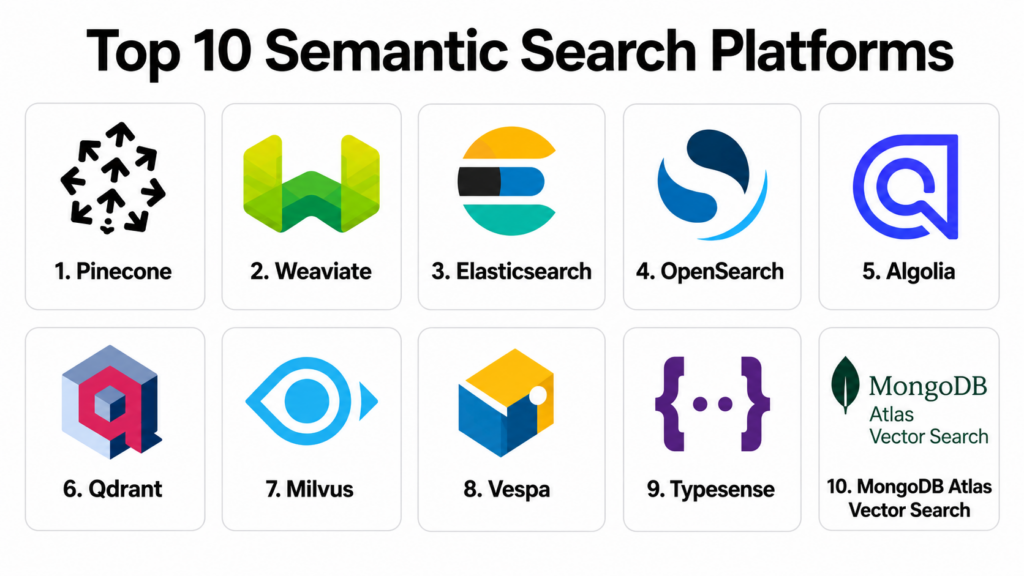
Introduction
Semantic Search Platforms help organizations find information based on meaning, intent, context, and similarity instead of only matching exact keywords. In simple terms, these platforms understand that users may search for “refund delay,” “payment reversal,” or “money not returned” and still expect related results even when the exact words are different. They use embeddings, vectors, natural language processing, metadata, ranking models, hybrid search, and sometimes generative AI to deliver more relevant results.
Semantic search matters because modern users expect search systems to understand natural language queries across documents, products, support tickets, knowledge bases, logs, research content, websites, and enterprise data. Traditional keyword search is still useful, but it often struggles with synonyms, vague queries, multilingual content, intent matching, and AI-powered knowledge retrieval.
Real world use cases include enterprise knowledge search, customer support search, ecommerce product discovery, RAG pipelines, document search, legal research, biomedical discovery, developer documentation search, personalization, recommendation systems, and internal AI assistant retrieval.
Buyers should evaluate vector search quality, hybrid search, metadata filtering, reranking, indexing speed, latency, scalability, multilingual support, APIs, security, integrations, relevance tuning, observability, governance, and deployment flexibility.
Best for: Semantic Search Platforms are best for AI teams, search engineers, product teams, data teams, knowledge management teams, ecommerce teams, customer support teams, enterprise search teams, legal teams, research teams, and organizations building RAG or AI-powered discovery experiences.
Not ideal for: These platforms may not be necessary for very small websites, simple catalogs, or teams that only need basic keyword search over limited content. In those cases, a traditional search engine, database search, CMS search, or simple website search plugin may be enough.
Key Trends in Semantic Search Platforms
- Hybrid search is becoming standard: Teams increasingly combine keyword search, vector search, metadata filters, and reranking to improve relevance instead of relying on vector search alone.
- RAG is driving adoption: Semantic search platforms are now a core part of retrieval-augmented generation pipelines because AI assistants need accurate, contextual, and source-grounded retrieval.
- Reranking is more important: Cross-encoder rerankers, LLM reranking, and relevance scoring help improve the final result quality after initial retrieval.
- Vector databases and search engines are converging: Traditional search engines are adding vector search, while vector databases are adding filtering, hybrid search, metadata handling, and ranking controls.
- Multimodal semantic search is growing: Organizations increasingly search across text, images, audio, videos, product attributes, code, and document chunks using embeddings.
- Enterprise governance is now critical: Semantic search systems often index sensitive documents, so SSO, RBAC, audit logs, data masking, tenant isolation, and access-aware retrieval matter.
- Embedding model flexibility is a key buying factor: Teams want the option to use OpenAI, Cohere, Voyage, Hugging Face, cloud provider models, or internally trained embedding models.
- Cost-aware search architecture is rising: Index size, embedding generation, storage, query latency, reranking cost, and cloud compute can affect long-term platform cost.
- Real-time and incremental indexing are important: Search systems must update quickly when documents, product catalogs, policies, tickets, or knowledge base articles change.
- AI search observability is becoming essential: Teams need to track failed queries, poor results, hallucination risk, retrieval quality, latency, click behavior, and answer grounding.
How We Selected These Tools
The tools in this list were selected based on their relevance to semantic search, vector search, hybrid retrieval, enterprise search, AI retrieval infrastructure, RAG systems, product discovery, and knowledge search.
Selection logic included:
- Recognition in semantic search, vector database, enterprise search, product search, or AI retrieval markets.
- Support for vector search, hybrid search, metadata filtering, relevance tuning, or reranking workflows.
- Ability to index and retrieve documents, product catalogs, knowledge bases, embeddings, and structured metadata.
- Integration with AI frameworks, embedding models, LLM applications, data pipelines, APIs, and cloud platforms.
- Fit for RAG, enterprise search, ecommerce search, developer search, recommendation, and AI assistant use cases.
- Scalability for large indexes, high query volumes, multi-tenant use cases, and production workloads.
- Security and governance features such as SSO, RBAC, encryption, audit logs, access policies, and deployment controls.
- Deployment flexibility across cloud, self-hosted, managed, open-source, and enterprise environments.
- Developer experience, documentation, ecosystem strength, support model, and community activity.
- Overall value for improving relevance, reducing search friction, and powering AI-ready retrieval.
Top 10 Semantic Search Platforms
1- Pinecone
Short description:
Pinecone is a managed vector database platform designed for semantic search, RAG, recommendation systems, personalization, and AI application retrieval. It helps teams store embeddings, run similarity search, filter by metadata, and scale vector search without managing infrastructure. Pinecone is especially useful for teams that want a purpose-built managed vector search layer for production AI applications. It is a strong fit for SaaS products, AI assistants, enterprise search, and high-scale retrieval systems.
Key Features
- Managed vector database for semantic search.
- Similarity search over embeddings.
- Metadata filtering and namespace support.
- Scalable indexing and retrieval infrastructure.
- API-first developer experience.
- Support for RAG and AI application workflows.
- Managed operations with cloud deployment options.
Pros
- Reduces infrastructure management for vector search.
- Strong fit for production RAG and AI retrieval applications.
- Developer-friendly APIs and managed scaling.
Cons
- Primarily focused on vector search, so advanced keyword search may require hybrid architecture.
- Cost should be evaluated carefully at scale.
- Best value depends on embedding quality and retrieval design.
Platforms / Deployment
Web / APIs / SDKs
Cloud
Security & Compliance
Pinecone provides managed cloud security controls such as access management, API keys, encryption, and enterprise governance features depending on plan. Specific compliance coverage should be validated during procurement.
Integrations & Ecosystem
Pinecone integrates with AI frameworks, embedding providers, LLM application stacks, data pipelines, and developer tools. It is useful when teams need a vector retrieval layer for AI applications.
- LangChain and LlamaIndex
- OpenAI and other embedding providers
- Python and JavaScript SDKs
- Cloud data pipelines
- RAG applications
- AI assistant workflows
Support & Community
Pinecone provides documentation, customer support, examples, developer resources, and enterprise assistance depending on plan. Its community is strong among AI application developers and RAG teams.
2- Weaviate
Short description:
Weaviate is an open-source vector database and semantic search platform that supports vector search, hybrid search, metadata filtering, generative search patterns, and AI-native application development. It can be self-hosted or used through managed cloud options. Weaviate is especially useful for teams that want flexible vector search with schema, objects, filtering, modules, and AI integrations. It is a strong fit for RAG, enterprise search, recommendation systems, and semantic product discovery.
Key Features
- Vector search and semantic retrieval.
- Hybrid keyword and vector search.
- Metadata filtering and object schema support.
- Integration with embedding and generative AI models.
- GraphQL and API-based access patterns.
- Cloud and self-hosted deployment options.
- Useful for RAG and AI-native search applications.
Pros
- Flexible open-source and managed deployment options.
- Strong hybrid search and AI integration capabilities.
- Good developer experience for semantic applications.
Cons
- Self-hosted deployments require operational expertise.
- Schema and indexing choices need careful planning.
- Large-scale workloads should be benchmarked with real data.
Platforms / Deployment
Web / APIs / SDKs
Cloud / Self-hosted / Hybrid options may vary
Security & Compliance
Weaviate provides authentication, authorization, encryption, access controls, and enterprise features depending on deployment and plan. Specific compliance coverage should be validated with the vendor.
Integrations & Ecosystem
Weaviate integrates with embedding models, LLM frameworks, data pipelines, and AI application tools. It is useful when semantic search must connect with generative AI workflows.
- LangChain and LlamaIndex
- OpenAI, Cohere, and other model providers
- Python, JavaScript, and Go clients
- Cloud platforms
- RAG pipelines
- Data ingestion workflows
Support & Community
Weaviate has strong documentation, open-source community support, managed cloud support, examples, and AI developer resources. Its community is active among vector search and RAG builders.
3- Elasticsearch
Short description:
Elasticsearch is a widely used search and analytics platform that supports keyword search, full-text search, vector search, hybrid search, filtering, relevance tuning, and large-scale indexing. It is especially useful for teams that want semantic search combined with mature search engine capabilities. Elasticsearch can support enterprise search, observability search, ecommerce search, document retrieval, and AI search workflows. It is a strong fit for organizations that need both classic search and semantic relevance in one mature platform.
Key Features
- Full-text search and keyword relevance.
- Vector search and hybrid retrieval support.
- Filtering, facets, aggregations, and ranking controls.
- Scalable indexing and distributed search.
- Relevance tuning and search analytics.
- Security and access controls depending on edition.
- Integration with Elastic Stack and AI workflows.
Pros
- Mature search platform with broad use cases.
- Strong hybrid search and filtering capabilities.
- Good fit when keyword search and semantic search must work together.
Cons
- Cluster operations can be complex when self-managed.
- Vector search tuning requires careful configuration.
- Licensing and feature availability should be validated by edition.
Platforms / Deployment
Web / APIs / Linux / Windows / macOS clients
Cloud / Self-hosted / Hybrid options may vary
Security & Compliance
Elasticsearch provides authentication, authorization, encryption, role-based access, audit features, and enterprise security controls depending on deployment and license. Specific compliance coverage should be validated during procurement.
Integrations & Ecosystem
Elasticsearch integrates with data pipelines, observability stacks, application frameworks, BI tools, and AI workflows. It is useful when semantic search must coexist with traditional search and analytics.
- Elastic Stack
- Logstash and Beats
- Python, Java, and JavaScript clients
- Cloud platforms
- RAG pipelines
- Enterprise search applications
Support & Community
Elastic provides documentation, cloud support, enterprise support, training resources, and a large developer community. Its ecosystem is mature across search, logging, analytics, and observability.
4- OpenSearch
Short description:
OpenSearch is an open-source search and analytics engine that supports full-text search, k-NN vector search, hybrid retrieval, filtering, dashboards, and analytics use cases. It is useful for organizations that want an open-source search platform with vector search capabilities and strong control over deployment. OpenSearch can support semantic search, log search, ecommerce search, enterprise document search, and RAG retrieval. It is a strong fit for teams that prefer open-source search infrastructure.
Key Features
- Full-text search and analytics engine.
- Vector search through k-NN capabilities.
- Hybrid search with keyword and vector retrieval.
- Filtering, aggregations, and dashboards.
- Open-source deployment flexibility.
- Managed service options through cloud providers may vary.
- Useful for search, observability, and AI retrieval workloads.
Pros
- Open-source search platform with vector search support.
- Good fit for teams needing control over infrastructure.
- Useful for hybrid search and analytics workloads.
Cons
- Self-hosting requires search infrastructure expertise.
- Vector search quality and performance need benchmarking.
- Enterprise governance may require managed or supported distributions.
Platforms / Deployment
Web / APIs / Linux
Self-hosted / Cloud managed options may vary
Security & Compliance
OpenSearch provides security features such as access controls, authentication, encryption, audit logs, and index-level permissions depending on deployment and plugins. Compliance depends on hosting and operational controls.
Integrations & Ecosystem
OpenSearch integrates with dashboards, data pipelines, log systems, cloud services, and AI retrieval workflows. It is useful for organizations that need both search analytics and semantic retrieval.
- OpenSearch Dashboards
- Log and event pipelines
- Cloud platforms
- Python and Java clients
- RAG workflows
- Application search systems
Support & Community
OpenSearch has an open-source community, documentation, cloud provider ecosystem, and enterprise support options through vendors and managed services. It is strongest among teams comfortable with open-source search operations.
5- Algolia
Short description:
Algolia is a search-as-a-service platform widely used for fast website search, ecommerce search, product discovery, app search, and user-facing search experiences. It supports typo tolerance, ranking controls, personalization, recommendations, and AI-enhanced search capabilities depending on product setup. Algolia is especially useful for product teams that need fast, polished, and business-friendly search experiences. It is a strong fit for ecommerce, SaaS search, marketplace search, and customer-facing discovery.
Key Features
- Hosted search-as-a-service platform.
- Fast keyword and relevance-based search.
- Semantic and AI-enhanced search capabilities depending on setup.
- Facets, filters, synonyms, and ranking controls.
- Personalization and recommendations support.
- Analytics for search behavior and relevance tuning.
- Developer-friendly APIs and frontend search components.
Pros
- Very strong user-facing search experience.
- Easy to implement compared with self-hosted search engines.
- Good fit for ecommerce and product discovery teams.
Cons
- Cost can grow with large query and record volume.
- Deep custom infrastructure control is limited compared with self-hosted engines.
- Enterprise semantic retrieval needs should be validated carefully.
Platforms / Deployment
Web / APIs / SDKs
Cloud
Security & Compliance
Algolia provides API key controls, access management, encryption, and enterprise security features depending on plan. Specific compliance certifications and governance needs should be validated with the vendor.
Integrations & Ecosystem
Algolia integrates with ecommerce platforms, CMS tools, frontend frameworks, analytics workflows, and developer stacks. It is useful when search relevance directly affects user experience and conversion.
- Shopify and ecommerce platforms
- React, Vue, and frontend frameworks
- CMS platforms
- APIs and application backends
- Analytics workflows
- Recommendation systems
Support & Community
Algolia provides documentation, support, developer examples, frontend libraries, partner resources, and enterprise assistance depending on plan. Its community is strong among ecommerce and product search teams.
6- Qdrant
Short description:
Qdrant is an open-source vector database and similarity search engine designed for semantic search, recommendation systems, RAG, image search, and AI applications. It is written in Rust and focuses on performance, filtering, payload management, and developer-friendly APIs. Qdrant can be self-hosted or used through managed cloud options. It is a strong fit for teams that want open-source vector search with strong filtering and production-ready retrieval patterns.
Key Features
- Vector similarity search.
- Rich payload and metadata filtering.
- Open-source and managed cloud options.
- API-first design with developer SDKs.
- Support for RAG and recommendation use cases.
- Collection and index management.
- Scalable search for embeddings and semantic applications.
Pros
- Strong filtering and vector search capabilities.
- Open-source flexibility with managed options.
- Good developer experience for AI retrieval systems.
Cons
- Keyword search and full search engine features may require complementary tools.
- Self-hosted operations require infrastructure expertise.
- Large production workloads should be benchmarked carefully.
Platforms / Deployment
Web / APIs / Docker / Linux
Cloud / Self-hosted options may vary
Security & Compliance
Qdrant provides access controls, API keys, encryption and deployment security options depending on hosting model and plan. Specific enterprise compliance coverage should be validated during procurement.
Integrations & Ecosystem
Qdrant integrates with AI frameworks, embedding pipelines, application backends, and RAG tools. It is useful when teams need a dedicated vector retrieval component.
- LangChain and LlamaIndex
- Python and JavaScript clients
- Embedding providers
- Docker and Kubernetes
- RAG pipelines
- Recommendation workflows
Support & Community
Qdrant has open-source documentation, community support, examples, and commercial cloud support options. Its community is active among AI developers and vector database users.
7- Milvus
Short description:
Milvus is an open-source vector database designed for large-scale similarity search, semantic search, recommendation systems, image retrieval, and AI applications. It is built for high-scale vector indexing and retrieval and is commonly associated with Zilliz Cloud for managed deployments. Milvus is especially useful for teams managing large embedding collections and performance-sensitive retrieval workloads. It is a strong fit for AI platforms, RAG systems, computer vision search, and high-volume vector applications.
Key Features
- Open-source vector database.
- High-scale vector indexing and similarity search.
- Support for multiple index types and distance metrics.
- Metadata filtering and collection management.
- Cloud and self-hosted deployment options.
- Designed for large embedding datasets.
- Strong fit for AI search and recommendation workloads.
Pros
- Strong scale and vector database focus.
- Open-source ecosystem with managed cloud option.
- Useful for large AI retrieval and similarity search workloads.
Cons
- Operational complexity can be higher when self-hosted.
- Keyword and business search features may require other tools.
- Requires careful index and infrastructure planning.
Platforms / Deployment
Linux / Docker / Kubernetes / APIs
Cloud / Self-hosted options may vary
Security & Compliance
Milvus security depends on deployment, access controls, authentication, network configuration, and managed service plan. Specific compliance coverage should be validated with the vendor or hosting provider.
Integrations & Ecosystem
Milvus integrates with AI frameworks, embedding pipelines, data platforms, and RAG application stacks. It is useful when teams need a scalable vector retrieval engine.
- LangChain and LlamaIndex
- Python and Java SDKs
- Zilliz Cloud
- Kubernetes
- AI and ML pipelines
- Computer vision search workflows
Support & Community
Milvus has open-source community support, documentation, ecosystem resources, and commercial support through Zilliz. It is widely recognized among vector database and AI infrastructure teams.
8- Vespa
Short description:
Vespa is an open-source search, recommendation, and serving platform designed for large-scale applications that need lexical search, vector search, ranking, structured retrieval, and real-time inference. It is especially useful for teams building advanced search, recommendation, personalization, and AI ranking systems. Vespa can combine keyword, vector, structured filters, and machine-learned ranking in one serving layer. It is a strong fit for engineering-heavy teams building custom high-scale relevance systems.
Key Features
- Search, recommendation, and serving platform.
- Support for lexical, vector, and structured search.
- Machine-learned ranking and model inference.
- Real-time indexing and serving capabilities.
- Scalable architecture for large applications.
- Advanced ranking and relevance tuning.
- Open-source and managed options may vary.
Pros
- Strong for advanced relevance and ranking systems.
- Combines multiple retrieval and ranking approaches.
- Useful for large-scale product, content, and recommendation platforms.
Cons
- Requires engineering expertise to use effectively.
- Less plug-and-play than hosted search-as-a-service tools.
- Advanced ranking configuration may have a learning curve.
Platforms / Deployment
Linux / APIs / Search serving infrastructure
Cloud / Self-hosted options may vary
Security & Compliance
Vespa security depends on deployment model, access controls, network configuration, authentication, and operational governance. Specific enterprise compliance coverage should be validated by deployment and support plan.
Integrations & Ecosystem
Vespa integrates with application backends, ranking models, AI workflows, data pipelines, and search systems. It is useful when teams need a custom relevance engine rather than a simple search API.
- Machine learning ranking models
- Application APIs
- Data pipelines
- Content platforms
- Recommendation systems
- Vector and lexical search workflows
Support & Community
Vespa has open-source documentation, community support, examples, and commercial support options depending on deployment. Its community is strongest among search relevance engineers and large-scale application teams.
9- Typesense
Short description:
Typesense is an open-source search engine focused on fast, typo-tolerant, developer-friendly search experiences. It is commonly used for website search, product search, documentation search, and app search. While traditionally keyword-focused, Typesense supports modern search patterns and can be used in semantic or hybrid search architectures depending on setup. It is a strong fit for teams that want simpler search operations and fast user-facing search experiences.
Key Features
- Fast typo-tolerant search.
- Developer-friendly APIs.
- Faceting, filtering, sorting, and ranking controls.
- Self-hosted and cloud options.
- Useful for website, product, and documentation search.
- Simple operational model compared with larger search engines.
- Can support hybrid search patterns depending on architecture.
Pros
- Easy to use and developer-friendly.
- Good fit for fast application and website search.
- Simpler than many large enterprise search engines.
Cons
- Advanced semantic search may require embedding and hybrid architecture setup.
- Enterprise search governance may need additional controls.
- Not as feature-heavy as Elasticsearch or OpenSearch for complex analytics.
Platforms / Deployment
Web / APIs / Docker / Linux
Cloud / Self-hosted options may vary
Security & Compliance
Typesense provides API key controls, access configuration, and deployment-level security options. Specific enterprise compliance and governance capabilities should be validated based on hosting and plan.
Integrations & Ecosystem
Typesense integrates with frontend frameworks, CMS systems, ecommerce catalogs, documentation sites, and application backends. It is useful when teams want simple and fast search implementation.
- JavaScript and frontend frameworks
- Ecommerce catalogs
- Documentation platforms
- CMS systems
- APIs and app backends
- Website search workflows
Support & Community
Typesense has documentation, open-source community support, examples, cloud support options, and developer resources. Its community is strongest among developers building fast search experiences.
10- MongoDB Atlas Vector Search
Short description:
MongoDB Atlas Vector Search allows teams to perform vector search on data stored in MongoDB Atlas, combining document data, metadata, and embeddings inside a managed operational database. It is useful for teams that already use MongoDB and want to add semantic search or RAG retrieval without operating a separate vector database. MongoDB Atlas Vector Search is especially relevant for application teams that store product, user, document, or operational data in MongoDB. It is a strong fit for app-native semantic search and AI features.
Key Features
- Vector search inside MongoDB Atlas.
- Combine embeddings with document data and metadata.
- Managed cloud database experience.
- Useful for RAG and AI application search.
- Filtering and document-style query patterns.
- Integration with MongoDB application development workflows.
- Works well when operational data and embeddings live together.
Pros
- Strong fit for MongoDB-centered application teams.
- Reduces need for a separate vector database in some architectures.
- Good for combining structured document data with semantic retrieval.
Cons
- Best value depends on MongoDB Atlas adoption.
- Specialized vector databases may offer deeper vector-specific controls.
- Large-scale retrieval should be benchmarked with real workloads.
Platforms / Deployment
Web / APIs / MongoDB drivers
Cloud
Security & Compliance
MongoDB Atlas provides managed cloud security features such as authentication, access controls, encryption, networking controls, auditing, and enterprise governance depending on plan. Specific compliance coverage should be validated during procurement.
Integrations & Ecosystem
MongoDB Atlas Vector Search integrates with MongoDB drivers, application frameworks, AI tools, and cloud services. It is useful when semantic search is embedded directly into application data workflows.
- MongoDB drivers
- LangChain and LlamaIndex
- Application backends
- Cloud platforms
- Embedding providers
- RAG workflows
Support & Community
MongoDB provides documentation, enterprise support, training resources, developer community support, and managed cloud assistance. Its ecosystem is strong among application developers and database teams.
Comparison Table Top 10
| Tool Name | Best For | Platform Supported | Deployment | Standout Feature | Public Rating |
|---|---|---|---|---|---|
| Pinecone | Managed vector search and RAG retrieval | Web, APIs, SDKs | Cloud | Purpose-built managed vector database | N/A |
| Weaviate | Open-source semantic and hybrid search | Web, APIs, SDKs | Cloud / Self-hosted / Hybrid options may vary | Vector search with hybrid retrieval and AI modules | N/A |
| Elasticsearch | Mature hybrid search and analytics | Web, APIs, Linux, Windows, macOS clients | Cloud / Self-hosted / Hybrid options may vary | Full-text plus vector and hybrid search | N/A |
| OpenSearch | Open-source hybrid search infrastructure | Web, APIs, Linux | Self-hosted / Cloud managed options may vary | Open-source search with k-NN vector capabilities | N/A |
| Algolia | Fast ecommerce and product discovery search | Web, APIs, SDKs | Cloud | Hosted user-facing search experience | N/A |
| Qdrant | Open-source vector search with filtering | Web, APIs, Docker, Linux | Cloud / Self-hosted options may vary | Vector search with rich payload filtering | N/A |
| Milvus | Large-scale vector database workloads | Linux, Docker, Kubernetes, APIs | Cloud / Self-hosted options may vary | Scalable vector indexing for large embedding datasets | N/A |
| Vespa | Advanced relevance and recommendation systems | Linux, APIs, search serving infrastructure | Cloud / Self-hosted options may vary | Hybrid retrieval with ML ranking and serving | N/A |
| Typesense | Developer-friendly site and app search | Web, APIs, Docker, Linux | Cloud / Self-hosted options may vary | Fast typo-tolerant search with simple APIs | N/A |
| MongoDB Atlas Vector Search | App-native semantic search in MongoDB | Web, APIs, MongoDB drivers | Cloud | Vector search inside operational document database | N/A |
Evaluation and Scoring of Semantic Search Platforms
The scoring below is comparative and based on semantic search depth, ease of use, integrations, security posture signals, performance, support expectations, and overall value. These are not public ratings and should be used as directional evaluation scores only.
| Tool Name | Core 25% | Ease 15% | Integrations 15% | Security 10% | Performance 10% | Support 10% | Value 15% | Weighted Total 0–10 |
|---|---|---|---|---|---|---|---|---|
| Pinecone | 9 | 9 | 9 | 8 | 9 | 8 | 8 | 8.65 |
| Weaviate | 9 | 8 | 9 | 8 | 8 | 8 | 9 | 8.50 |
| Elasticsearch | 9 | 7 | 10 | 9 | 9 | 9 | 8 | 8.75 |
| OpenSearch | 8 | 7 | 9 | 8 | 8 | 8 | 10 | 8.30 |
| Algolia | 8 | 10 | 9 | 8 | 10 | 9 | 7 | 8.65 |
| Qdrant | 9 | 8 | 8 | 8 | 9 | 8 | 9 | 8.50 |
| Milvus | 9 | 6 | 8 | 7 | 9 | 8 | 9 | 8.05 |
| Vespa | 10 | 6 | 8 | 8 | 10 | 8 | 8 | 8.35 |
| Typesense | 7 | 9 | 8 | 7 | 8 | 7 | 9 | 7.80 |
| MongoDB Atlas Vector Search | 8 | 8 | 9 | 9 | 8 | 9 | 8 | 8.35 |
These scores should be interpreted by use case. Pinecone, Weaviate, Qdrant, and Milvus are strong for vector-first AI retrieval. Elasticsearch, OpenSearch, Vespa, and Algolia are stronger when semantic search must combine with mature keyword search, ranking, filtering, and product search. MongoDB Atlas Vector Search is useful when semantic search belongs inside an existing MongoDB application. Typesense is practical for teams that want simple, fast, developer-friendly search.
Which Semantic Search Platform Is Right for You?
Solo / Freelancer
Solo professionals should prioritize fast setup, simple APIs, and low maintenance. Pinecone, Weaviate Cloud, Qdrant Cloud, Typesense, or MongoDB Atlas Vector Search can be practical depending on project needs. If the project is a RAG prototype, Pinecone, Weaviate, or Qdrant may be easiest. If the project is website or documentation search, Typesense or Algolia may be more practical. Freelancers should avoid complex self-hosted search clusters unless the client specifically needs them.
SMB
SMBs should focus on ease of use, manageable cost, good relevance, and simple integration with existing apps. Algolia is strong for ecommerce and product search, while Pinecone, Weaviate, Qdrant, and MongoDB Atlas Vector Search are strong for AI assistants and RAG. Typesense can be a good option for simple app search. SMBs should avoid overengineering relevance pipelines too early. Start with a focused index, clear metadata, and measurable search quality.
Mid-Market
Mid-market companies often need hybrid search, access control, analytics, relevance tuning, multi-source ingestion, and better production monitoring. Elasticsearch, OpenSearch, Pinecone, Weaviate, Qdrant, Algolia, and MongoDB Atlas Vector Search are strong candidates depending on use case. If the company already uses Elastic or OpenSearch, adding vector and hybrid search may be efficient. If the goal is AI retrieval, vector-first platforms may be faster to implement. Real search logs should guide evaluation.
Enterprise
Enterprises need SSO, RBAC, audit logs, encryption, data isolation, governance, compliance, multi-tenant indexing, high availability, and support for sensitive content. Elasticsearch, OpenSearch, Pinecone, Weaviate, Vespa, Algolia, Milvus, and MongoDB Atlas Vector Search can fit different enterprise needs. Enterprises should evaluate access-aware retrieval carefully so users only receive results they are authorized to see. For RAG, retrieval security is as important as LLM security.
Budget vs Premium
Budget-focused teams can start with OpenSearch, Typesense, Qdrant, Weaviate open-source, Milvus, or self-hosted Elasticsearch depending on skills and scale. These can reduce licensing cost but require operations work. Premium managed platforms such as Pinecone, Algolia, Elastic Cloud, Weaviate Cloud, Qdrant Cloud, Zilliz Cloud, and MongoDB Atlas may justify cost by reducing infrastructure burden and improving reliability. Buyers should compare license cost, infrastructure cost, embedding cost, reranking cost, and support.
Feature Depth vs Ease of Use
Feature depth matters when teams need hybrid search, reranking, personalization, access control, analytics, filters, facets, real-time indexing, and AI retrieval. Elasticsearch, Vespa, Algolia, Weaviate, Pinecone, Qdrant, and Milvus provide strong depth in different areas. Ease of use matters when teams need quick implementation. Algolia, Pinecone, Typesense, and MongoDB Atlas Vector Search may be easier for many developers. The best choice depends on whether the search use case is product-facing, enterprise-facing, or AI-facing.
Integrations and Scalability
Semantic search platforms must integrate with content sources, databases, warehouses, document stores, embedding models, LLM frameworks, APIs, frontend apps, and analytics tools. Buyers should test ingestion, update frequency, metadata filtering, query latency, multilingual content, and relevance tuning. Scalability includes vector count, index size, query concurrency, reranking workload, access filtering, and update volume. A pilot should use real content and real search queries, not only sample embeddings.
Security and Compliance Needs
Semantic search systems often index sensitive documents, customer records, tickets, internal policies, legal data, financial content, or employee information. Buyers should evaluate SSO, RBAC, tenant isolation, encryption, audit logs, data retention, access-aware retrieval, and deletion workflows. If the platform powers an AI assistant, it must respect document permissions during retrieval. Security teams should review both indexing and query-time authorization. Poorly governed semantic search can expose sensitive content quickly.
Frequently Asked Questions FAQs
1. What is a Semantic Search Platform?
A Semantic Search Platform helps users find information based on meaning rather than exact keyword matches. It uses embeddings, vectors, NLP models, metadata, and ranking methods to understand similarity and intent. For example, it can connect “cancel subscription” with “stop membership” even if the words are different. These platforms are used for enterprise search, product search, document search, and AI retrieval. They improve relevance when traditional keyword search is not enough.
2. How is semantic search different from keyword search?
Keyword search matches exact words, phrases, and text patterns, while semantic search looks for meaning and similarity. Keyword search is strong for precise terms, product codes, names, and filters. Semantic search is better for natural language questions, synonyms, vague queries, and concept matching. In many production systems, the best approach is hybrid search. Hybrid search combines keyword precision with semantic understanding and often improves relevance.
3. What pricing models are common for Semantic Search Platforms?
Pricing varies by platform type. Managed vector databases may charge by storage, index size, queries, pods, compute, or serverless usage. Search-as-a-service tools may charge by records, operations, users, or query volume. Self-hosted tools may reduce license costs but require infrastructure and engineering time. Teams should also include embedding generation and reranking costs. Total cost depends on index size, update frequency, latency requirements, and query volume.
4. How long does implementation usually take?
Implementation time depends on data sources, content cleaning, embedding strategy, metadata design, access controls, UI requirements, and relevance testing. A small prototype can be built quickly, but production semantic search takes longer because teams must tune chunking, filters, ranking, permissions, and feedback loops. The most important steps are indexing real content, testing real queries, measuring relevance, and improving results iteratively. For enterprise search, security and access control can be the longest part. A phased rollout is recommended.
5. What are common mistakes when choosing a Semantic Search Platform?
A common mistake is assuming vector search alone will solve relevance. Many systems need hybrid search, metadata filters, reranking, better chunking, and domain-specific tuning. Another mistake is ignoring access control when indexing sensitive documents. Teams also forget to evaluate update speed, deletion workflows, and observability. Some choose a platform based on demos rather than real search logs. The best evaluation uses actual content, actual users, and actual queries.
6. Are Semantic Search Platforms secure?
Semantic Search Platforms can be secure when configured with authentication, authorization, encryption, audit logs, data isolation, and access-aware retrieval. However, they can also expose sensitive content if document permissions are not enforced during indexing and retrieval. Security is especially important when semantic search powers an AI assistant or RAG system. Buyers should test whether users only retrieve content they are allowed to see. Data deletion, retention, and tenant isolation should also be reviewed carefully.
7. Can Semantic Search Platforms support RAG?
Yes, semantic search is one of the most important components of RAG systems. It retrieves relevant documents, passages, product details, policies, or knowledge base entries before the language model generates an answer. The quality of RAG depends heavily on retrieval quality, chunking, metadata, reranking, freshness, and source grounding. A weak search layer can produce poor AI answers even if the LLM is strong. For production RAG, teams should measure retrieval accuracy, not only final answer quality.
8. What is hybrid search?
Hybrid search combines multiple retrieval methods such as keyword search, vector search, metadata filtering, and reranking. Keyword search is good for exact matches, while vector search is good for meaning and similarity. Metadata filters narrow results by category, date, permissions, language, location, or document type. Reranking then improves final result order. Hybrid search is often better than pure vector search because it balances precision and semantic flexibility.
9. What alternatives exist if a full semantic search platform is not needed?
Alternatives include traditional search engines, database full-text search, CMS search plugins, website search tools, BI search, knowledge base search, or simple vector indexes inside an existing database. These may work for small sites, simple apps, or limited content. A dedicated semantic search platform becomes valuable when search quality, natural language queries, AI retrieval, personalization, or scale matters. The right alternative depends on content volume, query complexity, and user expectations. Many teams start small and upgrade when relevance needs increase.
10. How should buyers evaluate Semantic Search Platforms?
Buyers should evaluate relevance quality, hybrid search, metadata filtering, latency, indexing speed, security, scalability, APIs, deployment model, observability, and support. They should test real content and real user queries rather than sample datasets only. A good pilot should include difficult queries, synonyms, long documents, permissions, multilingual content, and freshness requirements. Product, engineering, security, support, and business teams should all participate. The best platform is the one that improves user outcomes while staying secure and maintainable.
Conclusion
Semantic Search Platforms help organizations move beyond exact keyword matching and deliver search experiences based on meaning, intent, context, and relevance. The right platform depends on whether the main goal is AI retrieval, enterprise knowledge search, ecommerce product discovery, document search, recommendation, or application search. Pinecone, Weaviate, Qdrant, and Milvus are strong for vector-first RAG and AI retrieval systems, Elasticsearch and OpenSearch are strong for hybrid search with mature search engine capabilities, Algolia is excellent for customer-facing product discovery, Vespa is strong for advanced ranking and recommendation systems, Typesense is practical for simple developer-friendly search, and MongoDB Atlas Vector Search fits teams that want semantic search inside an existing MongoDB application. There is no universal best platform because every search problem has different content, query behavior, metadata, security, latency, and business goals.

Utilizing specialized contextual intent information retrieval infrastructure software optimizes corporate digital knowledge access logistics, ensuring accelerated natural language understanding tracking and seamless semantic query accuracy workflows.