MOTOSHARE 🚗🏍️
Rent Bikes & Cars Directly from Owners
Motoshare connects vehicle owners with people who need bikes and cars on rent. Owners earn from idle vehicles, and renters get flexible ride options.
Visit Motoshare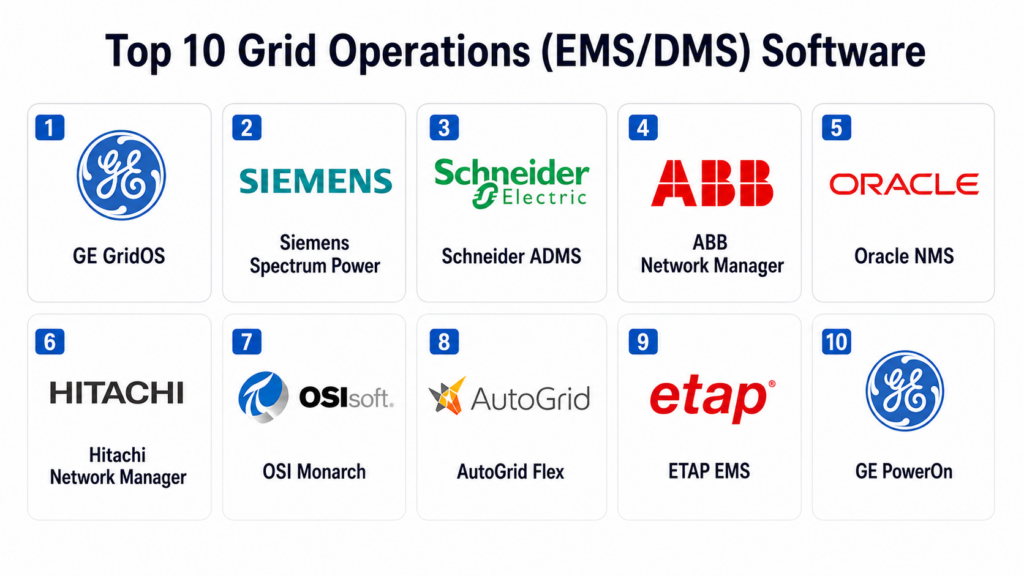
Introduction
Grid Operations Software, including Energy Management Systems (EMS) and Distribution Management Systems (DMS), is used by utilities and grid operators to monitor, control, and optimize the electrical grid in real time. These systems are the operational backbone of modern power systems, enabling safe, reliable, and efficient electricity delivery from generation to end consumers.EMS typically focuses on transmission-level grid control, generation scheduling, and system stability. DMS focuses on distribution networks, outage management, fault detection, voltage optimization, and integration with smart grids.
These platforms are widely used by power utilities, transmission system operators, renewable energy operators, and smart grid operators to maintain grid reliability, manage demand fluctuations, and integrate distributed energy resources (DERs) such as solar and wind.
Common real-world use cases include:
- Real-time grid monitoring and control
- Load balancing and demand forecasting
- Outage detection and restoration management
- Renewable energy integration (solar, wind, storage)
- Voltage and frequency optimization
- Transmission and distribution network management
Buyers evaluating EMS/DMS software should focus on:
- Real-time grid visibility and control
- SCADA integration capability
- Renewable energy and DER integration
- Outage management and restoration speed
- Load forecasting and optimization algorithms
- Cybersecurity and grid protection features
- Scalability for large transmission/distribution networks
- Interoperability with AMI, MDMS, and ERP systems
- AI/ML-driven predictive grid analytics
- Regulatory compliance and audit readiness
Best for: Electricity utilities, transmission operators, distribution companies, renewable energy operators, and smart grid infrastructure providers.
Not ideal for: Small businesses or organizations without grid operation responsibilities.
Key Trends in EMS/DMS Software
- AI-driven grid optimization is improving real-time decision-making
- Renewable energy integration is reshaping grid management
- DER (distributed energy resources) orchestration is becoming essential
- Cloud-based grid analytics platforms are emerging
- Digital twin modeling of power grids is increasing accuracy
- Edge computing is reducing latency in grid operations
- Advanced outage management systems are improving restoration time
- Cybersecurity frameworks for critical infrastructure are strengthening
- Real-time SCADA + EMS convergence is becoming standard
- Predictive maintenance using AI is gaining adoption
How We Selected These Tools
The platforms below were selected based on utility adoption, grid control capabilities, real-time performance, and integration strength.
- Evaluated global adoption in transmission and distribution utilities
- Assessed real-time grid monitoring and control capabilities
- Reviewed EMS and DMS functional depth
- Considered SCADA integration and interoperability
- Evaluated renewable energy and DER support
- Assessed scalability for national grid systems
- Reviewed outage management and restoration features
- Considered cybersecurity and compliance readiness
- Evaluated vendor maturity in power systems domain
- Reviewed analytics and forecasting capabilities
Top 10 Grid Operations (EMS/DMS) Software
#1 — GE Digital GridOS (EMS/DMS)
Short description: GE Digital GridOS is a leading grid operations platform that combines EMS and DMS capabilities for real-time monitoring, control, and optimization of power systems. It is widely used by transmission and distribution utilities globally. The platform is especially strong in real-time grid intelligence. It supports renewable integration and advanced grid analytics. GE focuses on digital transformation of energy networks.
Key Features
- Real-time grid monitoring and control
- Transmission and distribution management
- SCADA integration support
- Renewable energy integration tools
- Load forecasting and optimization
- Outage detection and response
- Advanced analytics and visualization
Pros
- Strong global utility adoption
- Excellent real-time capabilities
- Advanced grid analytics
Cons
- Complex deployment
- High enterprise cost
- Requires specialized expertise
Platforms / Deployment
- On-premise / Hybrid / Cloud
Security & Compliance
Supports enterprise encryption, RBAC, audit logs, and critical infrastructure security standards.
Integrations & Ecosystem
- SCADA systems
- MDMS platforms
- ERP systems
- AMI systems
- APIs
- Data warehouses
Support & Community
Strong global utility and grid operations ecosystem.
#2 — Siemens Spectrum Power EMS/DMS
Short description: Siemens Spectrum Power is a comprehensive EMS/DMS platform designed for large-scale transmission and distribution grid operations. It provides advanced control, monitoring, and optimization capabilities. The platform is widely used by national grid operators. It is especially strong in transmission system management. Siemens focuses on high-reliability grid infrastructure.
Key Features
- Transmission grid control (EMS)
- Distribution network management (DMS)
- Real-time system monitoring
- Load flow analysis
- Outage management
- Renewable integration support
- SCADA integration
Pros
- Highly reliable system
- Strong transmission focus
- Scalable for national grids
Cons
- Complex implementation
- High cost
- Limited UI flexibility
Platforms / Deployment
- On-premise / Hybrid
Security & Compliance
Supports enterprise-grade encryption, RBAC, and critical infrastructure compliance standards.
Integrations & Ecosystem
- SCADA systems
- AMI platforms
- MDMS systems
- ERP systems
- APIs
- Grid sensors
Support & Community
Strong global utility and transmission operator support.
#3 — Schneider Electric EcoStruxure ADMS
Short description: Schneider Electric EcoStruxure ADMS is an advanced distribution management system that integrates EMS and DMS capabilities for smart grid operations. It provides real-time monitoring, outage management, and grid optimization. The platform is widely used in modern smart utilities. It is especially strong in distribution automation. Schneider focuses on intelligent and sustainable grid systems.
Key Features
- Advanced distribution management
- Outage detection and restoration
- Voltage optimization (VVO)
- Renewable integration support
- SCADA integration
- Load forecasting
- Grid automation tools
Pros
- Strong distribution capabilities
- Modern smart grid features
- Good automation tools
Cons
- Complex setup
- Requires integration effort
- High enterprise cost
Platforms / Deployment
- Cloud / Hybrid / On-premise
Security & Compliance
Supports enterprise encryption, RBAC, audit logs, and utility compliance frameworks.
Integrations & Ecosystem
- SCADA systems
- MDMS platforms
- ERP systems
- AMI systems
- APIs
- IoT grid devices
Support & Community
Strong global utility support ecosystem.
#4 — ABB Ability Network Manager
Short description: ABB Ability Network Manager is a powerful EMS/DMS platform used for real-time grid control, monitoring, and optimization. It supports transmission and distribution grid operations. The platform is widely used by utilities worldwide. It is especially strong in mission-critical grid operations. ABB focuses on reliable and scalable energy systems.
Key Features
- Real-time grid monitoring
- Transmission system management
- Distribution network optimization
- SCADA integration
- Outage management
- Load forecasting
- Renewable integration
Pros
- Strong reliability
- High scalability
- Good grid control capabilities
Cons
- Complex configuration
- High cost
- Limited modern UI
Platforms / Deployment
- On-premise / Hybrid
Security & Compliance
Supports enterprise security frameworks, RBAC, encryption, and compliance standards.
Integrations & Ecosystem
- SCADA systems
- MDMS platforms
- AMI systems
- ERP platforms
- APIs
- Data systems
Support & Community
Strong industrial utility support ecosystem.
#5 — Oracle Utilities Network Management System (NMS)
Short description: Oracle Utilities NMS is a distribution management system designed for smart grid operations, outage management, and real-time network optimization. It integrates with Oracle utility platforms for end-to-end grid management. The platform is widely used in distribution utilities. It is especially strong in outage and fault management. Oracle focuses on integrated utility intelligence.
Key Features
- Distribution network management
- Outage management system (OMS)
- Fault detection and isolation
- SCADA integration
- Load balancing tools
- Renewable integration support
- Grid analytics
Pros
- Strong outage management
- Deep Oracle integration
- Scalable architecture
Cons
- Complex setup
- High cost
- Requires expertise
Platforms / Deployment
- Cloud / Hybrid
Security & Compliance
Supports Oracle enterprise security standards, RBAC, encryption, and audit logging.
Integrations & Ecosystem
- Oracle Utilities suite
- SCADA systems
- AMI platforms
- MDMS systems
- APIs
- ERP systems
Support & Community
Strong enterprise utility ecosystem support.
#6 — Hitachi Energy Network Manager
Short description: Hitachi Energy Network Manager is an EMS/DMS platform designed for real-time grid control and optimization. It supports transmission and distribution operations. The platform is widely used in utility-scale energy systems. It is especially strong in grid stability and reliability. Hitachi focuses on intelligent energy infrastructure.
Key Features
- Real-time grid control
- Transmission system management
- Distribution automation
- SCADA integration
- Load forecasting
- Outage management
- Renewable integration
Pros
- Strong reliability
- Good grid optimization
- Scalable system
Cons
- Complex implementation
- Limited modern UI
- High cost
Platforms / Deployment
- On-premise / Hybrid
Security & Compliance
Supports enterprise encryption, RBAC, and critical infrastructure security standards.
Integrations & Ecosystem
- SCADA systems
- MDMS platforms
- AMI systems
- ERP systems
- APIs
- Grid sensors
Support & Community
Strong global utility support ecosystem.
#7 — OSI Monarch EMS/DMS
Short description: OSI Monarch is a widely used EMS/DMS platform designed for real-time grid operations and energy management. It provides monitoring, control, and optimization of electrical grids. The platform is widely used by utilities and transmission operators. It is especially strong in real-time operations. OSI focuses on high-performance grid control systems.
Key Features
- Real-time grid monitoring
- Transmission control systems
- Distribution management
- SCADA integration
- Load forecasting
- Outage management
- Grid analytics
Pros
- High performance
- Strong utility adoption
- Reliable operations
Cons
- Complex architecture
- Limited modern UI
- High cost
Platforms / Deployment
- On-premise / Hybrid
Security & Compliance
Supports enterprise-grade encryption, RBAC, audit logging, and compliance frameworks.
Integrations & Ecosystem
- SCADA systems
- MDMS platforms
- AMI systems
- ERP systems
- APIs
- Data warehouses
Support & Community
Strong utility operations ecosystem support.
#8 — AutoGrid Flex (DER & Grid Optimization)
Short description: AutoGrid Flex is a modern AI-driven grid management platform focused on DER orchestration, demand response, and grid optimization. It is widely used in smart grid and renewable energy systems. The platform is especially strong in AI-based energy management. AutoGrid focuses on flexible and intelligent grid operations. It supports distributed energy systems.
Key Features
- DER orchestration
- AI-driven demand response
- Grid optimization tools
- Renewable integration support
- Load forecasting
- Energy analytics
- Real-time grid monitoring
Pros
- Strong AI capabilities
- Modern cloud platform
- Excellent DER support
Cons
- Limited transmission focus
- Smaller enterprise footprint
- Requires integration effort
Platforms / Deployment
- Cloud / Web
Security & Compliance
Supports encryption, RBAC, and cloud security frameworks.
Integrations & Ecosystem
- Utility systems
- SCADA platforms
- AMI systems
- APIs
- Cloud data warehouses
- DER systems
Support & Community
Growing smart grid ecosystem support.
#9 — ETAP Real-Time EMS
Short description: ETAP Real-Time EMS is a power system monitoring and control platform used for electrical grid operations and simulation. It provides real-time modeling, analysis, and optimization of power systems. The platform is widely used in industrial and utility environments. It is especially strong in power system simulation. ETAP focuses on electrical engineering accuracy.
Key Features
- Real-time power system simulation
- Grid monitoring tools
- Load flow analysis
- Fault detection
- SCADA integration
- Outage management
- Energy optimization
Pros
- Strong simulation accuracy
- Good engineering tools
- Reliable system
Cons
- Complex for non-engineers
- Limited UI modernization
- High learning curve
Platforms / Deployment
- On-premise / Hybrid
Security & Compliance
Supports enterprise security frameworks, RBAC, and compliance controls.
Integrations & Ecosystem
- SCADA systems
- MDMS platforms
- ERP systems
- APIs
- Grid sensors
- Data systems
Support & Community
Strong engineering-focused support ecosystem.
#10 — General Electric PowerOn Advantage
Short description: GE PowerOn Advantage is a distribution management system designed for real-time grid operations, outage management, and distribution automation. It supports utilities in managing complex distribution networks. The platform is widely used in smart grid environments. It is especially strong in distribution automation. GE focuses on intelligent grid control systems.
Key Features
- Distribution network management
- Outage management system
- Fault detection and isolation
- SCADA integration
- Load balancing tools
- Renewable integration
- Grid analytics
Pros
- Strong distribution capabilities
- Reliable performance
- Good utility adoption
Cons
- Complex implementation
- High cost
- Limited modern UI
Platforms / Deployment
- On-premise / Hybrid
Security & Compliance
Supports enterprise encryption, RBAC, audit logs, and utility compliance frameworks.
Integrations & Ecosystem
- SCADA systems
- MDMS platforms
- AMI systems
- ERP systems
- APIs
- Grid sensors
Support & Community
Strong global utility support ecosystem.
Comparison Table
| Tool Name | Best For | Platform(s) Supported | Deployment | Standout Feature | Public Rating |
|---|---|---|---|---|---|
| GE GridOS | Smart grids | Web | Hybrid | Real-time grid control | N/A |
| Siemens Spectrum Power | Transmission grids | Web | Hybrid | High reliability | N/A |
| Schneider ADMS | Distribution grids | Web | Hybrid | Grid automation | N/A |
| ABB Network Manager | Utility operations | Web | Hybrid | Grid stability | N/A |
| Oracle NMS | Outage management | Web | Hybrid | OMS integration | N/A |
| Hitachi Network Manager | Grid control | Web | Hybrid | Stability control | N/A |
| OSI Monarch | Real-time EMS | Web | Hybrid | High performance | N/A |
| AutoGrid Flex | DER optimization | Web | Cloud | AI optimization | N/A |
| ETAP EMS | Power simulation | Web | Hybrid | Engineering accuracy | N/A |
| GE PowerOn | Distribution grids | Web | Hybrid | Fault management | N/A |
Evaluation & Scoring of EMS/DMS Platforms
| Tool Name | Core 25% | Ease 15% | Integrations 15% | Security 10% | Performance 10% | Support 10% | Value 15% | Weighted Total |
|---|---|---|---|---|---|---|---|---|
| GE GridOS | 9.5 | 8.0 | 9.5 | 9.5 | 9.5 | 9.0 | 8.5 | 9.0 |
| Siemens Spectrum | 9.5 | 7.5 | 9.5 | 9.5 | 9.5 | 9.0 | 8.0 | 8.9 |
| Schneider ADMS | 9.0 | 8.0 | 9.0 | 9.0 | 9.0 | 9.0 | 8.5 | 8.8 |
| ABB Network Manager | 9.0 | 7.5 | 9.0 | 9.0 | 9.0 | 9.0 | 8.0 | 8.7 |
| Oracle NMS | 9.0 | 7.5 | 9.0 | 9.0 | 9.0 | 9.0 | 8.0 | 8.7 |
| Hitachi Network | 9.0 | 7.5 | 9.0 | 9.0 | 9.0 | 9.0 | 8.0 | 8.7 |
| OSI Monarch | 9.0 | 7.5 | 9.0 | 9.0 | 9.5 | 9.0 | 8.0 | 8.8 |
| AutoGrid | 8.5 | 9.0 | 8.5 | 9.0 | 8.5 | 8.5 | 8.5 | 8.6 |
| ETAP | 8.5 | 7.5 | 8.5 | 9.0 | 8.5 | 8.5 | 8.0 | 8.4 |
| GE PowerOn | 9.0 | 7.5 | 9.0 | 9.0 | 9.0 | 9.0 | 8.0 | 8.7 |
Which EMS/DMS Software Is Right for You?
Solo / Small Utility
AutoGrid Flex and ETAP are suitable for smaller or specialized operations.
SMB Utilities
OSI Monarch and GE PowerOn are strong for mid-sized distribution utilities.
Mid-Market
Schneider ADMS, Oracle NMS, and Hitachi Network Manager are ideal for growing utilities.
Enterprise
GE GridOS, Siemens Spectrum Power, and ABB Network Manager are best for national grid operations.
Budget vs Premium
Budget tools focus on monitoring and basic control, while premium systems provide full real-time grid optimization and AI-driven forecasting.
Feature Depth vs Ease of Use
Advanced EMS/DMS platforms offer deep grid control, while simpler systems focus on operational visibility.
Integrations & Scalability
EMS/DMS platforms must integrate with SCADA, MDMS, AMI, ERP, and grid sensor networks.
Security & Compliance Needs
Critical infrastructure systems require encryption, RBAC, audit logging, and national grid security compliance.
Frequently Asked Questions
1. What is EMS/DMS software?
EMS manages transmission-level grid operations, while DMS manages distribution networks. They control and optimize electricity flow. They ensure grid stability. They are core utility systems.
2. Who uses EMS/DMS systems?
Electric utilities, transmission operators, and distribution companies use them. They manage grid operations. They support renewable integration. Usage depends on infrastructure scale.
3. What is the difference between EMS and DMS?
EMS focuses on high-voltage transmission systems. DMS focuses on local distribution networks. EMS handles generation balance. DMS handles end-user delivery.
4. Why are these systems important?
They ensure grid stability and reliability. They manage power demand and supply. They reduce outages. They optimize energy flow.
5. Do they support renewable energy?
Yes, modern systems integrate solar, wind, and storage. They manage variable energy sources. They improve grid flexibility. Integration is critical.
6. What is SCADA integration?
SCADA systems collect real-time grid data. EMS/DMS platforms use this data for control. It enables monitoring and automation. It is essential.
7. Are EMS/DMS systems real-time?
Yes, they operate in real time. They monitor grid conditions continuously. They respond instantly to changes. Speed is critical.
8. What are common challenges?
Challenges include complexity, cost, and integration difficulty. Grid scale increases complexity. Cybersecurity is critical. Training is required.
9. Can they integrate with smart meters?
Yes, they integrate with AMI and MDMS systems. This improves visibility. It enhances grid optimization. It is widely used.
10. How should a platform be selected?
Selection depends on grid size, complexity, renewable penetration, and integration needs. Real-world testing is essential. Long-term infrastructure planning should guide decisions.
Conclusion
EMS/DMS software forms the operational core of modern electrical grids, enabling real-time control, optimization, and monitoring of transmission and distribution systems. These platforms are essential for maintaining grid stability, integrating renewable energy, and managing complex power networks. Enterprise-grade systems like GE GridOS, Siemens Spectrum Power, and ABB Network Manager provide deep, mission-critical grid control capabilities, while tools like AutoGrid Flex and ETAP bring modern AI-driven and simulation-based approaches to grid optimization. The right solution depends on grid scale, operational complexity, and digital maturity. Utilities should prioritize real-time performance, interoperability, and scalability to build resilient and future-ready power infrastructure.
