MOTOSHARE 🚗🏍️
Rent Bikes & Cars Directly from Owners
Motoshare connects vehicle owners with people who need bikes and cars on rent. Owners earn from idle vehicles, and renters get flexible ride options.
Visit Motoshare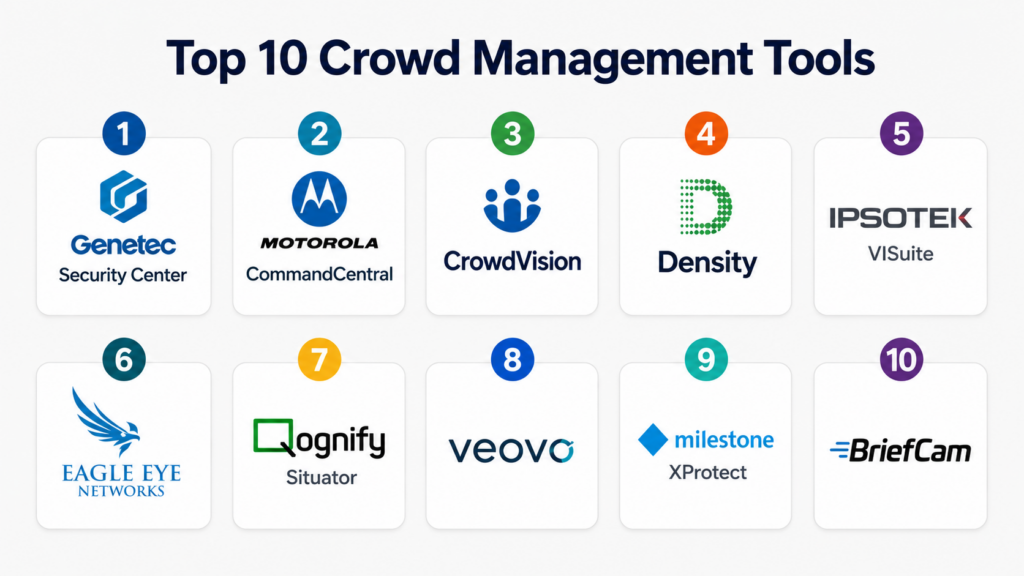
Introduction
Crowd Management Tools help stadiums, airports, entertainment venues, public events, transportation hubs, smart cities, and large facilities monitor, control, and optimize crowd movement and public safety. These platforms combine technologies such as AI video analytics, IoT sensors, access control systems, predictive analytics, incident management, and real-time monitoring to improve operational visibility and reduce safety risks.
As public venues continue handling larger crowds and more complex events, crowd management technology has become critical for improving safety, reducing congestion, optimizing traffic flow, and enhancing visitor experiences. Modern venues increasingly rely on AI-powered analytics, digital surveillance systems, and automated alerts to identify crowd density issues before they escalate. Governments, stadium operators, transportation authorities, and event organizers now prioritize proactive crowd intelligence rather than reactive incident response.
Common real-world use cases include:
- Stadium crowd flow monitoring
- Event congestion management
- Emergency evacuation coordination
- Queue and entry optimization
- Public safety and incident response
Buyers evaluating Crowd Management Tools should focus on:
- Real-time crowd monitoring capabilities
- AI-powered analytics accuracy
- Integration with CCTV and security systems
- Scalability for high-attendance events
- Incident management workflows
- Predictive analytics functionality
- Mobile operational visibility
- Deployment flexibility
- Reporting and operational dashboards
- Security and compliance controls
Best for: Stadium operators, airports, transportation authorities, smart city projects, entertainment venues, municipalities, event organizers, and enterprise public safety teams.
Not ideal for: Small venues with minimal crowd complexity or organizations needing only basic security camera monitoring without operational analytics.
Key Trends in Crowd Management Tools
- AI-powered crowd density analytics are becoming standard in modern venue operations.
- Predictive congestion monitoring is improving public safety planning.
- Smart city integrations are expanding crowd monitoring beyond venues into public infrastructure.
- Real-time mobile operational dashboards are improving field coordination.
- Computer vision technologies are enhancing incident detection accuracy.
- Cloud-native video analytics platforms are replacing isolated surveillance systems.
- Digital twin technology is emerging for evacuation and crowd simulation planning.
- Integrated emergency response workflows are improving coordination between agencies.
- IoT sensor ecosystems are supporting occupancy and movement monitoring.
- Privacy-focused analytics models are becoming increasingly important for compliance requirements.
How We Selected These Tools (Methodology)
The tools below were selected using a practical evaluation framework focused on operational safety, scalability, and real-world crowd management requirements.
- Evaluated adoption across stadiums, transportation hubs, and public venues
- Assessed AI analytics and monitoring capabilities
- Reviewed real-time operational visibility features
- Compared scalability for large crowd environments
- Evaluated integration ecosystems and APIs
- Reviewed incident management and alerting capabilities
- Assessed deployment flexibility and infrastructure requirements
- Compared reporting and analytics depth
- Evaluated operational reliability under high-volume conditions
- Considered support quality and enterprise readiness
Top 10 Crowd Management Tools
#1 — Genetec Security Center
Short description: Genetec Security Center is a unified security and operational management platform widely used in stadiums, airports, transportation systems, and public venues. The platform combines video surveillance, access control, analytics, and crowd monitoring into a centralized operational environment. Venue operators use Genetec to improve crowd visibility, monitor incidents, and coordinate emergency response activities in real time. AI-powered analytics and operational dashboards help security teams identify congestion risks and crowd anomalies before they escalate. Large enterprise venues benefit from its scalability and integration ecosystem.
Key Features
- Unified security operations
- Real-time crowd monitoring
- AI video analytics
- Incident management workflows
- Access control integrations
- Operational dashboards
- Multi-site monitoring
Pros
- Strong enterprise scalability
- Excellent integration ecosystem
- Advanced operational visibility
Cons
- Complex enterprise deployment
- Higher implementation costs
- Requires operational training
Platforms / Deployment
- Web / Windows / Mobile
- Cloud / Hybrid / Self-hosted
Security & Compliance
Supports RBAC, audit logging, encryption, MFA, and enterprise authentication integrations.
Integrations & Ecosystem
Genetec integrates with surveillance systems, access control infrastructure, public safety systems, and operational monitoring environments.
- CCTV systems
- Access control platforms
- IoT sensors
- Public safety systems
- APIs
Support & Community
Strong enterprise support ecosystem with implementation services and operational consulting.
#2 — Motorola Solutions CommandCentral
Short description: Motorola Solutions CommandCentral provides public safety and operational intelligence tools used across stadiums, transportation hubs, municipalities, and emergency response environments. The platform helps organizations monitor crowd activity, coordinate incidents, and improve situational awareness during large-scale events. AI analytics, video intelligence, and communication tools support proactive operational management. Security teams benefit from centralized operational dashboards and integrated incident workflows. It is particularly valuable for organizations requiring strong public safety coordination capabilities.
Key Features
- Incident command management
- Video intelligence analytics
- Crowd monitoring dashboards
- Public safety coordination
- Real-time alerts
- Mobile operational visibility
- Emergency response workflows
Pros
- Strong emergency coordination features
- Reliable operational monitoring
- Good integration with public safety infrastructure
Cons
- Enterprise-focused deployment
- Complex configuration requirements
- Premium pricing structure
Platforms / Deployment
- Web / Mobile
- Cloud / Hybrid
Security & Compliance
Supports enterprise authentication, audit logging, and operational security controls.
Integrations & Ecosystem
CommandCentral integrates with emergency response systems, communications infrastructure, and security environments.
- CCTV platforms
- Radio systems
- CAD systems
- Public safety tools
- APIs
Support & Community
Enterprise-grade support with onboarding and implementation assistance.
#3 — CrowdVision
Short description: CrowdVision is an AI-powered crowd analytics platform focused on real-time crowd movement monitoring and passenger flow optimization. Airports, transportation operators, stadiums, and public venues use CrowdVision to analyze movement patterns, occupancy levels, and congestion risks. The platform combines computer vision with operational analytics to improve crowd safety and operational efficiency. Organizations benefit from predictive insights that help optimize staffing and reduce bottlenecks. Its AI-driven operational intelligence makes it particularly useful for high-traffic environments.
Key Features
- AI crowd analytics
- Occupancy monitoring
- Predictive congestion analysis
- Passenger flow optimization
- Real-time dashboards
- Heat mapping
- Operational reporting
Pros
- Strong AI analytics capabilities
- Useful predictive insights
- Excellent congestion monitoring
Cons
- Requires video infrastructure
- Enterprise-oriented deployments
- Limited non-analytics operational workflows
Platforms / Deployment
- Web
- Cloud / Hybrid
Security & Compliance
Supports operational access controls and encrypted analytics workflows.
Integrations & Ecosystem
CrowdVision integrates with surveillance systems and operational analytics environments.
- CCTV systems
- Smart city infrastructure
- IoT sensors
- Analytics platforms
- APIs
Support & Community
Provides enterprise onboarding and analytics support services.
#4 — Density
Short description: Density provides occupancy and people-counting technology designed for workplaces, public venues, transportation hubs, and stadium environments. The platform uses privacy-focused sensors and analytics to monitor crowd density and occupancy levels in real time. Venue operators use Density to improve space utilization, reduce congestion, and support safety compliance initiatives. The platform is particularly attractive for organizations prioritizing operational intelligence without relying heavily on facial recognition technologies.
Key Features
- Occupancy monitoring
- Real-time people counting
- Space utilization analytics
- Privacy-focused analytics
- Operational dashboards
- Sensor-based monitoring
- Historical reporting
Pros
- Strong privacy-focused design
- Easy operational visibility
- Useful occupancy analytics
Cons
- Less focused on full incident management
- Hardware deployment required
- Limited advanced security workflows
Platforms / Deployment
- Web / Mobile
- Cloud
Security & Compliance
Supports secure operational data handling and user access controls.
Integrations & Ecosystem
Density integrates with workplace analytics and operational management ecosystems.
- Smart building systems
- Analytics platforms
- Workplace tools
- APIs
- IoT ecosystems
Support & Community
Responsive onboarding and customer support for operational deployments.
#5 — Ipsotek VISuite
Short description: Ipsotek VISuite is an AI-powered video analytics platform designed for crowd management, security monitoring, and operational intelligence. The platform is commonly used in transportation, smart cities, stadiums, and public infrastructure environments. AI-based detection models help identify crowd congestion, unusual behaviors, and operational risks in real time. Security operators benefit from automated alerts and centralized operational visibility. The platform is particularly valuable for organizations requiring advanced AI-driven surveillance analytics.
Key Features
- AI video analytics
- Crowd behavior detection
- Congestion monitoring
- Automated operational alerts
- Incident detection
- Real-time analytics
- Multi-camera monitoring
Pros
- Advanced AI detection capabilities
- Strong operational monitoring
- Useful anomaly detection features
Cons
- Requires extensive video infrastructure
- Enterprise deployment complexity
- Advanced configuration may require specialists
Platforms / Deployment
- Web / Windows
- Cloud / Hybrid / Self-hosted
Security & Compliance
Supports encrypted operational environments and enterprise authentication workflows.
Integrations & Ecosystem
Ipsotek integrates with surveillance ecosystems and operational intelligence environments.
- CCTV systems
- Access control platforms
- Security operations tools
- Smart city infrastructure
- APIs
Support & Community
Enterprise-focused onboarding and implementation support.
#6 — Eagle Eye Networks
Short description: Eagle Eye Networks provides cloud-based video surveillance and operational analytics solutions used across public venues, stadiums, transportation facilities, and smart infrastructure projects. The platform combines cloud video management with AI-powered operational intelligence. Organizations use Eagle Eye Networks to improve situational awareness, monitor crowd activity, and coordinate operational response workflows. Cloud-native deployment and remote operational visibility are key strengths of the platform.
Key Features
- Cloud video surveillance
- AI-powered analytics
- Real-time operational monitoring
- Remote access management
- Crowd visibility tools
- Operational alerts
- Multi-site support
Pros
- Strong cloud-native architecture
- Remote operational visibility
- Flexible deployment scalability
Cons
- Internet connectivity dependency
- Advanced AI features may vary
- Enterprise customization complexity
Platforms / Deployment
- Web / iOS / Android
- Cloud
Security & Compliance
Supports encrypted video workflows, audit logging, and enterprise access controls.
Integrations & Ecosystem
Eagle Eye Networks integrates with security systems and operational monitoring environments.
- CCTV infrastructure
- Access control systems
- Analytics tools
- IoT platforms
- APIs
Support & Community
Strong cloud onboarding resources and enterprise support services.
#7 — Qognify Situator
Short description: Qognify Situator is a physical security and incident management platform designed for operational coordination in complex public environments. Stadiums, transportation hubs, and municipalities use the platform to manage incidents, monitor crowd activity, and improve operational response coordination. The platform centralizes operational intelligence from multiple systems into a unified command environment. Real-time workflows and incident automation help reduce response times during emergencies and high-attendance events.
Key Features
- Incident management workflows
- Unified operational dashboards
- Security integrations
- Real-time situational awareness
- Workflow automation
- Emergency coordination
- Operational analytics
Pros
- Strong incident coordination features
- Unified operational visibility
- Useful workflow automation
Cons
- Enterprise deployment complexity
- Requires integration planning
- Premium implementation costs
Platforms / Deployment
- Web / Windows
- Cloud / Hybrid
Security & Compliance
Supports RBAC, audit logging, encryption, and operational governance controls.
Integrations & Ecosystem
Qognify integrates with security systems, operational intelligence platforms, and public safety infrastructure.
- CCTV systems
- Access control tools
- CAD systems
- Public safety tools
- APIs
Support & Community
Enterprise onboarding and operational consulting support available.
#8 — Veovo
Short description: Veovo provides crowd flow analytics and operational intelligence solutions used in airports, stadiums, public transportation, and entertainment venues. The platform helps organizations monitor crowd movement, predict congestion, and improve operational efficiency. AI-driven analytics provide actionable insights for staffing, queue management, and safety planning. Veovo is especially useful for organizations prioritizing operational optimization alongside crowd safety management.
Key Features
- Crowd flow analytics
- Queue management
- Predictive congestion monitoring
- Operational dashboards
- Real-time alerts
- AI-powered reporting
- Passenger movement analytics
Pros
- Strong operational optimization capabilities
- Useful predictive analytics
- Good queue management support
Cons
- Less focused on physical security operations
- Analytics-heavy deployment approach
- Enterprise-focused pricing
Platforms / Deployment
- Web
- Cloud / Hybrid
Security & Compliance
Supports operational access management and secure analytics workflows.
Integrations & Ecosystem
Veovo integrates with transportation systems, venue operations, and analytics environments.
- CCTV systems
- Transportation systems
- Smart infrastructure
- Analytics platforms
- APIs
Support & Community
Provides enterprise operational onboarding and analytics support.
#9 — Milestone XProtect
Short description: Milestone XProtect is a video management platform widely used across public venues, stadiums, transportation hubs, and enterprise security environments. Organizations use the platform to centralize surveillance operations, monitor crowd activity, and coordinate incident response workflows. Its flexible integration ecosystem and operational scalability make it attractive for large infrastructure environments. Milestone supports AI analytics integrations that improve crowd visibility and operational intelligence.
Key Features
- Video management system
- Multi-camera monitoring
- AI analytics integrations
- Incident monitoring
- Real-time operational visibility
- Security workflow support
- Centralized surveillance management
Pros
- Excellent integration flexibility
- Strong surveillance ecosystem
- Scalable operational architecture
Cons
- Requires third-party analytics for advanced AI
- Infrastructure-heavy deployments
- Complex enterprise configuration
Platforms / Deployment
- Web / Windows / Mobile
- Cloud / Hybrid / Self-hosted
Security & Compliance
Supports enterprise authentication, audit logging, and encrypted operational workflows.
Integrations & Ecosystem
Milestone integrates with AI analytics providers, surveillance systems, and operational management tools.
- CCTV systems
- Access control systems
- AI analytics platforms
- Security infrastructure
- APIs
Support & Community
Large enterprise ecosystem with strong integrator and partner support.
#10 — BriefCam
Short description: BriefCam provides AI-powered video analytics and operational intelligence tools used across public safety, transportation, and venue operations environments. The platform helps organizations analyze crowd activity, identify anomalies, and improve operational investigations through video analytics. Stadium operators benefit from real-time operational visibility and searchable surveillance intelligence. BriefCam is particularly valuable for organizations requiring advanced video analytics and incident investigation capabilities.
Key Features
- AI video analytics
- Crowd density analysis
- Behavioral anomaly detection
- Real-time alerts
- Video search intelligence
- Incident investigation tools
- Operational reporting
Pros
- Advanced AI analytics
- Strong investigative capabilities
- Useful operational insights
Cons
- Requires strong surveillance infrastructure
- Enterprise deployment complexity
- Premium analytics pricing
Platforms / Deployment
- Web / Windows
- Cloud / Hybrid / Self-hosted
Security & Compliance
Supports encrypted analytics environments and enterprise access management controls.
Integrations & Ecosystem
BriefCam integrates with surveillance ecosystems and operational intelligence environments.
- CCTV systems
- Security platforms
- Analytics tools
- Incident management systems
- APIs
Support & Community
Enterprise onboarding and technical implementation support available.
Comparison Table (Top 10)
| Tool Name | Best For | Platform(s) Supported | Deployment | Standout Feature | Public Rating |
|---|---|---|---|---|---|
| Genetec Security Center | Large stadium operations | Web, Windows, Mobile | Cloud, Hybrid, Self-hosted | Unified security operations | N/A |
| Motorola CommandCentral | Public safety coordination | Web, Mobile | Cloud, Hybrid | Incident response management | N/A |
| CrowdVision | AI crowd analytics | Web | Cloud, Hybrid | Predictive congestion analysis | N/A |
| Density | Occupancy intelligence | Web, Mobile | Cloud | Privacy-focused analytics | N/A |
| Ipsotek VISuite | AI surveillance analytics | Web, Windows | Cloud, Hybrid, Self-hosted | Behavioral anomaly detection | N/A |
| Eagle Eye Networks | Cloud surveillance operations | Web, iOS, Android | Cloud | Remote operational visibility | N/A |
| Qognify Situator | Incident coordination | Web, Windows | Cloud, Hybrid | Workflow automation | N/A |
| Veovo | Queue and crowd optimization | Web | Cloud, Hybrid | Passenger flow analytics | N/A |
| Milestone XProtect | Enterprise surveillance | Web, Windows, Mobile | Cloud, Hybrid, Self-hosted | Video management ecosystem | N/A |
| BriefCam | Video intelligence analytics | Web, Windows | Cloud, Hybrid, Self-hosted | AI video search and analytics | N/A |
Evaluation & Scoring of Crowd Management Tools
| Tool Name | Core 25% | Ease 15% | Integrations 15% | Security 10% | Performance 10% | Support 10% | Value 15% | Weighted Total |
|---|---|---|---|---|---|---|---|---|
| Genetec Security Center | 9.5 | 7.5 | 9.5 | 9.0 | 9.5 | 9.0 | 7.0 | 8.9 |
| Motorola CommandCentral | 9.0 | 7.5 | 8.5 | 9.0 | 9.0 | 8.5 | 7.0 | 8.4 |
| CrowdVision | 8.5 | 8.0 | 8.0 | 8.0 | 8.5 | 8.0 | 7.5 | 8.1 |
| Density | 7.5 | 9.0 | 7.0 | 8.0 | 8.0 | 8.0 | 8.5 | 7.9 |
| Ipsotek VISuite | 9.0 | 7.0 | 8.5 | 8.5 | 9.0 | 8.0 | 6.5 | 8.2 |
| Eagle Eye Networks | 8.0 | 8.5 | 8.0 | 8.0 | 8.5 | 8.0 | 8.0 | 8.1 |
| Qognify Situator | 8.5 | 7.0 | 8.5 | 8.5 | 8.5 | 8.0 | 7.0 | 8.0 |
| Veovo | 8.5 | 8.0 | 8.0 | 7.5 | 8.5 | 8.0 | 7.5 | 8.0 |
| Milestone XProtect | 9.0 | 7.0 | 9.0 | 8.5 | 9.0 | 8.5 | 7.0 | 8.4 |
| BriefCam | 9.0 | 7.0 | 8.5 | 8.5 | 9.0 | 8.0 | 6.5 | 8.2 |
These scores are comparative and intended to help buyers evaluate relative strengths across operational categories. Enterprise-focused platforms generally score higher in scalability, integrations, and operational intelligence, while lighter analytics-focused tools often perform better in usability and deployment simplicity. Buyers should prioritize features aligned with operational complexity, security requirements, and infrastructure scale rather than relying solely on total score rankings.
Which Crowd Management Tool Is Right for You?
Solo / Freelancer
Smaller event operators and independent venues may benefit from simpler analytics-focused tools such as Density or Eagle Eye Networks for operational visibility without large infrastructure complexity.
SMB
Mid-sized venues and entertainment facilities should consider CrowdVision, Eagle Eye Networks, or Veovo for balanced operational analytics and crowd monitoring capabilities.
Mid-Market
Organizations managing recurring public events or transportation environments may benefit from Qognify Situator or Milestone XProtect due to stronger operational coordination capabilities.
Enterprise
Large stadiums, municipalities, transportation hubs, and smart city projects should evaluate Genetec Security Center, Motorola CommandCentral, Ipsotek VISuite, and BriefCam for scalability and advanced operational intelligence.
Budget vs Premium
Budget-conscious buyers may prioritize Density or Eagle Eye Networks for easier cloud deployment and operational simplicity. Enterprise organizations requiring large-scale operational coordination may prefer Genetec or Motorola Solutions.
Feature Depth vs Ease of Use
Enterprise platforms typically provide deeper operational intelligence and integration flexibility but require more deployment planning and staff training. Simpler analytics-focused tools often prioritize faster onboarding and usability.
Integrations & Scalability
Organizations already operating large surveillance or public safety ecosystems should prioritize platforms with strong API ecosystems and integration support such as Genetec or Milestone.
Security & Compliance Needs
Public venues managing sensitive operational environments should prioritize RBAC, MFA, audit logging, encrypted operational workflows, and enterprise authentication support.
Frequently Asked Questions (FAQs)
1. What are Crowd Management Tools used for?
Crowd Management Tools help organizations monitor crowd activity, reduce congestion, improve public safety, and coordinate operational responses during events or high-traffic situations. These platforms combine analytics, surveillance systems, operational dashboards, and incident management workflows to provide real-time situational awareness. Modern venues use these tools to improve crowd flow and identify operational risks early. They are commonly used across stadiums, airports, transportation systems, festivals, and smart city environments. Many platforms now incorporate AI-powered analytics and predictive monitoring capabilities.
2. How do AI-powered crowd analytics work?
AI-powered crowd analytics use computer vision, surveillance feeds, and operational data to monitor crowd movement, occupancy levels, and unusual behaviors in real time. Machine learning models analyze movement patterns and detect anomalies such as congestion, unsafe crowd density, or operational disruptions. These systems generate alerts and actionable insights for security and operations teams. AI analytics help organizations improve staffing, reduce bottlenecks, and respond proactively to emerging risks. The accuracy of analytics often depends on camera quality and infrastructure design.
3. Are these tools only for stadiums?
No, Crowd Management Tools are widely used across airports, transportation systems, smart cities, shopping malls, public infrastructure, entertainment venues, and large corporate campuses. Any environment managing high visitor volumes can benefit from operational crowd intelligence. Different industries prioritize different capabilities such as queue optimization, public safety coordination, or occupancy analytics. Some platforms are more security-focused while others emphasize operational optimization. Buyers should evaluate industry-specific operational requirements before selecting a platform.
4. Why is predictive congestion monitoring important?
Predictive congestion monitoring helps organizations identify crowd bottlenecks before they become safety risks or operational disruptions. AI analytics and historical movement data allow operations teams to anticipate crowd flow challenges and adjust staffing or routing strategies proactively. Predictive monitoring improves visitor experiences and reduces emergency response situations. It is especially important for transportation hubs, festivals, and large sports events. Organizations increasingly prioritize proactive operational intelligence over reactive incident management.
5. What infrastructure is required for deployment?
Most crowd management platforms rely on surveillance cameras, operational dashboards, network connectivity, and analytics infrastructure. Some platforms also use IoT sensors or occupancy monitoring hardware. Cloud-based deployments generally reduce infrastructure complexity compared to self-hosted environments. Organizations should assess existing surveillance systems and operational technology before implementation. Infrastructure planning is especially important for enterprise-scale deployments. Integration with existing security systems is often a critical evaluation factor.
6. Can these tools improve emergency response coordination?
Yes, many platforms support incident management workflows, operational alerts, and centralized situational awareness dashboards that improve emergency coordination. Real-time visibility helps operations teams respond more effectively during evacuations, crowd surges, or security incidents. Some platforms also integrate with public safety systems and communication infrastructure. Faster operational coordination can significantly improve public safety outcomes. Enterprise organizations often prioritize incident workflow automation during evaluations.
7. Are privacy concerns important in crowd analytics?
Yes, privacy considerations are becoming increasingly important in crowd monitoring environments. Some organizations prioritize privacy-focused analytics that avoid facial recognition or personally identifiable tracking. Regulatory requirements may vary depending on geography and industry. Buyers should carefully evaluate data handling practices, retention policies, and compliance capabilities during vendor selection. Transparency around operational analytics is also becoming more important for public trust and governance.
8. How long does implementation typically take?
Implementation timelines vary depending on infrastructure complexity, integrations, and deployment scale. Smaller cloud-based deployments may be operational within weeks, while enterprise environments involving surveillance upgrades and operational integration may require several months. Pilot deployments are often recommended before large-scale rollouts. Staff training and operational testing are important components of successful implementation. Organizations should allocate sufficient time for infrastructure validation and workflow optimization.
9. What integrations should buyers prioritize?
Organizations should prioritize integrations with CCTV systems, access control platforms, incident management tools, communication systems, and analytics environments. Enterprise environments often require API flexibility for broader operational ecosystems. Integration compatibility significantly impacts operational visibility and workflow efficiency. Buyers should validate existing infrastructure compatibility during evaluations. Strong integration ecosystems can reduce long-term operational complexity and implementation costs.
10. What are the biggest mistakes organizations make when selecting these platforms?
One common mistake is focusing only on surveillance capabilities without evaluating operational analytics and workflow coordination features. Another issue is underestimating infrastructure requirements and integration complexity. Organizations sometimes overlook mobile usability for field operations teams. Selecting overly complex enterprise systems for smaller environments may increase operational costs unnecessarily. Buyers should involve operations, security, and IT stakeholders during evaluations. Real-world pilot testing is highly recommended before large-scale deployment.
Conclusion
Crowd Management Tools have become essential operational technologies for modern stadiums, transportation systems, smart cities, and large public venues. These platforms now extend far beyond traditional surveillance systems by providing AI-powered operational intelligence, predictive analytics, incident coordination, occupancy monitoring, and real-time situational awareness. Enterprise organizations often prioritize scalability, integration flexibility, and advanced operational analytics, while smaller venues focus more heavily on deployment simplicity and operational visibility. The ideal solution depends on infrastructure scale, crowd complexity, security requirements, and operational goals. Organizations evaluating these platforms should begin by identifying operational risks, infrastructure readiness, and integration priorities before comparing vendors. .
