MOTOSHARE 🚗🏍️
Rent Bikes & Cars Directly from Owners
Motoshare connects vehicle owners with people who need bikes and cars on rent. Owners earn from idle vehicles, and renters get flexible ride options.
Visit Motoshare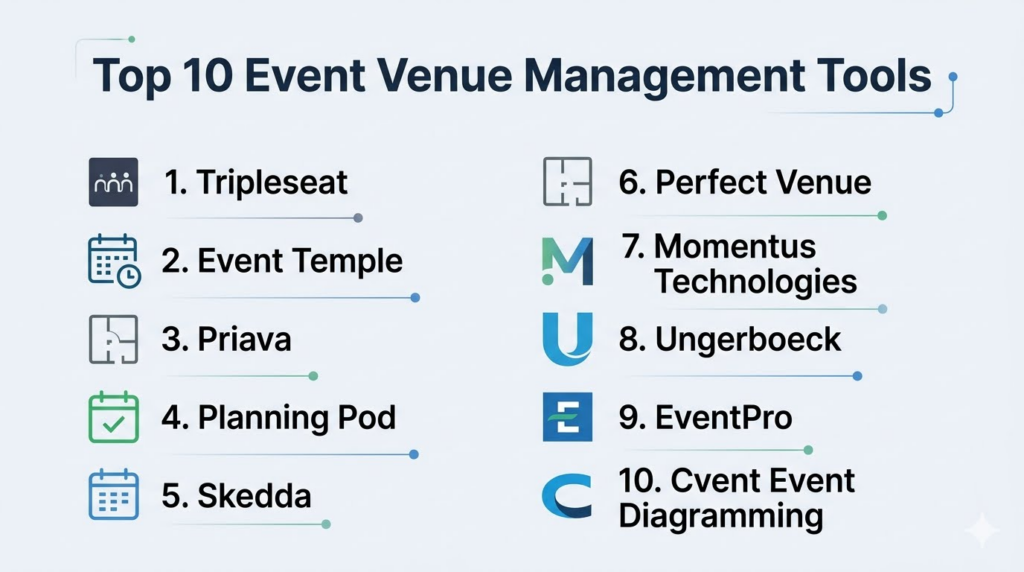
Introduction
Event Venue Management Tools help venues manage bookings, availability, inquiries, proposals, contracts, payments, floor plans, event details, staff tasks, catering notes, customer communication, and reporting from one centralized system. These platforms are used by hotels, banquet halls, conference centers, coworking event spaces, stadiums, universities, wedding venues, restaurants, and corporate event facilities.Venue operations can become difficult when teams rely on spreadsheets, email threads, phone calls, and manual calendars. A single missed booking detail, double-booked room, delayed contract, or unclear setup instruction can affect customer experience and revenue. Modern venue management tools help teams coordinate sales, operations, event planning, billing, and service delivery with better visibility.
Real-world use cases include:
- Managing venue inquiries and bookings
- Tracking room availability and event calendars
- Creating proposals, contracts, and invoices
- Coordinating event layouts, catering, and staff tasks
- Reporting revenue, occupancy, and event performance
Key evaluation criteria buyers should consider:
- Venue booking and calendar management
- Lead, inquiry, and proposal workflows
- Contract and invoice generation
- Floor plan and seating layout support
- Payment and deposit tracking
- Staff task and operations coordination
- Customer communication tools
- Reporting and revenue analytics
- Integrations with CRM, accounting, and payment systems
- Ease of use for sales and event teams
Best for: Event venues, hotels, conference centers, wedding venues, banquet halls, restaurants, stadiums, campuses, coworking spaces, cultural venues, and teams managing recurring events or venue rentals.
Not ideal for: Very small venues with rare bookings, teams that only need a shared calendar, or organizations that do not manage contracts, payments, layouts, or multi-step event workflows.
Key Trends in Event Venue Management Tools
- Cloud-based venue booking systems are replacing spreadsheet calendars.
- Digital proposals and contracts are speeding up sales cycles.
- Integrated payment and deposit workflows are improving cash flow visibility.
- Interactive floor plans are helping teams plan seating, layouts, and room setups.
- Self-service booking portals are becoming more common for simple venue rentals.
- CRM-style lead tracking is helping venues improve inquiry conversion.
- Reporting dashboards are helping managers measure event revenue and utilization.
- Integration with catering, hospitality, and POS systems is becoming more important.
- Mobile access is improving coordination between sales, planners, and operations teams.
- Automation is reducing repetitive follow-ups, reminders, and internal handoffs.
How We Selected These Tools
The following event venue management tools were selected using practical venue operations, booking, sales, and event planning criteria.
- Evaluated market adoption and venue management relevance
- Reviewed booking calendar and availability management
- Assessed proposal, contract, and invoice workflows
- Considered event layout and floor plan capabilities
- Evaluated CRM, lead, and customer communication features
- Reviewed payment and deposit tracking support
- Assessed reporting and revenue analytics
- Considered usability for sales, planning, and operations teams
- Evaluated integrations with accounting, CRM, and event systems
- Balanced venue-specific tools with broader event and hospitality platforms
Top 10 Event Venue Management Tools
1- Tripleseat
Short description: Tripleseat is an event sales and venue management platform designed for restaurants, hotels, banquet venues, catering teams, and private event spaces. It helps teams manage inquiries, leads, bookings, proposals, contracts, payments, menus, event details, and customer communication from one system. Tripleseat is especially useful for venues that rely heavily on private events, group bookings, and hospitality-driven sales workflows.
Key Features
- Lead and inquiry management
- Event booking calendar
- Proposals and contracts
- Payment and deposit tracking
- Menu and catering details
- Event communication workflows
- Reporting dashboards
Pros
- Strong hospitality and private event focus
- Good proposal-to-booking workflow
- Useful for restaurants and event venues
Cons
- Best suited for hospitality-style venues
- Advanced customization may require setup
- Pricing may be high for very small venues
Platforms / Deployment
- Web / Mobile
- Cloud
Security & Compliance
Supports secure user access, permissions, administrative controls, and payment workflow controls.
Integrations & Ecosystem
Tripleseat integrates with hospitality, CRM, payment, and venue operations workflows.
- Payment systems
- CRM tools
- Email workflows
- Hospitality systems
- Calendar tools
- Reporting platforms
Support & Community
Provides onboarding, documentation, customer support, training resources, and hospitality-focused implementation guidance.
2- Event Temple
Short description: Event Temple is a venue management and hotel sales platform built for event spaces, hotels, conference centers, restaurants, and hospitality teams. It supports lead tracking, booking management, proposals, contracts, task management, email communication, and reporting. Event Temple is especially useful for teams that want a modern CRM-style platform for venue sales and event operations.
Key Features
- Venue CRM
- Booking calendar
- Proposal generation
- Contract management
- Task automation
- Email templates
- Revenue reporting
Pros
- Strong venue sales workflow
- Good automation and task management
- Useful for hotels and event spaces
Cons
- Setup requires sales process planning
- Some integrations may require configuration
- Smaller venues may not use all features
Platforms / Deployment
- Web
- Cloud
Security & Compliance
Supports permissions, secure user access, and administrative controls.
Integrations & Ecosystem
Event Temple integrates with hospitality, communication, and business systems.
- Email systems
- Calendar platforms
- CRM workflows
- Payment tools
- Hotel systems
- Reporting tools
Support & Community
Provides onboarding, training, support resources, and customer success assistance for venue teams.
3- Priava
Short description: Priava is an event and venue management platform designed for venues, universities, conference centers, performing arts venues, government facilities, and corporate event spaces. It helps teams manage bookings, calendars, resources, event details, clients, contracts, and reporting. Priava is especially useful for complex venues with multiple spaces, resources, and event types that require centralized scheduling and operational coordination.
Key Features
- Venue booking management
- Multi-space calendar
- Resource scheduling
- Event details tracking
- Client management
- Contract workflows
- Reporting and analytics
Pros
- Strong multi-space venue management
- Good resource scheduling support
- Useful for universities and public venues
Cons
- Interface may require training
- Setup can be detailed for complex venues
- May be more than needed for simple event spaces
Platforms / Deployment
- Web
- Cloud
Security & Compliance
Supports user permissions, secure access, and administrative workflow controls.
Integrations & Ecosystem
Priava integrates with venue operations, calendars, finance, and reporting workflows.
- Calendar systems
- Finance systems
- Event operations workflows
- CRM processes
- Reporting tools
- Resource scheduling systems
Support & Community
Provides onboarding, training, implementation assistance, and support for venue operations teams.
4- Planning Pod
Short description: Planning Pod is an event management and venue management platform that supports bookings, calendars, proposals, contracts, invoices, floor plans, task lists, and client communication. It is useful for venues, event planners, caterers, wedding venues, conference centers, and event production teams. Planning Pod is especially practical for organizations that want one platform for both venue operations and event planning workflows.
Key Features
- Venue booking calendar
- Event planning tools
- Proposals and contracts
- Invoicing and payments
- Floor plan builder
- Task and timeline management
- Client portals
Pros
- Broad event planning functionality
- Good floor plan and client workflow support
- Useful for wedding and event venues
Cons
- Interface can feel broad for simple users
- Advanced enterprise workflows are limited
- Setup requires organizing event templates
Platforms / Deployment
- Web
- Cloud
Security & Compliance
Supports secure account access, permissions, and client-facing workflow controls.
Integrations & Ecosystem
Planning Pod integrates with payment, calendar, and business workflow systems.
- Payment tools
- Calendar systems
- Email workflows
- Accounting workflows
- Client portals
- Event planning workflows
Support & Community
Provides documentation, templates, onboarding support, and customer assistance for event professionals.
5- Skedda
Short description: Skedda is a space booking and venue scheduling platform used by event spaces, coworking venues, universities, studios, community centers, and shared facilities. It focuses on self-service booking, availability rules, pricing conditions, permissions, and space reservations. Skedda is especially useful for venues that need flexible space booking rather than full event sales management.
Key Features
- Venue and room booking
- Interactive booking calendar
- Booking rules and conditions
- User permissions
- Self-service reservations
- Payment support
- Usage reporting
Pros
- Easy booking experience
- Strong space reservation rules
- Good for shared and flexible venues
Cons
- Not a full event CRM
- Limited proposal and contract depth
- Better for booking than complex event planning
Platforms / Deployment
- Web / Mobile
- Cloud
Security & Compliance
Supports permissions, secure access, SSO on applicable plans, and administrative controls.
Integrations & Ecosystem
Skedda integrates with calendars, identity systems, payments, and workplace tools.
- Microsoft 365
- Google Workspace
- Payment systems
- SSO systems
- Calendar workflows
- Access control systems
Support & Community
Provides documentation, onboarding resources, customer support, and space booking guidance.
6- Perfect Venue
Short description: Perfect Venue is an event management platform designed for restaurants, private dining venues, event spaces, and hospitality teams. It helps venues manage event inquiries, bookings, contracts, menus, payments, and communication in a simple cloud-based system. Perfect Venue is especially useful for small and mid-sized hospitality venues that want a focused tool for private event sales and operations.
Key Features
- Event inquiry management
- Booking calendar
- Proposal and contract workflows
- Menu management
- Payment tracking
- Customer communication
- Event detail sheets
Pros
- Simple hospitality event workflow
- Good for private dining and restaurants
- Easy team adoption
Cons
- Less broad than enterprise venue platforms
- Advanced venue resource planning may be limited
- Best suited for hospitality use cases
Platforms / Deployment
- Web
- Cloud
Security & Compliance
Supports secure account access, permissions, and administrative controls.
Integrations & Ecosystem
Perfect Venue integrates with hospitality and business workflows.
- Payment platforms
- Email systems
- Calendar tools
- Menu workflows
- Customer communication tools
- Reporting systems
Support & Community
Provides onboarding, customer support, training resources, and hospitality-specific workflow guidance.
7- Momentus Technologies
Short description: Momentus Technologies provides venue and event management software for convention centers, stadiums, arenas, performing arts centers, universities, and large event facilities. It supports event booking, space management, operations planning, resource scheduling, financial workflows, and reporting. Momentus is especially useful for complex venues that manage high-volume events, large spaces, multiple departments, and operational logistics.
Key Features
- Venue booking management
- Event operations planning
- Resource scheduling
- Space management
- Contract and financial workflows
- Reporting dashboards
- Multi-department coordination
Pros
- Strong large-venue functionality
- Good operational coordination
- Useful for stadiums and convention centers
Cons
- Enterprise deployment complexity
- Requires structured operational processes
- May be too advanced for small venues
Platforms / Deployment
- Web / Mobile
- Cloud
Security & Compliance
Supports enterprise permissions, secure access, administrative controls, and audit-friendly workflows.
Integrations & Ecosystem
Momentus integrates with venue operations, ticketing, finance, and facility workflows.
- Ticketing systems
- Finance systems
- Facility operations tools
- CRM workflows
- Reporting platforms
- Event operations systems
Support & Community
Provides implementation support, onboarding, training, enterprise support, and venue operations guidance.
8- Ungerboeck
Short description: Ungerboeck is a venue and event management platform used by convention centers, exhibitions, stadiums, universities, and large event organizations. It supports booking, event planning, CRM, contracts, exhibitor management, financials, operations, and reporting. Ungerboeck is especially useful for complex event environments where sales, operations, and finance need to stay connected.
Key Features
- Event and venue booking
- CRM and sales workflows
- Contract management
- Exhibitor management
- Financial workflows
- Operations planning
- Reporting and analytics
Pros
- Strong enterprise event management depth
- Good for exhibitions and convention centers
- Broad sales-to-operations workflows
Cons
- Implementation can be complex
- Requires training for full adoption
- Smaller venues may find it heavy
Platforms / Deployment
- Web / Mobile
- Cloud
Security & Compliance
Supports enterprise access controls, permissions, secure workflows, and administrative governance.
Integrations & Ecosystem
Ungerboeck integrates with event, ticketing, finance, and venue operations systems.
- Finance systems
- Ticketing platforms
- CRM workflows
- Exhibition systems
- Event operations tools
- Reporting platforms
Support & Community
Provides enterprise onboarding, implementation resources, training, and support for venue and event organizations.
9- EventPro
Short description: EventPro is an event and venue management platform designed for event planners, venues, caterers, conference centers, and event service providers. It helps teams manage bookings, contacts, tasks, budgets, contracts, invoices, and event details. EventPro is useful for teams that need structured event planning and venue coordination with detailed operational workflows.
Key Features
- Event booking management
- Contact and client management
- Task tracking
- Budget and invoice workflows
- Event details management
- Document generation
- Reporting tools
Pros
- Broad event planning features
- Useful for caterers and venues
- Good operational detail tracking
Cons
- Interface may feel traditional
- Cloud and deployment options vary
- Advanced modern integrations may be limited
Platforms / Deployment
- Web / Windows depending on deployment
- Cloud / Desktop options
Security & Compliance
Supports user access controls and administrative permissions depending on deployment.
Integrations & Ecosystem
EventPro supports event planning, venue operations, and business workflows.
- Accounting workflows
- Calendar tools
- Event documents
- Client management systems
- Reporting tools
- Operational planning workflows
Support & Community
Provides documentation, customer support, training resources, and event operations guidance.
10- Cvent Event Diagramming
Short description: Cvent Event Diagramming supports venue layout planning, seating arrangements, room diagrams, collaboration, and event setup visualization. While Cvent is broader event technology, its diagramming capabilities are valuable for venues and planners that need visual event layouts and operational coordination. It is especially useful for hotels, meeting venues, corporate event teams, and planners who need accurate room setup collaboration.
Key Features
- Event floor plan design
- Seating and table layouts
- Room diagramming
- Collaboration tools
- Venue layout visualization
- Event setup planning
- Planner and venue coordination
Pros
- Strong visual layout planning
- Good planner-venue collaboration
- Useful for meetings and hospitality events
Cons
- Not a complete venue CRM alone
- Best used alongside booking tools
- Broader Cvent ecosystem may be needed for full value
Platforms / Deployment
- Web
- Cloud
Security & Compliance
Supports secure access, permissions, and administrative controls.
Integrations & Ecosystem
Cvent Event Diagramming integrates with event planning and venue collaboration workflows.
- Cvent event tools
- Venue management workflows
- Meeting planning systems
- Event registration systems
- Collaboration tools
- Hospitality workflows
Support & Community
Provides training resources, customer support, event planning documentation, and broad event technology ecosystem support.
Comparison Table
| Tool Name | Best For | Platform(s) Supported | Deployment | Standout Feature | Public Rating |
|---|---|---|---|---|---|
| Tripleseat | Restaurants and private events | Web, Mobile | Cloud | Event sales and hospitality workflows | N/A |
| Event Temple | Hotels and venues | Web | Cloud | Venue CRM and automation | N/A |
| Priava | Multi-space venues | Web | Cloud | Resource and venue scheduling | N/A |
| Planning Pod | Event planning and venues | Web | Cloud | Floor plans and client portals | N/A |
| Skedda | Flexible space booking | Web, Mobile | Cloud | Self-service venue reservations | N/A |
| Perfect Venue | Restaurants and small venues | Web | Cloud | Simple private event management | N/A |
| Momentus Technologies | Large venues and arenas | Web, Mobile | Cloud | Enterprise venue operations | N/A |
| Ungerboeck | Convention and exhibition venues | Web, Mobile | Cloud | Full event and venue management | N/A |
| EventPro | Caterers and event teams | Web, Windows options | Cloud, Desktop options | Detailed event operations tracking | N/A |
| Cvent Event Diagramming | Layout planning | Web | Cloud | Event room diagramming | N/A |
Evaluation & Scoring of Event Venue Management Tools
| Tool Name | Core 25% | Ease 15% | Integrations 15% | Security 10% | Performance 10% | Support 10% | Value 15% | Weighted Total |
|---|---|---|---|---|---|---|---|---|
| Tripleseat | 9.0 | 8.5 | 8.0 | 8.0 | 8.5 | 8.5 | 8.0 | 8.5 |
| Event Temple | 8.5 | 8.5 | 8.0 | 8.0 | 8.0 | 8.5 | 8.0 | 8.3 |
| Priava | 8.5 | 7.5 | 8.0 | 8.0 | 8.0 | 8.0 | 7.5 | 8.0 |
| Planning Pod | 8.0 | 8.5 | 7.5 | 8.0 | 8.0 | 8.0 | 8.0 | 8.0 |
| Skedda | 7.5 | 9.0 | 8.0 | 8.0 | 8.0 | 8.0 | 8.5 | 8.1 |
| Perfect Venue | 8.0 | 9.0 | 7.5 | 8.0 | 8.0 | 8.0 | 8.5 | 8.2 |
| Momentus Technologies | 9.5 | 6.5 | 8.5 | 9.0 | 9.0 | 8.5 | 7.0 | 8.3 |
| Ungerboeck | 9.0 | 6.5 | 8.5 | 9.0 | 8.5 | 8.5 | 7.0 | 8.2 |
| EventPro | 8.0 | 7.5 | 7.5 | 7.5 | 8.0 | 8.0 | 8.0 | 7.8 |
| Cvent Event Diagramming | 8.0 | 8.5 | 8.0 | 8.5 | 8.5 | 8.5 | 7.5 | 8.2 |
These scores are comparative and should be interpreted based on venue type and operational complexity. Tripleseat, Perfect Venue, and Event Temple are strong for hospitality and private event sales. Momentus and Ungerboeck are better for large venues, convention centers, and complex event operations. Skedda is best for simple space booking, while Planning Pod and EventPro are practical for event planning and venue coordination.
Which Event Venue Management Tool Is Right for You?
Solo / Freelancer
Solo event planners or small venue operators usually need simple booking, client communication, invoices, and event details. Planning Pod, Perfect Venue, Skedda, or EventPro can be practical depending on whether the need is planning-heavy or booking-heavy.
SMB
SMBs should prioritize ease of use, booking visibility, contracts, payments, and customer communication. Tripleseat, Event Temple, Perfect Venue, Planning Pod, and Skedda are strong choices for small and growing venues.
Mid-Market
Mid-market venues often need stronger sales pipelines, reporting, resource scheduling, client portals, and operations handoffs. Tripleseat, Event Temple, Priava, Planning Pod, and Cvent Event Diagramming can support more structured venue workflows.
Enterprise
Large venues should prioritize multi-space scheduling, operations planning, resource management, financial controls, reporting, integrations, and auditability. Momentus Technologies, Ungerboeck, Priava, and Cvent Event Diagramming are stronger enterprise candidates.
Budget vs Premium
Budget-conscious venues may prefer booking-first or planning-first tools with simpler pricing and setup. Premium platforms are better when venues need complex operations, multi-department workflows, large event volumes, deep reporting, or enterprise integrations.
Feature Depth vs Ease of Use
Skedda and Perfect Venue are easier for simple booking and hospitality workflows. Momentus and Ungerboeck provide deeper operational functionality but require more setup and training. Tripleseat and Event Temple offer a strong balance between sales workflows and venue operations.
Integrations & Scalability
Venues should prioritize integrations with calendars, accounting systems, payment tools, CRM platforms, ticketing systems, hotel systems, and event registration platforms. Venue management becomes more valuable when sales, operations, finance, and event delivery stay connected.
Security & Compliance Needs
Large venues, universities, hotels, government facilities, and stadiums should evaluate permissions, audit logs, payment controls, contract governance, role-based access, and data security before deployment.
Frequently Asked Questions
1. What are event venue management tools?
Event venue management tools help venues manage bookings, inquiries, contracts, payments, event details, staff tasks, layouts, and reporting. They centralize venue operations so sales, planning, finance, and operations teams can work from the same information. These tools are commonly used by restaurants, hotels, event spaces, conference centers, wedding venues, and stadiums. They reduce manual coordination and improve booking visibility. Many platforms also support proposals, invoices, and client communication.
2. Why do venues need venue management software?
Venues need venue management software because managing events through spreadsheets, emails, and paper contracts can create double bookings, missed details, and poor customer experiences. A dedicated platform helps track availability, client communication, deposits, contracts, menus, layouts, and staff tasks. It also improves sales follow-up and event handoff between departments. Better visibility helps venues increase booking efficiency and reduce operational mistakes.
3. What features matter most in event venue software?
Important features include booking calendars, lead tracking, proposals, contracts, invoices, payment tracking, event notes, floor plans, task management, reporting, and customer communication. Larger venues may also need resource scheduling, ticketing integrations, financial workflows, and multi-department operations planning. Restaurants may prioritize menus and private dining workflows, while convention centers may prioritize resource scheduling and complex reporting.
4. Can venue management tools prevent double bookings?
Yes, venue management platforms can reduce double bookings by centralizing availability, booking rules, event calendars, and approval workflows. Teams can see which rooms, spaces, or resources are already reserved before confirming new events. Some tools also support booking restrictions, capacity rules, and event status tracking. However, success depends on consistent team adoption and accurate calendar management. Clear internal processes are still important.
5. Are these tools useful for wedding venues?
Yes, many event venue management tools are useful for wedding venues because they support inquiries, proposals, contracts, deposits, timelines, seating plans, vendor notes, and client communication. Wedding venues often need detailed event planning and customer-facing workflows. Planning Pod, Tripleseat, Event Temple, and Perfect Venue can be practical depending on venue size and workflow needs. Tools with floor plans and client portals are especially helpful.
6. Can venue software handle payments and deposits?
Many venue management tools support payments, deposits, invoices, and payment tracking either natively or through integrations. This helps venues track outstanding balances, automate reminders, and connect bookings with revenue. Payment features are especially important for private event venues, restaurants, wedding venues, and conference centers. Buyers should confirm supported payment gateways and financial workflows before rollout.
7. What is the difference between event management and venue management software?
Event management software often focuses on attendee registration, ticketing, agendas, marketing, and event execution. Venue management software focuses more on space availability, bookings, contracts, rooms, resources, payments, layouts, and venue operations. Some platforms overlap, especially for event planners and large venues. The right choice depends on whether the main need is managing attendees or managing physical venue operations.
8. How long does implementation take?
Implementation time depends on venue size, number of spaces, workflows, integrations, pricing rules, contracts, and user training. Small venues can often start quickly with basic booking and proposal workflows. Large venues may require data migration, space setup, resource configuration, finance integration, and team training. A phased rollout is usually best, starting with inquiry tracking and booking calendars before adding advanced workflows.
9. What mistakes should buyers avoid?
A common mistake is choosing a platform without mapping the full booking lifecycle from inquiry to event closeout. Buyers should also avoid ignoring staff adoption, contract templates, payment workflows, and reporting needs. Another mistake is selecting a simple booking tool when the venue actually needs operations, staffing, and financial workflows. Teams should test the platform using real event scenarios before committing.
10. What are the best alternatives to event venue management tools?
Alternatives include shared calendars, spreadsheets, generic CRM systems, email templates, accounting tools, and project management platforms. These may work for very small venues with limited bookings. However, dedicated venue management tools are better when teams need booking control, contracts, payments, event details, floor plans, and reporting in one workflow. The best choice depends on event volume, venue complexity, and growth plans.
Conclusion
Event Venue Management Tools help venues improve booking visibility, sales follow-up, contract management, payment tracking, event planning, and operational coordination. The best platform depends on venue type, booking volume, event complexity, and team structure. Tripleseat, Event Temple, and Perfect Venue are strong choices for hospitality venues, restaurants, and private event spaces, while Priava supports complex multi-space venues such as universities and public facilities. Momentus Technologies and Ungerboeck are better suited for convention centers, arenas, stadiums, and large enterprise venues. Planning Pod and EventPro provide broad event planning workflows, while Skedda is ideal for flexible space booking and self-service reservations. Cvent Event Diagramming is valuable when visual room layouts and seating coordination are central. Venues should shortlist tools based on real booking workflows, test calendar and contract processes, validate payment and layout features, review integrations, and run a pilot before scaling across sales and operations teams.
