MOTOSHARE 🚗🏍️
Rent Bikes & Cars Directly from Owners
Motoshare connects vehicle owners with people who need bikes and cars on rent. Owners earn from idle vehicles, and renters get flexible ride options.
Visit Motoshare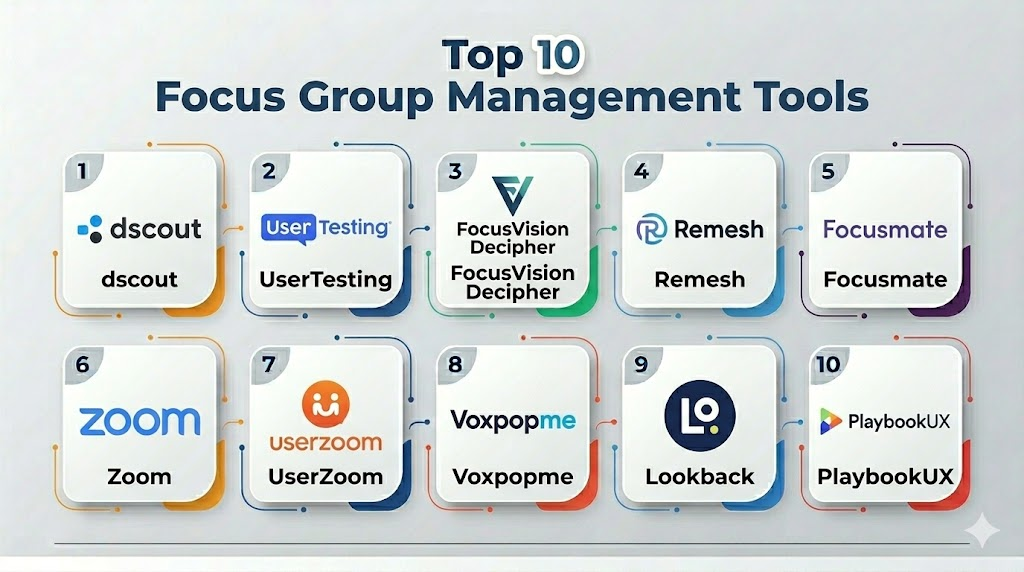
Introduction
Focus Group Management Tools are software platforms that help businesses plan, recruit, moderate, and analyze focus group research with participants from target audiences. These tools centralize recruitment workflows, screening and scheduling, session facilitation (live or asynchronous), recording and transcription, and analysis of qualitative insights. In , demand for structured qualitative feedback continues to grow as companies seek deeper understanding of consumer attitudes, product usability, concept testing, advertising effectiveness, and user experience feedback that surveys alone cannot provide.Focus group tools are used in market research, product development, UX research, academic research, and advertising testing. They often incorporate video conferencing, asynchronous discussion boards, AI transcription, sentiment tagging, and integrated reporting to streamline qualitative analysis and make results actionable.
Real‑world use cases include:
- User experience testing for digital products
- Concept and messaging testing for new products or campaigns
- In‑depth consumer insight gathering for strategy teams
- Pre‑launch usability evaluations
- Cultural and regional focus cohort comparisons
What buyers should evaluate:
- Participant recruitment and screening capabilities
- Scheduling and reminder automation
- Moderation and facilitation interfaces (live & asynchronous)
- Recording, transcription, and AI analysis
- Security and privacy controls
- Integration with CRM or survey systems
- Reporting and export capabilities
- Scalability for session size and frequency
- Participant incentives and tracking
Best for: Market researchers, UX researchers, product and design teams, academic research, innovation leadership, and strategy teams seeking rich qualitative insights.
Not ideal for: Organizations with minimal qualitative research needs, small teams without structured workflows, or businesses that do not plan to act on feedback insights.
Key Trends in Focus Group Management Tools
- AI‑Assisted Transcription & Insight Extraction: Automated transcription with tagging, sentiment detection, themes, and summarization.
- Hybrid & Asynchronous Group Formats: Combining live sessions with discussion boards and asynchronous participation.
- Mobile‑First Participation: Participants engage via mobile apps, increasing inclusivity and reach.
- Video Analytics: Facial emotion detection and interaction patterns to enrich insights.
- Automated Recruitment & Screening: AI‑driven criteria matching and panel sourcing for faster participant onboarding.
- Integrated Incentive Distribution: Built‑in incentive tracking, payments, and rewards.
- Real‑Time Collaboration & Annotation: Teams annotate recordings collaboratively with markers and tags.
- Compliance & Consent Workflows: Built‑in consent, GDPR/CCPA compliance, and privacy controls.
- Multilingual Panels: Tools support focus groups in multiple languages and regions.
- Connected Insights Ecosystems: Integration with survey platforms, analytics, and internal research repositories.
How We Selected These Tools (Methodology)
We evaluated platforms based on:
- Quality of recruitment and screening workflows
- Moderate facilitation tools (live and asynchronous)
- Recording, transcription, and analysis features
- Scalability and global reach of participant panels
- Integrations with analytics and internal systems
- Security and privacy safeguards
- Ease of use and onboarding experience
- Reporting, export, and collaboration capabilities
- Pricing and value relative to feature depth
- Customer support and documentation quality
Top 10 Focus Group Management Tools
#1 — dscout
Short description:
dscout is a qualitative research platform specializing in remote and mobile‑first focus groups, video diaries, and ethnographic research. It enables researchers to recruit participants, moderate sessions, and analyze rich qualitative feedback with video, text, and photos.
Key Features
- Remote focus group facilitation
- Mobile‑first participant engagement
- Asynchronous diary and discussion tasks
- Video and photo submissions
- AI‑assisted tagging and transcription
- Recruitment and screening workflows
- Team collaboration workspaces
Pros
- Excellent mobile engagement and mixed‑format sessions
- Strong qualitative analytics and tagging
- Behaviors and diaries beyond traditional focus group formats
Cons
- Smaller quantitative panel reach
- Premium pricing for advanced features
Platforms / Deployment
- Web / iOS / Android
- Cloud
Security & Compliance
Not publicly stated
Integrations & Ecosystem
APIs and exports to analytics and research systems.
Support & Community
Documentation, onboarding support, and qualitative research resources.
#2 — UserTesting
Short description:
UserTesting is a widely adopted platform for user feedback that supports remote moderated and unmoderated sessions, ideal for focus group style testing, usability studies, and rapid insights from real users.
Key Features
- Live moderated sessions
- Unmoderated recorded interactions
- Participant sourcing and targeting
- AI transcription and highlights
- Video feedback with screen recordings
- Journey tagging and metrics
- Collaboration dashboards
Pros
- Large panel of participants
- Fast results turnaround
- Strong UX and usability workflows
Cons
- Less deep demographic targeting
- Premium tiers required for enterprise features
Platforms / Deployment
- Web / iOS / Android
- Cloud
Security & Compliance
Not publicly stated
Integrations & Ecosystem
Integrations with product analytics and UX tools; export data flows.
Support & Community
Documentation, onboarding guides, and support tiers.
#3 — FocusVision Decipher (now Forsta)
Short description:
FocusVision Decipher (now part of Forsta) provides qualitative and quantitative research capabilities, including focus group management with respondent recruitment, session facilitation, and integrated analysis.
Key Features
- Recruit and schedule participants
- Live and virtual focus sessions
- Cross‑method surveys integration
- Transcription and tagging
- Reporting and dashboards
- Global panel support
Pros
- Combines qualitative and quantitative workflows
- Detailed reporting and analytics
- Enterprise‑ready features
Cons
- Enterprise focus may be overkill for small projects
- Higher implementation complexity
Platforms / Deployment
- Web
- Cloud
Security & Compliance
Not publicly stated
Integrations & Ecosystem
Integrates with survey data, CRM, and BI systems via exports.
Support & Community
Enterprise onboarding, documentation, and professional services.
#4 — Remesh
Short description:
Remesh is a real‑time conversation intelligence platform that runs large group discussions, allowing researchers to ask questions and receive structured responses, sentiment analysis, and AI‑driven themes.
Key Features
- Real‑time group discussions
- AI‑driven insight extraction
- Sentiment and theme detection
- Scalability to large cohorts
- Custom question flows
- Exportable analytics
Pros
- Real‑time engagement and insights
- AI analytics built in
- Scales beyond traditional small groups
Cons
- Less focus on video or moderated sessions
- Requires careful design to get full value
Platforms / Deployment
- Web
- Cloud
Security & Compliance
Not publicly stated
Integrations & Ecosystem
Export data to analytics platforms.
Support & Community
Documentation and support.
#5 — Focusmate
Short description:
Focusmate offers structured, scheduled live sessions where researchers and participants engage in moderated interactions, often used for small focus groups, interviews, or feedback exchanges.
Key Features
- Scheduled live focus sessions
- Participant calendars and reminders
- Recording capabilities
- Basic tagging and notes
Pros
- Simple scheduling and live engagement
- Good for small sample groups
- Affordable and transparent
Cons
- Less analysis tooling
- Not designed for large panels
Platforms / Deployment
- Web
- Cloud
Security & Compliance
Not publicly stated
Integrations & Ecosystem
Data export to research tools.
Support & Community
Basic documentation and support.
#6 — Zoom (with Research Add‑Ons)
Short description:
Zoom becomes a focus group tool when combined with scheduling, transcription, and research add‑ons. It supports large live groups, breakout rooms, recordings, and integration with transcription services.
Key Features
- Live group sessions
- Breakout rooms for sub‑discussion
- Recording and transcription add‑ons
- Participant chat and reactions
Pros
- Ubiquitous and familiar interface
- Supports large groups
- Flexible breakout moderation
Cons
- Not focus‑group‑native
- Requires add‑ons for transcription and tagging
Platforms / Deployment
- Web / Windows / macOS / iOS / Android
- Cloud
Security & Compliance
- Encrypted meetings
- Role‑based access controls
Integrations & Ecosystem
Integrates with transcription services, CRM, and analytics dashboards.
Support & Community
Strong documentation and support network.
#7 — UserZoom
Short description:
UserZoom is a UX research platform that supports moderated and unmoderated usability testing, card sorting, surveys, and qualitative group sessions akin to focus groups.
Key Features
- Live moderated sessions
- Unmoderated testing
- Participant recruitment and profiling
- Analytics dashboards
- Transcription and tagging
Pros
- Strong UX research functions
- Integrated analytics
- Scalable
Cons
- Enterprise pricing
- Less tailored to traditional focus group dynamics
Platforms / Deployment
- Web
- Cloud
Security & Compliance
Not publicly stated
Integrations & Ecosystem
Integrates with product analytics and UX stacks.
Support & Community
Documentation and enterprise support.
#8 — Voxpopme
Short description:
Voxpopme focuses on video‑based qualitative insights, enabling researchers to collect, analyze, and tag video responses from participants — valuable in focus group feedback.
Key Features
- Video insight capture
- Automatic transcription
- Sentiment analysis
- Tagging and theme extraction
- Dashboards and reporting
Pros
- Strong video analysis
- AI‑assisted insight tagging
- Easy engagement for participants
Cons
- Not full session facilitation
- May require external tools for scheduling
Platforms / Deployment
- Web / iOS / Android
- Cloud
Security & Compliance
Not publicly stated
Integrations & Ecosystem
Exports to research and analytics tools.
Support & Community
Documentation and onboarding support.
#9 — Lookback
Short description:
Lookback provides moderated and unmoderated research recording with tagging, notes, and collaboration features, useful for focus groups or guided sessions.
Key Features
- Live moderated sessions
- Unified recordings (video/audio/screen)
- Team annotations
- Participant recruitment tracking
Pros
- Clean research interface
- Team collaboration features
- Built for UX research
Cons
- Smaller panel reach
- Limited built‑in recruiting
Platforms / Deployment
- Web / iOS / Android
- Cloud
Security & Compliance
Not publicly stated
Integrations & Ecosystem
Exports to analytics/qualitative tools.
Support & Community
Documentation and support.
#10 — PlaybookUX
Short description:
PlaybookUX is a qualitative research platform that supports live and unmoderated interviews, focus group sessions, transcription, automated tagging, and integrated reporting.
Key Features
- Live and unmoderated groups
- Recruitment tools
- Transcription and tagging
- Analytics dashboards
- Incentive tracking
Pros
- Integrated recruitment and analytics
- Easy dashboard and tagging
- Balanced features for mid‑market
Cons
- Panel reach limited compared to enterprise tools
- Complex sessions need careful design
Platforms / Deployment
- Web / Cloud
Security & Compliance
Not publicly stated
Integrations & Ecosystem
Exports to CRM and analytics systems.
Support & Community
Documentation and support tiers.
Comparison Table (Top 10)
| Tool Name | Best For | Platforms Supported | Deployment | Standout Feature | Public Rating |
|---|---|---|---|---|---|
| dscout | Mobile‑first qualitative cohorts | Web, iOS, Android | Cloud | Asynchronous + diaries | N/A |
| UserTesting | UX & focus groups | Web, iOS, Android | Cloud | Large participant panel | N/A |
| FocusVision Decipher | Enterprise research | Web | Cloud | Qual + quant workflows | N/A |
| Remesh | Real‑time large groups | Web | Cloud | Real‑time insight extraction | N/A |
| Focusmate | Small group live sessions | Web | Cloud | Simple scheduling | N/A |
| Zoom | Live group facilitation | Web, Windows, macOS, iOS, Android | Cloud | Familiar meetings | N/A |
| UserZoom | UX research + groups | Web | Cloud | UX research integration | N/A |
| Voxpopme | Video insight capture | Web, iOS, Android | Cloud | Video analysis & tagging | N/A |
| Lookback | Recorded group sessions | Web, iOS, Android | Cloud | Collaboration & tagging | N/A |
| PlaybookUX | Live & unmoderated | Web | Cloud | Recruitment + analytics | N/A |
Evaluation & Scoring of Focus Group Management Tools
| Tool Name | Core (25%) | Ease (15%) | Integrations (15%) | Security (10%) | Performance (10%) | Support (10%) | Value (15%) | Weighted Total |
|---|---|---|---|---|---|---|---|---|
| dscout | 9 | 8 | 8 | 7 | 9 | 8 | 7 | 8.2 |
| UserTesting | 8 | 9 | 8 | 7 | 8 | 8 | 8 | 8.1 |
| FocusVision Decipher | 9 | 7 | 8 | 7 | 9 | 8 | 7 | 8.0 |
| Remesh | 8 | 8 | 8 | 7 | 8 | 7 | 7 | 7.8 |
| Focusmate | 6 | 9 | 7 | 7 | 7 | 7 | 8 | 7.5 |
| Zoom | 5 | 9 | 8 | 8 | 8 | 8 | 8 | 7.8 |
| UserZoom | 8 | 7 | 8 | 7 | 8 | 7 | 7 | 7.7 |
| Voxpopme | 7 | 8 | 8 | 7 | 8 | 7 | 8 | 7.7 |
| Lookback | 7 | 8 | 8 | 7 | 8 | 7 | 8 | 7.7 |
| PlaybookUX | 8 | 8 | 8 | 7 | 8 | 8 | 7 | 8.0 |
Interpreting scores:
- Core reflects recruitment, moderation, and analysis depth.
- Ease measures interface usability and session setup.
- Integrations considers data export and third‑party connections.
- Performance reflects speed of results and session facilitation quality.
Which Focus Group Management Tool Is Right for You?
Solo / Freelancer
Tools like Focusmate, Zoom, and Lookback offer straightforward setups and low barriers for small research teams.
SMB
dscout, UserTesting, and PlaybookUX balance structured moderation with analytics without enterprise complexity.
Mid‑Market
Remesh, UserTesting, and PlaybookUX support broader qualitative workflows and reporting.
Enterprise
FocusVision Decipher, dscout, and UserTesting scale with structured workflows, large cohorts, reporting, and governance.
Budget vs Premium
Budget‑oriented teams can use Focusmate or Zoom with add‑ons, while premium research requires dscout, FocusVision, or UserTesting.
Feature Depth vs Ease of Use
Deep analytic tools like Remesh and dscout require setup time; PlaybookUX and UserTesting emphasize usability.
Integrations & Scalability
Enterprise research plans should ensure APIs, exports, and integrations with internal BI, CRM, or analytics stacks.
Security & Compliance Needs
Verify secure data handling, consent capture, storage policies, and access controls—especially for regulated use cases.
Frequently Asked Questions (FAQs)
1. What are Focus Group Management Tools?
They help plan, recruit, moderate, record, and analyze qualitative research sessions with target audiences to gather in‑depth insights beyond surveys.
2. What types of research benefit from focus groups?
Product usability, concept testing, messaging validation, culturally nuanced feedback, and exploratory research benefit most from focus group methods.
3. Are remote focus groups as effective as in‑person?
Yes, with tools that support video, asynchronous participation, transcripts, and tagging, remote sessions can yield rich, nuanced qualitative data.
4. How do these tools handle transcription?
Many platforms offer AI‑assisted transcription with tagging, sentiment analysis, and theme extraction to accelerate analysis.
5. Can focus group software recruit participants?
Some include recruitment workflows; others integrate with panels or require external recruitment, depending on complexity and targeting needs.
6. How important is moderation?
Effective moderation ensures discussions stay on topic and data remains rich and usable. Built‑in tools for prompts, timers, and interactive features help facilitators.
7. How do I integrate insights with other data?
Most tools allow export or API access to research dashboards, CRM, product analytics, or BI systems for combined analysis.
8. Are these tools secure?
Enterprise options typically support encryption, controls, and compliance features, which should be validated per vendor.
9. How quickly can sessions be run?
Depending on recruitment and panel availability, some tools (like Pollfish for surveys) deliver feedback in hours; focus groups generally run within days or weeks.
10. How should teams choose?
Define research goals, budget, sample needs, workflow integration, analysis expectations, and pilot sessions before committing to a platform.
Conclusion
Focus Group Management Tools are essential for teams that require nuanced, qualitative insights beyond what quantitative surveys provide. From mobile‑first platforms like dscout, to enterprise‑grade research workflows in FocusVision Decipher, to UX‑centric options like UserTesting and PlaybookUX, organizations can choose based on scale, sophistication, and research goals. SMBs may lean on flexible tools such as PlaybookUX or Lookback, while enterprises benefit from structured workflows, analytics, and governance offered by FocusVision or dscout. Selecting the right platform depends on recruitment needs, analysis depth, integration requirements, and operational scale. Businesses should shortlist tools, run pilot sessions, validate recruitment and moderation workflows, and embed insights into product, marketing, and strategic decision processes.
