MOTOSHARE 🚗🏍️
Rent Bikes & Cars Directly from Owners
Motoshare connects vehicle owners with people who need bikes and cars on rent. Owners earn from idle vehicles, and renters get flexible ride options.
Visit Motoshare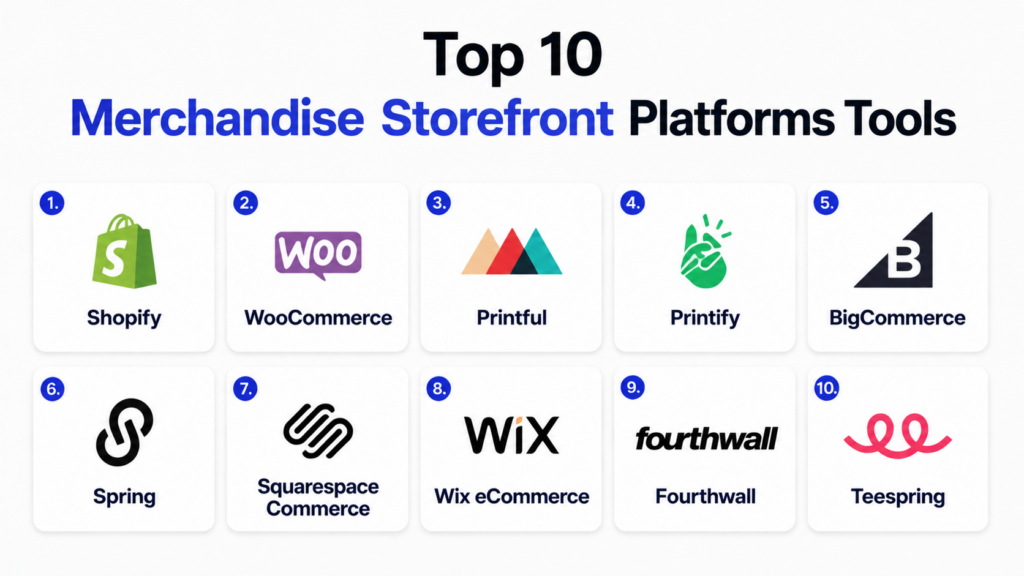
Introduction
Merchandise Storefront Platforms help businesses, creators, influencers, musicians, gaming communities, nonprofits, and ecommerce brands sell branded products online through customizable digital storefronts. These platforms simplify product listing, inventory tracking, order management, payment processing, fulfillment workflows, customer engagement, and multi-channel commerce operations.The category has become increasingly important because direct-to-consumer selling, creator-led commerce, and online brand monetization continue growing rapidly. Modern storefront platforms now include AI-driven recommendations, print-on-demand automation, mobile-first experiences, subscription merchandise programs, and integrations with social commerce platforms like TikTok, Instagram, YouTube, and Twitch.
Real-world use cases include:
- Creator merchandise stores for YouTubers and streamers
- Branded apparel stores for ecommerce companies
- Corporate employee merchandise programs
- Nonprofit fundraising merchandise campaigns
- Music and gaming fan merchandise storefronts
Key evaluation criteria for buyers include:
- Ease of storefront setup
- Product customization capabilities
- Print-on-demand support
- Payment gateway integrations
- Inventory and fulfillment automation
- Mobile commerce optimization
- Marketing and SEO features
- Integration ecosystem
- Scalability for growing brands
- Security and compliance readiness
Best for: creators, SMB ecommerce brands, apparel businesses, gaming communities, nonprofits, agencies, and enterprise retail teams.
Not ideal for: businesses requiring highly customized ERP-heavy commerce infrastructure or advanced manufacturing-focused retail systems.
Key Trends in Merchandise Storefront Platforms
- AI-powered product recommendations are improving conversion optimization.
- Print-on-demand automation is reducing inventory risks for creators and SMBs.
- Social commerce integrations are becoming essential for audience monetization.
- Mobile-first storefront experiences are now standard expectations.
- Subscription-based merchandise memberships are growing in creator ecosystems.
- Headless commerce deployment models are increasing among enterprise buyers.
- Sustainability-focused fulfillment options are becoming differentiators.
- Multi-currency storefronts are supporting global ecommerce expansion.
- Embedded analytics tools are becoming more advanced and accessible.
- Automated fulfillment integrations are reducing operational overhead.
How We Selected These Tools
The tools in this list were selected using practical evaluation criteria focused on business value, market relevance, and operational capabilities.
- Strong market adoption and ecommerce visibility
- Reliable storefront performance and uptime
- Merchandise and product customization depth
- Print-on-demand and fulfillment capabilities
- Ease of onboarding for non-technical users
- Integration ecosystem maturity
- Scalability across SMB and enterprise use cases
- Security and administrative controls
- Mobile commerce capabilities
- Support quality and community ecosystem strength
Top 10 Merchandise Storefront Platforms Tools
#1 — Shopify
Short description: Shopify is one of the most widely used ecommerce and merchandise storefront platforms globally. It supports creator commerce, branded merchandise stores, print-on-demand workflows, omnichannel retail operations, and enterprise ecommerce management. The platform is suitable for SMBs, growing ecommerce brands, and enterprise retailers looking for scalability, integrations, and operational flexibility.
Key Features
- Drag-and-drop storefront builder
- Large app marketplace ecosystem
- AI-assisted marketing tools
- Print-on-demand integrations
- Inventory and order management
- Mobile commerce optimization
- Omnichannel selling support
Pros
- Extremely user-friendly platform
- Massive integrations ecosystem
- Strong scalability for growing brands
Cons
- App costs can become expensive
- Transaction fees may apply
- Advanced customization may require developers
Platforms / Deployment
- Web / iOS / Android
- Cloud
Security & Compliance
Supports MFA, encryption, RBAC, audit logging, PCI DSS compliance, GDPR support, and SSO capabilities on enterprise plans.
Integrations & Ecosystem
Shopify provides one of the strongest ecommerce ecosystems available, allowing businesses to extend storefront functionality through APIs, applications, fulfillment tools, and marketing integrations.
- Printful
- Printify
- Klaviyo
- TikTok Shop
- Meta Commerce
- Amazon marketplace integrations
Support & Community
Excellent onboarding resources, large developer ecosystem, active community forums, partner agencies, and enterprise-grade support options.
#2 — WooCommerce
Short description: WooCommerce is a WordPress-based ecommerce platform that provides highly customizable merchandise storefront functionality. It is popular among businesses that want flexible storefront management, extensive plugin support, and strong SEO capabilities. WooCommerce works especially well for businesses already using WordPress as their primary content platform.
Key Features
- Open-source architecture
- Custom storefront themes
- Extensive plugin ecosystem
- SEO-friendly structure
- Print-on-demand integrations
- Multi-payment support
- Developer customization flexibility
Pros
- Highly customizable platform
- Strong content marketing capabilities
- Large open-source community
Cons
- Requires hosting management
- Plugin conflicts may occur
- Maintenance overhead is higher
Platforms / Deployment
- Web
- Self-hosted / Cloud
Security & Compliance
Security controls depend on hosting providers and installed plugins. GDPR readiness varies by implementation.
Integrations & Ecosystem
WooCommerce supports a large ecosystem of ecommerce, analytics, marketing, and fulfillment integrations.
- Stripe
- PayPal
- Printful
- Mailchimp
- HubSpot
- Zapier
Support & Community
Large global community with extensive tutorials, documentation, forums, developers, and third-party implementation partners.
#3 — Printful
Short description: Printful combines merchandise storefront management with integrated print-on-demand fulfillment services. The platform is designed for creators, artists, influencers, and ecommerce entrepreneurs who want automated product manufacturing and shipping without maintaining inventory.
Key Features
- Print-on-demand fulfillment
- Automated order processing
- Warehousing support
- Branding customization
- Product mockup generator
- Global shipping network
- Ecommerce platform integrations
Pros
- No inventory management required
- Simplified fulfillment workflows
- Strong creator onboarding experience
Cons
- Margins may be lower than self-fulfillment
- Limited deep storefront customization
- Shipping costs vary by location
Platforms / Deployment
- Web
- Cloud
Security & Compliance
Supports encryption, secure payment processing, and GDPR-related controls.
Integrations & Ecosystem
Printful integrates directly with major ecommerce platforms and marketplaces for automated fulfillment operations.
- Shopify
- WooCommerce
- Etsy
- BigCommerce
- Squarespace
- Amazon
Support & Community
Strong onboarding documentation, creator education resources, tutorials, and responsive customer support.
#4 — Printify
Short description: Printify is a print-on-demand merchandise platform focused on supplier flexibility and cost-efficient product production. Businesses can quickly launch branded merchandise stores while outsourcing manufacturing and logistics to third-party providers.
Key Features
- Large supplier network
- Merchandise mockup tools
- Automated order routing
- Product catalog management
- Ecommerce integrations
- Global fulfillment support
- Custom branding options
Pros
- Competitive supplier pricing
- Wide production flexibility
- Fast storefront deployment
Cons
- Quality consistency varies
- Limited enterprise-grade governance
- Advanced customization options are smaller
Platforms / Deployment
- Web
- Cloud
Security & Compliance
Encryption and secure payment handling supported. Additional compliance information not publicly stated.
Integrations & Ecosystem
Printify focuses heavily on ecommerce integrations and fulfillment automation.
- Shopify
- Etsy
- WooCommerce
- Wix
- Squarespace
- eBay
Support & Community
Good onboarding materials, active creator community, and expanding support infrastructure.
#5 — BigCommerce
Short description: BigCommerce is an enterprise-ready ecommerce platform supporting scalable merchandise storefronts and omnichannel commerce operations. The platform provides strong API flexibility, advanced catalog management, and multi-storefront capabilities for mid-market and enterprise businesses.
Key Features
- Multi-storefront management
- API-first architecture
- Headless commerce support
- Advanced SEO tools
- Multi-currency commerce
- Omnichannel selling
- Enterprise scalability
Pros
- Strong enterprise scalability
- Excellent API ecosystem
- Flexible commerce infrastructure
Cons
- Higher learning curve
- Premium plans may be expensive
- Advanced features require setup effort
Platforms / Deployment
- Web
- Cloud
Security & Compliance
Supports encryption, MFA, SSO, PCI DSS compliance, and enterprise security controls.
Integrations & Ecosystem
BigCommerce provides extensive enterprise integrations and developer extensibility.
- Salesforce
- HubSpot
- Meta Commerce
- Google Shopping
- Avalara
- ERP integrations
Support & Community
Strong documentation, implementation partner ecosystem, onboarding assistance, and enterprise support tiers.
#6 — Spring
Short description: Spring is a creator-focused merchandise storefront platform designed for influencers, streamers, musicians, and online communities. The platform simplifies audience monetization through social commerce integrations and automated merchandise fulfillment.
Key Features
- Creator storefront management
- Social commerce integrations
- Merchandise design tools
- Audience monetization support
- Automated fulfillment
- Mobile storefront optimization
- Creator analytics
Pros
- Very easy onboarding
- Low operational complexity
- Strong creator monetization focus
Cons
- Limited enterprise functionality
- Less customization flexibility
- Smaller integration ecosystem
Platforms / Deployment
- Web / Mobile
- Cloud
Security & Compliance
Supports encryption and secure payment processing features.
Integrations & Ecosystem
Spring focuses heavily on creator-oriented platform integrations.
- YouTube
- TikTok
- Twitch
- Discord
Support & Community
Strong creator onboarding content and beginner-friendly documentation.
#7 — Squarespace Commerce
Short description: Squarespace Commerce combines website creation and merchandise storefront management within a visually polished platform. It is popular among artists, photographers, designers, and small businesses prioritizing branding quality and simplified ecommerce operations.
Key Features
- Professional storefront templates
- Integrated ecommerce tools
- Mobile-optimized design
- Inventory management
- SEO optimization
- Subscription product support
- Built-in analytics
Pros
- Excellent visual design quality
- Easy storefront setup
- Strong branding capabilities
Cons
- Limited enterprise scalability
- Smaller integrations ecosystem
- Less flexible customization options
Platforms / Deployment
- Web / Mobile
- Cloud
Security & Compliance
Supports SSL encryption and secure ecommerce payment handling.
Integrations & Ecosystem
Squarespace integrates with major marketing and ecommerce tools while maintaining simplicity.
- Printful
- Stripe
- PayPal
- Google Analytics
- Mailchimp
Support & Community
Strong onboarding resources, beginner-friendly documentation, and responsive customer support.
#8 — Wix eCommerce
Short description: Wix eCommerce provides an accessible storefront platform for businesses wanting fast deployment and visual customization. The platform supports creator merchandise stores, SMB ecommerce operations, and direct-to-consumer brands through easy website management tools.
Key Features
- Drag-and-drop storefront builder
- AI-assisted website setup
- Mobile commerce support
- Integrated payments
- Inventory management
- Marketing automation
- Print-on-demand integrations
Pros
- Beginner-friendly experience
- Affordable starting plans
- Fast deployment process
Cons
- Less suitable for enterprise operations
- Limited advanced customization
- Complex catalogs may become difficult
Platforms / Deployment
- Web / Mobile
- Cloud
Security & Compliance
Supports encryption, secure payment processing, and account protection controls.
Integrations & Ecosystem
Wix provides growing ecommerce and marketing integrations suitable for SMB storefront operations.
- Printful
- Google Shopping
- TikTok
- Facebook Shops
- Zapier
Support & Community
Good onboarding tutorials, documentation, and support resources for smaller businesses.
#9 — Fourthwall
Short description: Fourthwall is a creator-commerce platform built specifically for online creators and digital communities. It combines merchandise selling, memberships, digital products, and audience engagement tools within a unified monetization platform.
Key Features
- Creator storefront management
- Membership monetization
- Merchandise fulfillment
- Digital product selling
- Mobile storefront support
- Audience engagement tools
- Custom branding options
Pros
- Strong creator monetization focus
- Modern storefront experience
- Supports multiple revenue streams
Cons
- Limited enterprise functionality
- Smaller integrations ecosystem
- Less suitable for large retail operations
Platforms / Deployment
- Web
- Cloud
Security & Compliance
Supports secure payment processing and account protection features.
Integrations & Ecosystem
Fourthwall focuses on creator-oriented ecosystem integrations.
- YouTube
- Twitch
- Discord
- Stripe
- Creator monetization tools
Support & Community
Strong onboarding experience and creator-focused support documentation.
#10 — Teespring
Short description: Teespring focuses on creator-led merchandise selling with integrated print-on-demand production and fulfillment. The platform helps influencers, streamers, and online communities launch branded merchandise campaigns with minimal operational effort.
Key Features
- Merchandise campaign management
- Print-on-demand fulfillment
- Creator monetization tools
- Social commerce integrations
- Product design templates
- Mobile storefront support
- Automated logistics workflows
Pros
- Simple onboarding experience
- Low upfront operational costs
- Strong creator-focused workflows
Cons
- Limited enterprise capabilities
- Smaller customization ecosystem
- Product variety may vary
Platforms / Deployment
- Web
- Cloud
Security & Compliance
Supports encryption and secure payment processing. Additional compliance details not publicly stated.
Integrations & Ecosystem
Teespring supports creator-focused integrations and social commerce workflows.
- YouTube
- Twitch
- TikTok
- Streamlabs
Support & Community
Moderate support infrastructure with strong creator onboarding resources.
Comparison Table Top 10
| Tool Name | Best For | Platforms Supported | Deployment | Standout Feature | Public Rating |
|---|---|---|---|---|---|
| Shopify | SMB to Enterprise ecommerce | Web, iOS, Android | Cloud | Massive integrations ecosystem | N/A |
| WooCommerce | WordPress-based stores | Web | Self-hosted / Cloud | Open-source flexibility | N/A |
| Printful | Print-on-demand brands | Web | Cloud | Automated fulfillment | N/A |
| Printify | Affordable POD businesses | Web | Cloud | Large supplier network | N/A |
| BigCommerce | Enterprise commerce | Web | Cloud | API-first architecture | N/A |
| Spring | Creator merchandise | Web, Mobile | Cloud | Social creator integrations | N/A |
| Squarespace Commerce | Design-focused brands | Web, Mobile | Cloud | Premium storefront templates | N/A |
| Wix eCommerce | Beginner storefronts | Web, Mobile | Cloud | AI-assisted setup | N/A |
| Fourthwall | Creator communities | Web | Cloud | Membership monetization | N/A |
| Teespring | Influencer merchandise | Web | Cloud | Campaign-based merchandise selling | N/A |
Evaluation & Scoring of Merchandise Storefront Platforms
| Tool Name | Core 25% | Ease 15% | Integrations 15% | Security 10% | Performance 10% | Support 10% | Value 15% | Weighted Total |
|---|---|---|---|---|---|---|---|---|
| Shopify | 9.5 | 9 | 10 | 9 | 9 | 9 | 8 | 9.1 |
| WooCommerce | 9 | 7 | 9 | 7 | 8 | 8 | 9 | 8.3 |
| Printful | 8 | 9 | 8 | 8 | 8 | 8 | 8 | 8.1 |
| Printify | 8 | 8 | 8 | 7 | 7 | 7 | 9 | 7.9 |
| BigCommerce | 9 | 7 | 9 | 9 | 9 | 8 | 7 | 8.5 |
| Spring | 7 | 9 | 7 | 7 | 7 | 7 | 8 | 7.5 |
| Squarespace Commerce | 8 | 9 | 7 | 8 | 8 | 8 | 8 | 8.0 |
| Wix eCommerce | 8 | 9 | 7 | 8 | 8 | 8 | 8 | 8.0 |
| Fourthwall | 8 | 9 | 7 | 7 | 8 | 8 | 8 | 8.0 |
| Teespring | 7 | 8 | 7 | 7 | 7 | 7 | 8 | 7.4 |
These scores are comparative rather than absolute measurements. Higher-scoring platforms generally provide stronger scalability, integrations, enterprise controls, and operational flexibility. Smaller creator-focused tools may score lower on enterprise functionality while still delivering excellent value for niche creator and community use cases. Buyers should prioritize the scoring categories most aligned with their operational requirements and growth strategy.
Which Merchandise Storefront Platforms Tool Is Right for You?
Solo / Freelancer
Creators, artists, influencers, and streamers often benefit most from Spring, Fourthwall, Teespring, and Printful because these platforms simplify monetization and reduce operational complexity. They are ideal for users who want fast storefront deployment without managing inventory or logistics manually.
SMB
Small and growing ecommerce brands usually succeed with Shopify, WooCommerce, Wix eCommerce, or Squarespace Commerce. These platforms provide strong balances between affordability, scalability, branding, and operational simplicity while supporting marketing and customer engagement workflows.
Mid-Market
Mid-sized businesses that need stronger integrations, analytics, and operational controls should evaluate Shopify Plus, BigCommerce, or advanced WooCommerce deployments with managed hosting and enterprise-grade plugins.
Enterprise
Large enterprises generally require platforms like Shopify Plus or BigCommerce because of their scalability, security capabilities, omnichannel commerce support, API flexibility, and governance controls.
Budget vs Premium
Budget-focused businesses may prefer WooCommerce, Printify, or Wix because of lower startup costs and flexible pricing models. Premium platforms like Shopify Plus and BigCommerce deliver stronger enterprise functionality but come with higher operational expenses.
Feature Depth vs Ease of Use
Wix and Squarespace prioritize ease of use and visual simplicity, while WooCommerce and BigCommerce focus more heavily on customization and operational depth. Shopify typically offers the best balance between simplicity and advanced commerce capabilities.
Integrations & Scalability
Businesses with complex ecommerce workflows should prioritize Shopify, WooCommerce, or BigCommerce because of their stronger APIs, integrations ecosystems, and scalability options.
Security & Compliance Needs
Organizations with strict governance requirements should focus on Shopify Plus and BigCommerce due to stronger administrative controls, enterprise security features, and operational governance capabilities.
Frequently Asked Questions FAQs
1. What is a Merchandise Storefront Platform?
A Merchandise Storefront Platform helps businesses and creators sell branded products through digital ecommerce storefronts. These platforms typically include inventory tracking, payment processing, order management, customer engagement, fulfillment support, and storefront customization capabilities. Many modern platforms also integrate print-on-demand production services, reducing operational complexity for smaller businesses and creators.
2. How do print-on-demand merchandise platforms work?
Print-on-demand platforms allow sellers to upload designs that are produced only after a customer places an order. The platform or fulfillment provider handles manufacturing, packaging, and shipping automatically. This reduces inventory risk and startup costs significantly, making the model highly attractive for creators, influencers, and small ecommerce businesses launching merchandise brands.
3. Which platform is best for creators and influencers?
Platforms like Fourthwall, Spring, and Teespring are particularly strong for creators because they focus heavily on audience monetization and social commerce integrations. Shopify is also widely used among creators who need more advanced customization and long-term scalability. The best platform depends on audience size, branding requirements, and operational complexity.
4. Are these platforms suitable for enterprise businesses?
Some platforms are highly enterprise-ready while others primarily target creators and SMBs. Shopify Plus and BigCommerce are commonly adopted by larger organizations because they support enterprise scalability, stronger integrations, advanced APIs, and security controls. Creator-focused platforms may not provide the governance or operational flexibility required by enterprise retail environments.
5. What pricing models are common in this category?
Pricing structures vary significantly across platforms. Some charge monthly subscription fees, while print-on-demand services usually add production and fulfillment costs per order. Enterprise platforms may include premium support pricing, transaction fees, and additional app or integration expenses. Buyers should evaluate long-term operational costs carefully before selecting a platform.
6. What security features should buyers prioritize?
Important security features include encryption, MFA, secure payment processing, RBAC, audit logging, SSO support, and GDPR readiness. Larger organizations may also require enterprise-grade governance controls and stronger administrative permissions. Security maturity varies substantially between platforms, making due diligence essential during platform evaluations.
7. How difficult is it to migrate between storefront platforms?
Migration complexity depends on product catalogs, integrations, customer data, SEO structure, and fulfillment workflows. Platforms with strong APIs and migration tools can simplify the process significantly. However, businesses often underestimate the effort required to preserve storefront design consistency, search visibility, and operational workflows during migration projects.
8. Can these platforms integrate with existing business systems?
Most modern storefront platforms integrate with CRMs, ERPs, analytics platforms, payment gateways, fulfillment providers, and marketing automation systems. Shopify and BigCommerce generally offer the strongest ecosystems for integrations and extensibility. Businesses should validate critical workflows before making final purchasing decisions.
9. What are the most common mistakes buyers make?
One of the most common mistakes is selecting a platform based solely on low upfront pricing without considering scalability, integrations, or operational complexity. Some businesses also fail to evaluate fulfillment capabilities or underestimate branding and customization requirements. Long-term growth planning is critical when selecting a merchandise storefront platform.
10. Should businesses prioritize ease of use or advanced functionality?
The right balance depends on operational maturity and technical capabilities. Smaller businesses often benefit from simpler platforms that reduce management overhead. Larger organizations may require deeper integrations, advanced customization, and enterprise-grade operational controls. Buyers should prioritize platforms aligned with their operational strategy instead of focusing only on feature volume.
Conclusion
Merchandise Storefront Platforms have evolved from basic online stores into sophisticated commerce ecosystems supporting creator monetization, print-on-demand automation, omnichannel retail operations, social commerce, and audience engagement. Modern platforms now combine storefront management, fulfillment workflows, analytics, marketing automation, and mobile commerce capabilities into scalable digital commerce environments. The right platform depends heavily on operational goals, technical resources, branding priorities, and long-term growth strategy. Creator-focused businesses may prioritize fast monetization and simplified fulfillment, while enterprise organizations typically require stronger integrations, governance controls, and advanced scalability. Shopify and BigCommerce continue leading enterprise-ready commerce deployments, while platforms like Fourthwall, Spring, Printful, and Teespring deliver compelling value for creators and community-driven brands. Before making a final decision, businesses should shortlist several platforms, validate integrations and fulfillment workflows, test storefront usability, review operational costs carefully, and run pilot deployments to ensure long-term scalability and alignment with business objectives.
