MOTOSHARE 🚗🏍️
Rent Bikes & Cars Directly from Owners
Motoshare connects vehicle owners with people who need bikes and cars on rent. Owners earn from idle vehicles, and renters get flexible ride options.
Visit Motoshare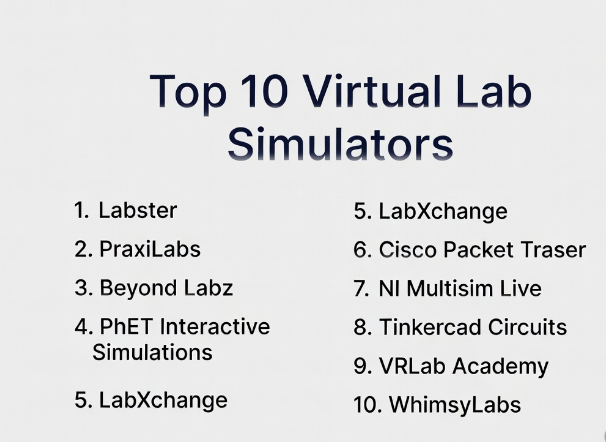
Introduction
Virtual Lab Simulators are digital platforms that recreate laboratory environments using software simulations, interactive experiments, 3D models, and guided learning workflows. These platforms allow students, educators, researchers, and training organizations to perform practical experiments without needing physical laboratories, expensive hardware, chemicals, or specialized infrastructure. Virtual labs are now widely used across STEM education, healthcare training, engineering programs, IT certification environments, and hybrid learning ecosystems.
The category has grown rapidly because educational institutions and enterprises increasingly need scalable, remote-accessible, and cost-effective hands-on learning environments. Modern virtual labs support interactive simulations, AI-assisted guidance, cloud collaboration, analytics, and curriculum-aligned learning workflows. Virtual simulations are especially valuable for remote education, safety-focused training, and institutions with limited laboratory resources.
Real-World Use Cases
- STEM and science experiment simulations
- Medical and anatomy training
- Engineering and electronics lab environments
- IT and cybersecurity hands-on training
- Remote and hybrid classroom practical learning
Evaluation Criteria for Buyers
When evaluating Virtual Lab Simulators, buyers should consider:
- Quality of simulations and realism
- Curriculum alignment
- Device and browser compatibility
- Interactive learning depth
- Analytics and assessment support
- LMS integration capabilities
- Collaboration and remote learning support
- Scalability for institutions
- Accessibility and usability
- Long-term ecosystem maturity
Best for: Schools, universities, STEM programs, healthcare training institutions, engineering colleges, IT certification providers, and enterprises delivering remote practical training.
Not ideal for: Environments where physical laboratory interaction is mandatory for accreditation or institutions with extremely limited digital infrastructure.
Key Trends in Virtual Lab Simulators
- AI-assisted lab guidance and assessment are becoming more common.
- Cloud-based practical learning environments are expanding rapidly.
- STEM-focused simulations remain the dominant adoption segment.
- Interactive 3D and immersive learning experiences are improving engagement.
- Hybrid and remote practical learning is driving institutional demand.
- Virtual labs are increasingly integrated into LMS ecosystems.
- Mobile-accessible simulations are becoming more important.
- Real-time analytics and automated grading are improving teaching workflows.
- Edge computing and browser-based simulations are reducing deployment complexity.
- Safety-focused virtual experimentation is expanding in healthcare and chemistry education.
How We Selected These Tools
The following Virtual Lab Simulators were selected using practical educational technology and simulation platform evaluation criteria.
- Strong educational adoption
- Quality of simulations and realism
- Curriculum relevance
- Scalability for institutions
- Hybrid learning support
- Device compatibility
- Teacher and student usability
- Analytics and reporting support
- Ecosystem integrations
- Long-term platform maturity
Top 10 Virtual Lab Simulators
1- Labster
Short description:
Labster is one of the most recognized virtual laboratory platforms for STEM education. It provides immersive science simulations across biology, chemistry, physics, medicine, and engineering through interactive 3D learning environments. The platform is widely used by universities and high schools to support remote learning, practical science education, and hybrid classroom workflows.
Key Features
- Interactive 3D STEM simulations
- Guided science experiments
- Curriculum-aligned content
- Gamified learning workflows
- Cloud-based access
- Assessment and quiz support
- Remote classroom compatibility
Pros
- Strong STEM learning ecosystem
- Excellent simulation realism
- Broad subject coverage
Cons
- Premium licensing can be expensive
- Advanced deployment requires onboarding
- Hardware performance impacts experience quality
Platforms / Deployment
- Web / Windows / macOS / Cloud
Security & Compliance
- User authentication support available
- Additional certifications not publicly stated
Integrations & Ecosystem
Labster integrates with educational productivity and LMS ecosystems.
- Canvas
- Moodle
- Blackboard
- Google Classroom
- Science learning workflows
Support & Community
Large educational ecosystem with strong university and school adoption.
2- PraxiLabs
Short description:
PraxiLabs is a virtual science laboratory platform focused on biology, chemistry, and physics education. It provides interactive simulations, AI-powered assistance, analytics, and LMS integration support for educational institutions. The platform is especially popular for remote STEM learning environments.
Key Features
- AI lab assistant support
- Interactive science simulations
- LMS integration
- Automated grading workflows
- Performance analytics
- Multi-language support
- Curriculum customization
Pros
- Strong STEM curriculum alignment
- Excellent analytics workflows
- Good institutional support
Cons
- Advanced customization may require support
- Premium access can increase costs
- Subject coverage varies by discipline
Platforms / Deployment
- Web / Cloud / Hybrid
Security & Compliance
- Administrative controls available
- Additional certifications not publicly stated
Integrations & Ecosystem
PraxiLabs integrates with educational management and collaboration systems.
- Moodle
- Canvas
- Blackboard
- Cloud learning workflows
- STEM classroom ecosystems
Support & Community
Strong institutional onboarding and educational support ecosystem.
3- Beyond Labz
Short description:
Beyond Labz focuses on virtual science labs for chemistry, biology, and physics education. The platform emphasizes interactive experimentation, practical simulation workflows, and browser-based accessibility for schools and universities.
Key Features
- Virtual chemistry labs
- Biology experiment simulations
- Physics simulations
- Browser-based deployment
- Interactive experimentation
- Cloud classroom support
- Practical learning workflows
Pros
- Good browser accessibility
- Strong chemistry simulation workflows
- Useful for remote science learning
Cons
- UI design can feel academic-focused
- Enterprise tooling is lighter
- Advanced analytics vary
Platforms / Deployment
- Web / Cloud
Security & Compliance
- Not publicly stated
Integrations & Ecosystem
Beyond Labz integrates with science-focused digital learning environments.
- LMS systems
- STEM teaching workflows
- Browser-based classrooms
- Remote science labs
Support & Community
Growing educational adoption among science-focused institutions.
4- PhET Interactive Simulations
Short description:
PhET Interactive Simulations is a widely used educational simulation platform focused on science and mathematics learning. Developed for interactive concept visualization, it supports physics, chemistry, biology, and mathematics education through browser-accessible simulations.
Key Features
- Interactive STEM simulations
- Browser-based learning
- Mathematics visualization
- Physics concept exploration
- Chemistry simulations
- Mobile accessibility
- Free educational access
Pros
- Extremely accessible
- Excellent STEM visualization
- Strong classroom adoption
Cons
- Less immersive than 3D lab environments
- Advanced practical workflows are limited
- Enterprise management features are lighter
Platforms / Deployment
- Web / Windows / macOS / Linux
Security & Compliance
- Not publicly stated
Integrations & Ecosystem
PhET integrates with STEM classrooms and online learning workflows.
- Classroom teaching systems
- Science education workflows
- Interactive lesson environments
- Browser-based learning
Support & Community
Large global educational community with broad classroom adoption.
5- LabXchange
Short description:
LabXchange is a science education platform focused on life sciences, interactive simulations, and modular learning pathways. It combines virtual experiments, educational resources, and collaborative science learning experiences for students and educators.
Key Features
- Life science simulations
- Interactive learning pathways
- Modular science resources
- Virtual experiment workflows
- Cloud-based access
- Student collaboration tools
- Educational content libraries
Pros
- Strong biology and life science support
- Free educational accessibility
- Good modular learning workflows
Cons
- Less broad than some premium platforms
- Advanced analytics are limited
- Enterprise features are lighter
Platforms / Deployment
- Web / Cloud
Security & Compliance
- Not publicly stated
Integrations & Ecosystem
LabXchange integrates with science learning and online education environments.
- Science classrooms
- Cloud learning workflows
- Educational content systems
- Interactive teaching platforms
Support & Community
Strong educational and academic community support.
6- Cisco Packet Tracer
Short description:
Cisco Packet Tracer is a network simulation platform designed for networking, cybersecurity, and IT infrastructure education. It helps students and professionals build virtual network environments and practice configuration workflows safely.
Key Features
- Virtual networking labs
- Router and switch simulation
- Cybersecurity training
- Network topology design
- Packet analysis workflows
- IT certification support
- Real-time network testing
Pros
- Excellent networking education support
- Strong IT certification alignment
- Useful hands-on training workflows
Cons
- Primarily networking-focused
- Requires networking knowledge
- Less suitable for general STEM education
Platforms / Deployment
- Windows / Linux / macOS
Security & Compliance
- User authentication workflows available
- Additional certifications not publicly stated
Integrations & Ecosystem
Packet Tracer integrates with networking education and IT certification ecosystems.
- Cisco Networking Academy
- Cybersecurity learning workflows
- IT infrastructure training
- Networking classrooms
Support & Community
Large networking and IT training ecosystem with strong educational adoption.
7- NI Multisim Live
Short description:
NI Multisim Live is a circuit simulation and electronics lab platform designed for engineering and electronics education. It allows students to design, simulate, and test electronic circuits through cloud-accessible environments.
Key Features
- Electronics circuit simulation
- Cloud-based engineering labs
- Interactive schematic design
- Real-time testing workflows
- Engineering education support
- Browser-based accessibility
- Practical electronics training
Pros
- Strong engineering simulation workflows
- Excellent electronics learning support
- Browser-based deployment
Cons
- Primarily electronics-focused
- Advanced engineering workflows require expertise
- Enterprise collaboration features are lighter
Platforms / Deployment
- Web / Cloud
Security & Compliance
- Not publicly stated
Integrations & Ecosystem
Multisim Live integrates with electronics engineering education ecosystems.
- Engineering classrooms
- Circuit design workflows
- Technical learning systems
- Cloud engineering simulations
Support & Community
Strong engineering education adoption with active technical communities.
8- Tinkercad Circuits
Short description:
Tinkercad Circuits is a beginner-friendly virtual electronics and coding simulation environment designed for students, makers, and STEM classrooms. It combines electronics simulation with simple programming and prototyping workflows.
Key Features
- Circuit simulation
- Arduino programming support
- Beginner-friendly UI
- Browser-based access
- STEM classroom workflows
- Electronics prototyping
- Collaborative learning support
Pros
- Excellent beginner accessibility
- Strong STEM classroom usability
- Easy browser-based deployment
Cons
- Limited advanced engineering depth
- Professional workflows are lighter
- Enterprise management is limited
Platforms / Deployment
- Web / Cloud
Security & Compliance
- User account management available
- Additional certifications not publicly stated
Integrations & Ecosystem
Tinkercad integrates with STEM and maker-learning ecosystems.
- Classroom STEM workflows
- Arduino learning
- Electronics prototyping
- Browser-based teaching
Support & Community
Large maker and educational community with strong beginner adoption.
9- VRLab Academy
Short description:
VRLab Academy provides immersive virtual science experiments designed for K-12 and STEM education. It focuses on realistic science simulations, curriculum alignment, and device-accessible practical learning workflows.
Key Features
- Curriculum-aligned science simulations
- Interactive STEM experiments
- Remote learning support
- Multi-device accessibility
- Physics and chemistry labs
- Practical experiment workflows
- Cloud-based deployment
Pros
- Strong curriculum alignment
- Good remote accessibility
- Broad STEM experiment coverage
Cons
- Smaller ecosystem than major competitors
- Advanced institutional tooling varies
- Collaboration workflows are lighter
Platforms / Deployment
- Web / Cloud / Mobile
Security & Compliance
- Not publicly stated
Integrations & Ecosystem
VRLab Academy integrates with STEM and remote learning ecosystems.
- Science classrooms
- Online learning workflows
- Mobile learning systems
- Curriculum-aligned teaching
Support & Community
Growing educational ecosystem with increasing STEM adoption.
10- WhimsyLabs
Short description:
WhimsyLabs is a modern STEM virtual laboratory platform focused on realistic physics-based science simulations and AI-driven assessment workflows. The platform emphasizes authentic experimentation and practical skill-building rather than rigid scripted simulations.
Key Features
- Physics-based lab simulations
- AI-driven assessment
- Realistic science workflows
- Interactive experimentation
- STEM learning support
- Browser-based access
- Automated grading workflows
Pros
- Strong realism and interactivity
- AI-powered assessment support
- Good practical experimentation workflows
Cons
- Newer ecosystem compared with larger competitors
- Institutional adoption is still growing
- Advanced deployment workflows vary
Platforms / Deployment
- Web / Cloud
Security & Compliance
- Not publicly stated
Integrations & Ecosystem
WhimsyLabs integrates with modern STEM learning and classroom workflows.
- Science teaching platforms
- AI grading workflows
- Browser-based classrooms
- STEM learning ecosystems
Support & Community
Emerging STEM education ecosystem with growing educator interest.
Comparison Table
| Tool Name | Best For | Platforms Supported | Deployment | Standout Feature | Public Rating |
|---|---|---|---|---|---|
| Labster | STEM higher education | Web, Windows, macOS | Cloud | Immersive 3D science labs | N/A |
| PraxiLabs | Science classrooms | Web | Cloud / Hybrid | AI-assisted STEM learning | N/A |
| Beyond Labz | Remote science learning | Web | Cloud | Browser-based science labs | N/A |
| PhET Interactive Simulations | STEM concept learning | Web, Desktop | Cloud / Offline | Interactive STEM visualization | N/A |
| LabXchange | Life science learning | Web | Cloud | Modular science pathways | N/A |
| Cisco Packet Tracer | Networking education | Windows, Linux, macOS | Desktop | Networking lab simulation | N/A |
| NI Multisim Live | Electronics engineering | Web | Cloud | Circuit simulation | N/A |
| Tinkercad Circuits | Beginner electronics learning | Web | Cloud | Simple electronics prototyping | N/A |
| VRLab Academy | STEM remote learning | Web, Mobile | Cloud | Curriculum-aligned simulations | N/A |
| WhimsyLabs | Realistic STEM experimentation | Web | Cloud | Physics-based lab realism | N/A |
Evaluation & Scoring of Virtual Lab Simulators
| Tool Name | Core 25% | Ease 15% | Integrations 15% | Security 10% | Performance 10% | Support 10% | Value 15% | Weighted Total |
|---|---|---|---|---|---|---|---|---|
| Labster | 9 | 8 | 8 | 7 | 8 | 8 | 7 | 8.0 |
| PraxiLabs | 8 | 8 | 8 | 7 | 8 | 8 | 8 | 8.0 |
| Beyond Labz | 7 | 7 | 6 | 6 | 7 | 7 | 7 | 6.9 |
| PhET Interactive Simulations | 8 | 9 | 7 | 6 | 8 | 9 | 10 | 8.3 |
| LabXchange | 7 | 8 | 6 | 6 | 7 | 8 | 9 | 7.5 |
| Cisco Packet Tracer | 9 | 7 | 8 | 7 | 8 | 9 | 9 | 8.3 |
| NI Multisim Live | 8 | 7 | 7 | 6 | 8 | 8 | 8 | 7.5 |
| Tinkercad Circuits | 7 | 9 | 7 | 6 | 7 | 8 | 10 | 8.0 |
| VRLab Academy | 8 | 8 | 6 | 6 | 7 | 7 | 8 | 7.4 |
| WhimsyLabs | 8 | 7 | 6 | 6 | 8 | 7 | 7 | 7.2 |
These scores are comparative rather than absolute. Institutions focused on immersive STEM education may prioritize Labster or PraxiLabs, while networking programs may benefit more from Cisco Packet Tracer. Budget-conscious institutions often prefer PhET or Tinkercad because of accessibility and lower deployment costs.
Which Virtual Lab Simulator Is Right for You?
Solo / Freelancer
Independent educators and tutors often benefit from PhET Interactive Simulations, Tinkercad Circuits, and LabXchange because they are accessible, browser-based, and easier to deploy without institutional infrastructure.
SMB
Small schools and coaching centers usually prioritize affordability, curriculum alignment, and classroom usability. PraxiLabs, PhET, and VRLab Academy provide strong STEM teaching support for these environments.
Mid-Market
Mid-sized educational institutions often need LMS integration, collaborative workflows, and analytics support. Labster, PraxiLabs, and Beyond Labz are strong choices for scalable digital practical learning.
Enterprise
Large universities and enterprise training environments should prioritize governance, analytics, curriculum management, and large-scale remote learning support. Labster and enterprise-focused STEM simulation ecosystems are especially valuable here.
Budget vs Premium
Budget-conscious institutions often prefer PhET, Tinkercad Circuits, and LabXchange because of lower barriers to adoption. Premium institutions usually prioritize immersive realism, analytics, and guided learning experiences from Labster or PraxiLabs.
Feature Depth vs Ease of Use
Labster and PraxiLabs provide deeper immersive simulation ecosystems, while PhET and Tinkercad focus more on accessibility and classroom simplicity.
Integrations & Scalability
Institutions already using LMS systems should prioritize platforms with strong integration capabilities to simplify assignment management and classroom collaboration.
Security & Compliance Needs
Educational organizations should evaluate user access controls, classroom privacy policies, administrative management, and cloud governance workflows before deployment, especially in district-wide or university-scale environments.
Frequently Asked Questions FAQs
1. What are Virtual Lab Simulators?
Virtual Lab Simulators are digital platforms that recreate laboratory experiments and practical learning environments through software simulations and interactive workflows. They allow students to perform experiments, test theories, and learn practical concepts without needing physical lab equipment. Virtual labs are increasingly used across STEM education, healthcare, engineering, and IT training.
2. Why are virtual labs becoming popular?
Virtual labs improve accessibility, reduce equipment costs, support remote learning, and provide safe experimentation environments. Educational institutions use them to expand practical learning opportunities while minimizing infrastructure limitations and laboratory risks.
3. Which subjects benefit most from virtual lab simulations?
STEM subjects such as biology, chemistry, physics, engineering, electronics, medicine, and networking benefit heavily from virtual simulations. Cybersecurity and IT infrastructure training are also major adoption areas.
4. Are virtual labs a replacement for physical laboratories?
Virtual labs are often used as complements rather than full replacements for physical labs. They are valuable for remote learning, concept reinforcement, safety-focused training, and pre-lab preparation, but some accredited programs still require physical practical work.
5. Do virtual labs require expensive hardware?
Most modern virtual lab platforms work through standard web browsers or common laptops and tablets. More immersive simulations may benefit from stronger graphics hardware, but many educational tools are designed for broad accessibility.
6. What are the biggest challenges when deploying virtual labs?
Common challenges include internet reliability, teacher onboarding, curriculum alignment, licensing costs, and ensuring students remain engaged during remote practical learning workflows.
7. Are virtual lab simulations effective for remote learning?
Yes. Virtual labs are widely used in hybrid and remote education because they allow students to complete practical activities from anywhere while maintaining interactive learning experiences.
8. How do virtual labs improve STEM education?
Virtual labs improve STEM education by helping students visualize complex concepts, perform safe experiments, repeat simulations multiple times, and engage with practical learning more interactively than static textbook instruction alone.
9. What is the difference between a simulation platform and a virtual lab?
A simulation platform may focus on demonstrating concepts, while a virtual lab often replicates full experiment workflows, including procedures, equipment interaction, analytics, and assessment environments.
10. What is the biggest mistake institutions make when choosing virtual labs?
A common mistake is selecting platforms based only on visual quality while ignoring curriculum alignment, LMS integration, teacher usability, and long-term scalability. Successful adoption depends heavily on educational integration and instructor readiness.
Conclusion
Virtual Lab Simulators are transforming modern education by making practical learning more accessible, scalable, interactive, and cost-effective across schools, universities, and enterprise training environments. Platforms like Labster and PraxiLabs lead immersive STEM education with advanced simulations and analytics, while PhET and Tinkercad provide highly accessible browser-based learning experiences for broader classrooms. Cisco Packet Tracer remains a strong option for networking and IT training, while NI Multisim Live supports electronics engineering education effectively. Emerging platforms such as VRLab Academy and WhimsyLabs are expanding immersive and AI-driven learning workflows even further. The right platform ultimately depends on curriculum requirements, infrastructure maturity, deployment scale, collaboration needs, and subject specialization. Educational institutions should shortlist tools based on learning objectives, test usability with real classroom scenarios, validate LMS and device compatibility, and evaluate long-term scalability before standardizing on a virtual laboratory ecosystem.
