MOTOSHARE 🚗🏍️
Rent Bikes & Cars Directly from Owners
Motoshare connects vehicle owners with people who need bikes and cars on rent. Owners earn from idle vehicles, and renters get flexible ride options.
Visit Motoshare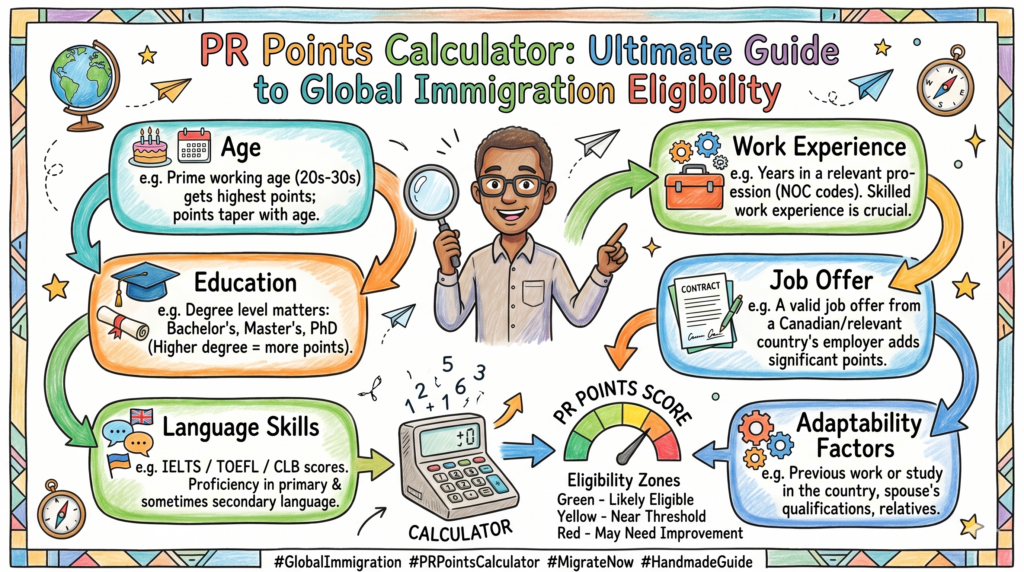
Introduction
Dreaming of a new life abroad is an exciting journey. Whether you picture yourself sipping coffee in a bustling Canadian city, surfing on an Australian beach, or trekking through the scenic landscapes of New Zealand, the first step is always the same: Eligibility.
For many, the biggest hurdle isn’t the flight or the job search—it’s the math. Most top-tier immigration destinations use a “Points-Based System” to select candidates. This is where a PR Points Calculator becomes your most valuable tool.
Think of it as a pre-screening test. Instead of spending thousands of dollars on consultants only to find out you don’t qualify, these calculators help you understand exactly where you stand. In this guide, we will break down how these systems work, how to calculate your own score, and—most importantly—how to improve it if you’re falling short.
What Is a PR Points Calculator?
At its core, a PR Points Calculator is a digital tool designed to estimate your likelihood of receiving a Permanent Residency (PR) invitation.
Why do countries use points?
Governments like Canada, Australia, and New Zealand receive millions of applications every year. They can’t interview everyone. To remain fair and efficient, they use a “merit-based” system. They assign numerical values to “human capital” factors—things like your age, how much you’ve studied, and your ability to speak the local language.
Eligibility Score vs. Invitation Score
This is a common point of confusion for beginners:
- Eligibility Score: The minimum points required to enter the “pool” or apply for a specific program (e.g., scoring 67 out of 100 for Canada’s Federal Skilled Worker program).
- Invitation Score: The actual score needed to be selected from that pool during a “draw” (e.g., the CRS score in Canada).
Just because you meet the eligibility score doesn’t mean you will get PR immediately; it just means you’ve officially joined the race.
How PR Points Systems Work
While every country has its own unique formula, most focus on the same “Big Five” factors. Here is a breakdown of how points are typically distributed:
1. Age
Immigration is often a demographic tool. Countries want young professionals who can contribute to the economy for decades.
- Peak Points: Usually between ages 25 and 32.
- The “Cliff”: Points often begin to drop after age 35 and can hit zero for the “age” category once you pass 45 or 50, depending on the country.
2. Education
The higher your degree, the higher your points.
- High Points: PhDs and Master’s degrees.
- Moderate Points: Bachelor’s degrees or two-year diplomas.
3. Language Proficiency
This is the most “controllable” factor. Whether it’s the IELTS, CELPIP, or PTE, your ability to prove high-level English (or French) can make or break your application.
4. Work Experience
Countries look for “Skilled Work.” This usually means jobs that require a degree or specialized training.
- Local Experience: Having worked inside the country you are applying to often gives you a massive points boost.
- Foreign Experience: Your experience back home still counts, but usually caps out after 3 to 6 years.
5. Adaptability & Spouse Factors
If you are moving with a partner, their education and language skills can either add points to your profile or, in some cases, slightly lower the primary applicant’s potential if they don’t meet certain levels.
| Factor | Description | Impact Level |
| Age | Younger applicants (20-30s) score highest. | High |
| Education | Master’s/PhDs get maximum points. | High |
| Language | IELTS/PTE scores are critical. | Very High |
| Experience | 3+ years of skilled work is ideal. | Medium |
| Job Offer | Having a valid offer can be a “fast track.” | Very High |
Canada PR Points Calculator
Canada is famous for its Express Entry system. It is one of the fastest and most transparent systems in the world.
The CRS Score
The Comprehensive Ranking System (CRS) is the calculator Canada uses to rank candidates. It’s a 1,200-point system. Most of your points come from “Core Factors” (Age, Education, Language, Experience), while “Additional Factors” (Provincial Nomination, Siblings in Canada, French skills) can provide a huge jump.
CRS Score Breakdown (Example for Single Applicant)
| Factor | Max Points |
| Age | 110 |
| Level of Education | 150 |
| Official Language Proficiency | 160 |
| Canadian Work Experience | 80 |
| Total Core Points | 500 |
Provincial Nominee Programs (PNP)
If your CRS score is too low, you can apply to a specific province (like Ontario or British Columbia). If they “nominate” you, you get an automatic 600-point boost, which virtually guarantees an Invitation to Apply (ITA).
Example Scenario:
- Rahul: 30 years old, Master’s Degree, 3 years work experience, high IELTS score.
- Estimated CRS: 470–480.
- Status: Competitive for General Draws.
Australia PR Points Calculator
Australia uses a points test for its General Skilled Migration (GSM) program. The magic number here is often 65 points, though in reality, competitive sectors (like IT or Engineering) may require 85 to 95 points.
Popular Visa Subclasses
- Subclass 189: Skilled Independent (No sponsor needed).
- Subclass 190: Skilled Nominated (State sponsorship needed).
- Subclass 491: Skilled Work Regional (Provisional – leads to PR).
Australia Points Breakdown (Typical)
- Age (25-32): 30 Points
- English (Superior): 20 Points
- Education (Bachelor/Master): 15 Points
- Work Experience (8+ years outside Australia): 15 Points
- Professional Year (in Australia): 5 Points
New Zealand PR Points Calculator
New Zealand recently overhauled its Skilled Migrant Category (SMC). They now use a simplified “6-point system.”
How to get 6 Points:
You can claim points from one of the following:
- Professional Registration (3-6 points)
- Educational Qualifications (Bachelor = 3, Master = 5, PhD = 6)
- Income (Earning 1.5x to 3x the median wage = 3-6 points)
AND
- 1 point for every year of skilled work in New Zealand (up to 3 points).
This system heavily favors those who already have a job offer in New Zealand or are working in “Green List” (high-demand) occupations.
PR Systems in Other Countries
While Canada and Australia are the most popular, other nations are opening “Points-Based” or “Opportunity” pathways to attract talent.
| Country | System Name | Focus |
| Germany | Opportunity Card (Chancenkarte) | 6 points needed to enter for job searching. |
| Japan | Highly Skilled Professional | Fast-track PR for researchers and business owners. |
| UK | Skilled Worker Visa | Must meet salary thresholds and English levels. |
Benefits of Using a PR Points Calculator
Why should you use an online calculator today?
- Clarity: It removes the guesswork. You see your score in black and white.
- Comparison: You might find you score 440 for Canada but qualify easily for Australia. It helps you pivot your strategy.
- Investment Protection: Don’t pay for an English test or an Education ECA if your age and experience scores are fundamentally too low.
- Goal Setting: If you need 20 more points, the calculator shows you exactly where to get them (e.g., “I need a better IELTS score”).
Step-by-Step Guide to Calculate Your PR Points
Ready to find your score? Follow these steps:
Step 1: Gather Documents
You don’t need the originals yet, but you need the details. Have your transcripts, CV (to check work dates), and any old English test results ready.
Step 2: Check Language Scores
Estimate your score. For Canada, a “CLB 9” (Reading 7.0, Writing 7.0, Listening 8.0, Speaking 7.0 in IELTS) is the “golden threshold” for high points.
Step 3: Evaluate Education
Was your degree 3 years or 4? Do you have two separate certificates? Use a calculator to see how these combinations change your score.
Step 4: Calculate Work Experience
Count only the years you worked after you graduated. Most systems do not count internships done during your degree.
Step 5: Final Tally
Input all data into a reliable PR Points Calculator. Be honest! Overestimating your skills now will only lead to a rejection later.
How to Increase Your PR Score
Is your score lower than the recent draws? Don’t panic. Here is how to boost it:
- Max Out Language Tests: Moving from an IELTS 7.5 to an 8.0 in Listening can sometimes grant 20+ extra points in the Canadian CRS system.
- Learn French: For Canada, even basic French can add significant points.
- Get a Second Degree: A one-year post-grad diploma on top of a Bachelor’s degree counts as “Two or more certificates,” which is a major points jump.
- State/Provincial Nomination: As mentioned, this is the “cheat code” for PR. Focus on provinces where your specific job is in demand.
- Wait for Experience: Sometimes, simply working one more year at your current job adds the 5-10 points you need.
Common Mistakes to Avoid
- Miscalculating Dates: Don’t count work experience you haven’t finished yet. If you have 2 years and 11 months, you only have 2 years.
- Wrong NOC/ANZSCO Codes: If you pick the wrong job category, your points might be invalid.
- Expired Results: Language tests are usually only valid for 2 years. Ensure yours won’t expire before you get an invitation.
- Ignoring the Spouse: Sometimes, applying as a “Single” applicant results in a higher score than applying with a spouse who has no degree or English skills.
Real-Life Case Studies
Case 1: The Young Techie (Canada)
- Profile: Anish, 26, Software Engineer, Bachelor’s Degree, 2 years experience.
- Initial CRS: 435 (IELTS: 7.0 overall).
- The Fix: Anish retook the IELTS and achieved CLB 9. He also waited 6 months to hit his 3rd year of work experience.
- Final CRS: 481.
- Result: Received ITA in a STEM-specific draw.
Case 2: The Experienced Couple (Australia)
- Profile: Mark (38) and Sarah (36). Mark is a Civil Engineer.
- Initial Score: 60 points (Too low for Subclass 189).
- The Fix: Sarah (the spouse) took the PTE and got “Proficient” English (+5 points). Mark got a State Nomination from New South Wales (+5 points).
- Final Score: 70 points.
- Result: Invited for a 190 Visa.
Case 3: The Healthcare Worker (New Zealand)
- Profile: Elena, Registered Nurse, 5 years experience in Dubai.
- Initial Score: Low, as she was outside NZ.
- The Fix: New Zealand put Nurses on the “Straight to Residence” Green List.
- Result: Elena applied for a job in Auckland, got the offer, and bypassed the traditional points-pool wait entirely.
FAQs
1. What is a PR Points Calculator?
It is an online tool that uses your age, education, and skills to estimate your eligibility for permanent residency in a foreign country.
2. What is a “good” CRS score for Canada?
While it changes, a score above 480-500 is generally considered very competitive for general draws.
3. Does age really matter that much?
Yes. In most systems, your points start to decline annually once you reach your mid-30s.
4. Can I apply for PR without a job offer?
Yes! Programs like Canada’s Express Entry and Australia’s 189 visa do not strictly require a job offer, though having one helps your score.
5. How accurate are these calculators?
They are very accurate if your input is accurate. They mirror the official government formulas.
6. Which country is easiest for PR?
It depends on your profile. Canada is great for those with high education/English; Australia is excellent for specific trades; Germany is becoming easier for job-seekers.
7. Do I need to include my spouse’s points?
In Canada, you can choose to be the primary applicant. If your spouse has high education/English, they add points. If not, they may slightly reduce your total.
8. Can I improve my score after submitting my profile?
Absolutely. You can update your profile with new test results or work experience at any time while you are in the pool.
9. How long does the PR process take?
Once you are invited based on your points, it typically takes 6 to 12 months for processing.
10. What is the minimum score for Australia?
The legal minimum is 65, but the competitive minimum for most jobs is 85+.
11. Is IELTS or PTE better?
Both are accepted. Many find the PTE (Pearson Test of English) easier to get high scores in due to its computer-based format.
12. Does having a sibling abroad help?
In Canada, having a sibling who is a PR or citizen gives you 15 extra CRS points.
Conclusion
Navigating the world of immigration can feel like solving a complex puzzle. However, the PR Points Calculator is the key that unlocks the door. By understanding how the math works, you move from “hoping” to “planning.”
Whether you need to study for another month to ace your English test or look into a different province that values your specific skill set, your journey begins with a single calculation. Be honest with your assessment, stay updated on policy changes, and keep refining your profile. Your dream of a new life is closer than you think.
