MOTOSHARE 🚗🏍️
Rent Bikes & Cars Directly from Owners
Motoshare connects vehicle owners with people who need bikes and cars on rent. Owners earn from idle vehicles, and renters get flexible ride options.
Visit Motoshare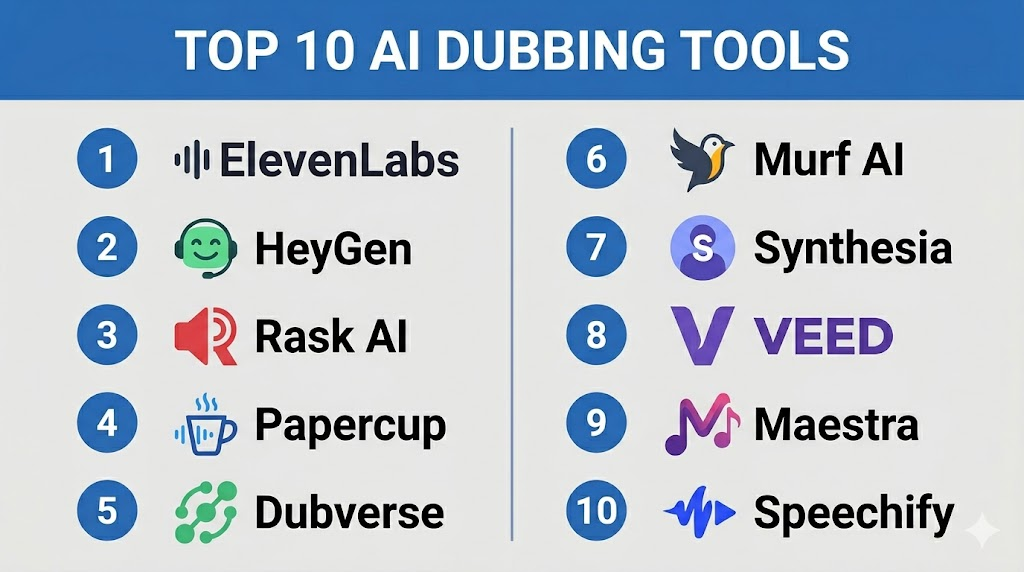
Introduction
AI Dubbing Tools help creators, businesses, educators, media teams, and marketers translate and dub video or audio content into different languages using artificial intelligence. These tools can generate translated voiceovers, preserve speaker tone, sync speech with video timing, and sometimes clone voices with permission. Instead of hiring separate translators, voice artists, editors, and localization teams for every language, AI dubbing platforms make multilingual content production faster and more scalable.AI dubbing is useful for YouTube videos, online courses, marketing videos, podcasts, training content, product demos, films, webinars, and social media videos. Modern platforms now combine speech recognition, machine translation, text-to-speech, voice cloning, lip-sync support, subtitle generation, and editing workflows into one system.Buyers should evaluate translation quality, voice realism, language support, speaker matching, lip-sync quality, editing controls, export options, security, collaboration features, and pricing structure.
Best for: Content creators, marketing teams, e-learning businesses, media companies, agencies, podcasters, corporate training teams, and global brands.
Not ideal for: Highly sensitive legal, medical, or cinematic projects that require professional human localization, cultural adaptation, or actor-directed voice performance.
Key Trends in AI Dubbing Tools
- Voice cloning is becoming more realistic and easier to use.
- Lip-sync dubbing is improving for video localization.
- Multilingual video creation is becoming faster for creators and brands.
- AI dubbing is increasingly integrated with subtitle and transcription tools.
- Enterprise teams are demanding stronger consent and voice rights controls.
- Human review workflows are becoming important for quality assurance.
- Short-form video localization is growing across social media teams.
- E-learning and training teams are using AI dubbing for global course delivery.
- AI voice libraries are expanding across accents, genders, and speaking styles.
- Brands are prioritizing consistent voice identity across multiple languages.
How We Selected These Tools
The tools in this list were selected using practical AI dubbing, localization, and content production evaluation criteria.
- Market adoption and creator/business reputation
- Dubbing quality and voice realism
- Language coverage and localization flexibility
- Voice cloning and speaker matching capabilities
- Lip-sync and timing support
- Editing workflow and collaboration features
- Export options and platform usability
- Security and voice consent controls
- Scalability for creators and enterprises
- Overall balance between quality, speed, usability, and value
Top 10 AI Dubbing Tools
1- ElevenLabs
Short Description: ElevenLabs is an AI voice and dubbing platform known for realistic synthetic voices, voice cloning, multilingual speech generation, and creator-focused audio workflows. It helps users convert scripts, videos, and audio into natural-sounding voiceovers across multiple languages. ElevenLabs is especially useful for creators, media teams, educators, and businesses that need high-quality AI voices with flexible dubbing and narration workflows.
Key Features
- AI voice generation
- Voice cloning workflows
- Multilingual dubbing
- Text-to-speech conversion
- Speech-to-speech generation
- Voice library options
- API access for developers
Pros
- Highly realistic voice quality
- Strong multilingual capabilities
- Useful for creators and enterprise workflows
Cons
- Voice cloning requires responsible usage controls
- Quality may vary by language and accent
- Advanced workflows may require careful editing
Platforms / Deployment
- Web / API
- Cloud
Security & Compliance
Supports account security, permission-based workflows, and voice usage controls. Specific compliance details vary by plan.
Integrations & Ecosystem
ElevenLabs supports creator, developer, and production workflows through API and platform-based usage.
- API integrations
- Video editing workflows
- Creator platforms
- Audio production workflows
- Developer tools
Support & Community
Provides documentation, developer resources, onboarding guidance, and customer support for creators and businesses.
2- HeyGen
Short Description: HeyGen is an AI video creation and dubbing platform focused on video translation, avatar videos, voice cloning, and multilingual content workflows. It helps users translate videos into multiple languages while supporting voice matching and lip-sync style localization. HeyGen is especially useful for marketing teams, educators, creators, and businesses that need fast video localization with polished visual results.
Key Features
- AI video translation
- Voice cloning support
- Lip-sync dubbing
- Avatar video creation
- Subtitle generation
- Multilingual video workflows
- Browser-based editing
Pros
- Strong video localization workflows
- Useful lip-sync capabilities
- Easy for non-technical users
Cons
- Advanced customization may be limited
- Voice realism varies by source quality
- Enterprise usage may require higher plans
Platforms / Deployment
- Web
- Cloud
Security & Compliance
Supports secure account workflows, access controls, and enterprise administration features depending on plan.
Integrations & Ecosystem
HeyGen fits into marketing, training, and creator video production workflows.
- Video editing workflows
- Marketing content workflows
- Training content workflows
- Creator platforms
- API workflows
Support & Community
Provides onboarding resources, tutorials, customer support, and business-focused workflow guidance.
3- Rask AI
Short Description: Rask AI is an AI dubbing and video localization platform designed to translate, dub, and adapt video content into multiple languages. It supports voice cloning, subtitles, speaker detection, and translated voiceover workflows. Rask AI is especially useful for YouTubers, educators, marketers, and businesses that regularly localize video content for global audiences.
Key Features
- AI video dubbing
- Voice cloning support
- Subtitle generation
- Speaker detection
- Multilingual translation
- Video localization workflows
- Audio editing support
Pros
- Strong focus on video dubbing
- Good workflow for creators and educators
- Helpful subtitle and translation support
Cons
- Dubbing quality may require manual review
- Voice cloning accuracy can vary
- Enterprise controls may vary by plan
Platforms / Deployment
- Web
- Cloud
Security & Compliance
Supports secure account access and content processing controls. Detailed compliance information varies by plan.
Integrations & Ecosystem
Rask AI supports video localization and creator production workflows.
- Video editing workflows
- YouTube content workflows
- E-learning workflows
- Marketing video workflows
- Export-based integrations
Support & Community
Provides onboarding resources, product guidance, tutorials, and customer support for creators and businesses.
4- Papercup
Short Description: Papercup is an AI dubbing and video localization platform focused on helping media companies, publishers, and enterprises translate video content into natural-sounding localized voiceovers. It combines AI dubbing with quality workflows designed for scalable localization. Papercup is especially useful for organizations managing large volumes of professional video content.
Key Features
- AI dubbing workflows
- Video localization
- Multilingual voiceovers
- Translation support
- Quality review workflows
- Enterprise content operations
- Scalable dubbing pipelines
Pros
- Strong fit for media and publishers
- Good scalable localization workflows
- Professional dubbing orientation
Cons
- May be more enterprise-focused
- Pricing may not suit small creators
- Detailed customization depends on workflow scope
Platforms / Deployment
- Web
- Cloud
Security & Compliance
Supports secure content workflows and enterprise access management. Specific compliance details are not publicly stated.
Integrations & Ecosystem
Papercup supports enterprise media and localization workflows.
- Media production workflows
- Publishing workflows
- Enterprise video operations
- Localization pipelines
- Export-based workflows
Support & Community
Provides enterprise onboarding, workflow support, localization guidance, and customer assistance.
5- Dubverse
Short Description: Dubverse is an AI dubbing platform designed for creators, educators, marketers, and businesses that want to translate videos into multiple languages quickly. It supports video dubbing, subtitles, AI voiceovers, and localization workflows. Dubverse is especially useful for teams creating educational, social, and business videos for multilingual audiences.
Key Features
- AI video dubbing
- Multilingual voiceovers
- Subtitle generation
- Translation workflows
- AI speaker voices
- Video localization
- Team collaboration support
Pros
- Easy multilingual dubbing workflows
- Useful for education and social content
- Good creator-friendly interface
Cons
- Voice realism may vary by language
- Advanced enterprise governance may be limited
- Manual quality review may still be needed
Platforms / Deployment
- Web
- Cloud
Security & Compliance
Supports secure account access and cloud-based content workflows. Detailed compliance details are not publicly stated.
Integrations & Ecosystem
Dubverse supports creator and business video localization workflows.
- Video editing workflows
- E-learning content workflows
- Social video workflows
- Marketing video workflows
- Export-based workflows
Support & Community
Provides onboarding guidance, tutorials, customer support, and creator-focused workflow resources.
6- Murf AI
Short Description: Murf AI is an AI voice generation and voiceover platform that supports multilingual narration, dubbing-style workflows, and professional audio creation. It helps businesses, educators, marketers, and creators produce realistic voiceovers for videos, presentations, ads, and training content. Murf AI is especially useful for teams needing polished narration rather than full cinematic dubbing.
Key Features
- AI voice generation
- Multilingual voiceovers
- Voice editing tools
- Script-based narration
- Presentation voiceovers
- Video voiceover workflows
- Voice style customization
Pros
- Easy voiceover creation
- Good for training and marketing content
- Strong narration workflow support
Cons
- Full dubbing workflows are more limited
- Lip-sync support is not the main focus
- Voice realism varies by voice and language
Platforms / Deployment
- Web
- Cloud
Security & Compliance
Supports secure account workflows, access controls, and encrypted content processing.
Integrations & Ecosystem
Murf AI fits into video, presentation, and e-learning production workflows.
- Presentation workflows
- Video editing workflows
- E-learning systems
- Marketing production workflows
- Export-based integrations
Support & Community
Provides tutorials, documentation, onboarding resources, and customer support.
7- Synthesia
Short Description: Synthesia is an AI video creation platform that supports multilingual video generation, avatars, voiceovers, and training content workflows. While best known for AI avatar videos, it also helps teams create localized video content in multiple languages. Synthesia is especially useful for corporate training, internal communications, product explainers, and enterprise learning content.
Key Features
- AI avatar videos
- Multilingual voiceovers
- Video localization workflows
- Script-based video creation
- Training video templates
- Brand controls
- Team collaboration
Pros
- Strong enterprise training workflows
- Easy multilingual video production
- Good for polished business content
Cons
- Not focused only on dubbing existing videos
- Avatar style may not suit all content
- Premium plans may be needed for scale
Platforms / Deployment
- Web
- Cloud
Security & Compliance
Supports enterprise access controls, secure content workflows, permissions management, and governance features depending on plan.
Integrations & Ecosystem
Synthesia integrates with corporate learning, marketing, and training workflows.
- LMS workflows
- Training content systems
- Marketing video workflows
- Internal communication workflows
- API integrations
Support & Community
Provides onboarding, templates, documentation, business support, and enterprise success resources.
8- VEED
Short Description: VEED is an online video editing platform that includes AI dubbing, subtitle generation, translation, voiceover, and editing workflows. It is useful for creators, marketers, agencies, and small businesses that want a browser-based tool for editing and localizing video content. VEED is especially practical for social media and short-form video production.
Key Features
- AI dubbing workflows
- Subtitle generation
- Video translation
- Online video editing
- Voiceover tools
- Social video templates
- Export controls
Pros
- Easy browser-based editing
- Good for short-form content
- Combines editing and localization
Cons
- Enterprise dubbing depth is lighter
- Voice quality varies by workflow
- Large-scale localization may require higher plans
Platforms / Deployment
- Web
- Cloud
Security & Compliance
Supports secure account access, cloud processing, and workspace permissions depending on plan.
Integrations & Ecosystem
VEED supports creator, marketing, and social video workflows.
- Social media workflows
- Video editing workflows
- Subtitle workflows
- Marketing content workflows
- Export-based workflows
Support & Community
Provides tutorials, templates, onboarding guidance, and customer support for creators and teams.
9- Maestra
Short Description: Maestra is an AI transcription, translation, subtitling, and voiceover platform designed for teams working with multilingual audio and video content. It helps users generate transcripts, translate subtitles, create voiceovers, and manage localization workflows. Maestra is useful for education, media, marketing, and corporate communication teams.
Key Features
- AI transcription
- Subtitle translation
- Voiceover generation
- Multilingual workflows
- Audio and video support
- Editing interface
- Export options
Pros
- Strong transcription and subtitle workflows
- Useful multilingual editing support
- Good for education and media teams
Cons
- Full dubbing realism may vary
- Lip-sync capabilities are limited
- Advanced enterprise workflows may need review
Platforms / Deployment
- Web
- Cloud
Security & Compliance
Supports secure account workflows and content processing controls. Detailed compliance details vary by plan.
Integrations & Ecosystem
Maestra supports media, education, and localization workflows.
- Subtitle workflows
- Video editing workflows
- E-learning content workflows
- Media production workflows
- Export-based integrations
Support & Community
Provides documentation, onboarding resources, tutorials, and customer assistance.
10- Speechify
Short Description: Speechify is an AI voice and text-to-speech platform that supports voiceover creation, narration, and multilingual audio workflows. It is useful for creators, educators, marketers, and individuals who need fast AI-generated spoken content from scripts or text. Speechify is better suited for voiceover and narration workflows than complex professional dubbing pipelines.
Key Features
- AI text-to-speech
- Multilingual voice generation
- Voiceover workflows
- Narration tools
- Audio export
- Creator-friendly interface
- Voice style options
Pros
- Easy to use
- Good narration workflows
- Useful for creators and educators
Cons
- Not a full video dubbing suite
- Limited lip-sync support
- Advanced localization workflows are lighter
Platforms / Deployment
- Web / iOS / Android
- Cloud
Security & Compliance
Supports secure account workflows and cloud-based processing. Detailed compliance information varies by plan.
Integrations & Ecosystem
Speechify supports creator, education, and audio production workflows.
- Audio production workflows
- Education workflows
- Creator tools
- Browser workflows
- Export-based integrations
Support & Community
Provides onboarding resources, app guidance, documentation, and customer support.
Comparison Table
| Tool Name | Best For | Platform(s) Supported | Deployment | Standout Feature | Public Rating |
|---|---|---|---|---|---|
| ElevenLabs | Realistic AI voice dubbing | Web, API | Cloud | High-quality voice cloning | N/A |
| HeyGen | Video translation and lip-sync | Web | Cloud | AI video localization | N/A |
| Rask AI | Creator video dubbing | Web | Cloud | Multilingual dubbing workflows | N/A |
| Papercup | Media localization | Web | Cloud | Scalable enterprise dubbing | N/A |
| Dubverse | Education and creator dubbing | Web | Cloud | Fast multilingual video dubbing | N/A |
| Murf AI | Voiceover and narration | Web | Cloud | Professional AI narration | N/A |
| Synthesia | Training video localization | Web | Cloud | AI avatar video workflows | N/A |
| VEED | Social video localization | Web | Cloud | Editing plus dubbing workflows | N/A |
| Maestra | Subtitles and voiceover | Web | Cloud | Transcription and translation support | N/A |
| Speechify | Narration and audio creation | Web, iOS, Android | Cloud | Fast text-to-speech workflows | N/A |
Evaluation & Scoring of AI Dubbing Tools
| Tool Name | Core (25%) | Ease (15%) | Integrations (15%) | Security (10%) | Performance (10%) | Support (10%) | Value (15%) | Weighted Total |
|---|---|---|---|---|---|---|---|---|
| ElevenLabs | 9.5 | 8.7 | 8.8 | 8.4 | 9.3 | 8.5 | 8.4 | 8.9 |
| HeyGen | 9.1 | 9.0 | 8.4 | 8.3 | 8.9 | 8.5 | 8.5 | 8.7 |
| Rask AI | 8.9 | 8.8 | 8.1 | 8.1 | 8.7 | 8.3 | 8.6 | 8.5 |
| Papercup | 8.8 | 8.0 | 8.3 | 8.5 | 8.8 | 8.6 | 7.9 | 8.5 |
| Dubverse | 8.4 | 8.9 | 7.9 | 8.0 | 8.3 | 8.2 | 8.8 | 8.4 |
| Murf AI | 8.3 | 9.0 | 8.0 | 8.2 | 8.5 | 8.4 | 8.6 | 8.4 |
| Synthesia | 8.7 | 8.8 | 8.4 | 8.7 | 8.6 | 8.6 | 8.1 | 8.6 |
| VEED | 8.2 | 9.2 | 8.0 | 8.0 | 8.2 | 8.3 | 8.7 | 8.4 |
| Maestra | 8.1 | 8.7 | 7.8 | 8.0 | 8.2 | 8.2 | 8.6 | 8.2 |
| Speechify | 7.9 | 9.1 | 7.7 | 8.0 | 8.2 | 8.2 | 8.7 | 8.2 |
These scores are comparative and should be used as a practical buying guide rather than absolute rankings. Tools focused on voice realism and video localization generally score higher in core capabilities, while simpler voiceover tools often score better in usability. Buyers should prioritize language quality, voice realism, editing control, consent management, and workflow fit.
Which AI Dubbing Tool Is Right for You?
Solo / Freelancer
Solo creators, YouTubers, podcasters, and educators usually need fast dubbing, affordable plans, and easy editing workflows. Rask AI, Dubverse, VEED, ElevenLabs, and Maestra are practical options depending on whether the goal is video dubbing, voiceover, subtitles, or social media localization.
SMB
SMBs often need multilingual marketing videos, product explainers, training content, and customer education materials without hiring large localization teams. HeyGen, ElevenLabs, Murf AI, VEED, and Synthesia provide strong usability and practical workflows for business content teams.
Mid-Market
Mid-market organizations usually require team collaboration, consistent brand voice, language scaling, review workflows, and better security controls. ElevenLabs, HeyGen, Rask AI, Papercup, and Synthesia are strong choices depending on content volume and localization quality requirements.
Enterprise
Enterprise organizations often require scalable localization, governance, security controls, voice consent workflows, brand consistency, and quality assurance. Papercup, ElevenLabs, Synthesia, and HeyGen are especially strong for larger teams managing multilingual content operations.
Budget vs Premium
Budget-conscious creators may prefer VEED, Dubverse, Maestra, or Speechify for simple dubbing and voiceover workflows. Premium buyers needing realistic voice cloning, lip-sync, and enterprise localization workflows may benefit more from ElevenLabs, HeyGen, Papercup, or Synthesia.
Feature Depth vs Ease of Use
ElevenLabs and Papercup provide stronger voice quality and advanced localization capabilities but may require more review and setup. VEED, Murf AI, Speechify, and Dubverse are easier for quick workflows. Buyers should choose based on whether they need production quality or speed.
Integrations & Scalability
Teams producing content at scale should evaluate API access, export formats, collaboration features, video editing compatibility, and integration with learning, marketing, and media production systems. Enterprise buyers should also review workflow governance and user management.
Security & Compliance Needs
Organizations using voice cloning or sensitive content should review consent controls, data handling policies, permissions, access management, and brand voice governance. Human review is strongly recommended for important public-facing or regulated content.
Frequently Asked Questions
1. What is an AI Dubbing Tool?
An AI Dubbing Tool uses artificial intelligence to translate and recreate spoken audio in another language or voice style. These tools usually combine speech recognition, translation, text-to-speech, speaker matching, and audio timing workflows. Some platforms also support subtitles, lip-sync, and voice cloning.
2. How does AI dubbing work?
AI dubbing generally starts by transcribing the original audio, translating the script, generating a new voiceover, and aligning the audio with the original video timing. Advanced tools may also preserve speaker tone, match voice style, and improve lip-sync. Human review is still important for accuracy and cultural quality.
3. What features should buyers prioritize first?
Buyers should prioritize language support, voice realism, translation accuracy, speaker matching, editing controls, subtitle support, export options, security, and workflow scalability. For video-heavy workflows, lip-sync and timing quality are especially important.
4. Are AI Dubbing Tools suitable for professional media?
AI dubbing can be useful for scaling professional media localization, especially for high-volume content. However, premium entertainment, legal, medical, or culturally sensitive content may still require human translators, voice actors, editors, and localization specialists for final quality assurance.
5. What is voice cloning in AI dubbing?
Voice cloning allows AI to create a synthetic voice that sounds similar to a real speaker, usually based on sample audio. This can help maintain speaker identity across languages. It should only be used with proper consent, ownership rights, and clear internal governance.
6. Can AI dubbing replace human voice actors?
AI dubbing can reduce production time and cost for many workflows, but it does not fully replace human voice actors in every situation. Human voice talent is still valuable for emotional performance, creative direction, cultural nuance, and premium storytelling. Many teams use AI for speed and humans for final refinement.
7. Which AI dubbing tools are best for YouTube creators?
Rask AI, Dubverse, VEED, HeyGen, and ElevenLabs are useful for YouTube creators because they support multilingual video localization, subtitles, voiceovers, and creator-friendly workflows. The best choice depends on whether the creator needs speed, voice realism, lip-sync, or budget-friendly editing.
8. Which AI dubbing tools are best for corporate training?
Synthesia, Murf AI, HeyGen, Papercup, and ElevenLabs are strong options for corporate training because they support multilingual learning content, narration, video localization, and scalable training workflows. Enterprises should also evaluate security, collaboration, and content governance features.
9. What are common mistakes in AI dubbing projects?
Common mistakes include skipping human review, using poor-quality source audio, ignoring cultural context, overusing literal translations, and failing to obtain consent for cloned voices. Teams should also test output across target languages before publishing widely.
10. What alternatives exist if a company does not need AI dubbing?
Alternatives include manual subtitling, professional human dubbing, traditional translation services, voiceover recording, or localized transcript publishing. For high-stakes content, human localization may be a better option. For lower-cost scaling, AI dubbing can be a practical starting point.
Conclusion
AI Dubbing Tools have become essential for creators, businesses, educators, media teams, and global brands that need to localize video and audio content faster across multiple languages. Modern platforms now combine transcription, translation, voice generation, speaker matching, subtitles, lip-sync, and editing workflows into practical systems that reduce localization time and expand audience reach. The best tool depends on content type, quality expectations, budget, language needs, voice realism, security requirements, and production scale. Creators and SMBs may prefer Rask AI, Dubverse, VEED, Murf AI, or Maestra for fast and affordable workflows, while enterprises and media teams may benefit more from ElevenLabs, Papercup, HeyGen, or Synthesia for higher-quality dubbing, stronger localization workflows, and scalable content operations. Before selecting a platform, teams should test real source videos, review translation quality, compare voice realism, confirm consent and security controls, evaluate editing flexibility, and run pilot dubbing projects before scaling multilingual content production.
