MOTOSHARE 🚗🏍️
Rent Bikes & Cars Directly from Owners
Motoshare connects vehicle owners with people who need bikes and cars on rent. Owners earn from idle vehicles, and renters get flexible ride options.
Visit Motoshare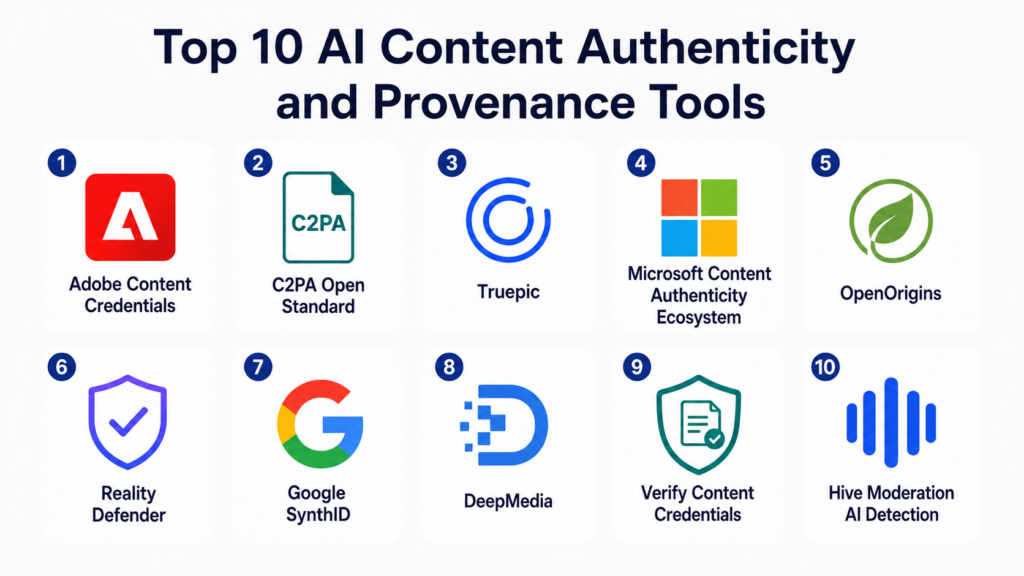
Introduction
AI content authenticity and provenance tools help organizations verify where digital content originated, whether it has been modified, and if artificial intelligence was involved in the creation process. These platforms use provenance metadata, cryptographic verification, watermarking, content credentials, and authenticity frameworks to improve trust in images, videos, audio, and documents.The category has become increasingly important because generative AI tools can now create highly realistic content at massive scale. Businesses, media companies, governments, creators, and social platforms need ways to identify authentic media and reduce the spread of manipulated or misleading content. Modern authenticity systems are now integrated into cameras, editing tools, publishing workflows, and AI generation platforms.
Common real-world use cases include:
- Verifying AI-generated images and videos
- Authenticating journalism and news content
- Tracking editing history of media assets
- Protecting enterprise marketing content
- Detecting manipulated or synthetic media
- Supporting compliance and media transparency initiatives
Buyers should evaluate:
- Provenance metadata support
- C2PA compatibility
- Watermarking capabilities
- Verification workflows
- Media format support
- Enterprise scalability
- API integrations
- AI-generated content labeling
- Tamper detection
- Auditability and governance
Best for: media organizations, enterprises, publishers, marketing teams, government agencies, creators, cloud-native media platforms, and businesses managing large digital content operations.
Not ideal for: organizations with minimal digital media workflows, businesses that only need basic watermarking, or teams without AI-generated content concerns.
Key Trends in AI Content Authenticity and Provenance Tools
- C2PA standards are becoming the primary framework for provenance metadata.
- AI-generated content labeling is expanding across publishing ecosystems.
- Creative software vendors are embedding content credentials directly into workflows.
- Enterprises are integrating provenance into digital asset management systems.
- Deepfake detection and provenance verification are increasingly combined together.
- Watermarking technologies are evolving alongside cryptographic verification.
- Media organizations are adopting authenticity workflows to improve public trust.
- Camera and mobile device manufacturers are adding secure metadata capabilities.
- AI governance regulations are increasing demand for content transparency.
- Provenance verification is becoming part of enterprise compliance strategies.
How We Selected These Tools Methodology
The tools in this list were selected based on practical relevance for AI content authenticity, provenance verification, and enterprise media trust workflows.
Selection factors included:
- Market adoption and ecosystem momentum
- Provenance and metadata capabilities
- Compatibility with authenticity standards
- Enterprise deployment readiness
- AI-generated content verification support
- Media workflow integrations
- API flexibility and scalability
- Documentation and onboarding quality
- Community and ecosystem support
- Practical use across publishing and enterprise environments
Top 10 AI Content Authenticity and Provenance Tools
#1 — Adobe Content Credentials
Short description: Adobe Content Credentials is one of the leading provenance systems for digital content authenticity. It allows creators and organizations to attach tamper-evident metadata that records how media was created and edited. The platform integrates deeply into Adobe Creative Cloud applications and enterprise publishing workflows. It is widely used for AI transparency and media authenticity initiatives.
Key Features
- Provenance metadata support
- AI-generated content disclosure
- Editing history tracking
- Tamper-evident credentials
- Creative workflow integration
- Media verification support
- Enterprise publishing compatibility
Pros
- Strong ecosystem adoption
- Excellent integration with creative workflows
- Mature provenance infrastructure
Cons
- Best experience inside Adobe ecosystem
- Enterprise deployment may require workflow changes
- Verification visibility depends on platform support
Platforms / Deployment
- Windows / macOS / Web
- Cloud / Hybrid
Security & Compliance
- Cryptographic metadata
- Tamper-evident credentials
- Identity-linked provenance
- Compliance certifications: Not publicly stated
Integrations & Ecosystem
Adobe Content Credentials integrates into media production, publishing, and digital asset management workflows. It is strongly aligned with enterprise creative ecosystems.
- Adobe Photoshop
- Adobe Premiere Pro
- Adobe Firefly
- Creative Cloud
- Enterprise publishing workflows
- Content authenticity ecosystems
Support & Community
Strong enterprise adoption with mature documentation and broad creative industry support.
#2 — C2PA Open Standard
Short description: C2PA is one of the most important open standards for digital content provenance and authenticity. It defines how provenance metadata should be attached, verified, and shared across platforms and workflows. The standard is supported by major technology, media, and AI organizations. It acts as the foundation for many authenticity and provenance systems.
Key Features
- Open provenance standard
- Tamper-evident metadata
- Cross-platform verification
- Editing history support
- AI disclosure compatibility
- Cryptographic manifests
- Interoperable verification workflows
Pros
- Strong industry support
- Open interoperability model
- Broad ecosystem relevance
Cons
- Not a standalone product
- Platform support varies
- End-user visibility still evolving
Platforms / Deployment
- Windows / macOS / Linux / Web
- Cloud / Self-hosted / Hybrid
Security & Compliance
- Cryptographic provenance
- Metadata verification
- Tamper-evident manifests
- Compliance certifications: Not publicly stated
Integrations & Ecosystem
C2PA integrates across media editing, publishing, verification, and AI generation ecosystems.
- Creative software platforms
- Verification tools
- Camera manufacturers
- Publishing workflows
- Enterprise media systems
Support & Community
Strong global ecosystem support with growing enterprise and media adoption.
#3 — Truepic
Short description: Truepic provides secure image and video authenticity verification infrastructure. The platform combines trusted capture workflows, metadata integrity, and provenance verification to validate digital content authenticity. It is commonly used in insurance, enterprise verification, and media integrity environments.
Key Features
- Secure image capture
- Provenance verification
- Metadata integrity validation
- Mobile verification workflows
- Chain-of-custody support
- Enterprise APIs
- Trusted media workflows
Pros
- Strong enterprise verification capabilities
- Useful for trusted capture workflows
- Good API flexibility
Cons
- More enterprise-focused than creator-focused
- Controlled capture environments may be required
- Workflow integration effort varies
Platforms / Deployment
- iOS / Android / Web
- Cloud / Hybrid
Security & Compliance
- Secure capture workflows
- Metadata protection
- Provenance validation
- Compliance certifications: Not publicly stated
Integrations & Ecosystem
Truepic integrates with enterprise verification workflows and digital trust systems. It is often used in industries requiring trusted visual evidence.
- Enterprise APIs
- Verification systems
- Insurance workflows
- Media validation systems
- Mobile applications
Support & Community
Strong enterprise support model with growing adoption across verification-focused industries.
#4 — Microsoft Content Authenticity Ecosystem
Short description: Microsoft supports AI content authenticity and provenance workflows through enterprise cloud and AI ecosystems. The company participates heavily in provenance standards and digital trust initiatives. Microsoft’s ecosystem is especially useful for organizations building enterprise-scale authenticity workflows integrated with cloud infrastructure.
Key Features
- Provenance support
- Enterprise AI workflow integration
- Identity-linked metadata
- Cloud-native governance support
- Verification workflows
- AI transparency capabilities
- Enterprise-scale deployment support
Pros
- Strong enterprise ecosystem
- Broad cloud integration potential
- Large-scale deployment support
Cons
- Features vary across products
- Less creator-centric than Adobe
- Verification workflows differ by platform
Platforms / Deployment
- Windows / Web / Cloud
- Cloud / Hybrid
Security & Compliance
- Identity-linked workflows
- Provenance support
- Enterprise governance controls
- Compliance certifications vary by deployment
Integrations & Ecosystem
Microsoft integrates authenticity workflows into enterprise cloud and AI ecosystems.
- Microsoft Azure
- Enterprise AI systems
- Cloud workflows
- Publishing platforms
- Identity systems
Support & Community
Strong enterprise support backed by Microsoft cloud infrastructure and developer ecosystem.
#5 — OpenOrigins
Short description: OpenOrigins focuses on image and visual media authenticity verification. The platform helps organizations validate media provenance and reduce misinformation risks through trusted authenticity workflows. It is useful for publishers, enterprises, and organizations handling high-value media assets.
Key Features
- Image authenticity verification
- Provenance metadata support
- Tamper detection
- Chain-of-custody workflows
- Media verification APIs
- Publishing workflow compatibility
- Enterprise deployment support
Pros
- Strong focus on visual authenticity
- Useful for media publishing workflows
- Good verification capabilities
Cons
- Smaller ecosystem than major platforms
- Enterprise adoption still growing
- Workflow customization may be needed
Platforms / Deployment
- Web / Cloud environments
- Cloud / Hybrid
Security & Compliance
- Metadata verification
- Provenance validation
- Tamper detection
- Compliance certifications: Not publicly stated
Integrations & Ecosystem
OpenOrigins fits into enterprise publishing and authenticity verification systems.
- Publishing workflows
- Verification APIs
- Enterprise media systems
- Digital asset platforms
- Provenance ecosystems
Support & Community
Growing enterprise interest with increasing visibility in media authenticity initiatives.
#6 — Reality Defender
Short description: Reality Defender specializes in AI-generated media detection and authenticity analysis. It helps enterprises identify manipulated, synthetic, or AI-generated content across multiple media formats. The platform is widely used for enterprise media risk management and deepfake detection workflows.
Key Features
- Deepfake detection
- AI-generated media analysis
- Multi-modal verification
- Enterprise APIs
- Audio and video analysis
- Risk scoring workflows
- Media monitoring support
Pros
- Strong AI detection capabilities
- Supports multiple media types
- Useful for enterprise monitoring
Cons
- More detection-focused than provenance-focused
- Requires operational tuning
- False positives may require manual review
Platforms / Deployment
- Web / Cloud
- Cloud / Hybrid
Security & Compliance
- AI-generated media detection
- Risk analysis workflows
- Enterprise monitoring support
- Compliance certifications: Not publicly stated
Integrations & Ecosystem
Reality Defender integrates into enterprise content monitoring and authenticity workflows.
- Enterprise APIs
- Monitoring systems
- Security platforms
- Media analysis workflows
Support & Community
Strong enterprise-oriented support with growing adoption in AI risk management.
#7 — Google SynthID
Short description: Google SynthID is an AI watermarking technology designed to identify AI-generated content. It embeds invisible markers into generated media to support authenticity and disclosure workflows. The platform is primarily connected to Google AI generation ecosystems and watermark verification initiatives.
Key Features
- AI watermarking
- Invisible watermark embedding
- AI-generated content labeling
- Multi-modal support
- Verification workflows
- AI ecosystem compatibility
- Detection support
Pros
- Strong AI ecosystem alignment
- Useful for generated media identification
- Supports multiple content formats
Cons
- Closely tied to Google ecosystem
- Watermark durability varies
- Industry adoption still evolving
Platforms / Deployment
- Web / Cloud
- Cloud
Security & Compliance
- Watermark-based verification
- AI labeling support
- Compliance certifications: Not publicly stated
Integrations & Ecosystem
SynthID works primarily with AI generation and verification workflows.
- Google AI systems
- AI content workflows
- Verification systems
- Media generation environments
Support & Community
Strong visibility due to Google ecosystem support and growing AI governance discussions.
#8 — DeepMedia
Short description: DeepMedia provides AI-generated content detection and media authenticity analysis tools. The platform helps organizations identify manipulated media before publication or distribution. It is commonly used in enterprise media monitoring and trust-focused workflows.
Key Features
- Deepfake detection
- Media authenticity analysis
- AI-generated content detection
- Audio verification
- Video analysis
- Enterprise APIs
- Monitoring workflows
Pros
- Strong media analysis capabilities
- Useful for AI-generated content detection
- Good enterprise workflow support
Cons
- Detection-focused rather than provenance-focused
- Workflow integration effort varies
- Confidence levels differ by media type
Platforms / Deployment
- Web / Cloud
- Cloud / Hybrid
Security & Compliance
- Media verification support
- AI-generated content analysis
- Compliance certifications: Not publicly stated
Integrations & Ecosystem
DeepMedia integrates into enterprise media analysis and monitoring environments.
- Enterprise APIs
- Monitoring systems
- Media workflows
- Risk management platforms
Support & Community
Growing enterprise adoption among organizations focused on media trust and authenticity.
#9 — Verify Content Credentials
Short description: Verify Content Credentials is a verification platform for inspecting provenance metadata and authenticity records attached to digital content. It helps publishers, creators, and users understand how media was created and edited. The platform supports transparency-focused verification workflows.
Key Features
- Provenance inspection
- Content credential verification
- Editing history visibility
- Metadata validation
- AI disclosure visibility
- Web-based verification
- Transparency workflows
Pros
- Easy verification experience
- Useful for transparency initiatives
- Good educational value
Cons
- Primarily verification-focused
- Limited enterprise governance features
- Depends on available metadata
Platforms / Deployment
- Web
- Cloud
Security & Compliance
- Metadata verification
- Provenance validation
- Tamper-evident inspection
- Compliance certifications: Not publicly stated
Integrations & Ecosystem
The platform integrates closely with provenance and authenticity ecosystems.
- Content authenticity systems
- Verification workflows
- Publishing ecosystems
- Provenance tools
Support & Community
Strong ecosystem visibility with useful public-facing verification workflows.
#10 — Hive Moderation AI Detection
Short description: Hive Moderation provides AI-generated content detection and authenticity analysis capabilities for enterprises and online platforms. It helps organizations identify manipulated, synthetic, or AI-generated media across multiple content formats. The platform is commonly used in moderation and media governance workflows.
Key Features
- AI-generated content detection
- Deepfake analysis
- Multi-modal scanning
- Enterprise moderation APIs
- Automated risk scoring
- Content analysis workflows
- Large-scale media processing
Pros
- Strong moderation-focused capabilities
- Useful for large-scale content analysis
- Good API integration support
Cons
- Detection-focused rather than provenance-focused
- False positives may require review
- Workflow tuning may be needed
Platforms / Deployment
- Web / Cloud
- Cloud / Hybrid
Security & Compliance
- AI-generated content analysis
- Media authenticity workflows
- Compliance certifications: Not publicly stated
Integrations & Ecosystem
Hive Moderation integrates into enterprise moderation and AI content governance systems.
- Enterprise APIs
- Moderation workflows
- Platform governance systems
- Media analysis tools
Support & Community
Strong enterprise-focused support with growing adoption across moderation and media platforms.
Comparison Table Top 10
| Tool Name | Best For | Platform Supported | Deployment | Standout Feature | Public Rating |
|---|---|---|---|---|---|
| Adobe Content Credentials | Creative media provenance | Windows, macOS, Web | Cloud, Hybrid | Integrated provenance metadata | N/A |
| C2PA Open Standard | Provenance interoperability | Windows, macOS, Linux, Web | Hybrid | Open authenticity standard | N/A |
| Truepic | Trusted image verification | iOS, Android, Web | Cloud, Hybrid | Secure media capture | N/A |
| Microsoft Content Authenticity Ecosystem | Enterprise authenticity workflows | Windows, Web | Cloud, Hybrid | Enterprise cloud integration | N/A |
| OpenOrigins | Media authenticity validation | Web | Cloud, Hybrid | Visual provenance workflows | N/A |
| Reality Defender | Deepfake detection | Web | Cloud, Hybrid | Multi-modal AI analysis | N/A |
| Google SynthID | AI watermarking | Web | Cloud | Invisible AI watermarking | N/A |
| DeepMedia | AI-generated media analysis | Web | Cloud, Hybrid | Deepfake analysis workflows | N/A |
| Verify Content Credentials | Provenance verification | Web | Cloud | Credential inspection workflows | N/A |
| Hive Moderation AI Detection | Enterprise AI moderation | Web | Cloud, Hybrid | Large-scale media analysis | N/A |
Evaluation & Scoring of AI Content Authenticity and Provenance Tools
| Tool Name | Core 25% | Ease 15% | Integrations 15% | Security 10% | Performance 10% | Support 10% | Value 15% | Weighted Total |
|---|---|---|---|---|---|---|---|---|
| Adobe Content Credentials | 9 | 8 | 9 | 9 | 8 | 9 | 8 | 8.55 |
| C2PA Open Standard | 9 | 7 | 9 | 9 | 8 | 8 | 9 | 8.45 |
| Truepic | 8 | 8 | 8 | 9 | 8 | 8 | 8 | 8.05 |
| Microsoft Content Authenticity Ecosystem | 8 | 7 | 8 | 8 | 8 | 8 | 8 | 7.90 |
| OpenOrigins | 8 | 7 | 7 | 8 | 8 | 7 | 8 | 7.65 |
| Reality Defender | 8 | 8 | 8 | 8 | 8 | 8 | 7 | 7.90 |
| Google SynthID | 8 | 8 | 7 | 8 | 8 | 8 | 8 | 7.85 |
| DeepMedia | 8 | 7 | 7 | 8 | 8 | 7 | 8 | 7.60 |
| Verify Content Credentials | 7 | 9 | 7 | 8 | 7 | 7 | 9 | 7.75 |
| Hive Moderation AI Detection | 8 | 8 | 8 | 8 | 8 | 8 | 7 | 7.90 |
These scores are comparative rather than absolute. Some platforms focus more on provenance and metadata integrity, while others specialize in AI-generated media detection or watermarking. Organizations should evaluate whether they primarily need content provenance, AI-generated media detection, moderation workflows, or enterprise governance before selecting a solution.
Which AI Content Authenticity and Provenance Tool Is Right for You?
Solo / Freelancer
Independent creators, journalists, and publishers should prioritize tools that are easy to adopt and integrate into existing workflows. Adobe Content Credentials and Verify Content Credentials are strong choices because they provide transparency and provenance visibility without requiring heavy infrastructure.
SMB
Small and medium-sized businesses should focus on practical authenticity controls that fit publishing, marketing, and media workflows. Adobe Content Credentials, Truepic, and Reality Defender offer a good balance between provenance tracking and AI-generated media verification.
Mid-Market
Mid-market organizations should combine provenance metadata with AI-generated content detection. Platforms such as OpenOrigins, Reality Defender, and enterprise authenticity ecosystems provide stronger governance and verification workflows.
Enterprise
Enterprises need scalable provenance management, AI-generated media analysis, governance controls, and auditability. Adobe Content Credentials, C2PA-based systems, Microsoft ecosystems, and enterprise AI detection platforms are strong options for large-scale deployment.
Budget vs Premium
Open standards such as C2PA provide flexibility and interoperability, while enterprise platforms add workflow management, APIs, governance controls, and support services. Smaller organizations can begin with verification workflows and later expand into enterprise-scale authenticity systems.
Feature Depth vs Ease of Use
Adobe Content Credentials and Verify Content Credentials are easier for creators and publishing teams to adopt quickly. Enterprise AI analysis and deepfake detection platforms provide more advanced capabilities but may require more operational maturity and workflow integration.
Integrations & Scalability
Organizations with large publishing or media operations should prioritize tools that integrate into content management systems, cloud platforms, AI workflows, and digital asset management environments. Enterprise workflow integration is especially important for scalable authenticity verification.
Security & Compliance Needs
Security-sensitive organizations should prioritize provenance metadata, tamper-evident verification, auditability, and AI-generated content disclosure workflows. Enterprises in media, journalism, government, and regulated industries should validate governance and verification controls carefully before deployment.
Frequently Asked Questions FAQs
1. What are AI content authenticity tools?
AI content authenticity tools help verify whether digital media is authentic, AI-generated, edited, or manipulated. They use technologies such as provenance metadata, watermarking, verification workflows, and cryptographic records to improve trust in digital content. These tools are increasingly important for publishers, enterprises, and media organizations.
2. What is provenance in digital media?
Provenance refers to information about where digital content originated and how it was created or edited. Provenance metadata may include editing history, creation tools, timestamps, and AI involvement. This helps users and organizations understand whether media can be trusted.
3. What is C2PA?
C2PA is an open standard designed to support content provenance and authenticity. It defines how metadata and authenticity records can be attached to digital content and verified across platforms. Many major technology and media organizations support the standard.
4. Are provenance tools the same as deepfake detection tools?
No. Provenance tools focus on proving the origin and editing history of content, while deepfake detection tools analyze content for signs of AI generation or manipulation. Many organizations combine both approaches because they solve different trust problems.
5. Can provenance metadata be removed?
Yes. Metadata can sometimes be removed during editing, compression, screenshots, or reposting workflows. This is why ecosystem-wide support and verification workflows are important. Provenance systems work best when platforms preserve authenticity metadata consistently.
6. Why are AI content authenticity tools becoming important?
Generative AI systems can create realistic images, videos, and audio very quickly and at large scale. This increases the risk of misinformation, manipulated media, and trust issues. Authenticity tools help organizations prove content origin and improve transparency.
7. Is watermarking enough for AI content verification?
Watermarking alone is usually not enough because watermarks can sometimes be altered or removed. Stronger authenticity systems combine watermarking with provenance metadata, cryptographic verification, and content credentials. A layered approach generally provides better trust.
8. Which industries benefit most from authenticity and provenance systems?
Media organizations, journalism platforms, marketing agencies, governments, legal sectors, and enterprise publishing workflows benefit the most. These industries often face higher risks from manipulated or AI-generated media.
9. What are the biggest challenges in AI content provenance?
The biggest challenges include inconsistent platform support, metadata removal during sharing, interoperability limitations, and limited public awareness. Organizations also need workflows that balance transparency with operational simplicity.
10. What is the best way to start with authenticity workflows?
Organizations should begin with high-value media workflows and gradually add provenance metadata and verification processes. Creative teams often start with content credentials, while enterprises may later expand into AI-generated media analysis and governance systems.
Conclusion
AI content authenticity and provenance tools are becoming essential for organizations that need to establish trust in digital media workflows. As generative AI expands across images, audio, video, and publishing ecosystems, businesses increasingly need reliable ways to verify how content was created and whether it has been manipulated. Adobe Content Credentials and the broader C2PA ecosystem currently lead much of the market momentum because they provide interoperable provenance standards and tamper-evident metadata workflows. Platforms such as Truepic, Reality Defender, Google SynthID, and DeepMedia strengthen AI-generated media analysis and authenticity verification capabilities. The best solution depends on whether your organization prioritizes provenance tracking, AI-generated content labeling, deepfake detection, enterprise governance, or secure media capture.

Incorporating comprehensive unique automated digital asset verification cryptographic tracking platform software optimizes corporate media publishing workflow mechanics, ensuring rapid decentralized content origin validity auditing and frictionless commercial communication marketing trust validation methodologies.