MOTOSHARE 🚗🏍️
Rent Bikes & Cars Directly from Owners
Motoshare connects vehicle owners with people who need bikes and cars on rent. Owners earn from idle vehicles, and renters get flexible ride options.
Visit Motoshare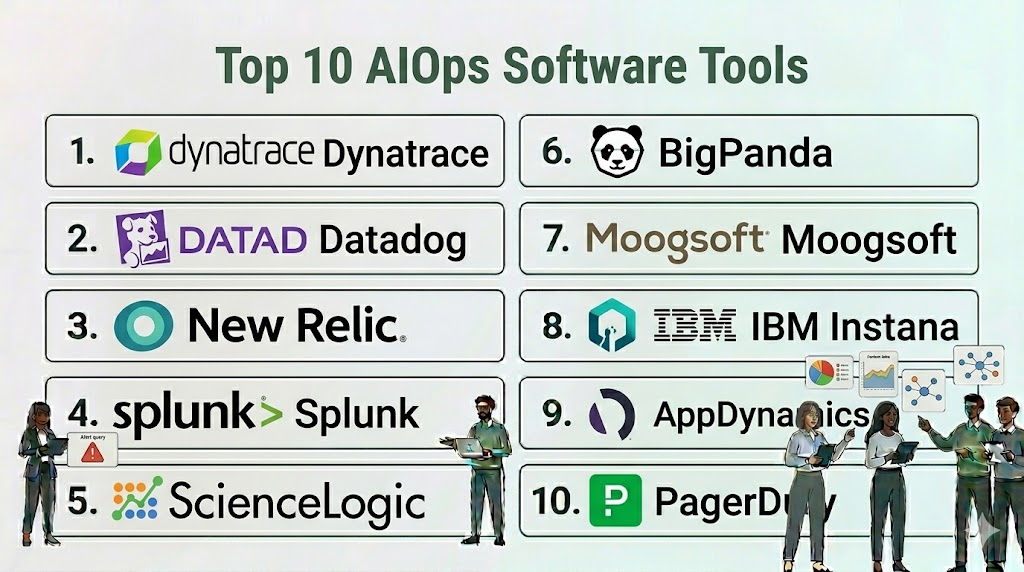
Introduction
AIOps, or Artificial Intelligence for IT Operations, represents the convergence of big data, machine learning, and advanced analytics to automate and improve IT operational processes. In plain English, these platforms act as an intelligent layer that sits above an organization’s entire digital infrastructure. They ingest massive volumes of telemetry data—including logs, metrics, events, and traces—to identify patterns that a human eye would likely miss. By shifting from reactive “firefighting” to proactive management, AIOps platforms allow IT teams to predict system failures, identify the root cause of complex outages, and automate remediations.
In a modern technological landscape, AIOps has become a necessity rather than a luxury. As businesses migrate to multi-cloud environments, microservices, and serverless architectures, the sheer volume of data generated is too vast for manual monitoring. AIOps platforms provide the “computational peripheral vision” required to maintain system uptime and performance. These tools use predictive modeling to forecast capacity needs and causal AI to understand exactly how a failure in one microservice might cascade through an entire global network.
Real-world use cases for these platforms include:
- Predictive Incident Management: Detecting anomalies in server performance that indicate a coming crash hours before it occurs.
- Intelligent Alert Correlation: Grouping thousands of redundant alerts into a single, actionable incident to reduce “noise.”
- Automated Root Cause Analysis: Instantly pinpointing the exact line of code or specific hardware failure responsible for an outage.
- Dynamic Thresholding: Automatically adjusting performance benchmarks based on historical usage patterns (e.g., higher traffic during a holiday sale).
- Cloud Cost Optimization: Identifying idle or over-provisioned resources to reduce monthly cloud expenditure without impacting performance.
When evaluating an AIOps platform, buyers should prioritize the following criteria:
- Data Ingestion Breadth: Can the platform ingest data from both legacy on-premises servers and modern cloud-native stacks?
- Noise Reduction Efficiency: How effectively does the platform suppress redundant alerts?
- Algorithmic Transparency: Does the platform offer “Explainable AI” so the team understands why a specific root cause was identified?
- Deployment Flexibility: Support for SaaS, on-premises, or hybrid cloud environments.
- Time to Value: How quickly can the machine learning models be trained to provide accurate insights?
- Extensibility: The availability of APIs and pre-built integrations with the existing IT Service Management (ITSM) stack.
- Automation Maturity: The capability to execute “closed-loop” remediations, where the system fixes the problem it identifies.
- Security and Compliance: Does the platform meet global data privacy and residency requirements?
Best for: Large-scale enterprises, DevOps-heavy organizations, Managed Service Providers (MSPs), and high-growth technology companies managing complex distributed systems.
Not ideal for: Small businesses with static, low-complexity websites or organizations that lack the data volume required to effectively train an artificial intelligence model.
Key Trends in AIOps Platforms
- Generative AI for Operations: Integration of natural language interfaces allows engineers to ask conversational questions about system health and receive summarized explanations.
- Causal AI Adoption: A shift from simple correlation (Event A happened with Event B) to causation (Event A caused Event B), leading to significantly higher accuracy in root cause analysis.
- Shift-Left AIOps: Using AI models during the pre-production and testing phases to predict how new code deployments will affect system stability.
- Edge AIOps Deployment: Moving AI models closer to the data source (edge devices) to process telemetry locally, reducing latency and cloud egress costs.
- Autonomous Remediation: An increasing focus on self-healing systems that can execute complex multi-step scripts to resolve common IT issues without human intervention.
- FinOps and AIOps Convergence: AIOps platforms are taking on a larger role in financial management, automatically scaling resources down during low-traffic periods to maximize ROI.
- Sustainable IT Monitoring: Platforms are beginning to monitor the energy consumption of data centers, helping companies align IT operations with environmental sustainability goals.
- Observability-Driven AIOps: The merging of traditional monitoring with deep observability (tracing and logging) to provide the AI with richer context for decision-making.
How We Selected These Tools (Methodology)
To determine the top 10 AIOps platforms for this guide, we applied a rigorous selection methodology based on professional industry standards:
- Market Presence and Reliability: We prioritized platforms with a proven track record in high-stakes enterprise environments.
- Technological Sophusiasm: We evaluated the maturity of the underlying machine learning engines and their ability to handle real-time data streams.
- Ease of Integration: We analyzed how well each tool connects with common monitoring and ticketing ecosystems like ServiceNow, Slack, and Jira.
- Automation Capabilities: A higher weight was given to tools that offer advanced automated remediation and self-healing features.
- User Experience: We assessed the quality of the dashboards and the ease with which technical and non-technical stakeholders can extract insights.
- Scalability Signals: We looked for platforms capable of processing millions of events per second without significant performance degradation.
- Security Posture: We verified the presence of enterprise-grade security protocols, including encryption and robust access controls.
Top 10 AIOps Software Tools
#1 — Dynatrace
Short description: A high-end observability and security platform that uses a deterministic AI engine named Davis to provide precise root-cause analysis and automated remediation for enterprise-scale environments.
Key Features
- Davis AI Engine: Unlike traditional black-box AI, Davis provides precise answers rather than just guesses or correlations.
- OneAgent Technology: A single agent that automatically discovers and instruments every component of the tech stack without manual configuration.
- Smartscape Topology: Provides a live map of the entire environment, showing exactly how every service and host is connected.
- Cloud Automation: Built-in tools for automated quality gates and self-healing in development and production environments.
- Application Security: Real-time vulnerability detection that correlates security risks with actual application performance.
Pros
- Extremely high accuracy in identifying the specific root cause of failures.
- Significant reduction in administrative overhead due to full-stack automation.
Cons
- Premium pricing model that targets larger enterprise budgets.
- Requires a shift in mindset to fully trust the deterministic AI results.
Platforms / Deployment
- Web / Windows / macOS / Linux
- Cloud / Managed / Hybrid
Security & Compliance
- SSO/SAML, RBAC, End-to-end encryption
- SOC 2, ISO 27001, HIPAA, GDPR compliant
Integrations & Ecosystem
Dynatrace offers an extensive marketplace with hundreds of pre-built integrations designed to fit into modern DevOps pipelines.
- ServiceNow
- Kubernetes
- AWS / Azure / GCP
- Slack / PagerDuty
Support & Community
Comprehensive professional support, a dedicated university platform for training, and an active global user group for sharing best practices.
#2 — Datadog
Short description: A modern, cloud-scale monitoring and security platform that provides full-stack visibility. Its Watchdog AI features automate anomaly detection and correlation for fast-moving engineering teams.
Key Features
- Watchdog AI: Automatically detects anomalies and outliers across metrics, traces, and logs without manual setup.
- Service Map: Real-time visualization of dependencies between microservices, including health status and traffic volume.
- Log Management: Seamlessly correlates log data with application performance metrics to speed up debugging.
- Synthetic Monitoring: Monitors critical user journeys from multiple global locations to identify regional performance issues.
- Cloud Cost Management: Directly links cloud expenditure to specific infrastructure and application performance.
Pros
- Incredibly fast setup and intuitive UI that is a favorite among DevOps engineers.
- Unified platform that combines monitoring, security, and AIOps in one interface.
Cons
- The billing model is complex and can lead to unexpected costs as more features are enabled.
- Alerting can become noisy if not properly tuned during the initial deployment phase.
Platforms / Deployment
- Web / Windows / macOS / Linux / iOS / Android
- Cloud-native (SaaS)
Security & Compliance
- MFA, SSO/SAML, RBAC
- SOC 2, ISO 27001, HIPAA compliant
Integrations & Ecosystem
Datadog boasts one of the largest integration libraries in the industry, covering nearly every modern technology.
- GitHub / GitLab
- Slack / Microsoft Teams
- Terraform / Ansible
- Every major cloud provider
Support & Community
Strong online community, extensive documentation, and a highly active Slack community for technical support and networking.
#3 — New Relic
Short description: An all-in-one observability platform that centralizes data from across the stack. Its AIOps features focus on alert correlation and root-cause analysis to reduce MTTR (Mean Time To Resolution).
Key Features
- Applied Intelligence: A machine learning engine that automatically groups related alerts and identifies anomalies.
- Errors Details: Provides deep code-level visibility into application errors with stack traces and local variable data.
- Infrastructure Monitoring: Real-time visibility into the health of servers, containers, and cloud services.
- NRQL Query Language: A powerful SQL-like language for performing custom real-time analytics on telemetry data.
- Browser Monitoring: Detailed insights into front-end performance and the actual end-user experience.
Pros
- Transparent, consumption-based pricing that allows teams to scale data ingestion flexibly.
- Strong focus on Application Performance Monitoring (APM) with deep historical data.
Cons
- The user interface can feel cluttered due to the massive volume of data it displays.
- Certain advanced AIOps features require manual configuration and “training” to reach peak accuracy.
Platforms / Deployment
- Web / Windows / macOS / Linux
- Cloud (SaaS)
Security & Compliance
- SSO/SAML, RBAC, Data masking
- SOC 2, ISO 27001 compliant
Integrations & Ecosystem
New Relic integrates with the full DevOps toolchain to ensure visibility from code to cloud.
- ServiceNow
- Jira
- PagerDuty
- Kubernetes
Support & Community
Offers a robust developer hub, tiered support models, and a community forum with millions of contributors.
#4 — Splunk
Short description: A leading data analytics platform for IT and security. Its IT Service Intelligence (ITSI) module provides powerful AIOps capabilities to predict and resolve issues using big data.
Key Features
- Splunk ITSI: A premium AIOps solution for monitoring health and predicting service levels through machine learning.
- Predictive Analytics: Uses historical trends to forecast service outages up to 30 minutes in advance.
- Event Analytics: Automatically aggregates and correlates thousands of events into single, high-level notable incidents.
- Universal Forwarder: A lightweight agent for collecting data from virtually any hardware or software source.
- Search Processing Language (SPL): An industry-standard language for searching and analyzing petabytes of data in real-time.
Pros
- Unmatched flexibility; if it generates a log, Splunk can analyze and correlate it.
- Proven reliability in massive, multi-national enterprise environments.
Cons
- Expensive pricing that often requires a dedicated team to manage data ingestion costs.
- Steep learning curve for the SPL language and complex system administration.
Platforms / Deployment
- Web / Windows / macOS / Linux
- Cloud / Self-hosted / Hybrid
Security & Compliance
- SSO/SAML, MFA, RBAC, Encryption
- SOC 2, FedRAMP, HIPAA, PCI DSS compliant
Integrations & Ecosystem
Splunk has one of the largest app stores (Splunkbase) with thousands of partner-built integrations for every niche.
- ServiceNow
- Cisco
- AWS / GCP / Azure
- Salesforce
Support & Community
Premium enterprise support, extensive global training programs, and a massive community of certified administrators and architects.
#5 — ScienceLogic
Short description: An AIOps platform that specializes in “context-infused” data for hybrid-cloud infrastructure management. It excels at mapping relationships between disparate systems to provide clear operational views.
Key Features
- SL1 Platform: Automates data collection across silos to create a real-time, clean operational data lake.
- Behavioral Correlation: Identifies anomalies by comparing live performance against dynamic historical baselines.
- Relationship Mapping: Automatically discovers dependencies between hardware, software, and business services.
- Automated Incident Enrichment: Automatically adds diagnostic data to tickets to speed up human intervention.
- Skylar AI: An integrated AI engine focused on predictive analysis and automated troubleshooting workflows.
Pros
- Excellent for managing complex, heterogeneous environments that mix legacy and modern tools.
- Strong focus on business service impact, showing exactly how a server failure affects a specific business process.
Cons
- The initial configuration and setup can be complex for very large organizations.
- The UI feels more traditional and “enterprise” compared to sleeker cloud-native tools.
Platforms / Deployment
- Web / Linux
- Cloud / Self-hosted / Hybrid
Security & Compliance
- SSO, MFA, Encryption at rest
- SOC 2, ISO 27001, FIPS 140-2 compliant
Integrations & Ecosystem
ScienceLogic is designed to be the “manager of managers,” integrating with a wide variety of secondary monitoring tools.
- ServiceNow
- VMware / Nutanix
- Amazon Web Services
- Microsoft Azure
Support & Community
High-quality professional services, dedicated customer success programs, and a growing community of infrastructure managers.
#6 — BigPanda
Short description: A specialized AIOps event correlation platform that sits above existing monitoring tools to organize and automate incident response for large enterprises.
Key Features
- Open Box AI: An “explainable” AI engine that shows the logic behind why alerts were grouped together.
- Unified Analytics: Consolidates alerts from dozens of different monitoring tools into a single, unified view.
- Root Cause Analysis: Automatically pinpoints the “likely” cause of an outage by correlating recent changes with incoming alerts.
- Incident Timeline: Provides a visual history of how an incident evolved across different systems and teams.
- Self-Service Automation: Allows IT teams to build their own correlation and automation rules using a simple UI.
Pros
- Does not require replacing existing tools; it acts as a “glue” that makes the entire monitoring stack more efficient.
- Extremely high noise reduction rates, often exceeding 90% in messy IT environments.
Cons
- It is not a standalone monitoring tool; it requires data from tools like Nagios, Zabbix, or Splunk.
- Smaller ecosystem compared to “all-in-one” giants like Dynatrace.
Platforms / Deployment
- Web
- Cloud-native (SaaS)
Security & Compliance
- SSO/SAML, RBAC, Encryption
- SOC 2 Type II compliant
Integrations & Ecosystem
BigPanda is designed to be the central nervous system for the modern Network Operations Center (NOC).
- ServiceNow / Jira
- Nagios / Zabbix
- SolarWinds
- AppDynamics
Support & Community
Dedicated customer success managers and white-glove onboarding for enterprise teams.
#7 — Moogsoft
Short description: A pioneer in the AIOps space that focuses on algorithmic noise reduction and anomaly detection to keep mission-critical services running without interruption.
Key Features
- Algorithmic Noise Reduction: Uses patented machine learning to separate signals from the background noise in real-time.
- Probable Root Cause: Scores potential causes of an incident to lead responders directly to the problem area.
- Collaborative Situations: Groups alerts into “Situations” and provides a virtual workspace for teams to collaborate on the fix.
- Workflow Automation: Triggers external actions like ticketing or automated scripts based on AI-driven insights.
- Data Neutrality: Ingests data from any source without requiring proprietary agents or specific formats.
Pros
- Deeply mature AI models that have been refined over a decade of high-scale enterprise use.
- Excellent at preventing “alert storms” from overwhelming the IT team during major failures.
Cons
- The transition to Dell ownership has led to some changes in product packaging and roadmap clarity.
- Can be more difficult to customize than some of the newer “low-code” AIOps competitors.
Platforms / Deployment
- Web
- Cloud (SaaS)
Security & Compliance
- SSO, RBAC, Encryption
- SOC 2, ISO 27001 compliant
Integrations & Ecosystem
Integrates with the standard enterprise monitoring and ITSM stack to provide a unified workflow.
- ServiceNow
- Datadog
- Splunk
- Slack
Support & Community
Robust enterprise support through Dell’s global infrastructure and professional services organizations.
#8 — IBM Instana
Short description: An enterprise observability platform that focuses on fully automated application performance management (APM) and AIOps for cloud-native applications and microservices.
Key Features
- Automatic Instrumentation: Discovers and monitors application components without any manual coding or configuration changes.
- Dynamic Graph: A real-time model of all dependencies between services, clusters, and infrastructure components.
- Contextual Alerting: Alerts are automatically linked to specific services and their upstream/downstream dependencies for faster RCA.
- Unbounded Analytics: Allows users to query 100% of their traces with no sampling for absolute accuracy in troubleshooting.
- Mobile App Monitoring: Extends AIOps visibility into mobile application performance and end-user experience.
Pros
- The “zero configuration” approach makes it ideal for fast-moving microservices and containerized environments.
- Provides incredibly high-resolution data (1-second metrics) for granular visibility.
Cons
- Primarily focused on modern, cloud-native stacks; slightly less robust for legacy “big iron” hardware.
- The interface can be extremely data-dense, requiring time for users to learn how to filter efficiently.
Platforms / Deployment
- Web / Windows / macOS / Linux
- Cloud / Self-hosted (On-prem)
Security & Compliance
- SSO, RBAC, Encryption
- SOC 2, ISO 27001 compliant
Integrations & Ecosystem
Deeply integrated with the IBM and Red Hat ecosystems, as well as general modern cloud stacks.
- Red Hat OpenShift
- Kubernetes / Docker
- Prometheus / Jenkins
- IBM Cloud
Support & Community
Backed by IBM’s global enterprise support network and professional services organizations.
#9 — AppDynamics
Short description: A Cisco-owned observability platform that links technical performance metrics directly to business outcomes like revenue and user conversion.
Key Features
- Cognitive Engine: An AI engine that automates anomaly detection and accelerates root-cause analysis for complex apps.
- Business iQ: Translates technical telemetry into business KPIs in real-time for executive-level reporting.
- Experience Monitoring: Tracks real-user journeys across web and mobile applications to identify friction points.
- SAP Monitoring: Specialized visibility for complex enterprise SAP environments and their associated infrastructure.
- Network Visibility: Integrated visibility into how network performance impacts application health and user experience.
Pros
- Excellent for showing executives the direct financial impact of IT performance issues.
- Very strong performance in complex, hybrid-cloud enterprise environments.
Cons
- Can be heavy and expensive to deploy at massive scale compared to lightweight cloud-native tools.
- The UI is comprehensive but can feel “enterprise-heavy” compared to more modern DevOps-focused tools.
Platforms / Deployment
- Web / Windows / macOS / Linux
- Cloud / Self-hosted / Hybrid
Security & Compliance
- SSO/SAML, RBAC, Encryption
- SOC 2, ISO 27001, HIPAA, FedRAMP compliant
Integrations & Ecosystem
Leverages Cisco’s massive partnership network and broad hardware/software footprint for deep connectivity.
- Cisco Intersight / ThousandEyes
- ServiceNow
- AWS / Azure / GCP
- TIBCO
Support & Community
World-class global support, a dedicated learning platform (AppDynamics University), and a large partner network.
#10 — PagerDuty
Short description: An operations cloud platform that has expanded from simple on-call management to a full AIOps solution for incident orchestration and automated response.
Key Features
- Event Intelligence: Uses ML to suppress noise, group alerts, and surface “past successful resolutions” to responders.
- Incident Workflows: Automatically triggers response sequences (e.g., creating a Slack channel, paging a dev, running a script).
- Change Events: Integrates with CI/CD tools to show what code or infrastructure changes happened right before an incident.
- Service Standards: Helps teams maintain best practices for service health and reliability across the whole organization.
- Runbook Automation: Allows for the creation of self-service, automated troubleshooting scripts to resolve issues instantly.
Pros
- The industry standard for incident response; if something breaks, you want PagerDuty managing the fix.
- Extremely strong at the “human” side of AIOps—coordinating people and processes during a crisis.
Cons
- It is not a monitoring or logging tool itself; it requires data from tools like Datadog or Splunk.
- Can be expensive if used only for simple paging without utilizing the advanced AIOps features.
Platforms / Deployment
- Web / iOS / Android
- Cloud-native (SaaS)
Security & Compliance
- SSO/SAML, MFA, RBAC
- SOC 2, ISO 27001, HIPAA compliant
Integrations & Ecosystem
PagerDuty has the most mature integration ecosystem for incident response in the world.
- 700+ Integrations
- Slack / MS Teams / Zoom
- ServiceNow / Jira
- AWS / GCP / Azure
Support & Community
Excellent support, a huge community of “Ops” professionals, and the famous PagerDuty “Incident Response” open-source documentation.
Comparison Table (Top 10)
| Tool Name | Best For | Platform(s) Supported | Deployment | Standout Feature | Public Rating |
| Dynatrace | Enterprise Autonomous Ops | Win/Mac/Linux | Hybrid | Davis Deterministic AI | N/A |
| Datadog | DevOps & Cloud-Native | Mobile/Win/Mac/Linux | Cloud | Watchdog AI Insights | N/A |
| New Relic | All-in-one Observability | Win/Mac/Linux | Cloud | Consumption-based pricing | N/A |
| Splunk | Data Analytics & Security | Win/Mac/Linux | Hybrid | Predictive Service Health | N/A |
| ScienceLogic | Hybrid-Cloud Management | Linux | Hybrid | Contextual Context Mapping | N/A |
| BigPanda | Alert Correlation | Web | Cloud | Open Box Explainable AI | N/A |
| Moogsoft | Noise Reduction | Web | Cloud | Patented ML Algorithms | N/A |
| IBM Instana | Microservices & APM | Win/Mac/Linux | Hybrid | 1-Second Resolution Data | N/A |
| AppDynamics | Business Impact Monitoring | Win/Mac/Linux | Hybrid | Business iQ KPIs | N/A |
| PagerDuty | Incident Orchestration | Mobile/Web | Cloud | Runbook Automation | N/A |
Evaluation & Scoring of AIOps Platforms
The scoring below represents a comparative analysis of each platform’s performance in high-scale enterprise environments.
| Tool Name | Core (25%) | Ease (15%) | Integrations (15%) | Security (10%) | Performance (10%) | Support (10%) | Value (15%) | Weighted Total |
| Dynatrace | 10 | 7 | 9 | 10 | 10 | 9 | 7 | 8.8 |
| Datadog | 9 | 10 | 10 | 9 | 9 | 9 | 8 | 9.2 |
| New Relic | 9 | 8 | 9 | 9 | 9 | 8 | 9 | 8.7 |
| Splunk | 10 | 5 | 10 | 10 | 8 | 9 | 6 | 8.1 |
| ScienceLogic | 8 | 7 | 9 | 9 | 8 | 8 | 8 | 8.0 |
| BigPanda | 8 | 8 | 9 | 8 | 9 | 8 | 8 | 8.1 |
| Moogsoft | 9 | 6 | 8 | 8 | 8 | 8 | 7 | 7.6 |
| IBM Instana | 9 | 9 | 8 | 9 | 10 | 8 | 8 | 8.7 |
| AppDynamics | 9 | 6 | 9 | 10 | 9 | 9 | 7 | 8.3 |
| PagerDuty | 8 | 9 | 10 | 9 | 9 | 10 | 8 | 8.8 |
How to interpret the scores
- High “Core” Score: Represents superior machine learning maturity and root cause analysis precision.
- High “Ease” Score: Indicates a low barrier to entry and intuitive, modern user experience.
- High “Integration” Score: Reflects a platform that can easily connect to nearly any data source or downstream tool.
- Weighted Total: A calculated score representing the platform’s overall readiness for modern enterprise operational needs.
Which AIOps Platform Tool Is Right for You?
Solo / Freelancer
AIOps is generally an enterprise-scale need, but for a solo developer managing several apps, Datadog or New Relic are the most accessible. They offer free or low-cost tiers that provide immediate visibility without needing a complex engineering team to set up.
SMB
Small-to-medium businesses should prioritize “Ease of Use” and “Time to Value.” Datadog and IBM Instana are excellent here because they handle the heavy lifting of data collection and AI modeling automatically, allowing a small team to focus on development rather than monitoring.
Mid-Market
For companies with growing complexity and a dedicated DevOps team, New Relic or BigPanda are strong contenders. New Relic provides broad visibility, while BigPanda can help organize a messy alert environment without forcing a total tool replacement.
Enterprise
Large enterprises with hybrid infrastructure, legacy systems, and strict compliance requirements should focus on Dynatrace, Splunk, or AppDynamics. These tools offer the depth of security and deterministic AI required to manage thousands of servers and millions of transactions securely.
Budget vs Premium
New Relic offers a compelling consumption-based model that can be budget-friendly if data ingestion is monitored. On the premium side, Dynatrace and Splunk offer the highest level of technical depth but require a significant financial and personnel investment to reach their full potential.
Feature Depth vs Ease of Use
Dynatrace offers the most technical depth but requires more expertise to navigate. Datadog offers the best ease of use, with a modern interface that makes complex data feel accessible to everyone in the organization.
Integrations & Scalability
Splunk and PagerDuty are the leaders in integration depth. Splunk can ingest literally any data type, while PagerDuty can orchestrate a response across almost any team and tool in a modern company.
Security & Compliance Needs
Organizations in highly regulated fields like Finance or Defense should lean toward Splunk, Dynatrace, or AppDynamics. These platforms have the most extensive lists of security certifications, including FedRAMP High and PCI DSS compliance.
Frequently Asked Questions (FAQs)
1. What is the difference between AIOps and traditional IT monitoring?
Traditional monitoring simply tells you when a threshold is breached (e.g., CPU usage is too high). AIOps uses AI to understand the context of that breach, determining if it is a normal spike, how it affects other services, and what the likely root cause is.
2. How does AIOps help with “alert fatigue”?
AIOps platforms use machine learning to correlate and group hundreds of related alerts into a single, actionable incident. This prevents IT teams from being overwhelmed by a “storm” of notifications during a single failure.
3. Do I need to replace my existing monitoring tools to use AIOps?
Not necessarily. Tools like BigPanda and PagerDuty are designed to sit “on top” of your current tools. However, unified platforms like Dynatrace or Datadog combine monitoring and AIOps into a single system.
4. How long does it take for the AI to “learn” my environment?
Most modern AIOps platforms can start showing value within 24 to 48 hours. However, the machine learning models typically require 1 to 2 weeks of historical data to reach peak accuracy for anomaly detection and predictive insights.
5. Can AIOps actually fix problems automatically?
Yes, this is called “Closed-Loop Remediation.” When the AI identifies a well-known issue with a clear fix (like a full disk), it can trigger a script or a playbook to resolve the issue without human intervention.
6. Is AIOps only for cloud-native applications?
No. While AIOps is essential for cloud-native complexity, it is also highly effective for legacy data centers. Tools like ScienceLogic and Splunk excel at bridging the gap between old “bare metal” servers and new cloud services.
7. What is “Explainable AI” (XAI) in AIOps?
Explainable AI means the platform provides a clear, human-readable audit trail of how it reached a conclusion. Instead of just saying “Restart the Server,” the AI shows the specific data points and logic it used to make that recommendation.
8. How does AIOps impact the role of SREs and SysAdmins?
AIOps does not replace these roles; it evolves them. Instead of spending 80% of their time “firefighting” and manually looking through logs, SREs can focus on improving system architecture and building automation.
9. What are the security risks of giving AI control over IT operations?
The main risk is “unintended automation.” To mitigate this, most companies start by using AIOps for “recommendations” only, and only enable full automation once the AI has proven its accuracy over several months.
10. Does AIOps help with cloud cost management?
Yes. Many AIOps platforms now include FinOps features that use AI to identify over-provisioned or idle cloud resources, allowing companies to save money by automatically scaling down during low-traffic periods.
Conclusion
AIOps is no longer an optional “luxury” for IT teams; it is a survival requirement for any organization managing a digital presence. As the volume of data continues to explode, humans simply cannot keep up with the complexity of monitoring and managing these systems manually. Whether you choose a cloud-native powerhouse like Datadog, a deterministic AI leader like Dynatrace, or an incident orchestration giant like PagerDuty, the goal remains the same: moving from reactive firefighting to proactive, autonomous operations.Your next step should be to evaluate your current “noise” levels and incident response times. Shortlist 2-3 platforms from this list that align with your infrastructure—whether it is hybrid-cloud or purely cloud-native—and start a pilot project. Focus on the platform’s ability to reduce alert noise and identify root causes accurately, as these are the biggest drivers of operational ROI.

I enjoyed the way this topic was presented. Clean and professional writing.
AIOps value depends heavily on telemetry quality and operational guardrails. Before enabling auto-remediation, teams should define ownership, approval paths, rollback steps, and model-drift reviews; otherwise the platform may reduce alert noise but still create risky automation and hidden maintenance work.