MOTOSHARE 🚗🏍️
Rent Bikes & Cars Directly from Owners
Motoshare connects vehicle owners with people who need bikes and cars on rent. Owners earn from idle vehicles, and renters get flexible ride options.
Visit Motoshare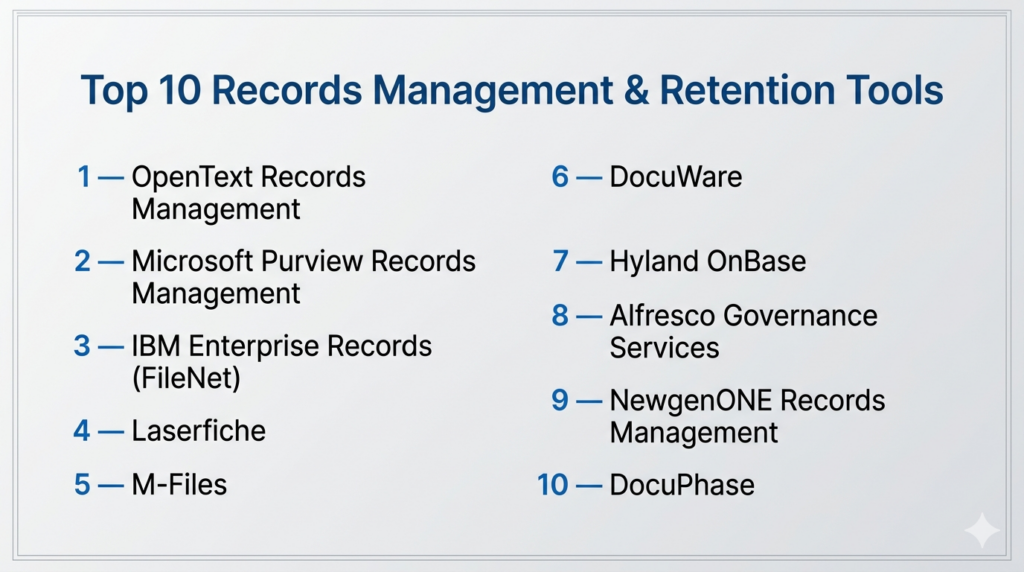
Introduction
Records Management & Retention Tools are specialized software solutions designed to manage the lifecycle of organizational records—from creation and classification to retention, archival, and secure disposal. Unlike general document management systems, these tools focus heavily on compliance, governance, and legal requirements.
In modern organizations, especially those operating in regulated industries, managing records properly is critical. These tools ensure that records are retained for the required duration, protected from unauthorized access, and disposed of according to policy. They also help organizations respond to audits, legal holds, and compliance mandates efficiently.
Common Use Cases
- Managing regulatory compliance and audits
- Automating retention schedules and disposition
- Legal hold and e-discovery processes
- Archiving business-critical records
- Governance of digital and physical records
What Buyers Should Evaluate
- Retention policy automation capabilities
- Legal hold and compliance features
- Records classification and metadata management
- Audit trails and reporting
- Integration with ECM/DMS platforms
- Scalability for large record volumes
- Security controls (RBAC, encryption, access logs)
- Deployment model (cloud, on-premise, hybrid)
- Ease of implementation and governance
Best for: Enterprises, government agencies, legal firms, healthcare, finance, and compliance-heavy industries.
Not ideal for: Small teams needing only basic file storage or simple collaboration tools.
Key Trends in Records Management & Retention Tools
- Automated retention policies: Systems automatically enforce retention schedules and disposal rules
- AI-driven classification: Tools auto-tag and categorize records for better governance
- Legal hold automation: Preventing deletion during investigations or audits
- Cloud-native records management: Increasing adoption of SaaS-based governance platforms
- Integration with ECM systems: Seamless lifecycle management across enterprise content
- Metadata-driven organization: Improved search and classification capabilities
- Compliance-first design: Built-in support for GDPR, HIPAA, and industry regulations
- Hybrid deployment models: Combining on-premise control with cloud scalability
- Audit-ready reporting: Real-time compliance tracking and reporting
- Lifecycle automation dashboards: Visibility into record status and retention timelines
How We Selected These Tools (Methodology)
- Evaluated enterprise adoption and industry reputation
- Assessed records lifecycle management capabilities
- Compared compliance and governance features
- Reviewed integration with ECM/DMS platforms
- Evaluated scalability and performance
- Assessed automation and AI capabilities
- Reviewed deployment flexibility
- Considered usability and administrative controls
- Evaluated vendor ecosystem and support
Top 10 Records Management & Retention Tools
#1 — OpenText Records Management
Short description: A leading enterprise-grade records management solution designed for compliance-heavy industries and large-scale governance.
Key Features
- Automated retention schedules
- Legal hold management
- Records classification frameworks
- Policy-based disposal workflows
- Audit and compliance reporting
- Integration with ECM systems
Pros
- Strong compliance capabilities
- Highly scalable
Cons
- Complex deployment
- Premium pricing
Platforms / Deployment
Web / Cloud / Hybrid
Security & Compliance
Encryption, RBAC, audit logs; certifications vary
Integrations & Ecosystem
- SAP
- Microsoft ecosystem
- APIs
Support & Community
Enterprise-grade support with global partners
#2 — Microsoft Purview Records Management
Short description: A compliance-focused records management solution integrated into Microsoft 365 ecosystem.
Key Features
- Retention labels and policies
- Automated classification
- Compliance center dashboard
- Legal hold capabilities
- Integration with Microsoft tools
Pros
- Seamless Microsoft integration
- Strong compliance tooling
Cons
- Requires Microsoft ecosystem
- Configuration complexity
Platforms / Deployment
Cloud / Hybrid
Security & Compliance
Enterprise-grade controls (details vary)
Integrations & Ecosystem
- Microsoft 365
- Azure services
- APIs
Support & Community
Extensive documentation and enterprise support
#3 — IBM Enterprise Records (FileNet)
Short description: A robust records management system for large enterprises with strict compliance requirements.
Key Features
- Lifecycle management
- Retention scheduling
- Legal holds
- Audit trails
- Integration with IBM ECM
Pros
- Highly scalable
- Strong governance features
Cons
- Expensive
- Complex implementation
Platforms / Deployment
Cloud / On-premise / Hybrid
Security & Compliance
Enterprise-grade; details vary
Integrations & Ecosystem
- IBM ecosystem
- APIs
Support & Community
Strong enterprise support
#4 — Laserfiche
Short description: A comprehensive ECM and records management platform with strong automation capabilities.
Key Features
- Records classification
- Retention policies
- Workflow automation
- Document lifecycle tracking
- Compliance reporting
Pros
- Strong automation
- Easy workflow creation
Cons
- Learning curve
- Cost considerations
Platforms / Deployment
Cloud / On-premise
Security & Compliance
Not publicly stated
Integrations & Ecosystem
- Enterprise applications
- APIs
Support & Community
Active community
#5 — M-Files
Short description: A metadata-driven records management platform focusing on intelligent organization.
Key Features
- Metadata-based classification
- Automated retention policies
- Workflow automation
- Version control
- Compliance tracking
Pros
- Powerful search
- Flexible organization
Cons
- Setup complexity
- Higher cost
Platforms / Deployment
Cloud / Hybrid
Security & Compliance
Not publicly stated
Integrations & Ecosystem
- CRM/ERP systems
- APIs
Support & Community
Strong
#6 — DocuWare
Short description: A document and records management solution with strong workflow automation.
Key Features
- Document capture and indexing
- Workflow automation
- Retention policies
- Audit trails
- Secure storage
Pros
- Strong automation
- Scalable
Cons
- Setup complexity
- Customization effort
Platforms / Deployment
Cloud / Self-hosted
Security & Compliance
SSO, MFA, encryption, audit logs
Integrations & Ecosystem
- ERP/CRM systems
- APIs
Support & Community
Professional support
#7 — Hyland OnBase
Short description: A versatile ECM platform with strong records management and compliance features.
Key Features
- Records lifecycle management
- Document imaging and capture
- Workflow automation
- Compliance tracking
- Integration with enterprise apps
Pros
- Strong enterprise capabilities
- Flexible deployment
Cons
- Complex setup
- Requires training
Platforms / Deployment
Cloud / On-premise
Security & Compliance
Not publicly stated
Integrations & Ecosystem
- SAP
- Enterprise systems
Support & Community
Strong enterprise support
#8 — Alfresco Governance Services
Short description: An open-source records management solution for flexible governance.
Key Features
- Retention schedules
- Records classification
- Audit trails
- Workflow automation
- Open-source extensibility
Pros
- Highly customizable
- Open-source flexibility
Cons
- Requires technical expertise
- Setup complexity
Platforms / Deployment
Cloud / On-premise
Security & Compliance
Not publicly stated
Integrations & Ecosystem
- APIs
- Enterprise systems
Support & Community
Strong developer community
#9 — NewgenONE Records Management
Short description: A records lifecycle management solution with strong automation and monitoring capabilities.
Key Features
- Lifecycle tracking dashboards
- Metadata classification
- Retention and deletion tracking
- Reporting tools
- Integration with Microsoft systems
Pros
- Strong automation
- Good visibility
Cons
- Pricing not transparent
- Limited public details
Platforms / Deployment
Varies / N/A
Security & Compliance
Not publicly stated
Integrations & Ecosystem
- Microsoft ecosystem
- APIs
Support & Community
Customer support portal available
#10 — DocuPhase
Short description: A cloud-based records and document management solution with AI-driven indexing.
Key Features
- AI-powered indexing
- Workflow automation
- Retention management
- Search functionality
- Permissions control
Pros
- Strong automation
- Easy search
Cons
- Limited enterprise depth
- Pricing not transparent
Platforms / Deployment
Cloud / On-premise
Security & Compliance
Not publicly stated
Integrations & Ecosystem
- Third-party tools
- APIs
Support & Community
Moderate
Comparison Table (Top 10)
| Tool Name | Best For | Platform(s) Supported | Deployment | Standout Feature | Public Rating |
|---|---|---|---|---|---|
| OpenText | Enterprises | Web | Hybrid | Retention automation | N/A |
| Microsoft Purview | Microsoft users | Web | Cloud | Compliance integration | N/A |
| IBM FileNet | Regulated industries | Web | Hybrid | Enterprise governance | N/A |
| Laserfiche | Workflow automation | Web | Cloud/On-prem | Process automation | N/A |
| M-Files | Metadata mgmt | Desktop/Web | Hybrid | AI classification | N/A |
| DocuWare | Automation | Web | Cloud | Workflow engine | N/A |
| OnBase | Enterprise ops | Web | Hybrid | Lifecycle mgmt | N/A |
| Alfresco | Developers | Web | On-prem/Cloud | Open-source | N/A |
| NewgenONE | Monitoring | Web | N/A | Lifecycle dashboards | N/A |
| DocuPhase | SMB automation | Web | Cloud | AI indexing | N/A |
Evaluation & Scoring of Records Management & Retention Tools
| Tool Name | Core | Ease | Integrations | Security | Performance | Support | Value | Weighted Total |
|---|---|---|---|---|---|---|---|---|
| OpenText | 10 | 6 | 10 | 9 | 9 | 9 | 6 | 8.7 |
| Microsoft Purview | 9 | 7 | 10 | 9 | 9 | 9 | 7 | 8.8 |
| IBM FileNet | 10 | 6 | 9 | 10 | 9 | 9 | 6 | 8.7 |
| Laserfiche | 8 | 7 | 8 | 8 | 8 | 8 | 7 | 7.9 |
| M-Files | 9 | 6 | 8 | 8 | 8 | 8 | 6 | 7.8 |
| DocuWare | 8 | 7 | 8 | 8 | 8 | 7 | 7 | 7.8 |
| OnBase | 9 | 6 | 8 | 8 | 8 | 8 | 6 | 7.9 |
| Alfresco | 8 | 6 | 9 | 7 | 8 | 7 | 8 | 7.9 |
| NewgenONE | 8 | 7 | 7 | 7 | 8 | 7 | 7 | 7.6 |
| DocuPhase | 7 | 8 | 7 | 7 | 7 | 6 | 8 | 7.4 |
How to interpret scores:
- Higher scores indicate stronger enterprise readiness
- Enterprise tools rank higher in compliance and integrations
- Open-source tools score higher in value
- Simpler tools rank higher in ease of use
- Scores are comparative benchmarks, not absolute
Which Records Management Tool Is Right for You?
Solo / Freelancer
- Not recommended
- Use simple cloud storage instead
SMB
- Best: DocuPhase, DocuWare
- Focus on automation and ease
Mid-Market
- Best: M-Files, Laserfiche
- Balance flexibility and governance
Enterprise
- Best: OpenText, IBM FileNet, Microsoft Purview
- Advanced compliance and scalability
Budget vs Premium
- Budget: Alfresco
- Premium: OpenText, IBM
Feature Depth vs Ease of Use
- Deep: IBM, OpenText
- Easy: DocuPhase
Integrations & Scalability
- Strong: Microsoft, OpenText
- Moderate: others
Security & Compliance Needs
- Best: OpenText, IBM, Microsoft
Frequently Asked Questions (FAQs)
What is records management software?
Software that manages records lifecycle, retention, and compliance.
Why is retention important?
It ensures legal compliance and avoids data risks.
What is a retention schedule?
A policy defining how long records must be kept.
What is legal hold?
A process preventing deletion during investigations.
Are these tools cloud-based?
Many offer cloud, on-premise, or hybrid options.
Do they support automation?
Yes, automation is a core feature.
Are they secure?
Enterprise tools offer strong security features.
Can they integrate with ECM systems?
Yes, integration is common.
Are they expensive?
Enterprise solutions can be costly.
How to choose the right tool?
Evaluate compliance, features, and scalability.
Conclusion
Records Management & Retention Tools are essential for organizations that must comply with strict regulatory requirements and manage large volumes of structured and unstructured records. These tools ensure proper governance, automate retention policies, and provide audit-ready compliance frameworks.

One aspect that is often underestimated in records management projects is the complexity of maintaining retention policies across multiple jurisdictions and evolving regulations. A retention period that satisfies one country’s compliance requirements may conflict with another region’s privacy or data minimization laws. Organizations should evaluate how easily retention schedules, legal holds, policy exceptions, and audit requirements can adapt over time, as long-term governance flexibility often becomes more important than initial feature depth.