MOTOSHARE 🚗🏍️
Rent Bikes & Cars Directly from Owners
Motoshare connects vehicle owners with people who need bikes and cars on rent. Owners earn from idle vehicles, and renters get flexible ride options.
Visit Motoshare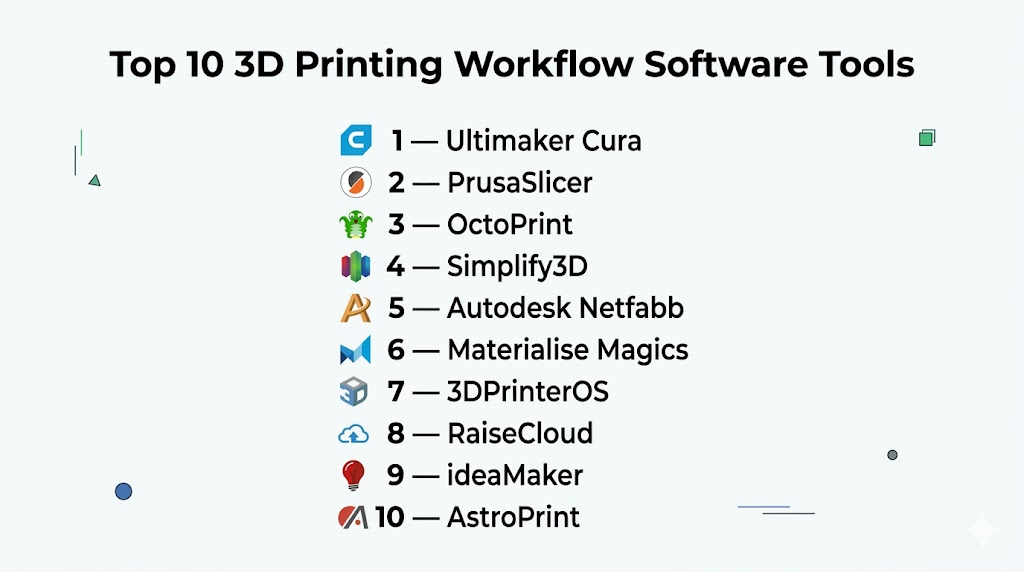
Introduction
3D printing workflow software helps manage the entire additive manufacturing lifecycle—from preparing 3D models to slicing, printer control, monitoring, and production management. Instead of handling each step manually, these tools streamline workflows, reduce errors, and improve efficiency across single printers or large-scale print farms.
As 3D printing evolves from prototyping to full production, managing complexity becomes critical. Workflow software enables centralized control, real-time monitoring, job scheduling, and material tracking—helping organizations optimize output and reduce waste.
Common Use Cases
- Preparing and slicing models into printable layers
- Managing multiple printers and print queues
- Monitoring print jobs remotely
- Optimizing material usage and reducing failures
- Scaling additive manufacturing operations
What to Evaluate Before Choosing a Tool
- Printer compatibility and file format support
- Slicing precision and customization
- Workflow automation capabilities
- Multi-printer (print farm) management
- Remote monitoring and control
- Integration with CAD, PLM, or ERP tools
- Cloud vs local deployment
- Security and user access controls
- Ease of onboarding and usability
- Pricing and scalability
Mandatory Considerations
Best for:
Manufacturers, engineering teams, product designers, educational labs, and businesses scaling 3D printing operations.
Not ideal for:
Hobby users or occasional printing needs where basic slicers are sufficient without full workflow management.
Key Trends in 3D Printing Workflow Software
- AI-driven slicing and automatic print optimization
- Cloud-based print farm management systems
- Real-time IoT monitoring of printers
- Automated error detection and failure prediction
- Integration with PLM, ERP, and digital manufacturing systems
- Increasing use of simulation before printing
- Sustainability tracking (material usage, waste reduction)
- Standardization of file formats (STL, 3MF, OBJ)
- Enhanced collaboration features for distributed teams
- Role-based access control and enterprise-grade security
How We Selected These Tools (Methodology)
- High adoption across hobbyist, professional, and industrial segments
- Feature completeness (slicing, monitoring, workflow management)
- Proven performance in real-world printing environments
- Integration with CAD tools and printer ecosystems
- Strength of plugin/API ecosystems
- Support for different user segments (individual to enterprise)
- Innovation in AI, automation, and cloud workflows
- Community support and documentation
- Deployment flexibility (cloud, local, hybrid)
Top 10 3D Printing Workflow Software Tools
1 — Ultimaker Cura
Short description: A widely used open-source slicing tool that converts 3D models into printable instructions and supports a broad range of printers.
Key Features
- Advanced slicing engine
- Adaptive layer height
- Plugin marketplace
- Extensive printer compatibility
- Material profiles
- Real-time preview
Pros
- Free and widely adopted
- Easy for beginners
- Large plugin ecosystem
Cons
- Limited enterprise workflow features
- Can be complex for advanced tuning
Platforms / Deployment
Windows / macOS / Linux
Security & Compliance
Not publicly stated
Integrations & Ecosystem
Supports integration with multiple CAD and printing workflows.
- Plugins marketplace
- CAD integrations
- Printer compatibility
- APIs
Support & Community
Massive global community and extensive tutorials.
2 — PrusaSlicer
Short description: An open-source slicing tool known for precision, customization, and strong performance across multiple printer types.
Key Features
- Advanced slicing controls
- Multi-material support
- Variable layer height
- Custom supports
- G-code preview
Pros
- Highly customizable
- Free and regularly updated
- Strong precision
Cons
- Steeper learning curve
- Best optimized for Prusa printers
Platforms / Deployment
Windows / macOS / Linux
Security & Compliance
Not publicly stated
Integrations & Ecosystem
- Printer integrations
- Open-source extensions
- File compatibility
Support & Community
Active and engaged community.
3 — OctoPrint
Short description: An open-source platform for remote monitoring and controlling 3D printers through a web interface.
Key Features
- Remote printer control
- Webcam monitoring
- Plugin system
- Job scheduling
- Notifications
Pros
- Highly customizable
- Free and open-source
- Excellent remote control
Cons
- Requires setup
- Not a slicer
Platforms / Deployment
Web / Self-hosted
Security & Compliance
Not publicly stated
Integrations & Ecosystem
- Plugin ecosystem
- API support
- Hardware integrations
Support & Community
Very strong community and plugin ecosystem.
4 — Simplify3D
Short description: A premium slicing software focused on performance and detailed control.
Key Features
- Advanced slicing engine
- Custom support structures
- Multi-part printing
- Simulation preview
- Hardware compatibility
Pros
- High-quality output
- Fine control over settings
Cons
- Paid software
- Slower updates
Platforms / Deployment
Windows / macOS / Linux
Security & Compliance
Not publicly stated
Integrations & Ecosystem
- Printer integrations
- File compatibility
Support & Community
Moderate support ecosystem.
5 — Autodesk Netfabb
Short description: A professional tool for industrial additive manufacturing with strong simulation and optimization features.
Key Features
- Mesh repair
- Build preparation
- Simulation tools
- Support generation
- Process optimization
Pros
- Industrial-grade capabilities
- Reduces print errors
Cons
- Expensive
- Complex
Platforms / Deployment
Windows / Cloud
Security & Compliance
Not publicly stated
Integrations & Ecosystem
- Autodesk ecosystem
- CAD tools
- APIs
Support & Community
Enterprise-level support.
6 — Materialise Magics
Short description: A leading industrial tool for data preparation and workflow optimization in additive manufacturing.
Key Features
- File repair and editing
- Part orientation and nesting
- Support generation
- Workflow automation
- Quality control
Pros
- Industry-standard for prep workflows
- Highly reliable
Cons
- Expensive
- Focused on pre-print stage
Platforms / Deployment
Windows
Security & Compliance
Not publicly stated
Integrations & Ecosystem
- Industrial printers
- PLM systems
- APIs
Support & Community
Strong enterprise support.
7 — 3DPrinterOS
Short description: A cloud-based platform for managing and scaling 3D printing operations across teams and devices.
Key Features
- Cloud print management
- Multi-printer control
- File storage
- User management
- Workflow automation
Pros
- Scalable
- Remote access
Cons
- Internet dependency
- Subscription model
Platforms / Deployment
Web / Cloud
Security & Compliance
Not publicly stated
Integrations & Ecosystem
- Printer integrations
- APIs
- Cloud storage
Support & Community
Growing enterprise adoption.
8 — RaiseCloud
Short description: A cloud platform designed for managing Raise3D printers and workflows.
Key Features
- Remote monitoring
- Print scheduling
- File management
- Multi-printer support
- Analytics
Pros
- Easy to use
- Good for print farms
Cons
- Limited ecosystem
- Hardware-specific
Platforms / Deployment
Web / Cloud
Security & Compliance
Not publicly stated
Integrations & Ecosystem
- Raise3D ecosystem
- Cloud integrations
Support & Community
Moderate support.
9 — ideaMaker
Short description: A slicing tool focused on usability and balanced performance for mid-level users.
Key Features
- Advanced slicing
- Custom templates
- Simulation preview
- Multi-printer support
- Material profiles
Pros
- Free
- Easy to use
Cons
- Smaller ecosystem
- Limited enterprise features
Platforms / Deployment
Windows / macOS / Linux
Security & Compliance
Not publicly stated
Integrations & Ecosystem
- Printer compatibility
- File formats
Support & Community
Active but smaller community.
10 — AstroPrint
Short description: A cloud-based platform for managing 3D printing workflows remotely.
Key Features
- Cloud dashboard
- Remote printing
- File management
- Analytics
- Mobile access
Pros
- Easy remote control
- Scalable
Cons
- Internet dependency
- Limited slicing features
Platforms / Deployment
Web / Cloud
Security & Compliance
Not publicly stated
Integrations & Ecosystem
- APIs
- Cloud tools
- Printer integrations
Support & Community
Moderate support.
Comparison Table (Top 10)
| Tool Name | Best For | Platform(s) Supported | Deployment | Standout Feature | Public Rating |
|---|---|---|---|---|---|
| Cura | Beginners | Win / macOS / Linux | Local | Free slicing engine | N/A |
| PrusaSlicer | Precision | Win / macOS / Linux | Local | Advanced controls | N/A |
| OctoPrint | Remote control | Web | Self-hosted | Printer monitoring | N/A |
| Simplify3D | Advanced users | Win / macOS / Linux | Local | Detailed customization | N/A |
| Netfabb | Industrial | Win / Cloud | Hybrid | Simulation tools | N/A |
| Magics | Enterprise | Windows | Local | Build preparation | N/A |
| 3DPrinterOS | Print farms | Web | Cloud | Multi-printer management | N/A |
| RaiseCloud | Raise3D users | Web | Cloud | Printer ecosystem | N/A |
| ideaMaker | Mid-level | Win / macOS / Linux | Local | Balanced slicer | N/A |
| AstroPrint | Remote workflows | Web | Cloud | Cloud dashboard | N/A |
Evaluation & Scoring of 3D Printing Workflow Software
| Tool Name | Core | Ease | Integrations | Security | Performance | Support | Value | Weighted Total |
|---|---|---|---|---|---|---|---|---|
| Cura | 8 | 9 | 7 | 5 | 8 | 9 | 10 | 8.2 |
| PrusaSlicer | 9 | 7 | 7 | 5 | 9 | 8 | 10 | 8.1 |
| OctoPrint | 7 | 7 | 8 | 5 | 8 | 9 | 10 | 7.9 |
| Simplify3D | 9 | 7 | 7 | 5 | 9 | 7 | 6 | 7.7 |
| Netfabb | 10 | 6 | 9 | 6 | 10 | 8 | 5 | 8.1 |
| Magics | 10 | 5 | 9 | 6 | 10 | 8 | 4 | 7.9 |
| 3DPrinterOS | 8 | 8 | 8 | 6 | 8 | 8 | 8 | 8.0 |
| RaiseCloud | 7 | 8 | 6 | 5 | 7 | 7 | 8 | 7.2 |
| ideaMaker | 8 | 8 | 6 | 5 | 8 | 7 | 9 | 7.8 |
| AstroPrint | 7 | 8 | 7 | 5 | 7 | 7 | 8 | 7.4 |
These scores are comparative and reflect relative strengths. A higher score indicates better overall capability, but the best tool depends on your workflow, scale, and technical requirements.
Which 3D Printing Workflow Software Is Right for You?
Solo / Freelancer
Cura, PrusaSlicer, and OctoPrint are affordable and flexible.
SMB
3DPrinterOS and ideaMaker provide scalability with usability.
Mid-Market
Simplify3D and Netfabb offer advanced capabilities.
Enterprise
Materialise Magics and Netfabb are best for industrial workflows.
Budget vs Premium
Budget: Cura, PrusaSlicer
Premium: Magics, Netfabb
Feature Depth vs Ease of Use
Deep features: Netfabb, Magics
Ease of use: Cura, AstroPrint
Integrations & Scalability
Best: 3DPrinterOS, Netfabb
Security & Compliance Needs
Most tools do not publicly disclose certifications—verify directly for enterprise use.
Frequently Asked Questions (FAQs)
What is 3D printing workflow software?
It manages the entire process from model preparation to printing and monitoring.
Do I need it for a single printer?
Not always—basic slicers may be enough.
What is slicing?
It converts a 3D model into printable layers (G-code).
Are cloud tools reliable?
Yes, but depend on internet connectivity.
Can I manage multiple printers?
Yes, many tools support print farms.
What file formats are supported?
STL, OBJ, and 3MF are common.
Is open-source software reliable?
Yes, tools like Cura and OctoPrint are widely used.
Can I automate workflows?
Yes, especially in enterprise tools.
What are common mistakes?
Incorrect slicing settings and poor calibration.
Are these tools expensive?
They range from free to enterprise-level pricing.
Conclusion
3D printing workflow software is essential for scaling additive manufacturing and ensuring consistent, high-quality output. From simple slicers to enterprise-grade platforms, the ecosystem offers tools for every level of complexity.

One practical area I would add is the quality-control loop between the digital workflow and the physical printed part. In real production environments, successful slicing and printing do not necessarily mean the final part meets the required specifications. Teams need to track printer calibration, material batches, machine parameters, failed builds, dimensional inspection results, and post-processing steps. It is also useful to connect these records back to the exact model and slicing configuration used for each print so problems can be reproduced and traced. Without this level of traceability, recurring print failures or quality issues can be difficult to diagnose as production volumes increase.