MOTOSHARE 🚗🏍️
Rent Bikes & Cars Directly from Owners
Motoshare connects vehicle owners with people who need bikes and cars on rent. Owners earn from idle vehicles, and renters get flexible ride options.
Visit Motoshare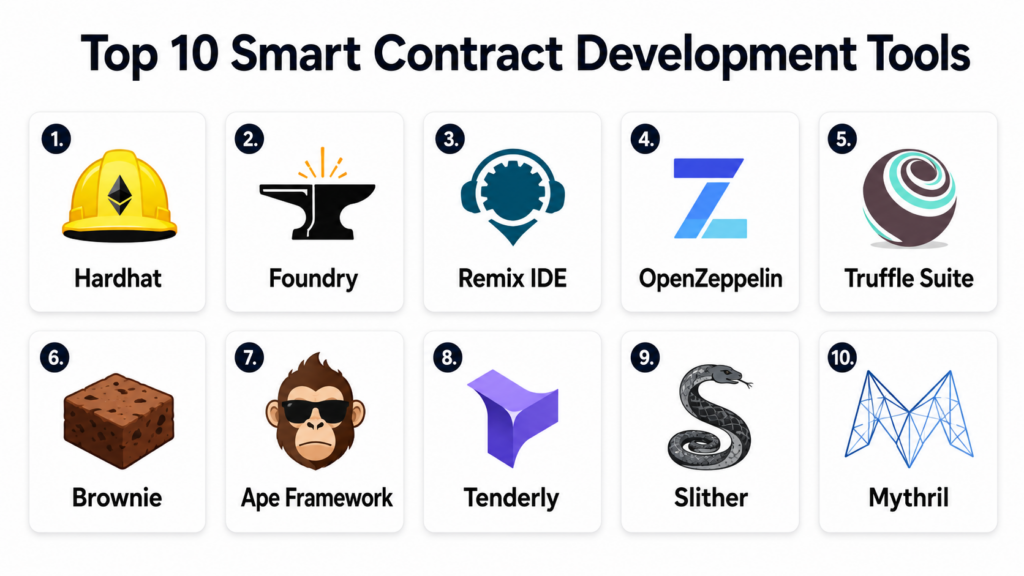
Introduction
Smart contract development tools help developers build, test, debug, deploy, audit, and maintain blockchain-based applications. A smart contract is code that runs on a blockchain and automatically executes business logic such as token transfers, escrow rules, lending actions, governance voting, NFT minting, settlement workflows, or access permissions. These tools matter because smart contract mistakes can be expensive, public, and difficult to reverse once deployed.
Modern smart contract teams need more than a compiler. They need local blockchain testing, deployment automation, security checks, gas optimization, wallet integration, contract verification, monitoring, debugging, and collaboration workflows. Real-world use cases include DeFi protocols, NFT platforms, tokenization projects, DAO governance, gaming economies, supply chain records, digital identity, stablecoin flows, and enterprise blockchain applications.
Buyers and developers should evaluate language support, blockchain compatibility, testing depth, debugging experience, security tooling, deployment automation, gas profiling, documentation, ecosystem adoption, CI/CD fit, and production monitoring options.
Best for: blockchain developers, Web3 startups, DeFi teams, NFT builders, protocol engineers, security auditors, enterprise blockchain teams, and software teams building decentralized applications. Not ideal for: teams that only need a basic website, simple database-backed app, or internal workflow tool where blockchain and smart contracts do not add real value.
Key Trends in Smart Contract Development Tools
- Security-first development is now essential, with teams adding static analysis, fuzz testing, invariant testing, formal verification, and audit preparation earlier in the development cycle.
- Foundry-style fast testing workflows are becoming popular, especially among advanced Solidity developers who need speed, scripting, fuzzing, and local execution.
- JavaScript and TypeScript ecosystems remain strong, especially for teams using Hardhat, OpenZeppelin, Ethers, and frontend Web3 tooling.
- Smart contract monitoring is becoming part of production operations, not just development, because deployed contracts need alerts, transaction tracing, and incident response.
- Gas optimization remains important, especially for public blockchain deployments where inefficient code can increase user transaction costs.
- Multi-chain deployment is now common, so tools must support Ethereum, Layer 2 networks, EVM-compatible chains, and sometimes non-EVM ecosystems.
- Developer experience is improving, with better local nodes, deployment scripts, contract verification, wallet testing, and debugging interfaces.
- AI-assisted development is emerging, but smart contract teams still need human review, security audits, and deterministic testing before production.
- CI/CD integration is becoming standard, with teams running automated tests, linting, static analysis, deployment checks, and verification steps before release.
- Enterprise buyers want governance and access controls, especially when multiple developers manage keys, deployments, upgrades, and production contract changes.
How We Selected These Tools
- Selected tools widely recognized in smart contract development, testing, deployment, debugging, auditing, or production operations.
- Balanced developer frameworks, security tools, IDEs, monitoring platforms, and contract libraries.
- Considered practical use across Solidity, Ethereum, EVM-compatible chains, and modern Web3 workflows.
- Prioritized tools with strong ecosystem adoption, documentation, and active developer relevance.
- Evaluated usefulness across solo developers, startups, protocol teams, and enterprise blockchain projects.
- Considered local development experience, testing quality, deployment support, security workflows, and integration depth.
- Avoided public ratings because reliable universal ratings are not consistently available for developer tools in this category.
- Used “Not publicly stated” where enterprise security certifications or compliance controls are not clearly known.
- Scoring is comparative and practical, not a claim of absolute superiority.
- Included both beginner-friendly and advanced tools so different teams can choose based on maturity and workflow needs.
Top 10 Smart Contract Development Tools
1- Hardhat
Short description:
Hardhat is one of the most popular Ethereum development environments for building, testing, debugging, and deploying smart contracts. It is widely used by Solidity developers because it fits naturally into JavaScript and TypeScript workflows. Hardhat provides local blockchain simulation, plugin support, testing utilities, deployment scripting, and contract debugging features. It is a strong choice for teams that want a flexible, mature, and ecosystem-friendly development framework.
Key Features
- Local Ethereum development network for testing smart contracts.
- Strong JavaScript and TypeScript support.
- Plugin ecosystem for deployment, verification, gas reporting, and testing.
- Solidity debugging and stack trace support.
- Works well with Ethers and common Web3 libraries.
- Suitable for EVM-compatible blockchain development.
- Good fit for CI/CD-based smart contract workflows.
Pros
- Mature and widely adopted developer framework.
- Strong plugin ecosystem and documentation.
- Excellent fit for JavaScript and TypeScript teams.
Cons
- Plugin choices can become complex for new teams.
- Advanced security testing may require additional tools.
- Performance may not match specialized Rust-based testing workflows in some scenarios.
Platforms / Deployment
Linux / macOS / Windows through Node.js environments.
Self-hosted / Local development / Cloud CI environments.
Security & Compliance
Not publicly stated as an enterprise compliance platform. Security depends on contract design, testing discipline, plugin usage, key management, CI/CD controls, and deployment governance.
Integrations & Ecosystem
Hardhat integrates with many Web3 development tools and is often the center of Solidity development workflows. Teams can connect it with testing libraries, wallets, deployment systems, verification tools, and monitoring platforms.
- Ethers and Web3 libraries
- OpenZeppelin contracts
- Test frameworks
- Gas reporting plugins
- Contract verification tools
- CI/CD pipelines
Support & Community
Hardhat has strong documentation, a large developer community, and broad ecosystem support. Many tutorials, plugins, and professional teams use it, making onboarding easier for Solidity developers.
2- Foundry
Short description:
Foundry is a fast smart contract development toolkit built for Solidity developers who want powerful testing, scripting, fuzzing, and local execution workflows. It is known for speed and developer productivity, especially among advanced protocol teams. Foundry lets developers write tests in Solidity itself, which can make contract behavior easier to validate directly. It is especially useful for DeFi, protocol engineering, and security-heavy smart contract development.
Key Features
- Fast Solidity testing and development toolkit.
- Tests can be written directly in Solidity.
- Built-in fuzz testing capabilities.
- Local Ethereum node support through Anvil.
- Deployment and scripting support through Forge and Cast.
- Strong fit for advanced smart contract testing workflows.
- Useful for gas optimization and protocol development.
Pros
- Very fast testing experience for Solidity developers.
- Excellent for fuzzing and protocol-level testing.
- Strong fit for advanced DeFi and security-focused teams.
Cons
- Learning curve may be higher for beginners.
- Teams used to JavaScript testing may need workflow changes.
- Some frontend-heavy teams may still prefer Hardhat-based flows.
Platforms / Deployment
Linux / macOS / Windows depending on setup.
Self-hosted / Local development / Cloud CI environments.
Security & Compliance
Not publicly stated as an enterprise compliance platform. Security depends on how tests, fuzzing, deployment keys, scripts, and CI/CD workflows are configured.
Integrations & Ecosystem
Foundry integrates well with Solidity-first development workflows and can also coexist with other tools. Many advanced teams use it alongside contract libraries, audit tools, deployment scripts, and monitoring services.
- Solidity test suites
- EVM-compatible networks
- OpenZeppelin contracts
- CI/CD pipelines
- Security testing workflows
- Protocol deployment scripts
Support & Community
Foundry has a strong and growing developer community, especially among advanced Solidity and DeFi engineers. Documentation and examples are useful, but new developers may need time to become comfortable with the workflow.
3- Remix IDE
Short description:
Remix IDE is a browser-based smart contract development environment that helps developers write, compile, deploy, and test Solidity contracts quickly. It is especially useful for beginners, educators, auditors, and developers who need a fast way to experiment without setting up a full local toolchain. Remix is often used for learning, prototyping, and quick contract testing. It is not always the best fit for large production repositories, but it remains highly useful for early development and debugging.
Key Features
- Browser-based Solidity development environment.
- Built-in compiler and deployment tools.
- Useful for quick smart contract prototyping.
- Supports local and injected wallet-based deployments.
- Includes debugging and analysis plugins.
- Good for education, demos, and contract experiments.
- No heavy local setup required for basic usage.
Pros
- Very beginner-friendly and quick to start.
- Useful for education and rapid prototyping.
- Good for testing small contracts and examples.
Cons
- Less suitable for large production codebases.
- Team collaboration and CI/CD require external tools.
- Advanced workflows may need Hardhat, Foundry, or similar frameworks.
Platforms / Deployment
Web / Browser-based.
Cloud / Local browser usage / Self-hosted options may vary.
Security & Compliance
Not publicly stated as an enterprise compliance platform. Developers should avoid exposing private keys or sensitive deployment credentials in unsafe environments and should use secure wallet and key management practices.
Integrations & Ecosystem
Remix works well for quick Solidity development and can connect with wallets, local nodes, and blockchain networks. It is often used alongside more formal development frameworks.
- Solidity compiler
- Wallet connections
- Local blockchain environments
- Contract debugging plugins
- Static analysis plugins
- EVM-compatible networks
Support & Community
Remix has strong educational value, documentation, and community familiarity. It is widely used by beginners and experienced developers for quick experiments, debugging, and contract demonstrations.
4- OpenZeppelin
Short description:
OpenZeppelin provides widely used smart contract libraries and developer tools for secure contract development. Its reusable contracts help teams avoid rebuilding common components such as tokens, access control, upgradeability, and governance logic from scratch. OpenZeppelin is especially useful for teams that want battle-tested patterns and safer development workflows. It is not a full development framework by itself, but it is a core part of many production Solidity projects.
Key Features
- Reusable smart contract libraries for Solidity.
- Common patterns for tokens, access control, governance, and upgradeability.
- Helps reduce risk from custom code.
- Works well with Hardhat, Foundry, and other frameworks.
- Provides security-focused development patterns.
- Useful for audit preparation and standard contract architecture.
- Supports widely recognized contract standards and modules.
Pros
- Strong security reputation in smart contract development.
- Saves time by providing reusable, tested components.
- Excellent fit for production Solidity projects.
Cons
- Developers still need to understand how modules work.
- Incorrect customization can introduce risk.
- Not a complete replacement for audits or testing.
Platforms / Deployment
Linux / macOS / Windows through Solidity development environments.
Developer library / Cloud and self-hosted workflows depending on usage.
Security & Compliance
OpenZeppelin contracts are security-focused, but compliance certifications are not the main purpose of the open-source libraries. Application security depends on contract implementation, configuration, testing, audits, deployment controls, and governance.
Integrations & Ecosystem
OpenZeppelin is commonly integrated into smart contract projects as a foundational library. It works with most EVM development frameworks and supports common production patterns.
- Hardhat
- Foundry
- Remix
- Solidity projects
- EVM-compatible networks
- Audit and testing workflows
Support & Community
OpenZeppelin has strong documentation, community usage, and professional ecosystem recognition. Teams often rely on its libraries as a starting point for secure smart contract development.
5- Truffle Suite
Short description:
Truffle Suite is a long-standing smart contract development framework for Ethereum and EVM-compatible networks. It includes tools for compiling, testing, migrating, and deploying smart contracts. While many newer teams have shifted toward Hardhat or Foundry, Truffle remains historically important and still appears in existing projects, tutorials, and legacy codebases. It is most useful for teams maintaining older smart contract projects or learning classic Ethereum development workflows.
Key Features
- Smart contract compilation, testing, and migration workflows.
- JavaScript-based development environment.
- Supports Ethereum and EVM-compatible networks.
- Useful for legacy smart contract projects.
- Includes deployment migration patterns.
- Works with Ganache-style local blockchain testing.
- Familiar to many early Ethereum developers.
Pros
- Historically important and widely recognized.
- Useful for maintaining older Web3 projects.
- Clear development structure for basic contract workflows.
Cons
- Many modern teams prefer Hardhat or Foundry.
- Ecosystem momentum may be lower than newer tools.
- Advanced workflows may require additional tooling.
Platforms / Deployment
Linux / macOS / Windows through Node.js environments.
Self-hosted / Local development / Cloud CI environments.
Security & Compliance
Not publicly stated as an enterprise compliance platform. Security depends on development process, dependencies, testing, deployment key management, and audit practices.
Integrations & Ecosystem
Truffle integrates with JavaScript testing workflows, local blockchain environments, and Ethereum development tools. It may still be relevant where older repositories or tutorials use it.
- JavaScript test frameworks
- Ganache-style local networks
- Ethereum smart contracts
- EVM-compatible networks
- Deployment scripts
- Legacy Web3 projects
Support & Community
Truffle has broad historical documentation and community familiarity. Teams starting new projects should compare it carefully with modern alternatives, while teams maintaining existing Truffle projects may continue using it effectively.
6- Brownie
Short description:
Brownie is a Python-based smart contract development and testing framework for Ethereum and EVM-compatible networks. It is useful for developers and auditors who prefer Python over JavaScript or Solidity-only testing. Brownie became especially popular among DeFi developers and security researchers who wanted Python-based scripting, testing, and contract interaction. It remains a practical option for teams with Python-heavy workflows, although some newer projects may prefer Foundry or Hardhat.
Key Features
- Python-based smart contract development framework.
- Supports Solidity and Vyper workflows.
- Useful for testing, deployment, and scripting.
- Good fit for Python developers and auditors.
- Supports contract interaction from Python scripts.
- Practical for DeFi testing and protocol experimentation.
- Works with EVM-compatible blockchain networks.
Pros
- Strong fit for Python-first teams.
- Useful for auditors and DeFi researchers.
- Good scripting experience for contract interaction.
Cons
- Ecosystem momentum may vary compared with Hardhat and Foundry.
- JavaScript-heavy teams may prefer other frameworks.
- Production workflows require careful dependency and environment management.
Platforms / Deployment
Linux / macOS / Windows through Python environments.
Self-hosted / Local development / Cloud CI environments.
Security & Compliance
Not publicly stated as an enterprise compliance platform. Security depends on contract tests, dependency handling, deployment key controls, audit practices, and CI/CD governance.
Integrations & Ecosystem
Brownie fits well into Python-based smart contract workflows and can be useful for testing, deployment, and blockchain interaction scripts. It is often used with local nodes and EVM-compatible networks.
- Python scripts
- Solidity and Vyper contracts
- Local blockchain environments
- EVM-compatible networks
- DeFi testing workflows
- Audit and research scripts
Support & Community
Brownie has documentation and a developer community familiar with Python-based Web3 development. Teams should validate current compatibility and maintenance fit before choosing it for new large-scale production projects.
7- Ape Framework
Short description:
Ape Framework is a Python-based smart contract development framework designed for professional Ethereum and EVM workflows. It provides a modular approach for compiling, testing, deploying, and interacting with contracts. Ape is especially useful for teams that want Python-based tooling with a more modern and extensible architecture. It can fit developers, auditors, and protocol teams that prefer Python while still needing structured project workflows.
Key Features
- Python-based smart contract development framework.
- Modular plugin architecture.
- Supports contract compilation, testing, and deployment.
- Useful for Ethereum and EVM-compatible workflows.
- Good fit for auditors and Python-based protocol teams.
- Supports scripting and contract interaction.
- Designed for extensibility across networks and tools.
Pros
- Modern Python-first development experience.
- Plugin-based architecture supports flexibility.
- Useful for testing, deployment, and audit workflows.
Cons
- Smaller ecosystem than Hardhat or Foundry.
- New users may need time to understand plugin patterns.
- Team adoption depends on Python skill availability.
Platforms / Deployment
Linux / macOS / Windows through Python environments.
Self-hosted / Local development / Cloud CI environments.
Security & Compliance
Not publicly stated as an enterprise compliance platform. Security depends on contract design, testing, dependency management, key handling, deployment workflows, and audit processes.
Integrations & Ecosystem
Ape Framework integrates with Python development workflows and supports plugins for networks, compilers, and providers. It is useful where teams need flexible Python-based contract development.
- Python development workflows
- Ethereum and EVM-compatible networks
- Contract compilers
- Provider plugins
- Testing frameworks
- Audit and scripting workflows
Support & Community
Ape has documentation and a focused developer community. It is especially useful for Python-oriented smart contract professionals, but teams should validate plugin availability for their target networks and workflows.
8- Tenderly
Short description:
Tenderly is a smart contract development, debugging, simulation, monitoring, and observability platform. It helps teams inspect transactions, simulate contract behavior, debug failures, monitor deployed contracts, and understand production activity. Tenderly is especially useful for teams running live smart contract applications where visibility and incident response matter. It complements development frameworks like Hardhat and Foundry by providing deeper operational insight.
Key Features
- Smart contract debugging and transaction tracing.
- Simulation tools for contract interactions.
- Monitoring and alerting for deployed contracts.
- Useful for production observability and incident response.
- Supports development and testing workflows.
- Helps inspect failed transactions and contract behavior.
- Useful for DeFi, NFT, DAO, and Web3 application teams.
Pros
- Strong visibility into smart contract execution.
- Useful for debugging and production monitoring.
- Helps teams reduce deployment and incident risk.
Cons
- Not a standalone smart contract coding framework.
- Advanced usage may require paid plans or platform-specific setup.
- Teams still need separate testing and security audit workflows.
Platforms / Deployment
Web / Cloud platform.
Cloud.
Security & Compliance
Security and compliance details may vary by plan and deployment model. Buyers should validate SSO, RBAC, audit logs, data handling, and enterprise security controls directly where required.
Integrations & Ecosystem
Tenderly integrates into Web3 development and operations workflows. It is commonly used alongside smart contract frameworks, dashboards, monitoring systems, and deployment pipelines.
- Hardhat workflows
- Foundry workflows
- EVM-compatible networks
- Webhooks and alerts
- Debugging and simulation workflows
- Production monitoring processes
Support & Community
Tenderly provides documentation, platform resources, and developer support options. It is well suited for teams that need better visibility into smart contract behavior before and after deployment.
9- Slither
Short description:
Slither is a static analysis tool for Solidity smart contracts. It helps developers and auditors detect common vulnerabilities, code quality issues, and risky patterns before deployment. Slither is especially useful in security-focused development pipelines because it can be run automatically during testing and CI/CD workflows. It is not a full audit replacement, but it is a valuable early warning system for smart contract teams.
Key Features
- Static analysis for Solidity smart contracts.
- Detects common vulnerabilities and risky patterns.
- Useful for CI/CD security checks.
- Helps improve code quality before audits.
- Supports custom detectors for advanced use cases.
- Useful for auditors and protocol developers.
- Works well with security-focused smart contract workflows.
Pros
- Strong value for automated security checks.
- Useful for early vulnerability detection.
- Good fit for audit preparation and CI pipelines.
Cons
- Static analysis can produce false positives or miss contextual issues.
- Not a complete replacement for manual audits.
- Requires developers to understand findings and remediation.
Platforms / Deployment
Linux / macOS / Windows through Python environments.
Self-hosted / Local development / Cloud CI environments.
Security & Compliance
Not publicly stated as an enterprise compliance platform. It supports security review workflows but does not replace secure development governance, audits, access controls, or deployment controls.
Integrations & Ecosystem
Slither can be integrated into development pipelines, audit workflows, and local contract testing environments. It is especially useful when paired with frameworks and manual review.
- Solidity projects
- CI/CD pipelines
- Hardhat workflows
- Foundry workflows
- Audit processes
- Security reporting workflows
Support & Community
Slither is widely recognized in the smart contract security community. Documentation and examples are useful for developers, auditors, and security teams building automated review pipelines.
10- Mythril
Short description:
Mythril is a smart contract security analysis tool focused on detecting vulnerabilities in Ethereum smart contracts. It uses symbolic execution and security analysis techniques to identify potential issues in contract logic. Mythril is useful for developers and auditors who want deeper automated security testing beyond basic linting. It should be used as part of a broader security process that includes tests, static analysis, fuzzing, review, and professional audits.
Key Features
- Security analysis for Ethereum smart contracts.
- Uses symbolic execution techniques.
- Helps detect potential vulnerabilities in contract logic.
- Useful for audit preparation and automated testing.
- Supports smart contract security research workflows.
- Can complement static analysis and fuzz testing tools.
- Useful for deeper vulnerability exploration.
Pros
- Valuable for automated smart contract security analysis.
- Helps identify issues that simple testing may miss.
- Good fit for security-conscious teams and auditors.
Cons
- Can be slower or more complex than basic static checks.
- May produce findings that require expert interpretation.
- Not a substitute for manual security review or formal audits.
Platforms / Deployment
Linux / macOS / Windows through supported environments.
Self-hosted / Local development / Cloud CI environments.
Security & Compliance
Not publicly stated as an enterprise compliance platform. It supports security testing but does not provide complete compliance, governance, or deployment security controls.
Integrations & Ecosystem
Mythril can be used in smart contract security workflows alongside other tools. It is useful for teams that want deeper automated analysis before audits or production deployment.
- Ethereum smart contracts
- Security testing workflows
- CI/CD pipelines
- Audit preparation
- Solidity development environments
- Automated vulnerability analysis
Support & Community
Mythril has recognition in the smart contract security ecosystem. Teams should use it with other testing and review methods because automated analysis alone cannot guarantee contract safety.
Comparison Table
| Tool Name | Best For | Platforms Supported | Deployment | Standout Feature | Public Rating |
|---|---|---|---|---|---|
| Hardhat | JavaScript and TypeScript smart contract development | Linux, macOS, Windows | Self-hosted / Local / Cloud CI | Flexible plugin-based Ethereum development | N/A |
| Foundry | Fast Solidity testing and advanced protocol development | Linux, macOS, Windows | Self-hosted / Local / Cloud CI | Solidity-native fast testing and fuzzing | N/A |
| Remix IDE | Beginners, education, and quick prototyping | Web | Cloud / Browser-based | Browser-based Solidity IDE | N/A |
| OpenZeppelin | Secure reusable contract components | Linux, macOS, Windows | Developer library | Trusted reusable smart contract libraries | N/A |
| Truffle Suite | Legacy Ethereum development workflows | Linux, macOS, Windows | Self-hosted / Local / Cloud CI | Classic smart contract project structure | N/A |
| Brownie | Python-based contract testing and scripting | Linux, macOS, Windows | Self-hosted / Local / Cloud CI | Python-first Web3 development | N/A |
| Ape Framework | Modern Python smart contract workflows | Linux, macOS, Windows | Self-hosted / Local / Cloud CI | Plugin-based Python development framework | N/A |
| Tenderly | Debugging, simulation, and contract monitoring | Web | Cloud | Smart contract observability and simulation | N/A |
| Slither | Solidity static analysis and audit preparation | Linux, macOS, Windows | Self-hosted / Local / Cloud CI | Automated vulnerability pattern detection | N/A |
| Mythril | Symbolic security analysis for smart contracts | Linux, macOS, Windows | Self-hosted / Local / Cloud CI | Deeper automated vulnerability analysis | N/A |
Evaluation & Scoring of Smart Contract Development Tools
| Tool Name | Core 25% | Ease 15% | Integrations 15% | Security 10% | Performance 10% | Support 10% | Value 15% | Weighted Total |
|---|---|---|---|---|---|---|---|---|
| Hardhat | 9 | 8 | 9 | 8 | 8 | 9 | 9 | 8.65 |
| Foundry | 9 | 7 | 8 | 9 | 10 | 8 | 9 | 8.65 |
| Remix IDE | 7 | 10 | 7 | 6 | 7 | 8 | 9 | 7.80 |
| OpenZeppelin | 9 | 8 | 9 | 10 | 8 | 9 | 9 | 8.85 |
| Truffle Suite | 7 | 7 | 7 | 6 | 6 | 7 | 7 | 6.80 |
| Brownie | 7 | 7 | 7 | 7 | 7 | 7 | 8 | 7.15 |
| Ape Framework | 7 | 7 | 7 | 7 | 7 | 7 | 8 | 7.15 |
| Tenderly | 8 | 8 | 8 | 8 | 8 | 8 | 7 | 7.85 |
| Slither | 8 | 7 | 8 | 10 | 8 | 8 | 9 | 8.25 |
| Mythril | 7 | 6 | 7 | 9 | 7 | 7 | 8 | 7.25 |
These scores are comparative and should be used as a practical evaluation guide, not as fixed public ratings. A high score means the tool is broadly strong across development capability, ease of use, integrations, security value, performance, support, and price-to-value fit. Some lower-scoring tools may still be excellent for specific situations such as education, legacy maintenance, Python workflows, or security analysis. Teams should choose based on their programming stack, blockchain target, security needs, deployment maturity, and production risk profile.
Which Smart Contract Development Tool Is Right for You?
Solo / Freelancer
Solo developers should usually start with Remix IDE, Hardhat, Foundry, and OpenZeppelin. Remix is excellent for learning and fast prototyping, while Hardhat is better for structured JavaScript and TypeScript projects. Foundry is a strong choice if the developer wants faster Solidity-native testing and advanced fuzzing. OpenZeppelin should be used whenever common token, access control, or governance patterns are needed. Security tools like Slither and Mythril are also useful once the project moves beyond simple experimentation.
SMB
Small and mid-sized Web3 teams should prioritize productivity, security, and deployment discipline. Hardhat plus OpenZeppelin is a practical stack for many JavaScript and TypeScript teams. Foundry can be added for faster testing and fuzzing, especially for DeFi or protocol-heavy work. Tenderly is useful when teams deploy contracts that need simulation, debugging, and monitoring. Slither should be added early to catch common issues before review. SMBs should avoid deploying unaudited contracts that hold meaningful value.
Mid-Market
Mid-market teams usually need stronger CI/CD, review workflows, deployment governance, monitoring, and audit preparation. A common stack may include Hardhat or Foundry for development, OpenZeppelin for reusable secure components, Slither and Mythril for automated security checks, and Tenderly for simulation and production observability. Python-focused teams may choose Brownie or Ape Framework. Mid-market teams should document deployment permissions, upgrade processes, emergency controls, and incident response procedures.
Enterprise
Enterprise teams should prioritize governance, compliance, access controls, testing depth, and operational visibility. Hardhat, Foundry, OpenZeppelin, Tenderly, Slither, and Mythril can form a strong technical foundation, but enterprises also need secure key custody, approval workflows, audit logs, infrastructure controls, and legal review. If teams are maintaining older systems, Truffle or Brownie may still appear in existing repositories. Enterprises should require formal testing, audit preparation, deployment review, and post-deployment monitoring before production launch.
Budget vs Premium
Many smart contract development tools are open-source, so direct licensing cost can be low. However, smart contract development becomes expensive through audits, security reviews, monitoring, infrastructure, incident response, and developer expertise. Budget-conscious teams can start with Remix, Hardhat, Foundry, OpenZeppelin, Slither, and Mythril. Premium costs usually appear with managed monitoring, professional audits, enterprise support, custody systems, and specialized security services. Teams should not save money by skipping security review for contracts that manage real assets.
Feature Depth vs Ease of Use
Remix is easiest for beginners, but it lacks the structure needed for large production systems. Hardhat provides a strong balance of ease and ecosystem depth. Foundry offers powerful speed and testing depth but may require more learning. OpenZeppelin provides secure building blocks rather than a complete environment. Tenderly adds debugging and production visibility. Slither and Mythril add security depth. The right choice depends on whether the team values beginner simplicity, advanced testing, reusable libraries, or production monitoring.
Integrations & Scalability
Smart contract tools must integrate with development frameworks, wallets, node providers, test networks, CI/CD systems, contract verification, monitoring, and security tools. Hardhat and Foundry are strong choices for scalable engineering workflows. OpenZeppelin integrates well with most Solidity projects. Tenderly is valuable for simulation and operational insight. Slither and Mythril integrate into automated security pipelines. Teams should test the full lifecycle: write, test, analyze, deploy, verify, monitor, upgrade, and respond to incidents.
Security & Compliance Needs
Smart contract security is critical because deployed contracts may be public, irreversible, and financially exposed. Teams should combine reusable secure components, automated analysis, fuzz testing, manual review, audits, deployment controls, and monitoring. Compliance needs may include access governance, key custody, audit logs, approval workflows, transaction monitoring, and legal review. No development tool alone guarantees safety. The strongest teams treat security as a continuous process from design to production operations.
Frequently Asked Questions
1- What is a smart contract development tool?
A smart contract development tool helps developers write, test, deploy, debug, analyze, or monitor blockchain-based smart contracts. These tools may include compilers, local blockchain networks, testing frameworks, deployment scripts, contract libraries, static analyzers, and monitoring platforms. They are important because smart contracts often control digital assets or business rules that cannot be easily changed after deployment. A good toolchain helps reduce bugs, improve development speed, and prepare contracts for audits. Developers usually combine multiple tools rather than relying on one platform. The best setup depends on the blockchain network, programming language, team skills, and risk level.
2- How much do smart contract development tools cost?
Many core smart contract development tools are open-source and free to use. Examples include frameworks, libraries, and security tools that developers can run locally or in CI/CD pipelines. However, the real cost comes from developer time, audits, testing, infrastructure, monitoring, key management, and production operations. Cloud-based debugging, simulation, and monitoring platforms may have paid plans depending on usage and team size. Security audits can be one of the biggest costs for serious projects. Teams should budget for the full lifecycle, not only the development framework.
3- Which tool is best for beginners?
Remix IDE is usually the easiest starting point for beginners because it runs in a browser and does not require a complex local setup. Developers can write, compile, deploy, and test simple Solidity contracts quickly. After learning the basics, many developers move to Hardhat or Foundry for structured project development. Hardhat is often easier for JavaScript and TypeScript developers, while Foundry is powerful for Solidity-native testing. OpenZeppelin is also important for beginners because it provides safer reusable contract components. Beginners should avoid deploying real-value contracts without review and testing.
4- Which tool is best for professional smart contract teams?
Professional teams often use a combination of Hardhat, Foundry, OpenZeppelin, Slither, Mythril, and Tenderly. Hardhat is strong for JavaScript and TypeScript workflows, while Foundry is excellent for fast Solidity testing and fuzzing. OpenZeppelin provides reusable secure contract components. Slither and Mythril help with automated security analysis. Tenderly supports simulation, debugging, and production monitoring. The best professional stack depends on team skills, chain support, audit requirements, and deployment complexity.
5- Are smart contract development tools enough for security?
No, development tools are necessary but not enough by themselves. Smart contract security also requires good architecture, threat modeling, code review, automated testing, fuzzing, static analysis, manual audits, deployment governance, and monitoring. Tools like OpenZeppelin, Slither, Mythril, Hardhat, and Foundry can reduce risk, but they cannot guarantee safety. Developers must understand contract logic, upgrade risks, access controls, oracle dependencies, and economic attack vectors. For contracts holding meaningful value, a professional audit is strongly recommended. Security should continue after deployment through monitoring and incident response.
6- What are common mistakes in smart contract development?
Common mistakes include deploying unaudited contracts, using custom token logic instead of tested libraries, ignoring access control, mishandling upgradeability, and failing to test edge cases. Teams may also underestimate oracle risks, reentrancy issues, gas costs, and governance vulnerabilities. Another mistake is keeping deployment keys insecure or giving too many people production permissions. Some teams test only happy paths and miss failure scenarios. Smart contract development should include unit tests, integration tests, fuzzing, static analysis, and review. A disciplined process is more important than choosing a single popular tool.
7- How long does it take to implement a smart contract project?
Implementation time depends on contract complexity, security requirements, integrations, and audit scope. A simple prototype can be created quickly with Remix, Hardhat, or Foundry. A production DeFi protocol, marketplace, tokenization platform, or enterprise blockchain workflow can take much longer because it requires testing, security analysis, integrations, audits, deployment planning, and monitoring. Teams should also account for frontend development, wallet integration, backend services, and compliance review. Rushing deployment is risky because smart contract bugs can be expensive. A staged testnet rollout is usually safer than immediate mainnet deployment.
8- What integrations should smart contract teams evaluate?
Teams should evaluate wallet integrations, node providers, blockchain explorers, contract verification tools, CI/CD pipelines, monitoring platforms, oracle networks, indexing services, and security tools. Development frameworks should connect smoothly with testing libraries, deployment scripts, and local blockchain environments. Production applications may also need custody, analytics, alerting, identity, and compliance integrations. DeFi applications often need oracle and liquidity integrations. Enterprise applications may need ERP, CRM, identity, and approval workflow integrations. A smart contract toolchain should support the full path from local development to production operations.
9- Should teams use Hardhat or Foundry?
Hardhat is often a strong choice for teams that prefer JavaScript or TypeScript, plugin-based workflows, and broad ecosystem compatibility. Foundry is often better for teams that want fast Solidity-native tests, fuzzing, and advanced protocol development workflows. Many professional teams use both, depending on project needs. Hardhat can be useful for deployment scripting and integrations, while Foundry can be used for fast testing and security-heavy validation. The choice should depend on team skill, test strategy, contract complexity, and CI/CD requirements. Neither tool removes the need for audits and secure development practices.
10- What are alternatives to smart contract development tools?
Alternatives depend on the project goal. If blockchain is not required, teams may use traditional backend frameworks, databases, workflow tools, or payment systems. If smart contracts are needed but development risk is high, teams can use audited contract templates, managed tokenization platforms, or specialized blockchain development firms. For security, teams can use professional audits, formal verification tools, bug bounty programs, and monitoring platforms alongside development frameworks. For enterprise workflows, permissioned blockchain platforms may offer more controlled environments. The right alternative depends on whether decentralization, immutability, tokenization, or shared trust is truly required.
Conclusion
Smart contract development tools are essential for building reliable, secure, and production-ready blockchain applications. Hardhat remains one of the best all-around choices for JavaScript and TypeScript teams, while Foundry is excellent for fast Solidity-native testing, fuzzing, and advanced protocol development. Remix IDE is ideal for beginners and quick prototypes, OpenZeppelin provides trusted reusable contract components, and Truffle Suite remains relevant for legacy Ethereum workflows. Brownie and Ape Framework serve Python-oriented developers, Tenderly adds simulation and production observability, while Slither and Mythril strengthen automated security analysis. The best toolchain depends on your team’s skills, blockchain target, contract complexity, risk tolerance, and deployment model. A practical next step is to shortlist your core framework, add reusable security libraries, integrate automated analysis, run a testnet pilot, complete a security review, and validate monitoring before deploying contracts that manage real value.
