MOTOSHARE 🚗🏍️
Rent Bikes & Cars Directly from Owners
Motoshare connects vehicle owners with people who need bikes and cars on rent. Owners earn from idle vehicles, and renters get flexible ride options.
Visit Motoshare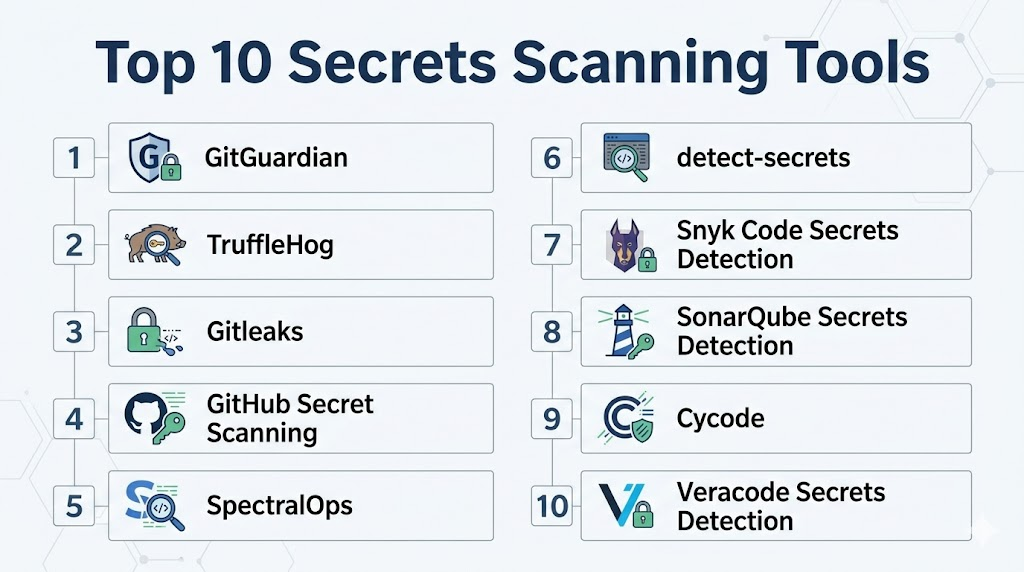
Introduction
Secrets scanning tools help organizations detect exposed credentials, API keys, passwords, tokens, certificates, SSH keys, and sensitive configuration data across source code, repositories, CI/CD pipelines, containers, cloud storage, logs, and collaboration platforms. As DevOps adoption, cloud-native infrastructure, AI workloads, and Git-based development continue growing, secret exposure has become one of the most common causes of security breaches. A single leaked token in a public repository can lead to cloud compromise, ransomware incidents, data theft, or unauthorized infrastructure access.
Modern secrets scanning platforms automate detection and remediation before secrets reach production systems or public repositories. These tools are increasingly integrated into CI/CD pipelines, Git workflows, cloud governance systems, and developer security platforms.
Real-world use cases include:
- Detecting exposed API keys in Git repositories
- Preventing hardcoded credentials in CI/CD pipelines
- Scanning Kubernetes manifests and IaC templates
- Monitoring cloud storage and collaboration platforms
- Enforcing DevSecOps security policies
Evaluation Criteria for Buyers:
- Detection accuracy
- False positive reduction
- CI/CD integration support
- Repository and SCM coverage
- Real-time scanning capabilities
- Developer workflow integration
- Compliance and audit features
- Scalability across large environments
- Remediation automation
- Cloud and Kubernetes support
Best for: DevSecOps teams, application security engineers, platform engineers, cloud security teams, enterprises managing large codebases, SaaS companies, and organizations adopting shift-left security.
Not ideal for: Very small development teams with limited repositories, organizations without CI/CD workflows, or businesses relying solely on manual security reviews.
Key Trends in Secrets Scanning Tools
- AI-assisted secret detection is improving pattern recognition and reducing false positives.
- Real-time Git scanning is becoming standard across developer workflows.
- Pre-commit scanning adoption is increasing to stop secrets before code is pushed.
- Kubernetes and IaC scanning are now critical requirements.
- Cloud-native integrations are expanding across AWS, Azure, and Google Cloud.
- Automated remediation workflows are becoming more common.
- Developer-focused feedback loops are improving usability and adoption.
- Continuous runtime secret monitoring is growing beyond repository-only scanning.
- Compliance-driven reporting is increasingly important for regulated industries.
- Secrets management integration is becoming a key differentiator.
How We Selected These Tools Methodology
The tools in this list were selected using the following evaluation criteria:
- Market adoption and DevSecOps mindshare
- Detection quality and secret coverage
- CI/CD and Git platform integrations
- Cloud and Kubernetes scanning capabilities
- Enterprise governance and reporting
- False positive handling effectiveness
- Scalability across repositories and teams
- Developer workflow usability
- Security automation ecosystem support
- Community strength and documentation quality
Top 10 Secrets Scanning Tools
1- GitGuardian
Short description:
GitGuardian is one of the most recognized secrets detection platforms for DevSecOps and Git security. It continuously scans repositories, CI/CD pipelines, collaboration systems, and developer workflows to identify exposed credentials and sensitive information. It is widely used by enterprises, security teams, and cloud-native engineering organizations.
Key Features
- Real-time secrets detection
- GitHub and GitLab monitoring
- CI/CD scanning
- Public repository monitoring
- Incident remediation workflows
- Kubernetes and IaC scanning
- Developer remediation guidance
Pros
- Strong detection accuracy
- Excellent developer workflow integrations
- Enterprise-ready governance features
Cons
- Advanced enterprise features may increase cost
- Large environments require policy tuning
- Some remediation workflows need customization
Platforms / Deployment
- Cloud / Hybrid
- Linux / macOS / Windows integrations
- CI/CD and Git-native deployment support
Security & Compliance
- RBAC
- Audit logs
- SSO/SAML
- Encryption support
- Compliance reporting features
Integrations & Ecosystem
GitGuardian integrates deeply into modern DevSecOps workflows and cloud-native development pipelines.
- GitHub
- GitLab
- Bitbucket
- Jenkins
- Kubernetes
- Slack
- AWS
Support & Community
GitGuardian provides strong documentation, enterprise onboarding, security guidance, and customer support options.
2- TruffleHog
Short description:
TruffleHog is a popular open-source secrets scanning tool that detects high-entropy strings, API keys, and credentials across Git repositories and cloud environments. It is commonly used by developers and security teams looking for lightweight scanning capabilities with broad repository coverage.
Key Features
- Git repository scanning
- Entropy-based detection
- Verified secrets detection
- Cloud credential scanning
- CI/CD integration
- Historical Git commit scanning
- Open-source extensibility
Pros
- Easy to deploy
- Strong open-source adoption
- Good historical scanning support
Cons
- False positives may require tuning
- Enterprise workflow controls are limited
- Reporting features are basic
Platforms / Deployment
- Self-hosted / Hybrid
- Linux / macOS / Windows
Security & Compliance
- Encryption depends on deployment
- Audit logging depends on environment
- Compliance mapping is custom
Integrations & Ecosystem
TruffleHog integrates easily into DevOps and Git-based workflows.
- GitHub
- GitLab
- Bitbucket
- Jenkins
- AWS
- Azure DevOps
Support & Community
TruffleHog has a strong open-source community and practical documentation for DevSecOps teams.
3- Gitleaks
Short description:
Gitleaks is a lightweight open-source secrets detection tool that scans Git repositories, commits, branches, and CI/CD workflows for exposed credentials. It is widely adopted by developers and security teams seeking fast and customizable secret scanning.
Key Features
- Git commit scanning
- Pre-commit scanning
- Custom rules support
- CI/CD integration
- Entropy detection
- JSON reporting
- Repository history analysis
Pros
- Lightweight and fast
- Easy CI/CD integration
- Strong customization support
Cons
- Enterprise dashboards are limited
- Requires rule tuning
- Advanced remediation workflows are minimal
Platforms / Deployment
- Self-hosted / Hybrid
- Linux / macOS / Windows
Security & Compliance
- Compliance depends on configured policies
- Audit reporting depends on CI/CD systems
- Encryption depends on environment
Integrations & Ecosystem
Gitleaks fits naturally into Git-based and DevSecOps workflows.
- GitHub
- GitLab
- Jenkins
- Docker
- Kubernetes
- Azure DevOps
Support & Community
Gitleaks has strong community adoption, practical examples, and good documentation for developer teams.
4- GitHub Secret Scanning
Short description:
GitHub Secret Scanning is GitHub’s native secrets detection capability designed to identify exposed credentials in repositories and developer workflows. It integrates directly into GitHub security workflows and supports push protection capabilities for preventing accidental exposure.
Key Features
- Native GitHub integration
- Push protection
- Partner pattern detection
- Repository scanning
- Real-time alerts
- Pull request scanning
- Enterprise visibility dashboards
Pros
- Deep GitHub ecosystem integration
- Easy to enable for GitHub users
- Strong developer experience
Cons
- GitHub-focused scope
- Advanced cross-platform workflows may require additional tooling
- Some enterprise capabilities depend on licensing tiers
Platforms / Deployment
- Cloud
- GitHub-native deployment
Security & Compliance
- RBAC
- Audit logs
- SSO/SAML
- Encryption support
- Enterprise security controls
Integrations & Ecosystem
GitHub Secret Scanning integrates tightly into GitHub security and DevSecOps ecosystems.
- GitHub Actions
- GitHub Advanced Security
- CI/CD workflows
- Pull request workflows
- Security alerting systems
Support & Community
GitHub provides enterprise support, documentation, and onboarding resources through its security platform ecosystem.
5- SpectralOps
Short description:
SpectralOps focuses on developer-first secrets scanning and code security analysis. It helps teams detect secrets, misconfigurations, and risky patterns directly within development workflows. The platform is useful for organizations emphasizing shift-left security and developer enablement.
Key Features
- Secrets scanning
- Code risk analysis
- Developer IDE integrations
- CI/CD enforcement
- Custom policy support
- Cloud-native workflow support
- Risk prioritization
Pros
- Strong developer experience
- Shift-left security focus
- Good customization flexibility
Cons
- Advanced governance may require enterprise plans
- Smaller ecosystem than some competitors
- Custom policies need operational planning
Platforms / Deployment
- Cloud / Hybrid
- Linux / macOS / Windows
Security & Compliance
- RBAC
- Audit logging
- Encryption support
- Compliance workflow support
Integrations & Ecosystem
SpectralOps integrates into modern software engineering and DevSecOps environments.
- GitHub
- GitLab
- Bitbucket
- VS Code
- CI/CD pipelines
- Kubernetes
Support & Community
SpectralOps provides documentation, onboarding resources, and support focused on developer security workflows.
6- detect-secrets
Short description:
detect-secrets is an open-source secrets detection tool originally developed by Yelp. It scans repositories for sensitive information and supports baseline management to reduce false positives. It is commonly used in developer pre-commit and CI/CD workflows.
Key Features
- Baseline management
- Pre-commit scanning
- Plugin-based detection
- Entropy detection
- Keyword matching
- Lightweight operation
- Git workflow support
Pros
- Simple and lightweight
- Effective pre-commit scanning
- Open-source flexibility
Cons
- Enterprise governance is limited
- Reporting capabilities are basic
- Requires tuning for large environments
Platforms / Deployment
- Self-hosted / Hybrid
- Linux / macOS / Windows
Security & Compliance
- Policy enforcement depends on configuration
- Compliance mapping is custom
- Audit logs depend on environment
Integrations & Ecosystem
detect-secrets works well inside lightweight developer security workflows.
- Git
- Pre-commit frameworks
- Jenkins
- GitHub Actions
- GitLab CI
Support & Community
detect-secrets has an active open-source community and practical developer documentation.
7- Snyk Code Secrets Detection
Short description:
Snyk Code Secrets Detection combines secret scanning with broader developer security analysis. It helps organizations identify exposed credentials while integrating into application security workflows and developer tooling. It is attractive for teams already invested in the Snyk ecosystem.
Key Features
- Secrets scanning
- Developer security workflows
- IDE integrations
- CI/CD scanning
- Policy enforcement
- Cloud-native scanning
- Vulnerability management integration
Pros
- Unified developer security platform
- Strong IDE integrations
- Good DevSecOps usability
Cons
- Full platform adoption can become costly
- Best value inside Snyk ecosystem
- Advanced workflows require onboarding
Platforms / Deployment
- Cloud / Hybrid
- Linux / macOS / Windows
Security & Compliance
- RBAC
- SSO/SAML
- Audit logs
- Encryption support
- Compliance workflow support
Integrations & Ecosystem
Snyk integrates deeply into software development and cloud-native security workflows.
- GitHub
- GitLab
- Bitbucket
- Jenkins
- Kubernetes
- Docker
- IDE platforms
Support & Community
Snyk provides strong onboarding resources, developer-focused documentation, and enterprise support.
8- SonarQube Secrets Detection
Short description:
SonarQube includes secrets detection capabilities within its broader code quality and application security platform. It helps organizations identify hardcoded credentials and risky patterns during software development and CI/CD processes.
Key Features
- Secrets detection
- Code quality analysis
- Static application security testing
- CI/CD integration
- Developer remediation workflows
- Multi-language support
- Quality gates
Pros
- Combines quality and security analysis
- Strong developer workflow integration
- Broad language support
Cons
- Secret scanning is not the sole platform focus
- Advanced governance may require enterprise editions
- Large deployments need tuning
Platforms / Deployment
- Cloud / Self-hosted / Hybrid
- Linux / Windows / macOS
Security & Compliance
- RBAC
- Audit logging
- SSO/SAML in enterprise editions
- Encryption support
Integrations & Ecosystem
SonarQube integrates naturally into software quality and DevSecOps pipelines.
- Jenkins
- GitHub
- GitLab
- Azure DevOps
- Kubernetes
- IDE integrations
Support & Community
SonarQube has a large global community, strong documentation, and enterprise support programs.
9- Cycode
Short description:
Cycode is an application security posture management platform that includes secrets detection across repositories, CI/CD systems, cloud environments, and developer workflows. It is designed for organizations building broader software supply chain security programs.
Key Features
- Secrets scanning
- CI/CD security visibility
- Supply chain security workflows
- Cloud posture visibility
- Risk prioritization
- Developer remediation workflows
- Security analytics
Pros
- Broad software supply chain coverage
- Good enterprise visibility
- Useful governance workflows
Cons
- Platform complexity may require onboarding
- Commercial pricing may not fit smaller teams
- Advanced workflows need operational maturity
Platforms / Deployment
- Cloud / Hybrid
- Linux / macOS / Windows integrations
Security & Compliance
- RBAC
- Audit logs
- SSO/SAML
- Encryption support
- Governance workflows
Integrations & Ecosystem
Cycode integrates into enterprise DevSecOps and application security ecosystems.
- GitHub
- GitLab
- Bitbucket
- Jenkins
- Kubernetes
- Cloud providers
- CI/CD systems
Support & Community
Cycode provides onboarding, customer success programs, documentation, and enterprise support.
10- Veracode Secrets Detection
Short description:
Veracode includes secrets scanning as part of its broader application security testing and DevSecOps platform. It helps organizations detect exposed credentials while integrating security into software development workflows and compliance programs.
Key Features
- Secrets detection
- Application security testing
- CI/CD integration
- Developer remediation guidance
- Compliance reporting
- Multi-language support
- Enterprise governance workflows
Pros
- Strong enterprise security ecosystem
- Broad compliance capabilities
- Mature AppSec workflows
Cons
- Broader platform may exceed small team needs
- Commercial pricing may be higher
- Best value for enterprise security programs
Platforms / Deployment
- Cloud / Hybrid
- Linux / macOS / Windows integrations
Security & Compliance
- RBAC
- SSO/SAML
- Audit logs
- Encryption support
- Compliance reporting
Integrations & Ecosystem
Veracode integrates into enterprise software security and governance workflows.
- GitHub
- GitLab
- Jenkins
- Azure DevOps
- Kubernetes
- CI/CD systems
Support & Community
Veracode provides enterprise onboarding, training, documentation, and customer support programs.
Comparison Table Top 10
| Tool Name | Best For | Platform Supported | Deployment | Standout Feature | Public Rating |
|---|---|---|---|---|---|
| GitGuardian | Enterprise DevSecOps | Linux, macOS, Windows | Cloud / Hybrid | Real-time Git secrets monitoring | N/A |
| TruffleHog | Open-source repository scanning | Linux, macOS, Windows | Self-hosted / Hybrid | Historical Git scanning | N/A |
| Gitleaks | Lightweight CI/CD scanning | Linux, macOS, Windows | Self-hosted / Hybrid | Fast customizable scanning | N/A |
| GitHub Secret Scanning | GitHub-native security | GitHub Cloud | Cloud | Push protection workflows | N/A |
| SpectralOps | Developer-first security | Linux, macOS, Windows | Cloud / Hybrid | IDE-focused security workflows | N/A |
| detect-secrets | Lightweight pre-commit scanning | Linux, macOS, Windows | Self-hosted / Hybrid | Baseline management | N/A |
| Snyk Code Secrets Detection | Unified developer security | Linux, macOS, Windows | Cloud / Hybrid | Integrated AppSec workflows | N/A |
| SonarQube Secrets Detection | Code quality and security | Linux, Windows, macOS | Hybrid | Combined code quality analysis | N/A |
| Cycode | Software supply chain security | Linux, macOS, Windows | Cloud / Hybrid | Enterprise security posture visibility | N/A |
| Veracode Secrets Detection | Enterprise AppSec | Linux, macOS, Windows | Cloud / Hybrid | Compliance-focused security workflows | N/A |
Evaluation & Scoring of Secrets Scanning Tools
| Tool Name | Core 25% | Ease 15% | Integrations 15% | Security 10% | Performance 10% | Support 10% | Value 15% | Weighted Total |
|---|---|---|---|---|---|---|---|---|
| GitGuardian | 9.5 | 8.5 | 9.0 | 9.0 | 9.0 | 9.0 | 8.0 | 8.9 |
| TruffleHog | 8.5 | 8.0 | 8.0 | 8.0 | 8.0 | 7.5 | 9.0 | 8.2 |
| Gitleaks | 8.5 | 8.5 | 8.0 | 8.0 | 8.5 | 7.5 | 9.0 | 8.3 |
| GitHub Secret Scanning | 9.0 | 9.0 | 8.5 | 9.0 | 8.5 | 8.5 | 7.5 | 8.6 |
| SpectralOps | 8.5 | 8.5 | 8.5 | 8.5 | 8.0 | 8.0 | 7.5 | 8.2 |
| detect-secrets | 8.0 | 8.5 | 7.5 | 7.5 | 8.0 | 7.0 | 9.0 | 8.0 |
| Snyk Code Secrets Detection | 8.5 | 8.5 | 9.0 | 8.5 | 8.5 | 8.5 | 7.0 | 8.4 |
| SonarQube Secrets Detection | 8.0 | 8.0 | 8.5 | 8.0 | 8.0 | 8.5 | 7.5 | 8.0 |
| Cycode | 8.5 | 7.5 | 9.0 | 9.0 | 8.5 | 8.5 | 7.0 | 8.3 |
| Veracode Secrets Detection | 8.5 | 7.5 | 8.5 | 9.0 | 8.5 | 8.5 | 7.0 | 8.2 |
These scores are comparative rather than absolute. Higher scores typically reflect stronger enterprise readiness, ecosystem maturity, and broader workflow support. Open-source tools often provide strong value and flexibility, while commercial platforms typically offer better governance, reporting, and support. Organizations should prioritize scoring categories differently depending on their security maturity, repository scale, compliance requirements, and DevSecOps workflows.
Which Secrets Scanning Tool Is Right for You?
Solo / Freelancer
Solo developers and freelancers often benefit from lightweight tools such as Gitleaks, detect-secrets, or TruffleHog. These tools are easy to integrate into local workflows and CI/CD pipelines without major operational overhead. GitHub Secret Scanning is also valuable for developers already using GitHub heavily.
SMB
SMBs should prioritize ease of use, CI/CD integration, and cost efficiency. GitGuardian, Gitleaks, SpectralOps, and Snyk Code Secrets Detection are practical choices depending on whether the focus is developer security, DevSecOps automation, or broader application security workflows.
Mid-Market
Mid-market organizations often require centralized reporting, governance, and cloud-native integrations. GitGuardian, Snyk, Cycode, and SonarQube provide stronger workflow visibility and security integration capabilities for growing engineering organizations.
Enterprise
Enterprises usually need audit logging, RBAC, compliance workflows, supply chain security visibility, and large-scale repository scanning. GitGuardian, Cycode, Veracode, GitHub Secret Scanning, and Snyk are strong candidates depending on cloud strategy and security program maturity.
Budget vs Premium
Open-source tools such as Gitleaks, detect-secrets, and TruffleHog provide strong value for smaller teams and cost-sensitive organizations. Premium platforms justify cost through centralized governance, remediation workflows, compliance support, and enterprise reporting.
Feature Depth vs Ease of Use
GitHub Secret Scanning and GitGuardian are easier to operationalize quickly. Open-source tools may require more tuning and policy management. Enterprise platforms add stronger governance but often require onboarding and operational planning.
Integrations & Scalability
GitGuardian, Snyk, Cycode, and Veracode provide strong integration ecosystems and scalability for larger organizations. Open-source tools integrate well into CI/CD pipelines but may require additional tooling for enterprise-wide governance.
Security & Compliance Needs
Organizations in regulated industries should prioritize audit logs, RBAC, compliance reporting, remediation workflows, and centralized visibility. Enterprise-grade governance and reporting become increasingly important as repository counts and engineering teams grow.
Frequently Asked Questions FAQs
1. What are secrets scanning tools?
Secrets scanning tools identify exposed credentials, passwords, API keys, certificates, tokens, and other sensitive information across repositories, CI/CD pipelines, cloud storage, and infrastructure code. These tools help organizations prevent accidental exposure that could lead to breaches or unauthorized access. Modern secrets scanning platforms automate detection and often integrate into developer workflows. They are now considered essential components of DevSecOps programs and cloud security strategies.
2. Why are secrets leaks dangerous?
Leaked secrets can provide attackers with direct access to cloud environments, APIs, databases, internal systems, and production infrastructure. A single exposed token may allow unauthorized resource creation, data theft, privilege escalation, or ransomware deployment. Public Git repositories are common targets for automated attackers scanning for exposed credentials. Even temporary leaks can cause major operational and financial damage. Early detection and rapid remediation are critical.
3. What types of secrets can these tools detect?
Most secrets scanning tools can detect API keys, SSH keys, passwords, cloud credentials, database connection strings, certificates, OAuth tokens, and private keys. Advanced tools may also detect custom internal credentials or organization-specific patterns. Some platforms support entropy-based detection, while others use pattern matching or AI-assisted analysis. Enterprise tools often provide custom policy creation for specialized environments.
4. What is the difference between secrets scanning and secrets management?
Secrets scanning detects exposed credentials, while secrets management stores and controls sensitive credentials securely. Secrets management platforms such as Vault or cloud secret managers help teams avoid hardcoding credentials in the first place. Secrets scanning tools help identify accidental exposures that still occur during development. Both technologies work best together in a complete DevSecOps strategy.
5. Should secrets scanning happen before or after deployment?
Secrets scanning should happen throughout the software development lifecycle. Pre-commit scanning helps stop secrets before code is pushed. CI/CD scanning prevents risky deployments from reaching production. Repository monitoring provides continuous detection for existing codebases. Runtime monitoring and cloud scanning may also help identify exposed credentials after deployment. Multiple scanning stages improve security coverage significantly.
6. Are open-source secrets scanning tools good enough?
Open-source tools such as Gitleaks, TruffleHog, and detect-secrets are highly effective for many organizations, especially smaller teams and DevSecOps-focused environments. However, enterprise organizations may require centralized reporting, governance workflows, remediation tracking, audit logs, and compliance reporting. The right choice depends on operational scale, compliance requirements, and security maturity. Many enterprises use both open-source and commercial tools together.
7. What are common mistakes when implementing secrets scanning?
Common mistakes include ignoring false positives, failing to rotate exposed credentials, relying only on repository scanning, and not integrating scanning into CI/CD workflows. Some organizations also enable scanning without training developers on remediation procedures. Another major issue is scanning without enforcing secure secrets management practices. Teams should combine scanning, education, secret rotation, and policy enforcement for stronger security outcomes.
8. How do secrets scanning tools integrate with CI/CD?
Secrets scanning tools commonly integrate into CI/CD pipelines as automated validation steps. During commits, pull requests, or builds, the scanner checks repositories and configuration files for exposed secrets. If a secret is found, the pipeline may fail, warn developers, or trigger remediation workflows. Integration with GitHub Actions, GitLab CI, Jenkins, Azure DevOps, and Kubernetes workflows is common. This supports shift-left security practices.
9. Can secrets scanning reduce compliance risk?
Yes, secrets scanning helps organizations reduce compliance risk by identifying exposed credentials that could violate security policies and regulatory requirements. It supports governance initiatives by providing visibility, auditability, and remediation tracking. However, compliance also requires operational controls, incident response processes, access management, and security training. Secrets scanning should be treated as one component of a broader compliance and risk management program.
10. How should a company start using secrets scanning tools?
Organizations should start by enabling scanning in source control repositories and CI/CD pipelines. Begin with warning-mode scanning to understand exposure levels and false positives. Prioritize remediation of high-risk credentials such as cloud admin keys and production database passwords. Teams should also implement secrets management systems and developer education programs. Gradual rollout and policy tuning usually lead to stronger adoption and fewer workflow disruptions.
Conclusion
Secrets scanning tools have become a critical part of modern DevSecOps, cloud security, and software supply chain protection. As organizations accelerate cloud adoption, Kubernetes deployments, Infrastructure as Code automation, and AI-driven development workflows, the risk of accidentally exposing credentials continues growing rapidly. The best secrets scanning platforms help organizations identify and remediate exposures early, integrate security into developer workflows, reduce operational risk, and improve compliance visibility across repositories and infrastructure environments.The right tool depends heavily on your environment, workflow maturity, and governance requirements. Open-source tools such as Gitleaks, TruffleHog, and detect-secrets provide excellent value for smaller teams and flexible DevSecOps pipelines. Enterprise platforms such as GitGuardian, Snyk, Cycode, and Veracode offer stronger centralized governance, audit reporting, workflow orchestration, and enterprise-scale visibility. Organizations should shortlist several tools, test them in real CI/CD environments, validate false-positive handling, evaluate developer experience carefully, and then scale gradually with clear remediation workflows and secrets management best practices.
