MOTOSHARE 🚗🏍️
Rent Bikes & Cars Directly from Owners
Motoshare connects vehicle owners with people who need bikes and cars on rent. Owners earn from idle vehicles, and renters get flexible ride options.
Visit Motoshare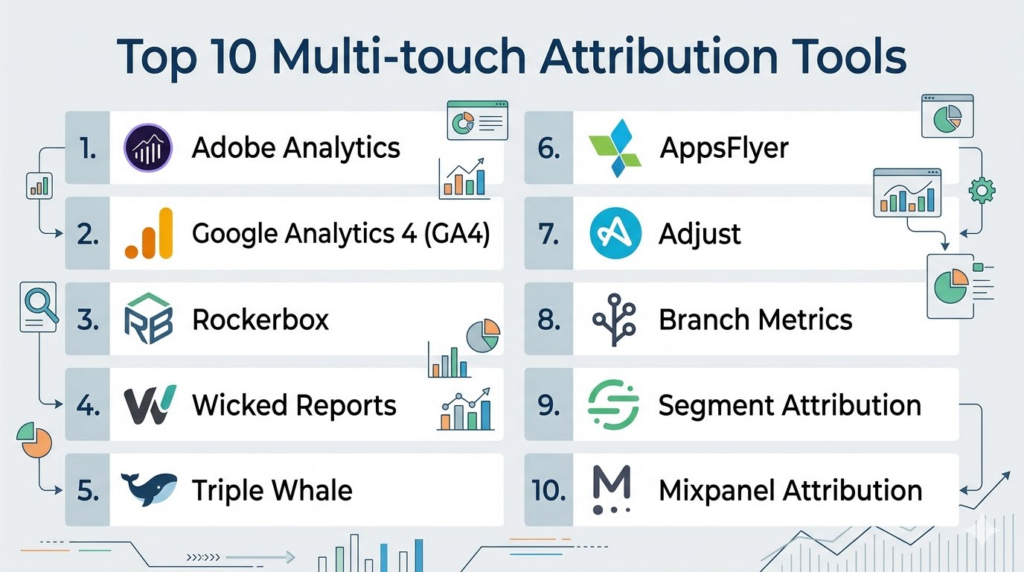
Introduction
Multi‑touch Attribution (MTA) Tools are software platforms that help businesses understand how value is distributed across multiple marketing touchpoints throughout a customer’s journey. Instead of giving all credit to the first or last touch, multi‑touch models (linear, time‑decay, position‑based, algorithmic, or data‑driven) allocate credit across interactions to give marketers a clearer picture of channel influence. These tools ingest data from ads, email, web analytics, CRM, offline sources, and other systems to build a holistic attribution view.In as customer journeys span social, search, email, content, app, offline, and emerging formats like connected TV and podcasts, MTA tools matter more than ever. They help marketers justify spend, optimize budgets, personalize outreach, and forecast outcomes. With privacy changes and fragmented identities, modern MTA platforms rely on first‑party data, server‑side tracking, and advanced modeling.
Real‑world use cases include:
- Understanding combined influence of paid, organic, and direct interactions
- Allocating budget across search, display, social, and email for better ROI
- Measuring impact of offline activities (events, billboards) alongside digital
- Identifying friction points and drop‑offs in multi‑step funnels
- Optimizing content and channel mix for increased conversions
What buyers should evaluate:
- Quality and flexibility of multi‑touch models
- Support for cross‑device, cross‑channel data unification
- Integration with analytics, CRM, CDP, and ad platforms
- Ability to handle offline data sources
- Real‑time vs batch processing
- AI or data‑driven model capabilities
- Privacy and compliance readiness
- Reporting and visualization quality
- Ease of setup and ongoing maintenance
- Price/value balance
Best for: Marketing operations teams, growth teams, performance marketers, digital analytics leads, and CMOs in mid‑market and enterprise organizations with diverse channel mixes.
Not ideal for: Small businesses with simple customer journeys, limited data sources, or minimal cross‑channel investment; simpler analytics tools may suffice.
Key Trends in Multi‑touch Attribution Tools
- AI‑enhanced algorithmic modeling: Automated model optimization and inferential insights backed by machine learning.
- Privacy‑first identity strategies: First‑party identity graphs, probabilistic matching, and server‑side tracking as cookies wane.
- Hybrid offline/online integration: Attribution that bridges in‑store, call centers, events, and traditional advertising.
- Real‑time activation and dashboards: Near‑instant feedback loops for optimization.
- Cross‑device stitching: Better resolution of behaviors across phones, tablets, desktops, and apps.
- Unified CDP & attribution integration: Attribution embedded in customer data platforms for seamless activation.
- Predictive attribution and forecasting: Not just measuring past performance but predicting future touch influence.
- Audience‑level attribution: Moving beyond channel credit to cohort and segment contribution.
- Flexible attribution engines: Custom, rule‑based, and dynamically evolving models.
- Self‑serve configuration: Marketers can choose or customize attribution logic without heavy IT.
How We Selected These Tools (Methodology)
- Multi‑touch model support: Tools with flexible, industry‑recognized attribution methodologies.
- Cross‑channel data integrations: Connectivity with web, ad platforms, CRM, CDP, offline sources.
- Identity and cross‑device resolution: Ability to unify journeys across contexts.
- AI or data‑driven modeling: Platforms offering algorithmic or predictive models.
- Ease of use: Setup simplicity and intuitive reporting.
- Security and compliance: Support for data governance and privacy controls.
- Scalability: Ability to handle large datasets and complex journeys.
- Reporting and dashboards: Quality of visualization and insights delivery.
- Support & documentation: Clarity, onboarding help, and community resources.
- Value relative to capabilities: Fair pricing for features offered.
Top 10 Multi‑touch Attribution Tools
#1 — Adobe Analytics Attribution
Short description:
Enterprise analytics platform with multi‑touch attribution models embedded within a broader analytics suite, offering customizable models, real‑time insights, and deep segmentation for complex customer journeys.
Key Features
- Support for multiple attribution models (rule‑based & AI enabled)
- Cross‑device and cross‑channel analysis
- Cohort and segmentation reporting
- Real‑time dashboards
- Integration with the Adobe Experience Cloud
- Unified customer profiles
- Journey visualization
Pros
- Deep enterprise scalability
- Flexible model configurations
- Strong visualization and reporting
Cons
- Premium pricing
- Complex learning curve
Platforms / Deployment
- Web
- Cloud
Security & Compliance
Not publicly stated
Integrations & Ecosystem
Integrates broadly across analytics, CDP, martech, and CRM systems:
- Adobe Experience Cloud
- CRM systems and data warehouses
- Ad platforms
- CDP
Support & Community
Enterprise support, extensive documentation, training programs.
#2 — Google Analytics 4 (GA4) Attribution
Short description:
Part of Google Analytics 4 with built‑in multi‑touch attribution reporting that allocates credit across touchpoints captured by GA4’s event‑based model, optimized for cross‑platform and cross‑device measurement.
Key Features
- Data‑driven attribution model
- Cross‑platform event tracking
- Integration with Google Ads & campaigns
- User pathing visualization
- Real‑time insights (with BigQuery)
- Custom funnels
Pros
- Harmonized with Google ecosystem
- Widely used and familiar interface
- Strong multi‑device analytics
Cons
- Attribution limited to tracked events
- Less flexibility than specialized tools
Platforms / Deployment
- Web
- Cloud
Security & Compliance
Not publicly stated
Integrations & Ecosystem
Best for Google integrated environments:
- Google Ads & Campaign Manager
- BigQuery
- CRM via connectors
Support & Community
Documentation, community forums, and learning resources.
#3 — Rockerbox
Short description:
Rockerbox is designed for direct‑to‑consumer brands and other digital businesses, delivering multi‑touch attribution by unifying media and conversion data and allowing marketers to evaluate channel effectiveness holistically.
Key Features
- Multi‑touch attribution engine
- Identity resolution
- Unified dashboards
- Event deduplication
- Custom attribution models
- Cohort revenue analysis
Pros
- Practical for ecommerce and digital brands
- Strong unification of diverse channels
- Custom modeling options
Cons
- Less focus on offline channels
- Smaller enterprise footprint
Platforms / Deployment
- Web
- Cloud
Security & Compliance
Not publicly stated
Integrations & Ecosystem
Common integrations include:
- Ad platforms (search, social)
- Ecommerce systems
- Analytics tools
- Data warehouses
Support & Community
Documentation and support resources.
#4 — Wicked Reports
Short description:
A multi‑touch attribution and analytics platform focusing on tying revenue back to original marketing interactions across channels, especially for ecommerce and direct response advertisers.
Key Features
- Revenue attribution across touchpoints
- Multi‑touch models
- Funnel and cohort analyses
- Automated reporting
- Customer lifetime insights
Pros
- Revenue‑centric measurement
- Optimized for ecommerce and performance budgets
- Practical dashboards
Cons
- Bias toward digital channels
- Fewer enterprise features
Platforms / Deployment
- Web
- Cloud
Security & Compliance
Not publicly stated
Integrations & Ecosystem
Typical integrations:
- Ecommerce platforms
- Ad networks
- Analytics and CRM systems
Support & Community
User support and onboarding resources.
#5 — Triple Whale Attribution
Short description:
A newer entrant focused on unified ecommerce measurement with multi‑touch attribution and cohort insights to help brands understand media performance and customer value across digital channels.
Key Features
- Multi‑touch attribution dashboards
- Customer lifecycle views
- Real‑time updates
- Cohort and channel breakdowns
- Ad spend analysis
Pros
- Designed for scaling ecommerce brands
- Easy to interpret dashboards
- Quick onboarding
Cons
- Smaller enterprise presence
- Less offline support
Platforms / Deployment
- Web
- Cloud
Security & Compliance
Not publicly stated
Integrations & Ecosystem
Connects with:
- Ecommerce platforms
- Ad networks
- Analytics providers
Support & Community
Documentation and responsive support.
#6 — AppsFlyer
Short description:
Mobile attribution leader focusing on user acquisition attribution across mobile and connected channels, with multi‑touch models for marketers to understand installs, events, and ad contributions.
Key Features
- Multi‑touch mobile attribution
- Cohort analysis
- Fraud detection signals
- Media source optimization
- Unified dashboards
Pros
- Deep mobile tracking and measurement
- Robust cohort insights
Cons
- Primarily mobile centric
- Less traditional web attribution depth
Platforms / Deployment
- Web
- Cloud
Security & Compliance
Not publicly stated
Integrations & Ecosystem
Integrated with:
- Ad networks
- Analytics tools
- CRM systems
Support & Community
Documentation and support services.
#7 — Adjust
Short description:
A multi‑touch mobile attribution and measurement platform, helping marketers connect user acquisition sources to in‑app events and measure contribution across campaigns.
Key Features
- SDK‑based mobile attribution
- Multi‑touch event mapping
- Cohort and lifetime analyses
- Fraud prevention insights
Pros
- Strong mobile data fidelity
- Attribution for installs and in‑app behaviors
Cons
- Less cross‑web attribution
- Limited offline support
Platforms / Deployment
- Web
- Cloud
Security & Compliance
Not publicly stated
Integrations & Ecosystem
Integrates with:
- Mobile ad networks
- Analytics stacks
- CRM systems
Support & Community
Support documentation and tiers.
#8 — Branch Metrics
Short description:
Branch specializes in deep linking and multi‑touch attribution for mobile and cross‑platform journeys, providing insights into user acquisition and engagement tied to specific sources.
Key Features
- Multi‑platform attribution
- Deep linking and routing analytics
- Cohort performance views
- Cross‑device user graphs
Pros
- Strong for app marketers
- Combines routing & attribution
Cons
- Not a full omnichannel solution
- Limited offline support
Platforms / Deployment
- Web
- Cloud
Security & Compliance
Not publicly stated
Integrations & Ecosystem
Works with:
- Ad platforms
- Analytics
- CRM
Support & Community
Documentation and support tiers.
#9 — Segment Attribution Plugins
Short description:
Segment (customer data platform) provides building blocks for attribution via plugins or models that utilize unified, first‑party customer data to power multi‑touch insights and activate audiences downstream.
Key Features
- Unified customer profiles
- Identity resolution
- Plug‑in attribution models
- Data governance
- Cross‑device stitching
Pros
- Flexible and extensible
- Central data layer for attribution
Cons
- Requires configuration
- Attribution is not plug‑and‑play
Platforms / Deployment
- Web
- Cloud
Security & Compliance
Not publicly stated
Integrations & Ecosystem
Part of a broad CDP ecosystem connecting:
- CRM
- Analytics
- Ad platforms
- CDP outputs
Support & Community
Rich documentation and community resources.
#10 — Mixpanel (Attribution Reports)
Short description:
Behavioral analytics platform with multi‑touch attribution capabilities focused on product and engagement measurement, helping teams understand how interactions lead to conversions or retention.
Key Features
- User‑centric event and attribution tracking
- Multi‑touch reporting
- Retention and funnel analysis
- Cohort segmentation
Pros
- Strong behavioral insights
- Attribution tied to product usage
Cons
- Attribution secondary to core analytics
- Not a dedicated attribution engine
Platforms / Deployment
- Web / iOS / Android
- Cloud
Security & Compliance
Not publicly stated
Integrations & Ecosystem
Integrates with:
- Product telemetry
- CRM
- Analytics tools
Support & Community
Documentation and support.
Comparison Table (Top 10)
| Tool Name | Best For | Platforms Supported | Deployment | Standout Feature | Public Rating |
|---|---|---|---|---|---|
| Adobe Analytics Attribution | Enterprise measurement | Web | Cloud | Flexible multi‑model options | N/A |
| Google Analytics 4 Attribution | Integrated GA users | Web | Cloud | Data‑driven attribution | N/A |
| Rockerbox | Ecommerce brands | Web | Cloud | Unified channel view | N/A |
| Wicked Reports | Revenue attribution | Web | Cloud | Revenue crediting | N/A |
| Triple Whale | Ecommerce analytics | Web | Cloud | Real‑time dashboards | N/A |
| AppsFlyer | Mobile acquisition | Web | Cloud | Install & event measurement | N/A |
| Adjust | Mobile attribution | Web | Cloud | Fraud and install tracking | N/A |
| Branch Metrics | Cross‑platform journeys | Web | Cloud | Deep linking attribution | N/A |
| Segment Attribution | CDP‑centric attribution | Web | Cloud | Unified identity | N/A |
| Mixpanel Attribution | Product engagement | Web, iOS, Android | Cloud | Behavioral attribution | N/A |
Evaluation & Scoring of Multi‑touch Attribution Tools
| Tool Name | Core (25%) | Ease (15%) | Integrations (15%) | Security (10%) | Performance (10%) | Support (10%) | Value (15%) | Weighted Total |
|---|---|---|---|---|---|---|---|---|
| Adobe Analytics Attribution | 9 | 6 | 9 | 8 | 9 | 7 | 7 | 8.1 |
| Google Analytics 4 Attribution | 7 | 9 | 8 | 7 | 7 | 8 | 9 | 7.9 |
| Rockerbox | 8 | 8 | 8 | 7 | 8 | 8 | 8 | 8.0 |
| Wicked Reports | 8 | 8 | 8 | 7 | 8 | 7 | 8 | 7.9 |
| Triple Whale | 7 | 9 | 7 | 7 | 7 | 8 | 8 | 7.8 |
| AppsFlyer | 7 | 8 | 7 | 7 | 7 | 7 | 7 | 7.3 |
| Adjust | 7 | 8 | 7 | 7 | 7 | 7 | 7 | 7.3 |
| Branch Metrics | 7 | 8 | 7 | 7 | 7 | 7 | 7 | 7.3 |
| Segment Attribution | 8 | 8 | 9 | 8 | 8 | 8 | 8 | 8.3 |
| Mixpanel Attribution | 7 | 8 | 8 | 7 | 7 | 7 | 8 | 7.7 |
Interpreting scores:
- Core (25%) reflects modeling capabilities and depth of multi‑touch logic.
- Ease (15%) measures usability and setup friction for diverse teams.
- Integrations (15%) judges connectivity to diverse data sources.
- Security (10%) considers governance and compliance foundations.
- Performance (10%) shows reliability and responsiveness.
- Support (10%) captures documentation and assistance options.
- Value (15%) balances cost against capabilities.
These are comparative scores. A higher total indicates broader strengths across prioritized dimensions.
Which Multi‑touch Attribution Tool Is Right for You?
Solo / Freelancer
Start with Google Analytics 4 Attribution or Triple Whale for quick setup and integrated insights without heavy investment.
SMB
Rockerbox, Wicked Reports, and GA4 Attribution provide balanced multi‑touch insights with manageable cost and onboarding.
Mid‑Market
Segment Attribution and Adobe Analytics Attribution scale for more complex journeys and deeper analysis across segments.
Enterprise
Adobe Analytics Attribution and Segment Attribution offer flexibility, identity resolution, and governance for enterprise teams.
Budget vs Premium
Budget teams benefit from GA4 and Triple Whale; premium deployments may require Adobe or Segment with deeper modeling.
Feature Depth vs Ease of Use
Enterprise tools (Adobe) provide depth at the cost of complexity. GA4 and Rockerbox emphasize ease.
Integrations & Scalability
Enterprise and mid‑market need broad connectors across CRM, CDP, warehouses, analytics, ad platforms, and offline sources.
Security & Compliance Needs
Business handling sensitive customer data should validate encryption, identity access controls, audit trails, and regional compliance.
Frequently Asked Questions (FAQs)
1. What is multi‑touch attribution?
Multi‑touch attribution allocates credit for a conversion across multiple touchpoints (channels, ads, content, interactions) to reflect their real influence on a customer’s journey.
2. How does it differ from single‑touch?
Single‑touch (first/last) assigns credit to one point, while multi‑touch distributes credit across all meaningful interactions, offering a more nuanced understanding.
3. Why is multi‑touch important?
Complex journeys involve multiple influences (search, social, email, content). Multi‑touch shows real contribution across these touchpoints so marketers can optimize spend and strategy.
4. How do tools handle privacy changes?
Modern MTA tools rely on first‑party data, probabilistic matching, server‑side tracking, and privacy‑centric identity graphs to adjust for cookie deprecation and regulatory constraints.
5. Can multi‑touch attribute offline channels?
Some enterprise tools can incorporate offline data (events, POS) when pipelines or integrations are configured, strengthening unified measurement.
6. How long does implementation take?
Simple setups can be weeks; enterprise integrations with identity resolution and offline data may take months, depending on data maturity.
7. What integrations matter most?
CRM, CDP, ad platforms (search, social), analytics, ecommerce, and data warehouses are key for comprehensive multi‑touch coverage.
8. What role does AI play?
AI enhances algorithmic attribution, trend detection, predictive attribution, and recommendations, helping derive insights with less manual calibration.
9. Should small businesses use these tools?
Yes, lightweight options like GA4 Attribution or Triple Whale offer practical insights without heavy cost or complexity.
10. What are common pitfalls in attribution?
Inadequate data quality, missing offline sources, ignoring identity resolution, relying only on default models, and misinterpreting outputs can lead to misinformed decisions.
Conclusion
Multi‑touch attribution tools sit at the core of modern marketing measurement, helping teams allocate credit across complex journeys and varied channels. From Google Analytics 4 Attribution for integrated, easy deployment, to Adobe Analytics Attribution and Segment Attribution for enterprise‑grade modeling and identity consolidation, the landscape supports diverse scales and needs. Emerging brands benefit from Rockerbox, Wicked Reports, and Triple Whale for ecommerce and digital analysis, while mobile‑focused attribution is well‑handled by AppsFlyer, Adjust, and Branch. Selecting the right tool depends on data maturity, channel mix, integrations, compliance, and user sophistication.
