MOTOSHARE 🚗🏍️
Rent Bikes & Cars Directly from Owners
Motoshare connects vehicle owners with people who need bikes and cars on rent. Owners earn from idle vehicles, and renters get flexible ride options.
Visit Motoshare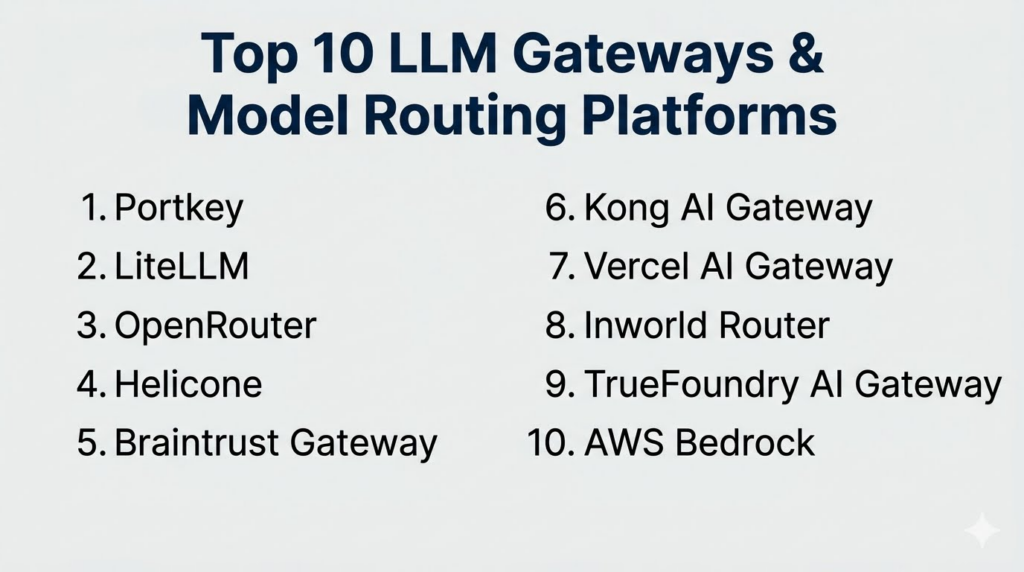
Introduction
LLM Gateways and Model Routing Platforms provide a centralized infrastructure layer between applications and multiple AI model providers such as OpenAI, Anthropic, Google Gemini, Azure OpenAI, AWS Bedrock, Mistral, Cohere, and open-source LLMs. These platforms help organizations manage routing, failover, observability, governance, authentication, caching, rate limiting, and cost optimization for production AI workloads.As enterprises move from single-model experiments to multi-model AI systems, LLM gateways have become critical infrastructure. Modern AI applications need intelligent model selection, traffic balancing, prompt tracing, fallback handling, and centralized policy enforcement. Instead of directly integrating every AI provider separately, organizations now use AI gateways to simplify operations and improve scalability.
Real-World Use Cases
- Multi-provider AI routing for enterprise applications
- Cost optimization across different LLM vendors
- AI observability and request tracing
- Failover and redundancy for production AI systems
- Centralized governance for AI copilots and chatbots
Evaluation Criteria for Buyers
When evaluating LLM Gateways and Model Routing Platforms, buyers should consider:
- Multi-model and multi-provider support
- Routing flexibility and failover capabilities
- Cost optimization features
- Observability and tracing depth
- Security and governance controls
- OpenAI-compatible API support
- Scalability and latency handling
- Kubernetes and cloud-native readiness
- Caching and token optimization
- Developer experience and integrations
Best for: Enterprise AI teams, AI SaaS providers, platform engineering teams, MLOps organizations, and companies operating production-scale generative AI systems.
Not ideal for: Small hobby projects using only one model provider where direct API integrations may already be sufficient.
Key Trends in LLM Gateways & Model Routing Platforms
- Multi-provider AI routing is becoming a standard enterprise requirement.
- Cost-aware model selection is increasingly important for token optimization.
- AI observability and tracing are becoming mandatory production requirements.
- Semantic caching is reducing latency and infrastructure costs.
- OpenAI-compatible APIs are emerging as the default integration standard.
- AI governance and policy enforcement are gaining importance in regulated industries.
- AI gateways are integrating with agent frameworks and orchestration stacks.
- Edge inference routing and hybrid AI deployments are expanding rapidly.
- Security concerns around exposed AI proxies are increasing.
- AI traffic management is evolving similarly to traditional API gateway ecosystems.
How We Selected These Tools
The following platforms were selected using practical enterprise AI infrastructure evaluation criteria.
- Strong production adoption
- Multi-provider compatibility
- Observability and monitoring depth
- Routing and failover flexibility
- Enterprise governance capabilities
- Developer experience quality
- Cloud-native deployment readiness
- Security and policy management features
- Ecosystem maturity and integrations
- Long-term infrastructure scalability
Top 10 LLM Gateways & Model Routing Platforms
1- Portkey
Short description:
Portkey is one of the leading AI gateway platforms for routing, governance, observability, and failover management across multiple LLM providers. It offers centralized APIs, analytics, prompt management, semantic caching, and policy enforcement capabilities for enterprise AI deployments. The platform is widely used for production-grade generative AI infrastructure.
Key Features
- Multi-provider routing
- AI observability dashboards
- Semantic caching
- Cost optimization tools
- Prompt management
- Retry and failover handling
- OpenAI-compatible APIs
Pros
- Strong enterprise governance capabilities
- Excellent observability tooling
- Mature routing workflows
Cons
- Advanced setup may require platform expertise
- Enterprise onboarding can be complex
- Full feature adoption may take time
Platforms / Deployment
- Cloud / Kubernetes / Self-hosted / Hybrid
Security & Compliance
- RBAC support available
- Audit logging support available
- Policy enforcement supported
- Additional certifications vary by deployment
Integrations & Ecosystem
Portkey integrates deeply with modern AI infrastructure and development ecosystems.
- OpenAI
- Anthropic
- Google Gemini
- Azure OpenAI
- AWS Bedrock
- LangChain
Support & Community
Strong enterprise ecosystem with growing developer adoption and extensive documentation resources.
2- LiteLLM
Short description:
LiteLLM is an open-source LLM proxy and model routing platform that simplifies access across multiple AI providers through a unified API format. It is especially popular among developer teams building AI applications that require provider flexibility, fallback handling, and simplified integration workflows.
Key Features
- Unified API proxy
- Multi-provider support
- Load balancing
- Cost tracking
- Retry handling
- OpenAI-compatible APIs
- Lightweight deployment architecture
Pros
- Strong open-source community
- Easy developer onboarding
- Broad provider compatibility
Cons
- Enterprise governance depth is lighter
- Advanced observability may require external tools
- Large-scale deployment tuning can require customization
Platforms / Deployment
- Linux / Kubernetes / Cloud / Self-hosted
Security & Compliance
- Authentication support available
- Additional compliance details not publicly stated
Integrations & Ecosystem
LiteLLM integrates well with modern AI development frameworks and infrastructure environments.
- OpenAI
- Anthropic
- Hugging Face
- LangChain
- Docker
- Kubernetes
Support & Community
Large open-source community with active development and strong GitHub adoption.
3- OpenRouter
Short description:
OpenRouter provides unified access to a large catalog of AI models across multiple providers through a single API layer. It focuses on simplifying model experimentation, provider access, and billing management. The platform is attractive for startups and developers seeking broad AI model availability without managing complex routing infrastructure.
Key Features
- Unified model access
- Consolidated billing
- Multi-provider routing
- OpenAI-compatible APIs
- Failover support
- Broad model catalog
- Cost-aware request routing
Pros
- Extremely broad model access
- Fast onboarding experience
- Good developer usability
Cons
- Enterprise governance depth is limited
- Managed platform dependency
- Routing customization is lighter than infrastructure-focused tools
Platforms / Deployment
- Cloud / Managed Platform
Security & Compliance
- API authentication support available
- Additional certifications not publicly stated
Integrations & Ecosystem
OpenRouter integrates with modern AI development SDKs and frameworks.
- OpenAI SDKs
- Anthropic SDKs
- LangChain
- AI developer frameworks
- Frontend AI SDKs
Support & Community
Growing developer ecosystem with strong startup and independent developer adoption.
4- Helicone
Short description:
Helicone is an AI observability and request monitoring platform focused on logging, tracing, analytics, caching, and debugging for production AI systems. It helps engineering teams track AI costs, prompts, latency, and operational metrics while simplifying AI infrastructure visibility.
Key Features
- AI request tracing
- Prompt logging
- Observability dashboards
- Semantic caching
- Cost analytics
- OpenAI-compatible APIs
- Rate limiting support
Pros
- Strong observability workflows
- Useful AI analytics tooling
- Developer-friendly setup
Cons
- Advanced routing depth is lighter
- Enterprise governance varies
- Large-scale orchestration may require external systems
Platforms / Deployment
- Cloud / Self-hosted
Security & Compliance
- Authentication support available
- Additional compliance details not publicly stated
Integrations & Ecosystem
Helicone integrates with modern AI application and observability environments.
- OpenAI
- Anthropic
- LangChain
- Vercel AI SDK
- PostHog
- Analytics stacks
Support & Community
Rapidly growing ecosystem among AI engineering and observability-focused teams.
5- Braintrust Gateway
Short description:
Braintrust Gateway combines AI routing, evaluation workflows, tracing, and observability into a unified platform. It is designed for engineering teams that need integrated AI quality evaluation alongside model routing and production monitoring.
Key Features
- Unified provider routing
- AI evaluation workflows
- Request tracing
- Encrypted caching
- Prompt analytics
- OpenAI-compatible APIs
- Debugging tools
Pros
- Strong AI evaluation support
- Good tracing capabilities
- Developer-centric workflows
Cons
- Smaller ecosystem than major vendors
- Enterprise maturity is evolving
- Advanced governance may require customization
Platforms / Deployment
- Cloud / Managed Platform
Security & Compliance
- Encrypted caching support
- Authentication controls available
- Additional certifications not publicly stated
Integrations & Ecosystem
Braintrust integrates with AI evaluation and observability workflows.
- OpenAI
- Anthropic
- AWS Bedrock
- Vertex AI
- LangChain
- Evaluation pipelines
Support & Community
Growing adoption among AI platform engineering and evaluation-focused teams.
6- Kong AI Gateway
Short description:
Kong AI Gateway extends traditional API gateway infrastructure into AI request management and governance workflows. It provides authentication, traffic control, observability, and enterprise-grade policy enforcement for AI applications.
Key Features
- AI API traffic management
- Authentication controls
- Rate limiting
- Governance policies
- AI request analytics
- API lifecycle management
- Enterprise routing controls
Pros
- Mature enterprise API infrastructure
- Strong governance capabilities
- Excellent cloud-native integration
Cons
- Less AI-native than specialized AI gateways
- Advanced model-aware routing is lighter
- AI-specific observability may need extensions
Platforms / Deployment
- Cloud / Kubernetes / Self-hosted / Hybrid
Security & Compliance
- RBAC support
- MFA support
- SSO integration
- Enterprise security tooling available
Integrations & Ecosystem
Kong integrates deeply with enterprise API and cloud-native infrastructure ecosystems.
- Kubernetes
- Service meshes
- Identity providers
- OpenAI
- Observability platforms
- API gateways
Support & Community
Large enterprise ecosystem with mature support and commercial deployment options.
7- Vercel AI Gateway
Short description:
Vercel AI Gateway is designed for developers building AI-powered web applications and frontend experiences. It simplifies AI provider management, request routing, and AI integration workflows inside modern frontend ecosystems.
Key Features
- Unified provider access
- OpenAI-compatible APIs
- Edge deployment support
- Frontend AI workflows
- Provider management
- AI request routing
- Developer-focused integrations
Pros
- Excellent frontend developer experience
- Strong edge deployment workflows
- Simplified AI integration
Cons
- Best suited for Vercel-centric environments
- Enterprise governance depth is limited
- Routing customization is lighter
Platforms / Deployment
- Cloud / Edge Platform
Security & Compliance
- Authentication support available
- Additional certifications not publicly stated
Integrations & Ecosystem
Vercel AI Gateway integrates strongly with frontend AI application environments.
- Vercel
- Next.js
- OpenAI
- Anthropic
- AI SDKs
- Edge runtimes
Support & Community
Strong adoption among frontend developers and AI web application builders.
8- Inworld Router
Short description:
Inworld Router focuses on intelligent conditional routing, experimentation, and failover workflows for production AI systems. It supports routing decisions based on latency, cost, complexity, user segments, and optimization strategies.
Key Features
- Conditional routing
- Failover handling
- Traffic splitting
- Sticky session routing
- Multi-provider orchestration
- AI experimentation workflows
- Optimization-based request handling
Pros
- Advanced routing logic
- Strong experimentation workflows
- Good production traffic control
Cons
- Ecosystem maturity is evolving
- Enterprise deployment depth varies
- Smaller community than larger competitors
Platforms / Deployment
- Cloud / Managed Platform
Security & Compliance
- Authentication controls available
- Additional certifications not publicly stated
Integrations & Ecosystem
Inworld Router integrates with AI orchestration and experimentation workflows.
- OpenAI SDKs
- Anthropic SDKs
- AI routing systems
- Traffic analytics
- Observability pipelines
Support & Community
Growing ecosystem focused on AI routing and orchestration innovation.
9- TrueFoundry AI Gateway
Short description:
TrueFoundry AI Gateway is focused on enterprise AI governance, request tracing, routing, and infrastructure observability for large-scale production AI systems. It emphasizes centralized operational control and scalable infrastructure management.
Key Features
- AI governance controls
- Request tracing
- Cost attribution
- Routing policies
- Access management
- Environment isolation
- AI observability tooling
Pros
- Strong enterprise governance focus
- Mature observability capabilities
- Good cloud-native scalability
Cons
- More enterprise-focused than startup-oriented
- Operational setup can require expertise
- Smaller developer ecosystem
Platforms / Deployment
- Kubernetes / Cloud / Hybrid / Self-hosted
Security & Compliance
- RBAC support
- Policy enforcement support
- Authentication integrations available
- Additional certifications vary by deployment
Integrations & Ecosystem
TrueFoundry integrates deeply with enterprise AI infrastructure and observability ecosystems.
- Kubernetes
- OpenTelemetry
- Prometheus
- LangChain
- Cloud AI services
- Observability stacks
Support & Community
Enterprise-oriented ecosystem with growing AI platform adoption.
10- AWS Bedrock Gateway Layer
Short description:
AWS Bedrock provides managed access to foundation models inside the AWS ecosystem while simplifying governance, monitoring, and AI deployment workflows. It is especially attractive for organizations already standardized on AWS infrastructure.
Key Features
- Managed foundation model access
- AWS-native governance
- Enterprise security controls
- Multi-model availability
- Monitoring integrations
- API management
- Cloud-native deployment workflows
Pros
- Strong AWS integration
- Enterprise-grade infrastructure
- Simplified managed deployment
Cons
- Best suited for AWS-centric organizations
- Less flexibility outside AWS ecosystem
- Cloud cost management can become complex
Platforms / Deployment
- Cloud / Managed Platform
Security & Compliance
- IAM integration
- Encryption support
- Enterprise cloud security integrations
- AWS governance tooling available
Integrations & Ecosystem
AWS Bedrock integrates deeply with AWS AI and infrastructure services.
- AWS IAM
- CloudWatch
- SageMaker
- Lambda
- Bedrock models
- Cloud-native workflows
Support & Community
Strong enterprise cloud ecosystem with mature support resources.
Comparison Table
| Tool Name | Best For | Platforms Supported | Deployment | Standout Feature | Public Rating |
|---|---|---|---|---|---|
| Portkey | Enterprise AI governance | Kubernetes, Cloud | Hybrid | AI observability and routing | N/A |
| LiteLLM | Open-source routing | Linux, Kubernetes | Self-hosted | Unified AI proxy | N/A |
| OpenRouter | Broad model access | Cloud | Managed | Large model catalog | N/A |
| Helicone | AI observability | Cloud | Self-hosted / Cloud | Prompt analytics | N/A |
| Braintrust Gateway | AI evaluation workflows | Cloud | Managed | Routing plus evaluations | N/A |
| Kong AI Gateway | Enterprise API governance | Kubernetes, Cloud | Hybrid | API management | N/A |
| Vercel AI Gateway | Frontend AI apps | Cloud, Edge | Managed | Frontend integration | N/A |
| Inworld Router | Conditional routing | Cloud | Managed | Intelligent routing logic | N/A |
| TrueFoundry AI Gateway | Enterprise governance | Kubernetes, Cloud | Hybrid | Operational control | N/A |
| AWS Bedrock | AWS AI infrastructure | Cloud | Managed | AWS-native AI ecosystem | N/A |
Evaluation & Scoring of LLM Gateways & Model Routing Platforms
| Tool Name | Core 25% | Ease 15% | Integrations 15% | Security 10% | Performance 10% | Support 10% | Value 15% | Weighted Total |
|---|---|---|---|---|---|---|---|---|
| Portkey | 9 | 8 | 9 | 9 | 8 | 8 | 8 | 8.5 |
| LiteLLM | 8 | 9 | 8 | 7 | 8 | 8 | 10 | 8.3 |
| OpenRouter | 8 | 9 | 8 | 7 | 8 | 7 | 9 | 8.1 |
| Helicone | 8 | 8 | 8 | 7 | 8 | 8 | 8 | 7.9 |
| Braintrust Gateway | 9 | 8 | 8 | 8 | 8 | 8 | 8 | 8.3 |
| Kong AI Gateway | 8 | 7 | 9 | 9 | 8 | 9 | 7 | 8.1 |
| Vercel AI Gateway | 7 | 9 | 8 | 7 | 8 | 8 | 8 | 7.9 |
| Inworld Router | 9 | 7 | 8 | 7 | 8 | 7 | 8 | 8.0 |
| TrueFoundry AI Gateway | 9 | 7 | 9 | 9 | 8 | 8 | 7 | 8.2 |
| AWS Bedrock | 8 | 8 | 9 | 10 | 9 | 9 | 7 | 8.5 |
These scores are comparative rather than absolute. Some organizations prioritize governance and security, while others focus more heavily on developer simplicity, model accessibility, or cost optimization. Startups may prefer lightweight platforms like LiteLLM or OpenRouter, while enterprises may prioritize Portkey, Kong AI Gateway, or AWS Bedrock for governance and operational scalability.
Which LLM Gateway & Model Routing Platform Is Right for You?
Solo / Freelancer
Independent AI developers and solo builders often benefit from LiteLLM, OpenRouter, or Vercel AI Gateway because these platforms simplify provider access and reduce operational overhead. Developers experimenting with multiple models usually prioritize flexibility and ease of integration over enterprise governance features.
SMB
Small and medium-sized AI companies often need observability, failover handling, and cost optimization without maintaining large infrastructure teams. Portkey, Helicone, and Braintrust Gateway provide a balanced combination of routing, analytics, and deployment simplicity.
Mid-Market
Mid-market organizations deploying several AI applications typically require centralized governance, request tracing, and scalable infrastructure workflows. TrueFoundry AI Gateway, Kong AI Gateway, and Portkey are strong options for organizations operating across multiple environments and teams.
Enterprise
Large enterprises should prioritize governance, authentication, audit logging, routing controls, and multi-cloud infrastructure support. AWS Bedrock, Portkey, Kong AI Gateway, and TrueFoundry AI Gateway are especially suitable for enterprise-grade AI deployments with strict operational requirements.
Budget vs Premium
Open-source platforms like LiteLLM provide flexibility and lower infrastructure licensing costs but may require additional operational expertise. Managed platforms simplify deployment and reduce maintenance effort but can create long-term platform dependency and higher operational spending.
Feature Depth vs Ease of Use
Portkey and TrueFoundry provide deeper enterprise routing and governance capabilities, while LiteLLM and OpenRouter focus more on rapid onboarding and developer simplicity.
Integrations & Scalability
Organizations already operating Kubernetes, observability stacks, and cloud-native AI systems should prioritize platforms with strong infrastructure integrations and scalable deployment models.
Security & Compliance Needs
Security should be a major evaluation factor because AI gateways centralize model access, prompts, tokens, and AI traffic. Buyers should evaluate authentication, RBAC, encryption, audit logging, and policy enforcement capabilities carefully before deployment into production environments.
Frequently Asked Questions FAQs
1. What is an LLM Gateway?
An LLM Gateway is a centralized infrastructure layer that sits between applications and multiple AI model providers. Instead of directly integrating every provider separately, organizations use gateways to manage routing, observability, authentication, caching, governance, and failover from one unified platform. This simplifies production AI infrastructure significantly.
2. Why are model routing platforms important?
Model routing platforms help organizations optimize cost, latency, reliability, and AI quality by dynamically selecting the best model for each request. Simpler requests can route to cheaper models, while more complex workloads can use premium models. This improves operational efficiency and reduces unnecessary AI spending.
3. What is the difference between an AI gateway and an API gateway?
Traditional API gateways manage generic HTTP traffic, authentication, and rate limiting. AI gateways add AI-specific capabilities such as token tracking, prompt logging, semantic caching, AI routing, model failover, and inference observability. They are specifically designed for generative AI workloads and multi-model orchestration.
4. Are LLM gateways only useful for enterprises?
No. Startups, independent developers, and SMBs also benefit from simplified provider access, fallback handling, and centralized APIs. Smaller teams often use LiteLLM or OpenRouter to avoid building custom routing systems manually while still maintaining flexibility across multiple AI providers.
5. What are the biggest challenges with LLM routing?
The biggest challenges include balancing cost, latency, reliability, and output quality simultaneously. Organizations also struggle with provider outages, observability gaps, inconsistent model behavior, and security management. AI routing systems must continuously optimize traffic while maintaining stable user experiences.
6. Do AI gateways improve reliability?
Yes. AI gateways improve reliability through failover management, retries, traffic balancing, caching, and provider switching. If one provider becomes unavailable or rate-limited, requests can automatically reroute to another provider. This reduces downtime for production AI systems significantly.
7. What is semantic caching in AI gateways?
Semantic caching stores responses for semantically similar prompts so repeated requests can reuse existing outputs instead of generating new ones. This reduces latency, lowers token costs, and improves infrastructure efficiency. Advanced gateways combine semantic caching with observability and routing workflows.
8. Are there security risks with AI gateways?
Yes. AI gateways centralize prompts, tokens, and model access, making them critical infrastructure components. Misconfigured gateways can expose APIs, credentials, or internal AI systems. Organizations should carefully evaluate authentication, encryption, RBAC, audit logging, and network isolation before deployment.
9. Which platform is best for Kubernetes-native AI environments?
Organizations heavily invested in Kubernetes often evaluate Portkey, Kong AI Gateway, and TrueFoundry AI Gateway because of their cloud-native deployment models and enterprise infrastructure integrations. Kubernetes-native environments usually prioritize scalability, governance, and observability over simplified onboarding.
10. What is the biggest mistake organizations make when choosing an AI gateway?
A common mistake is focusing only on provider connectivity while ignoring governance, scalability, observability, and long-term operational complexity. Some organizations also underestimate the importance of routing logic and failover handling. The best gateway should align with long-term AI infrastructure strategy rather than only short-term integration convenience.
Conclusion
LLM Gateways and Model Routing Platforms are rapidly becoming foundational infrastructure for production AI systems as organizations move toward multi-model and multi-provider architectures. Modern enterprises now require centralized observability, governance, routing, failover management, semantic caching, and cost optimization to operate AI applications efficiently at scale. Portkey and TrueFoundry AI Gateway stand out for enterprise governance and observability, while LiteLLM and OpenRouter provide flexible developer-focused experiences with lower operational overhead. Braintrust Gateway adds integrated evaluation workflows, Helicone focuses heavily on observability, and Kong AI Gateway extends traditional API governance into AI environments. AWS Bedrock remains attractive for AWS-centric organizations, while Vercel AI Gateway supports frontend AI workflows effectively. The right platform ultimately depends on infrastructure maturity, governance needs, operational expertise, deployment architecture, and long-term AI strategy. Organizations should shortlist platforms based on routing complexity, test failover workflows carefully, validate observability depth, and evaluate security controls before standardizing on a production AI gateway layer.
