MOTOSHARE 🚗🏍️
Rent Bikes & Cars Directly from Owners
Motoshare connects vehicle owners with people who need bikes and cars on rent. Owners earn from idle vehicles, and renters get flexible ride options.
Visit Motoshare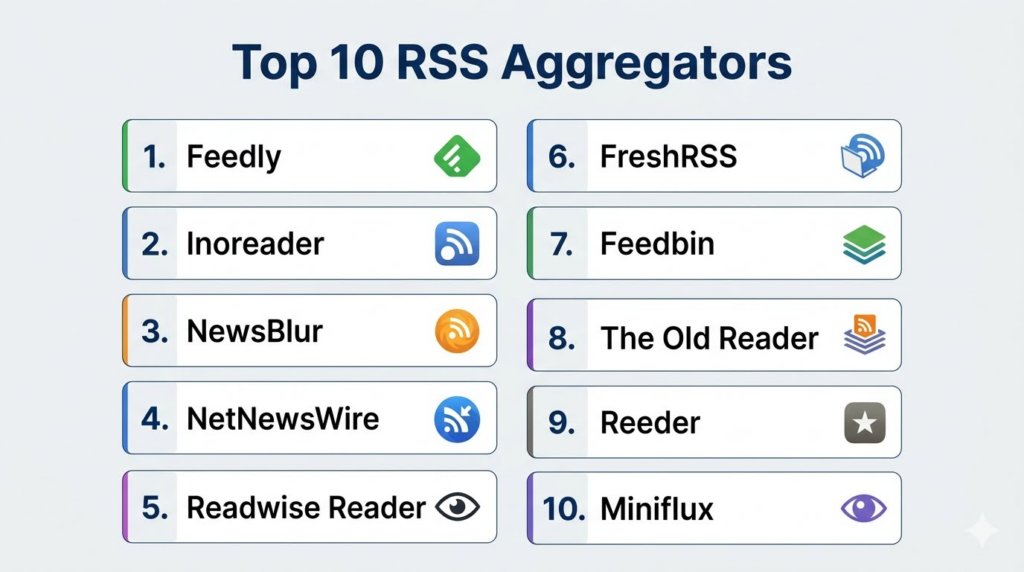
Introduction
RSS Aggregators help users collect updates from websites, blogs, newsletters, podcasts, YouTube channels, publications, and news sources into one centralized reading interface. Instead of manually visiting multiple websites every day, users can subscribe to RSS feeds and receive updates automatically in chronological or filtered streams.RSS aggregators matter because many users are becoming frustrated with algorithm-driven feeds, social media clutter, distracting ads, and unreliable content discovery. RSS gives readers more control over what they consume and where information comes from. Modern RSS aggregators now include AI summaries, newsletter support, smart filtering, offline reading, tagging, and integrations with knowledge management systems. RSS is increasingly used for research, industry monitoring, competitive analysis, learning, and distraction-free reading.
Real-world use cases include:
- Following industry blogs, publications, and news sites
- Monitoring competitors, keywords, or market trends
- Reading newsletters outside email inboxes
- Organizing research and professional reading
- Building distraction-free information workflows
Buyers evaluating RSS Aggregators should consider:
- RSS feed management quality
- Feed filtering and automation
- AI summaries and prioritization
- Newsletter support
- Offline reading support
- Cross-device sync
- Search, tagging, and organization
- Open-source or self-hosting options
- Privacy and data ownership
- Integration with PKM and productivity tools
Best for: Researchers, journalists, developers, analysts, marketers, content creators, students, founders, knowledge workers, and readers who want direct control over information sources.
Not ideal for: Users who only browse social media casually, readers who do not want to manage feeds manually, or organizations requiring enterprise-grade media intelligence rather than personal reading workflows.
Key Trends in RSS Aggregators
- AI-assisted filtering and summarization are becoming standard in premium RSS platforms.
- Newsletter support is growing because many publications now distribute content through email rather than traditional RSS.
- Open-source and self-hosted RSS readers are gaining popularity among privacy-focused users.
- RSS adoption is increasing again as users move away from algorithm-heavy social feeds.
- Cross-device synchronization is now expected across desktop, mobile, and browser environments.
- Advanced filtering rules and automation are becoming important for professional research workflows.
- Read-it-later functionality is increasingly integrated into RSS readers.
- Native mobile experiences are improving, especially for Apple ecosystem users.
- Knowledge management integrations with Obsidian, Notion, Logseq, and Readwise are becoming common.
- Minimal and distraction-free reading interfaces are becoming more popular than ad-heavy content feeds.
How We Selected These Tools
The tools in this list were selected based on RSS management quality, feed control, automation features, platform support, privacy posture, ecosystem maturity, and overall reading experience.
Selection criteria included:
- RSS feed organization and discovery
- Search, filtering, and automation capabilities
- AI and smart prioritization features
- Mobile and desktop reading experience
- Offline reading and synchronization
- Open-source or self-hosted support
- Integration with PKM and productivity tools
- Privacy and data ownership flexibility
- Performance with large feed libraries
- Suitability for both casual and professional readers
Top 10 RSS Aggregators
1- Feedly
Short description:
Feedly is one of the most widely used RSS aggregators for professionals, researchers, marketers, and knowledge workers. It combines traditional RSS reading with AI-assisted filtering, topic tracking, and research workflows. Feedly is especially useful for users who want a clean interface with strong organization and discovery features. It works well for competitive intelligence, cybersecurity monitoring, market research, and everyday reading. Feedly remains one of the largest RSS platforms with millions of users globally.
Key Features
- RSS feed management
- AI-assisted filtering through Leo AI
- Topic and keyword tracking
- Team boards and collaboration
- Feed folders and organization
- Newsletter support on selected plans
- Cross-device synchronization
Pros
- Excellent balance of usability and advanced features
- Strong research and monitoring workflows
- Good mobile and web experience
Cons
- Advanced AI features require premium plans
- Feed limits on free plans
- Less attractive for privacy-focused self-hosting users
Platforms / Deployment
- Web
- iOS
- Android
- Browser extensions
- Cloud
Security & Compliance
- Account-based controls
- Encryption
- Team admin controls on enterprise plans
- Compliance details vary by plan
Integrations & Ecosystem
Feedly integrates well with productivity and knowledge workflows.
- Slack
- Evernote
- Notion workflows
- Zapier
- Browser integrations
- Research workflows
Support & Community
Feedly has strong documentation, broad adoption, active product updates, and a large professional user base.
2- Inoreader
Short description:
Inoreader is a feature-rich RSS aggregator designed for power users who want advanced filters, rules, searches, automation, and feed organization. It is especially useful for journalists, analysts, researchers, and heavy RSS readers managing large feed libraries. Inoreader provides more granular control than many competitors and is often preferred by advanced users who need monitoring and automation workflows. Many reviewers consider it one of the strongest alternatives to Feedly.
Key Features
- Advanced RSS management
- Rules and automation
- Feed filtering
- Offline reading
- Saved searches
- Newsletter support
- Translation and monitoring tools
Pros
- Excellent control and filtering features
- Strong free-tier capabilities
- Great for large-scale feed management
Cons
- Interface may feel advanced for beginners
- Setup takes time for optimal use
- Some premium features require higher-tier plans
Platforms / Deployment
- Web
- iOS
- Android
- Browser extensions
- Cloud
Security & Compliance
- Account-based controls
- Encryption
- Privacy settings
- Detailed compliance is Not publicly stated
Integrations & Ecosystem
Inoreader supports professional reading and automation workflows.
- RSS feeds
- Automation rules
- Read-it-later integrations
- Cloud exports
- Newsletter workflows
- Search-based monitoring
Support & Community
Inoreader has strong adoption among RSS power users and provides detailed support documentation.
3- NewsBlur
Short description:
NewsBlur is an open-source RSS aggregator known for intelligent filtering, privacy-friendly positioning, and strong source control. It is especially useful for users who want trainable feed intelligence and open-source transparency. NewsBlur allows users to teach the platform which stories and topics matter most. It is widely appreciated by users who prefer RSS reading without aggressive algorithmic recommendation systems.
Key Features
- RSS feed aggregation
- Intelligence training filters
- Open-source architecture
- Story clustering
- Newsletter support
- Full-text feed reading
- Self-hosting support
Pros
- Strong privacy and transparency approach
- Useful trainable filtering system
- Good balance between automation and control
Cons
- Interface feels less modern than competitors
- Requires setup and training for best results
- Casual users may prefer simpler apps
Platforms / Deployment
- Web
- iOS
- Android
- Cloud / Self-hosted
Security & Compliance
- Open-source transparency
- Self-hosting options
- Account-based controls
- Detailed enterprise compliance is Not publicly stated
Integrations & Ecosystem
NewsBlur supports flexible reading and automation workflows.
- RSS feeds
- IFTTT
- Zapier
- Self-hosted workflows
- Story filters
- Full-text feeds
Support & Community
NewsBlur has a loyal community, open-source support, and strong adoption among privacy-focused RSS users.
4- NetNewsWire
Short description:
NetNewsWire is a free and open-source RSS aggregator built specifically for Apple users. It focuses on simplicity, speed, and native Apple ecosystem integration. NetNewsWire is especially useful for users who want a lightweight RSS experience without complex dashboards or AI features. It works well for readers who value clean interfaces and privacy-friendly reading.
Key Features
- RSS feed reading
- Apple-native interface
- Open-source design
- Feed syncing
- Offline reading
- Keyboard shortcuts
- Minimal reading mode
Pros
- Free and lightweight
- Excellent Apple-native experience
- Strong privacy-friendly positioning
Cons
- Limited outside Apple ecosystem
- Fewer advanced automation features
- Not ideal for enterprise research workflows
Platforms / Deployment
- macOS
- iOS
- Apple ecosystem
- Local / Sync-supported
Security & Compliance
- Open-source transparency
- Device-based controls
- Privacy depends on sync configuration
- Detailed compliance is Not publicly stated
Integrations & Ecosystem
NetNewsWire focuses on clean RSS workflows rather than large integration ecosystems.
- RSS feeds
- iCloud sync
- Apple ecosystem
- Local reading workflows
- Keyboard navigation
Support & Community
NetNewsWire has strong support among Apple RSS users and an active open-source community.
5- Readwise Reader
Short description:
Readwise Reader combines RSS aggregation, read-it-later functionality, annotation, newsletter reading, and knowledge management exports in one platform. It is especially useful for users who want reading to connect directly into their PKM workflows. Reader works well for professionals, researchers, and creators who highlight articles and export insights into note systems like Obsidian or Notion.
Key Features
- RSS reading
- Newsletter support
- Highlighting and annotations
- AI-assisted reading features
- PDF and EPUB support
- Read-it-later workflows
- Highlight export tools
Pros
- Strong PKM integration
- Excellent for serious readers
- Combines multiple reading workflows in one app
Cons
- Premium pricing may not suit casual readers
- More complex than traditional RSS readers
- Best value requires active reading habits
Platforms / Deployment
- Web
- iOS
- Android
- Cloud
Security & Compliance
- Account-based controls
- Encryption
- Privacy settings
- Detailed compliance is Not publicly stated
Integrations & Ecosystem
Readwise Reader connects reading and knowledge management systems.
- Obsidian
- Notion
- Logseq
- Roam Research
- Highlight exports
- Newsletter workflows
Support & Community
Readwise Reader has strong adoption among PKM enthusiasts, researchers, and knowledge workers.
6- FreshRSS
Short description:
FreshRSS is a self-hosted open-source RSS aggregator designed for users who want maximum control, privacy, and ownership over their feed data. It is especially useful for technical users and privacy-focused readers who prefer hosting their own RSS platform. FreshRSS supports large feed collections, multiple users, and integrations with mobile RSS clients.
Key Features
- Self-hosted RSS aggregation
- Multi-user support
- Feed filtering
- API support
- Lightweight architecture
- Feed organization
- Open-source codebase
Pros
- Full data ownership
- Strong privacy advantages
- Free and open-source
Cons
- Requires hosting and setup knowledge
- Less polished than commercial tools
- Support depends on community resources
Platforms / Deployment
- Web
- Self-hosted
- Linux server environments
Security & Compliance
- Self-managed security
- Open-source transparency
- Access controls depend on deployment configuration
Integrations & Ecosystem
FreshRSS works well for self-hosted reading workflows.
- RSS feeds
- Self-hosted environments
- API integrations
- Mobile RSS apps
- Feed exports
Support & Community
FreshRSS has an active open-source community and strong support among self-hosting enthusiasts.
7- Feedbin
Short description:
Feedbin is a premium RSS aggregator focused on clean design, speed, reliability, and privacy-conscious reading. It is especially useful for users who want a polished RSS experience without excessive complexity. Feedbin works well for readers who value stability, fast syncing, and distraction-free reading rather than AI-heavy workflows.
Key Features
- RSS feed management
- Fast syncing
- Full-text feeds
- Podcast support
- Newsletter subscriptions
- Feed organization
- API access
Pros
- Clean and reliable interface
- Strong performance
- Good for distraction-free reading
Cons
- Paid-only approach may limit adoption
- Smaller ecosystem than Feedly
- Fewer advanced AI features
Platforms / Deployment
- Web
- iOS support through compatible clients
- Cloud
Security & Compliance
- Account-based controls
- Encryption
- Privacy-focused positioning
- Detailed compliance is Not publicly stated
Integrations & Ecosystem
Feedbin supports reading-focused workflows and third-party RSS clients.
- RSS feeds
- API access
- Podcast subscriptions
- Mobile RSS clients
- Newsletter support
Support & Community
Feedbin has a strong reputation among long-time RSS users and privacy-focused readers.
8- The Old Reader
Short description:
The Old Reader is an RSS aggregator inspired by the classic Google Reader experience. It focuses on simplicity, chronological reading, and lightweight feed management. It is especially useful for users who want a traditional RSS experience without modern AI-heavy complexity.
Key Features
- RSS feed reading
- Simple chronological feeds
- Social sharing
- Feed folders
- Lightweight interface
- Feed imports
- Browser reading support
Pros
- Simple and familiar experience
- Good for classic RSS users
- Lightweight reading workflow
Cons
- Fewer modern features
- Less suitable for professional monitoring
- Interface feels dated compared to newer tools
Platforms / Deployment
- Web
- Browser-based workflows
- Cloud
Security & Compliance
- Account-based controls
- Privacy settings
- Detailed compliance is Not publicly stated
Integrations & Ecosystem
The Old Reader focuses on traditional RSS reading simplicity.
- RSS feeds
- Feed imports
- Browser workflows
- Social sharing
Support & Community
The Old Reader maintains a loyal user base among long-time RSS readers.
9- Reeder
Short description:
Reeder is a premium RSS reading app for Apple users known for elegant design, smooth reading experience, and support for multiple RSS services. It is especially useful for users who want a polished mobile and desktop reading experience connected to services like Feedly or Feedbin. Reeder focuses more on reading quality than heavy feed management.
Key Features
- RSS reading client
- Feed service integration
- Offline reading
- Reader mode
- Multi-account support
- Minimal interface
- Gesture-based navigation
Pros
- Beautiful reading experience
- Excellent Apple-native design
- Strong offline reading support
Cons
- Depends on external RSS services for some workflows
- Apple-focused ecosystem
- Less suited for advanced monitoring automation
Platforms / Deployment
- macOS
- iOS
- Apple ecosystem
Security & Compliance
- Device-based controls
- Privacy depends on connected RSS service
- Detailed compliance is Not publicly stated
Integrations & Ecosystem
Reeder integrates with major RSS synchronization services.
- Feedly
- Feedbin
- Inoreader
- Local RSS accounts
- Apple ecosystem
Support & Community
Reeder is highly respected among Apple RSS readers for its polished reading experience.
10- Miniflux
Short description:
Miniflux is a minimalist open-source RSS aggregator built for users who value speed, simplicity, and self-hosted reading. It is especially useful for technical users who want a lightweight and distraction-free RSS platform. Miniflux prioritizes performance and low resource usage over visual complexity.
Key Features
- Minimal RSS aggregation
- Self-hosted deployment
- Fast performance
- Feed filtering
- Keyboard shortcuts
- API support
- Lightweight interface
Pros
- Extremely lightweight and fast
- Strong for self-hosting
- Minimal distraction reading
Cons
- Requires technical setup
- Minimal interface may feel too basic
- Smaller ecosystem than commercial tools
Platforms / Deployment
- Web
- Self-hosted
- Linux server environments
Security & Compliance
- Self-managed security
- Open-source transparency
- Access controls depend on deployment setup
Integrations & Ecosystem
Miniflux supports lightweight self-hosted RSS workflows.
- RSS feeds
- API integrations
- Self-hosted servers
- Minimal reading workflows
Support & Community
Miniflux has a strong technical open-source community and good documentation for self-hosted users.
Comparison Table
| Tool Name | Best For | Platform Supported | Deployment | Standout Feature | Public Rating |
|---|---|---|---|---|---|
| Feedly | Professional RSS workflows | Web, iOS, Android | Cloud | AI-assisted filtering | N/A |
| Inoreader | RSS power users | Web, iOS, Android | Cloud | Advanced automation rules | N/A |
| NewsBlur | Open-source RSS filtering | Web, iOS, Android | Cloud / Self-hosted | Intelligence training | N/A |
| NetNewsWire | Apple RSS users | macOS, iOS | Local / Sync-supported | Free Apple-native RSS | N/A |
| Readwise Reader | RSS plus PKM workflows | Web, iOS, Android | Cloud | Highlight exports | N/A |
| FreshRSS | Self-hosted RSS aggregation | Web | Self-hosted | Full data ownership | N/A |
| Feedbin | Premium distraction-free RSS | Web | Cloud | Clean reading experience | N/A |
| The Old Reader | Traditional RSS reading | Web | Cloud | Classic Google Reader feel | N/A |
| Reeder | Premium Apple reading client | macOS, iOS | Apple ecosystem | Elegant reading design | N/A |
| Miniflux | Lightweight self-hosted RSS | Web | Self-hosted | Minimal fast performance | N/A |
Evaluation & Scoring of RSS Aggregators
| Tool Name | Core 25% | Ease 15% | Integrations 15% | Security 10% | Performance 10% | Support 10% | Value 15% | Weighted Total |
|---|---|---|---|---|---|---|---|---|
| Feedly | 9 | 9 | 9 | 8 | 8 | 9 | 8 | 8.6 |
| Inoreader | 9 | 7 | 9 | 8 | 8 | 8 | 9 | 8.4 |
| NewsBlur | 8 | 7 | 8 | 9 | 8 | 8 | 9 | 8.1 |
| NetNewsWire | 7 | 9 | 6 | 9 | 9 | 7 | 10 | 8.0 |
| Readwise Reader | 8 | 8 | 9 | 7 | 8 | 8 | 7 | 7.9 |
| FreshRSS | 8 | 6 | 7 | 9 | 8 | 7 | 10 | 7.9 |
| Feedbin | 8 | 8 | 7 | 8 | 9 | 8 | 8 | 8.0 |
| The Old Reader | 7 | 8 | 6 | 7 | 7 | 7 | 8 | 7.2 |
| Reeder | 7 | 9 | 7 | 8 | 9 | 8 | 8 | 7.9 |
| Miniflux | 7 | 6 | 7 | 9 | 9 | 7 | 10 | 7.8 |
These scores are comparative and should be interpreted based on reading style and technical preferences. Feedly and Inoreader are strongest for professional workflows, while NetNewsWire and Reeder are excellent for Apple users. NewsBlur, FreshRSS, and Miniflux are attractive for privacy-focused and self-hosting users. Readwise Reader is strongest for users integrating RSS into personal knowledge management systems.
Which RSS Aggregator Is Right for You?
Solo / Freelancer
Solo users should choose based on reading habits and complexity tolerance. Feedly is excellent for professionals tracking industries and topics. Inoreader is better for advanced filtering and research. Pocket-style readers may feel easier for casual readers, while Readwise Reader is ideal for users who highlight and export insights into note systems.
SMB
Small businesses, consultants, marketers, and content teams benefit from Feedly or Inoreader because they support monitoring, categorization, and collaborative research workflows. RSS aggregation can help SMBs track competitors, industry publications, and market changes without relying entirely on search engines or social media feeds.
Mid-Market
Mid-market teams often need stronger automation, keyword tracking, and collaborative research. Feedly’s AI workflows and Inoreader’s automation rules are practical choices. Teams handling technical monitoring, cybersecurity, finance, or industry intelligence may benefit most from structured RSS aggregation.
Enterprise
Enterprises should prioritize access controls, scalability, compliance review, and workflow integrations. Feedly enterprise offerings may support intelligence and monitoring teams, while privacy-sensitive organizations may prefer self-hosted options like FreshRSS or Miniflux. Large organizations should also evaluate governance and content sharing policies.
Budget vs Premium
Budget users can start with NetNewsWire, NewsBlur free tiers, FreshRSS, or Miniflux. Premium plans become valuable when users need AI filtering, newsletters, advanced automation, saved searches, or team collaboration. Self-hosted solutions can reduce subscription costs but require technical maintenance.
Feature Depth vs Ease of Use
Feedly offers a strong balance between usability and advanced functionality. Inoreader provides deeper automation but has a steeper learning curve. NetNewsWire and The Old Reader are simpler and more approachable. NewsBlur and self-hosted tools appeal more to technical and privacy-focused readers.
Integrations & Scalability
Users should evaluate whether they need Slack sharing, PKM exports, automation rules, newsletters, APIs, or self-hosting support. Feedly and Inoreader provide broader ecosystems, while Readwise Reader integrates deeply with note-taking workflows. Self-hosted users may prioritize API flexibility and open-source ecosystems.
Security & Compliance Needs
RSS aggregators store reading history, interests, subscriptions, and sometimes professional monitoring data. Users should review sync methods, account security, privacy policies, export capabilities, and self-hosting options. Privacy-focused users may prefer open-source or self-hosted platforms to reduce dependency on centralized providers.
Frequently Asked Questions
1. What are RSS Aggregators?
RSS Aggregators are tools that collect updates from websites, blogs, publications, newsletters, podcasts, and other online sources into one reading interface. Users subscribe to RSS feeds, and the aggregator automatically displays new content in a central feed. This helps users follow information without manually visiting many websites. RSS aggregation is widely used for research, learning, and distraction-free reading.
2. Why are RSS readers becoming popular again?
RSS readers are becoming popular again because many users are frustrated with algorithm-driven social feeds, excessive ads, and unreliable content discovery. RSS gives readers more direct control over what they see and where information comes from. It also supports focused reading without engagement-driven distractions. Many users now prefer curated source lists over algorithmic timelines.
3. Which RSS Aggregator is best for beginners?
Feedly is often considered one of the best options for beginners because it combines a clean interface with easy source discovery and mobile apps. Apple users may also enjoy NetNewsWire because it is lightweight and simple. Beginners should start with a small number of feeds and organize them into categories instead of subscribing to hundreds of sources immediately.
4. Which RSS Aggregator is best for power users?
Inoreader and NewsBlur are strong choices for power users because they provide advanced filtering, automation, searches, and monitoring workflows. Inoreader excels at automation rules and feed organization, while NewsBlur offers intelligence training and open-source flexibility. Power users usually benefit from tools that support large feed libraries and detailed filtering systems.
5. Are self-hosted RSS readers worth it?
Self-hosted RSS readers like FreshRSS and Miniflux are worth considering for users who value privacy, data ownership, and full control over their reading infrastructure. However, they require technical setup and maintenance. Casual users may prefer cloud-based platforms, while technical users often appreciate the flexibility and privacy advantages of self-hosted RSS systems.
6. Can RSS Aggregators replace social media for news?
RSS aggregators can replace much of social media news consumption for users who primarily want information rather than social interaction. RSS allows users to choose trusted sources directly and avoid engagement-based algorithms. However, RSS may not capture every real-time discussion or community conversation. Many users combine RSS with selective social media use.
7. What are common mistakes users make with RSS readers?
A common mistake is subscribing to too many feeds too quickly, which creates information overload. Another mistake is failing to organize feeds into categories or use filtering tools. Users also often collect articles without reviewing or saving important insights. The best RSS workflow focuses on manageable source lists, regular cleanup, and intentional reading habits.
8. Are RSS Aggregators safe for privacy?
Privacy depends on the platform and deployment model. Cloud-based RSS readers store reading history and subscription data, while self-hosted platforms provide more direct control. Users concerned about privacy should review account settings, export options, sync methods, and tracking policies. Open-source and self-hosted platforms generally offer greater transparency.
9. Which RSS Aggregator works best with PKM systems?
Readwise Reader integrates strongly with PKM tools like Obsidian, Notion, Logseq, and Roam Research through highlight exports and reading workflows. Feedly and Inoreader also support integrations and automation workflows. Users building second-brain systems often prioritize export flexibility and annotation support when choosing an RSS aggregator.
10. How should users choose the right RSS Aggregator?
Users should first decide whether they prioritize simplicity, automation, privacy, AI summaries, or integrations. Feedly is strong for balanced professional use, Inoreader for advanced workflows, NetNewsWire for Apple simplicity, NewsBlur for open-source filtering, and FreshRSS or Miniflux for self-hosting. The right choice depends on reading habits, technical comfort, and how deeply RSS fits into the user’s daily workflow.
Conclusion
RSS Aggregators help users regain control over online information by organizing updates from trusted sources into focused and customizable reading environments. The best platform depends on whether the user prioritizes simplicity, automation, privacy, AI assistance, or knowledge management integration. Feedly remains one of the strongest overall options for professionals and researchers, while Inoreader excels for power users needing advanced automation and filtering. NewsBlur offers intelligent filtering with open-source transparency, NetNewsWire provides an excellent Apple-native experience, and Readwise Reader connects RSS with personal knowledge workflows. Self-hosted solutions like FreshRSS and Miniflux appeal to privacy-conscious users, while Feedbin, Reeder, and The Old Reader provide cleaner and more traditional reading experiences. Buyers should shortlist a few platforms, test them with real reading workflows, evaluate feed organization and privacy needs, compare free versus premium features, and choose the RSS aggregator that helps them stay informed without becoming overwhelmed by information overload.
