MOTOSHARE 🚗🏍️
Rent Bikes & Cars Directly from Owners
Motoshare connects vehicle owners with people who need bikes and cars on rent. Owners earn from idle vehicles, and renters get flexible ride options.
Visit Motoshare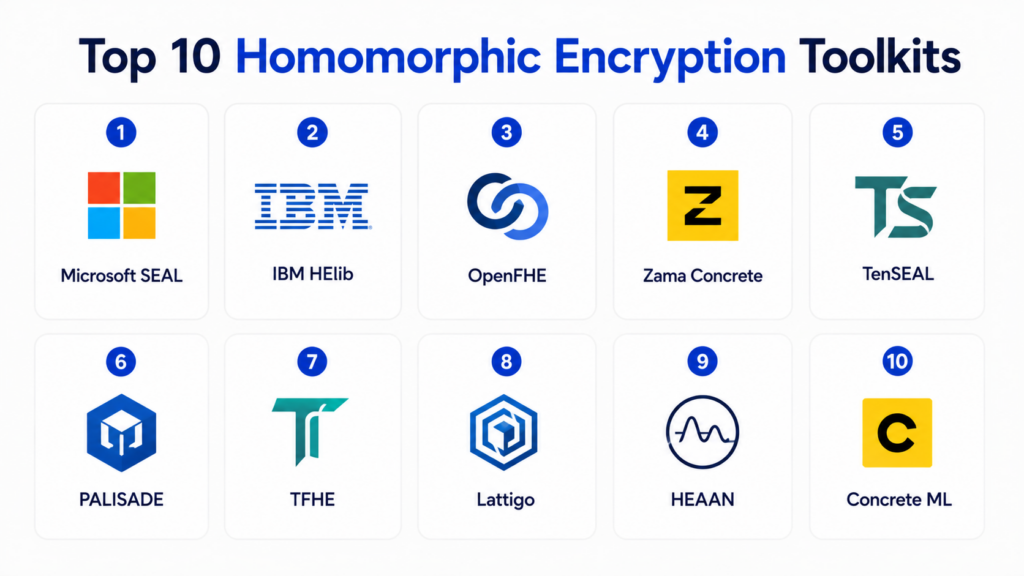
Introduction
Homomorphic Encryption Toolkits help developers and organizations perform computation on encrypted data without decrypting it first. This means sensitive data can remain protected while still being used for analytics, machine learning, search, financial modeling, healthcare research, and privacy-preserving collaboration.
This category matters because organizations increasingly need to use sensitive data across cloud platforms, AI systems, third-party environments, and multi-party workflows without exposing raw information. Homomorphic encryption is still technically complex, but toolkits are making it more practical for developers, researchers, and security teams.
Real World Use Cases:
- Privacy-preserving machine learning
- Secure financial and risk analytics
- Protected healthcare data research
- Encrypted database search and computation
- Secure multi-party data collaboration
Evaluation Criteria for Buyers:
- Encryption scheme support
- Developer usability
- Performance optimization
- Language and framework compatibility
- Machine learning support
- Documentation quality
- Deployment flexibility
- Community maturity
- Security model clarity
- Enterprise support availability
Best for: Cryptography researchers, privacy engineers, AI teams, healthcare organizations, financial institutions, government projects, and developers building privacy-preserving computation workflows.
Not ideal for: Teams needing simple encryption only, organizations without cryptography expertise, or applications requiring ultra-low latency where homomorphic encryption overhead may be too high.
Key Trends in Homomorphic Encryption Toolkits
- Privacy-preserving AI is increasing interest in homomorphic encryption.
- Toolkits are becoming easier to use through Python APIs and developer-friendly libraries.
- Fully homomorphic encryption is improving, but performance remains a major consideration.
- Hybrid privacy architectures are combining homomorphic encryption with secure enclaves and differential privacy.
- Healthcare, finance, and government research are key adoption areas.
- Open-source libraries dominate experimentation and academic research.
- Hardware acceleration is becoming more important for practical deployment.
- Machine learning inference on encrypted data is a growing use case.
- Standardization efforts are improving confidence in secure implementations.
- Cloud providers and privacy vendors are exploring managed encrypted computation workflows.
How We Selected These Tools
The tools in this list were evaluated using practical technical and enterprise-focused criteria:
- Recognition in cryptography and privacy-preserving computation
- Homomorphic encryption scheme coverage
- Developer usability and API quality
- Performance and optimization capabilities
- Documentation and learning resources
- Community adoption and ecosystem maturity
- Machine learning and analytics support
- Language compatibility
- Enterprise or commercial support availability
- Fit for research, prototyping, and production experimentation
Top 10 Homomorphic Encryption Toolkits
#1 — Microsoft SEAL
Short description: Microsoft SEAL is one of the most widely recognized open-source homomorphic encryption libraries. It enables encrypted computation using schemes suitable for exact and approximate arithmetic. SEAL is popular among researchers, developers, and organizations exploring privacy-preserving analytics. It is especially useful for teams that need a mature C++ library with strong documentation and broad community awareness.
Key Features
- BFV scheme support
- CKKS scheme support
- Encrypted arithmetic operations
- C++ implementation
- .NET wrapper support
- Strong documentation
- Open-source availability
Pros
- Mature and widely recognized
- Strong educational resources
- Good fit for research and prototyping
Cons
- Requires cryptography knowledge
- Performance tuning can be complex
- Not a complete application platform
Platforms / Deployment
- Windows / macOS / Linux
- Self-hosted
Security & Compliance
- Not publicly stated
Integrations & Ecosystem
Microsoft SEAL is used in privacy-preserving computation research and custom application development. It works well when teams need low-level control over encrypted arithmetic.
- C++ ecosystem
- .NET workflows
- Research prototypes
- Custom encrypted analytics
- Privacy-preserving ML experiments
Support & Community
Strong open-source documentation and active research visibility. Enterprise support depends on internal expertise or partner implementation.
#2 — IBM HElib
Short description: IBM HElib is an open-source homomorphic encryption library designed for advanced encrypted computation research and development. It supports powerful FHE capabilities and is widely known in cryptography communities. HElib is useful for teams exploring complex encrypted computation workflows. It is best suited for technical users with cryptography and C++ experience.
Key Features
- Fully homomorphic encryption support
- BGV scheme support
- CKKS scheme support
- C++ implementation
- Advanced cryptographic operations
- Bootstrapping support
- Research-oriented architecture
Pros
- Strong cryptographic depth
- Backed by IBM research history
- Good for advanced FHE experimentation
Cons
- Steep learning curve
- Requires technical expertise
- Not beginner-friendly
Platforms / Deployment
- Linux / macOS
- Self-hosted
Security & Compliance
- Not publicly stated
Integrations & Ecosystem
IBM HElib is most commonly used in research, experimentation, and custom encrypted computation projects.
- C++ ecosystem
- Research workflows
- Academic projects
- Privacy-preserving analytics
- Custom FHE applications
Support & Community
Open-source community and research documentation are available. Production support usually requires internal cryptography expertise.
#3 — OpenFHE
Short description: OpenFHE is an open-source fully homomorphic encryption library built to support modern FHE research and development. It provides broad scheme support and is designed for flexibility across encrypted computation use cases. OpenFHE is suitable for researchers, advanced developers, and privacy engineering teams. It is one of the most comprehensive open-source FHE toolkits available.
Key Features
- BFV scheme support
- BGV scheme support
- CKKS scheme support
- FHEW and TFHE-style support
- Multiparty FHE support
- Bootstrapping support
- C++ and Python support
Pros
- Broad scheme coverage
- Strong research flexibility
- Active open-source ecosystem
Cons
- Complex for beginners
- Requires cryptographic expertise
- Production deployment needs careful validation
Platforms / Deployment
- Linux / macOS / Windows
- Self-hosted
Security & Compliance
- Not publicly stated
Integrations & Ecosystem
OpenFHE integrates into research projects, privacy-preserving analytics, and advanced encrypted computation prototypes.
- C++ workflows
- Python bindings
- Academic research
- Multiparty computation experiments
- Encrypted ML prototypes
Support & Community
Strong open-source and academic community support. Documentation and examples are available for technical users.
#4 — Zama Concrete
Short description: Zama Concrete is a homomorphic encryption framework focused on making FHE more practical for developers. It provides tools for building encrypted applications and supports compilation-style workflows for privacy-preserving computation. Concrete is especially relevant for teams exploring encrypted machine learning and secure application logic. It aims to make FHE development more approachable than low-level cryptography libraries.
Key Features
- Fully homomorphic encryption framework
- Developer-friendly tooling
- Python support
- Encrypted computation compilation
- Machine learning use cases
- Application-focused workflow
- Open-source ecosystem
Pros
- More developer-friendly than many FHE libraries
- Strong focus on practical encrypted applications
- Good fit for privacy-preserving AI experiments
Cons
- Still requires FHE understanding
- Performance depends heavily on workload design
- Ecosystem is newer than older libraries
Platforms / Deployment
- Linux / macOS
- Self-hosted
Security & Compliance
- Not publicly stated
Integrations & Ecosystem
Zama Concrete supports privacy-preserving application development and encrypted computation workflows.
- Python ecosystem
- Machine learning workflows
- Encrypted application development
- Research prototypes
- Developer tooling integrations
Support & Community
Growing developer community with active documentation and examples. Commercial support options vary by use case.
#5 — TenSEAL
Short description: TenSEAL is an open-source library designed to make homomorphic encryption more accessible for machine learning and tensor operations. Built around Microsoft SEAL concepts, it provides higher-level abstractions for encrypted vectors and tensors. TenSEAL is useful for privacy-preserving machine learning experiments and encrypted inference prototypes. It is especially approachable for Python users.
Key Features
- Encrypted tensor operations
- Python-friendly APIs
- CKKS support
- BFV support
- Machine learning workflow support
- Integration with PyTorch-style concepts
- Open-source availability
Pros
- Good for encrypted ML experiments
- Python-friendly interface
- Easier than low-level FHE libraries
Cons
- Limited compared to full FHE frameworks
- Performance depends on model design
- Not ideal for all ML workloads
Platforms / Deployment
- Linux / macOS / Windows
- Self-hosted
Security & Compliance
- Not publicly stated
Integrations & Ecosystem
TenSEAL fits well into privacy-preserving ML research and Python-based experimentation.
- Python ecosystem
- PyTorch-style workflows
- Encrypted inference prototypes
- Academic research
- Custom privacy ML pipelines
Support & Community
Open-source community support with documentation and examples. Enterprise support is not publicly stated.
#6 — PALISADE
Short description: PALISADE was a widely used open-source lattice cryptography library for homomorphic encryption research and development. Many concepts and ecosystem efforts around PALISADE influenced later FHE libraries and projects. It supports multiple schemes and advanced cryptographic operations. For new projects, OpenFHE is often considered the more current successor path, but PALISADE remains important historically and in existing research workflows.
Key Features
- Multiple homomorphic encryption schemes
- Lattice cryptography support
- C++ implementation
- Research-focused design
- Multiparty computation support
- Bootstrapping capabilities
- Advanced cryptographic operations
Pros
- Strong research heritage
- Broad technical capabilities
- Useful for existing FHE projects
Cons
- New projects may prefer OpenFHE
- Requires advanced expertise
- Not designed for non-technical users
Platforms / Deployment
- Linux / macOS / Windows
- Self-hosted
Security & Compliance
- Not publicly stated
Integrations & Ecosystem
PALISADE has been used in academic, government, and research-oriented privacy-preserving computation projects.
- C++ workflows
- Research environments
- Secure computation prototypes
- Multiparty computation experiments
- Legacy FHE projects
Support & Community
Community and historical documentation are available, but newer development momentum is stronger around OpenFHE.
#7 — TFHE
Short description: TFHE is an open-source library focused on fast fully homomorphic encryption over binary gates. It is well known for gate-level FHE and bootstrapping capabilities. TFHE is useful for researchers building encrypted logic circuits and low-level secure computation workflows. It is best suited for specialized cryptography and computer science teams.
Key Features
- Fully homomorphic encryption over binary gates
- Fast bootstrapping
- Boolean circuit evaluation
- Low-level encrypted computation
- C/C++ implementation
- Research-oriented design
- Open-source availability
Pros
- Strong gate-level FHE capabilities
- Useful for encrypted logic computation
- Important research foundation
Cons
- Highly technical
- Not application-platform focused
- Requires advanced cryptographic knowledge
Platforms / Deployment
- Linux / macOS
- Self-hosted
Security & Compliance
- Not publicly stated
Integrations & Ecosystem
TFHE is mainly used in research, encrypted circuit evaluation, and specialized FHE experimentation.
- C/C++ workflows
- Academic research
- Encrypted circuit evaluation
- Cryptographic prototypes
- Privacy-preserving computation experiments
Support & Community
Open-source research community support. Practical production usage requires significant technical expertise.
#8 — Lattigo
Short description: Lattigo is an open-source Go library for lattice-based homomorphic encryption. It is useful for developers and researchers who prefer Go-based cryptographic development. Lattigo supports encrypted arithmetic and privacy-preserving computation workflows. It is a strong option for teams building secure systems in Go.
Key Features
- Go-based FHE library
- CKKS support
- BFV and BGV-style capabilities
- Multiparty homomorphic encryption support
- Encrypted arithmetic operations
- Research-friendly architecture
- Open-source availability
Pros
- Good fit for Go developers
- Strong lattice cryptography capabilities
- Useful for secure systems engineering
Cons
- Smaller ecosystem than C++ libraries
- Requires cryptography expertise
- Limited beginner-friendly tooling
Platforms / Deployment
- Linux / macOS / Windows
- Self-hosted
Security & Compliance
- Not publicly stated
Integrations & Ecosystem
Lattigo integrates naturally with Go-based systems and privacy-preserving computation prototypes.
- Go ecosystem
- Secure application development
- Research workflows
- Multiparty computation
- Custom encrypted analytics
Support & Community
Open-source support and technical documentation are available. Community is specialized but active among privacy engineers.
#9 — HEAAN
Short description: HEAAN is a homomorphic encryption library known for approximate arithmetic using the CKKS scheme. It is especially relevant for encrypted numerical computation and privacy-preserving analytics. HEAAN has influenced many later FHE systems and remains important in cryptographic research. It is best suited for advanced users working with approximate encrypted computations.
Key Features
- CKKS approximate arithmetic
- Encrypted numerical computation
- C++ implementation
- Research-oriented architecture
- Privacy-preserving analytics support
- Floating-point style encrypted operations
- Advanced cryptographic workflows
Pros
- Strong approximate computation capabilities
- Important in CKKS research history
- Useful for numeric encrypted workloads
Cons
- Research-focused usability
- Requires advanced FHE knowledge
- Not a general enterprise platform
Platforms / Deployment
- Linux / macOS
- Self-hosted
Security & Compliance
- Not publicly stated
Integrations & Ecosystem
HEAAN is primarily used in research and specialized encrypted analytics workflows.
- C++ ecosystem
- Cryptography research
- Numeric computation prototypes
- Privacy-preserving analytics
- Academic experimentation
Support & Community
Research-oriented community support. Production use requires expert cryptography and engineering capability.
#10 — Concrete ML
Short description: Concrete ML is a toolkit from Zama focused on machine learning with fully homomorphic encryption. It helps developers convert certain machine learning models into encrypted inference workflows. Concrete ML is especially useful for privacy-preserving AI prototypes where data should remain encrypted during inference. It aims to make encrypted machine learning more practical for developers.
Key Features
- FHE-based machine learning inference
- Python APIs
- Model compilation workflows
- Scikit-learn style support
- Encrypted prediction support
- Developer-friendly experimentation
- Integration with Concrete ecosystem
Pros
- Strong focus on encrypted ML
- Python-friendly workflow
- Useful for privacy-preserving AI prototypes
Cons
- Model support can be limited by FHE constraints
- Performance overhead must be tested
- Requires careful workload design
Platforms / Deployment
- Linux / macOS
- Self-hosted
Security & Compliance
- Not publicly stated
Integrations & Ecosystem
Concrete ML integrates with Python-based machine learning workflows and Zama’s broader encrypted computation ecosystem.
- Python ML workflows
- Scikit-learn style models
- Concrete framework integration
- Encrypted inference applications
- Privacy-preserving AI prototypes
Support & Community
Growing documentation, examples, and developer community. Commercial support availability varies by project scope.
Comparison Table
| Tool Name | Best For | Platform(s) Supported | Deployment | Standout Feature | Public Rating |
|---|---|---|---|---|---|
| Microsoft SEAL | General FHE development | Windows / macOS / Linux | Self-hosted | Mature BFV and CKKS library | N/A |
| IBM HElib | Advanced FHE research | Linux / macOS | Self-hosted | BGV and CKKS research depth | N/A |
| OpenFHE | Broad FHE experimentation | Windows / macOS / Linux | Self-hosted | Wide scheme support | N/A |
| Zama Concrete | Developer-friendly FHE apps | Linux / macOS | Self-hosted | Compilation-style encrypted computation | N/A |
| TenSEAL | Encrypted ML tensors | Windows / macOS / Linux | Self-hosted | Python tensor operations | N/A |
| PALISADE | Legacy FHE research | Windows / macOS / Linux | Self-hosted | Broad historical scheme support | N/A |
| TFHE | Boolean circuit FHE | Linux / macOS | Self-hosted | Fast gate bootstrapping | N/A |
| Lattigo | Go-based FHE systems | Windows / macOS / Linux | Self-hosted | Go-native lattice cryptography | N/A |
| HEAAN | Approximate encrypted math | Linux / macOS | Self-hosted | CKKS approximate arithmetic | N/A |
| Concrete ML | Encrypted ML inference | Linux / macOS | Self-hosted | FHE machine learning workflows | N/A |
Evaluation & Scoring of Homomorphic Encryption Toolkits
| Tool Name | Core 25% | Ease 15% | Integrations 15% | Security 10% | Performance 10% | Support 10% | Value 15% | Weighted Total |
|---|---|---|---|---|---|---|---|---|
| Microsoft SEAL | 9.2 | 8.0 | 8.5 | 8.8 | 8.7 | 8.6 | 9.0 | 8.7 |
| IBM HElib | 9.0 | 6.8 | 7.8 | 8.8 | 8.5 | 8.0 | 8.8 | 8.3 |
| OpenFHE | 9.4 | 7.4 | 8.4 | 8.9 | 8.6 | 8.5 | 9.0 | 8.6 |
| Zama Concrete | 8.9 | 8.2 | 8.3 | 8.6 | 8.4 | 8.3 | 8.8 | 8.5 |
| TenSEAL | 8.3 | 8.4 | 8.2 | 8.2 | 8.0 | 7.9 | 8.9 | 8.3 |
| PALISADE | 8.6 | 6.7 | 7.8 | 8.5 | 8.2 | 7.6 | 8.5 | 8.0 |
| TFHE | 8.4 | 6.5 | 7.4 | 8.6 | 8.4 | 7.5 | 8.6 | 7.9 |
| Lattigo | 8.5 | 7.3 | 7.9 | 8.5 | 8.3 | 7.8 | 8.7 | 8.1 |
| HEAAN | 8.2 | 6.4 | 7.2 | 8.4 | 8.1 | 7.3 | 8.4 | 7.7 |
| Concrete ML | 8.6 | 8.3 | 8.1 | 8.4 | 8.0 | 8.2 | 8.7 | 8.4 |
These scores are comparative and intended as a practical evaluation guide. Homomorphic encryption toolkits are highly technical, so ease of use and documentation can matter as much as cryptographic depth. Research-focused libraries may offer more scheme flexibility, while developer-oriented frameworks can be better for application prototypes. Teams should validate performance, security assumptions, and implementation complexity before using any toolkit in production.
Which Homomorphic Encryption Toolkit Is Right for You?
Solo / Freelancer
Solo developers and researchers should start with Microsoft SEAL, TenSEAL, Zama Concrete, or Concrete ML depending on the use case. SEAL is strong for learning core concepts, while TenSEAL and Concrete ML are easier for Python-based encrypted ML experiments. Developers should expect a learning curve because homomorphic encryption requires careful parameter selection and workload design.
SMB
SMBs should use homomorphic encryption only when there is a clear privacy-preserving computation need. Zama Concrete, Concrete ML, and TenSEAL are practical starting points for prototypes. Teams without cryptography expertise may need consulting or managed support. For many SMBs, confidential computing or data masking may be simpler alternatives.
Mid-Market
Mid-market organizations exploring privacy-preserving analytics or encrypted AI inference should evaluate Microsoft SEAL, OpenFHE, Zama Concrete, and Concrete ML. The best choice depends on whether the team needs low-level cryptographic control or developer-friendly abstractions. Performance benchmarking is especially important before committing to architecture decisions.
Enterprise
Enterprises with advanced privacy requirements should evaluate OpenFHE, Microsoft SEAL, IBM HElib, Fortanix-style confidential workflows, and Zama’s ecosystem depending on internal expertise. Homomorphic encryption is best suited for high-value workloads where privacy protection justifies engineering complexity. Enterprise teams should involve cryptographers, security architects, and compliance leaders early.
Budget vs Premium
Most leading homomorphic encryption toolkits are open source, which lowers licensing barriers. However, the real cost comes from engineering time, cryptography expertise, performance tuning, and security validation. Commercial support or specialized consulting may be necessary for production use. Buyers should evaluate total implementation effort, not only software cost.
Feature Depth vs Ease of Use
OpenFHE, HElib, and SEAL provide strong cryptographic capabilities but require deeper technical knowledge. Concrete, Concrete ML, and TenSEAL provide more developer-friendly workflows for specific use cases. Teams should choose depth when building research-grade systems and usability when building prototypes or application-focused workflows.
Integrations & Scalability
Integration needs vary by use case. Python-based AI teams may prefer TenSEAL or Concrete ML, while systems teams may prefer SEAL, OpenFHE, or Lattigo. Scalability depends on encryption parameters, computation complexity, hardware resources, and workload design. Every serious project should include performance testing with realistic data and operations.
Security & Compliance Needs
Homomorphic encryption can strengthen privacy, but it does not automatically guarantee compliance. Organizations still need access controls, key management, audit trails, secure deployment practices, and legal review. Parameter selection and implementation quality are critical. For regulated workloads, independent security review is strongly recommended.
Frequently Asked Questions FAQs
1. What is homomorphic encryption?
Homomorphic encryption is a cryptographic technique that allows computation on encrypted data without decrypting it first. The result remains encrypted and can only be decrypted by the authorized key holder. This makes it possible to use sensitive data in analytics, AI, or third-party systems while reducing exposure. It is especially useful when raw data should never be visible to the processor. Homomorphic encryption is powerful but technically complex. Toolkits help developers build applications using these encrypted computation methods.
2. What is the difference between partially and fully homomorphic encryption?
Partially homomorphic encryption supports limited operations on encrypted data, such as addition or multiplication. Fully homomorphic encryption supports more general computation by allowing many operations over encrypted values. FHE is more powerful but typically more computationally expensive. Some practical systems use leveled homomorphic encryption, which supports a limited computation depth without bootstrapping. The right approach depends on workload complexity and performance requirements. Many toolkits support multiple schemes for different needs.
3. Why are Homomorphic Encryption Toolkits important?
These toolkits make privacy-preserving computation more practical for developers, researchers, and security teams. Without toolkits, implementing homomorphic encryption correctly would be extremely difficult and risky. Toolkits provide encryption schemes, APIs, parameter management, examples, and optimized operations. They are used in secure analytics, encrypted machine learning, healthcare research, finance, and privacy-preserving collaboration. As AI and cloud adoption grow, encrypted computation is becoming more relevant. Toolkits help bridge the gap between theory and real-world experimentation.
4. Is homomorphic encryption ready for production use?
Homomorphic encryption can be used in production for carefully selected workloads, but it is not a drop-in replacement for normal computation. Performance overhead can be significant, and implementation requires expertise. Production readiness depends on workload type, encryption scheme, parameters, latency requirements, and security review. Some use cases such as encrypted inference, secure scoring, and privacy-preserving analytics are becoming more practical. Organizations should start with pilots and benchmarks. High-risk deployments should involve cryptography experts.
5. Can homomorphic encryption be used for AI and machine learning?
Yes, homomorphic encryption can support privacy-preserving AI workflows, especially encrypted inference on selected model types. Tools like TenSEAL and Concrete ML are designed to make encrypted ML more approachable. However, not all AI models are practical under homomorphic encryption due to performance and operation constraints. Model architecture may need to be adapted for encrypted computation. Homomorphic encryption is strongest when privacy is critical and workloads are well-defined. AI teams should test accuracy, latency, and compute cost before production use.
6. What are common challenges with homomorphic encryption?
The biggest challenges are performance overhead, parameter selection, limited operation support, and developer complexity. Encrypted computation is usually much slower than plaintext computation. Some mathematical operations are difficult or expensive under homomorphic encryption. Choosing secure and efficient parameters requires expertise. Debugging encrypted workflows can also be challenging because data remains protected. Teams should begin with narrow use cases and expand gradually as they build experience.
7. Are open-source homomorphic encryption libraries safe?
Open-source libraries can be safe when they are mature, well-reviewed, and used correctly. However, cryptographic security depends heavily on correct parameter choices, implementation design, and threat modeling. A respected library does not automatically make an application secure. Developers should use documented parameter recommendations and avoid modifying cryptographic internals without expertise. Production systems should undergo security review. Open-source transparency is valuable, but operational discipline is still necessary.
8. How does homomorphic encryption compare with confidential computing?
Homomorphic encryption allows computation on encrypted data without decrypting it, even during processing. Confidential computing protects data during processing inside hardware-isolated trusted execution environments. Homomorphic encryption can offer strong cryptographic privacy but often has higher performance overhead. Confidential computing is usually easier to deploy for general workloads but relies on hardware trust assumptions. Many organizations evaluate both approaches. The right choice depends on threat model, performance needs, and architecture.
9. What skills are needed to use Homomorphic Encryption Toolkits?
Teams need software engineering skills, cryptography awareness, mathematical understanding, and performance optimization experience. Python-friendly tools make experimentation easier, but production deployment still requires careful design. Developers should understand encryption schemes, ciphertext noise, bootstrapping, parameter selection, and security levels. AI use cases also require machine learning knowledge. Organizations without internal expertise may need advisors or specialized vendors. Successful projects usually involve collaboration between security, engineering, and data science teams.
10. How should organizations choose the right toolkit?
Organizations should begin by defining the exact computation they need to perform on encrypted data. Then they should evaluate which scheme and toolkit support that workload efficiently. SEAL and OpenFHE are strong general-purpose options, while TenSEAL and Concrete ML are better for encrypted ML experiments. Lattigo is useful for Go-based systems, while TFHE is valuable for gate-level computation. Teams should benchmark performance, review documentation, validate security assumptions, and run a pilot before committing to production architecture.
Conclusion
Homomorphic Encryption Toolkits are powerful privacy-preserving technologies that allow organizations to compute on encrypted data without exposing raw information. They are especially relevant for AI, healthcare, finance, research, cloud analytics, and secure collaboration use cases where sensitive data must remain protected throughout processing. However, homomorphic encryption is still technically demanding, and the best toolkit depends heavily on workload type, performance needs, developer skills, and security requirements. Microsoft SEAL, IBM HElib, OpenFHE, Zama Concrete, TenSEAL, PALISADE, TFHE, Lattigo, HEAAN, and Concrete ML each serve different technical needs across encrypted arithmetic, machine learning, circuit evaluation, and research-grade experimentation. Teams should avoid treating FHE as a simple plug-in privacy layer and instead evaluate it through careful pilots, benchmarks, and expert review. The best next step is to shortlist toolkits based on programming language, encryption scheme, and use case, test them with realistic workloads, validate performance and security assumptions, and then decide whether homomorphic encryption is the right fit or whether confidential computing, tokenization, or data masking would better serve the organization.
