MOTOSHARE 🚗🏍️
Rent Bikes & Cars Directly from Owners
Motoshare connects vehicle owners with people who need bikes and cars on rent. Owners earn from idle vehicles, and renters get flexible ride options.
Visit Motoshare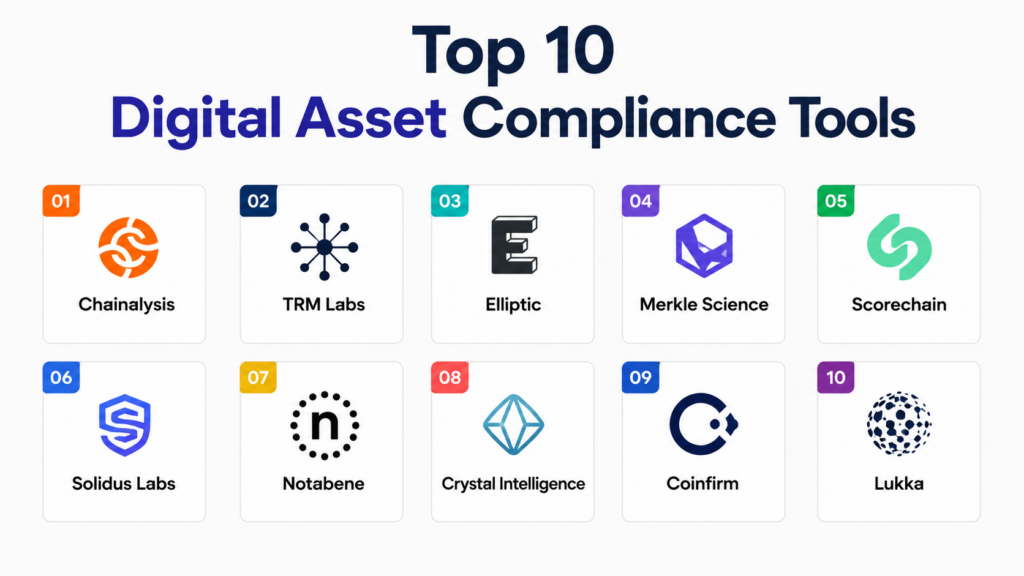
Introduction
Digital Asset Compliance Tools help crypto exchanges, fintech companies, banks, payment providers, custodians, DeFi teams, NFT marketplaces, stablecoin issuers, and Web3 businesses monitor risk across blockchain-based assets. In simple terms, these tools help organizations detect suspicious wallet activity, screen transactions, assess sanctions exposure, investigate illicit flows, manage Travel Rule requirements, and document compliance decisions for internal and regulatory review.
These platforms matter because digital assets are increasingly connected with mainstream finance, cross-border payments, tokenized assets, stablecoins, and decentralized applications. Compliance teams now need visibility across wallets, transactions, counterparties, bridges, mixers, scams, ransomware exposure, darknet activity, fraud patterns, and sanctioned entities. Real-world use cases include crypto AML monitoring, wallet screening, transaction risk scoring, sanctions screening, blockchain investigations, suspicious activity review, Travel Rule compliance, market abuse detection, regulatory reporting, and digital asset risk management.
Buyers should evaluate blockchain coverage, risk scoring quality, investigation workflows, alert management, integrations, APIs, Travel Rule support, sanctions screening, case management, auditability, analyst usability, pricing transparency, support quality, and fit for their jurisdiction.
Best for: compliance officers, AML teams, risk managers, crypto exchanges, fintechs, banks, custodians, stablecoin issuers, payment companies, law enforcement teams, regulators, and enterprises operating with digital assets. Not ideal for: individual traders, hobby crypto users, small projects with no regulated activity, or businesses that only need basic portfolio tracking rather than formal compliance monitoring.
Key Trends in Digital Asset Compliance Tools
- Blockchain analytics is becoming core compliance infrastructure, especially for exchanges, custodians, banks, and payment companies handling crypto transactions.
- AI-assisted risk detection is increasing, helping teams identify suspicious patterns, wallet clusters, fraud behavior, and unusual transaction flows more efficiently.
- Travel Rule compliance is becoming more operational, with more virtual asset service providers needing secure counterparty information exchange.
- Stablecoin monitoring is now a major use case, especially for issuers, payment companies, and financial institutions managing high-volume flows.
- DeFi and cross-chain risk coverage is becoming essential, because illicit funds often move through bridges, decentralized exchanges, mixers, and multi-chain ecosystems.
- Case management and analyst workflows are improving, helping compliance teams move from raw alerts to documented investigations and escalation decisions.
- Real-time screening is becoming expected, especially for high-volume exchanges, fiat ramps, wallets, and payment platforms.
- Regulatory reporting expectations are rising, so audit trails, alert histories, evidence capture, and suspicious activity documentation matter more.
- Market integrity tools are converging with AML tools, especially for crypto exchanges that need trade surveillance, wash trading detection, and market manipulation monitoring.
- Enterprise buyers want API-first compliance, so transaction monitoring, wallet screening, customer risk scoring, and policy automation can be embedded into business systems.
How We Selected These Tools
- Selected platforms widely recognized in crypto compliance, blockchain analytics, AML monitoring, Travel Rule workflows, and digital asset risk management.
- Balanced blockchain intelligence platforms, transaction monitoring tools, Travel Rule specialists, market surveillance tools, and crypto risk analytics providers.
- Considered suitability for crypto exchanges, fintech companies, banks, custodians, regulators, law enforcement teams, and Web3 businesses.
- Evaluated blockchain coverage, wallet risk scoring, alert workflows, sanctions screening, investigations, APIs, and analyst usability.
- Considered whether tools support real-world compliance operations such as case management, suspicious activity review, reporting, and audit evidence.
- Prioritized platforms with practical relevance for regulated digital asset businesses and institutional adoption.
- Avoided public ratings because reliable universal ratings are not consistently available for this category.
- Used “Not publicly stated” where certifications, compliance controls, or security details are not clearly known.
- Scoring is comparative and practical, not a claim that one tool is universally best.
- Included tools that serve different buyer needs, from AML teams and investigators to Travel Rule operations and trade surveillance teams.
Top 10 Digital Asset Compliance Tools
1- Chainalysis
Short description:
Chainalysis is one of the most recognized blockchain analytics and crypto compliance platforms for exchanges, financial institutions, regulators, law enforcement agencies, and crypto businesses. It helps teams monitor transactions, investigate suspicious activity, assess wallet risk, and understand blockchain fund flows. The platform is especially useful for AML, sanctions screening, investigations, and crypto risk intelligence. It is a strong fit for organizations that need broad blockchain visibility and formal compliance workflows.
Key Features
- Blockchain transaction monitoring and wallet risk scoring.
- AML and sanctions screening workflows.
- Investigation tools for tracing crypto fund flows.
- Case management and evidence support for compliance teams.
- Risk intelligence for exchanges, financial institutions, and public-sector users.
- Support for crypto crime detection and suspicious activity review.
- API options for embedding blockchain risk checks into business workflows.
Pros
- Strong recognition in crypto compliance and blockchain investigations.
- Good fit for regulated crypto businesses and public-sector teams.
- Useful for both real-time monitoring and deeper investigations.
Cons
- May be expensive or complex for small teams.
- Analysts may need training to use advanced investigation features effectively.
- Buyers should validate chain coverage and workflow fit for their specific market.
Platforms / Deployment
Web / API-based.
Cloud.
Security & Compliance
Security and compliance controls should be validated directly. Buyers should review SSO, MFA, RBAC, audit logs, data handling, certifications, and enterprise security documentation based on their requirements.
Integrations & Ecosystem
Chainalysis integrates into compliance, investigations, exchange operations, and financial crime workflows. It is commonly used where transaction risk intelligence must connect with internal compliance systems.
- Crypto exchanges
- Wallet and transaction monitoring workflows
- AML case management processes
- Law enforcement investigations
- Financial institution risk workflows
- API-based screening and risk checks
Support & Community
Chainalysis has strong industry recognition, training resources, and enterprise support options. Buyers should validate onboarding, analyst training, support tiers, and jurisdiction-specific compliance fit before adoption.
2- TRM Labs
Short description:
TRM Labs is a digital asset risk management and blockchain intelligence platform used by compliance teams, financial institutions, crypto businesses, and public-sector organizations. It supports wallet screening, transaction monitoring, investigations, fraud detection, sanctions risk, and anomaly detection. TRM is especially useful for organizations that need practical AML workflows and broad digital asset risk visibility. It fits teams that want a compliance platform designed for modern crypto operations.
Key Features
- Wallet screening and transaction monitoring.
- Blockchain intelligence and risk scoring.
- AML, sanctions, and suspicious activity workflows.
- Behavioral anomaly detection for digital asset risk.
- Investigation and case review capabilities.
- API-first architecture for business integration.
- Coverage for multiple digital asset ecosystems depending on product scope.
Pros
- Strong fit for crypto AML and risk operations.
- Useful for compliance teams needing alert workflows and investigations.
- API-friendly for fintechs, exchanges, and financial institutions.
Cons
- Advanced workflows may require analyst training.
- Pricing and packaging should be validated directly.
- Buyers should test coverage for their target chains and assets.
Platforms / Deployment
Web / API-based.
Cloud.
Security & Compliance
Security and compliance capabilities should be validated directly. Buyers should review SSO, MFA, RBAC, audit logs, certifications, data retention, and enterprise security controls as part of due diligence.
Integrations & Ecosystem
TRM Labs can be embedded into compliance operations, onboarding workflows, transaction monitoring systems, and investigations. It is useful where digital asset risk checks must operate in real time.
- Exchanges and crypto platforms
- Fiat on-ramp and off-ramp workflows
- Financial institution compliance systems
- AML alert management
- Investigation workflows
- API-based wallet and transaction screening
Support & Community
TRM Labs provides documentation, onboarding support, and compliance-focused resources. Buyers should validate support levels, analyst enablement, regulatory workflow fit, and escalation support.
3- Elliptic
Short description:
Elliptic is a blockchain analytics and crypto compliance platform focused on financial crime risk management for digital assets. It helps organizations screen wallets, monitor transactions, investigate illicit activity, and manage regulatory risk. Elliptic is useful for crypto exchanges, banks, fintechs, regulators, and compliance teams that need blockchain intelligence across digital asset flows. It is especially relevant for organizations focused on AML, sanctions exposure, and transaction risk.
Key Features
- Blockchain analytics for financial crime risk.
- Wallet and transaction screening.
- Crypto AML monitoring and investigations.
- Risk scoring for digital asset exposure.
- Support for compliance and regulatory workflows.
- API integration for real-time risk checks.
- Useful for exchanges, banks, and digital asset businesses.
Pros
- Strong fit for AML and financial crime compliance.
- Useful for both screening and investigation workflows.
- Recognized in crypto compliance and blockchain analytics.
Cons
- Advanced investigation workflows may require specialist training.
- Chain and asset coverage should be validated for each use case.
- Pricing and enterprise packaging are not always simple for small teams.
Platforms / Deployment
Web / API-based.
Cloud.
Security & Compliance
Security controls should be validated directly. Buyers should review access controls, audit logs, data handling, certifications, and compliance documentation based on internal vendor risk requirements.
Integrations & Ecosystem
Elliptic integrates with compliance operations, exchange systems, wallet screening workflows, and investigation processes. It is useful when organizations need blockchain risk intelligence inside regulated workflows.
- AML monitoring systems
- Exchange compliance teams
- Banking digital asset workflows
- Wallet screening APIs
- Investigations and case review
- Sanctions risk processes
Support & Community
Elliptic provides compliance-focused resources and enterprise support options. Buyers should validate onboarding, analyst training, support response, and jurisdictional fit before production use.
4- Merkle Science
Short description:
Merkle Science is a crypto risk intelligence and compliance platform that helps organizations monitor transactions, investigate suspicious activity, and manage digital asset risk. It is useful for exchanges, fintechs, banks, law enforcement agencies, and compliance teams that need blockchain analytics and risk monitoring. Merkle Science is especially relevant for organizations that want practical wallet risk scoring, transaction monitoring, and investigation workflows. It fits teams handling regulated crypto transaction flows.
Key Features
- Wallet risk scoring and blockchain analytics.
- Transaction monitoring for crypto AML workflows.
- Investigation tools for suspicious activity review.
- Sanctions and illicit activity risk detection.
- API support for embedding compliance checks.
- Useful for exchanges, fintechs, and law enforcement teams.
- Supports digital asset risk management workflows.
Pros
- Good fit for crypto compliance monitoring and investigations.
- Useful API capabilities for business integration.
- Practical for exchanges and fintech compliance teams.
Cons
- Buyers should validate asset and chain coverage.
- Advanced analytics may require trained compliance analysts.
- Enterprise pricing and service scope should be reviewed directly.
Platforms / Deployment
Web / API-based.
Cloud.
Security & Compliance
Not publicly stated for all enterprise requirements. Buyers should validate SSO, MFA, RBAC, audit logs, data protection, certifications, and compliance documentation directly.
Integrations & Ecosystem
Merkle Science fits into compliance operations where wallet risk and transaction monitoring must connect with internal workflows and customer risk systems.
- Crypto exchanges
- Fintech compliance systems
- Wallet screening workflows
- Investigation teams
- Law enforcement processes
- API-driven transaction checks
Support & Community
Support is compliance and enterprise oriented. Buyers should evaluate onboarding, analyst training, case workflow support, regional coverage, and service response expectations.
5- Scorechain
Short description:
Scorechain is a crypto AML compliance and blockchain analytics platform used for transaction monitoring, wallet risk scoring, sanctions screening, and investigations. It serves VASPs, banks, Web3 platforms, token issuers, law enforcement agencies, and regulators. Scorechain is especially useful for teams that need practical AML controls, risk intelligence, and compliance APIs across blockchain activity. It is a strong option for organizations looking for end-to-end crypto risk management workflows.
Key Features
- Blockchain analytics and crypto AML monitoring.
- Wallet and transaction risk scoring.
- Sanctions screening and suspicious activity detection.
- Source-of-funds review and investigation workflows.
- Travel Rule API support depending on use case.
- Developer APIs for risk data access.
- Useful for VASPs, banks, token issuers, and regulators.
Pros
- Strong fit for AML, risk scoring, and crypto compliance workflows.
- Useful for both compliance teams and developers.
- Practical for regulated digital asset businesses.
Cons
- Buyers should validate chain coverage and data depth.
- Advanced workflows may require onboarding and analyst training.
- Pricing and plan details should be reviewed directly.
Platforms / Deployment
Web / API-based.
Cloud.
Security & Compliance
Security and compliance controls should be validated directly. Buyers should review access controls, API security, audit logs, certifications, and data handling based on internal requirements.
Integrations & Ecosystem
Scorechain integrates into crypto compliance workflows, transaction monitoring systems, and risk analysis processes. Its API options can support automated checks in business applications.
- AML monitoring workflows
- Wallet screening
- Transaction risk APIs
- Travel Rule workflows where applicable
- Investigation and source-of-funds review
- Regulator and law enforcement use cases
Support & Community
Scorechain provides compliance-focused services, training, and platform resources. Buyers should validate onboarding, regional regulatory fit, support model, and analyst enablement.
6- Solidus Labs
Short description:
Solidus Labs focuses on crypto market integrity, trade surveillance, transaction monitoring, and digital asset compliance workflows. It is especially relevant for crypto exchanges, brokerages, trading platforms, and financial institutions that need to detect market manipulation, suspicious trading behavior, fraud, and compliance risks. Solidus Labs is a strong fit where AML and market surveillance overlap. It is particularly useful for trading-focused digital asset businesses.
Key Features
- Crypto trade surveillance and market integrity tools.
- Transaction monitoring and compliance workflows.
- Detection of suspicious trading patterns and market abuse.
- Risk monitoring for exchanges and trading platforms.
- Case management and alert workflows.
- Useful for brokerages, marketplaces, and financial institutions.
- Compliance support for digital asset market operations.
Pros
- Strong fit for trading surveillance and market integrity.
- Useful for exchanges and brokerages with active trading flows.
- Helps compliance teams monitor both transaction and trading risks.
Cons
- Less focused on pure wallet intelligence than some blockchain analytics platforms.
- Best fit is trading and market infrastructure use cases.
- Buyers should validate AML, surveillance, and reporting scope.
Platforms / Deployment
Web / API-based.
Cloud.
Security & Compliance
Security controls should be validated directly. Buyers should review access controls, audit logs, compliance documentation, data handling, and enterprise security features.
Integrations & Ecosystem
Solidus Labs fits into exchange operations, broker systems, trading platforms, compliance desks, and market surveillance workflows.
- Crypto exchanges
- Broker-dealer style workflows
- Trading surveillance systems
- Market integrity monitoring
- Case management processes
- Compliance reporting workflows
Support & Community
Solidus Labs is oriented toward regulated market participants and digital asset trading firms. Buyers should validate onboarding, analyst support, implementation resources, and regulatory workflow fit.
7- Notabene
Short description:
Notabene is a Travel Rule compliance platform designed for virtual asset service providers that need to exchange required sender and recipient information securely. It is especially useful for crypto exchanges, custodians, payment providers, and fintech companies managing compliant asset transfers. Notabene helps teams operationalize Travel Rule workflows across counterparties and jurisdictions. It is a specialist platform rather than a general blockchain analytics tool.
Key Features
- Travel Rule compliance workflows.
- Counterparty discovery and information exchange.
- Support for VASP-to-VASP transfer compliance.
- Policy and rules management for digital asset transfers.
- Helps operationalize jurisdiction-specific Travel Rule processes.
- Useful for exchanges, custodians, and crypto payment providers.
- API support for integration into transaction workflows.
Pros
- Strong specialist focus on Travel Rule operations.
- Useful for regulated VASPs and custodians.
- Helps reduce manual counterparty information exchange friction.
Cons
- Not a full blockchain analytics or investigation platform by itself.
- Best value depends on Travel Rule exposure and counterparty network.
- Buyers may still need separate AML analytics and monitoring tools.
Platforms / Deployment
Web / API-based.
Cloud.
Security & Compliance
Security and compliance details should be validated directly. Buyers should review encryption, access controls, audit logs, data handling, jurisdictional fit, and enterprise security features.
Integrations & Ecosystem
Notabene integrates into transfer workflows where Travel Rule information must be collected, exchanged, validated, and documented.
- Crypto exchanges
- Custodians
- Payment providers
- VASP counterparty workflows
- Travel Rule information exchange
- Transaction compliance systems
Support & Community
Notabene provides compliance-focused support and resources for Travel Rule operations. Buyers should validate network coverage, onboarding, integration effort, and jurisdictional alignment.
8- Crystal Intelligence
Short description:
Crystal Intelligence is a blockchain analytics and crypto investigation platform used for AML compliance, transaction monitoring, wallet screening, and digital asset investigations. It is relevant for exchanges, banks, law enforcement agencies, regulators, and compliance teams that need visibility into crypto transactions. Crystal Intelligence is especially useful for tracing funds, understanding wallet exposure, and supporting suspicious activity review. It fits organizations that need both compliance monitoring and investigation capabilities.
Key Features
- Blockchain analytics and investigation tools.
- Wallet risk scoring and transaction monitoring.
- AML and sanctions risk workflows.
- Fund tracing and visual investigation support.
- Useful for law enforcement and compliance teams.
- API access for integration into business workflows.
- Supports digital asset risk review and case analysis.
Pros
- Good fit for investigations and transaction tracing.
- Useful for compliance teams and public-sector users.
- Practical for wallet screening and AML workflows.
Cons
- Buyers should validate chain coverage and data sources.
- Analysts may need training for advanced investigations.
- Pricing and support model should be reviewed directly.
Platforms / Deployment
Web / API-based.
Cloud.
Security & Compliance
Not publicly stated for all enterprise security requirements. Buyers should validate SSO, MFA, RBAC, audit logs, certifications, and data protection controls directly.
Integrations & Ecosystem
Crystal Intelligence can integrate with compliance teams, investigation workflows, law enforcement processes, and crypto transaction monitoring systems.
- Wallet screening
- Transaction monitoring
- Investigation and tracing workflows
- Law enforcement analytics
- Exchange compliance systems
- API-based risk checks
Support & Community
Support is compliance and investigation oriented. Buyers should validate onboarding, training, analyst support, and regional fit before adoption.
9- Coinfirm
Short description:
Coinfirm is a crypto AML and blockchain analytics solution focused on risk scoring, transaction monitoring, wallet screening, and digital asset compliance. It is useful for exchanges, financial institutions, crypto businesses, and compliance teams managing blockchain risk. Coinfirm is especially relevant for organizations needing automated AML checks and blockchain risk intelligence. Buyers should validate current product structure, supported assets, and integration options for their specific operating model.
Key Features
- Crypto AML risk scoring.
- Wallet and transaction screening.
- Blockchain analytics for compliance workflows.
- Risk indicators for suspicious activity review.
- API support for automated checks.
- Useful for exchanges, fintechs, and digital asset businesses.
- Helps support compliance documentation and monitoring.
Pros
- Practical fit for crypto AML and wallet risk workflows.
- API capabilities can support automated screening.
- Useful for organizations needing blockchain risk scoring.
Cons
- Buyers should validate current product availability and packaging.
- Chain and asset coverage must be confirmed directly.
- May need complementary tools for Travel Rule or market surveillance.
Platforms / Deployment
Web / API-based.
Cloud.
Security & Compliance
Security and compliance capabilities should be validated directly. Buyers should review access controls, audit logs, API security, certifications, and data handling practices.
Integrations & Ecosystem
Coinfirm can fit into digital asset compliance workflows where wallet and transaction risk scoring need to connect with internal systems.
- Crypto AML monitoring
- Wallet risk APIs
- Exchange compliance workflows
- Fintech onboarding checks
- Transaction screening systems
- Investigation support processes
Support & Community
Support expectations should be validated based on product plan and customer requirements. Buyers should review onboarding, documentation, analyst support, and integration assistance.
10- Lukka
Short description:
Lukka provides digital asset data, tax, accounting, risk, and compliance-oriented solutions for institutions working with crypto assets. While it is broader than pure blockchain transaction monitoring, it is relevant for organizations that need financial, operational, reporting, and compliance data around digital assets. Lukka is especially useful for funds, enterprises, accountants, financial institutions, and businesses that need trusted data workflows for digital asset operations. It can complement AML-focused platforms by supporting accounting, tax, and institutional data governance.
Key Features
- Digital asset data and reporting workflows.
- Tax and accounting support for crypto assets.
- Risk and compliance-oriented data services.
- Useful for institutions, funds, and enterprises.
- Supports operational digital asset data management.
- Helps with financial reporting and reconciliation needs.
- Can complement blockchain analytics and custody workflows.
Pros
- Strong fit for institutional crypto accounting and reporting.
- Useful for organizations needing financial data governance.
- Complements AML and transaction monitoring tools.
Cons
- Not a pure blockchain investigation platform.
- Buyers may still need separate AML transaction monitoring.
- Product fit depends heavily on finance, tax, and reporting needs.
Platforms / Deployment
Web / API-based.
Cloud.
Security & Compliance
Security and compliance capabilities should be validated directly. Buyers should review access controls, audit logs, data handling, certifications, and financial reporting requirements.
Integrations & Ecosystem
Lukka fits into institutional digital asset operations where accounting, tax, data quality, and reporting matter. It can integrate with custody, trading, finance, and compliance workflows.
- Accounting systems
- Tax reporting workflows
- Institutional data operations
- Custody and trading records
- Financial reporting processes
- Digital asset reconciliation
Support & Community
Lukka is oriented toward institutional and finance-focused digital asset teams. Buyers should validate onboarding, accounting workflow support, data coverage, and enterprise service levels.
Comparison Table
| Tool Name | Best For | Platforms Supported | Deployment | Standout Feature | Public Rating |
|---|---|---|---|---|---|
| Chainalysis | Blockchain investigations and AML compliance | Web / APIs | Cloud | Broad blockchain intelligence and investigations | N/A |
| TRM Labs | Digital asset risk management | Web / APIs | Cloud | Wallet screening and behavioral risk detection | N/A |
| Elliptic | Financial crime risk management | Web / APIs | Cloud | Crypto AML and sanctions risk intelligence | N/A |
| Merkle Science | Wallet risk and transaction monitoring | Web / APIs | Cloud | Practical compliance investigation workflows | N/A |
| Scorechain | Crypto AML and blockchain analytics | Web / APIs | Cloud | AML monitoring and risk scoring platform | N/A |
| Solidus Labs | Trade surveillance and market integrity | Web / APIs | Cloud | Crypto market abuse and surveillance detection | N/A |
| Notabene | Travel Rule compliance | Web / APIs | Cloud | VASP counterparty information exchange | N/A |
| Crystal Intelligence | Blockchain investigations and tracing | Web / APIs | Cloud | Visual fund tracing and wallet analysis | N/A |
| Coinfirm | Crypto AML risk scoring | Web / APIs | Cloud | Automated wallet and transaction risk scoring | N/A |
| Lukka | Digital asset accounting and compliance data | Web / APIs | Cloud | Institutional digital asset reporting and data workflows | N/A |
Evaluation & Scoring of Digital Asset Compliance Tools
| Tool Name | Core 25% | Ease 15% | Integrations 15% | Security 10% | Performance 10% | Support 10% | Value 15% | Weighted Total |
|---|---|---|---|---|---|---|---|---|
| Chainalysis | 10 | 8 | 9 | 9 | 9 | 9 | 8 | 8.95 |
| TRM Labs | 9 | 8 | 9 | 8 | 9 | 8 | 8 | 8.55 |
| Elliptic | 9 | 8 | 8 | 8 | 8 | 8 | 8 | 8.25 |
| Merkle Science | 8 | 8 | 8 | 8 | 8 | 8 | 8 | 8.00 |
| Scorechain | 8 | 8 | 8 | 8 | 8 | 8 | 8 | 8.00 |
| Solidus Labs | 8 | 8 | 8 | 8 | 8 | 8 | 7 | 7.85 |
| Notabene | 8 | 8 | 8 | 8 | 8 | 8 | 8 | 8.00 |
| Crystal Intelligence | 8 | 7 | 8 | 8 | 8 | 7 | 8 | 7.75 |
| Coinfirm | 7 | 7 | 8 | 7 | 7 | 7 | 8 | 7.30 |
| Lukka | 7 | 8 | 8 | 8 | 8 | 8 | 7 | 7.65 |
These scores are comparative and should be used as an evaluation guide, not as public ratings. A higher score means the platform appears stronger across compliance functionality, ease of use, integrations, security expectations, performance, support, and value. A lower score may still be excellent for a focused use case such as Travel Rule, trade surveillance, accounting, or crypto tax reporting. Buyers should run vendor due diligence, test workflows with real data, validate jurisdictional requirements, and review integration effort before selecting a platform.
Which Digital Asset Compliance Tool Is Right for You?
Solo / Freelancer
Solo consultants and independent compliance analysts should choose tools based on the client’s regulatory exposure and investigation needs. Chainalysis, TRM Labs, Elliptic, Crystal Intelligence, and Scorechain are useful for blockchain analytics and wallet investigations. Lukka may be better when the work is focused on accounting, tax, or reporting. Notabene is only relevant if Travel Rule workflows are part of the client’s operations. Solo users should avoid overbuying enterprise platforms unless the client’s risk profile justifies the cost.
SMB
Small and mid-sized crypto businesses should prioritize transaction monitoring, wallet screening, alert workflows, and basic case documentation. TRM Labs, Elliptic, Merkle Science, Scorechain, and Coinfirm can be practical options depending on budget, chain coverage, and integration needs. Notabene should be evaluated if the business is a VASP with Travel Rule obligations. Solidus Labs is more relevant if the SMB operates a trading venue or marketplace. SMBs should begin with core AML coverage and expand into advanced analytics as volume grows.
Mid-Market
Mid-market organizations usually need stronger alert handling, APIs, internal controls, reporting, and analyst workflows. Chainalysis, TRM Labs, Elliptic, Merkle Science, and Scorechain are strong candidates for AML and blockchain analytics. Solidus Labs should be considered for trade surveillance and market integrity. Notabene should be evaluated for Travel Rule operations. Lukka may be useful where accounting, tax, and digital asset data governance are major requirements. Mid-market buyers should involve compliance, operations, legal, security, and engineering teams early.
Enterprise
Enterprises should evaluate digital asset compliance tools through a formal vendor risk and regulatory lens. Banks, custodians, exchanges, stablecoin issuers, and payment companies should assess blockchain coverage, sanctions screening, case management, audit logs, APIs, reporting, support, and jurisdictional fit. Chainalysis, TRM Labs, Elliptic, Solidus Labs, Notabene, and Lukka may all be relevant depending on use case. Enterprises often need more than one tool because AML, Travel Rule, surveillance, accounting, and investigations solve different problems. A single universal platform may not cover every compliance need.
Budget vs Premium
Budget-conscious teams should start with the most critical compliance requirement first: wallet screening, transaction monitoring, Travel Rule, accounting, or market surveillance. Premium platforms may be worth the cost when transaction volume, regulatory exposure, and enforcement risk are high. Lower-cost tools may help with basic screening, but regulated businesses need reliable evidence, auditability, support, and integration. The cheapest option is not always the safest if it produces weak alerts or poor documentation. Buyers should compare total compliance value, not only subscription cost.
Feature Depth vs Ease of Use
Chainalysis, TRM Labs, and Elliptic offer strong depth for AML, investigations, and blockchain analytics. Merkle Science, Scorechain, Crystal Intelligence, and Coinfirm can provide practical monitoring and risk scoring workflows. Notabene is highly focused on Travel Rule rather than broad analytics. Solidus Labs is strongest for trading surveillance and market integrity. Lukka is stronger for accounting, tax, and institutional data workflows. Buyers should select tools based on compliance function, not only brand recognition.
Integrations & Scalability
Digital asset compliance tools must integrate with exchanges, custodians, wallets, payment systems, customer onboarding, KYC tools, AML systems, case management, reporting, and data warehouses. API quality matters for high-volume transaction screening. Scalability depends on transaction volume, alert frequency, chain coverage, analyst capacity, and false positive management. Buyers should test real transaction flows, risk rules, alert queues, and investigation workflows before launch. A tool that works for a small pilot may need tuning before enterprise-scale deployment.
Security & Compliance Needs
Security and compliance requirements should include SSO, MFA, RBAC, audit logs, data encryption, access reviews, case history, evidence retention, and vendor risk documentation. Regulated businesses should validate how the platform handles customer data, wallet intelligence, sanctions updates, alert histories, and regulator-facing evidence. Compliance teams should also define escalation procedures, suspicious activity review, case closure standards, and quality assurance. A strong tool is only effective when paired with a well-designed compliance program.
Frequently Asked Questions
1- What are Digital Asset Compliance Tools?
Digital Asset Compliance Tools help organizations monitor, analyze, and manage compliance risks related to cryptocurrencies, tokens, stablecoins, NFTs, and blockchain transactions. They typically support wallet screening, transaction monitoring, sanctions checks, AML alerts, investigations, and risk scoring. Some platforms also support Travel Rule workflows, trade surveillance, accounting, tax reporting, or regulatory evidence management. These tools are important because blockchain activity can be complex, fast-moving, and multi-chain. They help compliance teams turn raw on-chain data into risk decisions. They do not replace compliance staff, but they improve visibility and documentation.
2- How much do digital asset compliance tools cost?
Pricing varies widely based on transaction volume, number of users, blockchain coverage, API usage, investigation features, Travel Rule needs, and enterprise support. Many vendors use custom pricing rather than public pricing because customer requirements differ greatly. A small crypto startup may need a basic screening workflow, while a global exchange may need real-time monitoring across many chains and high-volume transactions. Buyers should also consider indirect costs such as analyst training, integration, alert tuning, and compliance operations. The right way to compare cost is to evaluate total compliance value. A low-cost tool may be expensive if it creates too many false positives or weak evidence.
3- Are these tools required by law?
Requirements depend on jurisdiction, business model, and regulatory classification. Crypto exchanges, custodians, payment providers, stablecoin issuers, and other VASPs may face AML, sanctions, Travel Rule, reporting, and customer due diligence obligations. Even where a specific tool is not legally mandated, regulators often expect businesses to have appropriate controls for transaction monitoring and suspicious activity detection. A digital asset compliance tool helps support those controls. However, using a tool does not automatically guarantee compliance. Organizations still need policies, procedures, trained staff, legal review, and documented decision-making.
4- What is wallet screening?
Wallet screening is the process of checking a blockchain address for risk indicators before allowing deposits, withdrawals, onboarding, transfers, or business activity. A wallet may be associated with sanctions, scams, ransomware, darknet markets, mixers, stolen funds, fraud, high-risk exchanges, or other suspicious activity. Compliance tools assign risk scores and show why a wallet may require review. Wallet screening can happen during onboarding, before a transaction, or as part of ongoing monitoring. It helps organizations reduce exposure to illicit funds. However, risk scores should be reviewed carefully and not treated as automatic legal conclusions.
5- What is transaction monitoring for crypto?
Crypto transaction monitoring tracks deposits, withdrawals, transfers, and on-chain movements to detect suspicious behavior. It can identify high-risk counterparties, unusual transaction patterns, exposure to illicit services, rapid fund movement, structuring behavior, and sanctions risk. Monitoring may happen in real time or through batch review. Compliance teams use alerts to investigate transactions and decide whether to approve, block, escalate, or report activity. Good transaction monitoring requires rules, thresholds, risk scoring, and analyst review. It should be tuned to reduce false positives while still catching meaningful risk.
6- What is Travel Rule compliance?
Travel Rule compliance requires certain virtual asset transfers to include required originator and beneficiary information between regulated entities. The exact requirements vary by jurisdiction and business type. Travel Rule tools help VASPs identify counterparties, exchange required information securely, apply rules, and document compliance decisions. Notabene is an example of a platform focused specifically on this workflow. Travel Rule compliance is different from blockchain analytics because it deals with regulated counterparty information exchange. Many businesses need both Travel Rule tools and AML transaction monitoring tools.
7- Can these tools detect all illicit crypto activity?
No tool can detect all illicit activity perfectly. Blockchain analytics depends on data quality, attribution methods, risk models, chain coverage, and behavior patterns. Criminals may use mixers, bridges, privacy tools, chain hopping, scams, decentralized exchanges, and newly created wallets to avoid detection. Compliance tools improve visibility and reduce risk, but they cannot eliminate risk completely. Analysts still need policies, training, review procedures, and escalation workflows. A strong compliance program combines technology, human judgment, legal guidance, and continuous monitoring.
8- What integrations should buyers evaluate?
Buyers should evaluate integrations with KYC systems, customer onboarding, transaction processing, wallets, custody platforms, exchanges, case management tools, data warehouses, reporting systems, and compliance dashboards. API access is especially important for high-volume businesses that need real-time screening. Teams should also evaluate webhook support, bulk screening, alert export, audit trails, and role-based access. Travel Rule workflows may require counterparty network integrations. Trade surveillance tools may need order book and trading data integration. Integration fit should be tested before vendor selection.
9- How should teams reduce false positives?
Teams can reduce false positives by tuning risk rules, setting thresholds by customer type, segmenting transaction flows, improving data quality, and training analysts. They should avoid using a single generic risk rule for every product, region, or asset. Alerts should be prioritized by severity, exposure type, and business impact. Case outcomes should be reviewed regularly to improve tuning. Compliance teams should also document why alerts were closed, escalated, or reported. Reducing false positives is important because too many weak alerts can overwhelm analysts and hide real risk.
10- What are alternatives to digital asset compliance tools?
Alternatives include manual blockchain explorer review, traditional AML systems, basic sanctions screening, crypto accounting tools, internal analytics, and external investigation consultants. However, these alternatives may not provide enough scale, attribution, risk scoring, or auditability for regulated digital asset businesses. Traditional AML tools may not understand blockchain-specific patterns. Manual review may work for very small volumes but becomes risky at scale. Some organizations use a combination of blockchain analytics, Travel Rule tools, market surveillance, and accounting platforms. The best alternative depends on transaction volume, regulation, and risk exposure.
Conclusion
Digital Asset Compliance Tools are essential for organizations that operate in crypto, tokenization, stablecoins, Web3 payments, custody, exchanges, and digital asset markets. Chainalysis, TRM Labs, and Elliptic are strong choices for broad blockchain analytics, AML monitoring, wallet screening, and investigations. Merkle Science, Scorechain, Crystal Intelligence, and Coinfirm provide practical risk scoring, transaction monitoring, and crypto compliance workflows. Notabene is especially useful for Travel Rule compliance, Solidus Labs is strong for trade surveillance and market integrity, and Lukka is valuable for digital asset accounting, tax, reporting, and institutional data workflows. The best tool depends on business model, jurisdiction, transaction volume, supported chains, integration needs, and compliance maturity. A practical next step is to shortlist tools by compliance function, test them with real transaction data, validate integrations and audit logs, review security and vendor risk documentation, and run a controlled pilot before scaling across production digital asset operations.
