MOTOSHARE 🚗🏍️
Rent Bikes & Cars Directly from Owners
Motoshare connects vehicle owners with people who need bikes and cars on rent. Owners earn from idle vehicles, and renters get flexible ride options.
Visit Motoshare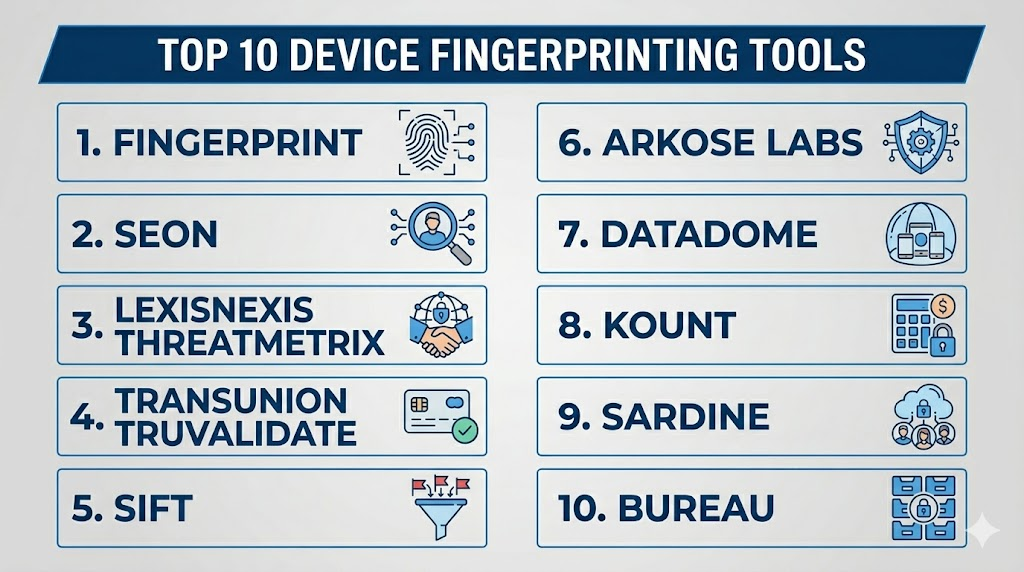
Introduction
Device Fingerprinting Tools help businesses identify and evaluate devices based on signals such as browser configuration, operating system, IP behavior, device attributes, network patterns, cookies, session history, and interaction signals. Instead of relying only on passwords or OTPs, these tools create a device profile that helps security and fraud teams understand whether a device looks trusted, new, suspicious, spoofed, automated, or linked to previous risky activity.Device fingerprinting matters now because online fraud, account takeover, fake account creation, payment abuse, bot attacks, and identity manipulation are becoming more advanced. Attackers often hide behind VPNs, proxies, emulators, anti-detect browsers, and disposable devices. Device fingerprinting gives businesses an additional intelligence layer to detect risk without adding friction for genuine users.
Real-world use cases include:
- Account takeover prevention during login and session activity
- Payment fraud detection for ecommerce, fintech, and marketplaces
- Bot and automation detection across registration, checkout, and promotions
- Fake account and multi-accounting prevention
- Risk-based authentication using device trust signals
Evaluation Criteria for Buyers:
- Device identification accuracy
- Resistance to spoofing and anti-detect browsers
- Browser, mobile, and API coverage
- Real-time risk scoring
- Fraud analytics and reporting
- Integration with IAM, fraud, payment, and SIEM tools
- Privacy and compliance controls
- False positive management
- Scalability for high-volume traffic
- Support quality and implementation guidance
Best for: Fraud teams, digital banks, fintech platforms, ecommerce businesses, marketplaces, gaming platforms, SaaS companies, IAM teams, and security teams that need device-level risk intelligence.
Not ideal for: Very small websites with low fraud exposure, teams that only need basic login protection, businesses without enough traffic to benefit from device intelligence, or organizations that cannot integrate risk signals into decision workflows.
Key Trends in Device Fingerprinting Tools
- Device intelligence is becoming broader than browser fingerprinting, combining device, IP, behavior, network, and session signals.
- AI-based risk scoring is improving fraud detection, especially for identifying suspicious patterns that rules alone may miss.
- Anti-detect browser detection is becoming more important because fraudsters increasingly try to spoof or manipulate device attributes.
- Mobile device fingerprinting is growing, especially for fintech, banking, gaming, and app-based commerce.
- Bot mitigation and device fingerprinting are converging, since many bot attacks depend on device rotation and automation tools.
- Privacy-first design is becoming a core buyer requirement, especially for companies operating across regulated regions.
- Risk-based authentication is replacing static authentication decisions, allowing trusted users to move smoothly while risky devices face step-up checks.
- API-first deployment is now expected, because modern teams want device intelligence embedded into login, checkout, onboarding, and payment flows.
- Device reputation networks are becoming valuable, helping businesses identify devices linked to previous fraud signals.
- Cross-channel intelligence is becoming more important, especially when users move between web, mobile, app, and payment environments.
How We Selected These Tools
The tools in this list were selected based on category relevance, market recognition, feature coverage, fraud prevention value, and practical buyer fit.
- Market adoption and mindshare across fraud prevention, digital identity, ecommerce, banking, and SaaS security
- Feature completeness, including fingerprinting, device reputation, risk scoring, bot detection, and analytics
- Reliability and performance signals for high-volume real-time environments
- Security posture signals, such as access control, auditability, encryption, and enterprise readiness where publicly clear
- Integration flexibility with IAM, CIAM, payment systems, fraud engines, APIs, and case management platforms
- Customer fit across segments, from developer-first teams to large enterprises
- Support for web, mobile, and API-based use cases
- Practical usability for fraud analysts and security teams
- Scalability for login, onboarding, checkout, and transaction flows
- Balanced coverage of specialized fingerprinting tools and broader fraud platforms
Top 10 Device Fingerprinting Tools
1- Fingerprint
Short description:
Fingerprint is a device intelligence and browser fingerprinting platform built for developers and digital product teams. It helps identify returning visitors, detect suspicious devices, reduce fraud, and improve account security. The platform is widely used in SaaS, ecommerce, fintech, and online platforms that need reliable visitor identification. It is especially useful for teams that want API-first device intelligence without building fingerprinting logic from scratch.
Key Features
- Browser and device fingerprinting
- Visitor identification for web and mobile apps
- Bot and fraud detection signals
- API and JavaScript-based integration
- Risk intelligence for account protection
- Developer-focused documentation
- Support for fraud, abuse, and personalization use cases
Pros
- Strong developer experience and straightforward integration
- Good fit for SaaS, ecommerce, and product-led teams
- Useful for identifying returning visitors even when cookies are unreliable
Cons
- Advanced fraud workflows may require higher-tier capabilities
- Browser privacy changes can affect some fingerprinting approaches
- May need additional fraud tools for complex enterprise risk operations
Platforms / Deployment
Web / iOS / Android / API
Cloud
Security & Compliance
Security details vary by plan and deployment. Buyers should validate SSO, audit logs, RBAC, encryption, data retention, and compliance requirements directly.
Integrations & Ecosystem
Fingerprint is designed for developer-first integration into web and mobile applications. It works well when teams need device intelligence inside login, signup, checkout, trial abuse prevention, or account protection workflows.
- Web applications
- Mobile applications
- SaaS platforms
- Fraud prevention workflows
- Authentication systems
- API-based risk systems
Support & Community
Fingerprint provides developer documentation and support resources. Enterprise support options may vary by plan, so buyers should confirm onboarding, SLA, and technical support requirements.
2- SEON
Short description:
SEON is a fraud prevention platform that includes device fingerprinting, IP intelligence, email intelligence, phone intelligence, rules, and machine learning risk scoring. It is popular among fintech companies, ecommerce businesses, marketplaces, gaming platforms, and digital-first businesses. SEON helps teams detect suspicious devices, fake accounts, multi-accounting, payment fraud, and bonus abuse. It is a strong option for buyers who want device fingerprinting as part of a broader fraud prevention toolkit.
Key Features
- Device and browser fingerprinting
- IP, email, and phone intelligence
- Custom risk rules and scoring
- Machine learning-assisted fraud detection
- Transaction monitoring support
- API-first deployment model
- Fraud analyst dashboard and reporting
Pros
- Strong balance of device intelligence and wider fraud signals
- Useful for SMB, mid-market, and enterprise fraud teams
- Flexible rules and API integrations
Cons
- Needs careful configuration to reduce false positives
- Some advanced capabilities may depend on plan or setup
- Not purely focused on device fingerprinting alone
Platforms / Deployment
Web / Mobile / API
Cloud
Security & Compliance
Security and compliance details vary by product configuration. Buyers should validate SSO, audit logs, encryption, RBAC, GDPR readiness, and data residency requirements during procurement.
Integrations & Ecosystem
SEON integrates well into fraud, payment, onboarding, and account protection workflows. Its strength is combining device signals with broader digital footprint intelligence.
- Payment gateways
- Ecommerce platforms
- Fraud management systems
- Customer onboarding flows
- API-based applications
- Risk decisioning workflows
Support & Community
SEON provides vendor-led onboarding, documentation, and customer support. Support level may vary by plan and customer size.
3- LexisNexis ThreatMetrix
Short description:
LexisNexis ThreatMetrix is an enterprise digital identity and fraud prevention platform with strong device intelligence capabilities. It helps organizations evaluate devices, sessions, identities, and transactions to detect fraud and reduce account takeover risk. ThreatMetrix is commonly used by banks, payment providers, ecommerce businesses, and large digital platforms. It is best suited for organizations that need device fingerprinting connected with large-scale identity risk intelligence.
Key Features
- Device intelligence and device reputation
- Digital identity risk assessment
- Account takeover detection
- Transaction risk scoring
- Bot and suspicious session detection
- Cross-channel intelligence
- Fraud analytics and investigation workflows
Pros
- Strong fit for enterprise fraud and risk teams
- Useful for banking, payments, and ecommerce environments
- Combines device intelligence with broader identity risk signals
Cons
- May be complex for small teams
- Enterprise implementation can require planning and technical resources
- Pricing and packaging are not always simple for SMB buyers
Platforms / Deployment
Web / Mobile / API
Cloud / Hybrid
Security & Compliance
Security controls vary by deployment and contract. Buyers should validate SSO, RBAC, audit logs, encryption, privacy controls, and regulatory requirements directly.
Integrations & Ecosystem
ThreatMetrix works best as part of a larger fraud prevention and digital identity architecture. It can support risk-based decisions across login, registration, transactions, and account changes.
- Fraud engines
- IAM and CIAM systems
- Payment platforms
- Digital banking applications
- Case management systems
- Risk orchestration tools
Support & Community
Support is enterprise-focused with implementation guidance and customer support. Public community resources are limited compared with developer-first platforms.
4- TransUnion TruValidate
Short description:
TransUnion TruValidate includes device intelligence and identity risk capabilities used for fraud prevention, identity verification, and trust decisions. It is relevant for financial services, insurance, ecommerce, gaming, marketplaces, and digital onboarding teams. The platform helps businesses assess device risk, user identity risk, and transaction risk together. It is suitable for companies that want device fingerprinting connected with broader identity and fraud intelligence.
Key Features
- Device recognition and device reputation
- Identity and fraud risk signals
- Account takeover prevention support
- New account fraud detection
- Transaction risk assessment
- Cross-channel device intelligence
- Fraud analytics and decision support
Pros
- Strong fit for regulated and fraud-heavy industries
- Combines device risk with identity intelligence
- Useful for onboarding, login, and transaction protection
Cons
- May be more enterprise-oriented than small businesses need
- Implementation can require fraud workflow planning
- Public details vary across product modules
Platforms / Deployment
Web / Mobile / API
Cloud / Hybrid
Security & Compliance
Not publicly stated in full detail. Buyers should validate encryption, access control, audit logs, privacy controls, and compliance obligations directly.
Integrations & Ecosystem
TruValidate can connect device intelligence with identity verification, fraud decisioning, and risk orchestration. It is strongest where device signals must support larger trust decisions.
- Identity verification systems
- Fraud management platforms
- Digital onboarding workflows
- Payment systems
- IAM and CIAM tools
- Risk analytics platforms
Support & Community
Support is enterprise and vendor-led. Buyers should confirm onboarding, implementation support, response times, and technical documentation quality.
5- Sift
Short description:
Sift is a fraud decisioning platform that includes device, behavioral, network, and transaction risk signals. It is used by ecommerce companies, marketplaces, fintech platforms, and digital businesses to detect fraud, account takeover, payment abuse, fake accounts, and policy abuse. Device intelligence is part of its wider fraud prevention model rather than a standalone-only product. Sift is a strong fit for teams that want fingerprinting, machine learning, and case management in one fraud platform.
Key Features
- Device and session risk signals
- Machine learning-based fraud scoring
- Account takeover protection
- Payment fraud detection
- Content and policy abuse detection
- Case management and review workflows
- Network-based fraud intelligence
Pros
- Broad fraud coverage beyond device fingerprinting
- Strong fit for ecommerce and marketplace environments
- Useful analyst workflows for fraud teams
Cons
- May be more platform than needed for simple device identification
- Requires integration with business workflows for best value
- Pricing may be less suitable for very small teams
Platforms / Deployment
Web / Mobile / API
Cloud
Security & Compliance
Security details vary by offering and customer setup. Buyers should validate SSO, RBAC, audit logs, encryption, and compliance requirements directly.
Integrations & Ecosystem
Sift fits into fraud operations where device signals are combined with transactions, accounts, users, and behavior. It is useful when fraud teams need scoring and investigation in one workflow.
- Ecommerce platforms
- Marketplace platforms
- Payment systems
- Fraud case management
- Customer account systems
- API-based applications
Support & Community
Sift provides vendor documentation, onboarding, and customer support. Support depth may vary by plan and customer segment.
6- Arkose Labs
Short description:
Arkose Labs is a fraud and bot mitigation platform that uses device intelligence, behavioral signals, risk scoring, and adaptive challenges to stop automated abuse and high-risk activity. It is commonly used by digital platforms facing bot attacks, account abuse, credential stuffing, fake account creation, and transaction abuse. Device fingerprinting helps Arkose identify suspicious environments and decide when to challenge users. It is best for businesses that want device intelligence plus active bot defense.
Key Features
- Device fingerprinting and device risk signals
- Bot and automation detection
- Adaptive challenge-response workflows
- Account abuse prevention
- Credential stuffing protection
- Risk scoring and analytics
- Support for high-volume digital platforms
Pros
- Strong fit for bot-heavy environments
- Combines fingerprinting with adaptive enforcement
- Useful for protecting login, signup, and transaction flows
Cons
- May introduce user friction if not tuned carefully
- More focused on fraud and bot defense than pure fingerprinting
- Enterprise implementation may require careful workflow design
Platforms / Deployment
Web / Mobile / API
Cloud
Security & Compliance
Not publicly stated in full detail. Buyers should validate access control, encryption, audit logs, data processing, and compliance needs directly.
Integrations & Ecosystem
Arkose Labs integrates into user-facing flows where suspicious sessions need to be challenged or blocked. It works well with authentication, fraud, and bot defense workflows.
- Login flows
- Signup and registration flows
- Ecommerce checkout
- IAM and CIAM systems
- Fraud operations
- Bot mitigation programs
Support & Community
Support is vendor-led and enterprise-oriented. Buyers should confirm onboarding support, tuning assistance, reporting options, and response times.
7- DataDome
Short description:
DataDome is a bot and online fraud protection platform that uses device signals, browser analysis, behavioral patterns, and real-time detection to identify malicious automation. While best known for bot mitigation, it is highly relevant to device fingerprinting because bot operators often rely on spoofed devices, browser manipulation, and automated infrastructure. DataDome is useful for ecommerce, media, travel, ticketing, and marketplace companies. It helps protect web, mobile, and API traffic from automated abuse.
Key Features
- Device and browser signal analysis
- Bot detection and mitigation
- Real-time traffic protection
- Protection for web, mobile, and APIs
- Behavioral and technical fingerprinting signals
- Dashboard and threat analytics
- Automated blocking and challenge workflows
Pros
- Strong protection against automated traffic
- Useful for high-traffic consumer platforms
- Covers web, mobile app, and API attack surfaces
Cons
- More focused on bot mitigation than fraud case management
- May need careful configuration to avoid blocking legitimate users
- Advanced fraud use cases may need additional platforms
Platforms / Deployment
Web / Mobile / API
Cloud
Security & Compliance
Security details vary by deployment. Buyers should validate SSO, RBAC, audit logs, encryption, and regional compliance requirements directly.
Integrations & Ecosystem
DataDome fits well in frontend, API, and traffic protection environments. It is especially useful when device fingerprinting is needed to distinguish real users from bots.
- Web applications
- Mobile applications
- API gateways
- CDN and edge environments
- Ecommerce platforms
- Security monitoring systems
Support & Community
DataDome provides vendor-led support and documentation. Enterprise buyers should confirm onboarding, tuning, and incident response support.
8- Kount
Short description:
Kount is a fraud prevention platform that uses device intelligence, machine learning, identity signals, and transaction analytics to detect risky activity. It is commonly used by ecommerce, payments, fintech, and digital businesses to prevent payment fraud, account takeover, chargebacks, and fake account activity. Device fingerprinting is part of Kount’s broader fraud decisioning approach. It is a good fit for teams that need real-time fraud scoring and business-friendly review workflows.
Key Features
- Device fingerprinting and device risk signals
- Transaction fraud scoring
- Machine learning-based risk detection
- Account takeover prevention
- Chargeback and payment fraud support
- Rules and decisioning workflows
- Fraud analytics dashboard
Pros
- Strong fit for ecommerce and payment fraud prevention
- Combines device intelligence with transaction analytics
- Useful for reducing manual review effort
Cons
- Not a standalone-only device fingerprinting tool
- Requires integration with payment and order workflows
- Enterprise features may require more setup
Platforms / Deployment
Web / Mobile / API
Cloud
Security & Compliance
Not publicly stated in full detail. Buyers should validate encryption, audit logs, access controls, privacy controls, and compliance requirements.
Integrations & Ecosystem
Kount is strongest when connected to ecommerce, payment, order management, and fraud review systems. Device signals support automated fraud decisions and manual investigations.
- Ecommerce platforms
- Payment gateways
- Order management systems
- Fraud review tools
- API-based applications
- Customer account systems
Support & Community
Kount support is vendor-led, with implementation and customer support options. Buyers should validate support tiers and onboarding assistance.
9- Sardine
Short description:
Sardine is a fraud, compliance, and risk platform used by fintech, banking, crypto, payments, and digital financial businesses. It includes device intelligence, behavioral signals, risk scoring, and transaction monitoring capabilities. Sardine is especially relevant for companies dealing with money movement, onboarding risk, payment fraud, and account takeover. It is best suited for financial businesses that want device fingerprinting connected with broader fraud and compliance workflows.
Key Features
- Device fingerprinting and visitor intelligence
- Behavioral risk signals
- Payment and transaction fraud detection
- Account takeover prevention
- Risk scoring for onboarding and money movement
- Fraud and compliance workflow support
- API-first integration model
Pros
- Strong fit for fintech and financial risk use cases
- Combines device, behavior, payment, and compliance signals
- Useful for high-risk transaction environments
Cons
- May be more specialized than general ecommerce tools
- Implementation requires risk workflow planning
- Public packaging details may vary by use case
Platforms / Deployment
Web / Mobile / API
Cloud
Security & Compliance
Security details should be validated directly. Buyers should review access controls, encryption, audit logs, data retention, and regulatory requirements.
Integrations & Ecosystem
Sardine works best in fintech and payment environments where device intelligence must connect with transaction monitoring, onboarding, and compliance review.
- Fintech platforms
- Payment systems
- Banking applications
- Crypto platforms
- Compliance workflows
- Risk operations tools
Support & Community
Support is vendor-led and focused on fraud, compliance, and financial risk teams. Buyers should confirm onboarding, implementation guidance, and support availability.
10- Bureau
Short description:
Bureau provides device intelligence, identity risk, and fraud prevention tools for digital businesses. Its device fingerprinting capabilities help detect risky devices, repeat fraud attempts, collusion, mule activity, and suspicious onboarding patterns. Bureau is especially relevant for fintech, marketplaces, gig platforms, lenders, ecommerce, and digital onboarding teams. It is a strong choice for businesses that want device intelligence connected with user, identity, and risk graph signals.
Key Features
- Device intelligence and device identification
- Fraud risk scoring
- Collusion and mule account detection support
- Identity risk signals
- Onboarding fraud prevention
- API-based implementation
- Risk graph and relationship analysis
Pros
- Strong fit for onboarding and identity risk use cases
- Useful for detecting repeat fraud and linked devices
- API-first approach supports digital product teams
Cons
- May require careful configuration for non-fintech use cases
- Public security and pricing details should be validated
- Less known globally than some larger enterprise vendors
Platforms / Deployment
Web / Mobile / API
Cloud
Security & Compliance
Not publicly stated in full detail. Buyers should validate SSO, RBAC, audit logs, encryption, data retention, and compliance requirements directly.
Integrations & Ecosystem
Bureau fits into onboarding, fraud prevention, risk scoring, and identity verification workflows. It is valuable when device signals need to connect with user relationships and risk networks.
- Digital onboarding systems
- Fintech applications
- Marketplace platforms
- Identity verification tools
- Fraud operations
- API-based risk workflows
Support & Community
Support is vendor-led, with implementation guidance expected for business and technical teams. Public community strength is limited compared with developer-first tools.
Comparison Table
| Tool Name | Best For | Platforms Supported | Deployment | Standout Feature | Public Rating |
|---|---|---|---|---|---|
| Fingerprint | Developer-first device intelligence | Web, iOS, Android, API | Cloud | Visitor identification and browser fingerprinting | N/A |
| SEON | Fintech, ecommerce, marketplaces | Web, Mobile, API | Cloud | Device fingerprinting with digital footprint signals | N/A |
| LexisNexis ThreatMetrix | Enterprise fraud and identity risk | Web, Mobile, API | Cloud / Hybrid | Device intelligence with identity risk network | N/A |
| TransUnion TruValidate | Identity risk and fraud prevention | Web, Mobile, API | Cloud / Hybrid | Device recognition with broader identity intelligence | N/A |
| Sift | Ecommerce and marketplace fraud | Web, Mobile, API | Cloud | Fraud decisioning with device and behavior signals | N/A |
| Arkose Labs | Bot mitigation and account abuse prevention | Web, Mobile, API | Cloud | Device intelligence with adaptive challenges | N/A |
| DataDome | Bot protection and automated abuse defense | Web, Mobile, API | Cloud | Real-time bot and device signal analysis | N/A |
| Kount | Ecommerce and payment fraud prevention | Web, Mobile, API | Cloud | Transaction risk scoring with device intelligence | N/A |
| Sardine | Fintech and financial risk operations | Web, Mobile, API | Cloud | Device intelligence for money movement risk | N/A |
| Bureau | Onboarding fraud and identity risk | Web, Mobile, API | Cloud | Device intelligence with risk graph signals | N/A |
Evaluation and Scoring of Device Fingerprinting Tools
| Tool Name | Core 25% | Ease 15% | Integrations 15% | Security 10% | Performance 10% | Support 10% | Value 15% | Weighted Total 0–10 |
|---|---|---|---|---|---|---|---|---|
| Fingerprint | 8.6 | 9.0 | 8.5 | 8.0 | 8.6 | 8.0 | 8.7 | 8.55 |
| SEON | 8.8 | 8.6 | 8.5 | 8.0 | 8.4 | 8.2 | 8.5 | 8.48 |
| LexisNexis ThreatMetrix | 9.2 | 7.8 | 8.8 | 8.6 | 8.8 | 8.5 | 8.0 | 8.58 |
| TransUnion TruValidate | 8.8 | 7.8 | 8.4 | 8.5 | 8.4 | 8.3 | 8.0 | 8.36 |
| Sift | 8.7 | 8.2 | 8.6 | 8.2 | 8.5 | 8.4 | 8.1 | 8.43 |
| Arkose Labs | 8.5 | 8.0 | 8.4 | 8.2 | 8.5 | 8.3 | 8.0 | 8.30 |
| DataDome | 8.4 | 8.2 | 8.5 | 8.2 | 8.7 | 8.2 | 8.0 | 8.34 |
| Kount | 8.6 | 8.0 | 8.5 | 8.2 | 8.5 | 8.2 | 8.0 | 8.31 |
| Sardine | 8.5 | 8.0 | 8.4 | 8.2 | 8.4 | 8.0 | 8.1 | 8.26 |
| Bureau | 8.2 | 8.0 | 8.2 | 8.0 | 8.2 | 7.8 | 8.2 | 8.11 |
The scores are comparative, not universal. A high score means the tool performs strongly across the selected criteria, but it may not be the best option for every buyer. For example, Fingerprint may be excellent for developer-first device intelligence, while ThreatMetrix may be better for enterprise fraud networks. A fintech company may prefer Sardine or Bureau, while a bot-heavy ecommerce company may prefer DataDome or Arkose Labs. Always validate scores through a pilot using your own traffic, fraud patterns, integration needs, and security requirements.
Which Device Fingerprinting Tool Is Right for You?
Solo / Freelancer
Solo developers and freelancers usually need a simple, affordable, and developer-friendly option. Fingerprint is a strong fit because it is easy to embed into web apps and provides practical visitor identification. If the use case is only basic abuse prevention, a lightweight device intelligence setup may be enough. Solo users should avoid complex enterprise fraud platforms unless they are building a high-risk financial or marketplace product. Focus on API simplicity, documentation quality, and predictable pricing.
SMB
SMBs should choose tools that balance fraud prevention, ease of use, and cost. SEON is a strong option for SMBs that need device fingerprinting along with IP, email, and phone intelligence. Fingerprint is also a good choice for product teams that want flexible device identification. If the SMB faces bot attacks, DataDome or Arkose Labs may be more suitable. SMB buyers should avoid overbuying complex tools before validating fraud volume and business impact.
Mid-Market
Mid-market companies usually need more structured fraud workflows, better dashboards, stronger integrations, and more scalable risk scoring. Sift, Kount, SEON, DataDome, and Arkose Labs are practical choices depending on the use case. Ecommerce and marketplace teams may prefer Sift or Kount. Bot-heavy businesses may prefer DataDome or Arkose Labs. Fintech companies should evaluate Sardine, Bureau, or SEON. Mid-market buyers should prioritize API quality, analyst workflows, and measurable fraud reduction.
Enterprise
Enterprises need scale, reliability, auditability, vendor support, global deployment readiness, and integration depth. LexisNexis ThreatMetrix, TransUnion TruValidate, Sift, Kount, and DataDome are strong enterprise candidates depending on the business model. Large banks and financial institutions may prioritize ThreatMetrix or TruValidate. Large ecommerce companies may evaluate Sift, Kount, DataDome, or Arkose Labs. Enterprises should run formal security reviews, privacy reviews, proof-of-concept testing, and integration validation before choosing.
Budget vs Premium
Budget-conscious buyers should start with a focused tool like Fingerprint or a flexible fraud platform like SEON, depending on the use case. Premium buyers with high fraud exposure should evaluate enterprise-grade platforms such as ThreatMetrix, TruValidate, Sift, Kount, or DataDome. Budget tools may be easier to deploy but may not include advanced fraud workflows. Premium tools may cost more but can provide stronger detection, support, analytics, and enterprise controls. The best budget decision is the one that reduces fraud without adding unnecessary complexity.
Feature Depth vs Ease of Use
If ease of use is the priority, developer-first and API-first tools are usually better. Fingerprint and SEON are easier starting points for many teams. If feature depth is more important, platforms like ThreatMetrix, Sift, Kount, and TruValidate provide broader fraud and risk intelligence. Bot-heavy businesses may need DataDome or Arkose Labs because fingerprinting alone may not stop automation. Buyers should decide whether they need device identification, fraud scoring, bot defense, or full risk orchestration.
Integrations & Scalability
Device fingerprinting tools must integrate smoothly with login, signup, checkout, payment, onboarding, risk review, and security workflows. API quality is important, but so are dashboards, webhooks, SDKs, data exports, and case management support. High-volume companies should test latency, uptime, regional performance, and failover behavior. Tools like ThreatMetrix, Sift, Kount, DataDome, and SEON are often better suited when fingerprinting must scale across multiple channels. Smaller teams should prioritize simpler integrations and avoid unnecessary operational overhead.
Security & Compliance Needs
Security and compliance are critical because device fingerprinting involves sensitive signals. Buyers should validate data retention, encryption, consent requirements, privacy notices, role-based access, audit logs, and regional data handling. Regulated industries should include legal, privacy, compliance, fraud, and security teams in the evaluation. If the business operates in multiple regions, data residency and privacy controls become even more important. No tool should be selected only because it detects fraud well; it must also match the organization’s governance and compliance model.
Common Mistakes to Avoid When Buying Device Fingerprinting Tools
- Choosing a tool only because it has strong branding, without testing it on real traffic
- Assuming device fingerprinting alone can stop all fraud
- Ignoring mobile app support when most users are mobile-first
- Not checking resistance against VPNs, proxies, emulators, and anti-detect browsers
- Forgetting to involve privacy and legal teams early
- Measuring only detection rate and ignoring false positives
- Not integrating risk scores into actual business workflows
- Failing to define what action should happen after a risky device is detected
- Overbuying enterprise tools before proving fraud impact
- Underestimating implementation and analyst training effort
- Not reviewing data retention and regional privacy requirements
- Using static rules without ongoing tuning and monitoring
Implementation Playbook
First Phase
Start by defining the exact use case. Common starting points include account takeover, fake account creation, checkout fraud, bot abuse, payment risk, or onboarding fraud. Select one or two journeys rather than trying to protect everything at once. Identify the systems involved, such as login, payment gateway, IAM, fraud review, customer support, and analytics. Define success metrics such as fraud reduction, false positives, manual review savings, and user friction impact.
Second Phase
Integrate the selected tool into a controlled environment. Capture device signals, generate risk scores, and compare them with known fraud and legitimate activity. Do not immediately block users unless confidence is high. Start with monitoring, alerting, or manual review workflows. Work with fraud analysts to understand whether the signals are useful and explainable. Tune rules and thresholds based on real behavior rather than assumptions.
Third Phase
Move from monitoring to automated decisioning only after the tool proves reliable. Use device risk scores to trigger step-up authentication, manual review, velocity limits, payment holds, or session challenges. Continue measuring fraud savings, customer friction, false positives, and operational workload. Expand coverage to more journeys after the first use case is stable. Review privacy, security, and compliance controls before scaling across regions or business units.
Frequently Asked Questions
1- What are Device Fingerprinting Tools?
Device Fingerprinting Tools identify devices by analyzing technical and behavioral signals such as browser type, operating system, screen resolution, fonts, IP data, cookies, hardware signals, and session behavior. The goal is to recognize whether a device appears trusted, new, suspicious, or linked to previous risky activity. These tools help businesses detect fraud, bots, fake accounts, and account takeover attempts. They are often used in login, signup, checkout, payment, and onboarding workflows. Device fingerprinting works best when combined with identity, behavior, and transaction data. It is not a complete security solution by itself, but it adds a valuable risk intelligence layer.
2- How do Device Fingerprinting Tools help prevent fraud?
Device Fingerprinting Tools help prevent fraud by identifying suspicious devices and patterns that may indicate abuse. For example, the same device may create many accounts, attempt multiple payments, use risky proxies, or appear with inconsistent browser attributes. The tool assigns risk signals that can trigger step-up authentication, manual review, blocking, or transaction limits. This helps fraud teams detect risky activity before financial loss happens. Device intelligence also helps recognize trusted returning users, reducing unnecessary friction. The best results come when fingerprinting is connected to fraud workflows and business rules.
3- Are Device Fingerprinting Tools legal to use?
Device fingerprinting can be used legally, but businesses must handle privacy, consent, disclosure, and data protection carefully. Requirements vary by region and industry, so legal and privacy teams should review the implementation. Organizations should avoid collecting unnecessary data and should clearly define retention policies. Device signals should be protected with strong access control and encryption. For regulated industries, compliance review is especially important. Buyers should choose vendors that support privacy-aware deployment and provide clear data handling documentation.
4- What is the difference between device fingerprinting and cookies?
Cookies store information in the user’s browser and can often be deleted, blocked, or restricted. Device fingerprinting uses a combination of device and browser signals to recognize a device even when cookies are unavailable or unreliable. This can make device fingerprinting more useful for fraud detection, but it also creates privacy considerations. Cookies are usually more visible to users, while fingerprinting can happen passively. Many modern platforms use both methods together. The best approach depends on the use case, user consent model, and regulatory requirements.
5- Can device fingerprinting detect bots?
Yes, device fingerprinting can help detect bots by identifying suspicious browser environments, automation tools, emulators, headless browsers, repeated device patterns, and abnormal session attributes. However, bot detection usually requires more than fingerprinting alone. Strong bot defense also uses behavioral analytics, traffic analysis, challenge-response workflows, rate limiting, and threat intelligence. Tools like DataDome and Arkose Labs combine device signals with broader bot mitigation capabilities. For businesses facing heavy automation attacks, a bot-focused platform may be better than a basic fingerprinting tool. Device fingerprinting is an important signal, but not the full bot defense stack.
6- How much do Device Fingerprinting Tools cost?
Pricing varies depending on traffic volume, API usage, number of users, number of sessions, fraud modules, support level, and deployment complexity. Developer-first tools may offer usage-based pricing, while enterprise platforms often use custom pricing. Buyers should consider not only subscription cost but also integration effort, analyst training, implementation time, and ongoing tuning. A cheaper tool may be enough for basic identification, while a premium platform may be justified for high fraud losses. The best way to estimate cost is to run a pilot with realistic traffic assumptions. Always ask vendors what is included and what requires additional modules.
7- How long does implementation take?
Implementation time depends on tool complexity, number of channels, engineering resources, and business workflows. A simple JavaScript or API-based implementation can be faster for a single web application. Enterprise deployments across web, mobile, checkout, payments, IAM, and fraud review systems take longer. Teams should plan for testing, signal validation, false-positive tuning, privacy review, and workflow design. It is better to start with one use case than to deploy everywhere at once. A phased rollout reduces risk and helps teams prove value before scaling.
8- What are the biggest risks of device fingerprinting?
The biggest risks are privacy concerns, false positives, poor integration, and overreliance on fingerprinting as a single control. If implemented poorly, device fingerprinting may create user friction or flag legitimate users incorrectly. Attackers may also try to spoof device attributes using anti-detect browsers, proxies, or emulators. Businesses must also manage data retention and access controls carefully. The tool should be part of a layered security strategy, not the only defense. Regular monitoring and tuning are essential for maintaining accuracy.
9- Can Device Fingerprinting Tools integrate with IAM and MFA?
Yes, many tools integrate with IAM, CIAM, MFA, and risk-based authentication workflows. Device risk scores can help decide whether a user should be allowed, challenged, blocked, or sent for manual review. For example, a trusted device may get a smooth login experience, while a suspicious device may trigger MFA. Integration quality varies by vendor, so buyers should check APIs, webhooks, SDKs, identity provider compatibility, and workflow support. Strong integration is essential because fingerprinting signals must lead to real actions. Without integration, the tool may only provide reports instead of protection.
10- What is the best Device Fingerprinting Tool?
There is no single best Device Fingerprinting Tool for every business. Fingerprint is strong for developer-first device intelligence, SEON is strong for fraud teams needing multiple digital footprint signals, and ThreatMetrix is strong for enterprise identity risk. DataDome and Arkose Labs are better for bot-heavy environments, while Sift and Kount are strong for ecommerce and fraud decisioning. Sardine and Bureau are useful for fintech and onboarding risk. The best choice depends on fraud type, traffic volume, integration needs, budget, privacy requirements, and operational maturity.
Conclusion
Device Fingerprinting Tools are now an important part of modern fraud prevention, identity security, bot defense, and risk-based authentication. They help businesses identify trusted and suspicious devices, detect repeat fraud attempts, reduce account takeover risk, stop automated abuse, and improve decisioning across login, signup, checkout, onboarding, and payment workflows. The best tool depends on the buyer’s environment: developer-first teams may prefer Fingerprint, fraud teams may evaluate SEON, Sift, Kount, or Bureau, enterprise risk teams may consider ThreatMetrix or TruValidate, and bot-heavy platforms may prefer DataDome or Arkose Labs. Buyers should not choose based only on feature lists. The right approach is to shortlist tools, run a pilot with real traffic, validate integrations, review privacy and security controls, measure false positives, and scale only after the platform proves measurable value.
