MOTOSHARE 🚗🏍️
Rent Bikes & Cars Directly from Owners
Motoshare connects vehicle owners with people who need bikes and cars on rent. Owners earn from idle vehicles, and renters get flexible ride options.
Visit Motoshare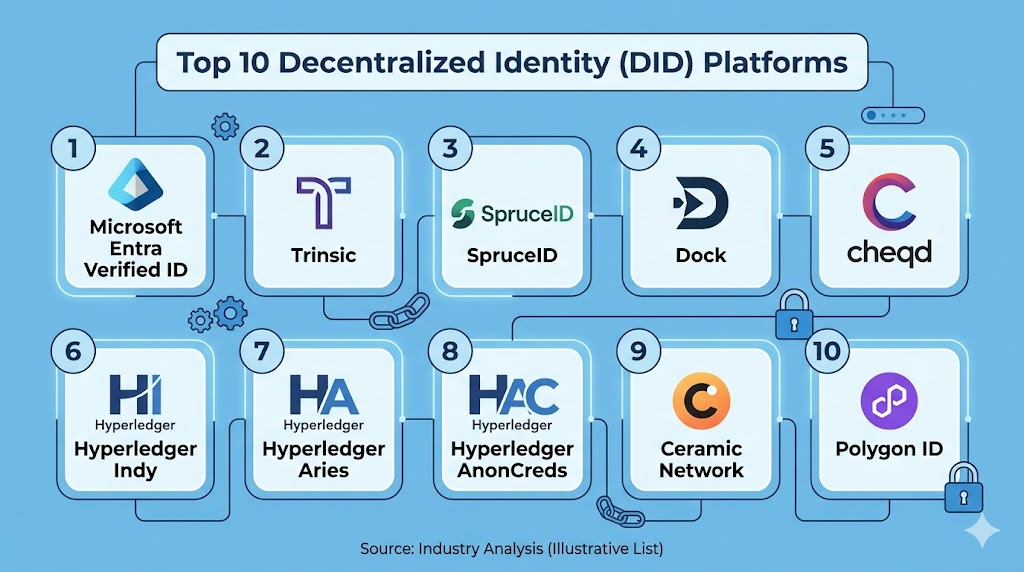
Introduction
Decentralized Identity DID platforms help people, businesses, devices, and applications prove identity or credentials without depending entirely on one centralized identity provider. In simple terms, DID platforms use decentralized identifiers, verifiable credentials, wallets, cryptographic proofs, and trust frameworks so users can share only the identity information needed for a specific interaction. Instead of repeatedly uploading documents or relying on one company to control identity data, DID allows more portable, privacy-aware, and user-controlled identity workflows.
DID platforms matter because organizations need better ways to verify users, partners, employees, students, customers, devices, AI agents, and digital credentials across ecosystems. Real-world use cases include digital identity wallets, reusable KYC, education credentials, workforce credentials, healthcare identity, supply chain identity, government IDs, age verification, access control, and passwordless login.
Buyers should evaluate standards support, verifiable credential workflows, wallet compatibility, privacy controls, governance, issuer and verifier tools, ecosystem adoption, APIs, security model, compliance readiness, scalability, and integration with existing identity systems.
Best for: governments, universities, banks, healthcare organizations, enterprise identity teams, Web3 platforms, compliance teams, HR teams, supply chain networks, and companies that need portable, privacy-preserving digital credentials. Not ideal for: teams that only need basic single sign-on, simple customer login, internal IAM, or traditional document verification where decentralized credentials do not add business value.
Key Trends in Decentralized Identity DID Platforms
- Verifiable credentials are becoming the main practical use case, especially for education, employment, KYC, healthcare, and government identity workflows.
- Digital identity wallets are becoming more user-friendly, helping individuals hold and share credentials across services.
- Privacy-preserving disclosure is gaining importance, allowing users to prove facts such as age, qualification, or membership without revealing unnecessary personal data.
- Enterprise IAM and DID are beginning to connect, especially where businesses need both centralized workforce controls and portable credentials.
- Reusable KYC is becoming a strong financial services use case, helping users prove identity across multiple regulated services without repeating every onboarding step.
- Government and public-sector identity programs are influencing adoption, especially for digital credentials, citizen services, and cross-border identity verification.
- Interoperability remains a major challenge, because DID ecosystems depend on standards, wallets, trust registries, credential schemas, and verifier compatibility.
- AI and agent identity are emerging use cases, where organizations need trusted identities for bots, software agents, APIs, and automated digital actors.
- Passwordless authentication and passkeys are shaping user expectations, even though DID platforms often solve broader credential portability and trust problems.
- Compliance and governance are becoming buying priorities, especially around data minimization, consent, revocation, auditability, retention, and identity proofing.
How We Selected These Tools
- Selected platforms and frameworks widely recognized in decentralized identity, verifiable credentials, identity wallets, and trust infrastructure.
- Balanced open-source frameworks, enterprise identity platforms, developer-focused DID tools, and digital credential platforms.
- Considered support for decentralized identifiers, verifiable credentials, issuers, holders, verifiers, wallets, and trust registries.
- Evaluated usability for real-world identity workflows such as education credentials, workforce identity, reusable KYC, government credentials, and Web3 identity.
- Considered developer experience, APIs, documentation, ecosystem maturity, and integration with existing identity systems.
- Included platforms useful for enterprises, public sector teams, startups, developers, and identity architects.
- Avoided public ratings because reliable universal ratings are not consistently available for DID platforms.
- Used “Not publicly stated” where certifications, security controls, or compliance claims are not clearly known.
- Scoring is comparative and practical, not a claim that one platform is universally best.
- Prioritized tools with strong relevance to current decentralized identity and verifiable credential adoption.
Top 10 Decentralized Identity DID Platforms
1- Microsoft Entra Verified ID
Short description:
Microsoft Entra Verified ID is a decentralized identity and verifiable credential solution designed for organizations that want to issue, manage, and verify digital credentials. It fits enterprises already using Microsoft identity infrastructure and looking to extend trust beyond traditional login. The platform is useful for workforce credentials, partner verification, education records, and reusable proof workflows. It is especially strong where DID needs to connect with enterprise identity and access management.
Key Features
- Verifiable credential issuance and verification workflows.
- Fits into broader Microsoft identity and access ecosystem.
- Supports organizational credential use cases.
- Useful for workforce, partner, education, and customer verification.
- Enables users to present digital credentials through compatible wallet workflows.
- Supports API-driven identity verification use cases.
- Designed for enterprise identity teams and business applications.
Pros
- Strong fit for Microsoft-centered enterprise environments.
- Useful bridge between traditional IAM and verifiable credentials.
- Practical for business credential issuance and verification.
Cons
- Best value is often for organizations already invested in Microsoft ecosystem.
- DID interoperability should be tested for specific wallets and workflows.
- Some advanced decentralized identity use cases may need custom integration.
Platforms / Deployment
Cloud / Web / API-based enterprise identity workflows.
Cloud.
Security & Compliance
Security controls depend on Microsoft Entra environment, tenant configuration, identity governance, access policies, MFA, audit logging, and organization setup. Buyers should validate required compliance controls directly for their environment.
Integrations & Ecosystem
Microsoft Entra Verified ID fits best where organizations already use Microsoft identity, productivity, and cloud platforms. It can connect verifiable credentials with enterprise applications and identity workflows.
- Microsoft Entra ecosystem
- Enterprise applications
- APIs and custom apps
- Workforce identity workflows
- Partner verification flows
- Credential issuer and verifier applications
Support & Community
Support is available through Microsoft documentation, enterprise support channels, and partner ecosystems. Organizations should plan identity architecture, credential schemas, governance, and rollout strategy before deployment.
2- Trinsic
Short description:
Trinsic is a decentralized identity and verifiable credential platform focused on helping developers and organizations build credential issuance, wallet, and verification workflows. It is useful for teams that want API-driven DID capabilities without building all infrastructure from scratch. Trinsic supports use cases such as identity verification, digital credentials, trust networks, and reusable credential flows. It is especially practical for startups and product teams building identity into applications.
Key Features
- APIs for verifiable credential issuance and verification.
- Supports decentralized identity application development.
- Useful for building credential wallets and trust workflows.
- Developer-friendly tooling for DID and VC use cases.
- Supports reusable digital credential experiences.
- Helps reduce infrastructure complexity for identity teams.
- Suitable for startups, platforms, and enterprises building credential products.
Pros
- Strong developer experience for DID applications.
- Useful for fast credential workflow implementation.
- Good fit for product teams building identity features.
Cons
- Advanced enterprise governance may require additional design.
- Buyers should validate standards support for their use case.
- Long-term ecosystem compatibility should be tested before scaling.
Platforms / Deployment
Cloud / API-based.
Cloud.
Security & Compliance
Not publicly stated for every compliance requirement in this context. Security depends on platform configuration, API controls, credential design, key handling, access policies, and deployment governance.
Integrations & Ecosystem
Trinsic is built for integration into identity applications and credential workflows. Developers can use APIs to issue, store, verify, and manage credentials within custom products.
- APIs and SDKs
- Credential issuer workflows
- Verifier applications
- Wallet experiences
- Identity verification workflows
- Custom product integrations
Support & Community
Trinsic provides developer resources and platform documentation. Teams should validate support levels, onboarding needs, standards compatibility, and production requirements before large-scale rollout.
3- SpruceID
Short description:
SpruceID provides decentralized identity, verifiable credential, and sign-in infrastructure for digital trust use cases. It is useful for organizations building identity wallets, credential workflows, and user-controlled data experiences. SpruceID is especially relevant for teams that want standards-based identity infrastructure and cryptographic trust flows. It can support Web3 identity, enterprise credentials, public-sector workflows, and privacy-aware user authentication.
Key Features
- Decentralized identity and verifiable credential infrastructure.
- Supports user-controlled identity and credential workflows.
- Useful for sign-in, credential issuance, and verification.
- Standards-oriented approach for digital identity applications.
- Relevant for Web3, enterprise, and public-sector identity use cases.
- Supports developer-focused integration patterns.
- Helps build trust flows using cryptographic credentials.
Pros
- Strong fit for standards-based identity projects.
- Useful for organizations building wallet and credential workflows.
- Practical for privacy-aware identity and login experiences.
Cons
- Implementation may require identity architecture expertise.
- Buyers should test interoperability with target wallets and verifiers.
- Broader business workflows may need custom development.
Platforms / Deployment
Cloud / API-based / Developer infrastructure.
Cloud / Hybrid depending on implementation.
Security & Compliance
Not publicly stated for all certifications in this context. Security depends on cryptographic key management, credential lifecycle design, API security, access controls, and deployment architecture.
Integrations & Ecosystem
SpruceID can be used in digital identity applications where credential issuance, verification, and user-controlled identity matter. It fits developer teams building modern identity experiences.
- Verifiable credential workflows
- Wallet and identity applications
- API-based integrations
- Web3 login patterns
- Enterprise identity extensions
- Trust and verification services
Support & Community
SpruceID has documentation and developer-oriented resources. Teams should validate onboarding, standards compatibility, wallet support, and support expectations before production deployment.
4- Dock
Short description:
Dock is a decentralized identity and verifiable credential platform designed to help organizations issue, manage, and verify digital credentials. It is useful for education, employment, compliance, training, membership, and professional certification use cases. Dock supports credential workflows that let recipients prove trusted information without relying on paper documents or repeated manual verification. It is especially relevant for organizations that need portable, tamper-resistant credential records.
Key Features
- Verifiable credential issuance and verification.
- Supports decentralized identity workflows.
- Useful for education, HR, training, and professional credentials.
- Credential management tools for issuers and verifiers.
- Helps reduce document fraud and repeated verification.
- Supports digital credential portability.
- Practical for trust networks and credential ecosystems.
Pros
- Strong fit for credential issuance use cases.
- Useful for education, workforce, and certification workflows.
- Helps organizations move from static documents to verifiable credentials.
Cons
- Best fit is credential-focused rather than broad IAM replacement.
- Buyers should validate wallet and verifier compatibility.
- Governance and trust framework design remain important.
Platforms / Deployment
Web / Cloud / API-based.
Cloud.
Security & Compliance
Not publicly stated for all enterprise compliance requirements. Security depends on credential issuance controls, key management, access policies, revocation design, and verifier workflows.
Integrations & Ecosystem
Dock can connect credential issuance and verification into business workflows. It is useful for organizations issuing digital certificates, employment credentials, training records, and membership proofs.
- Credential issuer portals
- Verification workflows
- APIs and SDKs
- Education systems
- HR and training systems
- Digital wallet workflows
Support & Community
Dock provides documentation and platform resources for credential workflows. Teams should plan issuer onboarding, credential schema design, verification policies, and support processes before launch.
5- cheqd
Short description:
cheqd is a decentralized identity network and infrastructure platform focused on verifiable credentials, trusted data, and payment-enabled credential ecosystems. It is useful for organizations building credential networks where issuers, holders, and verifiers need interoperable trust. cheqd is especially relevant for projects that want decentralized identity infrastructure with economic and governance models around credential exchange. It fits teams exploring reusable credentials, trust registries, and commercial identity ecosystems.
Key Features
- Decentralized identity network infrastructure.
- Supports verifiable credential ecosystems.
- Useful for trusted data and credential exchange workflows.
- Designed for issuer, holder, and verifier interactions.
- Supports trust registry and identity network concepts.
- Relevant for reusable KYC and digital trust use cases.
- Can support commercial models around credential verification.
Pros
- Strong fit for decentralized credential ecosystems.
- Useful for reusable identity and trusted data networks.
- Practical for projects needing network-level identity infrastructure.
Cons
- May require deeper understanding of DID network architecture.
- Not a simple plug-and-play login tool.
- Buyers should validate ecosystem adoption and partner compatibility.
Platforms / Deployment
Cloud / API-based / Network infrastructure.
Cloud / Hybrid depending on implementation.
Security & Compliance
Not publicly stated for all compliance requirements. Security depends on network usage, key management, credential schemas, governance model, access controls, and verifier policies.
Integrations & Ecosystem
cheqd is designed for integration into decentralized identity ecosystems where trusted credentials and verification flows need network infrastructure. It can support identity applications, credential platforms, and trust networks.
- Verifiable credential platforms
- Identity wallets
- Trust registries
- Reusable KYC workflows
- API-based verification services
- Credential payment and exchange models
Support & Community
cheqd has documentation and ecosystem resources for decentralized identity builders. Teams should validate technical integration, governance model, wallet compatibility, and support expectations before production use.
6- Hyperledger Indy
Short description:
Hyperledger Indy is an open-source distributed ledger project created specifically for decentralized identity. It provides tools and infrastructure for DIDs, verifiable credentials, and self-sovereign identity networks. Indy is especially useful for organizations and ecosystems that want to build identity networks with strong privacy and credential exchange patterns. It is more of a foundational framework than a simple out-of-the-box business application.
Key Features
- Open-source decentralized identity ledger framework.
- Built specifically for DIDs and verifiable credentials.
- Supports self-sovereign identity network patterns.
- Useful for trust frameworks and credential ecosystems.
- Strong privacy and identity focus.
- Suitable for public-sector, consortium, and research identity networks.
- Provides foundational infrastructure for DID-based systems.
Pros
- Strong identity-specific architecture.
- Useful for building decentralized identity networks.
- Open-source and standards-aligned community relevance.
Cons
- Requires technical expertise to deploy and maintain.
- Not a simple SaaS product for non-technical teams.
- Production governance and ecosystem management can be complex.
Platforms / Deployment
Linux-focused environments.
Self-hosted / Consortium / Network deployment.
Security & Compliance
Not publicly stated as a packaged compliance product. Security depends on network governance, node operations, key management, credential design, identity proofing, access controls, and operational practices.
Integrations & Ecosystem
Hyperledger Indy is often used as foundational infrastructure for decentralized identity ecosystems. It can be combined with agents, wallets, credential issuers, and verifier applications.
- DID networks
- Verifiable credential systems
- Identity agents
- Wallet applications
- Public-sector identity ecosystems
- Consortium identity networks
Support & Community
Support is open-source and community-driven through Hyperledger ecosystem participation. Organizations should plan technical staffing, governance, node operations, and long-term maintenance carefully.
7- Hyperledger Aries
Short description:
Hyperledger Aries provides open-source tools and protocols for decentralized identity agents, wallets, and verifiable credential exchange. It is commonly used with DID ecosystems where issuers, holders, and verifiers need to communicate securely. Aries is especially useful for developers building identity agents, credential exchange workflows, and self-sovereign identity applications. It complements ledger infrastructure and is best suited for technical teams building DID systems.
Key Features
- Open-source framework for DID agents and credential exchange.
- Supports verifiable credential communication workflows.
- Useful for issuer, holder, and verifier interactions.
- Works with decentralized identity ecosystems.
- Enables secure agent-to-agent messaging patterns.
- Supports wallet and identity application development.
- Relevant for self-sovereign identity architectures.
Pros
- Strong fit for building decentralized identity agents.
- Useful for credential exchange and wallet workflows.
- Open-source and aligned with DID ecosystem development.
Cons
- Requires technical expertise and architecture planning.
- Not a standalone business-user credential platform.
- Ecosystem compatibility must be tested carefully.
Platforms / Deployment
Linux / macOS / Windows depending on implementation and language stack.
Self-hosted / Hybrid / Developer framework.
Security & Compliance
Not publicly stated as a packaged enterprise compliance tool. Security depends on agent implementation, key management, message security, credential lifecycle, and deployment controls.
Integrations & Ecosystem
Hyperledger Aries integrates into decentralized identity systems that need agent communication and credential exchange. It is often used with ledgers, wallets, issuers, and verifiers.
- DID agents
- Wallet applications
- Credential exchange workflows
- Hyperledger Indy-related ecosystems
- Issuer and verifier tools
- Trust framework implementations
Support & Community
Aries has open-source community support and technical documentation. It is suitable for developers and identity architects who understand DID protocols and verifiable credential workflows.
8- Hyperledger AnonCreds
Short description:
Hyperledger AnonCreds is focused on privacy-preserving verifiable credentials, especially where selective disclosure and zero-knowledge-style credential proofs are important. It is useful for organizations that need users to prove specific facts without revealing full personal data. AnonCreds is especially relevant for age verification, eligibility checks, membership proof, education credentials, and privacy-sensitive identity workflows. It is best used as part of a broader DID and credential ecosystem.
Key Features
- Privacy-preserving verifiable credential technology.
- Supports selective disclosure workflows.
- Useful for proving attributes without exposing full identity data.
- Relevant for zero-knowledge-style credential proof use cases.
- Supports issuer, holder, and verifier credential flows.
- Strong fit for privacy-sensitive identity ecosystems.
- Can complement DID wallets and agent frameworks.
Pros
- Strong privacy orientation for credential verification.
- Useful where data minimization is important.
- Good fit for regulated or sensitive identity workflows.
Cons
- Not a full identity platform by itself.
- Requires integration with wallets, agents, and verifier systems.
- Technical complexity may be high for non-specialist teams.
Platforms / Deployment
Developer framework / Identity ecosystem component.
Self-hosted / Hybrid depending on implementation.
Security & Compliance
Not publicly stated as a packaged compliance product. Security depends on credential design, key handling, issuer governance, verifier policies, revocation, and deployment controls.
Integrations & Ecosystem
AnonCreds is best used within decentralized identity systems where privacy-preserving credential proofs are needed. It complements wallets, agents, trust registries, and verification applications.
- DID wallets
- Credential issuers
- Verifier workflows
- Agent frameworks
- Privacy-preserving proof systems
- Trust ecosystem infrastructure
Support & Community
AnonCreds has open-source and technical community relevance in decentralized identity. Teams should plan for specialist knowledge, standards alignment, and interoperability testing.
9- Ceramic Network
Short description:
Ceramic Network is a decentralized data network often used for identity-linked data, user-controlled profiles, reputation, and application data portability. While it is broader than DID alone, it is relevant for decentralized identity projects that need user-owned data and interoperable identity-linked records. Ceramic can support Web3 profiles, decentralized social applications, credentials-adjacent workflows, and data composability. It is best suited for developers building decentralized applications where identity and portable data are connected.
Key Features
- Decentralized data network for user-controlled information.
- Useful for identity-linked profiles and application data.
- Supports data portability across decentralized applications.
- Relevant for Web3 identity and reputation use cases.
- Helps developers build user-owned data experiences.
- Can support profile, social, and metadata workflows.
- Useful for decentralized application ecosystems.
Pros
- Strong fit for decentralized user data and identity-linked applications.
- Useful for Web3 profiles and reputation systems.
- Helps reduce application data lock-in.
Cons
- Not a dedicated enterprise verifiable credential platform.
- DID and credential workflows may require additional tools.
- Best fit is developer-led decentralized application architecture.
Platforms / Deployment
Developer infrastructure / Network-based.
Cloud / Self-hosted / Hybrid depending on implementation.
Security & Compliance
Not publicly stated as a universal enterprise compliance platform. Security depends on data model, authentication, key management, application permissions, and infrastructure choices.
Integrations & Ecosystem
Ceramic integrates into decentralized application workflows that need portable user data and identity-linked records. It is useful for Web3 applications, profiles, reputation systems, and composable data.
- Web3 applications
- Decentralized profile systems
- Reputation workflows
- Data portability tools
- Developer APIs
- Identity-linked application data
Support & Community
Ceramic has a developer and Web3-oriented ecosystem. Teams should validate current tooling, performance, governance, and fit for production identity use cases before adoption.
10- Polygon ID
Short description:
Polygon ID is a decentralized identity solution focused on privacy-preserving identity verification using verifiable credentials and zero-knowledge proof concepts. It is useful for Web3 applications, age or eligibility verification, Sybil resistance, compliance-friendly access, and privacy-aware identity checks. Polygon ID is especially relevant for teams building blockchain and Web3 applications that need identity proofs without exposing unnecessary personal data. It is a strong fit for privacy-preserving verification in decentralized ecosystems.
Key Features
- Decentralized identity solution for verifiable credentials.
- Supports privacy-preserving proofs and identity verification.
- Useful for Web3 access, eligibility, and compliance workflows.
- Helps users prove claims without revealing full personal data.
- Relevant for blockchain applications and decentralized communities.
- Supports issuer, holder, and verifier flows.
- Strong fit for privacy-aware identity in Web3 ecosystems.
Pros
- Good fit for Web3 identity and privacy-preserving access.
- Useful for proof-based verification without overexposing user data.
- Relevant for blockchain applications needing identity layers.
Cons
- Best suited for decentralized application ecosystems.
- Enterprises should validate interoperability with non-Web3 identity systems.
- Implementation may require DID, wallet, and proof-system expertise.
Platforms / Deployment
Web / API-based / Developer infrastructure.
Cloud / Self-hosted / Hybrid depending on implementation.
Security & Compliance
Not publicly stated as a universal compliance solution. Security depends on credential issuers, proof verification, key management, wallet safety, application policies, and governance model.
Integrations & Ecosystem
Polygon ID fits Web3 applications that need decentralized identity and verifiable credential workflows. It can support proof-based access, reputation, and compliance-friendly identity flows.
- Web3 applications
- Verifiable credential workflows
- Wallet-based identity
- Zero-knowledge proof verification
- Decentralized communities
- Access control and eligibility systems
Support & Community
Polygon ID benefits from the broader Polygon and Web3 developer ecosystem. Teams should validate documentation, wallet compatibility, proof flows, and production support before using it for critical identity systems.
Comparison Table
| Tool Name | Best For | Platforms Supported | Deployment | Standout Feature | Public Rating |
|---|---|---|---|---|---|
| Microsoft Entra Verified ID | Enterprise verifiable credentials | Web / Cloud / APIs | Cloud | Enterprise DID with Microsoft identity ecosystem | N/A |
| Trinsic | Developer-friendly credential workflows | Web / APIs | Cloud | APIs for issuing and verifying credentials | N/A |
| SpruceID | Standards-based decentralized identity | Web / APIs / Developer infrastructure | Cloud / Hybrid | User-controlled identity and credential workflows | N/A |
| Dock | Digital credentials for organizations | Web / APIs | Cloud | Credential issuance and verification | N/A |
| cheqd | Credential networks and trusted data ecosystems | Web / APIs / Network infrastructure | Cloud / Hybrid | Decentralized credential network infrastructure | N/A |
| Hyperledger Indy | DID ledger infrastructure | Linux-focused | Self-hosted / Consortium | Identity-specific decentralized ledger | N/A |
| Hyperledger Aries | DID agents and credential exchange | Linux, macOS, Windows depending on stack | Self-hosted / Hybrid | Agent-to-agent credential exchange | N/A |
| Hyperledger AnonCreds | Privacy-preserving credentials | Developer framework | Self-hosted / Hybrid | Selective disclosure credential proofs | N/A |
| Ceramic Network | Decentralized identity-linked data | Developer infrastructure | Cloud / Self-hosted / Hybrid | User-owned data and portable profiles | N/A |
| Polygon ID | Web3 identity and proof-based verification | Web / APIs / Developer infrastructure | Cloud / Self-hosted / Hybrid | Privacy-preserving identity proofs | N/A |
Evaluation & Scoring of Decentralized Identity DID Platforms
| Tool Name | Core 25% | Ease 15% | Integrations 15% | Security 10% | Performance 10% | Support 10% | Value 15% | Weighted Total |
|---|---|---|---|---|---|---|---|---|
| Microsoft Entra Verified ID | 9 | 8 | 9 | 9 | 8 | 9 | 8 | 8.60 |
| Trinsic | 8 | 8 | 8 | 8 | 8 | 8 | 8 | 8.00 |
| SpruceID | 8 | 7 | 8 | 8 | 8 | 7 | 8 | 7.75 |
| Dock | 8 | 8 | 7 | 8 | 8 | 7 | 8 | 7.75 |
| cheqd | 8 | 7 | 8 | 8 | 8 | 7 | 8 | 7.75 |
| Hyperledger Indy | 8 | 5 | 7 | 8 | 7 | 7 | 8 | 7.20 |
| Hyperledger Aries | 8 | 6 | 8 | 8 | 7 | 7 | 8 | 7.45 |
| Hyperledger AnonCreds | 8 | 5 | 7 | 9 | 7 | 7 | 8 | 7.30 |
| Ceramic Network | 7 | 7 | 8 | 7 | 7 | 7 | 8 | 7.25 |
| Polygon ID | 8 | 7 | 8 | 8 | 8 | 7 | 8 | 7.75 |
These scores are comparative and should be used as a practical evaluation guide, not fixed public ratings. A higher score means stronger overall fit across DID capabilities, ease of adoption, integration depth, security expectations, performance, support, and value. A lower score may still be excellent for specialized use cases such as open-source identity networks, agent frameworks, or privacy-preserving credential proofs. Teams should validate interoperability, wallet support, credential schemas, governance needs, and production readiness before making a final selection.
Which Decentralized Identity DID Platform Is Right for You?
Solo / Freelancer
Solo developers and independent consultants should start with tools that are easier to test through APIs, SDKs, and sample credential flows. Trinsic, SpruceID, Dock, Polygon ID, and Ceramic Network are practical options depending on whether the focus is credentials, Web3 identity, or user-owned data. If the goal is to understand DID architecture deeply, Hyperledger Indy, Aries, and AnonCreds are valuable learning paths. Solo users should avoid overbuilding complex trust frameworks before validating the actual credential use case.
SMB
Small and mid-sized businesses should focus on practical credential workflows rather than complex decentralized identity theory. Dock, Trinsic, SpruceID, and Microsoft Entra Verified ID can be useful depending on existing systems and business goals. A training provider may need credential issuance, while a fintech startup may need reusable identity verification. SMBs should prioritize ease of setup, APIs, wallet compatibility, and verifier experience. They should also define who issues credentials, who trusts them, and how revoked or expired credentials are handled.
Mid-Market
Mid-market organizations often need stronger governance, identity integration, and repeatable workflows. Microsoft Entra Verified ID is a strong option for organizations already using Microsoft identity systems. Trinsic, SpruceID, Dock, and cheqd are useful for building credential ecosystems or customer-facing digital identity products. Polygon ID may fit Web3 products needing proof-based access. Mid-market teams should define credential schemas, trust rules, user support, revocation policies, audit needs, and integration with existing IAM or CRM systems.
Enterprise
Enterprises should evaluate DID platforms based on governance, compliance, integration, auditability, trust frameworks, credential lifecycle management, and user adoption. Microsoft Entra Verified ID is strong for enterprise identity alignment, while Hyperledger Indy, Aries, and AnonCreds can support more customized open-source identity networks. cheqd, SpruceID, Trinsic, and Dock may fit credential ecosystems and partner verification. Enterprises should involve security, legal, compliance, architecture, and business process teams early because decentralized identity affects data sharing, privacy, trust, and operational support.
Budget vs Premium
Open-source DID frameworks can reduce license costs but increase implementation complexity. SaaS and API-based platforms may cost more directly but reduce development time and infrastructure burden. Budget-conscious teams should start with a narrow pilot and test one credential issuance and verification workflow. Premium investment may be justified when identity workflows are business-critical, regulated, or used across many partners. The biggest cost is often not software, but governance, integration, support, compliance review, and user education.
Feature Depth vs Ease of Use
Hyperledger Indy, Aries, and AnonCreds provide strong technical depth but require more expertise. Microsoft Entra Verified ID offers enterprise usability for Microsoft-centered environments. Trinsic, Dock, SpruceID, and cheqd provide practical credential infrastructure for product and ecosystem builders. Polygon ID is strong for privacy-preserving Web3 verification. Ceramic Network is better for decentralized user data and identity-linked application records. Teams should choose based on whether they need credential issuance, wallet infrastructure, proof verification, user-owned data, or enterprise IAM integration.
Integrations & Scalability
DID platforms must integrate with wallets, identity providers, mobile apps, APIs, issuer systems, verifier portals, trust registries, CRM, HR systems, learning platforms, compliance tools, and blockchain networks where relevant. Enterprise teams should test integration with existing IAM and access governance systems. Web3 teams should test wallet and dApp compatibility. Education and workforce teams should test credential schemas and verifier adoption. Scalability depends not only on technology but also on trust ecosystem growth and user onboarding.
Security & Compliance Needs
DID can improve privacy and portability, but it does not remove compliance obligations. Teams must manage identity proofing, credential issuance rules, consent, revocation, auditability, key management, data minimization, retention, and verifier trust. Security also depends on wallet safety, issuer key protection, verifier policies, and governance. Regulated industries should document how credentials are issued, what data is stored, how proofs are verified, and how users can recover access. DID should be part of a broader identity and privacy architecture.
Frequently Asked Questions
1- What is a Decentralized Identity DID platform?
A Decentralized Identity DID platform helps organizations create, issue, verify, and manage digital identity credentials using decentralized identifiers and verifiable credentials. Instead of relying only on one centralized database, DID allows identity information to be more portable, privacy-aware, and cryptographically verifiable. Users can hold credentials in wallets and present proofs when needed. Organizations can act as issuers, verifiers, or trust ecosystem participants. DID platforms are useful for education, workforce, KYC, healthcare, Web3, and government identity workflows. They do not remove the need for governance, but they can improve trust and reduce repeated data collection.
2- How is DID different from traditional identity management?
Traditional identity management usually depends on centralized accounts, passwords, directories, or identity providers. DID focuses on portable identifiers, verifiable credentials, wallets, and cryptographic proof. In traditional IAM, the organization often controls the user’s identity record. In DID, the user may hold credentials and selectively share proofs with verifiers. This can reduce repeated document uploads and unnecessary data exposure. However, DID does not fully replace enterprise IAM in most cases. Many organizations will combine DID with SSO, MFA, access governance, and existing identity systems.
3- How much do DID platforms cost?
Costs vary depending on whether the organization uses open-source frameworks, SaaS platforms, API-based services, or custom identity networks. Open-source tools may reduce license fees but require more engineering, hosting, governance, and security work. SaaS platforms may have subscription, API, issuer, verifier, or credential volume-based pricing. Enterprises may also pay for consulting, integration, compliance review, and support. The total cost includes wallet support, user onboarding, schema design, trust framework creation, and operations. Teams should estimate both technical and governance costs before scaling.
4- How long does DID implementation take?
A simple credential proof of concept can be built relatively quickly if the use case is narrow and the team uses API-based tools. Production deployment usually takes longer because teams must design credential schemas, issuer policies, verifier rules, user support, revocation workflows, and integrations. Multi-party ecosystems take more time because each participant must agree on trust rules. Enterprise deployments may also require legal, privacy, compliance, and security reviews. The best approach is to start with one credential and one verification workflow. After proving value, teams can expand to more credentials and partners.
5- What are common mistakes when adopting DID?
A common mistake is focusing on technology before defining the trust problem. Teams may build wallets or credentials without knowing who will issue, trust, verify, or revoke them. Another mistake is collecting too much data when DID is meant to support data minimization. Some projects fail because the user experience is too complicated or wallet support is unclear. Others ignore governance, recovery, consent, or compliance requirements. DID adoption works best when the credential has a clear business purpose, trusted issuer, simple verification flow, and strong user education.
6- Are DID platforms secure?
DID platforms can provide strong cryptographic verification, but security depends on implementation. Issuer keys must be protected, wallets must be safe, verifiers must validate credentials correctly, and revocation must be handled properly. Users can still be phished or lose access if recovery is poorly designed. Enterprise systems also need audit logs, access controls, monitoring, and incident response. Privacy-preserving credential systems can reduce data exposure, but they must be configured carefully. Security should be reviewed across the full lifecycle: issuance, storage, presentation, verification, revocation, and recovery.
7- Can DID platforms scale for enterprise use?
Yes, DID platforms can scale, but scalability includes more than technical throughput. Enterprises must scale credential governance, user onboarding, wallet support, verifier training, schema management, support operations, and compliance review. API-based platforms may simplify technical scaling, while open-source frameworks may require more infrastructure planning. Large organizations should test integrations with IAM, HR, CRM, compliance, and customer systems. They should also test user experience at scale. A DID project succeeds when the trust ecosystem scales, not just when the software can process credentials.
8- What integrations should buyers evaluate?
Buyers should evaluate integration with identity providers, HR systems, CRM, learning management systems, KYC systems, mobile apps, wallets, APIs, verifier portals, and access control systems. Enterprises may need Microsoft Entra, SSO, MFA, audit logs, and governance workflows. Education teams may need student information systems and credential registries. Web3 teams may need wallets, dApps, smart contracts, and proof verification. Integration requirements should be mapped before choosing a platform. The best DID platform is the one that fits existing business workflows and trust relationships.
9- What are alternatives to DID platforms?
Alternatives include traditional IAM, SSO, customer identity platforms, document verification tools, passwordless authentication, PKI, digital signatures, data clean rooms, and centralized credential databases. These alternatives may be better when portability, user-controlled credentials, or decentralized trust are not needed. For internal workforce access, standard IAM may be enough. For one-time onboarding, document verification may be simpler. DID is strongest when credentials need to be reused, verified by multiple parties, privacy-preserving, and portable across ecosystems. The right alternative depends on the trust problem and user journey.
10- Which industries benefit most from DID?
Education, government, healthcare, financial services, workforce management, supply chain, Web3, travel, and professional certification are strong candidates. Universities can issue digital diplomas, employers can verify skills, banks can support reusable identity checks, and healthcare organizations can improve trusted access workflows. Governments can explore citizen credentials and digital permits. Supply chain networks can verify organizations, products, or compliance records. Web3 platforms can use DID for reputation, access, and Sybil resistance. The best industry fit is where trusted credentials must move across organizations without repeated manual verification.
Conclusion
Decentralized Identity DID platforms are becoming important for organizations that need trusted, portable, privacy-aware, and reusable digital credentials. Microsoft Entra Verified ID is strong for enterprise identity teams already using Microsoft infrastructure, while Trinsic, SpruceID, Dock, and cheqd are practical for organizations building credential issuance, verification, and trust ecosystems. Hyperledger Indy, Aries, and AnonCreds provide open-source building blocks for deeper decentralized identity networks and privacy-preserving credential exchange. Ceramic Network is useful for decentralized user-owned data and identity-linked records, while Polygon ID is especially relevant for Web3 applications needing privacy-preserving identity proofs. The best DID platform depends on your use case, trust model, wallet strategy, integration needs, privacy requirements, and governance maturity. A practical next step is to shortlist two or three platforms, define one high-value credential workflow, run a pilot with real issuers and verifiers, validate wallet and integration support, review security and compliance requirements, and then scale only after the trust framework and user experience are proven.
