MOTOSHARE 🚗🏍️
Rent Bikes & Cars Directly from Owners
Motoshare connects vehicle owners with people who need bikes and cars on rent. Owners earn from idle vehicles, and renters get flexible ride options.
Visit Motoshare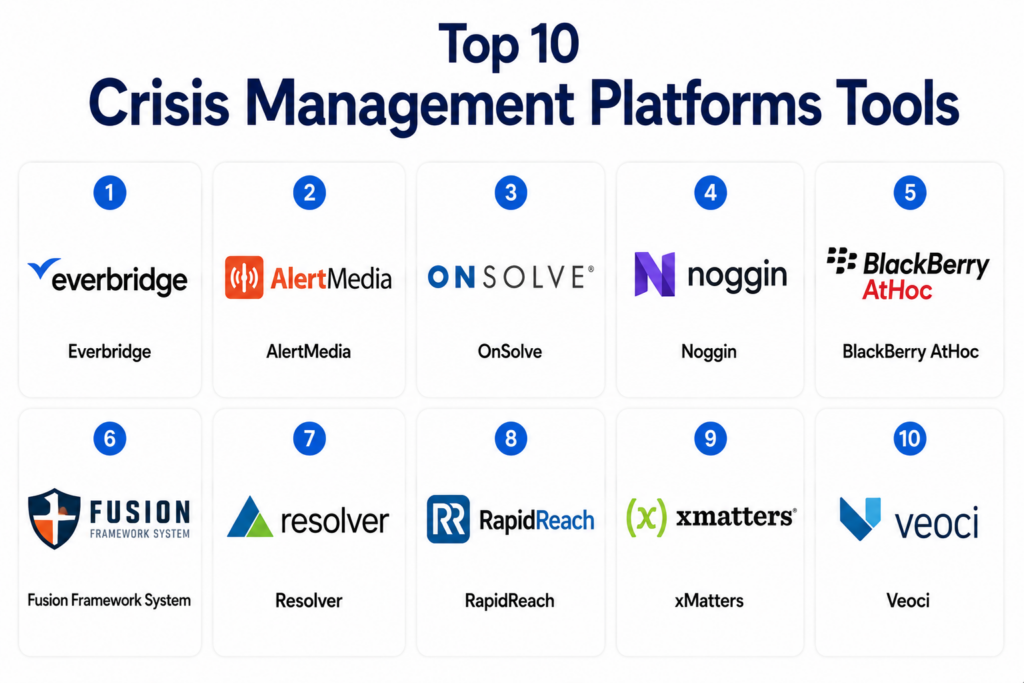
Introduction
Crisis Management Platforms help organizations prepare for, respond to, and recover from operational disruptions, cyber incidents, public relations emergencies, natural disasters, workplace safety events, and business continuity failures. These platforms combine communication, incident coordination, emergency notification, workflow automation, risk visibility, and executive reporting into a centralized operational command system.
Modern organizations face increasingly complex risks, including ransomware attacks, supply chain disruptions, severe weather events, geopolitical instability, compliance failures, and reputational crises. As businesses become more distributed and digitally connected, manual crisis response processes are often too slow and fragmented to support rapid decision-making. Crisis Management Platforms now play a critical role in resilience strategies across enterprises, governments, healthcare organizations, manufacturing companies, logistics providers, educational institutions, and critical infrastructure operators.
Real-world use cases include:
- Cybersecurity incident response coordination
- Emergency employee communication during disasters
- Business continuity planning and recovery workflows
- Crisis command center management
- Executive escalation and stakeholder communication
Key evaluation criteria for buyers include:
- Incident response workflow automation
- Emergency notification capabilities
- Mobile accessibility and offline support
- Business continuity planning tools
- Integration ecosystem and APIs
- Security controls and audit logging
- Scalability across global teams
- Ease of onboarding and usability
- Reporting and compliance capabilities
- Reliability during high-volume incidents
Best for: Enterprises, government agencies, healthcare systems, logistics providers, financial institutions, educational organizations, and distributed businesses requiring structured incident coordination and resilience management.
Not ideal for: Very small businesses with simple communication needs, teams that only require lightweight messaging apps, or organizations that already rely on integrated ITSM platforms with limited crisis response requirements.
Key Trends in Crisis Management Platforms
- AI-assisted incident prioritization is becoming common for identifying high-risk operational disruptions faster.
- Platforms increasingly combine business continuity, emergency notification, and operational resilience into unified systems.
- Mobile-first crisis response experiences are now expected for remote and field-based teams.
- Real-time collaboration dashboards and virtual war rooms are replacing manual spreadsheet coordination.
- Integration with cybersecurity platforms, SIEM systems, and ITSM tools is becoming a major buying factor.
- Regulatory pressure around operational resilience and disaster recovery is increasing in finance, healthcare, and infrastructure sectors.
- Automation workflows are reducing manual escalation and stakeholder communication delays.
- Hybrid deployment support remains important for regulated industries with strict data residency requirements.
- Geolocation and employee safety tracking features are expanding for workforce protection scenarios.
- Analytics and post-incident reporting capabilities are improving executive visibility and audit readiness.
How We Selected These Tools
The platforms included in this list were evaluated using practical enterprise buying criteria and operational resilience requirements.
- Strong market adoption across enterprise and mid-market organizations
- Breadth of crisis response and business continuity capabilities
- Reliability during high-volume emergency communication events
- Mobile readiness and remote workforce support
- Integration ecosystem maturity and API availability
- Security posture and enterprise identity management support
- Scalability for global operations and distributed teams
- Administrative usability and workflow customization
- Vendor reputation in operational resilience and emergency management
- Support quality, onboarding resources, and implementation flexibility
Top 10 Crisis Management Platforms Tools
#1 — Everbridge
Short description :
(4-5 lines): Everbridge is one of the most recognized enterprise crisis management and critical event management platforms. It helps organizations coordinate emergency communication, operational resilience, incident response, and workforce safety initiatives. The platform is widely used by governments, healthcare organizations, airports, financial institutions, and global enterprises. Its broad feature set makes it particularly suitable for large-scale operational environments.
Key Features
- Mass emergency notification system
- Incident management workflows
- Crisis collaboration dashboards
- Threat intelligence integration
- Employee safety and location awareness
- Business continuity planning tools
- Multi-channel communication delivery
Pros
- Strong enterprise-grade scalability
- Extensive emergency communication capabilities
- Mature operational resilience functionality
Cons
- Higher implementation complexity
- Premium pricing for advanced modules
- Smaller organizations may find it overwhelming
Platforms / Deployment
- Web / iOS / Android
- Cloud / Hybrid
Security & Compliance
- SSO/SAML
- MFA
- RBAC
- Audit logs
- Encryption
- GDPR support
- ISO 27001 reportedly supported
Integrations & Ecosystem
Everbridge integrates with enterprise IT, security, HR, and communication systems to support centralized incident coordination.
- Microsoft Teams
- ServiceNow
- Slack
- SIEM platforms
- HR systems
- Public safety systems
Support & Community
Everbridge provides enterprise onboarding, training programs, implementation consulting, and premium support tiers. Documentation quality is generally strong for enterprise deployments.
#2 — AlertMedia
Short description :
(4-5 lines): AlertMedia focuses on emergency communication, employee safety, and crisis coordination for modern organizations. The platform is known for usability, fast deployment, and strong mobile communication capabilities. It is commonly adopted by mid-sized businesses and enterprises seeking streamlined emergency notification systems. The platform also emphasizes threat intelligence and workforce visibility.
Key Features
- Emergency mass notification
- Threat monitoring and alerts
- Employee check-in workflows
- Crisis communication templates
- Mobile safety alerts
- Incident escalation automation
- Real-time reporting dashboards
Pros
- Easy-to-use interface
- Strong mobile experience
- Fast onboarding process
Cons
- Less advanced continuity planning than some enterprise competitors
- Advanced integrations may require additional configuration
- Premium features can increase costs
Platforms / Deployment
- Web / iOS / Android
- Cloud
Security & Compliance
- SSO/SAML
- MFA
- Encryption
- Audit logging
- GDPR support reportedly available
Integrations & Ecosystem
AlertMedia integrates with collaboration, HR, and operational systems to streamline emergency communication workflows.
- Microsoft Teams
- Slack
- HRIS platforms
- Active Directory
- API integrations
- Mapping tools
Support & Community
The vendor is generally recognized for responsive onboarding and customer success services. Documentation and implementation support are strong for mid-market customers.
#3 — OnSolve
Short description :
(4-5 lines): OnSolve provides critical event management and emergency notification solutions for enterprises, government organizations, and public sector agencies. Its platform combines risk intelligence, crisis communication, and operational incident management. The solution is commonly used in industries with high operational risk exposure. It supports large-scale communication and resilience coordination initiatives.
Key Features
- Emergency alert distribution
- Threat intelligence feeds
- Incident response orchestration
- Crisis collaboration tools
- Business continuity workflows
- Stakeholder communication management
- Public warning capabilities
Pros
- Strong public-sector adoption
- Broad critical event management coverage
- Reliable large-scale notifications
Cons
- User interface can feel complex
- Advanced modules may require training
- Some workflows require customization effort
Platforms / Deployment
- Web / iOS / Android
- Cloud / Hybrid
Security & Compliance
- SSO/SAML
- MFA
- Encryption
- RBAC
- Audit logs
Integrations & Ecosystem
OnSolve supports integrations with security, operations, and workforce management platforms.
- ServiceNow
- Microsoft Teams
- HR systems
- SIEM tools
- APIs
- GIS systems
Support & Community
Enterprise implementation assistance and training services are available. Public-sector support experience is considered a strong area.
#4 — Noggin
Short description :
(4-5 lines): Noggin specializes in operational resilience, incident management, and business continuity management. The platform provides configurable workflows that support emergency operations, crisis coordination, and recovery management. It is widely used in critical infrastructure, transportation, utilities, and government sectors. The platform emphasizes operational flexibility and situational awareness.
Key Features
- Crisis management workflows
- Business continuity management
- Operational resilience dashboards
- Incident lifecycle tracking
- Task coordination tools
- Compliance reporting
- Mobile response management
Pros
- Highly configurable workflows
- Strong operational resilience functionality
- Good support for regulated industries
Cons
- Initial setup may take time
- Some features require process customization
- Smaller teams may not use full platform depth
Platforms / Deployment
- Web / iOS / Android
- Cloud / Hybrid
Security & Compliance
- SSO/SAML
- MFA
- Encryption
- Audit trails
- Role-based permissions
Integrations & Ecosystem
Noggin integrates with operational systems and enterprise infrastructure platforms for centralized coordination.
- GIS platforms
- ServiceNow
- APIs
- HR systems
- Security tools
- Communication systems
Support & Community
The platform offers implementation consulting and enterprise onboarding support. Documentation is structured for operational resilience teams.
#5 — BlackBerry AtHoc
Short description :
(4-5 lines): BlackBerry AtHoc is an emergency communication and critical event management platform widely used in government, defense, and regulated industries. It focuses heavily on secure communication and operational coordination during emergencies. The platform is known for reliability in mission-critical environments. Organizations with high security requirements often consider it a strong candidate.
Key Features
- Secure emergency notification
- Crisis collaboration tools
- Personnel accountability tracking
- Location-based alerting
- Incident coordination workflows
- Multi-channel communication
- Operational command visibility
Pros
- Strong security reputation
- Suitable for government and defense environments
- Reliable high-volume communication
Cons
- Interface may feel dated
- Enterprise deployment complexity
- Higher cost for advanced deployments
Platforms / Deployment
- Web / iOS / Android
- Cloud / Hybrid
Security & Compliance
- SSO/SAML
- MFA
- Encryption
- Audit logging
- Role-based access control
Integrations & Ecosystem
BlackBerry AtHoc supports integrations with security, communication, and operational systems.
- Microsoft Teams
- GIS tools
- APIs
- HR systems
- Communication gateways
- Security infrastructure
Support & Community
Support is enterprise-focused with implementation assistance and training programs. Strong experience in regulated environments.
#6 — Fusion Framework System
Short description :
(4-5 lines): Fusion Framework System focuses on business continuity, risk management, and operational resilience. The platform helps enterprises centralize crisis planning, recovery workflows, and resilience governance. It is commonly used in financial services, healthcare, and enterprise risk management teams. Fusion emphasizes structured resilience programs rather than only emergency communication.
Key Features
- Business continuity management
- Risk assessment workflows
- Crisis coordination tools
- Recovery planning automation
- Operational resilience analytics
- Dependency mapping
- Executive reporting dashboards
Pros
- Strong resilience planning capabilities
- Enterprise governance support
- Advanced reporting features
Cons
- More continuity-focused than communication-focused
- Can require dedicated administrators
- Smaller organizations may find it excessive
Platforms / Deployment
- Web
- Cloud
Security & Compliance
- SSO/SAML
- RBAC
- Audit logs
- Encryption
Integrations & Ecosystem
Fusion integrates with enterprise governance and operational platforms for resilience coordination.
- ServiceNow
- APIs
- Risk management tools
- HR systems
- Business intelligence tools
Support & Community
Enterprise onboarding and advisory services are a major part of the vendor’s offering. Documentation is designed for resilience professionals.
#7 — Resolver
Short description :
(4-5 lines): Resolver provides incident management, risk intelligence, and crisis response capabilities for enterprises and public sector organizations. The platform supports operational investigations, crisis escalation, and resilience planning. It is commonly used in corporate security, healthcare, education, and infrastructure sectors. Resolver also emphasizes analytics and incident reporting visibility.
Key Features
- Incident reporting workflows
- Crisis escalation management
- Investigation tracking
- Risk intelligence dashboards
- Business continuity support
- Analytics and reporting
- Collaboration tools
Pros
- Strong reporting and analytics
- Flexible incident workflows
- Good fit for corporate security teams
Cons
- Advanced customization may require consulting
- UI complexity for new users
- Some modules sold separately
Platforms / Deployment
- Web
- Cloud
Security & Compliance
- SSO/SAML
- Encryption
- Audit logs
- Role-based permissions
Integrations & Ecosystem
Resolver integrates with enterprise risk, communication, and operational platforms.
- ServiceNow
- APIs
- SIEM systems
- HR platforms
- Collaboration tools
Support & Community
Resolver offers implementation support and enterprise customer onboarding programs. Training materials are generally well developed.
#8 — RapidReach
Short description :
(4-5 lines): RapidReach is an emergency notification and incident management platform focused on communication reliability and workforce safety. The platform supports mass communication, situational awareness, and crisis coordination across multiple industries. It is often selected by organizations requiring scalable emergency communication without excessive operational complexity. The platform balances usability and functionality well.
Key Features
- Emergency notifications
- Workforce accountability
- Incident management workflows
- Mobile communication
- GIS-based alerts
- Escalation automation
- Reporting dashboards
Pros
- Easy deployment process
- Strong communication delivery
- Good usability for operational teams
Cons
- Fewer advanced resilience modules
- Smaller ecosystem compared to larger competitors
- Limited advanced analytics depth
Platforms / Deployment
- Web / iOS / Android
- Cloud
Security & Compliance
- Encryption
- Audit logging
- Role-based access controls
Integrations & Ecosystem
RapidReach provides APIs and communication integrations for emergency coordination workflows.
- GIS tools
- APIs
- Communication gateways
- HR systems
- Email systems
Support & Community
Customer onboarding is considered approachable for mid-sized organizations. Support quality is generally rated positively.
#9 — xMatters
Short description :
(4-5 lines): xMatters combines incident response automation, operational communication, and workflow orchestration into a unified platform. It is widely used by IT operations, DevOps, and security teams for crisis escalation and incident coordination. The platform is particularly strong in automated workflows and system integrations. It fits organizations prioritizing operational automation.
Key Features
- Automated incident escalation
- Workflow orchestration
- On-call management
- Real-time collaboration
- Event-driven automation
- Incident notifications
- Integration automation
Pros
- Excellent automation capabilities
- Strong IT operations integrations
- Scalable workflow customization
Cons
- More IT-focused than enterprise-wide crisis platforms
- Requires workflow configuration expertise
- Broader resilience planning is limited
Platforms / Deployment
- Web / iOS / Android
- Cloud
Security & Compliance
- SSO/SAML
- MFA
- Encryption
- Audit logs
- RBAC
Integrations & Ecosystem
xMatters has a mature integration ecosystem for IT operations and incident response automation.
- ServiceNow
- Jira
- Slack
- Microsoft Teams
- SIEM tools
- Monitoring platforms
Support & Community
Strong documentation and developer resources are available. The platform has an active enterprise operations user base.
#10 — Veoci
Short description :
(4-5 lines): Veoci is a configurable crisis management and emergency operations platform used by enterprises, universities, healthcare organizations, and public agencies. The platform supports emergency planning, incident coordination, operational workflows, and compliance management. It is known for flexibility and customizable operational processes. Organizations seeking configurable emergency management often evaluate Veoci.
Key Features
- Emergency operations workflows
- Crisis communication
- Incident management dashboards
- Task coordination
- Compliance reporting
- Mobile response tools
- Configurable forms and automation
Pros
- Flexible workflow customization
- Broad operational use cases
- Good fit for educational and public organizations
Cons
- UI customization may require setup effort
- Smaller ecosystem than some enterprise competitors
- Reporting depth varies by configuration
Platforms / Deployment
- Web / iOS / Android
- Cloud / Hybrid
Security & Compliance
- SSO/SAML
- Encryption
- Role-based permissions
- Audit logs
Integrations & Ecosystem
Veoci supports integrations for operational coordination and communication workflows.
- APIs
- GIS systems
- Communication platforms
- HR systems
- Incident reporting tools
Support & Community
Implementation support and onboarding assistance are available. The platform is known for flexibility-focused customer engagement.
Comparison Table Top 10
| Tool Name | Best For | Platform(s) Supported | Deployment | Standout Feature | Public Rating |
|---|---|---|---|---|---|
| Everbridge | Large enterprises | Web, iOS, Android | Cloud / Hybrid | Critical event management scale | N/A |
| AlertMedia | Mid-market communication | Web, iOS, Android | Cloud | Employee safety communication | N/A |
| OnSolve | Government and public safety | Web, iOS, Android | Cloud / Hybrid | Threat intelligence integration | N/A |
| Noggin | Operational resilience | Web, iOS, Android | Cloud / Hybrid | Configurable resilience workflows | N/A |
| BlackBerry AtHoc | Secure critical communication | Web, iOS, Android | Cloud / Hybrid | Government-grade communication | N/A |
| Fusion Framework System | Business continuity | Web | Cloud | Operational resilience governance | N/A |
| Resolver | Corporate security operations | Web | Cloud | Incident analytics visibility | N/A |
| RapidReach | Emergency communication | Web, iOS, Android | Cloud | Workforce accountability tools | N/A |
| xMatters | IT incident automation | Web, iOS, Android | Cloud | Workflow orchestration | N/A |
| Veoci | Configurable emergency management | Web, iOS, Android | Cloud / Hybrid | Flexible operational workflows | N/A |
Evaluation & Scoring of Crisis Management Platforms
| Tool Name | Core 25% | Ease 15% | Integrations 15% | Security 10% | Performance 10% | Support 10% | Value 15% | Weighted Total |
|---|---|---|---|---|---|---|---|---|
| Everbridge | 9.5 | 7.5 | 9.0 | 9.0 | 9.0 | 8.5 | 7.5 | 8.6 |
| AlertMedia | 8.5 | 9.0 | 8.0 | 8.0 | 8.5 | 8.5 | 8.5 | 8.5 |
| OnSolve | 8.8 | 7.5 | 8.5 | 8.5 | 8.8 | 8.0 | 7.5 | 8.2 |
| Noggin | 8.7 | 7.8 | 8.2 | 8.5 | 8.5 | 8.0 | 7.8 | 8.2 |
| BlackBerry AtHoc | 8.8 | 7.0 | 7.8 | 9.2 | 8.8 | 8.2 | 7.2 | 8.1 |
| Fusion Framework System | 8.5 | 7.5 | 8.0 | 8.5 | 8.3 | 8.0 | 7.5 | 8.0 |
| Resolver | 8.2 | 7.8 | 8.0 | 8.0 | 8.2 | 8.0 | 7.8 | 8.0 |
| RapidReach | 7.8 | 8.5 | 7.2 | 7.8 | 8.0 | 7.8 | 8.5 | 7.9 |
| xMatters | 8.5 | 7.8 | 9.0 | 8.5 | 8.8 | 8.2 | 8.0 | 8.4 |
| Veoci | 8.0 | 7.8 | 7.5 | 8.0 | 8.0 | 7.8 | 8.0 | 7.9 |
These scores are comparative rather than absolute measurements. Higher-scoring platforms generally provide broader feature depth, stronger scalability, and more mature integration ecosystems. Organizations with highly regulated environments may prioritize security and governance over usability. Smaller businesses may prioritize ease of use and value rather than enterprise-grade operational depth. Buyers should evaluate platforms using pilot deployments and real operational scenarios rather than relying only on scoring tables.
Which Crisis Management Platforms Tool Is Right for You?
Solo / Freelancer
Solo operators and consultants usually do not require enterprise-grade crisis management suites. Lightweight emergency communication or operational alerting tools may be sufficient. AlertMedia and RapidReach are generally easier to deploy and operate for smaller environments with limited administrative resources.
SMB
Small and mid-sized businesses often benefit from platforms that balance usability, communication reliability, and affordability. AlertMedia, RapidReach, and Veoci provide practical functionality without the complexity of highly customized enterprise resilience systems. SMB buyers should prioritize deployment simplicity and mobile readiness.
Mid-Market
Mid-market organizations usually need stronger workflow automation, business continuity planning, and operational visibility. Noggin, Resolver, and xMatters are strong candidates for organizations scaling operational resilience programs. Integration flexibility becomes increasingly important at this stage.
Enterprise
Large enterprises typically require advanced operational resilience governance, cross-functional coordination, and large-scale communication reliability. Everbridge, OnSolve, BlackBerry AtHoc, and Fusion Framework System are often better suited for enterprise resilience operations with global teams and strict compliance requirements.
Budget vs Premium
Budget-focused organizations should prioritize platforms with predictable pricing and easier deployment models. Premium enterprise platforms typically provide stronger automation, governance, scalability, and integration ecosystems but require higher implementation investment. Organizations should evaluate long-term operational value rather than only licensing costs.
Feature Depth vs Ease of Use
Some platforms prioritize deep resilience functionality and workflow customization, while others emphasize simplicity and fast adoption. Everbridge and Fusion offer broader operational depth, whereas AlertMedia and RapidReach provide faster usability. Buyers should assess internal operational maturity before choosing highly configurable systems.
Integrations & Scalability
Organizations with mature IT ecosystems should prioritize platforms with strong APIs and integration marketplaces. xMatters stands out for workflow automation and IT integrations, while Everbridge and OnSolve provide broader operational ecosystem support. Scalability testing is critical for organizations with geographically distributed teams.
Security & Compliance Needs
Government agencies, healthcare providers, financial institutions, and critical infrastructure operators should prioritize platforms with mature security controls, audit logging, RBAC, and enterprise identity management support. BlackBerry AtHoc and Everbridge are often considered strong options for highly regulated environments.
Frequently Asked Questions FAQs
1. What is a Crisis Management Platform?
A Crisis Management Platform is software designed to help organizations prepare for, respond to, and recover from emergencies or operational disruptions. These platforms centralize communication, incident tracking, collaboration, and recovery workflows. They reduce response delays and improve coordination during critical situations. Most enterprise platforms also include business continuity and operational resilience capabilities.
2. How much do Crisis Management Platforms typically cost?
Pricing varies significantly depending on organization size, deployment scope, communication volume, and feature depth. Enterprise-grade platforms often use custom pricing models based on users, notifications, or operational modules. SMB-focused solutions may offer simpler subscription pricing. Buyers should also consider implementation and training costs.
3. Are these platforms only for large enterprises?
No. While many enterprise platforms target large organizations, several solutions support SMBs and mid-sized companies effectively. Smaller businesses often focus on emergency communication and employee safety rather than advanced resilience governance. Simpler deployment models are usually more suitable for smaller operational teams.
4. What integrations are most important for crisis management?
The most valuable integrations usually include collaboration platforms, ITSM systems, HR platforms, identity providers, SIEM tools, and communication systems. Integration quality affects operational visibility and workflow automation significantly. Enterprises with distributed operations should prioritize API maturity and automation capabilities during evaluations.
5. Can Crisis Management Platforms support cybersecurity incidents?
Yes. Many platforms now support cyber incident coordination workflows, escalation automation, stakeholder communication, and executive reporting. IT operations and security teams commonly use these tools during ransomware incidents, data breaches, or infrastructure failures. Some platforms also integrate directly with SIEM and monitoring tools.
6. How long does implementation usually take?
Implementation timelines vary based on customization requirements, integrations, workflow complexity, and organizational scale. SMB deployments may take only a few weeks, while enterprise resilience programs can require several months. Organizations with mature business continuity processes often deploy faster than teams building workflows from scratch.
7. What are the biggest mistakes organizations make when selecting these platforms?
Common mistakes include focusing only on emergency notifications, ignoring integration capabilities, underestimating administrative complexity, and failing to involve operational stakeholders early. Some organizations also choose highly complex platforms without having mature resilience programs. Pilot testing and workflow simulations help reduce selection risk.
8. Are mobile apps important in crisis management platforms?
Yes. Mobile accessibility is now considered essential because incidents rarely occur when teams are sitting at desks. Mobile apps support real-time communication, alerts, task management, accountability tracking, and field coordination. Offline functionality and push notifications are especially important for distributed operational environments.
9. What security capabilities should buyers prioritize?
Organizations should evaluate SSO/SAML support, MFA, encryption, audit logging, RBAC, and administrative visibility carefully. Regulated industries may also require GDPR alignment, retention controls, and detailed reporting capabilities. Security reviews should include vendor operational resilience and availability expectations.
10. How should organizations evaluate vendors before purchasing?
The best approach is to shortlist several platforms and conduct structured pilot evaluations. Buyers should simulate real-world incidents, test integrations, evaluate mobile usability, and review reporting workflows. Organizations should also assess vendor support responsiveness and long-term scalability before making a final decision.
Conclusion
Crisis Management Platforms have evolved from basic emergency notification systems into comprehensive operational resilience ecosystems that support incident coordination, communication, business continuity, workforce safety, and executive visibility. Organizations today face increasingly complex operational risks, including cybersecurity incidents, natural disasters, regulatory pressures, infrastructure disruptions, and reputational threats. As a result, the ability to coordinate fast, structured, and scalable crisis response workflows has become a strategic business requirement rather than just an operational feature. Enterprise buyers must carefully evaluate communication reliability, workflow automation, integration maturity, security controls, mobile readiness, and resilience governance capabilities before selecting a platform.

Clean and informative content. Thanks for sharing.