MOTOSHARE 🚗🏍️
Rent Bikes & Cars Directly from Owners
Motoshare connects vehicle owners with people who need bikes and cars on rent. Owners earn from idle vehicles, and renters get flexible ride options.
Visit Motoshare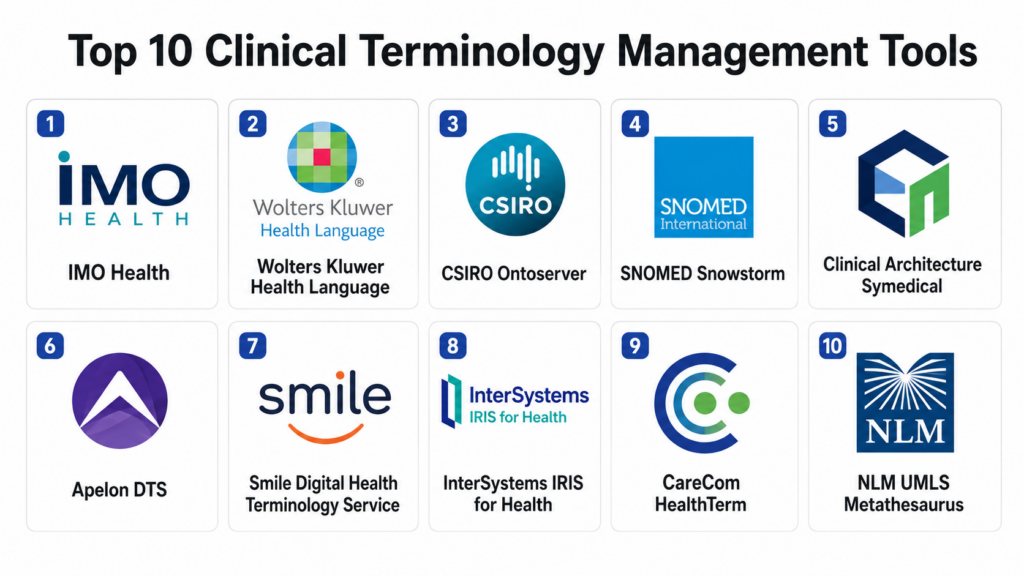
Introduction
Clinical Terminology Management Tools help healthcare organizations manage medical vocabularies, code systems, mappings, value sets, synonyms, and terminology updates across clinical, billing, research, analytics, and interoperability workflows. In simple terms, these tools make sure that healthcare data means the same thing across EHRs, labs, pharmacies, registries, claims systems, public health platforms, and analytics environments. They help teams manage standards such as SNOMED CT, LOINC, ICD, RxNorm, CPT, local codes, drug dictionaries, lab catalogs, and FHIR terminology resources.
Clinical terminology is essential because healthcare data is only useful when it is consistent, coded, searchable, and exchangeable. SNOMED CT is widely used for clinical concepts, LOINC is widely used for lab and observation identifiers, and RxNorm supports medication normalization, while FHIR terminology services use resources such as CodeSystem, ValueSet, and ConceptMap to support modern interoperability workflows.
Real World Use Cases
- Terminology governance: Manage approved clinical terms, synonyms, code systems, value sets, and mapping rules.
- EHR normalization: Convert local problem, lab, medication, and procedure terms into standard codes.
- FHIR terminology services: Support code lookup, validation, value set expansion, subsumption, and concept mapping.
- Analytics and reporting: Standardize clinical data for quality measures, population health, research, and regulatory reporting.
- Interoperability mapping: Map local codes to SNOMED CT, LOINC, ICD, RxNorm, CPT, and payer or registry-specific code sets.
- Terminology version control: Track terminology releases, updates, retired concepts, mapping changes, and value set changes.
Evaluation Criteria for Buyers
- Terminology coverage: SNOMED CT, LOINC, ICD, RxNorm, CPT, HCPCS, local codes, drug dictionaries, and custom vocabularies.
- FHIR support: CodeSystem, ValueSet, ConceptMap, terminology operations, and API readiness.
- Mapping capabilities: Local-to-standard mapping, crosswalks, semantic matching, synonym handling, and mapping review workflows.
- Governance workflow: Approval, versioning, change control, stewardship, audit trails, and terminology lifecycle management.
- Integration readiness: EHR, HIE, FHIR server, data warehouse, analytics, lab systems, pharmacy systems, and claims platforms.
- Search and normalization: Fast term lookup, synonym expansion, clinical phrase matching, and code recommendation.
- Scalability: Support for enterprise terminology services, national programs, payer networks, and multi-site health systems.
- Security controls: RBAC, SSO, audit logs, encryption, API security, and access governance.
- Implementation support: Terminology expertise, clinical mapping support, onboarding, documentation, and professional services.
- Cost and value: Licensing, content subscriptions, maintenance effort, implementation cost, and long-term governance benefits.
Best for: Hospitals, health systems, HIEs, payers, digital health companies, EHR vendors, clinical data platforms, public health agencies, research networks, interoperability teams, terminology stewards, informatics teams, and data governance leaders that need clean, coded, reusable healthcare data.
Not ideal for: Small clinics with limited interoperability needs, teams that only need basic ICD billing lookup, organizations without structured data governance, or companies where terminology management is fully handled by their EHR or outsourced data partner.
Key Trends in Clinical Terminology Management Tools
- FHIR-native terminology services: Healthcare organizations increasingly need terminology operations that work with FHIR CodeSystem, ValueSet, and ConceptMap resources.
- Enterprise terminology servers: Centralized terminology services are replacing scattered spreadsheets, local code tables, and one-off mapping files.
- Clinical data normalization: Healthcare analytics teams need normalized data to compare clinical information across multiple EHRs, sites, and data sources.
- AI-assisted mapping: AI and NLP are increasingly used to suggest mappings from local terms to standard vocabularies, though human review remains essential.
- Value set governance: Quality reporting, decision support, and population health programs require reliable value set authoring, versioning, and review workflows.
- Terminology version control: Organizations need better management of release updates, retired codes, new concepts, and downstream mapping impact.
- National terminology infrastructure: National terminology servers are used to provide centrally governed, version-controlled terminology access for health systems and application developers.
- Interoperability with analytics platforms: Terminology services are increasingly connected with data lakes, clinical data repositories, registries, and AI pipelines.
- Medication and lab normalization: RxNorm and LOINC mapping remain high-priority areas because medications and lab observations vary widely across systems.
- Stronger terminology stewardship: Healthcare organizations are treating terminology as a governed data asset rather than a technical reference table.
How We Selected These Tools
- We prioritized platforms recognized for clinical terminology management, terminology services, mapping, normalization, value set management, and healthcare interoperability.
- We included enterprise terminology tools, FHIR terminology servers, open-source terminology services, and healthcare data normalization platforms.
- We considered support for SNOMED CT, LOINC, ICD, RxNorm, CPT, local codes, value sets, and concept maps.
- We evaluated fit for hospitals, payers, HIEs, digital health vendors, research networks, and national-scale terminology programs.
- We considered FHIR API readiness, terminology operations, version management, and integration with clinical systems.
- We looked for mapping workflows, stewardship support, synonym management, terminology search, and code normalization capabilities.
- We avoided guessing public ratings, certifications, or pricing where details are not clearly known.
- We considered usability for informaticists, terminology stewards, data engineers, analysts, interoperability teams, and clinical data governance leaders.
- We reviewed vendor ecosystem, healthcare domain expertise, implementation maturity, and support availability.
- The scoring is comparative and should be validated through demos, pilot mappings, FHIR API tests, and real terminology governance workflows.
Top 10 Clinical Terminology Management Tools
1- IMO Health
Short description:
IMO Health provides clinical terminology, data normalization, and healthcare coding solutions used by healthcare organizations to improve clinical documentation, interoperability, analytics, and reporting. Its terminology capabilities help map clinical phrases, local terms, problem lists, diagnoses, procedures, and other healthcare concepts to standard codes. IMO is especially useful for health systems and digital health platforms that need clinically friendly terms connected to billing, analytics, and interoperability standards. It supports terminology normalization where raw clinical language must become structured and reusable healthcare data. IMO Health is best for organizations that need clinically usable terminology content and normalization workflows.
Key Features
- Clinical terminology normalization
- Diagnosis, procedure, and problem-list terminology support
- Mapping to standard healthcare code systems
- Clinician-friendly terminology search
- Data quality support for analytics and reporting
- Integration with EHR and healthcare data platforms
- Support for terminology governance and update workflows
Pros
- Strong fit for clinical documentation and terminology normalization.
- Useful for health systems that need clinician-friendly terms connected to standard codes.
- Helps improve downstream analytics, reporting, and interoperability consistency.
Cons
- May require content licensing and integration planning.
- Best value depends on EHR and data platform integration.
- Buyers should validate exact vocabulary and mapping coverage for their use case.
Platforms / Deployment
Web / API
Cloud / Hybrid options may vary
Security & Compliance
Not publicly stated for every deployment context.
Buyers should validate SSO, RBAC, encryption, audit logs, API security, data handling, and healthcare compliance requirements directly.
Integrations & Ecosystem
IMO Health can connect terminology content and normalization workflows with clinical systems and healthcare data platforms.
- EHR systems
- Clinical data warehouses
- Analytics platforms
- Interoperability platforms
- Coding and billing workflows
- Quality reporting systems
Support & Community
IMO Health provides vendor-led support, healthcare terminology expertise, implementation guidance, and customer success resources. Support is especially useful for mapping strategy, clinical vocabulary governance, and EHR integration planning.
2- Wolters Kluwer Health Language
Short description:
Wolters Kluwer Health Language is a clinical terminology management and data normalization platform designed to help healthcare organizations manage code sets, mappings, value sets, and standardized clinical content. It is commonly used by payers, providers, health IT companies, analytics teams, and interoperability programs. The platform helps normalize healthcare data from multiple sources so organizations can improve reporting, decision support, interoperability, and analytics. It is especially useful when organizations need centralized management of healthcare terminologies and code set updates. Health Language is best for enterprises that need strong terminology governance and normalization at scale.
Key Features
- Clinical terminology management
- Code set and vocabulary normalization
- Mapping and crosswalk support
- Value set management workflows
- Healthcare data standardization
- Terminology update management
- Integration with clinical, payer, and analytics systems
Pros
- Strong fit for enterprise terminology governance.
- Useful across provider, payer, and health IT environments.
- Helps standardize data for reporting, analytics, and interoperability.
Cons
- Implementation may require strong data governance ownership.
- Buyers should validate coverage for specific standards and local code systems.
- May be more advanced than smaller organizations need.
Platforms / Deployment
Web / API
Cloud / Hybrid options may vary
Security & Compliance
Not publicly stated for every deployment context.
Buyers should validate RBAC, SSO, encryption, audit logs, data governance, and healthcare security requirements.
Integrations & Ecosystem
Health Language can connect terminology services and normalized content with enterprise healthcare data workflows.
- EHR and clinical systems
- Payer platforms
- Data warehouses
- Analytics systems
- Quality reporting workflows
- Interoperability platforms
Support & Community
Wolters Kluwer provides enterprise support, healthcare content expertise, documentation, onboarding, and implementation assistance. Support is valuable for code set management, mapping governance, and terminology lifecycle planning.
3- CSIRO Ontoserver
Short description:
CSIRO Ontoserver is a FHIR-native clinical terminology server used for terminology services, value set expansion, code validation, concept lookup, and terminology operations. It is highly relevant for organizations implementing FHIR interoperability and national terminology infrastructure. Ontoserver supports standards-based access to clinical terminologies and has been used in national and enterprise terminology service contexts, including terminology server programs powered by Ontoserver. It is best for health systems, governments, HIEs, and digital health platforms that need robust FHIR terminology service capabilities.
Key Features
- FHIR terminology server capabilities
- CodeSystem, ValueSet, and ConceptMap support
- Value set expansion and code validation
- Terminology lookup and subsumption operations
- SNOMED CT and other terminology support
- Syndication-based terminology content support
- API-based integration with healthcare applications
Pros
- Strong fit for FHIR-based interoperability programs.
- Useful for national, regional, and enterprise terminology infrastructure.
- Standards-oriented platform for terminology services.
Cons
- Requires technical expertise to implement and operate effectively.
- May need additional governance tools for full terminology stewardship.
- Buyers should validate licensing and terminology content requirements.
Platforms / Deployment
Web / API
Cloud / Self-hosted / Hybrid options may vary
Security & Compliance
Not publicly stated for every deployment context.
Buyers should validate authentication, authorization, encryption, API security, audit logs, and operational security controls.
Integrations & Ecosystem
Ontoserver is designed to support terminology access for applications, FHIR servers, clinical platforms, and national terminology programs.
- FHIR servers
- EHR systems
- HIE platforms
- Clinical data repositories
- Terminology content repositories
- Digital health applications
Support & Community
CSIRO provides product support and terminology service expertise depending on licensing and engagement model. Support is especially valuable for FHIR terminology implementation, national-scale deployment, and terminology content operations.
4- SNOMED International Snowstorm
Short description:
Snowstorm is an open-source terminology server from SNOMED International that supports SNOMED CT terminology services and FHIR terminology APIs. It is useful for organizations that need a technical terminology service for SNOMED CT access, search, hierarchy navigation, concept lookup, and terminology operations. Snowstorm can support FHIR R4 terminology modules and is often used by technical teams building terminology infrastructure. Documentation describes Snowstorm as having SNOMED CT APIs and a FHIR API, with Elasticsearch used for terminology data storage and search. It is best for technical teams that want an open-source SNOMED CT-enabled terminology server.
Key Features
- Open-source SNOMED CT terminology server
- SNOMED CT API support
- FHIR terminology API support
- Concept search and lookup
- Hierarchy and relationship navigation
- Elasticsearch-backed terminology search
- Suitable for terminology service implementation projects
Pros
- Strong open-source option for SNOMED CT terminology services.
- Useful for technical teams building custom terminology infrastructure.
- Good fit for organizations needing SNOMED CT search and API access.
Cons
- Requires technical deployment, hosting, and maintenance expertise.
- Governance workflows may need additional tools or custom processes.
- Not a full commercial enterprise terminology management suite by itself.
Platforms / Deployment
Web / API
Self-hosted / Cloud-hosted by implementation team
Security & Compliance
Depends on deployment architecture.
Buyers and implementers should configure authentication, authorization, encryption, audit logs, network security, backup, and operational monitoring.
Integrations & Ecosystem
Snowstorm can support applications that need standards-based access to SNOMED CT and FHIR terminology operations.
- FHIR servers
- Clinical applications
- EHR platforms
- HIE systems
- Data repositories
- Terminology development workflows
Support & Community
Snowstorm has open-source community and SNOMED International ecosystem support. Enterprise support depends on implementation partner, internal technical team, or third-party service provider.
5- Clinical Architecture Symedical
Short description:
Clinical Architecture Symedical is a terminology management and data normalization platform designed to help healthcare organizations manage clinical vocabularies, mappings, synonyms, value sets, and terminology governance. It is useful for hospitals, payers, HIEs, public health agencies, and analytics organizations that need to normalize healthcare data across multiple source systems. Symedical supports terminology mapping and management workflows that help turn inconsistent clinical data into standardized and meaningful information. It is best for organizations with complex terminology governance and data normalization needs across many systems.
Key Features
- Enterprise terminology management
- Clinical data normalization
- Mapping and synonym management
- Value set and code set workflows
- Local-to-standard terminology mapping
- Data quality and interoperability support
- Governance and terminology lifecycle management
Pros
- Strong fit for terminology governance and normalization.
- Useful for organizations consolidating data from multiple healthcare systems.
- Helps support analytics, interoperability, and clinical data quality.
Cons
- Implementation requires terminology governance maturity.
- Buyers should validate coverage for required standards and local vocabularies.
- May need integration work with source systems and analytics platforms.
Platforms / Deployment
Web / API
Cloud / Hybrid options may vary
Security & Compliance
Not publicly stated for every deployment context.
Buyers should validate RBAC, SSO, encryption, audit logs, API security, and healthcare data handling requirements.
Integrations & Ecosystem
Symedical can connect terminology governance and normalization workflows with healthcare data platforms and operational systems.
- EHR systems
- Data warehouses
- HIE platforms
- Analytics platforms
- Quality reporting systems
- Payer and claims systems
Support & Community
Clinical Architecture provides vendor-led support, terminology expertise, implementation assistance, and customer success resources. Support is valuable for mapping strategy, vocabulary governance, and normalization program design.
6- Apelon Distributed Terminology System
Short description:
Apelon Distributed Terminology System is a terminology management platform designed for healthcare terminology authoring, mapping, distribution, and maintenance. It helps organizations manage complex vocabulary assets, create mappings, maintain local terminology extensions, and support terminology services. Apelon has long been associated with healthcare terminology management and controlled vocabulary systems. It is useful for organizations that need strong terminology curation, editing, and enterprise vocabulary stewardship. Apelon DTS is best for terminology teams that need control over custom vocabularies, mappings, and enterprise terminology assets.
Key Features
- Terminology authoring and management
- Mapping and vocabulary maintenance
- Local terminology extension support
- Version and release management
- Terminology distribution workflows
- Controlled vocabulary governance
- API and system integration support
Pros
- Strong fit for terminology authoring and vocabulary stewardship.
- Useful for organizations managing custom terminology assets.
- Good option where mapping governance and vocabulary maintenance matter.
Cons
- May require specialized terminology expertise.
- User experience and deployment fit should be validated during demos.
- Buyers should confirm current support, roadmap, and integration options.
Platforms / Deployment
Web / Windows / API options may vary
Cloud / Self-hosted / Hybrid options may vary
Security & Compliance
Not publicly stated.
Buyers should validate user permissions, audit logs, encryption, access governance, and deployment security requirements.
Integrations & Ecosystem
Apelon DTS can support terminology teams that need to distribute controlled vocabulary assets to multiple clinical and analytics systems.
- EHR systems
- Clinical data repositories
- Mapping workflows
- Analytics platforms
- Custom applications
- Terminology publishing pipelines
Support & Community
Apelon provides vendor-led support and terminology expertise depending on engagement model. Support is especially important for terminology migration, vocabulary modeling, and mapping workflow setup.
7- Smile Digital Health Terminology Service
Short description:
Smile Digital Health provides FHIR infrastructure and terminology service capabilities for healthcare organizations building interoperable digital health platforms. Its terminology capabilities are relevant for organizations that need FHIR-based validation, value set expansion, concept mapping, and terminology operations as part of a broader healthcare data platform. It is especially useful when terminology services must be connected with FHIR repositories, interoperability APIs, and clinical data exchange. Smile Digital Health is best for organizations implementing enterprise FHIR architecture and needing terminology support within that ecosystem.
Key Features
- FHIR terminology service capabilities
- Code validation and value set expansion
- Concept map and code system support
- Integration with FHIR data repositories
- API-first interoperability architecture
- Healthcare data exchange workflows
- Enterprise digital health platform support
Pros
- Strong fit for FHIR-first healthcare interoperability programs.
- Useful when terminology services are part of a broader FHIR platform.
- Good option for health systems and digital health networks building modern API infrastructure.
Cons
- May not replace a full terminology governance suite by itself.
- Buyers should validate terminology content coverage and mapping workflows.
- Best value depends on broader FHIR platform strategy.
Platforms / Deployment
Web / API
Cloud / Self-hosted / Hybrid options may vary
Security & Compliance
Not publicly stated for every deployment context.
Buyers should validate authentication, authorization, encryption, audit logs, API security, and healthcare compliance controls.
Integrations & Ecosystem
Smile Digital Health terminology capabilities can connect with FHIR-based clinical systems, data exchange platforms, and digital health applications.
- FHIR repositories
- EHR systems
- HIE platforms
- Clinical applications
- Analytics systems
- API gateways and integration layers
Support & Community
Smile Digital Health provides enterprise support, implementation services, documentation, and healthcare interoperability expertise. Support is valuable for FHIR architecture, terminology operations, and system integration.
8- InterSystems IRIS for Health
Short description:
InterSystems IRIS for Health is a healthcare data platform that supports interoperability, FHIR, analytics, integration, and clinical data management. While it is broader than a dedicated terminology management tool, it can support terminology-enabled interoperability workflows as part of healthcare data exchange and application development. It is useful for organizations that need terminology services integrated into a larger healthcare data platform, especially where EHR integration, FHIR support, and data normalization are part of the architecture. InterSystems IRIS for Health is best for organizations that need terminology support within a broader clinical data and interoperability platform.
Key Features
- Healthcare data platform capabilities
- FHIR and interoperability support
- Clinical data integration workflows
- Terminology-enabled application development support
- Data normalization and exchange architecture
- Integration with healthcare systems
- Analytics and operational data support
Pros
- Strong fit for healthcare interoperability and data platform modernization.
- Useful when terminology functions need to be part of broader system integration.
- Good option for organizations already using InterSystems healthcare infrastructure.
Cons
- Not a standalone terminology governance tool for every buyer.
- Terminology management depth should be validated for specific requirements.
- Implementation may require technical expertise and architecture planning.
Platforms / Deployment
Web / API / Server platform
Cloud / Self-hosted / Hybrid options may vary
Security & Compliance
Enterprise security controls may vary by deployment.
Buyers should validate RBAC, SSO, encryption, audit logs, API security, and healthcare data protection requirements.
Integrations & Ecosystem
InterSystems IRIS for Health fits into healthcare architectures where terminology, FHIR, integration, and analytics need to work together.
- EHR systems
- FHIR APIs
- HIE platforms
- Clinical data repositories
- Analytics systems
- Healthcare applications
Support & Community
InterSystems provides enterprise support, documentation, implementation partners, and healthcare integration expertise. Support is strongest for organizations building complex healthcare data platforms.
9- CareCom HealthTerm
Short description:
CareCom HealthTerm is a clinical terminology management platform focused on healthcare terminology, mapping, content management, and semantic interoperability. It supports terminology workflows for healthcare organizations that need to manage standard terminologies, local codes, and clinical mappings. HealthTerm is useful for organizations working on terminology governance, value sets, cross-system mappings, and clinical data consistency. It is especially relevant for European and international healthcare environments where multiple languages, national extensions, and local coding systems may need to be managed. HealthTerm is best for organizations that need structured terminology management and mapping workflows.
Key Features
- Clinical terminology management
- Mapping and code system workflows
- Support for standard and local terminologies
- Value set and terminology content management
- Semantic interoperability support
- Multi-language terminology workflows
- Governance and release management support
Pros
- Strong fit for terminology governance and semantic interoperability.
- Useful for organizations managing local and standard code systems.
- Good option for international environments with multilingual terminology needs.
Cons
- Buyers should validate current coverage for required national code systems.
- May require terminology governance and informatics expertise.
- Integration scope should be tested with real systems and workflows.
Platforms / Deployment
Web / API
Cloud / Hybrid options may vary
Security & Compliance
Not publicly stated.
Buyers should validate RBAC, SSO, encryption, audit logs, API security, and healthcare data governance needs.
Integrations & Ecosystem
HealthTerm can support healthcare organizations that need terminology content connected to clinical applications, data platforms, and interoperability workflows.
- EHR systems
- National terminology services
- Clinical data repositories
- Interoperability platforms
- Mapping workflows
- Analytics and reporting systems
Support & Community
CareCom provides vendor support, terminology expertise, onboarding assistance, and implementation guidance. Support is useful for multilingual terminology governance and mapping projects.
10- NLM UMLS Metathesaurus and Related Tools
Short description:
The UMLS Metathesaurus from the National Library of Medicine is not a commercial terminology management suite, but it is a critical resource for healthcare terminology integration, synonym management, concept linking, and mapping research. It brings together many biomedical vocabularies and provides concept relationships that can support terminology normalization, clinical NLP, analytics, and mapping workflows. It is commonly used by researchers, informaticists, developers, and healthcare data teams building terminology-aware applications. UMLS is best for teams that need a foundational terminology resource rather than a packaged enterprise workflow platform.
Key Features
- Biomedical terminology integration resource
- Concept identifiers and synonym relationships
- Cross-vocabulary terminology support
- Useful for clinical NLP and data normalization
- Supports mapping and semantic research workflows
- Can support custom terminology applications
- Valuable for informatics and healthcare data science teams
Pros
- Strong foundational resource for terminology research and normalization.
- Useful for linking concepts across multiple biomedical vocabularies.
- Helpful for clinical NLP, analytics, and custom mapping workflows.
Cons
- Not a turnkey terminology management platform.
- Requires technical and informatics expertise.
- Licensing, vocabulary restrictions, and update processes must be managed carefully.
Platforms / Deployment
Downloadable data / APIs / Local tools depending on use case
Self-hosted / Custom implementation
Security & Compliance
Depends on local implementation.
Teams should configure access controls, licensing governance, data handling, and audit practices based on internal policy.
Integrations & Ecosystem
UMLS is often used as a terminology reference layer in custom healthcare data applications, NLP pipelines, and mapping workflows.
- Clinical NLP systems
- Research databases
- Data warehouses
- Custom terminology services
- Mapping tools
- Analytics platforms
Support & Community
NLM provides documentation and terminology resources. Support is more resource-oriented than vendor-managed implementation support, so teams need internal informatics and technical expertise.
Comparison Table
| Tool Name | Best For | Platform Supported | Deployment | Standout Feature | Public Rating |
|---|---|---|---|---|---|
| IMO Health | Clinical terminology normalization and EHR-friendly terms | Web / API | Cloud / Hybrid varies | Clinician-friendly terminology normalization | N/A |
| Wolters Kluwer Health Language | Enterprise terminology governance and data standardization | Web / API | Cloud / Hybrid varies | Code set and value set management | N/A |
| CSIRO Ontoserver | FHIR terminology services and national terminology infrastructure | Web / API | Cloud / Self-hosted / Hybrid varies | Standards-based FHIR terminology server | N/A |
| SNOMED Snowstorm | Open-source SNOMED CT terminology service | Web / API | Self-hosted / Cloud-hosted | Open-source SNOMED CT and FHIR terminology APIs | N/A |
| Clinical Architecture Symedical | Mapping, normalization, and terminology governance | Web / API | Cloud / Hybrid varies | Enterprise clinical data normalization | N/A |
| Apelon DTS | Terminology authoring and vocabulary stewardship | Web / Windows / API varies | Cloud / Self-hosted / Hybrid varies | Controlled vocabulary authoring and management | N/A |
| Smile Digital Health Terminology Service | FHIR-first healthcare interoperability programs | Web / API | Cloud / Self-hosted / Hybrid varies | Terminology support within FHIR infrastructure | N/A |
| InterSystems IRIS for Health | Healthcare data platform with terminology-enabled interoperability | Web / API / Server platform | Cloud / Self-hosted / Hybrid varies | Clinical data platform plus interoperability support | N/A |
| CareCom HealthTerm | Multilingual terminology management and mapping | Web / API | Cloud / Hybrid varies | Semantic interoperability and terminology content management | N/A |
| NLM UMLS Metathesaurus | Research, terminology linking, and custom normalization | Data / API / Local tools | Self-hosted / Custom | Foundational biomedical terminology integration resource | N/A |
Evaluation & Scoring of Clinical Terminology Management Tools
| Tool Name | Core 25% | Ease 15% | Integrations 15% | Security 10% | Performance 10% | Support 10% | Value 15% | Weighted Total |
|---|---|---|---|---|---|---|---|---|
| IMO Health | 9.3 | 8.2 | 8.8 | 8.0 | 8.8 | 8.7 | 8.0 | 8.60 |
| Wolters Kluwer Health Language | 9.0 | 8.0 | 8.7 | 8.2 | 8.6 | 8.8 | 8.0 | 8.50 |
| CSIRO Ontoserver | 8.8 | 7.6 | 9.2 | 8.0 | 9.0 | 8.3 | 8.2 | 8.48 |
| SNOMED Snowstorm | 8.3 | 7.0 | 8.8 | 7.0 | 8.7 | 7.6 | 9.0 | 8.10 |
| Clinical Architecture Symedical | 8.8 | 7.8 | 8.6 | 8.0 | 8.5 | 8.5 | 8.0 | 8.36 |
| Apelon DTS | 8.4 | 7.3 | 8.2 | 7.6 | 8.2 | 8.0 | 8.0 | 8.00 |
| Smile Digital Health Terminology Service | 8.2 | 7.8 | 9.0 | 8.2 | 8.6 | 8.4 | 8.0 | 8.34 |
| InterSystems IRIS for Health | 8.0 | 7.6 | 9.0 | 8.5 | 8.8 | 8.8 | 7.8 | 8.35 |
| CareCom HealthTerm | 8.2 | 7.8 | 8.2 | 7.8 | 8.2 | 8.0 | 8.0 | 8.06 |
| NLM UMLS Metathesaurus | 8.0 | 6.8 | 8.0 | 7.0 | 8.0 | 7.5 | 9.0 | 7.78 |
These scores are comparative and should be interpreted based on organizational needs. Clinical terminology normalization platforms score well when EHR-friendly term search and data standardization are priorities. FHIR terminology servers score well when interoperability and API operations matter most. Open-source and public terminology resources may offer strong value but require more internal expertise. Buyers should test tools with real local codes, value sets, FHIR operations, and mapping workflows before selection.
Which Clinical Terminology Management Tool Is Right for You?
Solo / Freelancer
Solo healthcare consultants, clinical informaticists, and data advisors usually do not need a full enterprise terminology platform for personal use. They may use UMLS, SNOMED CT browsers, LOINC resources, spreadsheets, and lightweight mapping tools for research or advisory work. If they work with clients, understanding IMO Health, Health Language, Ontoserver, Snowstorm, and Symedical is useful. The main consulting value is helping organizations design terminology governance, mapping review processes, and standards adoption strategy.
SMB
Small digital health companies, specialty clinics, and growing healthcare software vendors should avoid overbuying unless terminology is central to the product. Snowstorm may be useful for technical teams needing SNOMED CT services. UMLS may be useful for data science and terminology research. Smile Digital Health or Ontoserver may fit organizations building FHIR-native applications. SMBs should focus on the smallest terminology service that meets interoperability and reporting needs.
Mid-Market
Mid-market healthcare organizations often need stronger normalization, mapping governance, and analytics-ready clinical data. IMO Health, Wolters Kluwer Health Language, Clinical Architecture Symedical, Smile Digital Health, and CareCom HealthTerm may be strong candidates. If FHIR interoperability is a key initiative, Ontoserver or Snowstorm should be evaluated. Mid-market buyers should prioritize tools that reduce manual mapping work and improve consistency across EHR, analytics, and reporting environments.
Enterprise
Large health systems, payers, national programs, research networks, and HIEs should prioritize scalability, terminology governance, API performance, version control, and integration depth. IMO Health, Health Language, Ontoserver, Symedical, InterSystems IRIS for Health, and Apelon DTS are strong enterprise candidates depending on use case. Enterprises often need more than one layer: terminology content normalization, FHIR terminology APIs, value set governance, and analytics mapping. The best choice should align with enterprise data governance and interoperability architecture.
Budget vs Premium
Budget-sensitive teams can start with public resources, Snowstorm, UMLS, and carefully governed internal mapping workflows. This approach requires technical and informatics expertise but can be cost-effective. Premium buyers should evaluate IMO Health, Health Language, Symedical, Ontoserver, and InterSystems when they need managed content, enterprise support, advanced integration, and operational reliability. The trade-off is usually between internal effort and vendor-supported maturity.
Feature Depth vs Ease of Use
For clinical terminology normalization and user-friendly search, IMO Health and Health Language are strong choices. For standards-based FHIR terminology operations, Ontoserver, Snowstorm, Smile Digital Health, and InterSystems are strong options. For terminology authoring and governance, Apelon DTS, Symedical, and HealthTerm may fit better. Ease of use depends heavily on whether the primary users are clinicians, informaticists, developers, analysts, or data stewards.
Integrations & Scalability
Clinical terminology tools should integrate with EHRs, FHIR servers, HIEs, data warehouses, quality reporting tools, claims systems, lab systems, pharmacy systems, clinical NLP pipelines, and analytics platforms. FHIR terminology services should be tested for lookup, validate-code, expand, translate, and subsumption operations. Scalability should include terminology size, query volume, update frequency, number of systems, and mapping complexity. Buyers should use real code sets and local terms during evaluation.
Security & Compliance Needs
Clinical terminology tools may not always store patient records directly, but they often connect with clinical systems and healthcare data platforms. Buyers should validate RBAC, SSO, MFA, encryption, audit logs, API security, network controls, and data handling policies. If the platform processes clinical text or patient-linked data for normalization, privacy and compliance controls become more important. Security, IT, data governance, and clinical informatics teams should participate in evaluation.
Frequently Asked Questions
1- What are Clinical Terminology Management Tools?
Clinical Terminology Management Tools help healthcare organizations manage medical vocabularies, code systems, mappings, value sets, synonyms, and terminology updates. They support standards such as SNOMED CT, LOINC, ICD, RxNorm, CPT, and local code systems. These tools help make healthcare data consistent, searchable, and interoperable. They are used in EHRs, analytics platforms, HIEs, quality reporting, claims systems, and digital health applications.
2- How is terminology management different from medical coding?
Medical coding usually focuses on assigning codes for billing, reimbursement, reporting, and claims workflows. Terminology management is broader because it manages clinical meanings, synonyms, mappings, value sets, terminology versions, and interoperability rules. A terminology platform may support billing codes, but it also supports clinical documentation, analytics, decision support, and data exchange. Coding is one use case; terminology management is the governance layer behind many use cases.
3- What is a terminology server?
A terminology server is a system that provides access to terminology content through APIs and services. It can support code lookup, code validation, value set expansion, concept mapping, and terminology search. In FHIR, terminology services commonly work with CodeSystem, ValueSet, and ConceptMap resources. A terminology server helps applications use consistent medical codes without embedding terminology logic separately in every system.
4- What pricing models are common for these tools?
Pricing varies by vendor, terminology content, deployment model, users, API volume, modules, standards supported, and implementation services. Some tools use enterprise subscriptions, some charge for terminology content licenses, and open-source tools may require internal hosting and support costs. Additional costs can include mapping services, integration work, governance setup, training, and maintenance. Buyers should calculate total cost across software, content, implementation, and long-term stewardship.
5- How long does implementation usually take?
Implementation depends on scope, number of systems, terminology standards, local code complexity, mapping volume, and governance maturity. A simple terminology server setup can be faster than an enterprise-wide normalization and governance program. Teams usually need to load code systems, configure value sets, map local terms, test APIs, define approval workflows, and train users. A phased rollout by domain, such as labs, problems, medications, or procedures, is usually safer.
6- What are common mistakes when adopting terminology management tools?
A common mistake is treating terminology as a one-time mapping project instead of an ongoing governance program. Another mistake is relying only on automated mapping without clinical review. Some organizations also fail to manage terminology version updates, retired codes, and downstream analytics impact. Successful adoption requires terminology stewards, review workflows, change control, documentation, and regular quality checks.
7- Why are SNOMED CT, LOINC, ICD, and RxNorm important?
These standards support different healthcare data needs. SNOMED CT is commonly used for clinical concepts and problem documentation. LOINC is widely used for lab tests, observations, and clinical measurements. ICD supports diagnoses and reporting workflows, while RxNorm supports medication normalization. Using these standards helps organizations exchange and analyze healthcare data more consistently across systems.
8- What integrations should buyers look for?
Buyers should look for integrations with EHRs, FHIR servers, HIEs, lab systems, pharmacy systems, claims platforms, data warehouses, quality reporting tools, clinical NLP systems, and analytics platforms. API support is especially important for real-time terminology services. Integration should also support batch mapping, code updates, value set distribution, and terminology validation. Buyers should test integrations using real local codes and production-like workflows.
9- Can AI help with terminology mapping?
AI can help suggest mappings between local clinical terms and standard code systems, especially when there are many synonyms or messy source terms. NLP can also help extract terms from clinical text and link them to standard concepts. However, AI-generated mappings should be reviewed by clinical informaticists or terminology experts. Incorrect mappings can affect patient care, analytics, reporting, and compliance.
10- How should a company move away from spreadsheet-based terminology management?
The first step is to inventory all local code lists, spreadsheets, mappings, value sets, and terminology owners. Next, the organization should define governance roles, approval workflows, naming rules, and versioning policies. A pilot should focus on one high-value domain such as labs, problems, medications, or quality measures. Once the workflow is stable, the organization can migrate more terminology assets into a governed platform or terminology server.
Conclusion
Clinical Terminology Management Tools are essential for healthcare organizations that need consistent, coded, interoperable, and analytics-ready clinical data. The best platform depends on whether the main priority is terminology normalization, FHIR terminology services, value set governance, local code mapping, clinical NLP, enterprise data standardization, or national-scale terminology infrastructure. IMO Health and Wolters Kluwer Health Language are strong choices for normalization and enterprise terminology governance, while CSIRO Ontoserver, SNOMED Snowstorm, Smile Digital Health, and InterSystems are strong fits for FHIR-based interoperability and terminology service architecture. Clinical Architecture Symedical, Apelon DTS, and CareCom HealthTerm are practical options for mapping, stewardship, and vocabulary governance, while UMLS remains a valuable foundational resource for terminology linking and research.
