MOTOSHARE 🚗🏍️
Rent Bikes & Cars Directly from Owners
Motoshare connects vehicle owners with people who need bikes and cars on rent. Owners earn from idle vehicles, and renters get flexible ride options.
Visit Motoshare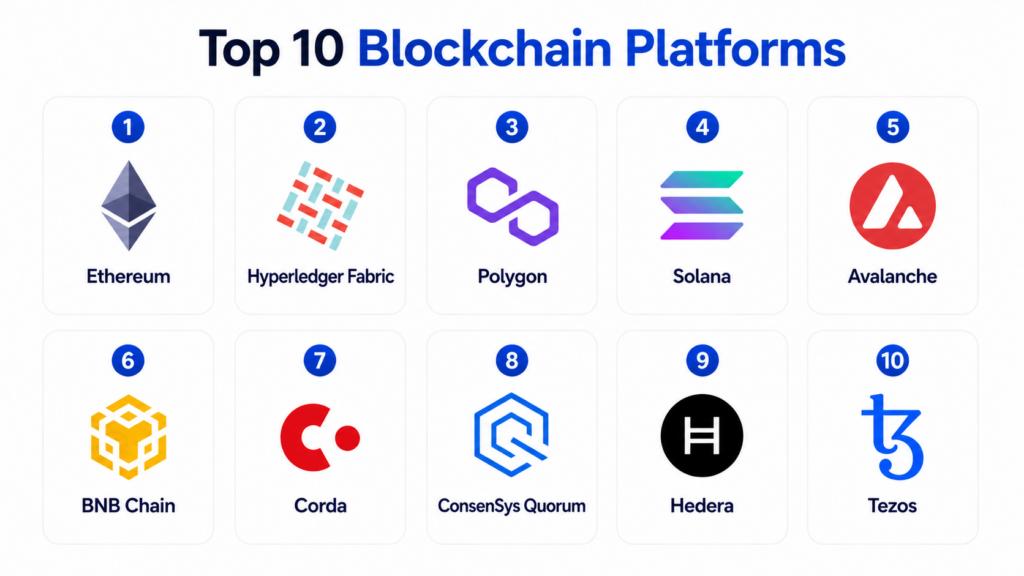
Introduction
Blockchain platforms are software ecosystems that let developers and organizations build decentralized applications, smart contracts, digital assets, tokenized workflows, and secure transaction networks. In simple terms, a blockchain platform provides the foundation for recording transactions in a tamper-resistant, distributed way where multiple participants can verify activity without depending on one central authority. Some platforms are public and permissionless, while others are private, permissioned, or enterprise-focused.
Blockchain matters now because businesses are moving beyond basic cryptocurrency use cases and exploring tokenization, digital identity, supply chain traceability, settlement systems, decentralized finance, gaming assets, loyalty programs, audit trails, and cross-organization data sharing. Buyers should evaluate scalability, security model, transaction costs, developer ecosystem, smart contract support, governance, interoperability, enterprise controls, compliance fit, and long-term ecosystem maturity.
Best for: developers, startups, financial institutions, supply chain teams, Web3 companies, public sector innovation teams, enterprise architects, and organizations building decentralized or multi-party trust systems. Not ideal for: teams that only need a normal database, simple internal workflow automation, private reporting dashboards, or systems where decentralization, shared trust, immutability, or tokenization do not add real business value.
Key Trends in Blockchain Platforms
- Enterprise tokenization is growing, especially for financial assets, real-world assets, loyalty points, carbon credits, and digital ownership records.
- Layer 2 and scaling ecosystems are becoming more important, helping reduce transaction costs and improve throughput for public blockchain applications.
- Interoperability is now a major buying factor, because businesses want assets, identities, and data to move across chains and networks.
- Private and permissioned blockchain use remains relevant, especially for banking, trade finance, supply chain, insurance, and consortium-led workflows.
- Developer tooling is improving, with better smart contract frameworks, testing environments, wallets, APIs, indexing tools, and observability solutions.
- Security expectations are increasing, especially around smart contract audits, validator security, key management, governance controls, and incident response.
- AI and blockchain are intersecting, mainly in provenance tracking, data marketplaces, agent payments, decentralized compute, and auditability of AI-generated assets.
- Compliance-friendly blockchain designs are gaining attention, especially where identity, permissions, transaction monitoring, and regulated asset flows matter.
- Sustainable and energy-efficient consensus mechanisms are now expected, especially for enterprise and public sector adoption.
- Modular blockchain architecture is expanding, with specialized layers for execution, settlement, data availability, identity, privacy, and cross-chain messaging.
How We Selected These Tools
- Selected platforms with strong recognition across public blockchain, enterprise blockchain, and developer ecosystems.
- Balanced general-purpose smart contract platforms with enterprise, permissioned, and industry-specific blockchain frameworks.
- Considered developer adoption, ecosystem maturity, infrastructure availability, and practical implementation use cases.
- Evaluated smart contract support, scalability, performance signals, tooling, governance, and integration options.
- Included platforms relevant for decentralized applications, tokenization, payments, supply chain, finance, gaming, and enterprise consortia.
- Considered security posture signals such as consensus model, validator ecosystem, permissioning, and governance maturity.
- Avoided public ratings because reliable universal ratings are not consistently available for blockchain platforms.
- Used “Not publicly stated” where certifications, compliance controls, or enterprise security details are not clearly known.
- Scoring is comparative and practical, not a claim of absolute technical superiority.
- Prioritized platforms that remain widely discussed, actively used, or strategically relevant for modern blockchain projects.
Top 10 Blockchain Platforms
1- Ethereum
Short description:
Ethereum is one of the most widely used smart contract blockchain platforms and a major foundation for decentralized applications, decentralized finance, NFTs, tokenization, and Web3 infrastructure. It has a large developer ecosystem, strong tooling, and broad wallet, exchange, and infrastructure support. Ethereum is especially useful for teams that need public blockchain credibility, composability, and access to a mature ecosystem. Its main trade-offs are cost variability and complexity when scaling high-volume applications.
Key Features
- General-purpose smart contract platform.
- Large developer and infrastructure ecosystem.
- Strong support for decentralized applications and token standards.
- Broad wallet, exchange, oracle, and indexing integrations.
- Mature tooling for smart contract development and testing.
- Strong ecosystem for DeFi, NFTs, DAOs, and tokenization.
- Layer 2 ecosystem available for scaling and lower transaction costs.
Pros
- Strong ecosystem maturity and developer adoption.
- Excellent choice for public smart contract applications.
- Broad compatibility with wallets, tools, and blockchain infrastructure providers.
Cons
- Main network transaction fees can vary.
- Smart contract security requires strong audit discipline.
- High-traffic applications may need Layer 2 or scaling architecture.
Platforms / Deployment
Public blockchain network.
Cloud / Self-hosted / Hybrid infrastructure possible through nodes, APIs, and managed providers.
Security & Compliance
Security depends on smart contract quality, wallet/key management, node setup, and application controls. Enterprise compliance features vary by infrastructure provider and implementation. SOC 2, ISO 27001, HIPAA, and similar controls are not inherent to the public protocol itself.
Integrations & Ecosystem
Ethereum has one of the strongest blockchain ecosystems for developers and businesses. It integrates with wallets, exchanges, oracles, developer frameworks, analytics tools, custody providers, and Layer 2 networks.
- Wallets and custody systems
- Smart contract frameworks
- Oracle networks
- DeFi and NFT protocols
- Blockchain analytics tools
- Layer 2 scaling networks
Support & Community
Ethereum has a large global developer community, extensive documentation, open-source tooling, and strong educational resources. Enterprise support typically comes from infrastructure providers, development firms, security auditors, and managed blockchain service vendors.
2- Hyperledger Fabric
Short description:
Hyperledger Fabric is an enterprise-focused permissioned blockchain framework designed for private and consortium networks. It is widely used for business workflows where known organizations need shared records, controlled access, and transaction privacy. Fabric is especially relevant for supply chain, trade finance, healthcare, government, manufacturing, and enterprise data-sharing use cases. It is not a public cryptocurrency platform, but it is strong for controlled multi-party business networks.
Key Features
- Permissioned blockchain framework for enterprise networks.
- Supports private channels and controlled data sharing.
- Modular architecture for consensus, membership, and smart contract logic.
- Suitable for consortium and multi-organization workflows.
- Supports chaincode for business logic implementation.
- Strong fit for supply chain and regulated enterprise use cases.
- Flexible identity and membership service design.
Pros
- Strong enterprise permissioning and access control model.
- Good fit for private business networks and consortia.
- Flexible architecture for complex organizational workflows.
Cons
- Requires significant architecture and implementation expertise.
- Not ideal for public token or open Web3 applications.
- Consortium governance can be complex to manage.
Platforms / Deployment
Linux-focused enterprise environments.
Self-hosted / Cloud / Hybrid.
Security & Compliance
Supports permissioned access models, identity management, and private data patterns. Compliance depends on implementation, hosting environment, access governance, logging, encryption, and operational controls. Specific certifications depend on the deployed environment and service provider.
Integrations & Ecosystem
Hyperledger Fabric integrates well with enterprise systems when implemented through APIs and middleware. It is often used alongside ERP, supply chain, identity, document management, and analytics systems.
- ERP and supply chain systems
- Enterprise identity providers
- API gateways
- Cloud infrastructure
- Data warehouses and reporting tools
- Industry consortium applications
Support & Community
Hyperledger Fabric has strong open-source community support and enterprise adoption history. Professional support is commonly available through implementation partners, cloud providers, systems integrators, and blockchain consulting firms.
3- Polygon
Short description:
Polygon is a blockchain scaling and infrastructure ecosystem commonly used to build lower-cost, Ethereum-compatible applications. It is popular among developers building decentralized applications, gaming projects, NFT platforms, payment flows, and consumer Web3 experiences. Polygon is especially attractive for teams that want Ethereum ecosystem compatibility with improved cost and throughput options. It works well for applications that need broad wallet and tooling support without relying only on Ethereum main network execution.
Key Features
- Ethereum-compatible blockchain scaling ecosystem.
- Supports smart contracts and decentralized applications.
- Lower-cost transaction environment for many use cases.
- Strong fit for gaming, NFT, consumer, and tokenization applications.
- Compatible with common Ethereum developer tooling.
- Supports multiple infrastructure and scaling approaches.
- Broad ecosystem of wallets, APIs, and developer services.
Pros
- Easier transition for Ethereum developers.
- Lower transaction costs for many application types.
- Good ecosystem for consumer-facing Web3 projects.
Cons
- Security assumptions may differ across Polygon ecosystem components.
- Ecosystem complexity can confuse new buyers.
- Application teams still need smart contract audits and operational controls.
Platforms / Deployment
Public blockchain ecosystem.
Cloud / Self-hosted / Hybrid node and infrastructure options.
Security & Compliance
Security depends on selected Polygon network component, smart contract design, validator assumptions, key management, and infrastructure provider. Compliance features are not automatic and must be implemented at the application and operational level.
Integrations & Ecosystem
Polygon benefits from Ethereum compatibility and a large Web3 tooling ecosystem. Developers can often use familiar wallets, smart contract tools, indexing services, and marketplaces.
- Ethereum developer tools
- Wallets and custody platforms
- NFT and gaming ecosystems
- Oracles and indexing tools
- DeFi infrastructure
- Web3 APIs and node providers
Support & Community
Polygon has a strong developer community, ecosystem programs, documentation, and infrastructure support. Enterprise-grade support typically depends on selected vendors, partners, and implementation teams.
4- Solana
Short description:
Solana is a high-performance public blockchain platform designed for fast and low-cost transaction processing. It is often used for decentralized finance, payments, NFTs, gaming, infrastructure applications, and high-throughput Web3 products. Solana is attractive for teams that need speed and user-friendly transaction costs. Its development model and ecosystem differ from Ethereum, so teams should evaluate developer skills, tooling fit, and operational requirements carefully.
Key Features
- High-throughput public blockchain platform.
- Supports smart contracts and decentralized applications.
- Designed for low transaction costs and fast confirmation.
- Useful for payments, DeFi, gaming, and consumer Web3.
- Strong ecosystem for wallets, apps, and developer tooling.
- Supports high-volume application patterns.
- Growing infrastructure and validator ecosystem.
Pros
- Strong performance profile for transaction-heavy applications.
- Low-cost user experience compared with many public chains.
- Good fit for consumer-scale blockchain applications.
Cons
- Developer ecosystem differs from Ethereum.
- Network and infrastructure assumptions should be reviewed carefully.
- Smart contract development requires specialized expertise.
Platforms / Deployment
Public blockchain network.
Cloud / Self-hosted / Hybrid node and infrastructure options.
Security & Compliance
Security depends on program quality, wallet/key management, infrastructure choices, validator assumptions, and application controls. Compliance features must be built around the application and operational environment.
Integrations & Ecosystem
Solana has a growing ecosystem of wallets, developer frameworks, DeFi tools, NFT marketplaces, analytics services, and infrastructure providers. Teams should validate compatibility with their target users and partners.
- Solana wallets
- DeFi protocols
- NFT and gaming tools
- Blockchain analytics
- Node and API providers
- Developer frameworks
Support & Community
Solana has an active developer and builder community with documentation, grants, ecosystem programs, and third-party infrastructure providers. Enterprise support depends on selected partners and service vendors.
5- Avalanche
Short description:
Avalanche is a smart contract blockchain platform known for fast finality, Ethereum compatibility, and customizable blockchain networks. It is used for DeFi, tokenization, enterprise experiments, gaming, and custom blockchain deployments. Avalanche is especially relevant for teams that want both public smart contract capabilities and the option to create tailored blockchain environments. Its subnet architecture can be useful for specialized networks with custom rules and validator requirements.
Key Features
- Smart contract platform with Ethereum compatibility.
- Supports customizable blockchain environments.
- Fast finality and scalable architecture.
- Useful for DeFi, tokenization, gaming, and enterprise use cases.
- Supports custom validator and network configurations.
- Developer tooling compatible with Ethereum-style workflows.
- Suitable for public and specialized blockchain applications.
Pros
- Flexible architecture for custom blockchain networks.
- Good fit for Ethereum-compatible applications.
- Strong performance and finality characteristics.
Cons
- Custom network design can add complexity.
- Ecosystem size may vary by use case compared with Ethereum.
- Teams must carefully evaluate validator and governance models.
Platforms / Deployment
Public blockchain ecosystem.
Cloud / Self-hosted / Hybrid node and subnet deployment options.
Security & Compliance
Security depends on selected network architecture, validator setup, smart contract quality, key management, and infrastructure controls. Compliance features must be designed into the application and operational model.
Integrations & Ecosystem
Avalanche integrates with Ethereum-compatible development tools and Web3 infrastructure. Its ecosystem supports DeFi, wallets, bridges, oracles, enterprise experiments, and custom chain deployments.
- Ethereum-compatible tooling
- Wallets and custody providers
- DeFi protocols
- Bridges and interoperability tools
- Oracle services
- Custom blockchain infrastructure
Support & Community
Avalanche has an active developer community, ecosystem resources, and infrastructure partners. Enterprise implementation support typically depends on specialized blockchain development firms and infrastructure vendors.
6- BNB Chain
Short description:
BNB Chain is a public blockchain ecosystem used for decentralized applications, DeFi, gaming, NFTs, payments, and token-based projects. It is known for Ethereum Virtual Machine compatibility and relatively accessible transaction costs. BNB Chain is attractive for teams targeting broad retail user bases, token applications, or Web3 products that need familiar Ethereum-style development tools. Buyers should evaluate governance assumptions, ecosystem fit, and compliance needs before choosing it.
Key Features
- Public blockchain ecosystem with smart contract support.
- Ethereum Virtual Machine compatibility.
- Used for DeFi, gaming, NFTs, and token applications.
- Lower-cost transaction environment for many workloads.
- Broad wallet and exchange ecosystem support.
- Useful for consumer-facing Web3 projects.
- Supports common smart contract development patterns.
Pros
- Familiar development model for Ethereum developers.
- Broad retail and token ecosystem presence.
- Practical for low-cost decentralized application deployment.
Cons
- Governance and decentralization assumptions should be reviewed.
- Not always the best fit for highly regulated enterprise workflows.
- Smart contract and application security remain critical.
Platforms / Deployment
Public blockchain ecosystem.
Cloud / Self-hosted / Hybrid infrastructure options.
Security & Compliance
Security depends on smart contract quality, validator model, key custody, application controls, and infrastructure providers. Compliance requirements must be handled at the application, partner, and operational level.
Integrations & Ecosystem
BNB Chain integrates with many Web3 tools because of Ethereum compatibility. It is commonly used with wallets, exchanges, DeFi protocols, token tools, and blockchain infrastructure services.
- Wallets and exchanges
- Ethereum-compatible smart contract tools
- DeFi applications
- NFT and gaming platforms
- Token launch tooling
- API and node providers
Support & Community
BNB Chain has broad community participation and ecosystem documentation. Professional support usually comes from Web3 development partners, infrastructure vendors, auditors, and wallet or custody providers.
7- Corda
Short description:
Corda is a distributed ledger platform designed for business networks, especially in finance, insurance, trade, and regulated enterprise workflows. Unlike public blockchains where all participants may see shared ledger activity, Corda focuses on controlled data sharing between parties involved in a transaction. It is especially useful when organizations need legally meaningful workflows, privacy between counterparties, and enterprise-grade network design. Corda is best suited for permissioned business networks rather than open public blockchain applications.
Key Features
- Distributed ledger platform for enterprise business networks.
- Designed for permissioned and regulated workflows.
- Supports transaction privacy between relevant parties.
- Strong fit for financial services, trade, insurance, and legal agreements.
- Uses smart contract concepts for business logic.
- Supports multi-party workflow automation.
- Suitable for consortium and institutional use cases.
Pros
- Strong fit for regulated business networks.
- Good privacy model for party-to-party transactions.
- Useful for legally meaningful workflow automation.
Cons
- Not designed for public token or open Web3 ecosystems.
- Requires enterprise architecture and governance planning.
- Ecosystem is more specialized than general smart contract platforms.
Platforms / Deployment
Enterprise server environments.
Cloud / Self-hosted / Hybrid.
Security & Compliance
Corda supports permissioned network design and controlled transaction visibility. Compliance depends on deployment environment, identity controls, access management, encryption, auditability, legal workflows, and operational governance.
Integrations & Ecosystem
Corda is commonly integrated with enterprise systems where business process automation, settlement, document exchange, and regulated workflows matter. It often connects through APIs and middleware.
- Banking and financial systems
- Trade finance workflows
- Insurance platforms
- Enterprise identity systems
- API middleware
- Compliance and reporting systems
Support & Community
Corda has enterprise-oriented documentation, partner support, and implementation ecosystem. Production adoption usually involves solution architects, systems integrators, legal teams, and industry consortium governance.
8- ConsenSys Quorum
Short description:
ConsenSys Quorum is an enterprise blockchain protocol based on Ethereum technology, designed for permissioned blockchain networks and private business applications. It is useful for organizations that want Ethereum-style smart contract capabilities with enterprise-focused privacy, permissioning, and network control. Quorum is often considered for financial services, consortium networks, settlement systems, tokenization, and controlled enterprise blockchain experiments. It is best suited for teams that want Ethereum compatibility in a permissioned context.
Key Features
- Enterprise blockchain platform based on Ethereum technology.
- Supports permissioned network deployment.
- Useful for private transactions and controlled blockchain networks.
- Compatible with Ethereum smart contract tooling.
- Suitable for tokenization and consortium use cases.
- Supports enterprise blockchain architecture patterns.
- Good fit for organizations wanting Ethereum-style workflows with more control.
Pros
- Familiar to Ethereum developers.
- Strong fit for permissioned enterprise blockchain networks.
- Useful for financial services and institutional workflows.
Cons
- Requires careful network design and governance.
- Not the same as deploying on a public blockchain.
- Enterprise privacy and compliance must be implemented carefully.
Platforms / Deployment
Linux / enterprise server environments.
Cloud / Self-hosted / Hybrid.
Security & Compliance
Supports enterprise permissioning and private network patterns. Compliance depends on deployment environment, identity controls, access management, encryption, audit logs, key custody, and operational governance.
Integrations & Ecosystem
Quorum benefits from Ethereum compatibility while supporting enterprise deployment patterns. It can connect with enterprise applications, APIs, wallets, custody tools, and blockchain infrastructure.
- Ethereum smart contract tools
- Enterprise APIs
- Custody and key management systems
- Financial infrastructure
- Tokenization platforms
- Consortium applications
Support & Community
Support depends on selected ConsenSys and partner offerings, implementation model, and enterprise architecture needs. Developer familiarity with Ethereum can reduce onboarding friction.
9- Hedera
Short description:
Hedera is a public distributed ledger platform known for fast, low-cost transactions and enterprise-oriented governance. It supports smart contracts, token services, consensus services, and decentralized application development. Hedera is especially useful for use cases such as tokenization, audit trails, identity workflows, payments, sustainability tracking, and enterprise-grade decentralized applications. Buyers should evaluate ecosystem fit, developer tooling, governance model, and integration needs.
Key Features
- Public distributed ledger platform.
- Supports smart contracts and token services.
- Offers consensus services for timestamping and ordering events.
- Useful for tokenization, identity, audit trails, and payments.
- Designed for fast and low-cost transaction patterns.
- Enterprise-oriented governance model.
- Supports decentralized application development.
Pros
- Good fit for enterprise-friendly public ledger use cases.
- Useful token and consensus service capabilities.
- Low-cost transaction model can support high-volume workflows.
Cons
- Ecosystem differs from Ethereum-first platforms.
- Some teams may prefer fully permissionless governance models.
- Developer adoption varies by target market and use case.
Platforms / Deployment
Public distributed ledger network.
Cloud / Self-hosted / Hybrid infrastructure options through nodes, APIs, and providers.
Security & Compliance
Security depends on application design, key management, network services used, and infrastructure setup. Enterprise compliance controls depend on implementation and selected service providers, not only the base network.
Integrations & Ecosystem
Hedera supports integrations through APIs, SDKs, wallets, token services, and enterprise application patterns. It is often used where timestamping, token issuance, and verifiable event records matter.
- SDKs and APIs
- Wallets and custody providers
- Token services
- Identity and audit workflows
- Enterprise applications
- Sustainability and tracking systems
Support & Community
Hedera has documentation, ecosystem resources, and enterprise-oriented community participation. Implementation support may come from ecosystem partners, development firms, and managed service providers.
10- Tezos
Short description:
Tezos is a public blockchain platform focused on smart contracts, digital assets, governance, and upgradeability. It is used for tokenization, NFTs, decentralized applications, institutional experiments, and digital asset infrastructure. Tezos is known for its on-chain governance approach and energy-efficient consensus design. It is useful for teams that value protocol upgradeability, formal methods orientation, and a mature public blockchain ecosystem.
Key Features
- Public smart contract blockchain platform.
- Supports digital assets, NFTs, and decentralized applications.
- On-chain governance and upgradeability model.
- Energy-efficient consensus approach.
- Suitable for tokenization and institutional blockchain experiments.
- Supports smart contract development.
- Ecosystem includes wallets, tooling, and infrastructure providers.
Pros
- Strong governance and upgradeability orientation.
- Useful for digital assets and tokenization projects.
- Energy-efficient design can appeal to sustainability-conscious teams.
Cons
- Developer ecosystem may be smaller than Ethereum’s.
- Tooling and hiring availability should be evaluated.
- Teams may need specialized smart contract knowledge.
Platforms / Deployment
Public blockchain network.
Cloud / Self-hosted / Hybrid node and infrastructure options.
Security & Compliance
Security depends on smart contract quality, key management, wallet security, infrastructure controls, and application governance. Compliance features must be implemented at the application and operational level.
Integrations & Ecosystem
Tezos integrates with wallets, developer tools, marketplaces, custody providers, and digital asset infrastructure. It is especially relevant for tokenization, NFT, and institutional digital asset workflows.
- Wallets and custody systems
- Smart contract tooling
- NFT and digital asset platforms
- Tokenization infrastructure
- Blockchain analytics
- API and node providers
Support & Community
Tezos has an active open-source and ecosystem community with documentation, development resources, and specialized partners. Enterprise support depends on selected infrastructure and implementation providers.
Comparison Table
| Tool Name | Best For | Platforms Supported | Deployment | Standout Feature | Public Rating |
|---|---|---|---|---|---|
| Ethereum | Public smart contracts and Web3 applications | Public blockchain ecosystem | Cloud / Self-hosted / Hybrid | Largest smart contract ecosystem | N/A |
| Hyperledger Fabric | Enterprise permissioned blockchain networks | Linux-focused enterprise environments | Cloud / Self-hosted / Hybrid | Private channels and permissioned workflows | N/A |
| Polygon | Ethereum-compatible scaling and consumer Web3 apps | Public blockchain ecosystem | Cloud / Self-hosted / Hybrid | Lower-cost Ethereum-compatible scaling | N/A |
| Solana | High-throughput public blockchain applications | Public blockchain ecosystem | Cloud / Self-hosted / Hybrid | Fast and low-cost transactions | N/A |
| Avalanche | Custom blockchain networks and smart contracts | Public blockchain ecosystem | Cloud / Self-hosted / Hybrid | Customizable subnet architecture | N/A |
| BNB Chain | Token applications and retail Web3 ecosystems | Public blockchain ecosystem | Cloud / Self-hosted / Hybrid | EVM compatibility with broad token ecosystem | N/A |
| Corda | Regulated enterprise business networks | Enterprise server environments | Cloud / Self-hosted / Hybrid | Privacy-focused party-to-party workflows | N/A |
| ConsenSys Quorum | Permissioned Ethereum-style enterprise networks | Linux / enterprise server environments | Cloud / Self-hosted / Hybrid | Ethereum-based enterprise blockchain | N/A |
| Hedera | Enterprise-friendly public ledger services | Public distributed ledger ecosystem | Cloud / Self-hosted / Hybrid | Token and consensus services | N/A |
| Tezos | Digital assets and upgradeable smart contracts | Public blockchain ecosystem | Cloud / Self-hosted / Hybrid | On-chain governance and upgradeability | N/A |
Evaluation & Scoring of Blockchain Platforms
| Tool Name | Core 25% | Ease 15% | Integrations 15% | Security 10% | Performance 10% | Support 10% | Value 15% | Weighted Total |
|---|---|---|---|---|---|---|---|---|
| Ethereum | 10 | 7 | 10 | 9 | 7 | 10 | 8 | 8.80 |
| Hyperledger Fabric | 9 | 6 | 8 | 9 | 8 | 8 | 8 | 8.00 |
| Polygon | 9 | 8 | 9 | 8 | 8 | 8 | 9 | 8.45 |
| Solana | 8 | 7 | 8 | 8 | 9 | 8 | 8 | 8.00 |
| Avalanche | 8 | 7 | 8 | 8 | 8 | 8 | 8 | 7.85 |
| BNB Chain | 8 | 8 | 8 | 7 | 8 | 7 | 8 | 7.75 |
| Corda | 8 | 6 | 8 | 9 | 7 | 8 | 7 | 7.60 |
| ConsenSys Quorum | 8 | 7 | 8 | 8 | 7 | 8 | 7 | 7.60 |
| Hedera | 8 | 7 | 7 | 8 | 9 | 7 | 8 | 7.75 |
| Tezos | 7 | 7 | 7 | 8 | 8 | 7 | 8 | 7.40 |
These scores are comparative and should be interpreted as a practical evaluation guide, not fixed public ratings. A high score means the platform is broadly strong across features, ecosystem, security expectations, usability, performance, support, and value. A lower score may still be excellent for a specific scenario, such as regulated enterprise workflows or specialized tokenization projects. Teams should run a pilot, validate developer experience, test integrations, review governance, and assess security assumptions before selecting a platform.
Which Blockchain Platform Is Right for You?
Solo / Freelancer
Solo developers and freelancers should usually start with Ethereum, Polygon, Solana, Avalanche, BNB Chain, or Tezos depending on the target ecosystem. Ethereum has the strongest learning resources and developer tooling, while Polygon can be easier for lower-cost Ethereum-compatible testing. Solana is useful for high-throughput consumer applications, but it requires learning a different development model. For enterprise consulting, Hyperledger Fabric, Corda, and Quorum can be valuable skills, but they usually require more setup and client-specific architecture.
SMB
Small and mid-sized businesses should choose a blockchain platform only when blockchain solves a real trust, transparency, tokenization, or multi-party workflow problem. Polygon, Avalanche, Hedera, and Ethereum Layer 2 ecosystems may be practical for customer-facing applications. Hyperledger Fabric or Quorum may be better for private business networks. SMBs should avoid building on blockchain just for branding. The best starting point is a small proof of concept with clear success metrics, cost assumptions, wallet requirements, and compliance review.
Mid-Market
Mid-market organizations often need a balance of ecosystem maturity, integration readiness, and governance. Ethereum, Polygon, Avalanche, Hedera, and Quorum may be suitable for tokenization, digital assets, and decentralized applications. Hyperledger Fabric and Corda are stronger choices for permissioned workflows involving known business partners. Solana may be useful for high-volume user-facing products. Mid-market teams should evaluate custody, identity, smart contract audits, API integrations, monitoring, and long-term maintenance costs before choosing.
Enterprise
Enterprises should prioritize governance, security, compliance, integration, scalability, and operational support. Hyperledger Fabric, Corda, and Quorum are strong candidates for permissioned networks and regulated multi-party workflows. Ethereum, Polygon, Avalanche, Hedera, and Tezos may be useful for tokenization, public verification, and digital asset initiatives. Solana and BNB Chain may fit high-volume or consumer-focused use cases depending on risk tolerance. Enterprise buyers should involve legal, compliance, finance, security, and architecture teams from the beginning.
Budget vs Premium
Public blockchains may reduce infrastructure ownership but introduce transaction fees, wallet complexity, and smart contract audit costs. Permissioned platforms may avoid public transaction fees but require more infrastructure, governance, and implementation work. Budget-conscious teams should start with testnets, managed APIs, and small pilots. Premium costs usually come from smart contract audits, custody, compliance tools, infrastructure providers, monitoring, and specialist developers. The cheapest platform is not always the best if it increases risk or limits scalability.
Feature Depth vs Ease of Use
Ethereum has deep features and ecosystem support but can require scaling decisions. Polygon offers Ethereum compatibility with easier cost management for many use cases. Solana offers strong performance but a different developer model. Hyperledger Fabric and Corda provide enterprise workflow depth but require more architecture work. Hedera and Tezos offer differentiated approaches for token services, governance, and digital assets. Buyers should match platform depth to business goals instead of choosing based only on popularity.
Integrations & Scalability
Integration needs vary widely across blockchain projects. Public blockchain applications may need wallets, custody, APIs, oracles, indexers, analytics, and bridges. Enterprise blockchain projects may need ERP, CRM, identity, compliance, data warehouses, document systems, and workflow platforms. Scalability should be tested using expected transaction volume, user behavior, settlement needs, and integration latency. Teams should also evaluate migration options, cross-chain interoperability, and whether the platform supports future business models.
Security & Compliance Needs
Blockchain security depends on far more than the base platform. Teams need secure smart contracts, audited business logic, key management, wallet security, access controls, monitoring, incident response, and governance processes. Regulated use cases may require identity verification, transaction monitoring, data privacy controls, reporting, and legal review. Public chains and permissioned chains have different risk profiles. Before production deployment, organizations should define who can transact, who can validate, who can upgrade contracts, and how disputes or incidents are handled.
Frequently Asked Questions
1- What is a blockchain platform?
A blockchain platform is a technology foundation for building distributed ledger applications, smart contracts, digital assets, and decentralized workflows. It records transactions across a network where participants can verify activity according to shared rules. Some blockchain platforms are public and open to anyone, while others are private or permissioned for known organizations. Developers use blockchain platforms to build applications involving tokens, payments, supply chain records, identity, settlement, and multi-party workflows. A platform usually includes consensus, smart contract execution, networking, developer tools, and ecosystem infrastructure. The right platform depends on whether the project needs openness, privacy, speed, governance, or enterprise control.
2- How much do blockchain platforms cost?
Blockchain platform costs depend on the deployment model. Public blockchains usually involve transaction fees, smart contract deployment costs, infrastructure APIs, audits, wallets, custody, and monitoring. Permissioned blockchains may require servers, cloud infrastructure, identity systems, implementation partners, governance setup, and ongoing maintenance. Open-source frameworks can reduce license costs, but they do not remove engineering and security costs. Enterprise blockchain projects often require legal, compliance, and architecture work. Teams should calculate total cost of ownership rather than only platform fees. A pilot is the best way to estimate real cost before production rollout.
3- How long does blockchain implementation take?
Implementation time depends on project complexity, integrations, security requirements, and governance model. A simple prototype or token experiment can be built quickly by an experienced team. A production enterprise blockchain network involving multiple organizations can take much longer because it requires legal agreements, participant onboarding, identity setup, infrastructure, testing, and governance. Smart contract security audits can also add time. Public blockchain applications may move faster but still require wallet, compliance, and user experience planning. The safest approach is to begin with a clear proof of concept before expanding. Teams should define success metrics before development starts.
4- What are the biggest mistakes when choosing a blockchain platform?
A common mistake is choosing blockchain before proving that decentralization or shared trust is actually needed. Another mistake is selecting a platform only because it is popular, without evaluating transaction costs, security model, tooling, integrations, and compliance needs. Teams also underestimate smart contract audit requirements and key management risks. Some enterprise projects fail because governance between participants is unclear. Others fail because the user experience is too complex for mainstream users. The best platform choice should come from business requirements, risk analysis, technical architecture, and long-term operating model.
5- Are blockchain platforms secure?
Blockchain platforms can provide strong tamper resistance and transaction verification, but security depends heavily on implementation. Smart contracts can have bugs, wallets can be compromised, private keys can be lost, bridges can introduce risk, and governance processes can fail. Public chains and permissioned chains have different threat models. Security also depends on validator assumptions, infrastructure providers, APIs, custody, monitoring, and incident response. Teams should not assume that using blockchain automatically makes an application secure. Every production blockchain project should include security review, testing, audits, and operational controls.
6- Which blockchain platform is best for enterprise use?
There is no single best enterprise blockchain platform for every organization. Hyperledger Fabric is strong for permissioned consortium networks and private enterprise workflows. Corda is useful for regulated business agreements and party-to-party transaction privacy. ConsenSys Quorum fits teams that want Ethereum-style smart contracts in permissioned environments. Ethereum, Polygon, Avalanche, Hedera, and Tezos may be better for public verification, tokenization, or digital asset strategies. Enterprises should choose based on governance, privacy, compliance, scalability, integrations, and support needs. A pilot with real stakeholders is essential before committing.
7- What integrations should blockchain buyers evaluate?
Blockchain buyers should evaluate wallet integrations, custody providers, identity systems, APIs, oracles, analytics tools, monitoring, ERP, CRM, payment systems, and compliance workflows. Public blockchain applications often need wallets, token standards, indexers, bridges, and smart contract development tools. Enterprise blockchain projects often need identity management, access controls, document systems, supply chain platforms, and audit reporting. Integration quality can determine whether the project succeeds or becomes isolated. Teams should also evaluate developer tooling and deployment automation. The platform should fit existing systems rather than forcing unnecessary rebuilds.
8- Can blockchain scale for high-volume applications?
Some blockchain platforms are designed for higher throughput, while others rely on scaling layers or specialized architecture. Ethereum applications often use Layer 2 networks or sidechains for cost and performance improvements. Solana, Hedera, Avalanche, Polygon, and BNB Chain may be suitable for higher-volume use cases depending on requirements. Permissioned blockchains can be tuned for enterprise workflows, but performance depends on network design and consensus choices. Teams should test real transaction patterns before production. Scalability is not only transactions per second; it also includes cost, latency, finality, data availability, monitoring, and operational reliability.
9- When should a company avoid blockchain?
A company should avoid blockchain when a normal database, workflow tool, API integration, or shared SaaS platform solves the problem more simply. Blockchain may not be needed if all users already trust one central operator, data does not need shared verification, or tokenization adds no business value. It can also be a poor fit when the team cannot manage private keys, audits, compliance, or user education. Blockchain adds complexity, so it should solve a real trust, transparency, settlement, or multi-party coordination problem. If the business case is unclear, start with a non-blockchain architecture first. Use blockchain only where its unique properties matter.
10- What are alternatives to blockchain platforms?
Alternatives include traditional databases, distributed databases, API-based data sharing, data clean rooms, secure data warehouses, workflow automation platforms, digital signature systems, and enterprise integration tools. For privacy-preserving collaboration, alternatives may include federated learning, secure multi-party computation, confidential computing, or data governance platforms. For payments, standard payment networks may be simpler than blockchain. For audit trails, append-only logs or document management systems may be enough. The right alternative depends on the problem being solved. Blockchain is strongest when multiple parties need shared verification without relying entirely on one central authority.
Conclusion
Blockchain platforms provide powerful foundations for decentralized applications, tokenized assets, multi-party workflows, and shared trust systems, but the best platform depends heavily on context. Ethereum remains the strongest general-purpose smart contract ecosystem, Polygon is practical for Ethereum-compatible scaling, Solana is strong for high-throughput public applications, Avalanche offers flexible custom blockchain architecture, BNB Chain supports broad token-based ecosystems, and Tezos provides governance-focused public blockchain capabilities. For enterprise and permissioned networks, Hyperledger Fabric, Corda, and ConsenSys Quorum are especially relevant, while Hedera offers enterprise-friendly public ledger services for tokenization, audit trails, and fast transaction workflows. The right next step is to shortlist platforms based on your use case, run a small pilot, validate security and compliance needs, test integrations, estimate total cost, and confirm whether blockchain truly adds value compared with simpler alternatives.
