MOTOSHARE 🚗🏍️
Rent Bikes & Cars Directly from Owners
Motoshare connects vehicle owners with people who need bikes and cars on rent. Owners earn from idle vehicles, and renters get flexible ride options.
Visit Motoshare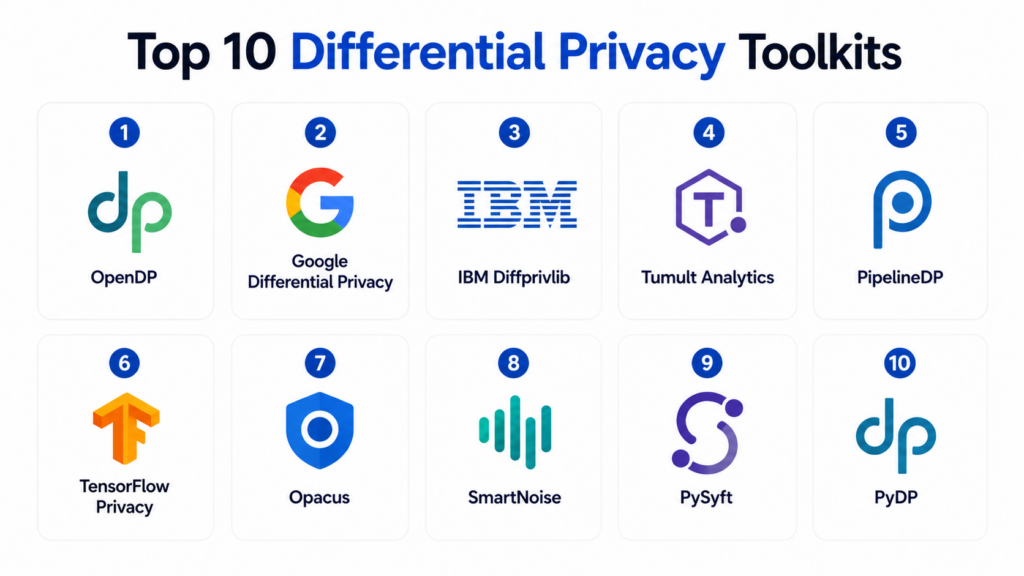
Introduction
Differential privacy toolkits help teams analyze, share, train on, or publish data while reducing the risk of exposing sensitive information about individuals. In plain English, differential privacy adds carefully controlled statistical noise so patterns can still be useful, but single-person details become much harder to identify. This matters now because organizations are using more customer, employee, health, financial, and behavioral data for analytics and AI, while privacy expectations and regulatory scrutiny continue to rise.
Real-world use cases include privacy-preserving analytics, AI model training, synthetic data workflows, public dataset release, telemetry analysis, research collaboration, and secure data sharing between teams or organizations. Buyers should evaluate mathematical guarantees, privacy budget management, supported data types, scalability, documentation, developer experience, governance controls, integration options, auditability, and suitability for production workloads.
Best for: data science teams, privacy engineers, AI teams, research organizations, public sector teams, healthcare analytics groups, financial services companies, and enterprises that need safer analytics on sensitive datasets. Not ideal for: teams that only need basic access controls, encryption, anonymized dashboards, or small internal reports where simpler aggregation, masking, or governance controls may be enough.
Key Trends in Differential Privacy Toolkits
- AI model privacy is becoming a major use case, especially for teams training models on customer, healthcare, financial, or behavioral datasets.
- Privacy budget management is becoming more important as organizations move from one-off experiments to repeatable analytics pipelines.
- Open-source adoption remains strong, especially among research teams and privacy engineers who need transparency and mathematical inspection.
- Enterprise buyers want governance, auditability, and workflow controls, not only privacy algorithms.
- Synthetic data and differential privacy are increasingly used together to create safer datasets for testing, research, and model development.
- Cloud and big-data integrations are becoming more relevant, especially for teams working with Spark, SQL engines, data lakes, and warehouse-scale analytics.
- Developer-first APIs are improving, making differential privacy easier to adopt in Python, machine learning, and data engineering workflows.
- Compliance-driven adoption is increasing, especially where personal data, regulated data, or public dataset release is involved.
- Usability is still a challenge, because teams must understand privacy loss, noise trade-offs, sensitivity, and accuracy impact.
- Privacy-enhancing technologies are converging, with differential privacy often combined with federated learning, secure enclaves, encryption, access governance, and anonymization.
How We Selected These Tools
- Selected tools with strong recognition in differential privacy, privacy-preserving analytics, AI privacy, or research communities.
- Considered both open-source frameworks and enterprise-oriented platforms to balance developer, research, and production needs.
- Prioritized tools with practical implementation value, not only theoretical relevance.
- Reviewed suitability for analytics, machine learning, data publishing, telemetry, and privacy-preserving collaboration use cases.
- Considered documentation quality, ecosystem maturity, and likely ease of adoption for technical teams.
- Favored tools with clear use cases such as SQL analytics, Python workflows, ML training, Spark pipelines, or privacy budget accounting.
- Included frameworks useful across different organization sizes, from academic researchers to enterprise privacy teams.
- Avoided assigning public ratings unless confidently known; all uncertain rating fields are marked as N/A.
- Treated security and compliance claims carefully and used “Not publicly stated” where vendor or project-level controls are not clearly established.
- Scoring is comparative and practical, based on category fit, feature depth, usability, ecosystem strength, and production readiness.
Top 10 Differential Privacy Toolkits
1- OpenDP
Short description:
OpenDP is an open-source differential privacy project focused on building trustworthy, composable, and mathematically grounded privacy tools. It is especially useful for researchers, privacy engineers, public sector teams, and organizations that need transparent privacy mechanisms. The project emphasizes careful privacy accounting and reusable building blocks rather than simple black-box anonymization. It is a strong fit when teams want to understand and validate privacy guarantees deeply.
Key Features
- Open-source differential privacy framework focused on trustworthy privacy mechanisms.
- Supports composable privacy transformations and measurements.
- Designed for statistical analysis and privacy-preserving data release workflows.
- Strong orientation toward research, public-good use cases, and formal privacy reasoning.
- Python-friendly usage patterns for data science and privacy engineering teams.
- Useful for building custom privacy-preserving analytics workflows.
- Emphasis on transparency and mathematical rigor.
Pros
- Strong credibility for teams that need inspectable privacy logic.
- Good fit for advanced users who understand privacy guarantees.
- Open-source approach supports research, review, and customization.
Cons
- May require more privacy expertise than simple analytics tools.
- Not a full enterprise data governance platform by itself.
- Production deployment may require custom engineering around workflows and controls.
Platforms / Deployment
Linux / macOS / Windows through supported development environments.
Self-hosted / Developer library.
Security & Compliance
Not publicly stated as an enterprise compliance product. Privacy strength depends on correct implementation, privacy budget design, data handling, and surrounding infrastructure controls.
Integrations & Ecosystem
OpenDP is best used as a library inside analytics, research, and data science workflows. Teams typically integrate it with Python-based processing, notebooks, and internal data pipelines rather than treating it as a standalone business application.
- Python data science workflows
- Statistical analysis pipelines
- Research environments
- Custom privacy-preserving data release workflows
- Internal data governance processes
- Academic and public-sector privacy projects
Support & Community
OpenDP has a research-oriented and open-source community. Documentation and examples are useful for technical users, but teams without differential privacy expertise may need additional onboarding, training, or advisory support.
2- Google Differential Privacy
Short description:
Google Differential Privacy is an open-source set of libraries for applying differential privacy to analytics workflows. It is useful for engineering teams that want production-inspired privacy mechanisms for counting, summing, histogram-style analysis, and aggregation. The toolkit is especially relevant for teams working with large-scale analytics and privacy-preserving measurement. It is developer-focused and suits teams with strong data engineering capabilities.
Key Features
- Open-source differential privacy libraries for analytics use cases.
- Supports common aggregate operations such as counts, sums, and histograms.
- Includes privacy accounting concepts for managing privacy loss.
- Useful for building privacy-preserving reporting pipelines.
- Designed with practical engineering scenarios in mind.
- Can support custom implementations around sensitive datasets.
- Suitable for developers and data engineers building privacy-aware applications.
Pros
- Strong fit for engineering-led analytics privacy projects.
- Useful for practical aggregation and reporting scenarios.
- Open-source availability supports transparency and customization.
Cons
- Requires technical knowledge to implement correctly.
- Not a complete end-user analytics platform.
- Governance, approvals, and audit workflows must be built separately.
Platforms / Deployment
Linux / macOS / Windows depending on language and build environment.
Self-hosted / Developer library.
Security & Compliance
Not publicly stated as a standalone certified enterprise security platform. Privacy guarantees depend on correct configuration, privacy budget management, and secure deployment practices.
Integrations & Ecosystem
Google Differential Privacy is commonly used as a building block in data engineering workflows. It is most useful when embedded into internal systems, analytics services, or data pipelines.
- C++ and related engineering workflows
- Data aggregation systems
- Internal reporting pipelines
- Privacy-preserving telemetry
- Custom analytics applications
- Data platform integrations through engineering implementation
Support & Community
Community support is open-source oriented. Documentation is useful for technical teams, but implementation success depends heavily on internal engineering and privacy expertise.
3- IBM Diffprivlib
Short description:
IBM Diffprivlib is an open-source Python library for differential privacy, especially useful for data scientists and machine learning practitioners. It provides tools for privacy-preserving statistics and machine learning models. Teams using Python-based analytics can use it to experiment with differentially private workflows without building every mechanism from scratch. It is a practical option for research, prototyping, and privacy-aware ML development.
Key Features
- Python library focused on differential privacy.
- Includes tools for differentially private statistics.
- Supports privacy-preserving machine learning approaches.
- Familiar style for Python data science users.
- Useful for experimentation, education, and prototyping.
- Can help teams understand accuracy and privacy trade-offs.
- Suitable for notebooks, research projects, and ML workflows.
Pros
- Easy starting point for Python data science teams.
- Useful for privacy-aware ML experimentation.
- Open-source and accessible for learning differential privacy.
Cons
- May not cover every enterprise-scale production requirement.
- Users must still understand privacy budget and parameter choices.
- Not a complete governance or compliance management platform.
Platforms / Deployment
Linux / macOS / Windows through Python environments.
Self-hosted / Developer library.
Security & Compliance
Not publicly stated as an enterprise compliance platform. Security depends on the environment where the library is used and the organization’s broader data protection controls.
Integrations & Ecosystem
Diffprivlib fits naturally into Python-based data science and machine learning ecosystems. It can be used with notebooks, model experiments, and internal analytics projects.
- Python analytics workflows
- Notebook environments
- Machine learning experimentation
- Statistical analysis projects
- Internal research pipelines
- Data science training and education
Support & Community
Support is mainly documentation, examples, and open-source community activity. It is suitable for technically skilled users, but production teams may need internal review and privacy engineering support.
4- Tumult Analytics
Short description:
Tumult Analytics is a differential privacy framework designed for privacy-preserving analytics at scale. It is useful for organizations that need structured data analysis with formal privacy guarantees and practical production workflows. The toolkit is especially relevant for teams working with tabular data, large datasets, and repeatable analytics releases. It is a strong fit for privacy engineers and data platform teams that need more than basic anonymization.
Key Features
- Differential privacy framework for analytics workflows.
- Designed for structured and tabular data analysis.
- Supports privacy-preserving query and release patterns.
- Useful for organizations publishing aggregate insights.
- Focuses on formal privacy guarantees and production-aware use.
- Can support repeatable data release workflows.
- Suitable for privacy engineering and data platform use cases.
Pros
- Strong fit for privacy-preserving analytics and data release.
- More production-oriented than many research-only tools.
- Useful for teams needing structured privacy workflows.
Cons
- Requires understanding of privacy budgets and query design.
- May be more advanced than needed for simple reporting.
- Deployment and integration planning may require skilled engineers.
Platforms / Deployment
Linux / macOS / Windows through compatible environments.
Self-hosted / Developer framework.
Security & Compliance
Not publicly stated for general enterprise security certifications in this context. Differential privacy guarantees depend on implementation, data pipeline controls, and privacy parameter management.
Integrations & Ecosystem
Tumult Analytics is typically integrated into data processing and analytics workflows. It can support teams that need privacy-preserving releases from structured datasets.
- Python-based analytics workflows
- Tabular data processing
- Data release pipelines
- Internal privacy review processes
- Research and public data publication workflows
- Enterprise data platform extensions
Support & Community
Documentation and technical resources are important parts of the ecosystem. Community and support depth may vary depending on use case, licensing, and organizational needs.
5- PipelineDP
Short description:
PipelineDP is an open-source framework for applying differential privacy in data processing pipelines. It is useful for teams that need privacy-preserving aggregations across larger datasets and distributed workflows. The toolkit is particularly relevant for data engineers working with batch processing and analytics pipelines. It helps teams move differential privacy from isolated experiments into repeatable pipeline-based processing.
Key Features
- Open-source differential privacy framework for data pipelines.
- Supports privacy-preserving aggregations.
- Designed for batch and distributed data processing scenarios.
- Useful for analytics, telemetry, and reporting workflows.
- Helps manage privacy parameters in pipeline logic.
- Developer-oriented and suitable for engineering teams.
- Can support scalable processing patterns depending on implementation.
Pros
- Strong fit for data engineering teams.
- Useful when privacy must be embedded into pipelines.
- Open-source model supports customization and review.
Cons
- Less suitable for non-technical users.
- Requires engineering effort to integrate into production systems.
- Governance, workflow approvals, and audits must be handled separately.
Platforms / Deployment
Linux / macOS / Windows depending on runtime and pipeline environment.
Self-hosted / Developer framework.
Security & Compliance
Not publicly stated as a certified enterprise security product. Security depends on pipeline infrastructure, access control, encryption, logging, and deployment practices.
Integrations & Ecosystem
PipelineDP is built for integration into data processing environments. It is useful where teams already have data engineering workflows and want to add differential privacy to aggregation logic.
- Batch data pipelines
- Distributed processing workflows
- Python engineering environments
- Analytics reporting systems
- Telemetry processing
- Internal data platform tooling
Support & Community
Support is primarily open-source documentation and community resources. It is best for teams with strong data engineering skills and privacy-aware architecture practices.
6- TensorFlow Privacy
Short description:
TensorFlow Privacy is a toolkit for training machine learning models with differential privacy techniques. It is especially useful for AI teams working with TensorFlow who need to reduce privacy risks during model training. The toolkit supports differentially private training approaches such as privacy-aware optimization. It is most relevant for machine learning engineers, researchers, and organizations training models on sensitive datasets.
Key Features
- Differential privacy tooling for machine learning.
- Supports privacy-preserving model training workflows.
- Useful for TensorFlow-based AI and ML projects.
- Helps measure and manage privacy loss during training.
- Supports experimentation with privacy and accuracy trade-offs.
- Relevant for sensitive data ML use cases.
- Developer-first toolkit for technical AI teams.
Pros
- Strong fit for TensorFlow users.
- Useful for AI privacy and privacy-preserving training research.
- Helps teams connect differential privacy with ML workflows.
Cons
- Mostly focused on ML training rather than general analytics.
- Requires machine learning and privacy expertise.
- May introduce model utility and performance trade-offs.
Platforms / Deployment
Linux / macOS / Windows through TensorFlow-supported environments.
Self-hosted / Developer library.
Security & Compliance
Not publicly stated as an enterprise compliance platform. It provides privacy-preserving training techniques, but broader security controls depend on the ML infrastructure and data governance setup.
Integrations & Ecosystem
TensorFlow Privacy fits into TensorFlow-based ML development workflows. It is most useful when teams already use TensorFlow for model training and experimentation.
- TensorFlow model training
- Python ML workflows
- Notebook-based experimentation
- Research pipelines
- AI privacy testing
- Internal model development systems
Support & Community
Support is developer and open-source oriented. Documentation and examples help technical teams, but successful adoption requires ML engineering skill and understanding of privacy accounting.
7- Opacus
Short description:
Opacus is an open-source library for training PyTorch models with differential privacy. It is useful for machine learning teams using PyTorch who need privacy-preserving training workflows. Opacus focuses on making differentially private stochastic gradient descent more accessible to developers. It is a strong option for AI researchers, model builders, and privacy-focused ML teams.
Key Features
- Differential privacy library for PyTorch.
- Supports privacy-preserving model training.
- Helps track privacy spending during training.
- Designed for developers familiar with PyTorch workflows.
- Useful for AI research and sensitive-data model development.
- Supports experimentation with privacy and model accuracy trade-offs.
- Fits modern deep learning workflows.
Pros
- Strong fit for PyTorch-based AI teams.
- Useful for privacy-aware deep learning experimentation.
- Developer-friendly for ML engineers already using PyTorch.
Cons
- Focused on ML training, not broad data anonymization.
- Differentially private training can affect model accuracy.
- Requires technical knowledge of privacy parameters and ML optimization.
Platforms / Deployment
Linux / macOS / Windows through PyTorch-supported environments.
Self-hosted / Developer library.
Security & Compliance
Not publicly stated as an enterprise compliance platform. It supports privacy-preserving training methods, but compliance depends on data handling, access controls, deployment, and governance processes.
Integrations & Ecosystem
Opacus works inside the PyTorch ecosystem and is best used as part of ML experimentation or production training pipelines where privacy-aware optimization is needed.
- PyTorch model training
- Python AI workflows
- Deep learning research
- Privacy-preserving ML experiments
- Internal ML platforms
- Sensitive-data model development
Support & Community
Opacus benefits from the broader PyTorch developer ecosystem. Documentation and examples are useful for ML engineers, but adoption requires comfort with deep learning and privacy trade-offs.
8- SmartNoise
Short description:
SmartNoise is a differential privacy toolkit ecosystem designed to help teams build privacy-preserving analytics and data release workflows. It has been associated with practical approaches to differentially private SQL-style analytics and synthetic data concepts. The toolkit is useful for organizations exploring privacy-enhanced data sharing and safer analytics. It is best suited for technical teams that need to combine privacy controls with data access workflows.
Key Features
- Differential privacy tooling for analytics workflows.
- Supports privacy-preserving data analysis patterns.
- Useful for SQL-style or structured data privacy use cases.
- Can support privacy-aware data release and synthetic data workflows.
- Designed for technical users working with sensitive datasets.
- Helps teams think about privacy budgets and query safety.
- Relevant for research, public data, and enterprise analytics exploration.
Pros
- Practical fit for privacy-preserving analytics.
- Useful for teams exploring safer data release workflows.
- Can complement broader privacy engineering initiatives.
Cons
- Ecosystem maturity and activity may vary by component.
- Requires technical skill to deploy and govern correctly.
- Not a complete replacement for access governance or compliance programs.
Platforms / Deployment
Linux / macOS / Windows depending on component and environment.
Self-hosted / Developer toolkit.
Security & Compliance
Not publicly stated as a general enterprise compliance suite. Security and compliance depend on implementation, infrastructure, access controls, and governance policies.
Integrations & Ecosystem
SmartNoise is typically used within data analysis and privacy engineering environments. It can support teams building differentially private analytics layers or privacy-preserving data release processes.
- SQL-style analytics workflows
- Python data workflows
- Structured data analysis
- Synthetic data exploration
- Research environments
- Privacy engineering pipelines
Support & Community
Support depends on project component, documentation, and community activity. Teams should validate current project fit, maintenance status, and implementation requirements before committing.
9- PySyft
Short description:
PySyft is a privacy-preserving data science and machine learning framework associated with secure and remote data access workflows. While it is broader than differential privacy alone, it is relevant for teams exploring privacy-enhancing technologies, federated learning, secure collaboration, and controlled data science. It can be useful where sensitive data cannot freely move between organizations or teams. Differential privacy may be part of a broader privacy-preserving architecture rather than the only feature.
Key Features
- Privacy-preserving data science framework.
- Supports secure and controlled data access concepts.
- Relevant for federated learning and collaborative analytics.
- Can support workflows where data stays closer to its source.
- Useful for privacy-enhancing technology experimentation.
- Suitable for research and advanced data collaboration use cases.
- Can complement differential privacy, secure computation, and governance approaches.
Pros
- Good fit for broader privacy-preserving AI and data collaboration.
- Useful when data movement is restricted.
- Strong relevance for research and advanced privacy architectures.
Cons
- Broader scope may add complexity.
- Not only a differential privacy toolkit.
- Requires skilled technical teams and careful architecture planning.
Platforms / Deployment
Linux / macOS / Windows depending on environment and setup.
Self-hosted / Hybrid depending on architecture.
Security & Compliance
Not publicly stated for general enterprise certification claims in this context. Security depends on deployment architecture, identity controls, access policies, encryption, and operational governance.
Integrations & Ecosystem
PySyft is best used in advanced data science environments where privacy-preserving collaboration is needed. It can integrate into research and machine learning workflows rather than simple business reporting.
- Python data science workflows
- Federated learning experiments
- Privacy-preserving research collaboration
- Controlled data access systems
- AI model development environments
- Secure data science platforms
Support & Community
PySyft has a technical open-source and research-oriented community. Documentation and examples are helpful, but teams should expect a learning curve and architecture design effort.
10- PyDP
Short description:
PyDP is a Python wrapper around differential privacy libraries, intended to make differentially private analysis more accessible to Python developers. It is useful for teams that want to experiment with privacy-preserving aggregations in a familiar Python environment. PyDP can help data scientists and engineers understand differential privacy concepts through practical implementation. It is best suited for prototyping, education, and custom workflows rather than full enterprise governance.
Key Features
- Python interface for differential privacy workflows.
- Useful for privacy-preserving aggregation experiments.
- Developer-friendly for Python users.
- Supports learning and prototyping differential privacy concepts.
- Can be used in notebooks and internal data science projects.
- Helps bridge lower-level privacy libraries with Python workflows.
- Suitable for lightweight experimentation and proof-of-concept work.
Pros
- Accessible for Python teams.
- Useful for education, experimentation, and prototyping.
- Helps teams start with differential privacy without heavy platform setup.
Cons
- May not be sufficient as a complete production platform.
- Requires users to understand privacy parameters.
- Governance and compliance workflows must be added separately.
Platforms / Deployment
Linux / macOS / Windows through Python environments.
Self-hosted / Developer library.
Security & Compliance
Not publicly stated as an enterprise security or compliance platform. Security depends on the surrounding Python environment, data access controls, and deployment practices.
Integrations & Ecosystem
PyDP is mainly useful inside Python-based analytics and data science workflows. It can be embedded into notebooks, scripts, experiments, and internal applications.
- Python scripts
- Notebook environments
- Data science experiments
- Privacy-preserving aggregation workflows
- Educational projects
- Custom analytics prototypes
Support & Community
Support is open-source and documentation-based. It is best for technical users who can validate current maintenance, compatibility, and suitability for their use case.
Comparison Table
| Tool Name | Best For | Platform(s) Supported | Deployment | Standout Feature | Public Rating |
|---|---|---|---|---|---|
| OpenDP | Formal privacy engineering and trusted statistical workflows | Linux, macOS, Windows through supported environments | Self-hosted | Composable privacy framework | N/A |
| Google Differential Privacy | Engineering-led privacy-preserving aggregation | Linux, macOS, Windows depending on environment | Self-hosted | Practical aggregate privacy mechanisms | N/A |
| IBM Diffprivlib | Python statistics and privacy-aware ML experimentation | Linux, macOS, Windows through Python | Self-hosted | Python-friendly DP statistics and ML | N/A |
| Tumult Analytics | Structured data release and privacy-preserving analytics | Linux, macOS, Windows through compatible environments | Self-hosted | Production-aware analytics privacy | N/A |
| PipelineDP | Data pipeline-based private aggregations | Linux, macOS, Windows depending on runtime | Self-hosted | DP for scalable pipeline workflows | N/A |
| TensorFlow Privacy | TensorFlow model training with differential privacy | Linux, macOS, Windows through TensorFlow | Self-hosted | DP training for ML models | N/A |
| Opacus | PyTorch model training with differential privacy | Linux, macOS, Windows through PyTorch | Self-hosted | DP training for PyTorch models | N/A |
| SmartNoise | Privacy-preserving analytics and data release exploration | Linux, macOS, Windows depending on component | Self-hosted | SQL-style and structured data privacy concepts | N/A |
| PySyft | Privacy-preserving AI collaboration and secure data science | Linux, macOS, Windows depending on setup | Self-hosted / Hybrid | Broader PET and federated data science workflows | N/A |
| PyDP | Python-based DP prototyping and learning | Linux, macOS, Windows through Python | Self-hosted | Simple Python entry point for DP experimentation | N/A |
Evaluation & Scoring of Differential Privacy Toolkits
| Tool Name | Core 25% | Ease 15% | Integrations 15% | Security 10% | Performance 10% | Support 10% | Value 15% | Weighted Total |
|---|---|---|---|---|---|---|---|---|
| OpenDP | 9 | 7 | 7 | 8 | 8 | 8 | 9 | 8.10 |
| Google Differential Privacy | 8 | 7 | 8 | 8 | 8 | 7 | 9 | 7.95 |
| IBM Diffprivlib | 8 | 8 | 7 | 7 | 7 | 7 | 9 | 7.70 |
| Tumult Analytics | 9 | 7 | 8 | 8 | 8 | 7 | 8 | 8.00 |
| PipelineDP | 8 | 7 | 8 | 7 | 8 | 7 | 8 | 7.65 |
| TensorFlow Privacy | 8 | 7 | 8 | 7 | 8 | 8 | 8 | 7.75 |
| Opacus | 8 | 8 | 8 | 7 | 8 | 8 | 8 | 7.90 |
| SmartNoise | 7 | 7 | 7 | 7 | 7 | 6 | 8 | 7.00 |
| PySyft | 7 | 6 | 8 | 7 | 7 | 7 | 8 | 7.15 |
| PyDP | 6 | 8 | 6 | 6 | 6 | 6 | 8 | 6.70 |
These scores are comparative, not absolute. A higher score means stronger overall fit for the category based on feature depth, usability, ecosystem, reliability, and value. A lower score does not mean the tool is poor; it may simply be narrower, more experimental, or better suited to a specific use case. Teams should validate the score against their own data sensitivity, technical skill, deployment model, and privacy goals before choosing a toolkit.
Which Differential Privacy Toolkits Tool Is Right for You?
Solo / Freelancer
Solo consultants, researchers, and independent data scientists should start with tools that are easy to test in local environments. IBM Diffprivlib, PyDP, and OpenDP are practical choices because they are accessible, Python-friendly, and useful for learning privacy concepts. If the work involves machine learning, Opacus or TensorFlow Privacy may be better depending on whether the model stack is PyTorch or TensorFlow. Solo users should avoid overly complex architectures unless the client or project specifically requires secure collaboration, distributed processing, or formal privacy reviews.
SMB
Small and mid-sized businesses should focus on toolkits that match existing technical skills. A Python-heavy team may prefer IBM Diffprivlib, OpenDP, PyDP, or Opacus. A data engineering team may prefer PipelineDP or Google Differential Privacy for aggregation workflows. SMBs should prioritize ease of implementation, documentation, and privacy budget clarity over advanced theoretical flexibility. If the business does not have privacy engineering expertise, it may be better to start with a narrow pilot instead of applying differential privacy across all analytics.
Mid-Market
Mid-market organizations usually need more repeatable governance, integration, and operational maturity. Tumult Analytics, OpenDP, Google Differential Privacy, PipelineDP, and SmartNoise-style workflows can be useful depending on whether the main need is data release, analytics, or pipeline processing. AI teams should evaluate TensorFlow Privacy and Opacus for model training. Mid-market buyers should involve data engineering, legal, compliance, and security teams early because differential privacy decisions affect accuracy, reporting, and risk posture.
Enterprise
Enterprises should look beyond the algorithm library and evaluate workflow governance, auditing, scalability, integration, and operational ownership. Tumult Analytics and OpenDP are strong candidates for formal analytics and release workflows, while Google Differential Privacy and PipelineDP are useful for engineering-scale aggregation. TensorFlow Privacy and Opacus are relevant for AI teams handling sensitive training data. PySyft may be considered where secure collaboration, federated learning, or controlled data access is part of a broader privacy-enhancing technology strategy.
Budget vs Premium
Most differential privacy toolkits are open-source or developer-first, so direct software cost may be low, but implementation cost can be significant. Budget-conscious teams should start with open-source libraries and a small pilot. Premium cost usually appears through engineering time, privacy expertise, external advisory, managed infrastructure, or enterprise support. The cheapest option is not always the best if the team lacks privacy expertise, because incorrect configuration can create false confidence.
Feature Depth vs Ease of Use
OpenDP, Tumult Analytics, Google Differential Privacy, and PipelineDP offer stronger depth for structured privacy workflows, but they may require more planning. IBM Diffprivlib and PyDP are easier starting points for Python users. TensorFlow Privacy and Opacus are deep in ML-specific privacy but less relevant for general reporting. Teams should decide whether they need broad analytics privacy, ML privacy, data release controls, or educational experimentation before choosing.
Integrations & Scalability
For scalable data engineering, PipelineDP and Google Differential Privacy are strong choices. For Python analytics, IBM Diffprivlib, OpenDP, and PyDP may be easier to embed. For ML stacks, TensorFlow Privacy and Opacus align with TensorFlow and PyTorch respectively. For broader privacy collaboration, PySyft may fit advanced architectures. The best integration choice depends on existing data warehouses, model frameworks, notebooks, workflow orchestration, and governance tools.
Security & Compliance Needs
Differential privacy is not a complete security or compliance solution. It helps reduce re-identification risk in analytics or model training, but it does not replace encryption, access controls, audit logs, data retention policies, consent management, or legal review. Teams in healthcare, finance, public sector, telecom, and AI should combine differential privacy with broader governance. If compliance evidence is required, ask vendors or internal teams to document privacy parameters, testing results, data flows, and operational controls.
Frequently Asked Questions
1- What is a differential privacy toolkit?
A differential privacy toolkit is a software library, framework, or platform that helps teams apply differential privacy techniques to data analysis, data release, or machine learning. It usually provides mechanisms for adding controlled noise, calculating privacy loss, and managing privacy parameters. The goal is to allow useful insights without exposing individual-level information. These tools are most useful when data is sensitive but teams still need analytics, research, reporting, or AI training. A toolkit does not automatically make data safe; it must be configured correctly. Teams still need governance, data security, and expert review.
2- How much do differential privacy toolkits cost?
Many well-known differential privacy toolkits are open-source, so the software license may be free. However, the real cost often comes from implementation, engineering time, privacy expertise, testing, monitoring, and governance. Enterprise use may also require advisory support, custom integrations, cloud infrastructure, or commercial support. Teams should evaluate total cost, not only license cost. A small pilot can be inexpensive, but production deployment across sensitive data workflows can require significant planning. Pricing for vendor-backed or enterprise-supported options varies, so teams should validate directly.
3- How long does onboarding usually take?
Onboarding depends heavily on the use case and team maturity. A data scientist can test a Python toolkit in a few days, but a production analytics pipeline may take weeks or months to design properly. Teams must define the dataset, privacy goals, acceptable accuracy loss, privacy budget, query types, access controls, and review process. Machine learning use cases may need extra time for model retraining, utility testing, and privacy accounting. The biggest onboarding challenge is usually not installing the library; it is designing a privacy-safe workflow. Starting with a narrow pilot is usually the safest path.
4- What are the most common mistakes when using differential privacy?
A common mistake is treating differential privacy as a simple anonymization button. Teams may also choose privacy parameters without understanding accuracy trade-offs or privacy loss. Another mistake is ignoring repeated queries, which can consume privacy budget over time. Some teams publish noisy outputs without checking whether the results remain useful or statistically valid. Others forget that differential privacy does not replace access control, encryption, or governance. The safest approach is to involve privacy, legal, security, data science, and engineering teams together.
5- Is differential privacy enough for compliance?
Differential privacy can support privacy and risk reduction, but it is not a complete compliance program by itself. Compliance depends on legal basis, consent, data minimization, access control, retention, auditability, breach response, and jurisdiction-specific obligations. Differential privacy may help reduce re-identification risk when releasing aggregate statistics or training models. However, teams must still document how the data is processed and how privacy parameters are chosen. In regulated industries, legal and compliance teams should review the workflow before production use. Use differential privacy as one layer in a broader privacy strategy.
6- Can differential privacy toolkits scale to enterprise datasets?
Some toolkits are better suited for scale than others. PipelineDP and Google Differential Privacy are more aligned with engineering and pipeline-based processing, while Tumult Analytics can support structured privacy-preserving analytics workflows. Python-first tools may work well for experiments but require additional engineering for large-scale production. Scalability depends on data size, query complexity, infrastructure, privacy budget, and performance requirements. Teams should benchmark accuracy and runtime before committing. Enterprise teams should also evaluate monitoring, reproducibility, governance, and operational ownership.
7- How do differential privacy toolkits integrate with existing systems?
Most toolkits integrate through developer workflows rather than plug-and-play business interfaces. They may be embedded into Python notebooks, ML training scripts, data pipelines, reporting systems, or custom analytics services. Some are better suited for PyTorch, TensorFlow, SQL-style workflows, or distributed processing. Integration planning should include data access, transformation logic, privacy accounting, testing, and downstream reporting. Teams should also consider CI/CD, model pipelines, data catalogs, and audit workflows. The best toolkit is usually the one that fits your current technical stack.
8- When should a company switch from basic anonymization to differential privacy?
A company should consider differential privacy when simple anonymization, masking, or aggregation does not provide enough confidence against re-identification risk. This is especially important when releasing public statistics, sharing datasets, analyzing sensitive user behavior, or training AI models on personal data. Differential privacy is also useful when repeated queries may reveal more than expected over time. However, it introduces complexity and may reduce accuracy. If the data is low-risk and used only internally, simpler controls may be enough. The decision should be based on risk, sensitivity, and business value.
9- What alternatives exist to differential privacy?
Alternatives include data masking, tokenization, aggregation, k-anonymity-style methods, synthetic data, secure enclaves, federated learning, encryption, access governance, and anonymized reporting. These methods solve different problems and are often combined. For example, encryption protects data in storage or transit, while differential privacy protects statistical outputs. Federated learning can reduce data movement, while differential privacy can reduce leakage from model updates. Synthetic data can support testing or sharing, but quality and privacy must be validated. The best privacy architecture usually combines multiple controls.
10- How should teams evaluate accuracy loss?
Teams should compare private outputs against non-private baselines using representative datasets and realistic query patterns. The goal is not to remove all noise but to find a privacy level where insights remain useful. Teams should test different privacy parameters, query types, dataset sizes, and reporting thresholds. For machine learning, they should compare model utility, fairness, stability, and performance before and after private training. Accuracy expectations should be documented with business stakeholders. A privacy workflow is successful only when it balances protection with usable results.
Conclusion
Differential privacy toolkits are becoming increasingly important for organizations that want to use sensitive data responsibly while reducing the risk of exposing individual-level information. The best choice depends on the use case: OpenDP and Tumult Analytics are strong for formal privacy-preserving analytics, Google Differential Privacy and PipelineDP fit engineering-led aggregation pipelines, IBM Diffprivlib and PyDP are useful for Python experimentation, TensorFlow Privacy and Opacus support AI model training, while PySyft and SmartNoise are relevant for broader privacy-preserving data science and analytics scenarios. No toolkit is a universal winner because differential privacy depends on data sensitivity, accuracy needs, privacy budget design, technical maturity, and governance requirements. The right next step is to shortlist two or three tools that match your stack, run a small pilot on a representative dataset, compare private and non-private results, validate integration requirements, and review security and compliance controls before scaling into production.
